FREETHINKER, n. A miscreant who wickedly refuses to look out of a priest’s eyes, and persists in looking into them with too searching a glance.
Ambrose Bierce (1842–1914?) American writer and journalist
“Freethinker,” “Devil’s Dictionary” column, San Francisco Wasp (1885-01-17)
(Source)
Not collected in later books.
Quotations about:
mistrust
Note not all quotations have been tagged, so Search may find additional quotes on this topic.

He who suspekts everyboddy, should be watched by everyboddy.
[He who suspects everybody should be watched by everybody.]
Josh Billings (1818–1885) American humorist, aphorist [pseud. of Henry Wheeler Shaw]
Josh Billings’ Farmer’s Allminax, 1874-11 (1874 ed.)
(Source)
See Johnson (1763).
In his 1879 Allminax (April), Billings provided a similar adage:Whenever yu cum akrost a man who distrusts everyboddy, yu have found one whom it is safe for everyboddy to distrust.
[Whenever you come across a man who distrusts everybody, you have found one whom it is safe for everybody to distrust.]

Dupes indeed are many: but, of all dupes, there is none so fatally situated as he who lives in undue terror of being duped.
Thomas Carlyle (1795–1881) Scottish essayist and historian
Lecture (1840-05-22), “The Hero as King,” Home House, Portman Square, London
(Source)
The lecture notes were collected by Carlyle into On Heroes, Hero-Worship, & the Heroic in History, Lecture 6 (1841).
The first thing a cult does is tell you everyone else is lying.
James Randi (1928–2020) Canadian-American stage magician ("The Amazing Randi") and scientific skeptic. [b. Randall James Hamilton Zwinge]
(Attributed)
Very widely quoted and attributed to Randi. I cannot, however, find any evidence showing Randi actually said this, though it is plausible.

Our understanding is conducted solely by means of the word: anyone who falsifies it betrays public society. It is the only tool by which we communicate our wishes and our thoughts; it is our soul’s interpreter: if we lack that, we can no longer hold together; we can no longer know each other. When words deceive us, it breaks all intercourse and loosens the bonds of our polity.
[Nostre intelligence se conduisant par la seule voye de la parolle, celuy qui la faulse, trahit la societé publique. C’est le seul util, par le moyen duquel se communiquent noz volontez & noz pensees : c’est le truchement de nostre ame : s’il nous faut, nous ne nous tenons plus, nous ne nous entreconnoissons plus. S’il nous trompe, il rompt tout nostre commerce, & dissoult toutes les liaisons de nostre police.]
Michel de Montaigne (1533–1592) French essayist
Essays, Book 2, ch. 18 (2.18), “Of Giving the Lie [Du Démentir]” (1578–79) [tr. Screech (1987)]
(Source)
This essay (and this passage) appeared in the 1st (1580) edition.
(Source (French)). Other translations:Our intelligence being onely conducted by the way of the Worde: Who so falsifieth the same, betraieth publike society. It is the onely instrument, by meanes wherof our wils and thoughts are communicated: it is the interpretour of our souls: If that faile us we hold our selves no more, we enterknow one another no longer. If it deceive us, it breaketh all our commerce, and dissolveth all bonds of our policie.
[tr. Florio (1603)]Our intelligence being by no other canal to be conveyed to one another but by words, he, who falsifies them, betrays public society: it is the only tube through which we communicate our thoughts and wills to one another; it is the interpreter of the soul, and, if it fails us, we no longer know, nor have any farther tie upon another: if that deceive us, it breaks all our correspondence, and dissolves all the bands of our government.
[tr. Cotton (1686)]Our intelligence being by no other way communicable to one another but by a particular word, he who falsifies that betrays public society. ’Tis the only way by which we communicate our thoughts and wills; ’tis the interpreter of the soul, and if it deceive us, we no longer know nor have further tie upon one another; if that deceive us, it breaks all our correspondence, and dissolves all the ties of government.
[tr. Cotton/Hazlitt (1877)]Our intelligence being conducted solely by the way of the word, he who falsifies that betrays all society. It is the only instrument by means of which our desires and our thoughts are exchanged; it is the interpreter of our souls; if it fails us, we no longer have any hold upon one another, we no longer mutually know one another. If it deceives us, it severs all our intercourse and dissolves all the ties of our government.
[tr. Ives (1925)]Our intercourse being carried on solely by means of the word, he who falsifies that is a traitor to society. It is the only instrument by which our thoughts and wills are communicated, it is the interpreter of our soul. If it fails us, we no longer hold together, we no longer know one anther. If it deceives us, it breaks up all our intercourse and dissolves all the ties of our government.
[tr. Zeitlin (1934)]Since mutual understanding is brought about solely by way of words, he who breaks his word betrays human society. It is the only instrument by means of which our wills and thoughts communicate, it is the interpreter of our soul. If it fails us, we have no more hold on each other, no more knowledge of each other. If it deceives us, it breaks up all our relations and dissolves all the bonds of our society.
[tr. Frame (1943)]

We can gain no lasting peace if we approach it with suspicion and mistrust — or with fear. We can gain it only if we proceed with the understanding and the confidence and the courage which flow from conviction.
Franklin Delano Roosevelt (1882–1945) American lawyer, politician, statesman; US President (1933–45)
Speech (1945-01-20), Inaugural Address, Washington, D.C.
(Source)
FEISAL: Young men make wars — and the virtues of war are the virtues of young men — courage and hope for the future. Then old men make the peace, and the vices of peace are the vices of old men — mistrust and caution.
Robert Bolt (1924–1995) English dramatist
Lawrence of Arabia, Part 2, sc. 411 (1962) [with Michael Wilson]
(Source)

We should be more ashamed to distrust our friends than to be deceived by them.
[Il est plus honteux de se défier de ses amis que d’en être trompé.]François VI, duc de La Rochefoucauld (1613–1680) French epigrammatist, memoirist, noble
Réflexions ou sentences et maximes morales [Reflections; or Sentences and Moral Maxims], ¶84 (1665-1678) [tr. Heard (1917)]
(Source)
First appeared in the second (1666) edition. Compare to Maxim 86, also from that edition: "Our distrust justifies the deception of others [Notre défiance justifie la tromperie d’autrui.]"
(Source (French)). Other translations:It is much less for a Man's Honour to distrust his Friends, than to be deceived by them.
[tr. Stanhope (1694), ¶85]It is more dishonourable to distrust a friend, than to be deceived by him.
[pub. Donaldson (1783), ¶171; ed. Lepoittevin-Lacroix (1797), ¶81; ed. Carvill (1835), ¶151]It is more disgraceful to distrust; one's friends than to be deceived by them.
[ed. Gowens (1851), ¶87]It is more disgraceful to distrust than to be deceived by our friends.
[tr. Bund/Friswell (1871), ¶84]It is more disgraceful to mistrust one's friends than to be the victim of their treachery.
[tr. Stevens (1939), ¶84]It is more shameful to distrust one's friends than to be deceived by them.
[tr. FitzGibbon (1957), ¶84; tr. Tancock (1959), ¶84]It is more shameful to distrust our friends than to be deceived by them.
[tr. Kronenberger (1959), ¶84; tr. Whichello (2016), ¶84]

Or fraud lurks somewhere to destroy:
Mistrust, mistrust it, men of Troy!
Whate’er it be, a Greek I fear,
Though presents in his hand he bear.[Aliquis latet error; equo ne credite, Teucri.
Quidquid id est, timeo Danaos et dona ferentes.]Virgil (70–19 BC) Roman poet [b. Publius Vergilius Maro; also Vergil]
The Aeneid [Ænē̆is], Book 2, l. 48ff (2.48-49) [Laocoön] (29-19 BC) [tr. Conington (1866)]
(Source)
Warning of the Trojan Horse; the origin of the phrase, "Beware Greeks bearing gifts." (Source (Latin)). Other translations:Some deceit lurks, Dardans trust not this Horse, What ere it is, Greeks bringing gifts I feare. [tr. Ogilby (1649)]Somewhat is sure designed, by fraud or force;
Trust not their presents, nor admit the horse.
[tr. Dryden (1697)]Some mischievous design lurks beneath it. Trojans, put no faith in this horse. Whatever it be, I dread the Greeks, even when they bring gifts.
[tr. Davidson/Buckley (1854)]Some other guile
Is lurking. Trojans, do not trust this horse.
Whatever it may be, I fear the Greeks,
Even when they bring us gifts.
[tr. Cranch (1872)]Some delusion lurks there: Trust not the horse, O Trojans. Be it what it may, I fear the Grecians even when they offer gifts.
[tr. Mackail (1885)]Some guile at least therein abides: Teucrians, trust not the horse!
Whatso it is, the Danaan folk, yea gift-bearing I fear.
[tr. Morris (1900)]Some mischief lies behind.
Trust not the horse, ye Teucrians. Whatso'er
This means, I fear the Greeks, for all the gifts they bear.
[tr. Taylor (1907), st. 7; l. 61ff]'T is a snare.
Trust not this horse, O Troy, whate'er it bode!
I fear the Greeks, though gift on gift they bear.
[tr. Williams (1910)]Some trickery lurks therein. Trust not the horse, ye Trojans. Whatever it be, I fear the Greeks, even when bringing gifts.
[tr. Fairclough (1916)]Tricky business
Is hiding in it. Do not trust it, Trojans,
Do not believe this horse. Whatever it may be,
I fear the Greeks, even when bringing presents.
[tr. Humphries (1951)]Sure, some trick
Is there. No, you must never feel safe with the horse, Trojans.
Whatever it is, I distrust the Greeks, even when they are generous.
[tr. Day Lewis (1952)]Some trickery is here. Trojans, do not
trust in the horse. Whatever it may be,
I fear the Greeks, even when they bring gifts.
[tr. Mandelbaum (1971), l. 68ff]Some crookedness
Is in this thing. Have no faith in the horse!
Whatever it is, even when Greeks bring gifts
I fear them, gifts and all.
[tr. Fitzgerald (1981), l. 67ff]There is some other trick we cannot see. Do not trust the horse, Trojans. Whatever it is, I am afraid of Greeks, particularly when they bring gifts.
[tr. West (1990)]Or it hides some other trick: Trojans, don’t trust this horse.
Whatever it is, I’m afraid of Greeks even those bearing gifts.
[tr. Kline (2002)]Some other evil lurks inside. Do not trust the Horse, Trojans! Whatever it is, I fear the Greeks, even when they bring gifts.
[tr. Lombardo (2005)]Some other deception’s lurking deep inside it.
Trojans, never trust that horse. Whatever it is,
I fear the Greeks, especially bearing gifts.
[tr. Fagles (2006), l. 60ff]Some trick lurks here. Citizens, don't trust the horse; fear Greeks, even bringing offerings.
[tr. Bartsch (2021)]
In a world that operates largely at random, coincidences are to be expected, but any one of them must always be mistrusted.

Women just can’t be trusted any more.
[Ἐπεὶ οὐκέτι πιστὰ γυναιξίν.]
Homer (fl. 7th-8th C. BC) Greek author
The Odyssey [Ὀδύσσεια], Book 11, l. 456 (11.456) [Agamemnon] (c. 700 BC) [tr. Lombardo (2000), l. 274]
(Source)
Agamemnon, who was slain on his homecoming by Clytemnestra, is giving Odysseus marital advice when the latter visits Hades. Original Greek. Other translations:
- "For ’tis no world to trust a woman now." [tr. Chapman (1616)]
- "Remember still, women unfaithful are." [tr. Hobbes (1675)]
- "For since of womankind so few are just, / Think all are false, nor even the faithful trust." [tr. Pope (1725)]
- "For woman merits trust no more." [tr. Cowper (1792), l. 453]
- "No more are women to be trusted now." [tr. Worsley (1861), st. 54]
- "For that trust / Henceforth in women must never be plac'd." [tr. Musgrave (1869), l. 706ff]
- "No trust in women!" [tr. Bigge-Wither (1869), l. 455]
- "For there is no more faith in woman." [tr. Butcher/Lang (1879) and Palmer (1891)]
- "From now henceforth in women no troth or trust shall be." [tr. Morris (1887)]
- "For after all this there is no trusting women." [tr. Butler (1898)]
- "For no longer is there faith in women." [tr. Murray (1919)]
- "There is no putting faith in women." [tr. Lawrence (1932)]
- "Women, I tell you, are no longer to be trusted." [tr. Rieu (1946) and DCH Rieu (2002)]
- "There is no trusting in women." [tr. Lattimore (1965)]
- "No woman merits trust." [tr. Mandelbaum (1990)]
- "The time for trusting women's gone forever!" [tr. Fagles (1996), l. 456]
- "Women are no longer to be trusted." [tr. Verity (2016)]
- "No more is there faith in women." [tr. Green (2018)]
- "For there’s no trust / in women anymore." [tr. Johnston (2019), l. 577ff]

His philosophy was a mixture of three famous schools — the Cynics, the Stoics and the Epicureans — and summed up all three of them in his famous phrase, “You can’t trust any bugger further than you can throw him, and there’s nothing you can do about it, so let’s have a drink.”
Terry Pratchett (1948–2015) English author
Discworld No. 13, Small Gods (1992)
(Source)
Describing the philosophy of Didactylos of Ephebe.

Mass propaganda discovered that its audience was ready at all times to believe the worst, no matter how absurd, and did not particularly object to being deceived because it held every statement to be a lie anyhow. The totalitarian mass leaders based their propaganda on the correct psychological assumption that, under such conditions, one could make people believe the most fantastic statements one day, and trust if the next day they were given irrefutable proof of their falsehood, they would take refuge in cynicism; instead of deserting the leaders who had lied to them, they would protest that they had known all along the statement was a lie and would admire the leaders for their superior tactical cleverness.
Hannah Arendt (1906–1975) German-American philosopher, political theorist
Origins of Totalitarianism, Part 3, ch. 11 “The Totalitarian Movement,” sec. 2 (1951)
(Source)

For some men, the stronger their desire, the more difficult it is for them to act. They are hampered by mistrust of themselves, daunted by the fear of giving offence; besides, deep feelings of affection are like respectable women; they are afraid of being found out and they go through life with downcast eyes.
Gustave Flaubert (1821–1880) French writer, novelist
Sentimental Education, Part 2, ch. 3 (1869)
(Source)
Elsewhere as Book 2, ch. 16.
Considering the temptations under which politicians are placed, of changing their opinions, or rather their professions of opinion, from motives of self interest, the world will not give them credit for motives of honest conviction, unless when the change shall be to their manifest loss and disadvantage.
Henry Taylor (1800–1886) English dramatist, poet, bureaucrat, man of letters
The Statesman: An Ironical Treatise on the Art of Succeeding, ch. 17 (1836)
(Source)

Lesson to the Indiscreet: They who say all they think, and tell all they know, put others on their guard and prevent themselves from being told anything of consequence.
Horace Walpole (1717–1797) English novelist, letter writer
A Note Book of Horace Walpole, “1781” (1927)

Suspicion is the companion of mean souls, and the bane of all good society.
Thomas Paine (1737–1809) American political philosopher and writer
Common Sense, “Of the Present Ability of America” (1776)

The seed had sprouted into that most wonderful and horrible of fruits: doubt, which, like the strawberry, has a succulent taste, but has also a tendency to spread and spread, until it dominates whatever garden it has taken root in.
Steven Brust (b. 1955) American writer, systems programmer
The Phoenix Guards (1991)

Suspicion often creates what it suspects.
C. S. Lewis (1898–1963) English writer, literary scholar, lay theologian [Clive Staples Lewis]
“Screwtape Proposes a Toast”

Every boddy in this world wants watching, but none more than ourselves.
[Everybody in this world wants watching, but none more than ourselves.]
Josh Billings (1818–1885) American humorist, aphorist [pseud. of Henry Wheeler Shaw]
Everybody’s Friend, Or; Josh Billing’s Encyclopedia and Proverbial Philosophy of Wit and Humor, ch. 142 “Affurisms: Fust Impreshuns” (1874)
(Source)
A thief believes everybody steals.
Edgar Watson "Ed" Howe (1853–1937) American journalist and author [E. W. Howe]
Country Town Sayings (1911)
It’s one thing to be aware of complex strategies and lies that might be going on around you. It’s another to let yourself become so worried about deception that you become paralyzed.
Steven Brust (b. 1955) American writer, systems programmer
Dragon (1998)
When a rogue kisses you, count your teeth.
[Ven a ganef kusht, darf men zikh di tseyn ibertseyln.]
[װען אַ גנבֿ קושט, דאַרף מען זיך די צײן איבערצײלן.]
Proverbs, Sayings, and Adages
Yiddish proverb
(Source)
Alt. trans.: "When a thief kisses you, count your teeth."

Distrust and caution are the parents of security.
Benjamin Franklin (1706–1790) American statesman, scientist, philosopher, aphorist
Poor Richard (1733 ed.)
(Source)
When young, we trust ourselves too much, and we trust others too little when old. Rashness is the error of youth, timid caution of age.
Charles Caleb "C. C." Colton (1780–1832) English cleric, writer, aphorist
Lacon: Or, Many Things in Few Words, Vol. 1, § 363 (1820)
(Source)
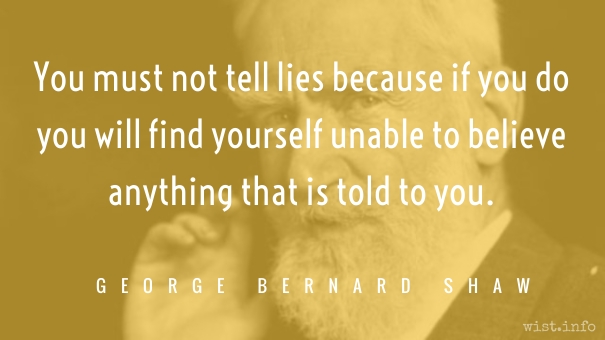
You must not tell lies because if you do you will find yourself unable to believe anything that is told to you.
George Bernard Shaw (1856–1950) Irish playwright and critic
The Intelligent Woman’s Guide to Socialism, Capitalism, Sovietism, and Fascism, ch. 74 (1928)

It is an essential part of every national character to pique itself mightily upon its faults, and to deduce tokens of its virtue or its wisdom from their very exaggeration. One great blemish in the popular mind of America, and the prolific parent of an innumerable brood of evils, is Universal Distrust. Yet the American citizen plumes himself upon this spirit, even when he is sufficiently dispassionate to perceive the ruin it works; and will often adduce it, in spite of his own reason, as an instance of the great sagacity and acuteness of the people, and their superior shrewdness and independence.
If there is distrust out there — and there is — perhaps it is because there is so much partisan jockeying for advantage at the expense of public policy. At times it feels as if American politics consists largely of candidates without ideas, hiring consultants without convictions, to stage campaigns without content. Increasingly the result is elections without voters.
Gerald R. Ford (1913–2006) American politician, US President (1974–77) [b. Leslie Lynch King, Jr.]
Speech, Profiles in Courage Award Acceptance, John F. Kennedy Presidential Library (2001)
(Source)
It is a sin to believe evil of others, but it is seldom a mistake.
H. L. Mencken (1880–1956) American writer and journalist [Henry Lewis Mencken]
A Little Book in C Major, ch. 5, § 23 (1916)
(Source)
Variants:EVIL. That which one believes of others. It is a sin to believe evil of others, but it is seldom a mistake.
A Book of Burlesques, "The Jazz Webster" (1924)Evil is that which one believes of others. It is a sin to believe evil of others, but it is seldom a mistake.
Chrestomathy, ch. 30 "Sententiae" (1949)
Trust him no further than you can throw him.
Thomas Fuller (1654–1734) English physician, preacher, aphorist, writer
Gnomologia: Adages and Proverbs (compiler), # 5286 (1732)
(Source)

I believe that that community is already in process of dissolution where each man begins to eye his neighbor as a possible enemy, where non-conformity with the accepted creed, political as well as religious, is a mark of disaffection; where denunciation, without specification or backing, takes the place of evidence; where orthodoxy chokes freedom of dissent; where faith in the eventual supremacy of reason has become so timid that we are not enter our convictions into the open list, to win or lose. Such fears as these are a solvent which can eat out the cement that binds the stones together; they may in the end subject us to a despotism as evil as any that we dread; and they can be allayed only in so far as we refuse to proceed on suspicion, and trust one another until we have tangible ground for misgiving,
Learned Hand (1872–1961) American jurist
“A Plea for the Open Mind and Free Discussion,” speech, University of the State of New York, Albany (1952-10-24)
(Source)
MESSENGER: Nothing is more useful to mankind than a prudent distrust.
[ἌΓΓΕΛΟΣ:σώφρονος δ᾽ ἀπιστίας
οὐκ ἔστιν οὐδὲν χρησιμώτερον βροτοῖς.]Euripides (485?-406? BC) Greek tragic dramatist
Helen [Ἑλένη], l. 1617ff (412 BC) [tr. Coleridge (1891)]
(Source)
Informing Theoklymenos that Helen and Menelaos have escaped to Greece.
(Source (Greek)). Other translations:Nought to man's welfare more
Avails, than disbelief by prudence rul'd.
[tr. Potter (1783), l. 1750ff]There's nought more beneficial to mankind
Than wise distrust.
[tr. Wodhull (1809)]But there is naught more useful to mortals than a wise distrust.
[tr. Buckley (1850)]Nought is of more avail
For mortals' need than wise mistrustfulness.
[tr. Way (Loeb) (1912)]My lord, I fear
There are advantages in honest doubt.
That lesson of my tale at least is clear.
[tr. Sheppard (1925)]I say there's nothing of more use
to mortals than a wise suspension of belief.
[tr. Warner (1951)]Well, there is one thing every man has to learn: it is, not to be too trustful.
[tr. Vellacott (1954)]Man's most valuable trait
is a judicious sense of what not to believe.
[tr. Lattimore (1956)]Knowing when not to believe someone ...
now that's the kind of wisdom we could use!
[tr. Meagher (1986)]To sum up, there’s nothing more useful in life than showing a healthy scepticism.
[tr. Davie (2002)]Ah! there is naught more serviceable to mankind than a prudent distrust.
[tr. Athenian Society (2006)]Seems you were a bit naive, sir:
There's nothing more useful in life
Than a good suspicious nature.
[tr. A. Wilson (2007)]Nothing is more useful than a prudent doubt.
[tr. Theodoridis (2011)]Nothing is more useful to man than thoughtful skepticism.
[Ambrose et al. (2018)]Nothing is more useful to mankind than a balanced [sōphrōn] distrust.
[tr. Coleridge / Helen Heroization Team]