And on the subject of burning books: I want to congratulate librarians, not famous for their physical strength or their powerful political connections or their great wealth, who, all over this country, have staunchly resisted anti-democratic bullies who have tried to remove certain books from their shelves, and have refused to reveal to thought police the names of persons who have checked out those titles.
So the America I loved still exists, if not in the White House or the Supreme Court or the Senate or the House of Representatives or the media. The America I love still exists at the front desks of our public libraries.
Quotations about:
privacy
Note not all quotations have been tagged, so Search may find additional quotes on this topic.

Big Brother in the form of an increasingly powerful government and in an increasingly powerful private sector will pile the records high with reasons why privacy should give way to national security, to law and order, to efficiency of operations, to scientific advancement, and the like.
William O. Douglas (1898–1980) American jurist; US Supreme Court Justice (1939–75)
Points of Rebellion, ch. 1 “How America Views Dissent” (1969)
(Source)
The greater part of the admirers of solitude, as of all other classes of mankind, have no higher or remoter view, than the present gratification of their passions. Of these, some, haughty and impetuous, fly from society only because they cannot bear to repay to others the regard which themselves exact; and think no state of life eligible, but that which places them out of the reach of censure or control, and affords them opportunities of living in a perpetual compliance with their own inclinations, without the necessity of regulating their actions by any other man’s convenience or opinion.
There are others, of minds more delicate and tender, easily offended by every deviation from rectitude, soon disgusted by ignorance or impertinence, and always expecting from the conversation of mankind more elegance, purity and truth, than the mingled mass of life will easily afford. Such men are in haste to retire from grossness, falsehood and brutality; and hope to find in private habitations at least a negative felicity, an exemption from the shocks and perturbations with which publick scenes are continually distressing them.
To neither of these votaries will solitude afford that content, which she has been taught so lavishly to promise. The man of arrogance will quickly discover, that by escaping from his opponents he has lost his flatterers, that greatness is nothing where it is not seen, and power nothing where it cannot be felt: and he, whose faculties are employed in too close an observation of failings and defects, will find his condition very little mended by transferring his attention from others to himself: he will probably soon come back in quest of new objects, and be glad to keep his captiousness employed on any character rather than his own.Samuel Johnson (1709–1784) English writer, lexicographer, critic
Essay (1754-01-19), The Adventurer, No. 126
(Source)
TARTUFFE: Your scruple, then, is easy to allay:
Our secret will be safe with us alone,
And there’s no evil if the thing’s not known.
The one offense lies in the public shame,
And secret sin is sin only in name.[Enfin votre scrupule est facile à détruire.
Vous êtes assurée ici d’un plein secret,
Et le mal n’est jamais que dans l’éclat qu’on fait.
Le scandale du monde est ce qui fait l’offense,
Et ce n’est pas pécher que pécher en silence]Molière (1622–1673) French playwright, actor [stage name for Jean-Baptiste Poquelin]
Tartuffe, or the Hypocrite [Le Tartuffe, ou L’Imposteur], Act 4, sc. 5 (1669) [tr. Frame (1967)]
(Source)
The ostensibly pious Tartuffe trying to seduce Elmire.
(Source (French)). Other translations:In short your Scruple, Madam, is easily overcome. You are sure of its being an inviolable Secret here, and the Harm never consists in any thing but the Noise one makes; the Scandal of the World is what makes the Offence; and Sinning in private is no Sinning at all.
[tr. Clitandre (1672)]In short, your scruples, Madam, are easily overcome. You may be sure of the secret being kept, and there is no harm done unless the thing is bruited about. The scandal which it causes constitutes the offence, and sinning in secret is no sinning at all.
[tr. Van Laun (1876)]In short, your scruples, madam, are easy to remove. You are sure of an inviolable secrecy with me, and it is only publicity which makes the wrong. The scandal is what constitutes the offence, and to sin in secret is not to sin at all.
[tr. Wall (1879)]In short, madame, your scruple is easily overcome. You are sure of absolute secrecy here, and the evil only consists in the noise that is made about it ; the world’s scandal makes the offence, and to sin in private is no sin at all.
[tr. Mathew (1890), 4.4]In short your scruple is easily overcome. You may be sure the secret will be well kept here, and no harm is done unless the thing is noised abroad. The scandal of the world is what makes the offence, and to sin in secret is not to sin at all.
[tr. Waller (1903)]In any case, your scruple's easily
Removed. With me you're sure of secrecy,
And there's no harm unless a thing is known.
The public scandal is what brings offence,
And secret sinning is not sin at all.
[tr. Page (1909)]Well, anyway, I can dispel your scruples.
You are assured that I will keep the secret.
Evil does not exist until it's published;
It's worldly scandal that creates the offense;
And sin in silence is not sin at all.
[tr. Bishop (1957)]If you're still troubled, think of things this way:
No one shall know our joys, save us alone,
And there's no evil till the act is known;
It's scandal, Madam, which makes it an offense,
And it's no sin to sin in confidence.
[tr. Wilbur (1963)]Well, Moses couldn't matter less,
The ten commandments don't apply,
There's no one here -- just you and I,
It's scandal that creates the sin,
This won't get out, so let's begin.
[tr. Bolt (2002)]In the end, I assure you, it's easy to dismiss your scruples. I promise complete secrecy; only when others make a fuss can there be any harm. Something is scandalous only when it is known; sin that no one knows is no sin.
[tr. Steiner (2008)]Look, your scruples are easily dealt with:
You can be quite certain that it will remain secret,
And the sin is only ever in the exposure;
A silent sin is not a sin at all.
[tr. Campbell (2013)]
Oh, you who read some song that I have sung,
What know you of the soul from whence it sprung?
Dost dream the poet ever speaks aloud
His secret thought unto the listening crowd?
Go take the murmuring sea-shell from the shore:
You have its shape, its color and no more.
It tells not one of those vast mysteries
That lie beneath the surface of the seas.
Our songs are shells, cast out by-waves of thought;
Here, take them at your pleasure; but think not
You’ve seen beneath the surface of the waves,
Where lie our shipwrecks and our coral caves.Ella Wheeler Wilcox (1850–1919) American author, poet, temperance advocate, spiritualist
Poems of Passion, Epigraph (1883)
(Source)

As long as I was in Washington I never met anybody that I thought was good enough, who knew enough, or who loved enough to make sexual decisions for anybody else.
Joycelyn Elders (b. 1933) American pediatrician, public health administrator, academic
Penn & Teller: Bullshit!, s. 4, ep. 6 “Abstinence” (2006-06-05)
(Source)

Civilization has taught us to eat with a fork, but even now if nobody is around we use our fingers.
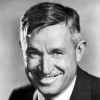
Civilization is the progress toward a society of privacy. The savage’s whole existence is public, ruled by the laws of his tribe. Civilization is the process of setting man free from men.
Ayn Rand (1905–1982) Russian-American writer, philosopher
The Fountainhead, ch. 18 [Roark] (1943)
(Source)
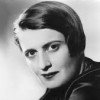
Indeed, Miss Manners has come to believe that the basic political division in the society is not between liberals and conservatives but between those who believe that they should have a say in the love lives of strangers and those who do not.
Judith Martin (b. 1938) American author, journalist, etiquette expert [a.k.a. Miss Manners]
Miss Manners Rescues Civilization, ch. 5 “The Law Takes Over from Etiquette” (1996)
(Source)

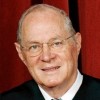
Our law affords constitutional protection to personal decisions relating to marriage, procreation, contraception, family relationships, child rearing, and education. Our cases recognize “the right of the individual, married or single, to be free from unwarranted governmental intrusion into matters so fundamentally affecting a person as the decision whether to bear or beget a child.” Our precedents “have respected the private realm of family life which the state cannot enter.” These matters, involving the most intimate and personal choices a person may make in a lifetime, choices central to personal dignity and autonomy, are central to the liberty protected by the Fourteenth Amendment. At the heart of liberty is the right to define one’s own concept of existence, of meaning, of the universe, and of the mystery of human life. Beliefs about these matters could not define the attributes of personhood were they formed under compulsion of the State.
Anthony Kennedy (b. 1936) US Supreme Court Justice
Planned Parenthood v. Casey (91-744), 505 U.S. 833 (29 Jun 1992) [Majority Opinion]
(Source)
Citations removed.
Who could deny that privacy is a jewel? I has always been the mark of privilege, the distinguishing feature of a truly urbane culture. Out of the cave, the tribal teepee, the pueblo, the community fortress, man emerged to build himself a house of his own with a shelter in it for himself and his diversions. Every age has seen it so. The poor might have to huddle together in cities for need’s sake, and the frontiersman cling to his neighbors for the sake of protection. But in each civilization, as it advanced, those who could afford it chose the luxury of a withdrawing-place.
Phyllis McGinley (1905–1978) American author, poet
“A Lost Privilege,” The Province of the Heart (1959)
(Source)

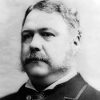
Madam, I may be President of the United States, but my private life is nobody’s damn business.
Chester Alan Arthur (1829–1886) American attorney, politician, US President (1881–85)
(Attributed)
In various sources, this was a reply made to a temperance reformer about his drinking alcohol, against journalists writing of his late wife and children, or to a gossip commenting on rumors he was seeing other women.
The poorest man may in his cottage bid defiance to all the forces of the Crown. It may be frail — its roof may shake — the wind may blow through it — the storm may enter — the rain may enter — but the King of England cannot enter! — all his force dares not cross the threshold of the ruined tenement!
William Pitt the Elder (1708–1778) British statesman, orator [Lord Chatham, 1st Earl of Chatham]
Speech on the Excise Bill, House of Commons (Mar 1763)
(Source)
The human animal needs a freedom seldom mentioned, freedom from intrusion. He needs a little privacy quite as much as he wants understanding or vitamins or exercise or praise.
Lesson to the Indiscreet: They who say all they think, and tell all they know, put others on their guard and prevent themselves from being told anything of consequence.
Horace Walpole (1717–1797) English novelist, letter writer
A Note Book of Horace Walpole, “1781” (1927)

[The people] have a right, an indisputable, unalienable, indefeasible, divine right to that most dreaded and envied kind of knowledge, I mean, of the characters and conduct of their rulers.
John Adams (1735–1826) American lawyer, Founder, statesman; US President (1797–1801)
Essay (1765-09-30), “A Dissertation on the Canon and the Feudal Law,” No. 3, Boston Gazette
(Source)
A bore is a man who deprives you of solitude without providing you with company.
Giovanni Vincenzo Gravina (1664–1718) Italian man of letters and jurist
(Attributed)
The actual provenance of this quotation is unknown. The earliest reference is in Reader's Digest (1949-03), where it is attributed by a contributor to Gravina, but identifying him as a contemporary author; the connection to the 18th Century Italian author and jurist is therefore tenuous.
Also attributed to Oscar Wilde (but not until long after his death), John C. MacDonald (who did use it, but attributed it to Gravina), and Roger Ebert (who did use it, but attributed it to John D. MacDonald).
A similar phrase can be found in Marcel Proust, The Captive [La Prisonnière], Part 1, ch. 1 (1923) [tr. Moncrieff (1929)] (Part 6 of his Remembrance of Things Past [A la Recherche du Temps Perdu]) [English, French]:Mamma would write to me: “Mme. Sazerat gave us one of those little luncheons of which she possesses the secret and which, as your poor grandmother would have said, quoting Mme. de Sévigné, deprive us of solitude without affording us company.”
[Maman m’écrivait : «Mme Sazerat nous a donné un de ces petits déjeuners dont elle a le secret et qui, comme eût dit ta pauvre grand’mère, en citant Mme de Sévigné, nous enlèvent à la solitude sans nous apporter la société.»]
More information and research into the quotation's origin can be found here: Quote Origin: A Bore Is a Person Who Deprives You of Solitude Without Providing You with Company – Quote Investigator®. QI says some very nice things about me and this site regarding the preliminary research I did on the question of authorship.
Trading privacy for security is stupid enough; not getting any actual security in the bargain is even more stupid.
Cory Doctorow (b. 1971) Canadian-British blogger, journalist, activist, author
Little Brother (2008)

Privacy is as necessary as company; you can drive a man crazy by depriving him of either.
Robert A. Heinlein (1907–1988) American writer
Time Enough For Love [Lazarus Long] (1973)
HARKEN: [In an interrogation room] You fought with Captain Reynolds in the war?
ZOE: Fought with a lot of people in the war.
HARKEN: And your husband?
ZOE: Fight with him sometimes, too.
HARKEN: Is there any particular reason you don’t wish to discuss your marriage?
ZOE: Don’t see that it’s any of your business, is all. We’re very private people.
WASH: [In a different interrogation room] The legs! [Laughs] Oh yeah, definitely have to say it was her legs. You can put that down. Her legs, and right where her legs — meet her back. That — actually, that whole area. That, and — and above it. […] Have you seen what she wears? Forget about it. Have you ever been with a warrior woman?Tim Minear (b. 1963) American screenwriter and director
Firefly, 1X03 “Bushwhacked” (27 Sep 2002)

INARA: What did I say to you about barging into my shuttle?
MAL: That it was manly and impulsive?
INARA: Yes, precisely. Only the exact phrase I used was, “Don’t.”
Joss Whedon (b. 1964) American screenwriter, author, producer [Joseph Hill Whedon]
Firefly, 1×02 “The Train Job” [with Tim Minear] (20 Sep 2002)

“My dear young lady,” said the Professor, suddenly looking up with a very sharp expression at both of them, “there is one plan which no one has yet suggested and which is well worth trying.”
“What’s that?” said Susan.
“We might all try minding our own business,” said he. And that was the end of that conversation.
C. S. Lewis (1898–1963) English writer, literary scholar, lay theologian [Clive Staples Lewis]
The Lion, the Witch, and the Wardrobe (1950)
You need not tell all the truth, unless to those who have a right to know it all. But let all you tell be truth.
James Burgh (1714–1775) British politician and writer
The Dignity of Human Nature, Sec. 5 “Miscellaneous Thoughts on Prudence in Conversation” (1754)
(Source)
A man always is to be himself the judge of how much of his mind he will show to other men; even to those he would have work along with him. There are impertinent inquiries made: your rule is to leave the inquirer uninformed on that matter; not, if you can help it, misinformed; but precisely as dark as he was!
Thomas Carlyle (1795–1881) Scottish essayist and historian
Lecture (1840-05-22), “The Hero as King,” Home House, Portman Square, London
(Source)
The lecture notes were collected by Carlyle into On Heroes, Hero-Worship, & the Heroic in History, Lecture 6 (1841).
Our Founders were no more willing to let the content of their prayers and their privilege of praying whenever they pleased be influenced by the ballot box than they were to let these vital matters of personal conscience depend upon the succession of monarchs. The First Amendment was added to the Constitution to stand as a guarantee that neither the power nor the prestige of the Federal Government would be used to control, support or influence the kinds of prayer the American people can say — that the people’s religions must not be subjected to the pressures of government for change each time a new political administration is elected to office. Under that Amendment’s prohibition against governmental establishment of religion, as reinforced by the provisions of the Fourteenth Amendment, government in this country, be it state or federal, is without power to prescribe by law any particular form of prayer which is to be used as an official prayer in carrying on any program of governmentally sponsored religious activity.
Hugo Black (1886–1971) American politician and jurist; US Supreme Court Justice (1937–71)
Engel v. Vitale, 370 U.S. 421, 429–30 (1962) [majority opinion]
(Source)
The makers of our Constitution undertook to secure conditions favorable to the pursuit of happiness. They recognized the significance of man’s spiritual nature, of his feelings and of his intellect. They knew that only a part of the pain, pleasure and satisfactions of life are to be found in material things. They sought to protect Americans in their beliefs, their thoughts, their emotions and their sensations. They conferred, as against the government, the right to be let alone — the most comprehensive of rights and the right most valued by civilized men.
Louis Brandeis (1856–1941) American lawyer, jurist, activist; US Supreme Court Justice (1916–39)
Olmstead v. United States, 277 U.S. 438 (1928) [dissent]
(Source)
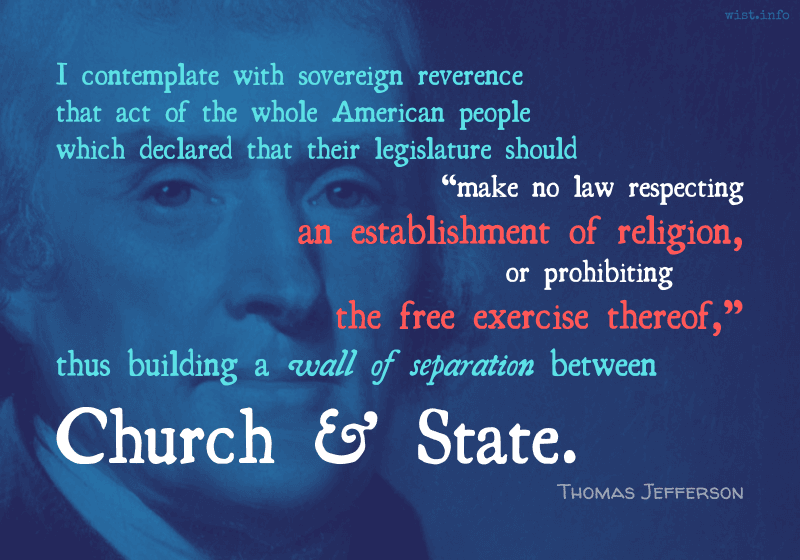
Believing with you that religion is a matter which lies solely between Man & his God, that he owes account to none other for his faith or his worship, that the legitimate powers of government reach actions only, & not opinions, I contemplate with sovereign reverence that act of the whole American people which declared that their legislature should “make no law respecting an establishment of religion, or prohibiting the free exercise thereof,” thus building a wall of separation between Church & State. adhering to this expression of the supreme will of the nation in behalf of the rights of conscience, I shall see with sincere satisfaction the progress of those sentiments which tend to restore to man all his natural rights, convinced he has no natural right in opposition to his social duties.
Thomas Jefferson (1743–1826) American political philosopher, polymath, statesman, US President (1801–09)
Letter (1802-01-01) to the Danbury Baptists
(Source)
Addressed to "messrs. Nehemiah Dodge, Ephraim Robbins, & Stephen S. Nelson, a committee of the Danbury Baptist association in the state of Connecticut."
It behooves every man, who values liberty of conscience for himself, to resist invasions of it in the case of others; or their case may, by change of circumstances, become his own. It behooves him, too, in his own case, to give no example of concession, betraying the common right of independent opinion, by answering questions of faith, which the laws have left between God and himself.
Thomas Jefferson (1743–1826) American political philosopher, polymath, statesman, US President (1801–09)
Letter (1803-04-21) to Benjamin Rush
(Source)
Be careful that you don’t practice your religion in front of people to draw their attention. If you do, you will have no reward from your Father who is in heaven.
Whenever you give to the poor, don’t blow your trumpet as the hypocrites do in the synagogues and in the streets so that they may get praise from people. I assure you, that’s the only reward they’ll get. But when you give to the poor, don’t let your left hand know what your right hand is doing so that you may give to the poor in secret. Your Father who sees what you do in secret will reward you.
When you pray, don’t be like hypocrites. They love to pray standing in the synagogues and on the street corners so that people will see them. I assure you, that’s the only reward they’ll get. But when you pray, go to your room, shut the door, and pray to your Father who is present in that secret place. Your Father who sees what you do in secret will reward you.[Προσέχετε [δὲ] τὴν δικαιοσύνην ὑμῶν μὴ ποιεῖν ἔμπροσθεν τῶν ἀνθρώπων πρὸς τὸ θεαθῆναι αὐτοῖς· εἰ δὲ μή γε, μισθὸν οὐκ ἔχετε παρὰ τῷ πατρὶ ὑμῶν τῷ ἐν τοῖς οὐρανοῖς.
Ὅταν οὖν ποιῇς ἐλεημοσύνην, μὴ σαλπίσῃς ἔμπροσθέν σου, ὥσπερ οἱ ὑποκριταὶ ποιοῦσιν ἐν ταῖς συναγωγαῖς καὶ ἐν ταῖς ῥύμαις, ὅπως δοξασθῶσιν ὑπὸ τῶν ἀνθρώπων· ἀμὴν λέγω ὑμῖν, ἀπέχουσιν τὸν μισθὸν αὐτῶν. σοῦ δὲ ποιοῦντος ἐλεημοσύνην μὴ γνώτω ἡ ἀριστερά σου τί ποιεῖ ἡ δεξιά σου, ὅπως ᾖ σου ἡ ἐλεημοσύνη ἐν τῷ κρυπτῷ· καὶ ὁ πατήρ σου ὁ βλέπων ἐν τῷ κρυπτῷ ἀποδώσει σοι.
Καὶ ὅταν προσεύχησθε, οὐκ ἔσεσθε ὡς οἱ ὑποκριταί, ὅτι φιλοῦσιν ἐν ταῖς συναγωγαῖς καὶ ἐν ταῖς γωνίαις τῶν πλατειῶν ἑστῶτες προσεύχεσθαι, ὅπως φανῶσιν τοῖς ἀνθρώποις· ἀμὴν λέγω ὑμῖν, ἀπέχουσιν τὸν μισθὸν αὐτῶν. σὺ δὲ ὅταν προσεύχῃ, εἴσελθε εἰς τὸ ταμεῖόν σου καὶ κλείσας τὴν θύραν σου πρόσευξαι τῷ πατρί σου τῷ ἐν τῷ κρυπτῷ· καὶ ὁ πατήρ σου ὁ βλέπων ἐν τῷ κρυπτῷ ἀποδώσει σοι.]The Bible (The New Testament) (AD 1st - 2nd C) Christian sacred scripture
Book 1. Gospel of Matthew 6: 1ff (Matt 6:1–6) (Jesus) [CEB (2011)]
(Source)
No Synoptic parallels.
(Source (Greek)). Other translations:Take heed that ye do not your alms before men, to be seen of them: otherwise ye have no reward of your Father which is in heaven. Therefore when thou doest thine alms, do not sound a trumpet before thee, as the hypocrites do in the synagogues and in the streets, that they may have glory of men. Verily I say unto you, They have their reward. But when thou doest alms, let not thy left hand know what thy right hand doeth: that thine alms may be in secret: and thy Father which seeth in secret himself shall reward thee openly.
And when thou prayest, thou shalt not be as the hypocrites are: for they love to pray standing in the synagogues and in the corners of the streets, that they may be seen of men. Verily I say unto you, They have their reward. But thou, when thou prayest, enter into thy closet, and when thou hast shut thy door, pray to thy Father which is in secret; and thy Father which seeth in secret shall reward thee openly.
[KJV (1611)]Be careful not to parade your good deeds before men to attract their notice; by doing this you will lose all reward from your Father in heaven.
So when you give alms, do not have it trumpeted before you; this is what the hypocrites do in the synagogues and in the streets to win men's admiration. I tell you solemnly, they have had their reward. But when you give alms, your left hand must not know what your right is doing; your almsgiving must be secret, and your Father who sees all that is done in secret will reward you.
And when you pray, do not imitate the hypocrites: they love to say their prayers standing up in the synagogues and at the street corners for people to see them; I tell you solemnly, they have had their reward. But when you pray, go to your private room and, when you have shut your door, pray to your Father who is in that secret place, and your Father who sees all that is done in secret will reward you.
[JB (1966)]Make certain you do not perform your religious duties in public so that people will see what you do. If you do these things publicly, you will not have any reward from your Father in heaven.
So when you give something to a needy person, do not make a big show of it, as the hypocrites do in the houses of worship and on the streets. They do it so that people will praise them. I assure you, they have already been paid in full. But when you help a needy person, do it in such a way that even your closest friend will not know about it. Then it will be a private matter. And your Father, who sees what you do in private, will reward you.
When you pray, do not be like the hypocrites! They love to stand up and pray in the houses of worship and on the street corners, so that everyone will see them. I assure you, they have already been paid in full. But when you pray, go to your room, close the door, and pray to your Father, who is unseen. And your Father, who sees what you do in private, will reward you.
[GNT (1976)]Be careful not to parade your uprightness in public to attract attention; otherwise you will lose all reward from your Father in heaven.
When you pray, don’t be like hypocrites. They love to pray standing in the synagogues and on the street corners so that people will see them. I assure you, that’s the only reward they’ll get. But when you pray, go to your room, shut the door, and pray to your Father who is present in that secret place. Your Father who sees what you do in secret will reward you.
So when you give alms, do not have it trumpeted before you; this is what the hypocrites do in the synagogues and in the streets to win human admiration. In truth I tell you, they have had their reward. But when you give alms, your left hand must not know what your right is doing; your almsgiving must be secret, and your Father who sees all that is done in secret will reward you.
[NJB (1985)]Be careful not to practice your righteousness in front of others to be seen by them. If you do, you will have no reward from your Father in heaven.
So when you give to the needy, do not announce it with trumpets, as the hypocrites do in the synagogues and on the streets, to be honored by others. Truly I tell you, they have received their reward in full. But when you give to the needy, do not let your left hand know what your right hand is doing, so that your giving may be in secret. Then your Father, who sees what is done in secret, will reward you.
And when you pray, do not be like the hypocrites, for they love to pray standing in the synagogues and on the street corners to be seen by others. Truly I tell you, they have received their reward in full. But when you pray, go into your room, close the door and pray to your Father, who is unseen. Then your Father, who sees what is done in secret, will reward you.
[NIV (2011 ed.)]Beware of practicing your righteousness before others in order to be seen by them, for then you have no reward from your Father in heaven.
So whenever you give alms, do not sound a trumpet before you, as the hypocrites do in the synagogues and in the streets, so that they may be praised by others. Truly I tell you, they have received their reward. But when you give alms, do not let your left hand know what your right hand is doing, so that your alms may be done in secret, and your Father who sees in secret will reward you.
And whenever you pray, do not be like the hypocrites, for they love to stand and pray in the synagogues and at the street corners, so that they may be seen by others. Truly I tell you, they have received their reward. But whenever you pray, go into your room and shut the door and pray to your Father who is in secret, and your Father who sees in secret will reward you.
[NRSV (2021 ed.)]
There is surely no contradiction in saying that a certain section of the community may be quite competent to protect the persons and property of the rest, yet quite unfit to direct our opinions, or to superintend our private habits.
Thomas Babington Macaulay (1800–1859) English writer and politician
Southey’s Colloquies on Society (1830)
Religion, a subject on which I have ever been most scrupulously reserved. I have considered it as a matter between every man and his maker, in which no other, & far less the public, had a right to intermeddle.
Thomas Jefferson (1743–1826) American political philosopher, polymath, statesman, US President (1801–09)
Letter (1813-05-31) to Richard Rush
(Source)
Say nothing of my religion. It is known to God and myself alone. Its evidence before the world is to be sought in my life: if it has been honest and dutiful to society the religion which has regulated it cannot be a bad one.
Thomas Jefferson (1743–1826) American political philosopher, polymath, statesman, US President (1801–09)
Letter (1817-01-11) to John Adams
(Source)
Instructions he gave to a biographer.
If the First Amendment means anything, it means that a State has no business telling a man, sitting alone in his own house, what books he may read or what films he may watch.
Thurgood Marshall (1908–1993) American lawyer, US Supreme Court Justice (1967–1991)
Stanley v. Georgia 394 U.S. 557 (1969) [Unanimous Opinion]
Does it really matter what these affectionate people do — so long as they don’t do it in the streets and frighten the horses!
Beatrice Campbell (1865–1940) English actress [Mrs. Patrick Campbell, née Beatrice Stella Tanner]
(Attributed)
Apocryphally a rebuke c. 1910 to a young actress who criticized an older actor as seeming too affectionate toward the handsome leading man in the production. Most famously given in this form in Alan Dent, Mrs. Patrick Campbell (1961).
Further discussion and variants:

When Miss Manners observes people behaving rudely, she never steps in to correct them. She behaves politely to them, and then goes home and snickers about them afterward. That is what the well-bred person does.
Judith Martin (b. 1938) American author, journalist, etiquette expert [a.k.a. Miss Manners]
Miss Manners’ Guide to Excruciatingly Correct Behavior, Introduction (1983)
(Source)
The word “idiot” comes from a Greek root meaning private person. Idiocy is the female defect: intent on their private lives, women follow their fate through a darkness deep as that cast by malformed cells in the brain. It is no worse than the male defect, which is lunacy: men are so obsessed by public affairs that they see the world as by moonlight, which shows the outlines of every object but not the details indicative of their nature.
Rebecca West (1892–1983) British author, journalist, literary critic, travel writer [pseud. for Cicily Isabel Fairfield]
Black Lamb and Grey Falcon, Prologue (1941)
(Source)
Sometimes oddly paraphrased, "The main difference between men and women is that men are lunatics and women are idiots."

My own belief is that there is hardly anyone whose sexual life, if it were broadcast, would not fill the world at large with surprise and horror.
W. Somerset Maugham (1874–1965) English novelist and playwright [William Somerset Maugham]
(Attributed)