

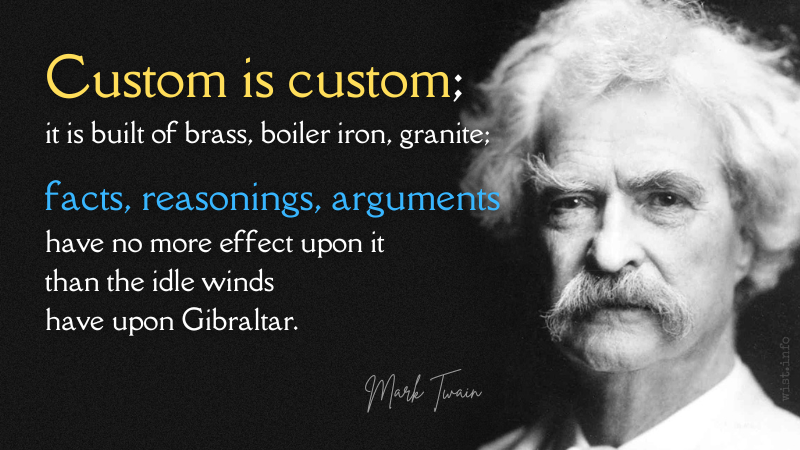
Custom is custom; it is built of brass, boiler iron, granite; facts, reasonings, arguments have no more effect upon it than the idle winds have upon Gibraltar.
Mark Twain (1835–1910) American writer [pseud. of Samuel Clemens]
Essay (1906), “The Gorky Incident,” Letters from the Earth (c. 1909; pub. 1962) [ed. DeVoto (1939)]
(Source)
Commenting on the eviction of Maxim Gorky from multiple hotels in New York City because the woman he was traveling with was not his wife. Twain was a supporter of Gorky's efforts to foment revolution in Tsarist Russia.
The essay was not published in Twain's lifetime. It's original publication was in the Slavonic and East European Review (1944-08), also edited by DeVoto.
Quotations about:
scandal
Note not all quotations have been tagged, so Search may find additional quotes on this topic.

Customs do not concern themselves with right or wrong or reason. But they have to be obeyed; one may reason all around them until he is tired, but he must not transgress them, it is sternly forbidden.
Mark Twain (1835–1910) American writer [pseud. of Samuel Clemens]
Essay (1906), “The Gorky Incident,” Letters from the Earth (c. 1909; pub. 1962) [ed. DeVoto (1939)]
(Source)
Commenting on the eviction of Maxim Gorky from multiple hotels in New York City because the woman he was traveling with was not his wife. Twain was a supporter of Gorky's efforts to foment revolution in Tsarist Russia.
The essay was not published in Twain's lifetime. It's original publication was in the Slavonic and East European Review (1944-08), also edited by DeVoto.
Laws are coldly reasoned out and established upon what the lawmakers believe to be a basis of right. But customs are not. Customs are not enacted, they grow gradually up, imperceptibly and unconsciously, like an oak from its seed. In the fullness of their strength they can stand up straight in front of a world of argument and reasoning and yield not an inch.
Mark Twain (1835–1910) American writer [pseud. of Samuel Clemens]
Essay (1906), “The Gorky Incident,” Letters from the Earth (c. 1909; pub. 1962) [ed. DeVoto (1939)]
(Source)
Commenting on the eviction of Maxim Gorky from multiple hotels in New York City because the woman he was traveling with was not his wife. Twain was a supporter of Gorky's efforts to foment revolution in Tsarist Russia.
The essay was not published in Twain's lifetime. It's original publication was in the Slavonic and East European Review (1944-08), also edited by DeVoto.
Our greatest danger is not from invasion by foreign armies. Our dangers are that we may commit suicide from within by complaisance with evil. Or by public tolerance of scandalous behavior. Or by cynical acceptance of dishonor. These evils have defeated nations many times in human history.
Herbert Hoover (1874–1964) American engineer, bureaucrat, US President (1929–33)
Speech (1951-08-30), “Concerning Honor in Public Life,” Iowa Centennial Celebration, Des Moines, Iowa (radio broadcast)
(Source)
Very few people can resist saying malicious things about their acquaintances, and even on occasion about their friends; yet when people hear that anything has been said against themselves, they are filled with indignant amazement.
Bertrand Russell (1872–1970) English mathematician and philosopher
Conquest of Happiness, Part 1, ch. 8 “Persecution Mania” (1930)
(Source)

Drive away and never endure Tale-bearers: Whoever entertains thee with the Faults of others, designs to serve thee in the same Kind.
Thomas Fuller (1654–1734) English physician, preacher, aphorist, writer
Introductio ad Prudentiam, Vol. 2, # 2057 (1727)
(Source)

Speak not ill, but upon certain Knowledge: there’s no sufficient Recompence for an unjust Scandal.
Thomas Fuller (1654–1734) English physician, preacher, aphorist, writer
Introductio ad Prudentiam, Vol. 2, # 1957 (1727)
(Source)
TARTUFFE: Your scruple, then, is easy to allay:
Our secret will be safe with us alone,
And there’s no evil if the thing’s not known.
The one offense lies in the public shame,
And secret sin is sin only in name.[Enfin votre scrupule est facile à détruire.
Vous êtes assurée ici d’un plein secret,
Et le mal n’est jamais que dans l’éclat qu’on fait.
Le scandale du monde est ce qui fait l’offense,
Et ce n’est pas pécher que pécher en silence]Molière (1622–1673) French playwright, actor [stage name for Jean-Baptiste Poquelin]
Tartuffe, or the Hypocrite [Le Tartuffe, ou L’Imposteur], Act 4, sc. 5 (1669) [tr. Frame (1967)]
(Source)
The ostensibly pious Tartuffe trying to seduce Elmire.
(Source (French)). Other translations:In short your Scruple, Madam, is easily overcome. You are sure of its being an inviolable Secret here, and the Harm never consists in any thing but the Noise one makes; the Scandal of the World is what makes the Offence; and Sinning in private is no Sinning at all.
[tr. Clitandre (1672)]In short, your scruples, Madam, are easily overcome. You may be sure of the secret being kept, and there is no harm done unless the thing is bruited about. The scandal which it causes constitutes the offence, and sinning in secret is no sinning at all.
[tr. Van Laun (1876)]In short, your scruples, madam, are easy to remove. You are sure of an inviolable secrecy with me, and it is only publicity which makes the wrong. The scandal is what constitutes the offence, and to sin in secret is not to sin at all.
[tr. Wall (1879)]In short, madame, your scruple is easily overcome. You are sure of absolute secrecy here, and the evil only consists in the noise that is made about it ; the world’s scandal makes the offence, and to sin in private is no sin at all.
[tr. Mathew (1890), 4.4]In short your scruple is easily overcome. You may be sure the secret will be well kept here, and no harm is done unless the thing is noised abroad. The scandal of the world is what makes the offence, and to sin in secret is not to sin at all.
[tr. Waller (1903)]In any case, your scruple's easily
Removed. With me you're sure of secrecy,
And there's no harm unless a thing is known.
The public scandal is what brings offence,
And secret sinning is not sin at all.
[tr. Page (1909)]Well, anyway, I can dispel your scruples.
You are assured that I will keep the secret.
Evil does not exist until it's published;
It's worldly scandal that creates the offense;
And sin in silence is not sin at all.
[tr. Bishop (1957)]If you're still troubled, think of things this way:
No one shall know our joys, save us alone,
And there's no evil till the act is known;
It's scandal, Madam, which makes it an offense,
And it's no sin to sin in confidence.
[tr. Wilbur (1963)]Well, Moses couldn't matter less,
The ten commandments don't apply,
There's no one here -- just you and I,
It's scandal that creates the sin,
This won't get out, so let's begin.
[tr. Bolt (2002)]In the end, I assure you, it's easy to dismiss your scruples. I promise complete secrecy; only when others make a fuss can there be any harm. Something is scandalous only when it is known; sin that no one knows is no sin.
[tr. Steiner (2008)]Look, your scruples are easily dealt with:
You can be quite certain that it will remain secret,
And the sin is only ever in the exposure;
A silent sin is not a sin at all.
[tr. Campbell (2013)]

The objection to a scandal-monger is not that she tells of racy doings, but that she pretends to be indignant about them.
H. L. Mencken (1880–1956) American writer and journalist [Henry Lewis Mencken]
A Little Book in C Major, ch. 5, § 29 (1916)
(Source)
This thing of being a hero, about the main thing to it is to know when to die. Prolonged life has ruined more men that it ever made.

But ye — who never felt a single thought
For what our Morals are to be, or ought;
Who wisely wish the charms you view to reap,
Say — would you make those beauties quite so cheap?
Hot from the hands promiscuously applied,
Round the slight waist, or down the glowing side,
Where were the rapture then to clasp the form
From this lewd grasp and lawless contact warm?George Gordon, Lord Byron (1788–1824) English poet
“The Waltz,” l. 230ff (1813)
(Source)
The new dance was considered something of a scandal, given its contact between male and female dancers. Published anonymously by Byron.

And thou hadst seen there,
If thou hadst had a hankering for such scurf,
That one, who by the Servant of the Servants
From Arno was transferred to Bacchiglione,
Where he has left his sin-excited nerves.[E vedervi,
s’avessi avuto di tal tigna brama,
colui potei che dal servo de’ servi
fu trasmutato d’Arno in Bacchiglione,
dove lasciò li mal protesi nervi.]Dante Alighieri (1265–1321) Italian poet
The Divine Comedy [Divina Commedia], Book 1 “Inferno,” Canto 15, l. 110ff (15.110-114) [Brunetto] (1309) [tr. Longfellow (1867)]
(Source)
Referring to Bishop Andrea de'Mozzi, one of the damned in the 7th Circle. In order to cover up de'Mozzi's continuous sexual scandals, Dante's enemy, Pope Boniface VIII (the "Servant of the Servants of God"), shuffled him from the See of Florence to that of Vicenza; he died there a year later.
There's also wordplay here around de'Mozzi's "unnatural vices" hidden in the last line of the Italian: "mal protesti nervi," which can mean "dissolute nerves" -- or, more suggestively, "ill-stretched muscles," or even "wrongly erect penis". Different translators vary as they (or the times) see fit. See Ciardi and Singleton for more commentary.
(Source (Italian)). Other translations:And, of such odious sights if fond, you him
May see, who by the Servants Servant was
To that which laves Vicenza's walls transferr'd
From Arno's river where he died contemn'd.
[tr. Rogers (1782), l. 108]He too is there, who late at Rome's request,
Forsook proud Florence for Vicenza's plain.
The living scandal of the hallow'd train,
'Till the kind clay his tainted limbs opprest.
[tr. Boyd (1802), st. 20]And, if the wish of so impure a blotch
Possess’d thee, him thou also might’st have seen,
Who by the servants’ servant was transferr’d
From Arno’s seat to Bacchiglione, where
His ill-strain’d nerves he left.
[tr. Cary (1814)]and, couldst thou crave
So leprous scab to see, was sight allowed
Of him to whom the servants' servant gave
Arno's to change for Bacchiglione's vale,
Wherein his ill-strung sinews found a grave.
[tr. Dayman (1843)]Also, if thou hadst had any longing for such scurf, thou mightest have seen
him there, who by the Servant of servants was translated from Arno to the Bacchiglionne, where he left his ill-strained nerves.
[tr. Carlyle (1849)]Even him you might have see, by servants' servant
From Arno taken to Bacchilion --
Abused, corrupted nerves to leave alone.
[tr. Bannerman (1850)]I could shew
If thou wouldst more of this uncleanness see,
Him by the servant's servant from the banks
Of Arno to Bacchiglione sent,
His foul-stretched members there in death to leave.
[tr. Johnston (1867)]And thou canst also see there, if thou hadst had a desire of such scurf, him who by the servant of servants was translated from Arno to Bacchiglione, where he left his nerves stretched to sin.
[tr. Butler (1885)]Thou might'st see
(If though hadst any whish to see such blame)
Him whom the slave of slaves translated free
From Arno's until Bacchiglione's tide,
Where all his rotten nerves he left in fee.
[tr. Minchin (1885)]And thou mightest also have seen, hadst thou had desire of such scurf, him who by the Servant of Servants was translated from Arno to Bacchiglione, where he left his ill-strained nerves.
[tr. Norton (1892)]And furthermore, thou mightest have looked, if thou hadst any care for suchlike scurf, on him who by the Servant of Servants was translated from the Arno to Bacchiglione, where he left his vice-warped senses.
[tr. Sullivan (1893)]And, if to see such scabs hadst had a craving,
Thou might'st see him who by the servants' servant
From Arno to Bacchilion was translated;
And there he left behind his sin-strained sinew.
[tr. Griffith (1908)]And if thou hast a craving for such scurf, him thou mightest see there that was translated by the Servant of Servants from the Arno to the Bacchiglione, where he left his sin-strained nerves behind.
[tr. Sinclair (1939)]And didst thou crave
Such scurf, thou mightest have seen and spoken to
Him who from Arno to Bacchiglon's wave
By the servant of God's servants was transferred,
And there his sinfully spent nerves outgave.
[tr. Binyon (1943)]Could thy hunger have been sated
By such scabbed meat, thou mightest have seen also
Him whom the Servant of servants once translated
From Arno to Bacchiglione, where he left
The body he'd unstrung and enervated.
[tr. Sayers (1949)]And also there,
if you had any longing for such scum,
you might have seen that one the Servant of Servants
send from the Arnot to the Bacchiglione
where he left his unnatural organ wrapped in cerements.
[tr. Ciardi (1954)]And you could also have seen there, had you hankered for such scurf, him who was transferred by the Servant of Servants form Arno to Bacchiglione, where he left his sinfully displayed muscles.
[tr. Singleton (1970)]And also there,
if you could have stomached such repugnancy,
you might have seen the one the Servant of Servants
transferred to the Bacchiglione from the Arno
where his sinfully-erected nerves were buried.
[tr. Musa (1971)]And among them you can see,
if you have any longing for such scurf,
the one the Servant of His Servants sent
from the Arno to the Bacchiglione's banks,
and there he left his tendons strained by sin.
[tr. Mandelbaum (1980)]And you might have seen,
If you had any taste for such pestilence,
Him who, by the servant of the servants,
Was translated from the Arno to the Bacchiglione,
Where he at last left his ill-stretched nerves.
[tr. Sisson (1981)]And if you crave
To see such scurf, among them you can find
One whom the Servant of Servants asked to leave
The Arno for Bacchiglione; and there
He left his body, distended in its nerve
And muscle.
[tr. Pinsky (1994)]And, if you had desired such scurf, you could see there
him who by the Servant of servants was transmuted from Arno to Bacchiglione, where he left his ill-protended muscles.
[tr. Durling (1996)]And if you had any desire for such scum, you might have seen Andrea di Mozzi there, who by Boniface, the Pope, servus servorum Dei, servant of servants, was translated from the Arno to Vicenza’s Bacchiglione, where he departed from his ill-strained body.
[tr. Kline (2002)]And if you yearn
to set your eyes on such-like mangy scabs,
you could. That bishop there! The Slave of Slaves
transferred him to Vicenza from the Arno.
He left his muscles, ill-distended, there.
[tr. Kirkpatrick (2006)]And, had you had
a hankering for such filth, you might have seen
the one transferred by the Servant of Servants
from the Arno to the Bacchiglione,
where he left his sin-stretched sinews.
[tr. Hollander/Hollander (2007)]And if you longed for
The company of such holy, but scurvy slime,
There's also Andrea de Mozzi, a bishop so strongly
Warped that the Servant of Servants was finally forced
To ship him off to Bacchiglione: he belonged there,
And died, left it his sin-stained body.
[tr. Raffel (2010)]And if you like scum you might see the man
Sent to Vicenza by the Pope, before
Florence should see his sin-worn nerves collapse:
Andrea de'Mozzi. Bishop, in your youth.
[tr. James (2013), l. 111ff]

A sin takes on new and real terrors when there seems a chance that it is going to be found out. This gives it a fresh and most substantial and important aspect.
Mark Twain (1835–1910) American writer [pseud. of Samuel Clemens]
Story (1899-12), “The Man That Corrupted Hadleyburg,” ch. 4, Harper’s Monthly, Vol. 100, No. 595
(Source)
(Source (Alternate)). First collected in The Man That Corrupted Hadleyburg and Other Stories and Essays (1900).
Rumor, quicksilver afoot
and swift on the wing, a monster, horrific, huge
and under every feather on her body — what a marvel —
an eye that never sleeps and as many tongues as eyes
and as many raucous mouths and ears pricked up for news.
By night she flies aloft, between the earth and sky,
whirring across the dark, never closing her lids
in soothing sleep. By day she keeps her watch,
crouched on a peaked roof or palace turret,
terrorizing the great cities, clinging as fast
to her twisted lies as she clings to words of truth.[… [P]edibus celerem et pernicibus alis,
monstrum horrendum, ingens, cui, quot sunt corpore plumae
tot vigiles oculi subter, mirabile dictu,
tot linguae, totidem ora sonant, tot subrigit aures.
Nocte volat caeli medio terraeque per umbram,
stridens, nec dulci declinat lumina somno;
luce sedet custos aut summi culmine tecti,
turribus aut altis, et magnas territat urbes;
tam ficti pravique tenax, quam nuntia veri.]Virgil (70–19 BC) Roman poet [b. Publius Vergilius Maro; also Vergil]
The Aeneid [Ænē̆is], Book 4, l. 180ff (4.180-188) (29-19 BC) [tr. Fagles (2006), l. 226ff]
(Source)
The personification of "Rumor" (Fame, or Fama).
(Source (Latin)). Other translations:Swift footed, quick she flyes,
A huge fowle Monster, in each feather lies
A watching eye conceal'd, (and strange) she bears
As many tongues, loud mouths, and list'ning ears.
A watch by day, on battlements she lights,
Or lofty towers, and mighty towns affrights.
Falshoods, and lyes, of as the truth she tells,
And Nations then with various rumours swells.
Things feign'd and reall, glad alike she sung.
[tr. Ogilby (1649)]Swift is her walk, more swift her winged haste:
A monstrous phantom, horrible and vast.
As many plumes as raise her lofty flight,
So many piercing eyes enlarge her sight;
Millions of opening mouths to Fame belong,
And ev'ry mouth is furnish'd with a tongue,
And round with list'ning ears the flying plague is hung.
She fills the peaceful universe with cries;
No slumbers ever close her wakeful eyes;
By day, from lofty tow'rs her head she shews,
And spreads thro' trembling crowds disastrous news;
With court informers haunts, and royal spies;
Things done relates, not done she feigns, and mingles truth with lies.
Talk is her business, and her chief delight
To tell of prodigies and cause affright.
[tr. Dryden (1697)]Swift to move with feet and persevering wings: a monster hideous, immense; who (wondrous to relate!) for as many plumes as are in her body, numbers so many wakeful eyes beneath, so many tongues, so many babblingmouths, pricks up so many listening ears. By night, through the mid regions of the sky, and through the shades of earth, she flies buzzing, nor inclines her eyes to balmy rest. Watchful by day, she perches either on some high house-top, or on lofty turrets, and fills mighty cities with dismay; as obstinately bent on falsehood and iniquity as on reporting truth.
[tr. Davidson/Buckley (1854)]... With feet and rapid wings for flight.
Huge, terrible, gigantic Fame!
For every plume that clothes her frame
An eye beneath the feather peeps,
A tongue rings loud, an ear upleaps.
Hurtling 'twixt earth and heaven she flies
By night, nor bows to sleep her eyes:
Perched on a roof or tower by day
She fills great cities with dismay;
How oft soe'er the truth she tell,
She loves a falsehood all too well.
[tr. Conington (1866)]With nimble feet, and swift persistent wings,
A monster huge and terrible is she.
As many feathers as her body bears,
So many watchful eyes beneath them lurk,
So many tongues and mouths, and ears erect.
By night 'twixt heaven and earth she flies, through shades,
With rushing wings, nor shuts her eyes in sleep.
By day she watches from the roofs or towers;
And the great cities fills with haunting fears;
As prone to crime and falsehood as to truth ...
[tr. Cranch (1872), l. 236ff]Fleet-footed and swift of wing, ominous, awful, vast; for every feather on her body is a waking eye beneath, wonderful to tell, and a tongue, and as many loud lips and straining ears. By night she flits between sky and land, shrilling through the dusk, and droops not her lids in sweet slumber; in daylight she sits on guard upon tall towers or the ridge of the house-roof, and makes great cities afraid; obstinate in perverseness and forgery no less than messenger of truth.
[tr. Mackail (1885)]Swift are her wings to cleave the air, swift-foot she treads the earth:
A monster dread and huge, on whom so many as there lie
The feathers, under each there lurks, O strange! a watchful eye;
And there wag tongues, and babble mouths, and hearkening ears upstand
As many: all a-dusk by night she flies 'twixt sky and land
Loud clattering, never shutting eye in rest of slumber sweet.
By day she keepeth watch high-set on houses of the street,
Or on the towers aloft she sits for mighty cities' fear!
And lies and ill she loves no less than sooth which she must bear.
[tr. Morris (1900)]Swift-winged, swift-footed, of enormous girth,
Huge, horrible, deformed, a giantess from birth.
As many feathers as her form surround,
Strange sight! peep forth so many watchful eyes,
So many mouths and tattling tongues resound,
So many ears among the plumes uprise.
By night with shrieks 'twixt heaven and earth she flies,
Nor suffers sleep her eyelids to subdue;
By day, the terror of great towns, she spies
From towers and housetops, perched aloft in view,
Fond of the false and foul, yet herald of the true.
[tr. Taylor (1907), st. 23-24, l. 206ff]Feet swift to run and pinions like the wind
the dreadful monster wears; her carcase huge
is feathered, and at root of every plume
a peering eye abides; and, strange to tell,
an equal number of vociferous tongues,
foul, whispering lips, and ears, that catch at all.
At night she spreads midway 'twixt earth and heaven
her pinions in the darkness, hissing loud,
nor e'er to happy slumber gives her eyes:
but with the morn she takes her watchful throne
high on the housetops or on lofty towers,
to terrify the nations. She can cling
to vile invention and malignant wrong,
or mingle with her word some tidings true.
[tr. Williams (1910)]Swift of foot and fleet of wing, a monster awful and huge, who for the many feathers in her body has as many watchful eyes below -- wondrous to tell -- as many tongues, as many sounding mouths, as many pricked-up ears. By night, midway between heaven and earth, she flies through the gloom, screeching, nor droops her eyes in sweet sleep; by day she sits on guard on high roof-top or lofty turrets, and affrights great cities, clinging to the false and wrong, yet heralding truth.
[tr. Fairclough (1916)]Swift of foot,
Deadly of wing, a huge and terrible monster,
With an eye below each feather in her body,
A tongue, a mouth, for every eye, and ears
Double that number; in the night she flies
Above the earth, below the sky, in shadow
Noisy and shrill; her eyes are never closed
In slumber; and by day she perches, watching
From tower or battlement, frightening great cities.
She heralds truth, and clings to lies and falsehood,
[tr. Humphries (1951)]A swift-footed creature, a winged angel of ruin,
A terrible, grotesque monster, each feather upon whose body --
Incredible though it sounds -- has a sleepless eye beneath it,
And for every eye she has also a tongue, a voice and a pricked ear.
At night she flits midway between earth and sky, through the gloom
Screeching, and never closes her eyelids in sweet slumber:
By day she is perched like a look-out either upon a roof-top
Or some high turret; so she terrorises whole cities,
Loud-speaker of truth, hoarder of mischievous falsehood, equally.
[tr. Day Lewis (1952)]Fast-footed
and lithe of wing, she is a terrifying
enormous monster with as many feathers
as she has sleepless eyes beneath each feather
(amazingly), as many sounding tongues
and mouths, and raises up as many ears.
Between the earth and skies she flies by night,
screeching across the darkness, and she never
closes her eyes in gentle sleep. By day
She sits as sentinel on some steep roof
or on high towers, frightening vast cities;
for she holds fast to falsehood and distortion
as often as to messages of truth.
[tr. Mandelbaum (1971), l. 237ff]... [G]iving her speed on foot and on the wing:
Monstrous, deformed, titanic. Pinioned, with
An eye beneath for every body feather,
And, strange to say, as many tongues and buzzing
Mouths as eyes, as many pricked-up ears,
By night she flies between the earth and heaven
Shrieking through darkness, and she never turns
Her eye-lids down to sleep. by day she broods,
On the alert, on rooftops or on towers,
Bringing great cities fear, harping on lies
And slander evenhandedly with truth.
[tr. Fitzgerald (1981), l. 248ff]Rumour is quick of foot and swift on the wing, a huge and terrible monster, and under every feather of her body, strange to tell, there lies an eye that never sleeps, a mouth and a tongue that are never silent, and an ear always pricked. by night she flies between earth and sky, squawking through the darkness, and never lowers her eyelids in sweet sleep. By day she keeps watch perched on the tops of gables or on high towers and causes fear in great cities, holding fast to her lies and distortions as often as she tells the truth.
[tr. West (1990)]A monster, vast and terrible, fleet-winged
and swift-footed, sister to Coeus and Enceladus,
who for every feather on her body has as many
watchful eyes below (marvelous to tell), as many
tongues speaking, as many listening ears.
She flies, screeching, by night through the shadows
between earth and sky, never closing her eyelids
in sweet sleep: by day she sits on guard on tall roof-tops
or high towers, and scares great cities, as tenacious
of lies and evil, as she is messenger of truth.
[tr. Kline (2002)]Fast on her feet, her beating wings a blur,
She is a dread, looming monster. Under every feather
On her body she has -- strange to say -- a watchful eye,
A tongue, a shouting mouth, and pricked-up ears.
By night she wheels through the dark skies, screeching,
And never closes her shining eyes in sleep.
By day she perches on rooftops or towers,
Watching, and she throws whole cities into panic,
As much a hardened liar as a herald of truth.
[tr. Lombardo (2005), l. 205ff]Her feet are swift and her wings are hateful,
A dread creation whose huge body bristles with feathers.
And beneath them all are watchful eyes, chilling to describe
And as many tongues within whispering mouths and between attentive ears.
At night she flights mid-sky and over the shadowed earth,
Hissing, refusing to rest her eyes in sweet sleep.
At day she stands guard at the highest roof-peak
Or on looming towers as she brings the cities terror.
She sticks at times to base lies and other times to truth.
[tr. @sentantiq (2015)]She's fast of foot and fleet of wing, a huge horrific monster.
Under all her feathers lurk (amazingly)
as many watching eyes and tongues,
as many talking mouths and pricked-up ears.
She flies by night, between the sky and earth, screeching through the dark.
Her eyes don't close in welcome sleep.
By day she perches as a lookout on high roofs
or towers and alarms great cities.
She's as fond of fiction and perversity as truth.
[tr. Bartsch (2021)]
Every word which goes from me, whether verbally or in writing, becomes the subject of so much malignant distortion, & perverted construction, that I am obliged to caution my friends against admitting the possibility of my letters getting into the public papers, or a copy of them to be taken under any degree of confidence.
Thomas Jefferson (1743–1826) American political philosopher, polymath, statesman, US President (1801–09)
Letter (1903-04-19) to Edward Dowse
(Source)

How can we account for our present situation unless we believe that men high in this government are concerting to deliver us to disaster? This must be the product of a great conspiracy, a conspiracy on a scale so immense as to dwarf any previous such venture in the history of man. A conspiracy of infamy so black that when it is finally exposed, its principals shall forever be deserving of the maledictions of all.
Joseph McCarthy (1908–1957) American politician, attorney
“America’s Retreat from Victory: The Story of Gen. George C. Marshall,” speech, US Senate (14 Jun 1951)
(Source)
Part of a 65,000 word speech given by McCarthy, attacking Sec. of Defense George C. Marshall (and, by proxy, Harry Truman), alleging a string of sinister post-WW2 US diplomatic and military failures, culminating in Truman's firing of Douglas MacArthur.

Where all are guilty, no one is; confessions of collective guilt are the best possible safeguard against the discovery of culprits, and the very magnitude of the crime the best excuse for doing nothing.
Hannah Arendt (1906–1975) German-American philosopher, political theorist
Essay (1969-02-27), “Reflections on Violence,” The New York Review of Books
(Source)
Revised and collected in Crises of the Republic, "On Violence" (1972).


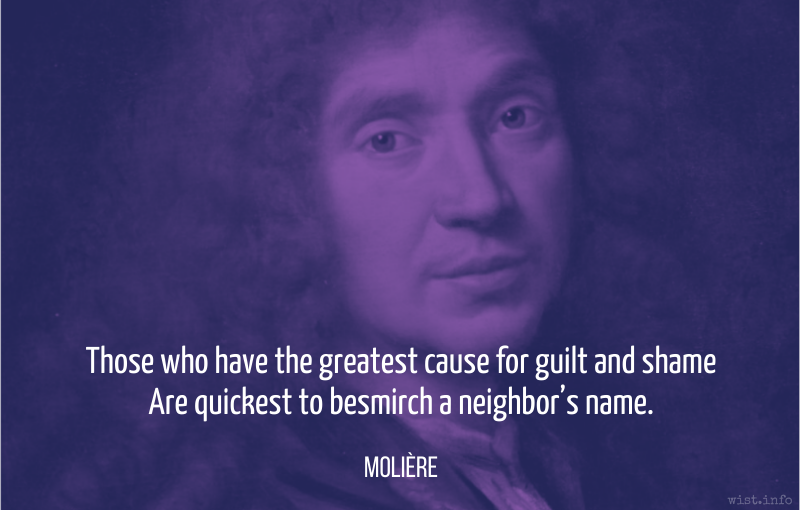
DORINE: Those who have the greatest cause for guilt and shame
Are quickest to besmirch a neighbor’s name.[Ceux de qui la conduite offre le plus à rire
Sont toujours sur autrui les premiers à médire.]
Molière (1622–1673) French playwright, actor [stage name for Jean-Baptiste Poquelin]
Tartuffe, or the Hypocrite [Le Tartuffe, ou L’Imposteur], Act 1, sc. 1 (1669) [tr. Wilbur (1963)]
(Source)
(Source (French)). Other translations:People, whose own Conduct is the most ridiculous, are always readiest to detract from that of others.
[tr. Clitandre (1672)]They whose own conduct is the most ridiculous are always the first to slander others.
[tr. Van Laun (1876)]The people whose conduct offers the greatest hold to ridicule are always the first to speak unkindly of others.
[tr. Wall (1879)]People whose conduct is the most ridiculous, are always the readiest to run down that of others.
[tr. Mathew (1890)]Those who are the most ridiculous in their own conduct are always the first to libel others.
[tr. Waller (1903)]Those whose own conduct's most ridiculous,
Are always quickest to speak ill of others.
[tr. Page (1909)]Those whose behavior is ridiculous
Always are first to see the faults of others.
[tr. Bishop (1957)]Those whose behavior is most asinine
Are always more than ready to malign.
[tr. Frame (1967)]Since they are always talked about,
They're sniffing other scandal out.
[tr. Bolt (2002)]It's always the most ridiculous people who are the first to slander others.
[tr. Steiner (2008)]People with the most to hide are always the worst.
Always the first to criticize others.
[tr. Campbell (2013)]Those whose conduct gives room for talk
Are always the first to attack their neighbors.
[Bartlett's]
CLEANTHES: To gossip seems to be a human need;
Our best protection is to pay no heed.
Let’s live in innocence as best we may,
And let the gossipmongers have their say.[Contre la médisance il n’est point de rempart.
À tous les sots caquets n’ayons donc nul égard;
Efforçons-nous de vivre avec toute innocence,
Et laissons aux causeurs une pleine licence.]Molière (1622–1673) French playwright, actor [stage name for Jean-Baptiste Poquelin]
Tartuffe, or the Hypocrite [Le Tartuffe, ou L’Imposteur], Act 1, sc. 1 (1669) [tr. Frame (1967)]
(Source)
(Source (French)). Other translations:There's no guarding against Calumny: Let us therefore not mind silly tittle-tattle, and let's endeavour to live innocently our selves, and leave the gossiping part of Mankind to say what they please.
[tr. Clitandre (1672)]There is no protection against slander. Let us, therefore, pay no regard to all this silly tittle-tattle; let us endeavour to live honestly, and leave the gossips to say what they please.
[tr. Van Laun (1876)]There is no safeguard against calumny. Let us, therefore, not mind all that foolish gossip, but only endeavour to lead a virtuous life, and leave full licence to the scandal-mongers.
[tr. Wall (1879)]There is no defence against calumny. So let us not mind foolish tittle-tattle, and let us endeavour to live innocently, and leave the gossips to say what they please.
[tr. Mathew (1890)]There is not any protection against slander. Do not let us pay any attention to foolish gossip, but endeavour to live honestly and leave the scandal-mongers to say what they will.
[tr. Waller (1903)]Against backbiting there is no defence
So let us try to live in innocence,
To silly tattle pay no heed at all,
And leave the gossips free to vent their gall.
[tr. Page (1909)]There is no wall so high it shuts out slander.
So let's not give a thought to silly gossip,
And let us try to live in innocence,
And let the talkers talk just as they please.
[tr. Bishop (1957)]One can't fight slander; it's a losing battle;
Let us instead ignore their tittle-tattle.
Let's strive to live by conscience' clear decrees,
And let the gossips gossip as they please.
[tr. Wilbur (1963)]There is nothing that can hold back gossip.
Let's give no attention to fools who chatter mean things;
Let's try to live in all innocence,
And leave it to other people to say what they will.
[tr. Siniscalchi (c. 1994)]Tongues would still wag, it's what tongues do,
Scandal will find a passage through
No matter how secure a wall
We built against it -- hang them all!
Their talk won't bother us a bit
As long as there's no grounds for it.
Provided we've done nothing wrong
They're free to babble all day long.
[tr. Bolt (2002)]There's no defense against slander.
Let's pay no attention to their cackling;
we'll try to live virtuously and
let busybodies have their way.
[tr. Steiner (2008)]There is no defence against malicious gossip.
Let's just concentrate on living a good and decent life
And let people talk all they please.
[tr. Campbell (2013)]There is no rampart that will hold out against malice.
[Bartlett's]
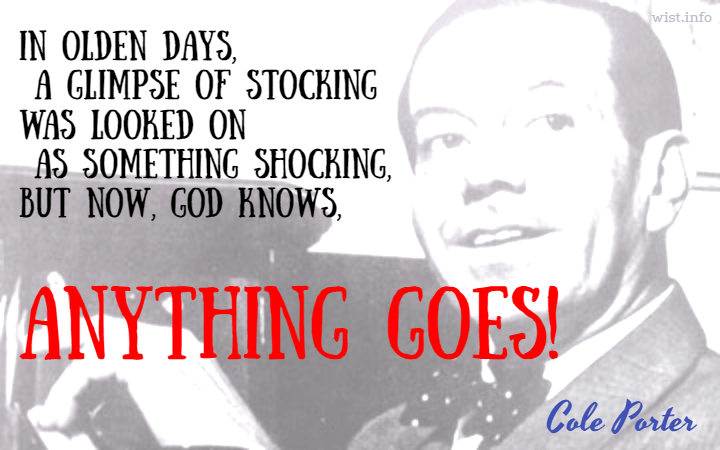
In olden days, a glimpse of stocking
Was looked on as something shocking,
But now, God knows,
Anything goes.
Cole Porter (1891–1964) American composer and songwriter
“Anything Goes” (1934)
You find out who your real friends are when you’re involved in a scandal.
Elizabeth Taylor (1932–2011) British-American actress
Comment (1961)
When in Rome during the filming of Cleopatra and a highly publicized adulterous love affair with Richard Burton.

Calumny is like a wasp which harasses you. Raise no hand against it unless you’re sure of killing it, for otherwise it will return to the charge more furious than ever.
[La calomnie est comme la guêpe qui vous importune, et contre laquelle il ne faut faire aucun mouvement, à moins qu’on ne soit sûr de la tuer, sans quoi elle revient à la charge, plus furieuse que jamais.]
Nicolas Chamfort (1741–1794) French writer, epigrammist (b. Nicolas-Sébastien Roch)
Products of Perfected Civilization [Produits de la Civilisation Perfectionée], Part 1 “Maxims and Thoughts [Maximes et Pensées],” ch. 5, ¶ 302 (1795) [tr. Dusinberre (1992)]
(Source)
(Source (French)). Other translations:Calumny is like the wasp which worries you, which it were best not to try to get rid of unless you are sure of slaying it; for otherwise it will return to the charge more furious than ever.
[Source (1872)]Scandal is an importunate wasp, against which we must make no movement unless we are quite sure that we can kill it; otherwise it will return to the attack more furious than ever.
[tr. Mathers (1926)]Calumny is like some annoying wasp, against which one must make no move unless one is sure of killing it, or else it will return to the charge more furiously than ever.
[tr. Merwin (1969)]Calumny is a wasp that bothers you, and against which you mustn't make any movement unless you are sure to kill it; otherwise it will attack you more furiously than before.
[tr. Siniscalchi (1994)]Slander is like a wasp which is pestering you but which you mustn't take any action against unless he happens to turn round.
[tr. Parmée (2003), ¶ 182]

Every man hath in his own life sins enough, in his own mind trouble enough, in his own fortune evils enough, and in performance of his offices failings more than enough, to entertain his own inquiry; so that curiosity after the affairs of others cannot be without envy, and an evil mind. What is it to me, if my neighbour’s grandfather were a Syrian, or his grandmother illegitimate; or that another is indebted five thousand pounds, or whether his wife be expensive?
Jeremy Taylor (1613–1667) English cleric and author
The Rules and Exercises of Holy Living (1650)

I do not believe the President’s sex life is any of our business. After thirty years of political reporting, I have been unable to establish a link between marital fidelity and high performance in public office. It really doesn’t matter who they screw in private, as long as they don’t screw the public.
Molly Ivins (1944–2007) American writer, political columnist [Mary Tyler Ivins]
Essay (1998-03), “A Dodge Too Far,” The Progressive, Vol. 62, No. 3
(Source)
In an interview (2006-10-09), "Who's It Screw, and Who's Doing the Screwing?" by Rosalind Alexander, Seattle Weekly, Ivins used a similar line:I have been watching politicians for 30 years, and I have never found a correlation between marital fidelity and high performance in public office. So I just decided a long time ago, I don’t care who they screw in private, as long as they’re not screwing the public.

My wife should be as much free from suspicion of a crime as she is from a crime itself.
[Meos tam suspicione quam crimine iudico carere oportere.]
Julius Caesar (100–44 BC) Roman general and statesman [Gaius Julius Caesar]
In Suetonius, Life of Caesar
Popularly, "Caesar’s wife must be above reproach" or "beyond reproach."
Caesar was called to be a witness against Clodius, who was charge with having defiled sacred rites and having an affair with Pompeia, Caesar's wife. Caesar said he had investigated and found out nothing to prove the Pompeia's fidelity. When asked why, then, he had divorced her, he gave this answer.
Other translations: "I judge it necessary for my kin to be as free from suspicion as from the charge of wrongdoing."
Other translations: "I wished my wife to be not so much as suspected." [in Plutarch, “Caesar,” Parallel Lives [tr. Dryden (1693)]].

Dishonor in public life has a double poison. When people are dishonorable in private business, they injure only those with whom they deal or their own chances in the next world. But when there is a lack of honor in Government, the morals of the whole people are poisoned.
Herbert Hoover (1874–1964) American engineer, bureaucrat, US President (1929–33)
Speech (1951-08-30), “Concerning Honor in Public Life,” Iowa Centennial Celebration, Des Moines, Iowa (radio broadcast)
(Source)
Laws are sand, customs are rock. Laws can be evaded and punishment escaped, but an openly transgressed custom brings sure punishment. The penalty may be unfair, unrighteous, illogical, and a cruelty; no mater, it will be inflicted, just the same.
Mark Twain (1835–1910) American writer [pseud. of Samuel Clemens]
Essay (1906), “The Gorky Incident,” Letters from the Earth (c. 1909; pub. 1962) [ed. DeVoto (1939)]
(Source)
Commenting on the eviction of Maxim Gorky from multiple hotels in New York City because the woman he was traveling with was not his wife. Twain was a supporter of Gorky's efforts to foment revolution in Tsarist Russia.
The essay was not published in Twain's lifetime. It's original publication was in the Slavonic and East European Review (1944-08), also edited by DeVoto.