

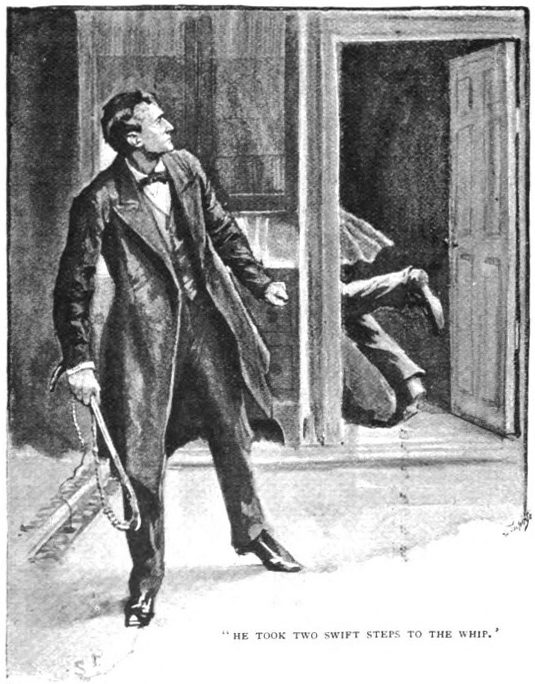
“The law cannot, as you say, touch you,” said Holmes, unlocking and throwing open the door, “yet there never was a man who deserved punishment more. If the young lady has a brother or a friend, he ought to lay a whip across your shoulders. By Jove!” he continued, flushing up at the sight of the bitter sneer upon the man’s face, “it is not part of my duties to my client, but here’s a hunting crop handy, and I think I shall just treat myself to —”
He took two swift steps to the whip, but before he could grasp it there was a wild clatter of steps upon the stairs, the heavy hall door banged, and from the window we could see Mr. James Windibank running at the top of his speed down the road.
“There’s a cold-blooded scoundrel!” said Holmes, laughing, as he threw himself down into his chair once more. “That fellow will rise from crime to crime until he does something very bad, and ends on a gallows.”Arthur Conan Doyle (1859–1930) British writer and physician
Story (1891-09), “A Case of Identity,” The Strand Magazine, Vol. 2, No. 3
(Source)
The miscreant in question disguised himself and seduced his own step-daughter so that she wouldn't marry and deprive him of her inherited fortune.
Collected in The Adventures of Sherlock Holmes, No. 3 (1892).
Quotations about:
crime
Note not all quotations have been tagged, so Search may find additional quotes on this topic.
Money — it’s love of money that is fatal;
for money’s sake men die before their time;
money is cruel; it nourishes men’s vices;
it is the source of woe, the seed of crime.[Ergo sollicitae tu causa, pecunia, vitae!
per te immaturum mortis adimus iter;
tu vitiis hominum crudelia pabula praebes;
semina curarum de capite orta tuo.]Propertius (50–16 BC) Roman elegiac poet [Sextus Propertius]
Elegies, Book 3, Elegy 7, l. 1ff (3.7.1–4) [tr. Carrier (1963)]
(Source)
Because of the corruption of the manuscripts of Propertius and speculating from internal references, some 19th Century scholars (e.g., Lachmann) argued for a different division of the elegies into books, thus the translations noted which instead label this as Book 4, Elegy 7.
(Source (Latin)). Other translations:Ah, Money, cause of all life's care and crime,
Through thee we walk death's path before our time;
Stern pander to the vices of mankind,
All tales of woe in thee commencement find.
[tr. Moore (1870), 4.7]Money! -- alas! from thee what troubles spring!
Through thee before our time deaths path we tread;
To human vices felly pandering,
Of cares the fosterer and fountain-head!
[tr. Cranstoun (1875), 4.7]Thou, money, art then the cause of an anxious life to us: it is owing to thee that we tread the path to death before our time. Thou affordest cruel food to the faults of men: from thee spring the seeds of care.
[tr. Gantillon (1884), 4.7]Then so it is: thou, Money, art the cause why our life is made unpeaceable; by thee we approach the road of death before our season; thou dost furnish a cruel provender for human weakness; and thyself are the author whence the seeds of sorrow arise.
[tr. Phillimore (1906)]Thou, therefore, money, art the cause that life is full of care! 'tis for thee we go down to death ere our time; 'tis thou that givest men's vices cruel nourishment, thou art the fount whence spring the seeds of woe.
[tr. Butler (Loeb) (1912)]Through you, then, money, our lives are full of trouble;
For you we take untimely the road to death.
It is you that cruelly nourish the vices of men;
From you come all the seeds of care.
[tr. Musker (1972)]So you then, Money, are the cause of our anguished lives! Through you we travel an untimely road to death; you furnish cruel nourishment for men’s faults; from your head have sprung the seeds of woe.
[tr. Goold (Loeb) (1990)]It's true then, Money -- you cause a life of trouble.
For you we take the early road to death.
You supply human vices with cruel nourishment.
From your stock spring the seeds of discontent.
[tr. Lee (1992)]So money you’re the cause of a troubled life! It’s because of you we go death’s path too soon: you offer human vices cruel nurture: from your source the seeds of sorrow spring.
[tr. Kline (2001)]How much can money vex us with a troubled life,
and urge us on to early death.
What cruel nourishment you furnish for men’s faults,
and from your head spring many cares.
[tr. Holcombe (2009)]You, O money, are the cause of a restless life!
Because of you we journey toward a premature death;
you provide cruel nourishment for the evils of men;
the seed of our cares sprouts from your head.
[E.g.]
FAULT, n. One of my offenses, as distinguished from one of yours, the latter being crimes.
Ambrose Bierce (1842–1914?) American writer and journalist
“Fault,” “Devil’s Dictionary” column, San Francisco Wasp (1884-08-02)
(Source)
Not collected in later books.

MEDEA: I know indeed what evil I intend to do,
But stronger than all my afterthoughts is my fury,
Fury that brings upon mortals the greatest evils.[ΜΉΔΕΙΑ: Καὶ μανθάνω μὲν οἷα τολμήσω κακά,
θυμὸς δὲ κρείσσων τῶν ἐμῶν βουλευμάτων,
ὅσπερ μεγίστων αἴτιος κακῶν βροτοῖς.]Euripides (485?-406? BC) Greek tragic dramatist
Medea [Μήδεια], l. 1078ff (431 BC) [tr. Warner (1944)]
(Source)
As she is about to murder her children as part of her revenge on Jason, their father.
(Source (Greek)). Other translations:I now am well aware
What crimes I venture on: but rage, the cause
Of woes most grievous to the human race,
Over my better reason hath prevail'd.
[tr. Wodhull (1782)]I know, I feel the ills, my soul now dares;
But rage, which lords it ov'er my breast, gives birth
To all the dreadful ills that chasten man.
[tr. Potter (1814)]Oh I do know what sorrows I shall make,
But anger keeps the mastery of my thoughts,
Which is the chiefest cause of human woes.
[tr. Webster (1868)]At last I understand the awful deed I am to do; but passion, that cause of direst woes to mortal man, hath triumphed o'er my sober thoughts.
[tr. Coleridge (1891)]I know indeed the ills that I am about to dare, but my rage is master of my counsels, which is indeed the cause of the greatest calamities to men.
[tr. Buckley (1892)]I know, indeed, the evil of that I purpose; but my inclination gets the better of my judgment.
[Bartlett's (1892)]Now, now, I learn what horrors I intend:
But passion overmastereth sober thought:
And this is cause of direst ills to men.
[tr. Way (Loeb) (1894)]Yea, I know to what bad things
I go, but louder than all thought doth cry
Anger, which maketh man's worst misery.
[tr. Murray (1906)]I understand
The horror of what I am going to do; but anger,
The spring of all life's horror, masters my resolve.
[tr. Vellacott (1963)]I understand how evilly I am about to act,
But my spirit is stronger than my will to resist,
Spirit, the greatest cause of evil for men.
[tr. Podlecki (1989)]And I know well what pain I am about to undergo, but my wrath overbears my calculation, wrath that brings mortal men their gravest hurt.
[tr. Kovacs (Loeb) (1994)]I am well aware how terrible a crime I am about to commit, but my passion is master of my reason, passion that causes the greatest suffering in the world.
[tr. Davie (1996)]I know only too well how horrible the crime I am about to commit is. Logic makes it clear for me but anger, the only cause of man’s most terrible suffering, anger, conquers my logic.
[tr. Theodoridis (2004)]I understand what evil I am about to do
but my wrath is stronger even than my thoughts,
which is the cause of the greatest wrongs of humankind.
[tr. Luschnig (2007)]I understand too well the dreadful act
I’m going to commit, but my judgment
cannot check my anger, and that incites
the greatest evils human beings do.
[tr. Johnston (2008)]I know well what evil I intend to do,
but anger overbears my calculation,
anger, cause of the worst misery to man.
[ed. Yeroulanos (2016)]I know how great a crime I'm going to commit,
but anger has control over my plans
anger, which is the greatest cause of human pain.
[tr. Ewans (2022)]At last I understand the evils [kaka] that I will perform; but my thūmos, responsible [aitios] for the greatest troubles [kaka] for mortals, is stronger than my sober thoughts.
[tr. Coleridge / Ceragioli / Nagy / Hour25]And I know well what pain I am about to undergo, but my wrath overpowers my calculation, wrath that brings mortal men their gravest hurt.
[tr. Kovacs / Zhang / Rogak]

We easily forget our faults when they are known only to ourselves.
[Nous oublions aisément nos fautes lorsqu’elles ne sont sues que de nous.]
François VI, duc de La Rochefoucauld (1613–1680) French epigrammatist, memoirist, noble
Réflexions ou sentences et maximes morales [Reflections; or Sentences and Moral Maxims], ¶196 (1665-1678) [tr. Stevens (1939)]
(Source)
Included in the 1st (1665) edition, reading "When we alone know of our crimes, they are soon forgotten [Quand il n’y a que nous qui savons nos crimes, ils sont bientôt oubliés]." Another variant is "Nous oublions aisément nos crimes lorsqu’ils ne sont sus que de nous" (bringing in the "crimes" term rather "faults").
See also ¶327.
(Source (French)). Other translations:We easily forget our Faults, when no body knows them but our selves.
[tr. Stanhope (1694), ¶197]We easily forget crimes that are known only to ourselves.
[pub. Donaldson (1783), ¶74]We easily forget crimes which are known only within ourselves.
[ed. Carvill (1835), ¶62]We easily forget our faults when they are only known to ourselves.
[ed. Gowens (1851), ¶205]We easily forget those faults which are known only to ourselves.
[tr. Bund/Friswell (1871), ¶196]Failings known to us alone are easily forgotten.
[tr. Heard (1917), ¶201]Our faults are easily forgotten when they are known only to ourselves.
[tr. FitzGibbon (1957), ¶196]We easily forget our faults when no one but ourselves knows them.
[tr. Kronenberger (1959), ¶196]Our misdeeds are easily forgotten when they are known only to ourselves.
[tr. Tancock (1959), ¶196]We easily forget our faults when they are known to ourselves alone.
[tr. Whichello (2016) ¶196]
A number of translators link this to Seneca, Moral Epistle 3:Most people fancy themselves innocent of those crimes of which they cannot be convicted.
Innocentem quisque se decit, respiciens testem, non conscientiam.

It seems to me a very unjust thing to take away a man’s life for a little money, for nothing in the world can be of equal value with a man’s life: and if it be said, “that it is not for the money that one suffers, but for his breaking the law,” I must say, extreme justice is an extreme injury: for we ought not to approve of those terrible laws that make the smallest offences capital, nor of that opinion of the Stoics that makes all crimes equal; as if there were no difference to be made between the killing a man and the taking his purse, between which, if we examine things impartially, there is no likeness nor proportion.
[Omnino mihi uidetur inquam pater benignissime homini uitam eripi propter ereptam pecuniam prorsus iniquum esse. Siquidem cum humana uita ne omnibus quidem fortunae possessionibus paria fieri posse arbitror. Quod si laesam iustitiam, si leges uiolatas, hac rependi poena dicant, haud pecuniam; quid ni merito summum illud ius, summa uocetur iniuria! Nam neque legum probanda sunt tam Manliana imperia, ut sicubi in leuissimis parum obtemperetur, illico stringant gladium; neque tam Stoica scita, ut omnia peccata adeo existiment paria, uti nihil iudicent interesse, occidatne aliquis hominem, an nummum ei surripiat, inter quae (si quicquam aequitas ualet) nihil omnino simile aut affine.]
Thomas More (1478–1535) English lawyer, social philosopher, statesman, humanist, Christian martyr
Utopia, Book 1, ch. 1 “Discourses of Raphael Hythloday” (1518 ed.) [tr. Burnet/Morley (1901)]
(Source)
Debating on the propriety of English laws that condemned thieves to hanging.
(Source (Latin)). Other translations:Suerlye my lorde, I thinke it not ryght nor justice, that the losse of money should cause the losse of mans life. For myne opinion is, that all the goodes in the worlde are not hable to countervayle mans life. But if they would thus say; that the breakynge of justice, and the transgression of the lawes is recompensed with this punishment, and not the losse of the money, then why maye not this extreme and rigorous justice wel be called plaine injurie? For so cruell govemaunce, so streite rules, and unmercyful lawes be not allowable, that if a small offense be committed, by and by the sword should be drawen: nor so stoical ordinaunces are to be borne withall, as to counte al offenses of suche equalitie, that the killing of a man, or the takyng of his money from him were both a matter, and the one no more heinous offense then the other: betwene the whyche two, yf we have anye respecte to equitie, no similitude or equalitie consisteth.
[tr. Robynson (1551)]It seems to me a very unjust thing to take away a Man's Life for a little Mony; for notyhing in the World can be of equal value with a Man's Life: and if it is said, that it is not for the Mony that one suffers, but for his breaking the Law; I must say extream Justice is an extream Injury: for we ought not to approve of these terrible Laws that make the smallest Offences capital; nor of that Opinion of the Stoicks that makes all Crimes equal, as if there were no difference to be made between the killing of a Man, and the taking his Purse; between wich if we examine things impartially, there is no likeness nor proportion.
[tr. Burnet (1684)]It seemeth very unjust to me to take away life for a little money, for nothing can be of equal value with life. And if it be said, that the suffering is not for the money, but for the breach of the law, I answer, extreme justice is an extreme injury. For we ought not to approve of those terrible laws, which make the smallest offences capital, nor of that opinion of the stoics which maketh all crimes equal: as if no difference were to be made between killing a man and taking his purse, between which, in reality, there is the greatest disproportion.
[tr. Cayley (1808)]Surely my lord, I think it not right nor justice, that the loss of money should cause the loss of man’s life. For mine opinion is, that all the goods in the world are not able to countervail man’s life. But if they would thus say: that the breaking of justice, and the transgression of the laws is recompensed with this punishment, and not the loss of the money, then why may not this extreme justice well be called extreme injury? For neither so cruel governance, so strait rules, and unmerciful laws be allowable, that if a small offence be committed, by-and-by the sword should be drawn: nor so stoical ordinances are to be borne withal, as to count all offences of such equality that the killing of a man, or the taking of his money from him were both a matter, and the one no more heinous offence than the other: between the which two, if we have any respect to equity, no similitude or equality consisteth.
[tr. Robinson (1909 ed.)]Certainly, right reverend father and my kind lord, I think it quite unjust that a man should lose his life for the loss of money. For in my opinion not all the goods that fortune can bestow on us can be set in the scale against a man's life. But if they say that this penalty is attached to the offence against justice and the breaking of the laws, and not to the theft of money, one may well style this extreme justice as extreme wrong. For we ought not to approve of such stern rules of law as should justify the drawing of the sword, when they are disobeyed in trifles, nor on the other hand such Stoical ordinances as count all offences equal, so that there is no difference whether one kills a man or robs him of a coin, when if equity has any meaning, there is no similarity or connexion between the two cases. God has said, "Thou shalt not kill," and shall we so lightly kill a man for taking a little money?
[tr. Richards (1923)]Your Grace, it seems to me quite unjust to take a man's life because he's taken some money. To my mind, no amount of property is equivalent to a human life. If it's argued that the punishment is not for taking the money, but for breaking the law and violating justice, isn't this conception of absolute justice absolutely unjust? One really can’t approve of a régime so dictatorial that the slightest disobedience is punishable by death, nor of a legal code based on the Stoic paradox that all offences are equal — so that there’s no distinction in law between theft and murder, though in equity the two things are so completely different.
[tr. Turner (1965 ed.)]Certainly, most reverend and kind Father, I think it altogether unjust that a man should suffer the loss of his life for the loss of someone’s money. In my opinion, not all the goods that fortune can bestow on us can be set in the scale against a man’s life. If they say that this penalty is attached to the offense against justice and the breaking of the laws, hardly to the money stolen, one may well characterize this extreme justice as extreme wrong. For we ought not to approve such stern Manlian rules of law as would justify the immediate drawing of the sword when they are disobeyed in trifles nor such Stoical ordinances as count all offenses equal so that there is no difference between killing a man and robbing him of a coin when, if equity has any meaning, there is no similarity or connection between the two cases.
[tr. Richards/Surtz (1964)]It seems to me, most kind and reverend father, that it's altogether unjust to take away a man's life for the loss of someone's money. Nothing in the world that fortune can bestow is equal in value to a man's life. If they say the thief suffers not for the money, but for violation of justice and transgression of laws, then this extreme justice should really be called extreme injury. We ought not to approve of these fierce Manlian laws that invoke the sword for the smallest violations. Neither should we accept the Stoic view that considers all crimes equal, as if there were no difference between killing a man and taking a coin from him. If equity means anything, there is no proportion or relation at all between these two crimes.
[tr. Adams (1992 ed.)]

Well, those are my objections on moral grounds. From a practical point of view, surely it’s obvious that to punish thieves and murderers in precisely the same way is not only absurd but also highly dangerous for the public. If a thief knows that a conviction for murder will get him into no more trouble than a conviction for theft, he’s naturally impelled to kill the person that he’d otherwise merely have robbed. It’s no worse for him if he’s caught, and it gives him a better chance of not being caught, and of concealing the crime altogether by eliminating the only witness. So in our efforts to terrorize thieves we’re actually encouraging them to murder innocent people.
[Non licere putem. Quam uero sit absurdum, atque etiam perniciosum reipublicae furem, atque homicidam ex aequo puniri, nemo est, opinor, qui nesciat.
Nempe quum latro conspiciat non minus imminere discriminis duntaxat furti damnato, quam si praeterea conuincatur homicidij, hac una cogitatione impellitur in caedem eius, quem alioqui fuerat tantum spoliaturus. quippe praeterquam quod deprehenso nihil sit plus periculi, est etiam in caede securitas maior, & maior caelandi spes sublato facinoris indice.
Itaque dum fures nimis atrociter studemus perterrefacere, in bonorum incitamus perniciem.]Thomas More (1478–1535) English lawyer, social philosopher, statesman, humanist, Christian martyr
Utopia, Book 1, ch. 1 “Discourses of Raphael Hythloday” (1518 ed.) [tr. Turner (1965 ed.)]
(Source)
On the hanging of thieves under English law.
(Source (Latin)). Other translations:I am persuaded that this punishement is unlawful. Furthermore I thinke ther is no body that knoweth not, how unreasonable, yea, how pernitious a thinge it is to the weale publike, that a thefe and a homicide or murderer, should suffer equall and like punishment. For the thefe seynge that man, that is condempned for thefte in no less jeoperdie, nor judged to no lesse punishment, then him that is convicte of manslaughter; throughe this cogitation onelye he is strongly and forciblye provoked, and in a maner constreined to kill him whome els he woulde have but robbed. For the murder beynge ones done, he is in lesse feare, and in more hoope that the deede shall not be bewrayed or knowen, seynge the partye is nowe deade and rydde oute of the waye, which onelye mighte have uttered and disclosed it. But if he chaunce to be taken and discrived, yet he is in no more daunger and jeoperdie, then if he had committed but single fellonye. Therfore whiles we go about with suche crueltie to make theves aferd, we provoke them to kil good men.
[tr. Robynson (1551)]I think the putting of Thieves to death is not lawful; and it is plain and obvious that it is absurd, and of ill Consequence to the Common-Wealth, that a Thief and a Murderer should be equally punished; for if a Robber sees that his Danger is the same, if he is convicted of Theft, as if he were guilty of Murder, this will naturally set him on to kill the Person whom otherwise he would only have robbed; since, if the Punishment is the same, there is more security, and less danger of discovery, when he that can best make it is put out of the way; so that terrifying Thieves too much provokes them to cruelty.
[tr. Burnet (1684)]I think putting thieves to death is not lawful ; and it is plain and obvious that it is absurd, and of ill consequence to the commonwealth, that a thief and a murderer should be equally punished: for if a robber sees that his danger is the same, if he is convicted of theft, as if he were guilty of murder, this will naturally incite him to kill the person whom otherwife he would only have robbed, since if the punishment is the same, there is more security and less danger of discovery, when he that can best make it is put out of the way; so that terrifying thieves too much, provokes them to cruelty.
[tr. Warner (1758)]I think putting thieves to death, not lawful. And it is obviously absurd, and prejudicial to the commonwealth, that theft and murder should be punished alike. For, if a robber find that his danger is the same, if he be convicted of theft as if he had been guilty of murder, he will be incited to kill the person whom otherwise he would only have robbed; since, the punishment being the same, there is less danger of discovery, when he who can best make it is killed. Thus, terrifying thieves too much, provoketh them to cruelty.
[tr. Cayley (1808)]I think putting thieves to death is not lawful; and it is plain and obvious that it is absurd and of ill consequence to the commonwealth that a thief and a murderer should be equally punished; for if a robber sees that his danger is the same if he is convicted of theft as if he were guilty of murder, this will naturally incite him to kill the person whom otherwise he would only have robbed; since, if the punishment is the same, there is more security, and less danger of discovery, when he that can best make it is put out of the way; so that terrifying thieves too much provokes them to cruelty.
[tr. Burnet/Morley (1901)]I am persuaded that this punishment is unlawful. Furthermore, I think there is no body that knoweth not how unreasonable, yea, how pernicious a thing it is to the weal public that a thief and a homicide or murderer should suffer equal and like punishment. For the thief, seeing that man that is condemned for theft in no less jeopardy, nor judged to no less punishment, than him that is convict of manslaughter; through this cogitation only he is strongly and forcibly provoked, and in a manner constrained, to kill him, whom else he would have but robbed. For the murder once done, he is in less care and in more hope, that the deed shall not be betrayed or known, seeing the party is now dead and rid out of the way, which only might have uttered and disclosed it. But if he chance to be taken and discrived, yet he is in no more danger and jeopardy than if he had committed but single felony. Therefore whiles we go about with such cruelty to make thieves afeared, we provoke them to kill good men.
[tr. Robynson/Lupton/Armes (1911)]I think this punishment unlawful. Now how absurd and even dangerous to the commonwealth it is that a thief and a murderer should receive the same punishment, surely everyone knows. For since the robber sees that he is in as great danger if merely condemned for theft as if he were convicted of murder as well, this consideration alone impels him to murder a man, whom otherwise he would only have robbed; for besides the fact that he is in no more danger if caught, there is greater safety in putting the man out of the way, and a greater hope of covering up the offence, if there is no one left to tell the tale. And so while we try to frighten thieves with excessive cruelty, we urge them on to the destruction of honest men.
[tr. Richards (1923)]I think this punishment unlawful. Besides, surely everyone knows how absurd and even dangerous to the commonwealth it is that a thief and a murderer should receive the same punishment. Since the robber sees that he is in as great danger if merely condemned for theft as if he were convicted of murder as well, this single consideration impels him to murder the man whom otherwise he would only have robbed. In addition to the fact that he is in no greater danger if caught, there is greater safety in putting the man out of the way and greater hope of covering up the crime if he leaves no one left to tell the tale. Thus, while we endeavor to terrify thieves with excessive cruelty, we urge them on to the destruction of honest citizens.
[tr. Richards/Surtz (1964)]I think it is wrong to put thieves to death. But everybody knows how absurd and even harmful to the public welfare it is to punish theft and murder alike. If theft carries the same penalty as murder, the thief will be encouraged to kill the victim whom otherwise he would only have robbed. When the punishment is the same, murder is safer, since one conceals both crimes by killing the witness. Thus while we try to terrify thieves with extreme cruelty, we really invite them to kill innocent men.
[tr. Adams (1992 ed.)]I think putting thieves to death is not lawful; and it is plain and obvious that it is absurd and of ill consequence to the commonwealth that a thief and a murderer should be equally punished; for if a robber sees that his danger is the same if he is convicted of theft as if he were guilty of murder, this will naturally incite him to kill the person whom otherwise he would only have robbed; since, if the punishment is the same, there is more security, and less danger of discovery, when he that can best make it is put out of the way; so that terrifying thieves too much provokes them to cruelty.
[tr. Open Utopia (Duncombe) (2012)]
In this world we never will be perfectly civilized as long as a gallows casts its shadow upon the earth. As long as there is a penitentiary, within the walls of which a human being is immured, we are not a perfectly civilized people. We shall never be perfectly civilized until we do away with crime.
And yet, according to this Christian religion, God is to have an eternal penitentiary; he is to be an everlasting jailer, an everlasting turnkey, a warden of an infinite dungeon, and he is going to keep prisoners there forever, not for the purpose of reforming them — because they are never going to get any better, only worse — but for the purpose of purposeless punishment. And for what? For something they failed to believe in this world. Born in ignorance, supported by poverty, caught in the snares of temptation, deformed by toil, stupefied by want — and yet held responsible through the countless ages of eternity! No man can think of a greater horror; no man can dream of a greater absurdity.Robert Green Ingersoll (1833–1899) American lawyer, freethinker, orator
Lecture (1884-01-20), “Orthodoxy,” Tabor Opera House, Denver, Colorado
(Source)
Published as its own book in 1884.
Well, I have a trade of my own. I suppose I am the only one in the world. I’m a consulting detective, if you can understand what that is. Here in London we have lots of government detectives and lots of private ones. When these fellows are at fault, they come to me, and I manage to put them on the right scent. They lay all the evidence before me, and I am generally able, by the help of my knowledge of the history of crime, to set them straight. There is a strong family resemblance about misdeeds, and if you have all the details of a thousand at your finger ends, it is odd if you can’t unravel the thousand and first.
Arthur Conan Doyle (1859–1930) British writer and physician
Story (1886-04), “A Study in Scarlet,” Part 1, ch. 2 [Holmes], Beeton’s Christmas Annual, Vol. 28 (1887-11-21)
(Source)
Our readiness to think ill of people without sufficiently examining the matter is based on laziness and pride. We want to find people guilty, we don’t want the bother of studying their crimes.
[La promptitude à croire le mal, sans l’avoir assez examiné, est un effet de l’orgueil et de la paresse: on veut trouver des coupables, et on ne veut pas se donner la peine d’examiner les crimes.]
François VI, duc de La Rochefoucauld (1613–1680) French epigrammatist, memoirist, noble
Réflexions ou sentences et maximes morales [Reflections; or Sentences and Moral Maxims], ¶267 (1665-1678) [tr. Kronenberger (1959)]
(Source)
Present in the 1st Edition. Variant: "... un effet de la paresse et de l'orguieil."
Another 1665 variant:La promptitude avec laquelle nous croyons le mal, sans l’avoir assez examiné, est un effet de la paresse et de l’orgueil.
[The readiness with which we believe evil, without having examined it sufficiently, is an effect of laziness and pride.]
Manuscript variant: "... est souvent un effet de paresse, qui se joint à l’orgueil [... is often an effect of laziness, combined with pride]."
(Source (French)). Other translations:A readiness to believe Ill, before we have duly Examined it, is the Effect of Laziness and Pride. Men are pleased to find Others to Blame and loth to give Themselves the Trouble of Enquiring, how far, and whether they are so, or not.
[tr. Stanhope (1694), ¶268]A readiness to believe ill without examination is the effect of pride and laziness. We are willing to find people guilty, and unwilling to be at the trouble of examining into the accusation.
[pub. Donaldson (1783), ¶245; ed. Lepoittevin-Lacroix (1797), ¶250]A willingness to believe ill, without examination, is the effect of pride and idleness. We are ready to suppose guilt, but unwilling to be at the trouble of examining into the accusation.
[ed. Carvill (1835), ¶214]Readiness; to believe evil without sufficient examination is the result of pride and indolence. We wish to find people guilty, and we do not wish to give ourselves the trouble of examining into the crimes.
[ed. Gowens (1851), ¶278]A quickness in believing evil without having sufficiently examined it, is the effect of pride and laziness. We wish to find the guilty, and we do not wish to trouble ourselves in examining the crime.
[tr. Bund/Friswell (1871), ¶267]A ready belief of evil without examining the facts is a form of pride, or of indolence. We are anxious to ferret out criminals without taking the pains of examining their crimes.
[tr. Heard (1917), ¶275]Readiness to believe evil without adequate inquiry is the result of pride and indolence. We like detecting criminals, but we dislike the labor of investigating crimes.
[tr. Stevens (1939), ¶267]The promptitude with which we will believe evil of others, without an adequate examination of the facts, is an effect of pride working with laziness. We wish to find the guilty men, and cannot be be bothered to study the crime.
[tr. FitzGibbon (1957), ¶267]Readiness to believe the worst without adequate examination comes from pride and laziness; we want to find culprits but cannot be bothered to investigate the crimes.
[tr. Tancock (1959), ¶267]A readiness to believe evil without sufficient examination, it is an effect both of pride and of idleness. On the one hand, we desire to find other people guilty; and on the other, we do not wish to take the pains necessary to examine their crimes.
[tr. Whichello (2016) ¶267]
This has happened before in our history — in fact, it’s a pretty predictable reaction to fear. We get so rattled by some big Scary Thing — communism or crime or drugs or illegal aliens or terrorism — something that scares us so much, we think we can make ourselves safer by giving up some of our freedom. Now, not only does that not hold a drop of water as a logical proposition but it has consistently proved to be an illusion as a practical matter. Empirically, when you make yourself less free, you are not safe, you are just less free.

INCORPORATION, n. The act of uniting several persons into one fiction called a corporation, in order that they may be no longer responsible for its actions. A, B and C are a corporation. A robs, B steals and C (it is necessary that there be one gentleman in the concern) cheats. It is a plundering, thieving, swindling corporation. But A, B and C, who have jointly determined and severally executed every crime of the corporation, are blameless. It is wrong to mention them by name when censuring their acts as a corporation, but right when praising.
Ambrose Bierce (1842–1914?) American writer and journalist
“Incorporation,” “Devil’s Dictionary” column, San Francisco Wasp (1885-10-03)
(Source)
Not collected in later books.
For if once a man indulges himself in murder, very soon he comes to think little of robbing; and from robbing he comes next to drinking and Sabbath-breaking, and from that to incivility and procrastination. Once begin upon this downward path, you never know where to stop. Many a man has dated his ruin from some murder or other that perhaps he thought little of the time.
Thomas De Quincey (1785–1859) English writer, essayist, literary critic
Essay (1839-11), “Second Paper on Murder Considered as One of the Fine Arts,” Blackwood’s Edinburgh Magazine, Vol. 46, No. 289
(Source)

The sinner sins against himself. The wrong-doer wrongs himself by making himself evil.
[Ὁ ἁμαρτάνων ἑαυτῷ ἁμαρτάνει: ὁ ἀδικῶν ἑαυτὸν ἀδικεῖ, ἑαυτὸν, ἑαυτὸν κακὸν ποιῶν.]
Marcus Aurelius (AD 121–180) Roman emperor (161–180), Stoic philosopher
Meditations [To Himself; Τὰ εἰς ἑαυτόν], Book 9, ch. 4 (9.4) (AD 161-180) [tr. Hutcheson/Chrystal (1902)]
(Source)
(Source (Greek)). Alternate translations:He that sinneth, sinneth unto himself. He that is unjust, hurts himself, in that he makes himself worse than he was before.
[tr. Casaubon (1634)]He that commits a Fault Abroad , is a Trespasser at Home; And he that injures his Neighbour, hurts himself , for to make himself an ill Man is a shrew'd Michief.
[tr. Collier (1701)]He who does wrong, does a wrong to himself. He who is injurious, does evil to himself, by making himself evil.
[tr. Hutcheson/Moor (1742)]He that commits a crime, is guilty of an offence against his own interest, and he that acts unjustly, injures himself: for to make himself a bad man, is an essential injury.
[tr. Graves (1792)]He who does wrong does wrong against himself. He who acts unjustly acts unjustly to himself, because he makes himself bad.
[tr. Long (1862)]He that commits a fault abroad is a trespasser at home; and he that injures his neighbour, hurts himself, for to make himself an evil man is a great mischief.
[tr. Collier/Zimmern (1887)]He who sins, sins against himself; he who does wrong, wrongs himself, making himself evil.
[tr. Rendall (1898)]He that does wrong, does wrong to himself. The unjust man is unjust to himself, for he makes himself bad.
[tr. Haines (Loeb) (1916)]Whosoever does wrong, wrongs himself; whosoever does injustice, does it to himself, making himself evil.
[tr. Farquharson (1944)]The sinner sins against himself; the wrongdoer wrongs himself, becoming the worse by his own action.
[tr. Staniforth (1964)]Whoever does wrong, wrongs himself; whosever acts unjustly, acts unjustly toward himself, because he makes himself bad.
[tr. Hard (1997 ed., 2011 ed.)]To do harm is to do yourself harm. To do an injustice is to do yourself an injustice -- it degrades you.
[tr. Hays (2003)]The sinner sins against himself: the wrongdoer wrongs himself, by making himself morally bad.
[tr. Hammond (2006)]He who acts wrongly harms himself. If a person commits an injustice, he acts badly toward himself, thus making himself bad.
[tr. Needleman/Piazza (2008)]

HIPPOLYTUS: Great crimes are never single, they are link’d
To former faults. He who has once transgress’d
May violate at last all that men hold
Most sacred; vice, like virtue, has degrees
Of progress; innocence was never seen
To sink at once into the lowest depths
Of guilt.[HIPPOLYTE: Quelques crimes toujours precedent les grands crimes.
Quiconque a pu franchir les bornes légitimes
Peut violer enfin les droits les plus sacrés ;
Ainsi que la vertu, le crime a ses degrés ;
Et jamais on n’a vu la timide innocence
Passer subitement à l’extrême licence.]Jean Racine (1639–1699) French dramatist
Phèdre [Phædra], Act 4, sc. 2, l. 1094ff (1677-01-01) [tr. Boswell (1897)]
(Source)
(Source (French)). Other translations:Crime, like virtue, hath degrees; one single day can not make a bad man just; nor can the good, in such short season, pass suddenly to utter baseness.
[tr. Heron (1858), 3.1]Some crimes always precede great crimes; whoever has overstepped the legitimate limits, may at last violate the most sacred rights; thus, as well as virtue, crime has its degrees, and we have never seen timid innocence pass suddenly into extreme licentiousness.
[tr. Mongan (1885)]Some lesser crimes always precede great sin.
He who hath once the bounds of right transgressed
May violate the most sacred laws at last;
But even as virtue, vice hath its degrees,
And modest innocence one never sees
Pass suddenly to wanton ways and lewd.
[tr. Lockert (1936)]A man who can transgress the lawful boundaries
may violate the most sacred rights in the end.
Like virtue, crime has its gradations;
Never has timid innocence
suddenly become extreme depravity.
[Unk.]Crime like virtue has its degrees; and timid innocence was never known to blossom suddenly into extreme license.
[Bartlett's]

When I speak of the banality of evil, I do so only on the strictly factual level, pointing to a phenomenon which stared one in the face at the trial. Eichmann was not Iago and not Macbeth, and nothing would have been farther from his mind than to determine with Richard III “to prove a villain.” Except for an extraordinary diligence in looking out for his personal advancement, he had no motives at all. And this diligence in itself was in no way criminal; he certainly would never have murdered his superior in order to inherit his post. He merely, to put the matter colloquially, never realized what he was doing.
Hannah Arendt (1906–1975) German-American philosopher, political theorist
Eichmann in Jerusalem: A Report on the Banality of Evil, Postscript (1963)
(Source)

In the discussion of these matters, and especially in the general moral denunciation of the Nazi crimes, it is almost always overlooked that the true moral issue did not arise with the behavior of the Nazis but of those who only “coordinated” themselves and did not act out of conviction. It is not too difficult to see and even to understand how someone may decide “to prove a villain” and, given the opportunity, to try out a reversal of the Decalogue, starting with the command: “Thou shalt kill” and ending with a precept: “Thou shalt lie.”
“Your money or your life.” We know what to do when a burglar makes this demand of us, but not when God does.
Mignon McLaughlin (1913–1983) American journalist and author
The Second Neurotic’s Notebook, ch. 8 (1966)
(Source)

YEVGRAF: I told myself it was beneath my dignity to arrest a man for pilfering firewood. But nothing ordered by the Party is beneath the dignity of any man. And the Party was right: one man desperate for a bit of fuel is pathetic; five million people desperate for fuel will destroy a city.
Robert Bolt (1924–1995) English dramatist
Doctor Zhivago, film (1965)
(Source)
Watching Yuri scavenging wood from a fence.
This line is not in the 1957 Boris Pasternak novel.
AGAMEMNON: Perhaps, for you, barbarians, it is easy to kill your guests but for us, Greeks, this is a thing of shame. How, then can I escape blame if I do not judge you guilty? I can’t do it. Since you could endure performing such a dishonourable deed, then you must also endure its awful consequences.
[ἈΓΑΜΈΜΝΩΝ: τάχ᾽ οὖν παρ᾽ ὑμῖν ῥᾴδιον ξενοκτονεῖν:
ἡμῖν δέ γ᾽ αἰσχρὸν τοῖσιν Ἕλλησιν τόδε.
πῶς οὖν σε κρίνας μὴ ἀδικεῖν φύγω ψόγον;
οὐκ ἂν δυναίμην. ἀλλ᾽ ἐπεὶ τὰ μὴ καλὰ
πράσσειν ἐτόλμας, τλῆθι καὶ τὰ μὴ φίλα.]Euripides (485?-406? BC) Greek tragic dramatist
Hecuba [Hekabe; Ἑκάβη], l. 1247ff (c. 424 BC) [tr. Theodoridis (2007)]
(Source)
Passing judgment on Polymestor for the death of Hecuba's son and theft of the Trojan treasure entrusted to him.
(Source (Greek)). Other translations:Perhaps the murder of your guests seems light,
We Greeks esteem it base. If I acquit thee
How shall I scape reproach? Indeed, I cannot:
since thou hast dar'd to perpetrate the crime,
Endure the consequences.
[tr. Wodhull (1809)]Perhaps with you it is a slight thing to kill your guests; but with us Grecians this thing is abhorred. How then, in giving my decision that thou hast not injured, can I escape blame? I can not; but as thou hast dared to do things dishonorable, endure now things unpleasant.
[tr. Edwards (1826)]Haply with you guest-murder is as nought,
But to us which be Greeks foul shame is this.
How can I uncondemned adjudge thee guiltless?
I cannot. Forasmuch as thou hast dared
To do foul deeds, even drain thy bitter cup.
[tr. Way (Loeb) (1894)]Perhaps among you it is a light thing to murder guests, but with us in Hellas it is a disgrace. How can I escape reproach if I judge you not guilty? I could not. No, since you endured your horrid crime, endure as well its painful consequence.
[tr. Coleridge (1938)]Perhaps you think it is a trifling matter
to kill a guest.
We Greeks call it murder.
How, therefore, could I acquit you now
without losing face among men?
I could not do it.
You committed a brutal crime; therefore accept
the consequences of your act.
[tr. Arrowsmith (1958)]Perhaps for lesser breeds it's no great thing to kill a guest, but to us Greeks it is. If I say you did no wrong I can't escape the censure and the blame that I'll incur. Since you were tough enough to do such deeds be tough enough to suffer the results.
[tr. Harrison (2005)]Maybe you think
killing a guest -- in this case a child who’d been
put in your care -- is a small matter in the larger
scheme of things. But we Greeks think of it
as heinous murder. How could I rule you innocent
and maintain a shred of credibility? I can’t.
You committed a brutal crime; be prepared,
therefore, for a justly brutal punishment.
[tr. Karden/Street (2011)]
That, Senators, is what a favour from gangsters amounts to. They refrain from murdering someone; then they boast that they have spared him!
[Quod est aliud, patres conscripti, beneficium latronum, nisi ut commemorare possint iis se dedisse vitam, quibus non ademerint?]
Marcus Tullius Cicero (106–43 BC) Roman orator, statesman, philosopher
Philippics [Philippicae; Antonian Orations], No. 2, ch. 3 / sec. 5 (3.3/3.5) (44-10-24 BC) [tr. Grant (1960)]
(Source)
(Source (Latin)). Other translations:What other services, my lords, can robbers render, save that they can claim to have given life to those whose lives they spare?
[tr. King (1877)]How; are brigands "benefactors," except in being able to assert that they have granted life to those from whom they have not taken it?
[tr. Ker (Loeb) (1926)]Us not this, O conscript fathers, such a kindness as is done by banditti, who are contented with being able to boast that they have granted their lives to all those men whose lives they have not taken?
[tr. Yonge (1903)]How else can brigands confer a favour, conscript fathers, except by asserting that they have granted life to those from whom they have not taken it away?
[tr. Berry (2006)]What is the kindness of outlaws, members of the Senate, other than their ability to remind us that they gave life to people from whom they did not steal it?
[tr. McElduff (2011)]
It is my belief that no crime, however cowardly and however shameless and cruel, can be imagined which there isn’t somebody in Christendom willing to commit.
Mark Twain (1835–1910) American writer [pseud. of Samuel Clemens]
Autobiographical Dictation (1908-06-26)
(Source)
Published in Autobiography of Mark Twain, Vol. 3 (2015).
The man who steals a buckle is put to death, the man who steals a state becomes a prince.
[竊鉤者誅,竊國者侯 – traditional]
[窃钩者诛,窃国者侯 – simplified]Chuang Tzu (369–286 BC) Chinese Taoist philosopher [Zhuang Zhou (莊周), Zhuangzi ( 莊子)]
Zhuangzi (Chuang Tzŭ), ch. 10 “Quqie [胠篋; Rifling Trunks]” (3rd C BC) [tr. Graham (1981)]
(Source)
See O'Neill (1921).
(Source (Chinese, traditional; simplified)). Other translations:One man steals a purse, and is punished. Another steals a State, and becomes a Prince.
[tr. Giles (1889)]Here is one who steals a hook (for his girdle); -- he is put to death for it: here is another who steals a state; -- he becomes its prince.
[tr. Legge (1891)]A poor man must swing
For stealing a belt buckle
But if a rich man steals a whole state
He is acclaimed
As statesman of the year.
[tr. Merton (1965)]This one steals a buckle and he is executed, that one steals a country and he becomes its ruler.
[tr. Palmer (1996)]He who steals a belt buckle pays with his life; he who steals a state gets to be a feudal lord.
[tr. Watson (2013)]One steals a hook -- he is put to death. Another steals a state -- he becomes a prince.
[tr. Yang/Höchsmann (2007)]He who steals a belt buckle is executed, but he who steals a state is made a feudal lord.
[tr. Ziporyn (2009)]
This adage can be found in a wide array of forms, with the same basic structure (steal something small, get punished; steal something big, get rewarded), usually stripped of its Chinese/Taoist origin, e.g.:Steal money you're a thief; steal a country you're a king.
["Japanese proverb"]Stealing a dog is said to be immoral. Still, they steal a country and call it righteousness.
[Source]To steal a purse is rightly held a crime.
To steal a country is an act sublime.
[Percy Russell (1919)]One who steals a pearl is persecuted as a thief. One who steals a nation is revered as a king.
[Source]When you steal a pin, you are executed; but if you steal a country, you become a king.
[Chinese historian Sima Qian (c. 145 – c. 86 BC)]One who steals a little is a thief. One who steals a little bit more is a robber. And one who steals a nation is a king.
[Source]To steal a fruit means theft, while to steal a country does not.
["Old Chinese saying"]Those that steal a loaf of bread are hanged as thieves - those that steal a country are made emperor.
[Source]Steal an apple and you're a thief. Steal a country and you're a statesman.
[Disney's Aladdin (2019)]

Books have another value, to those who have fallen forever and wholly in love with them. There are those who would cheat for them, steal for them, lie for them, even if then they could never show or boast of their treasures to any other creature. Kill for them? It was not impossible.
Ellis Peters (1913–1995) English writer, translator [pseud. of Edith Mary Pargeter, who also wrote under the names John Redfern, Jolyon Carr, Peter Benedict]
Cadfael Chronicles No. 17, The Heretic’s Apprentice, ch. 12 (1990)
(Source)

ALCESTE: His social polish can’t conceal his nature;
One sees at once that he’s a treacherous creature;
No one could possibly be taken in
By those soft speeches and that sugary grin.
The whole world knows the shady means by which
The low-brow’s grown so powerful and rich,
And risen to a rank so bright and high
That virtue can but blush, and merit sigh.
[Au travers de son masque on voit à plein le traître;
Partout il est connu pour tout ce qu’il peut être ;
Et ses roulements d’yeux, et son ton radouci
N’imposent qu’à des gens qui ne sont point d’ici.
On sait que ce pied plat, digne qu’on le confonde,
Par de sales emplois s’est poussé dans le monde,
Et que, par eux son sort de splendeur revêtu
Fait gronder le mérite et rougir la vertu.]Molière (1622–1673) French playwright, actor [stage name for Jean-Baptiste Poquelin]
Le Misanthrope, Act 1, sc. 1 (1666) [tr. Wilbur (1954)]
(Source)
(Source (French)). Other translations:You may plainly perceive the traitor through his mask; he is well known everywhere in his true colours; his rolling eyes and his honeyed tones impose only on those who do not know him. People are aware that this low-bred fellow, who deserves to be pilloried, has, by the dirtiest jobs, made his way in the world; and that the splendid position he has acquired makes merit repine and virtue blush.
[tr. Van Laun (1878)]The treacherous rascal is plainly seen through his mask, he is everywhere known for what he is; his rolling eyes and soft tones impose only upon strangers. People know that this wretched fellow, who ought to be hanged, has pushed his way in the world by dirty jobs, and that the splendid condition he finds himself in through them makes merit grumble and virtue blush.
[tr. Mathew (1890)]Behind his mask the knave is seen, wherever he is known, for what he is; the rolling of his eye, his bated voice, impose on none but those who do not live here. All others know that the sneaking fellow, fit only to be shunned, has by the foulest actions foisted himself upon society, where his career, by their connivance clothed in splendor, makes merit groan and virtue blush.
[tr. Wormeley (1894)]You can clearly see the traitor through his mask. He is known everywhere for what he is: his rolling eyes and his honeyed tones only impose on those people who do not know him. They know that this low-bred cur, who deserves to be exposed, has, by the dirtiest means, pushed himself on in the world; and the splendid position he has acquired by these means makes merit repine and virtue blush.
[tr. Waller (1903)]The traitor's face shows plainly through his mask,
And everywhere he's known for what he is;
His up-turned eyes, his honeyed canting voice,
Impose on none but strangers. All men know
That this confounded, low-bred, sneaking scamp
Has made his way by doing dirty jobs,
And that the splendid fortune these have brought him
Turns merit bitter and makes virtue blush.
[tr. Page (1913)]Behind his mask the scoundrel's visible.
Here everybody knows his character;
And his protesting eyes, his honeyed tongue,
Impose on no one but a casual stranger.
And that contemptible boor notoriously
Has made his way in the world by dirty means,
So that his present splendid situation
Makes merit grumble and makes virtue blush.
[tr. Bishop (1957)]Right through his mask men see the traitor's face,
And everywhere give him his proper place;
His wheedling eyes, his soft and cozening tone,
Fool only those to whom he is not known.
That this knave rose, where he deserved to fall,
By shameful methods, is well known to all,
And that his state, which thanks to these is lush,
Makes merit murmur and makes virtue blush.
[tr. Frame (1967)]

Nothing incites to money-crimes like great poverty or great wealth.
Mark Twain (1835–1910) American writer [pseud. of Samuel Clemens]
Quoted in Merle Johnson, ed., More Maxims of Mark (1927)
(Source)
Not found in a primary source. Johnson was a rare book collector who published the first thorough bibliography of Twain's works in 1910. His 1927 work is a 15-page pamphlet, generally considered authentic by scholars, but it provides no other context for the saying.
If the soul is left in darkness, sins will be committed. The guilty one is not he who commits the sin, but he who causes the darkness.
[Cette âme est pleine d’ombre, le péché s’y commet. Le coupable n’est pas celui qui y fait le péché, mais celui qui y a fait l’ombre.]Victor Hugo (1802–1885) French writer, journalist, human rights activist, politician
Les Misérables, Part 1 “Fantine,” Book 1 “An Upright Man,” ch. 4 (1.1.4) [Bishop Myriel] (1862) [tr. Wilbour (1862)]
(Source)
(Source (French)). Alternate translations:This soul is full of darkness, and sin is committed, but the guilty person is not the man who commits the sin, but he who produces the darkness.
[tr. Wraxall (1862)]This soul is full of shadow; sin is therein committed. The guilty one is not the person who has committed the sin, but the person who has created the shadow.
[tr. Hapgood (1887)]The soul in darkness sins, but the real sinner is he who caused the darkness.
[tr. Denny (1976)]If the soul is left in darkness, sins will be committed. The guilty one is not he who commits the sin, but the one who causes the darkness.
[tr. Wilbour/Fahnestock/MacAfee (1987)]In any benighted soul -- that's where sin will be committed. It's not he who commits the sin that's to blame, but he who causes the darkness to prevail.
[tr. Donougher (2013)]

If you had enough money, you could hardly commit crimes at all. You just perpetrated amusing little peccadilloes.

What pleasures habitual wrongdoing provides for men without principle or sense of shame, when they have escaped punishment and found themselves given a free hand!
[O consuetudo peccandi, quantam habes iucunditatem improbis et audacibus, cum poena afuit et licentia consecuta est!]
Marcus Tullius Cicero (106–43 BC) Roman orator, statesman, philosopher
In Verrem [Against Verres; Verrine Orations], Action 2, Book 3, ch. 76 / sec. 176 (2.3.76.176) (70 BC) [tr. Greenwood (1928)]
(Source)
(Source (Latin)). Other translations:O you habit of sinning, what delight you afford to the wicked and the audacious, when chastisement is afar off, and when impunity attends you!
[tr. Yonge (1903)]Alas, the habit of evil-doing! what pleasure it affords to the depraved and the shameless, when punishment is in abeyance, and has been replaced by license.
[Source (1906)]
Everything beautiful and noble is the result of reason and calculation. Crime, of which the human animal has learned the taste in his mother’s womb, is natural by origin. Virtue, on the other hand, is artificial, supernatural, since at all times and in all places gods and prophets have been needed to teach it to animalized humanity, man being powerless to discover it by himself. Evil happens without effort, naturally, fatally; Good is always the product of some art.
[Tout ce qui est beau et noble est le résultat de la raison et du calcul. Le crime, dont l’animal humain a puisé le goût dans le ventre de sa mère, est originellement naturel. La vertu, au contraire, est artificielle, surnaturelle, puisqu’il a fallu, dans tous les temps et chez toutes les nations, des dieux et des prophètes pour l’enseigner à l’humanité animalisée, et que l’homme, seul, eût été impuissant à la découvrir. Le mal se fait sans effort, naturellement, par fatalité ; le bien est toujours le produit d’un art.]
Charles Baudelaire (1821–1867) French poet, essayist, art critic
“Le Peintre de la Vie Moderne [The Painter of Modern Life],” sec. 11 (1863) [tr. Mayne (1964)]
(Source)
(Source (French)). Another translation:Everything beautiful and noble is the result of reason and calculation. Crime, for which the human creature has acquired a taste in its mother’s womb, is natural in origin. Virtue, on the contrary, is artificial, unnatural since, at all times and among all nations, gods and prophets were necessary to teach virtue to animalistic humanity, which humanity alone was unable to discover. Evil occurs without effort, naturally, through fatality; good is always the product of artifice.
[tr. Kline (2020)]

If men knew how to blush at their own actions, how many crimes, and not only those that are hidden, but those that are public and well known, would never be committed!
[Si l’homme savait rougir de soi, quels crimes, non seulement cachés, mais publics et connus, ne s’épargnerait-il pas!]
Jean de La Bruyère (1645–1696) French essayist, moralist
The Characters [Les Caractères], ch. 11 “Of Mankind [De l’Homme],” § 151 (11.151) (1688) [tr. Van Laun (1885)]
(Source)
(Source (French)). Other translations:If men could blush at their own actions, how many sins, publick and private, would they save by it?
[Bullord ed. (1696)]If Men knew how to blush at their own Actions, how many Crimes, publick and private, would they save by it!
[Curll ed. (1713)]If Men could blush for themselves, how many Sins, public and private, would they save by it!
[Browne ed. (1752)]If a man knew how to blush at his own actions, what crimes, not only secret but public and overt, would he not spare himself!
[tr. Stewart (1970)]

If a person transgresses any of these rules, the penalty shall fit the crime.
[Quod quis earum rerum migrassit, noxiae poena par esto.]
Marcus Tullius Cicero (106–43 BC) Roman orator, statesman, philosopher
De Legibus [On the Laws], Book 3, ch. 4 / sec. 11 (3.4/3.11) [Marcus] (c. 51 BC) [tr. Rudd (1998)]
(Source)
A variant on the Latin legal maxim, culpae poenae par esto, usually rendered "Let the punishment fit the crime" (see also Gilbert & Sullivan, The Mikado (1885)).
(Source (Latin)). Other translations:If any one shall infringe any of these laws, let him bear the penalty.
[tr. Barham (1842)]If any one shall infringe any of these laws, let him be liable to a penalty.
[tr. Barham/Yonge (1878)]The punishment for violation of any of these laws shall fit the offense.
[tr. Keyes (1928)]Whatever of these someone has violated, let the penalty be equivalent to the crime.
[tr. Zetzel (1999)]Whatever of these matters someone departs from, let there be a penalty equal to the wrongdoing.
[tr. Fott (2013)]Whatever someone has violated, let the punishment match the offense.
[Bartelett's]
When you think of the long and gloomy history of man, you will find that far more, and far more hideous, crimes have been committed in the name of obedience than have ever been committed in the name of rebellion.
C. P. Snow (1905–1980) English novelist, physical chemist, bureaucrat [Charles Percy Snow]
“The Moral Un-Neutrality of Science,” speech, American Association for the Advancement of Science, New York City (27 Dec 1960)
(Source)
Reprinted in Science (27 Jan 1961) and then in Public Affairs (1971).
No, not if I had a hundred tongues and a hundred mouths
and a voice of iron too — I could never capture
all the crimes or run through all the torments,
doom by doom.[Non, mihi si linguae centum sunt oraque centum
Ferrea vox, omnis scelerum comprendere formas,
Omnia poenarum percurrere nomina possim.]Virgil (70–19 BC) Roman poet [b. Publius Vergilius Maro; also Vergil]
The Aeneid [Ænē̆is], Book 6, l. 625ff (6.625-627) [The Sybil] (29-19 BC) [tr. Fagles (2006), l. 724ff]
(Source)
The punishments in Tartarus. Virgil uses a similar metaphor in Georgics 2.43.
(Source (Latin)). Other translations:Had I a hundred mouths, as many tongues,
A voice of iron, to these had brazen lungs;
Their crimes and tortures ne're could be displaid.
[tr. Ogilby (1649)]Had I a hundred mouths, a hundred tongues,
And throats of brass, inspired with iron lungs,
I could not half those horrid crimes repeat,
Nor half the punishments those crimes have met.
[tr. Dryden (1697)]Had I a hundred tongues, and a hundred mouths, and a voice of iron, I could not comprehend all the species of their crimes, nor enumerate the names of all their punishments.
[tr. Davidson/Buckley (1854)]No -- had I e'en a hundred tongues
A hundred mouths, and iron lungs,
Those types of guilt I could not show,
Nor tell the forms of penal woe.
[tr. Conington (1866)]Not if I had a hundred tongues, a voice
Of iron, could I tell thee all the forms
Of guilt, or number all their penalties.
[tr. Cranch (1872), l. 780ff]Not had I an hundred tongues, an hundred mouths, and a voice of iron, could I sum up all the shapes of crime or name over all their punishments.
[tr. Mackail (1885)]Nor, had I now an hundred mouths, an hundred tongues at need,
An iron voice, might I tell o'er all guise of evil deed,
Or run adown the names of woe those evil deeds are worth.
[tr. Morris (1900)]Ne'er had a hundred mouths, if such were mine,
Nor hundred tongues their endless sins declared,
Nor iron voice their torments could define,
Or tell what doom to each the avenging gods assign.
[tr. Taylor (1907), st. 83, l. 744ff]&I could not tell,
Not with a hundred mouths, a hundred tongues,
Or iron voice, their divers shapes of sin,
Nor call by name the myriad pangs they bear.
[tr. Williams (1910)]Nay, had I a hundred tongues, a hundred mouths, and voice of iron, I could not sum up all the forms of crime, or rehearse all the tale of torments.
[tr. Fairclough (1916)]If I had a hundred tongues,
A hundred iron throats, I could not tell
The fullness of their crime and punishment.
[tr. Humphries (1951)]No, not if I had a hundred tongues, a hundred mouths
And a voice of iron, could I describe all the shapes of wickedness,
Catalogue all the retributions inflicted here.
[tr. Day-Lewis (1952)]A hundred tongues,
a hundred mouths, an iron voice were not
enough for me to gather all the forms
of crime or tell the names of all the torments.
[tr. Mandelbaum (1971), l. 829ff]If I had
A hundred tongues, a hundred mouths, a voice
Of iron, I could not tell of all the shapes
Their crimes had taken, or their punishments.
[tr. Fitzgerald (1981)]If I had a hundred tongues, a hundred mouths and a voice of iron, I could not encompass all their different crimes or speak the names of all their different punishments.
[tr. West (1990)]Not if I had a hundred tongues, a hundred mouths,
a voice of iron, could I tell all the forms of wickedness
or spell out the names of every torment.
[tr. Kline (2002)]Not if I had a hundred mouths, a hundred tongues,
And a voice of iron, could I recount
All the crimes or tell all their punishments.
[tr. Lombardo (2005)]A hundred tongues and mouths, an iron voice, wouldn't let me cover the varieties of evil, nor all the names for punishments.
[tr. Bartsch (2021)]
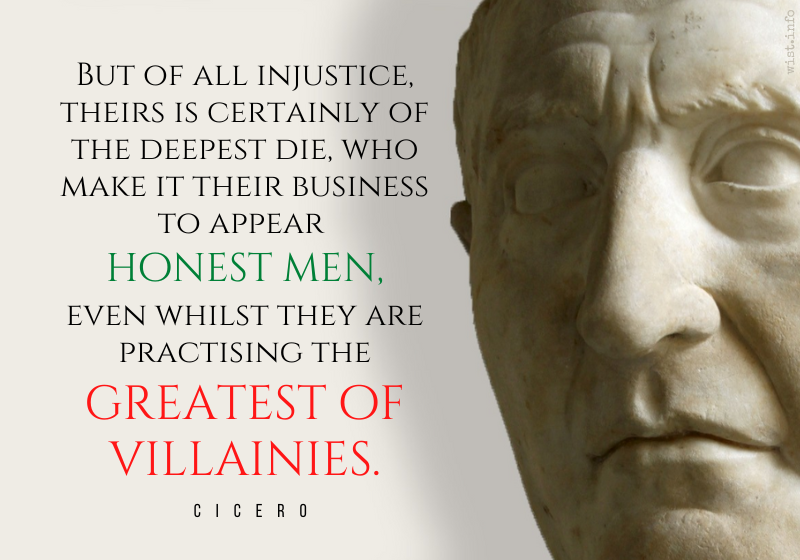
But of all injustice, theirs is certainly of the deepest die, who make it their business to appear honest men, even whilst they are practising the greatest of villainies.
[Totius autem iniustitiae nulla capitalior quam eorum, qui tum, cum maxime fallunt, id agunt, ut viri boni esse videantur.]
Marcus Tullius Cicero (106–43 BC) Roman orator, statesman, philosopher
De Officiis [On Duties; On Moral Duty; The Offices], Book 1, ch. 13 (1.13) / sec. 41 (44 BC) [tr. Cockman (1699)]
(Source)
(Source (Latin)). Other translations:No act of injustice is more pernicious than theirs, who while they are attempting the greatest deceit, labor to appear good men.
[tr. McCartney (1798)]But in the whole system of villainy, none is more capital than that of the men, who, when they most deceive, so manage as that they may seem to be virtuous men.
[tr. Edmonds (1865)]But of all forms of injustice, none is more heinous than that of the men who, while they practise fraud to the utmost of their ability, do it in such a way that they appear to be good men.
[tr. Peabody (1883)]The most criminal injustice is that of the hypocrite who hides an act of treachery under the cloak of virtue.
[tr. Gardiner (1899)]No iniquity is more deadly than that of those who, when they are most at fault, so behave as to seem men of integrity.
[ed. Harbottle (1906)]But of all forms of injustice, none is more flagrant than that of the hypocrite who, at the very moment when he is most false, makes it his business to appear virtuous.
[tr. Miller (1913)]Taking all forms of injustice into account, none is more deadly than that practiced by people who act as if they are good men when they are being most treacherous.
[tr. Edinger (1974)]
We have laws, jails, courts, armies, guns and armories enough to make saints of us all, if they were the true preventives of crime; but we know they do not prevent crime; that wickedness and depravity exist in spite of them, nay, increase as the struggle between classes grows fiercer, wealth greater and more powerful and poverty more gaunt and desperate.
Lucy Parsons (1851–1942) American labor organizer, anarchist, orator [a.k.a. Lucy Gonzalez]
“The Principles of Anarchism,” lecture (1905)
(Source)

PERICLES: Few love to hear the sins they love to act.
William Shakespeare (1564–1616) English dramatist and poet
Pericles, Act 1, sc. 1, l. 95 (1.1.95) (1607) [with George Wilkins]
(Source)

There are crimes I don’t commit mainly because I don’t want to find out I could.
James Richardson (b. 1950) American poet
Vectors: Aphorisms and Ten-Second Essays #124 (2001)
(Source)

To think yourself incapable of crime is one failure of the imagination. To think yourself capable of all crimes is another.
James Richardson (b. 1950) American poet
Vectors: Aphorisms and Ten-Second Essays, #122 (2001)
(Source)
We may then lay down this rule of friendship — neither ask nor consent to do what is wrong. For the plea “for friendship’s sake” is a discreditable one, and not to be admitted for a moment. This rule holds good for all wrong-doing, but more especially in such as involves disloyalty to the republic.
[Haec igitur lex in amicitia sanciatur, ut neque rogemus res turpes nec faciamus rogati. Turpis enim excusatio est et minime accipienda cum in ceteris peccatis, tum si quis contra rem publicam se amici causa fecisse fateatur.]
Marcus Tullius Cicero (106–43 BC) Roman orator, statesman, philosopher
Laelius De Amicitia [Laelius on Friendship], ch. 12 / sec. 40 (44 BC) [tr. Shuckburgh (1909)]
(Source)
Original Latin. Other translations:Let this law therefore be established in friendship, viz., that we should neither ask things that are improper, nor grant them when asked; for it is a disgraceful apology, and by no means to be admitted, as well in the case of other offenses, as when any one avows he has acted against the state for the sake of a friend.
[tr. Edmonds (1871)]As to friendship, then, let this law be enacted, that we neither ask of a friend what is wrong, nor do what is wrong at a friend’s request. The plea that it was for a friend’s sake is a base apology, -- one that should never be admitted with regard to other forms of guilt, and certainly not as to crimes against the State.
[tr. Peabody (1887)]Therefore let this law be established in friendship: neither ask dishonourable things, nor do them, if asked. And dishonourable it certainly is, and not to be allowed, for anyone to plead in defence of sins in general and especially of those against the State, that he committed them for the sake of a friend.
[tr. Falconer (1923)]Therefore, let this law be established for friendship: that we should neither ask for foul things nor fulfill requests for them. For this is a foul excuse and ought not be accepted for any crime, but especially not if someone is shown to have placed themselves against the Republic for the sake of a friend.
[Source]
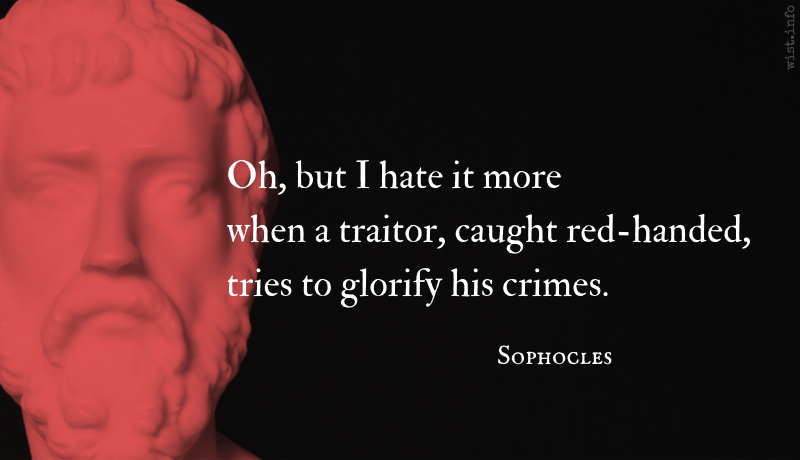
Oh, but I hate it more
when a traitor, caught red-handed,
tries to glorify his crimes.[μισῶ γε μέντοι χὤταν ἐν κακοῖσί τις
ἁλοὺς ἔπειτα τοῦτο καλλύνειν θέλῃ.]
Sophocles (496–406 BC) Greek tragic playwright
Antigone, l. 495ff [Creon] (441 BC) [tr. Fagles (1982), l. 552ff]
(Source)
Original Greek. Other translations:Howbeit, to me it is no less abhorrent,
When, caught in criminality, the culprit
Seeks with fine words to beautify his deed.
[tr. Donaldson (1848)]More hateful still the miscreant who seeks
When caught, to make a virtue of a crime.
[tr. Storr (1859)]But not less hateful
Seems it to me, when one that hath been caught
In wickedness would give it a brave show.
[tr. Campbell (1873)]But, truly, I detest it, too, when one who has been caught in treachery then seeks to make the crime a glory.
[tr. Jebb (1891)]I cannot bear to see the guilty stand
Convicted of their crimes, and yet pretend
To gloss them o'er with specious names of virtue.
[tr. Werner (1892)]But verily this, too, is hateful, -- when one who hath been caught in wickedness then seeks to make the crime a glory.
[tr. Jebb (1917)]But now much worse than this
Is brazen boasting of barefaced anarchy.
[tr. Fitts/Fitzgerald (1939), l. 390ff]The criminal who being caught still tries.
To make a fair excuse , is damned indeed.
[tr. Watling (1947), l. 414ff]I hate it too when someone caught in crime
then wants to make it seem a lovely thing.
[tr. Wyckoff (1954)]But this is worst of all: to be convicted
And then to glorify the name as virtue.
[tr. Kitto (1962)]But how I hate it when she's caught in the act, And the criminal still glories in her crime. [tr. Woodruff (2001)]I hate it when someone, caught in ugliness, afterwards wants to make it look pretty. [tr. Tyrell/Bennett (2002)]And there’s nothing I hate more than when someone is caught committing a crime and tries to hide it by embellishing it with sweet words.
[tr. Theodoridis (2004)]How I despise
a person caught committing evil acts
who then desires to glorify the crime.
[tr. Johnston (2005), l. 562ff]I, for my part, hate anyone caught in the act who tries to beautify his crimes thereupon.
[tr. Thomas (2005)]I hate it when someone is caught in the midst of their evil deeds and tries to gloss over them.
[tr. @sentantiq (2020)]
Where all are guilty, no one is; confessions of collective guilt are the best possible safeguard against the discovery of culprits, and the very magnitude of the crime the best excuse for doing nothing.
Hannah Arendt (1906–1975) German-American philosopher, political theorist
Essay (1969-02-27), “Reflections on Violence,” The New York Review of Books
(Source)
Revised and collected in Crises of the Republic, "On Violence" (1972).

No punishment has ever possessed enough power of deterrence to prevent the commission of crimes. On the contrary, whatever the punishment, once a specific crime has appeared for the first time, its reappearance is more likely than its initial emergence could ever have been.
Hannah Arendt (1906–1975) German-American philosopher, political theorist
Eichmann in Jerusalem: A Report on the Banality of Evil, Epilogue (1963)
(Source)

For the propaganda of totalitarian movements which precede and accompany totalitarian regimes is invariably as frank as it is mendacious, and would-be totalitarian rulers usually start their careers by boasting of their past crimes and carefully outlining their future ones. The Nazis were “convinced that evil-doing in our time has a morbid force of attraction,” Bolshevik assurances inside and outside Russia that they do not recognize ordinary moral standards have become a mainstay of Communist propaganda, and experience has proven time and again that the propaganda value of evil deeds and general contempt for moral standards is independent of mere self-interest, supposedly the most powerful psychological factor in politics.
Hannah Arendt (1906–1975) German-American philosopher, political theorist
Origins of Totalitarianism, Part 3, ch. 10 “A Classless Society,” sec. 1 (1951)
(Source)
Oh dear, I’m feeling political today. It’s just that it’s dawned on me that “zero tolerance” only seems to mean putting extra police in poor, run-down areas, and not in the Stock Exchange.
Satchelmouth was by no means averse to the finger-foxtrot and the skull fandango, but he’d never murdered anyone, at least on purpose. Satchelmouth had been made aware that he had a soul and, though it had a few holes in it and was a little ragged around the edges, he cherished the hope that some day the god Reg would find him a place in a celestial combo. You didn’t get the best gigs if you were a murderer. You probably had to play the viola.
Terry Pratchett (1948–2015) English author
Discworld No. 16, Soul Music (1994)
Things seem to tend downward, to justify despondency, to promote rogues, to defeat the just; and by knaves as well as by martyrs the just cause is carried forward. Although knaves win in every political struggle, although society seems to be delivered over from the hands of one set of criminals into the hands of another set of criminals, as fast as the government is changed, and the march of civilization is a train of felonies, yet, general ends are somehow answered.
Ralph Waldo Emerson (1803–1882) American essayist, lecturer, poet
“Montaigne; or, The Skeptic,” Representative Men, Lecture 4 (1850)
(Source)
Be it observed, that the most superstitious times have always been those of the most horrible crimes.
Voltaire (1694–1778) French writer [pseud. of Francois-Marie Arouet]
“Superstition,” sec. 4, Philosophical Dictionary (1764) [tr. Besterman (1971)]
(Source)


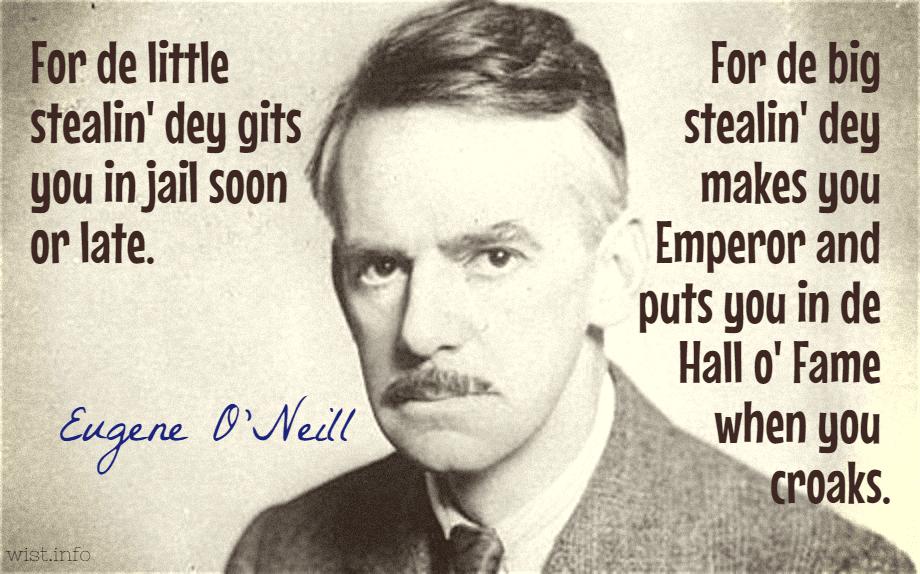
JONES: For de little stealin’ dey gits you in jail soon or late. For de big stealin’ dey makes you Emperor and puts you in de Hall o’ Fame when you croaks.
Eugene O'Neill (1888–1953) Irish American playwright, Nobel laureate
The Emperor Jones, Act 1 (1921)
(Source)
See Chuang Tzu.
Money dishonestly acquired is never worth its cost, while a good conscience never costs as much as it is worth.
Jean-Antoine Petit-Senn (1792–1870) French-Swiss poet
Maxims and Ethical Sentences
I am convinced that every boy, in his heart, would rather steal second base than an automobile.
Tom C. Clark (1899–1977) American lawyer, jurist; US Supreme Court Justice (1949–67)
(Attributed)
Speaking of recreational programs to reduce juvenile delinquency. Quoted in Reader's Digest, Vol. 60 (1952). Restated as "I still believe that any boy would rather steal second base than an automobile" in Washington World, Vol. 3 (1963).

AGAMEMNON:For it touches all,
Cities and men alike, that deeds of ill
Find evil ends, and virtue prosper still.[ἈΓΑΜΈΜΝΩΝ:πᾶσι γὰρ κοινὸν τόδε,
ἰδίᾳ θ᾽ ἑκάστῳ καὶ πόλει, τὸν μὲν κακὸν
κακόν τι πάσχειν, τὸν δὲ χρηστὸν εὐτυχεῖν.]Euripides (485?-406? BC) Greek tragic dramatist
Hecuba [Hekabe; Ἑκάβη], l. 900ff (c. 424 BC) [tr. Sheppard (1924)]
(Source)
(Source (Greek)). Other translations:For 'tis the common interest of mankind.
Of every individual, every state.
That he who hath transgress'd should suffer ill.
And Fortune crown the efforts of the virtuous.
[tr. Wodhull (1809)]For this is a general principle among all, both individuals in private and states,
That the wicked man should feel vengeance, but the good man enjoy prosperity.
[tr. Edwards (1826)]For the general good
Of individuals and of states requires
That vengeance overtake th’ unrighteous deed,
And virtue triumph in her just reward.
[ed. Ramage (1864)]For all men's weal is this, --
Each several man's, and for the state, -- that ill
Betide the bad, prosperity the good.
[tr. Way (Loeb) (1894)]For this is the interest alike of citizen and state, that the wrong-doer be punished and the good man prosper.
[tr. Coleridge (1938)]The common interests
of states and individuals alike demand
that good and evil receive their just rewards.
[tr. Arrowsmith (1958)]Every man -- every slave -- shares one wish. May we each get what we deserve.
[tr. McGuinness (2004)]I think the wish is common among men, as individuals and citizens, that bad men should suffer and good men thrive.
[tr. Harrison (2005)]It is everyone’s conviction, individually and collectively as a city, that the evil man suffers and the good man rejoices.
[tr. Theodoridis (2007)]It’s in the interests of both
states and individuals that evil suffers evil
and good fares well.
[tr. Karden/Street (2011)]
When evil-doing comes like falling rain, nobody calls out “stop!”
When crimes begin to pile up they become invisible.
When sufferings become unendurable the cries are no longer heard.
The cries, too, fall like rain in summer.Bertolt Brecht (1898–1956) German poet, playwright, director, dramaturgist
“When evil-doing comes like falling rain [Wenn die Untat kommt, wie der Regen fällt]” (1935) [tr. Willett]
No man was ever more than about nine meals away from crime or suicide.
Eric Sevareid (1912–1992) American journalist [Arnold Eric Sevareid]
“A New Kind of Leadership,” speech, Conference on Vision Care, Washington, DC (26 Apr 1974)
For more discussion of this and other closely parallel quotations, see: There Are Only Nine Meals Between Mankind and Anarchy – Quote Investigator.

I hear much of People’s calling out to punish the Guilty, but very few are concern’d to clear the Innocent.
Daniel Defoe (1660?-1731) English journalist and novelist
An Appeal to Honour and Justice, Tho’ it be of His Worse Enemies (1715)
There is no such thing as success in a bad business.
Elbert Hubbard (1856–1915) American writer, businessman, philosopher
The Note Book of Elbert Hubbard (1927) [ed. Elbert Hubbard II]
They had Gebert down there, slapping him around and squealing and yelling at him. If you’re so sure violence is inferior technique, you should have seen that exhibition; it was wonderful. They say it works sometimes, but even if it does, how could you depend on anything you got that way? Not to mention that after you had done it a few times any decent garbage can would be ashamed to have you found in it.
Rex Stout (1886–1975) American writer
The Red Box, ch. 14 [Archie] (1937)
Describing a police interrogation.

Remember that those of us who are both civilized and prudent commit our murders only under the complicated rules which permit us to avoid personal responsibility.
Rex Stout (1886–1975) American writer
Fer-de-Lance, Nero Wolfe, chapter 16 (1934)
All Crimes are safe, but hated Poverty.
This, only this, the rigid Law pursues.Samuel Johnson (1709–1784) English writer, lexicographer, critic
Poem (1738), “London: A Poem,” ll. 159-160
(Source)
We are to look upon it as more beneficial, that many guilty persons should escape unpunished, than one innocent person should suffer. The reason is, because it’s of more importance to community, that innocence should be protected, than it is, that guilt should be punished; for guilt and crimes are so frequent in the world, that all of them cannot be punished; and many times they happen in such a manner, that it is not of much consequence to the public, whether they are punished or not.
But when innocence itself, is brought to the bar and condemned, especially to die, the subject will exclaim, it is immaterial to me, whether I behave well or ill; for virtue itself, is no security. And if such a sentiment as this, should take place in the mind of the subject, there would be an end to all security what so ever.John Adams (1735–1826) American lawyer, Founder, statesman; US President (1797–1801)
Speech (1770-12-03/04), Argument for the Defense, Boston Massacre Trial
(Source)
This is frequently (in social media) paraphrased down to:It is more important that innocence be protected than it is that guilt be punished, for guilt and crimes are so frequent in this world that they cannot all be punished. But if innocence itself is brought to the bar and condemned, perhaps to die, then the citizen will say, “whether I do good or whether I do evil is immaterial, for innocence itself is no protection,” and if such an idea as that were to take hold in the mind of the citizen that would be the end of security whatsoever.
Adams volunteered to represent the British against murder charges, even though it was a very unpopular thing to do.
More info here: Quote Files: John Adams on Innocence, Guilt, and Punishment – The Skeptical Libertarian.
My wife should be as much free from suspicion of a crime as she is from a crime itself.
[Meos tam suspicione quam crimine iudico carere oportere.]
Julius Caesar (100–44 BC) Roman general and statesman [Gaius Julius Caesar]
In Suetonius, Life of Caesar
Popularly, "Caesar’s wife must be above reproach" or "beyond reproach."
Caesar was called to be a witness against Clodius, who was charge with having defiled sacred rites and having an affair with Pompeia, Caesar's wife. Caesar said he had investigated and found out nothing to prove the Pompeia's fidelity. When asked why, then, he had divorced her, he gave this answer.
Other translations: "I judge it necessary for my kin to be as free from suspicion as from the charge of wrongdoing."
Other translations: "I wished my wife to be not so much as suspected." [in Plutarch, “Caesar,” Parallel Lives [tr. Dryden (1693)]].
When hope is taken away from the people, moral degeneration follows swiftly after. Young colored men and women today are giving up hope of justice or security In their own country.
Pearl S. Buck (1892–1973) American writer
Letter to the Editor, The New York Times (1941-11-22)
(Source)
Responding to a Times editorial (1941-11-12) regarding rising crime in Harlem, which she blamed on systemic racism in the US.

Treat bad men exactly as if they were insane. They are in-sane, out of health, morally. Reason, which is food to sound minds, is not tolerated, still less assimilated, unless administered with the greatest caution; perhaps, not at all. Avoid collision with them, so far as you honorably can; keep your temper, if you can, — for one angry man is as good as another; restrain them from violence, promptly, completely, and with the least possible injury, just as in the case of maniacs, — and when you have got rid of them, or got them tied hand and foot so that they can do no mischief, sit down and contemplate them charitably, remembering that nine tenths of their perversity comes from outside influences, drunken ancestors, abuse in childhood, bad company, from which you have happily been preserved, and for some of which you, as a member of society, may be fractionally responsible.
Oliver Wendell Holmes, Sr. (1809–1894) American poet, essayist, scholar
Article (1860-08), “The Professor’s Story [Elsie Venner],” ch. 16 [The Professor], Atlantic Monthly, Vol. 6, No. 34
(Source)
Originally serialized as “The Professor’s Story,” but collected as the novel Elsie Venner, ch. 16 (1861).

There is all the difference in the world between the criminal’s avoiding the public eye and the civil disobedient’s taking the law into his own hands in open defiance. This distinction between an open violation of the law, performed in public, and a clandestine one is so glaringly obvious that it can be neglected only by prejudice or ill will.
Hannah Arendt (1906–1975) German-American philosopher, political theorist
Essay (1970-09-12), “Civil Disobedience,” The New Yorker
(Source)
Revised and collected in Crises of the Republic (1972).
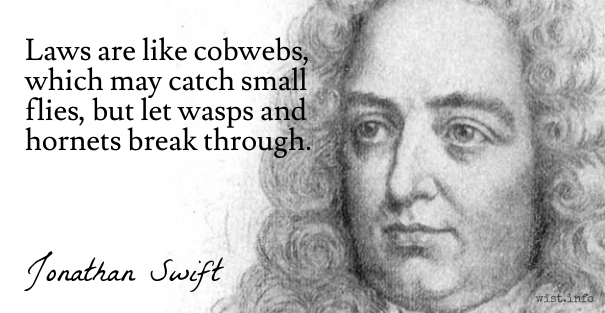

For it is in the person’s choice that wickedness and the commission of injustice are found.
[ἐν γὰρ τῇ προαιρέσει ἡ μοχθηρία καὶ τὸ ἀδικεῖν]
Aristotle (384–322 BC) Greek philosopher
Rhetoric [Ῥητορική; Ars Rhetorica], Book 1, ch. 13, sec. 10 (1.13.10) / 1374a.11 (350 BC) [tr. Bartlett (2019)]
(Source)
Often given as "The intention makes the crime." (Source (Greek)). Other translations:For the criminality and injustice of the act stands essentially in the deliberate principle on which it is done.
[tr. Buckley (1850)]For vice and wrong-doing depend on the moral purpose.
[tr. Jebb (1873)]It is deliberate purpose that constitutes wickedness and criminal guilt.
[tr. Roberts (1924)]For vice and wrongdoing consist in the moral purpose.
[tr. Freese (1926)]For the immorality and wrongness of an act depend on intentional choice.
[tr. Waterfield (2018)]
How many crimes committed merely because their authors could not endure being wrong?
Albert Camus (1913–1960) Algerian-French novelist, essayist, playwright
The Fall [La Chute] (1956) [tr. O’Brien]
(Source)

Corruption is like a ball of snow, when once set a rolling it must increase. It gives momentum to the activity of the knave, but it chills the honest man, and makes him almost weary of his calling: and all that corruption attracts, it also retains, for it is easier not to fall, than only to fall once, and not to yield a single inch than having yielded to regain it.
Charles Caleb "C. C." Colton (1780–1832) English cleric, writer, aphorist
Lacon: Or, Many Things in Few Words, Vol. 2, § 6 (1822)
(Source)

Once again prosperous and successful crime goes by the name of virtue; good men obey the bad, might is right and fear oppresses law.
Seneca the Younger (c. 4 BC-AD 65) Roman statesman, philosopher, playwright [Lucius Annaeus Seneca]
Hercules Furens, Part 1, l.255 [Amphitryon] [tr. Miller (1917)]
(Source)
Other translations: "Successful and fortunate crime is called virtue."
Books that cannot bear examination, certainly ought not to be established as divine inspiration by penal laws.
John Adams (1735–1826) American lawyer, Founder, statesman; US President (1797–1801)
Letter (1825-01-23) to Thomas Jefferson
(Source)
Complaining about laws, even in America, that punish people for "blasphemy" in doubting elements of the Bible.
The prestige of government has undoubtedly been lowered considerably by the prohibition law. For nothing is more destructive of respect for the government and the law of the land than passing laws which cannot be enforced. It is an open secret that the dangerous increase of crime in the United States is closely connected with this.
Albert Einstein (1879–1955) German-American physicist
“My First Impression of the U.S.A.” (1921)
(Source)
Later published as "Some Notes on my American Impressions" in The World As I See It (1949)

To punish a man because he has committed a crime, or because he is believed, though unjustly, to have committed a crime, is not persecution. To punish a man, because we infer from the nature of some doctrine which he holds, or from the conduct of other persons who hold the same doctrines with him, that he will commit a crime, is persecution, and is, in every case, foolish and wicked.
Thomas Babington Macaulay (1800–1859) English writer and politician
“Hallam’s Constitutional History,” Edinburgh Review (Sep 1828)
(Source)
Review of Henry Hallam, The Constitutional History of England, from the Accession of Henry VII to George II (1827).
I am against using death as a punishment. I am also against using it as a reward.
Stanislaw Lec (1909–1966) Polish aphorist, poet, satirist
Unkempt Thoughts [Myśli nieuczesane] (1957) [tr. Gałązka (1962)]

The great atrocities of our civilization have rarely been the acts of generals or presidents or kings. They have been the doings of petty bureaucrats acting within the strict confines of the law.
(Other Authors and Sources)
Alain Simon
There is no man so good that if he placed all his actions and thoughts under the scrutiny of the laws, he would not deserve hanging ten times in his life.
[Il n’est si homme de bien, qu’il mette à l’examen des loix toutes ses actions et pensées, qui ne soit pendable dix fois en sa vie.]
Michel de Montaigne (1533–1592) French essayist
Essays, Book 3, ch. 9 (3.9), “Of Vanity [De la vanité]” (1587) [tr. Frame (1943)]
(Source)
First appeared in the 1588 edition.
(Source (French)). Other translations:No man is so exquisitely honest or upright in living, but brings all his actions and thoughts within compasse and danger of the lawes; and that tenne times in his life might not lawfully be hanged.
[tr. Florio (1603)]There is no so good Man, that so squares all his Thoughts and Actions to the Laws, that he is not Faulty enough to deserve Hanging ten Times in his Life.
[tr. Cotton (1686)]There is no so good man, who so squares all his thoughts and actions to the laws, that he is not faulty enough to deserve hanging ten times in his life.
[tr. Cotton/Hazlitt (1877)]There does not exist a man of such worth that, were he to lay open to the scrutiny of the laws all his actions and thoughts, he would not deserve hanging ten times in his life.
[tr. Ives (1925)]No man is so moral but that, if he submitted his deeds and thoughts to cross-examination by the laws, he would be found worthy of hanging on ten occasions in his lifetime.
[tr. Screech (1987)]

Men don’t so much blush for their Crimes, as for their Weaknesses and Vanity.
[Les hommes rougissent moins de leurs crimes que de leurs faiblesses et de leur vanité.]
Jean de La Bruyère (1645–1696) French essayist, moralist
The Characters [Les Caractères], ch. 4 “Of the Heart [Du Coeur],” § 74 (4.74) (1688) [Bullord ed. (1696)]
(Source)
(Source (French)). Other translations:Men blush not so much for their Crimes, as for their Weaknesses and Vanity.
[Curll ed. (1713)]Men don't so much blush for their Crimes, as for their Weaknesses and Vanity.
[Browne ed. (1752)]Men are less ashamed of their crimes than of their weaknesses and their vanity.
[tr. Van Laun (1885)]Men are less ashamed of their crimes than of their failings and of what touches their vanity.
[tr. Stewart (1970)]