I never knu a man to brag ov hiz munny, or hiz pedigree, who had enny thing else worth bragging about.
[I never knew a man to brag of his money, or his pedigree, who had anything else worth bragging about.]
Josh Billings (1818–1885) American humorist, aphorist [pseud. of Henry Wheeler Shaw]
Josh Billings’ Farmer’s Allminax, 1877-10 (1877 ed.)
(Source)
Quotations about:
worth
Note not all quotations have been tagged, so Search may find additional quotes on this topic.

The book, the statue, the sonata, must be gone upon with the unreasoning good faith and the unflagging spirit of children at their play. Is it worth doing? — when it shall have occurred to any artist to ask himself that question, it is implicitly answered in the negative. It does not occur to the child as he plays at being a pirate on the dining-room sofa, nor to the hunter as he pursues his quarry; and the candour of the one and the ardour of the other should be united in the bosom of the artist.
The pleasure we derive from doing favors is partly in the feeling it gives us that we are not altogether worthless. It is a pleasant surprise to ourselves.
Eric Hoffer (1902–1983) American writer, philosopher, longshoreman
Passionate State of Mind, Aphorism 113 (1955)
(Source)
A man’s worth and reputation lie in the mind and in the will: his true honour is found there. Bravery does not consist in firm arms and legs but in firm minds and souls: it is not a matter of what our horse or our weapons are worth but of what we are.
[L’estimation & le prix d’un homme consiste au cœur & en la volonté: c’est là ou gist son vray honneur: la vaillance c’est la fermeté, non pas des jambes & des bras, mais du courage & de l’ame: elle ne consiste pas en la valeur de nostre cheval, ny de nos armes, mais en la nostre.]
Michel de Montaigne (1533–1592) French essayist
Essays, Book 1, ch. 30 (1.30), “Of Cannibals [Des Cannibales]” (1578) [tr. Screech (1987), 1.31]
(Source)
Some translators use the 1588 sequence of chapters, not the 1595, and so identify this as ch. 31.
(Source (French)). Alternate translations:The reputation and worth of a man consisteth in his heart and will: therein consists true honour: Constancie is valour, not of armes and legs, but of minde and courage: it consisteth not in the spirit and courage of our horse, nor of our armes, but in ours.
[tr. Florio (1603)]The estimate and value of a man consist in the heart and in the will: there his true honour lies. Valour is stability, not of legs and arms, but of the courage and the soul; it does not lie in the goodness of our horse or our arms but in our own.
[tr. Cotton (1686)]The estimation and value of a man consist in the heart and the will; and therein lies his true honour. Valour is the stability, not of legs and arms, but of courage and the mind; it does not consist in the goodness of our horse, or our armour, but in ourselves.
[tr. Friswell (1868)]The estimate and value of a man consist in the heart and in the will: there his true honor lies. Valor is stability, not of legs and arms, but of the courage and the soul; it does not lie in the goodness of our horse or our arms: but in our own.
[tr. Cotton/Hazlitt (1877)]A man's estimation and value depend on his heart and his will; that is where his true honour lives; valour is strength, not of arms and legs, but of the mind and the soul; it does not depend upon the worth of our horse or of our armour, but upon our own.
[tr. Ives (1925), 1.31]The worth and value of a man is in his heart and his will; there lies his real honor. Valor is the strength, not of legs and arms, but of heart and soul; it consists not in the worth of our horse or our weapons, but in our own.
[tr. Frame (1943), 1.31]A man’s value and reputation depend on his heart and his resolution; there his true honour lies. Valour is strength, not of leg or arm, but of the heart and soul; it lies not in the goodness of our horse or our weapons, but in our own.
[tr. Cohen (1958), 1.31]A man's value and worth are to be found in his heart and will: that is where his true honor lies. Valor is strength not of legs and arms but of heart and mind; it is not a matter of our horse's or our weapons' value, but of our own.
[tr. Atkinson/Sices (2012)]

But there’s a class of persons, led astray
By false desires, and this is what they say:
“You cannot have enough: what you possess,
That makes your value, be it more or less.”
What answer would you make to such as these?
Why, let them hug their misery if they please.[At bona pars hominum decepta cupidine falso
‘nil satis est’, inquit, ‘quia tanti quantum habeas sis’:
quid facias illi? iubeas miserum esse, libenter
quatenus id facit.]Horace (65–8 BC) Roman poet, satirist, soldier, politician [Quintus Horatius Flaccus]
Satires [Saturae, Sermones], Book 1, # 1 “Qui fit, Mæcenas,” l. 61ff (1.1.61-64) (35 BC) [tr. Conington (1874)]
(Source)
(Source (Latin)). Alternate translations:But out (alas) the greater parte with sweete empoysned bate
Of welthe bewitchde, do weene their wants aboundance in eache state.
For monye maks, and mars (say they) and coyne it keepes the coyle,
It byndes the beare, it rules the roste, it putts all things to foyle.
A mann's his money, and no more, wherin confused is
An heaven of happs, a worlde of weeles, an hunnye hath of blisse.
O dottrells dome, and is it so? what guardon for these doultes
Shall we devyse? lets suffer still the foolishe frantycke foultes
To wallowe in their wilfulnes, whose under eating myndes
Is never cramde, but prooles for more and swarves not from their kyndes.
[tr. Drant (1567)]But most of men deceiv'd by false desire,
Say, Noughts enough; 'cause they absurdly guess
At what men are, by what they do possess.
To such a Miser what is't best to do?
Let him be wretched, since he will be so.
[tr. A. B.; ed. Brome (1666)]But most are lost in a Confounded Cheat,
They would have more, for when their Wealth is great
They think their Worth as much as their Estate:
Well then, what must we do to such a one?
Why, let him, 'tis his Will to be undone.
[tr. Creech (1684)]Some, self-deceiv'd, who think their lust of gold
Is but a love of fame, this maxim hold,
No Fortune's large enough, since others rate
Your worth proportion'd to a large estate.
Say, for their cure what arts would you employ?
"Let them be wretched, and their choice enjoy."
[tr. Francis (1747)]Yet thousands, duped by avarice in disguise,
Intrench themselves in maxims sage and wise.
Go on, say they, and hoard up all you can;
For wealth is worth, and money makes the man!
What shall we say to such? Since 'tis their will
Still to be wretched, let them be so still!
[tr. Howes (1845)]But a great majority of mankind, misled by a wrong desire, cry, “No sum is enough; because you are esteemed in proportion to what you possess.” What can one do to such a tribe as this? Why, bid them be wretched, since their inclination prompts them to it.
[tr. Smart/Buckley (1853)]But some one argues: -- many men, misled by wrong desire of fame, say no sum is enough, because we all are rated by the money we possess. What would you do with them? Why, bid them live a wretched life, since they act thus of their free will.
[tr. Millington (1870)]But a good many people, misled by blind desire, say, "You cannot have enough: for you get your rating from what you have." What can you do to a man who talks thus? Bid him be miserable, since that is his whim.
[tr. Fairclough (Loeb) (1926)]Mankind for the most part, fooled by its own false desires,
Says, “There’s no such thing as enough. You are worth
Only as much as you have.” And what can you do
With a person like this? Oh, well! Wish him hell and farewell,
Since he's headed that way by choice.
[tr. Palmer Bovie (1959)]Still, since false desires fool a large portion of mankind,
they'll tell you, *Nothing's enough. What we own, we are."
What can you say? Say, "Be miserable," for that's the choice
they freely made.
[tr. Fuchs (1977)]Too many men, bewitched by false desire, insist that
"Nothing is enough: people value you by what you own."
What can I say? Let him be miserable, that's how
He wants it!
[tr. Raffel (1983)]And yet a good part of humankind is deceived
by false cupidity. “Nothing is enough,”
they say. “For you are esteemed for as much as you
possess.” What can you do with one of these fools?
Leave him to his misery. It’s all of his
own doing anyway.
[tr. Alexander (1999)]But most people
want all that they desire, and so say, “There’s no such
thing as too much: you are what you acquire.”
You can always tell such a man but you
can’t tell him much. Tell him to suffer, since
that’s his choice.
[tr. Matthews (2002)]People are enticed by a desire which continually cheats them.
"Nothing is enough," they say, "for you’re only worth what you have."
What can you do with a man like that? You might as well tell him
to be miserable, since misery is what he enjoys.
[tr. Rudd (2005 ed.)]Still, a good many people misled by foolish desire
Say: ‘There’s never enough, you’re only what you own.’
What can one say to that? Let such people be wretched,
Since that’s what they wish.
[tr. Kline (2015)]
How rich a man is all desire to know;
But none inquires if good he be or no.
FRIAR: For it so falls out
That what we have we prize not to the worth,
Whiles we enjoy it, but being lacked and lost,
Why then we rack the value, then we find
The virtue that possession would not show us
Whiles it was ours.William Shakespeare (1564–1616) English dramatist and poet
Much Ado About Nothing, Act 4, sc. 1, l. 228ff (4.1.228-233) (1598)
(Source)

There have been as great Souls unknown to fame as any of the most famous.
Benjamin Franklin (1706–1790) American statesman, scientist, philosopher, aphorist
Poor Richard (1734 ed.)
(Source)
ALBANY: You are not worth the dust which the rude wind
Blows in your face.William Shakespeare (1564–1616) English dramatist and poet
King Lear, Act 4, sc. 2, l. 39ff (4.2.39-40) (1606)
(Source)
Speaking to Goderil.
Modesty is to merit as shadows are to the figure in a painting: it strengthens it and sets it off.
[La modestie est au mérite ce que les ombres sont aux figures dans un tableau: elle lui donne de la force et du relief.]Jean de La Bruyère (1645–1696) French essayist, moralist
The Characters [Les Caractères], ch. 2 “Of Personal Merit [Du Mérite Personnel],” § 17 (2.17) (1688) [tr. Stewart (1970)]
(Source)
(Source (French)). Other translations:Modesty is to Merit, what Shades are to the Figures in a Picture; it gives it Strength and Heightening.
[Curll ed. (1713)]Modesty is to Merit as Shades to Figures in a Picture; giving it Strength and Beauty.
[Browne ed. (1752)]Modesty is to merit what shade is to figures in a picture; it gives it strength and makes it stand out.
[tr. Van Laun (1885)]
Where bread is wanting, all’s to be sold.
Benjamin Franklin (1706–1790) American statesman, scientist, philosopher, aphorist
Poor Richard (1733 ed.)
(Source)
The second time I ever saw you I learned what I had read in books but I had never actually believed: that love and suffering are the same thing and that the sum of love is what you have to pay for it and any time you get it cheap you have cheated yourself.
William Faulkner (1897–1962) American novelist
The Wild Palms [If I Forget Thee, Jerusalem], ch. 3 [Charlotte] (1939)
(Source)
Don’t worry about not being recognized by others; worry about not having any reason for them to recognize you.
[不患人之不己知、患其不能也]
Confucius (c. 551- c. 479 BC) Chinese philosopher, sage, politician [孔夫子 (Kǒng Fūzǐ, K'ung Fu-tzu, K'ung Fu Tse), 孔子 (Kǒngzǐ, Chungni), 孔丘 (Kǒng Qiū, K'ung Ch'iu)]
The Analects [論語, 论语, Lúnyǔ], Book 14, verse 30 (14.30) (6th C. BC – AD 3rd C.) [tr. Ames/Rosemont (1998)]
(Source)
(Source (Chinese)). Originally numbered by Legge as 14.32, but identified in modern translations as 14.30; the distinction is noted below. See also 1.16, 4.14, 15.19. Other translations:I will not be concerned at men's not knowing me; I will be concerned at my own want of ability.
[tr. Legge (1861), 14.32]My great concern is, not that men do not know me, but that they cannot.
[tr. Jennings (1895), 14.32; Jennings notes the unclear phrase could also mean "but that here is want of ability (in me to know them)."]Be not concerned that men do not know you =; be concerned that you have no ability.
[tr. Ku Hung-Ming (1898), 14.32](A wise man) is not distressed that people do not know him, he is distressed at his own lack of ability.
[tr. Soothill (1910), 14.32]Not worried that others don't know me, worried by my incapacities.
[tr. Pound (1933), 14.32](A gentleman) does not grieve that people do not recognize his merits; he grieves at his own incapacities.
[tr. Waley (1938), 14.32]Be not concerned over men’s not knowing of you; be concerned rather over your inabilities.
[tr. Ware (1950)]It is not the failure of others to appreciate your abilities that should trouble you, but rather your own lack of them.
[tr. Lau (1979), 14.30]One does not worry about the fact that other people do not appreciate one. One worries about the fact that one is incapable.
[tr. Dawson (1993), 14.30]It is not your obscurity that should distress you, but your incompetence.
[tr. Leys (1997), 14.30]Do not worry about men not knowing you; rather, worry about your incapability.
[tr. Huang (1997), 14.30]I do not worry about that others do not understand me, just worry about that i have no talent.
[tr. Cai/Yu (1998), 14.30, #370]He does not worry about others not knowing him; he worries about whether he is capable.
[tr. Brooks/Brooks (1998), 14:30; they consider this a later interpolation, with 4:14 being the actual Confucian saying.]Don't grieve when people fail to recognize your ability. Grieve for your lack of ability instead.
[tr. Hinton (1998), 14.30]Do not worry that you are not recognized by others; worry rather that you yourself lack ability.
[tr. Slingerland (2003), 14.30]Don’t worry about others’ not understanding you. Worry about your own lack of ability.
[tr. Watson (2007), 14.30]Do not worry that other people do not know you. Be concerned about your own lack of ability.
[tr. Chin (2014), 14.30]I am not concerned with not being known by others. I am concerned with my lack of ability.
[tr. Li (2020), 14.30]

Some people think they are worth a lot of money just because they have it.
Fannie Hurst (1889–1968) American novelist
(Attributed)
This is sometimes cited to an unknown issue of the Jewish Telegraphic Agency in 1952, but a search of the site does not turn it up.

Remember that you can’t necessarily sanctify a cause by virtue of the fact that men die for it. A death in a worthless or even questionable cause is a pointless, meaningless, tragically premature death.
Rod Serling (1924–1975) American screenwriter, playwright, television producer, narrator
Commencement Address, Ithaca College, New York (13 May 1972)
(Source)
Oh me! Oh life! of the questions of these recurring,
Of the endless trains of the faithless, of cities fill’d with the foolish,
Of myself forever reproaching myself, (for who more foolish than I, and who more faithless?)
Of eyes that vainly crave the light, of the objects mean, of the struggle ever renew’d,
Of the poor results of all, of the plodding and sordid crowds I see around me,
Of the empty and useless years of the rest, with the rest me intertwined,
The question, O me! so sad, recurring — What good amid these, O me, O life?Answer.
That you are here — that life exists and identity,
That the powerful play goes on, and you may contribute a verse.Walt Whitman (1819–1892) American poet
“O Me! O Life!” Leaves of Grass, Book 20 “By the Roadside” (1867 ed)
(Source)
When a man boasted in his presence that he was a native of an illustrious city, he said, “That is not what one ought to look at, but whether one is worthy of a great city.”
[πρὸς τὸν καυχώμενον ὡς ἀπὸ μεγάλης πόλεως εἴη, “οὐ τοῦτο,” ἔφη, “δεῖ σκοπεῖν, ἀλλ᾽ ὅστις μεγάλης πατρίδος ἄξιός ἐστιν.”]
Aristotle (384–322 BC) Greek philosopher
Attributed in Diogenes Laërtius, Lives and Opinions of Eminent Philosophers [Vitae Philosophorum], Book 5, sec. 11 [tr. Yonge (1853)]
(Source)
(Source (Greek)). Other translations:To one who boasted that he belonged to a great city his reply was, "That is not the point to consider, but who it is that is worthy of a great country."
[tr. Hicks (1925), sec. 19]To a man boasting that he was from a great city, he said “Don’t look at this, but instead who is worthy of a great country.”
[tr. @sentantiq (2016)]To someone who boasted that he came from a great city, he said, "That is not what one should consider, but who it is that is worthy of a great country."
[tr. Mensch (2018)]
The man is nothing, the work all!
[L’homme n’est rien, l’oeuvre tout!]
Gustave Flaubert (1821–1880) French writer, novelist
Letter to George Sand (Dec 1875)
Original French. Arthur Conan Doyle misquoted this in "The Red-Headed League" as "L'homme c'est rien -- l'oeuvre c'est tout."
For my part, I prefer a man without money to money without a man.
[Ego vero, malo virum, qui pecunia egeat, quam pecuniam, quae viro.]
Themistocles (c. 524–459 BC) Athenian politician and general
Quoted in Cicero, De Officiis [On Duties; On Moral Duty; The Offices], Book 2, ch. 20 / sec. 71 (44 BC) [tr. Miller (1913)]
(Source)
Original Latin (of Cicero). When asked whether he would choose for his daughter a poor but honest husband or a wealthy but disreputable one.
Other translations:The comment is also recorded in Plutarch, Parallel Lives, "Themistocles," ch. 18, sec. 5 [tr. Dryden (1653), rev. Clough (1859)]:
- "I had rather have a man without an estate, than to have an estate without a man." [tr. Cockman (1699)]
- "I would rather have a man without money, than money without a man." [tr. McCartney (1798)]
- "I certainly would rather she married a man without money, than money without a man." [tr. Edmonds (1865)]
- "I, indeed, prefer the man who lacks money to the money that lacks a man." [tr. Peabody (1883)]
Of two who made love to his daughter, he preferred the man of worth to the one who was rich, saying he desired a man without riches, rather than riches without a man.
Original Greek: τῶν δὲ μνωμένων αὐτοῦ τὴν θυγατέρα τὸν ἐπιεικῆ τοῦ πλουσίου προκρίνας ἔφη ζητεῖν ἄνδρα χρημάτων δεόμενον μᾶλλον ἢ χρήματα ἀνδρός.
Other translations:
- "When two men paid their addresses to his daughter, he chose the more agreeable instead of the richer of the two, saying that he preferred a man without money to money without a man." [tr. Stewart/Long (1894)]
- "Of two suitors for his daughter's hand, he chose the likely man in preference to the rich man, saying that he wanted a man without money rather than money without a man." [tr. Perrin (1914)]
There are more important things than money — the only trouble is they all cost money.
(Other Authors and Sources)
Louis A. Safian, The Book of Updated Proverbs, ch. 7 (1967)

Nothing should be made by man’s labour which is not worth making; or which must be made by labour degrading to the makers.
William Morris (1834–1896) British textile designer, writer, socialist activist
Art and Socialism (1884)
(Source)

The animals of the world exist for their own reasons. They were not made for humans any more than black people were made for whites or women for men.
Alice Walker (b. 1944) American writer, activist
Foreword to Marjorie Spiegel, The Dreaded Comparison: Human and Animal Slavery (1988; rev. ed. 1997)

ANTON EGO: In many ways, the work of a critic is easy. We risk very little, yet enjoy a position over those who offer up their work and their selves to our judgment. We thrive on negative criticism, which is fun to write and to read. But the bitter truth we critics must face, is that in the grand scheme of things, the average piece of junk is probably more meaningful than our criticism designating it so.
Brad Bird (b. 1957) American director, animator and screenwriter [Phillip Bradley Bird]
Ratatouille (2007)
As long as our civilization is essentially one of property, of fences, of exclusiveness, it will be mocked by delusions. Our riches will leave us sick; there will be bitterness in our laughter; and our wine will burn our mouth. Only that good profits which we can taste with all doors open, and which serves all men.
Ralph Waldo Emerson (1803–1882) American essayist, lecturer, poet
“Napoleon; or, The Man of the World,” Representative Men, Lecture 6 (1850)
(Source)
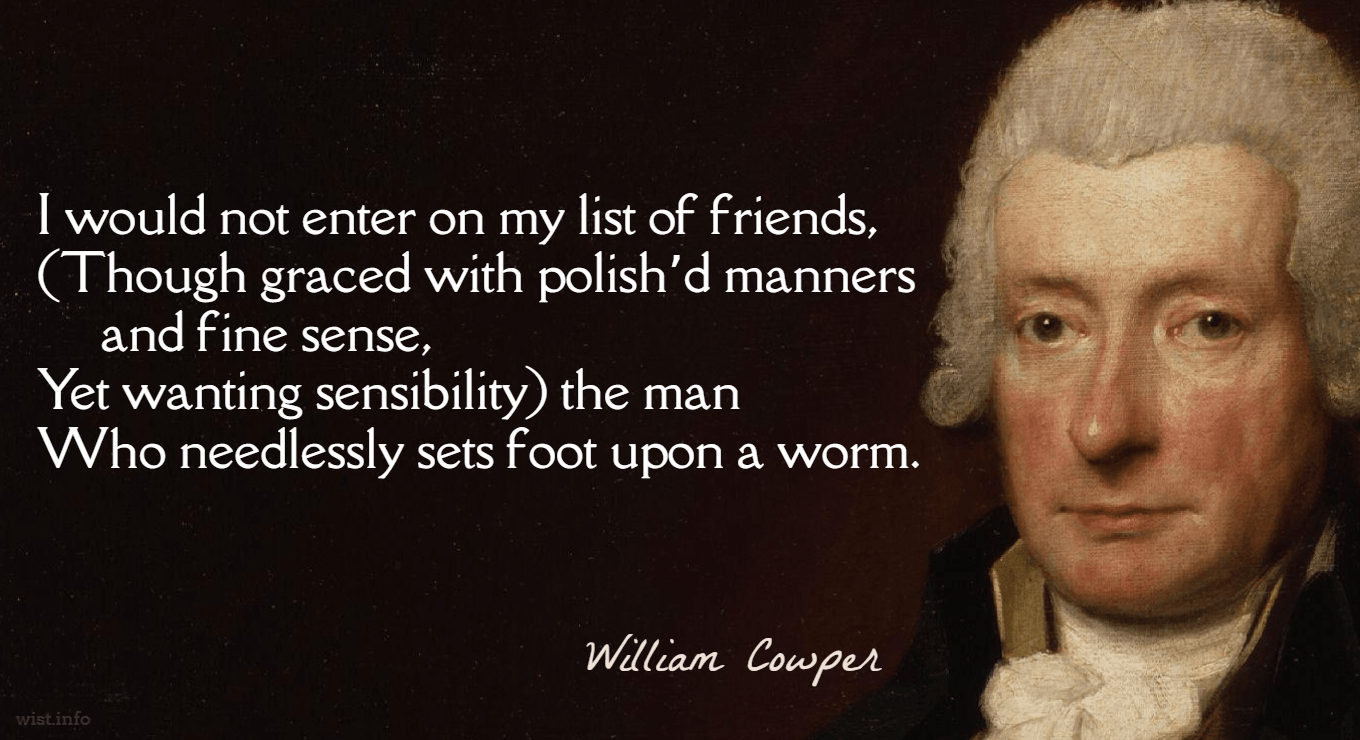
I would not enter on my list of friends,
(Though graced with polish’d manners and fine sense,
Yet wanting sensibility) the man
Who needlessly sets foot upon a worm.
William Cowper (1731–1800) English poet
“Winter Walk at Noon,” l. 560ff, The Task, Book 6 (1785)
(Source)
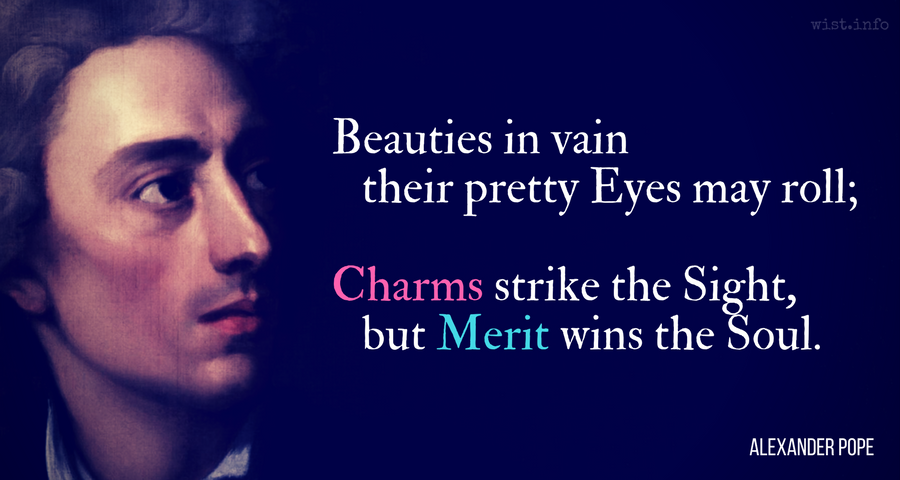
Beauties in vain their pretty Eyes may roll;
Charms strike the Sight, but Merit wins the Soul.
Fools! who fancy Christ mistaken;
Man a tool to buy and sell;
Earth a failure, God-forsaken,
Ante-room of Hell.Charles Kingsley (1819–1875) English clergyman, historian, essayist, novelist (pseud. "Parson Lot")
“The World’s Age” (1849)
(Source)
She ate her trifle, reflecting that grinding poverty, though loathsome while one is in it, has the advantage of making one enjoy money in a way denied to the rich-from-birth.
Kerry Greenwood (b. 1954) Australian author and lawyer
Phryne Fisher, Book 2, Flying Too High, ch. 2 (1990)
(Source)

No labor, however humble, is dishonoring.
The Talmud (AD 200–500) Collection of Jewish rabbinical writings
Babylonian Talmud, Nedarim 49b
Alt. trans.: "Great is labor, for it honors the worker." [tr. Freedman] Alt. trans.: "Labor is great, as it brings honor to the laborer who performs it."

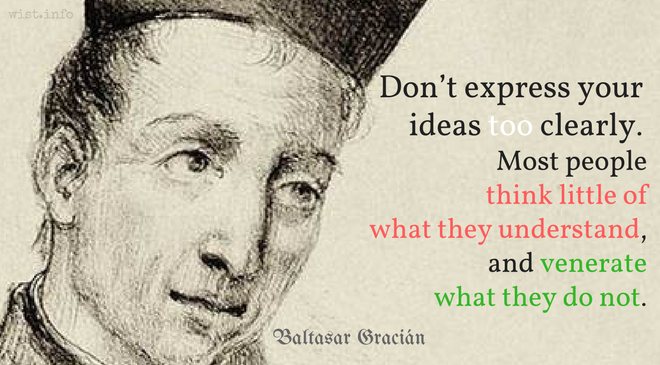
Don’t express your ideas too clearly. Most people think little of what they understand, and venerate what they do not. […] Many praise without being able to say why. They venerate anything hidden or mysterious, and they praise it because they hear it praised.
[No allanarse sobrado en el concepto. Los más no estiman lo que entienden, lo que no perciben lo veneran. […] Alaban muchos lo que, preguntados, no saben dar razón. ¿Por qué? Todo lo recóndito veneran por misterio y lo celebran porque oyen celebrarlo.]
Baltasar Gracián y Morales (1601–1658) Spanish Jesuit priest, writer, philosopher
The Art of Worldly Wisdom [Oráculo Manual y Arte de Prudencia], § 253 (1647) [tr. Maurer (1992)]
(Source)
See also § 3.
(Source (Spanish)). Other translations:Not to be too intelligible. Most part do not esteem what they conceive, but admire what they understand not. [...] Many praise that which they can give no reason for, when it is asked them: because they reverence as a mystery all that is hard to be comprehended, and extoll it, by reason they hear it extolled.
[Flesher ed. (1685)]Do not Explain overmuch. Most men do not esteem what they understand, and venerate what they do not see. [...] Many praise a thing without being able to tell why, if asked. The reason is that they venerate the unknown as a mystery, and praise it because they hear it praised.
[tr. Jacobs (1892)]A Bit Vague. For most men have low regard for what they understand, and venerate only what is beyond them. [...] Many praise, but if asked can give no reason: Why? for they revere all that is hidden because mysterious, and they sing its praises, because they hear its praises being sung.
[tr. Fischer (1937)]

Money dishonestly acquired is never worth its cost, while a good conscience never costs as much as it is worth.
Jean-Antoine Petit-Senn (1792–1870) French-Swiss poet
Maxims and Ethical Sentences
There is more treasure in books than in all the pirates loot on Treasure Island and at the bottom of the Spanish Main … and, best of all, you can enjoy these riches every day
of your life.Walt Disney (1901–1966) American entrepreneur, animator, film producer, showman
(Attributed)
The truest American president we have ever had, the companion of Washington in our love and honor, recognized that the poorest man, however outraged, however ignorant, however despised, however black, was, as a man, his equal. The child of the American people was their most prophetic man, because, whether as small shop-keeper, as flat-boatman, as volunteer captain, as honest lawyer, as defender of the Declaration, as President of the United States, he knew by the profoundest instinct and the widest experience and reflection, that in the most vital faith of this country it is just as honorable for an honest man to curry a horse and black a boot as it is to raise cotton or corn, to sell molasses or cloth, to practice medicine or law, to gamble in stocks or speculate in petroleum. He knew the European doctrine that the king makes the gentleman; but he believed with his whole soul the doctrine, the American doctrine, that worth makes the man.
George William Curtis (1824–1892) American essayist, editor, reformer, orator
“The Good Fight” (1865)
(Source)
PASTORE: Is there anything connected in the hopes of this accelerator that in any way involves the security of this country?
WILSON: No sir; I do not believe so.
PASTORE: Nothing at all?
WILSON: Nothing at all.
PASTORE: It has no value in that respect?
WILSON: It only has to do with the respect with which we regard one another, the dignity of men, our love of culture. It has to do with those things. It has nothing to do with the military, I am sorry.
PASTORE: Don’t be sorry for it.
WILSON: I am not, but I cannot in honesty say it has any such application.
PASTORE: Is there anything here that projects us in a position of being competitive with the Russians, with regard to this race?
WILSON: Only from a long-range point of view, of a developing technology. Otherwise, it has to do with: Are we good painters, good sculptors, great poets? I mean all the things that we really venerate and honor in our country and are patriotic about. In that sense, this new knowledge has all to do with honor and country but it has nothing to do directly with defending our country, except to make it worth defending.
Robert R. Wilson (1914–2000) American physicist
Testimony, Joint Committee on Atomic Energy (17 Apr 1969)Dialog between Senator John Pastore (D-RI) and Wilson regarding the funding for FY 1970 of Fermilab's first particle accelerator. Pastore was actually a proponent of Fermilab, but was seeking arguments to use with some of his colleagues.
The exchange is frequently portrayed as more hostile, and Wilson's answer is often paraphrased / elided as: "It has only to do with the respect with which we regard one another, the dignity of men, our love of culture. It has to do with are we good painters, good sculptors, great poets? I mean all the things we really venerate in our country and are patriotic about. It has nothing to do directly with defending our country except to make it worth defending."
See here for more background.
The worth of a man does not consist in the truth he possesses, or thinks he possesses, but in the pains he has taken to attain that truth. For his powers are extended not through possession but through the search for truth. In this alone his ever-growing perfection consists.
[Nicht die Wahrheit, in deren Besitz irgend ein Mensch ist, oder zu sein vermeint, sondern die aufrichtige Mühe, die er angewandt hat, hinter die Wahrheit zu kommen, macht den Wert des Menschen. Denn nicht den Besitz, sondern durch die Nachforschung der Wahrheit erweitern sich seine Kräfte, worin allein seine immer wachsende Vollkommenheit bestehet.]
Gotthold Lessing (1729–1781) German playwright, philosopher, dramaturg, writer
Eine Duplik, Part 1 (1778) [tr. Chadwick (1957)]
(Source)
This passage (in the Scott Horton translation below) is given as the epigraph to chapter 19 of Christopher Hitchens, God Is Not Great (2007); this prominence gave it a fair amount of fame. It is identified in Hitchens as being from Lessing's Anti-Goeze tracts (1778), though strictly speaking the passage is actually from Eine Duplik (1778), a different writing by Lessing over the same Fragment Dispute of 1777-1778.
(Source (German)). Other translations:It is not the truth that a man possesses, or believes he possesses, but the honest pains he has taken to get at truth, which makes a man's worth; for it is not by the possession of truth, but by the march after it, that his powers are extended, in which alone his perfection consists.
[Source (1884)]The true value of a man is not determined by his possession, supposed or real, of Truth, but rather by his sincere exertion to get to the Truth. It is not possession of the Truth, but rather the pursuit of Truth by which he extends his powers and in which his ever-growing perfectibility is to be found.
[tr. Horton (2007)]
To blame the poor for subsisting on welfare has no justice unless we are also willing to judge every rich member of society by how productive he or she is. Taken individual by individual, it is likely that there’s more idleness and abuse of government favors among the economically privileged than among the ranks of the disadvantaged.
Norman Mailer (1923–2007) American novelist, journalist, playwright, activist
(Attributed)
But more Euryalus finds grace:
So well the tears beseem his face,
And worth appears with brighter shine
When lodged within a lovely shrine.[Tutatur favor Euryalum, lacrimaeque decorae,
gratior et pulchro veniens in corpore virtus.]Virgil (70–19 BC) Roman poet [b. Publius Vergilius Maro; also Vergil]
The Aeneid [Ænē̆is], Book 5, l. 343ff (5.343-344) (29-19 BC) [tr. Conington (1866)]
(Source)
Why the spectators at the Funeral Games race support Eurayalus as winner, despite the shenanigans at the finish line: because he's pretty.
(Source (Latin)). Other translations:Beauty, sweat tears defend Euryalus:
Vertue with beauty joyn'd more gratefull is.
[tr. Ogilby (1649)]But favor for Euryalus appears;
His blooming beauty, with his tender tears,
Had brib'd the judges for the promis'd prize.
[tr. Dryden (1697)]The favor [of the spectators] befriends Euryalus, and his graceful tears, and merit that appears more lovely in a comely person.
[tr. Davidson/Buckley (1854)]But favor smiles
For Euryalus, and his becoming tears;
And worth seems worthier in a lovely form.
[tr. Cranch (1872), l. 407ff]Even virtue is fairer when it appears in a beautiful person.
[ed. Ward/Hoyt (1882)]Euryalus is strong in favour, and beauty in tears, and the merit that gains grace from so fair a form.
[tr. Mackail (1885)]But safe goodwill and goodly tears Euryalus do bear,
And lovelier seemeth valour set in body wrought so fair.
[tr. Morris (1900)]Tears aid Euryalus, and favour pleads
His worth, more winsome in a form so sweet
[tr. Taylor (1907)]But general favor smiles
upon Euryalus, whose beauteous tears
commend him much, and nobler seems the worth
of valor clothed in youthful shape so fair.
[tr. Williams (1910)]Goodwill befriends Euryalus, and his seemly tears and worth, that shows more winsome in a fair form.
[tr. Fairclough (1916)]But all the popular favor
Sides with Euryalus, who is young, and weeping,
And better-looking.
[tr. Humphries (1951)]Popular feeling sided with Euryalus -- there was also
His manly distress, and that worth which is made the more winning by good looks.
[tr. Day-Lewis (1952)]But popularity
protects Euryalus, together with
his graceful tears and worth that please the more
since they appear in such a handsome body.
[tr. Mandelbaum (1971), l. 451ff]The crowd's support and his own quiet tears
Were in Euryalus's favor: prowess
Ever more winning for a handsome form.
[tr. Fitzgerald (1981)]On the side of Euryalus were the favour in which he was held, his beauty as he stood there weeping and the manly spirit growing in that lovely body.
[tr. West (1990)]His popularity protects Euryalus, and fitting tears,
and ability is more pleasing in a beautiful body.
[tr. Kline (2002)]But Euryalus has the people on his side,
plus modest tears and his own gallant ways,
favored all the more for his handsome build.
[tr. Fagles (2006), l. 379ff]Euryalus' popularity and graceful tears protected him and his purity, so lovely in a lovely boy.
[tr. Bartsch (2021)]
Though I’ve belted you an’ flayed you,
By the livin’ Gawd that made you,
You’re a better man than I am, Gunga Din!Rudyard Kipling (1865–1936) English writer
“Gunga Din,” st. 5 (1892)
Morality is not properly the doctrine [of] how we should make ourselves happy, but how we should make ourselves worthy of happiness.
Immanuel Kant (1724–1804) German philosopher
Critique of Practical Reason [Kritik der praktischen Vernunft], 1.2.2.5 (1788) [tr. Abbott (1873)]

This mournful truth is ev’ry where confess’d,
SLOW RISES WORTH, BY POVERTY DEPRESS’D:
But here more slow, where all are slaves to gold,
Where looks are merchandise, and smiles are sold.Samuel Johnson (1709–1784) English writer, lexicographer, critic
Poem (1738), “London: A Poem,” ll. 176-179
(Source)
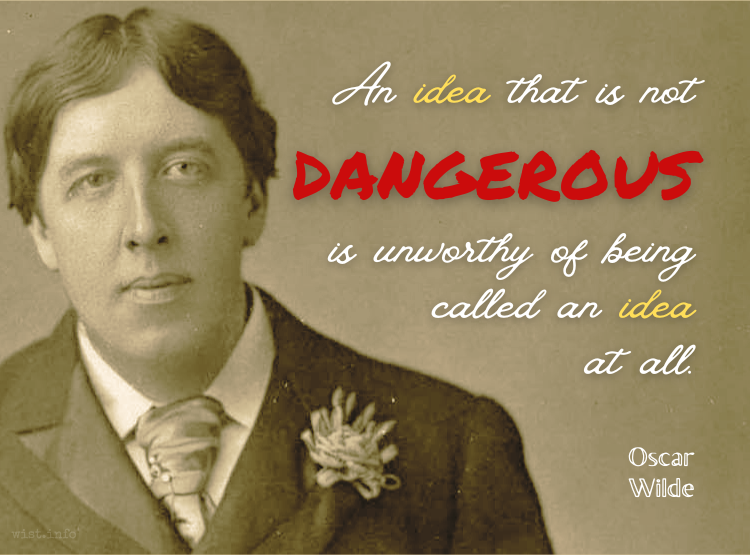
An idea that is not dangerous is unworthy of being called an idea at all.
Oscar Wilde (1854–1900) Irish poet, wit, dramatist
“The Critic as Artist,” Part 2 [Gilbert], Intentions (1891)
(Source)
Whatever you can lose, reckon of no account.
Publilius Syrus (d. 42 BC) Assyrian slave, writer, philosopher [less correctly Publius Syrus]
Sententiae [Moral Sayings], # 191 [tr. Lyman (1862)]
As one digs deeper into the national character of the Americans, one sees that they have sought the value of everything in this world only in the answer to this single question: how much money will it bring in?
[À mesure qu’on creuse plus avant dans le caractère national des Américains, on voit qu’ils n’ont cherché la valeur de toutes les choses de ce monde que dans la réponse à cette seule question : combien cela rapporte-t-il d’argent?]
Alexis de Tocqueville (1805–1859) French writer, diplomat, politician
Letter (1831-06-09) to Ernest de Chabrol [tr. Toupin/Boesche (1985)]
(Source)
(Source (French)). Collected in De Tocqueville, Selected Letters on Politics and Society, Part 1, No. 6 (1985) [ed. Roger Boesche].
Ernest de Chabrol-Chaméane was a childhood friend of De Tocqueville's.
Times of trouble best discover the true worth of a man; they do not weaken him, but show his true nature.
[Quantas autem virtutes quisque fecerit, melius patet occasione adversitatis. Occasiones namque hominem fragilem non faciunt, sed qualis sit, ostendunt.]
Thomas à Kempis (c. 1380–1471) German-Dutch priest, author
The Imitation of Christ [De Imitatione Christi], Book 1, ch. 16, v. 4 (1.16.4) (c. 1418-27) [tr. Sherley-Price (1952)]
(Source)
(Source (Latin)). Other translations:Who is of most virtue appeareth best in time of adversity. Occasions make not a man frail, but they shew openly what he is.
[tr. Whitford/Raynal (1530/1871)]The time of adversity shows who is of most virtue. Occasions do not make a man frail, but they do show openly what he is.
[tr. Whitford/Gardiner (1530/1955)]By occasion of adversity every man knoweth what great vertue is in himselfe, for such occasions make thee not frail, but shew thee what thou art.
[tr. Page (1639), 1.16.14]Besides we shall do well to reflect, that Afflictions and uneasy Accidents are the clearest Indication of a Man's Goodness, and the Degrees of his Improvement. For we mistake extremely in imagining that any thing which happens to us from without, is the real Cause of our doing well or ill; Adversity does not make Virtue or Vice, but exert and draw them into Practice; it does not change the Man from what he was, but only discover what he really is.
[tr. Stanhope (1696; 1706 ed.)]Besides, by outward occasions of suffering from the conduct of others, the nature and degree of every man's inward strength is more plainly discovered; for outward occasions do not make him frail, but only shew him what he is in himself.
[tr. Payne (1803)]Occasions of adversity best discover how great virtue or strength each one hath. For occasions do not make a man frail, but they shew what he is.
[ed. Parker (1841)]Besides, adversity better displays the fortitude and virtues that we possess: for these attacks to not contribute to make us frail, but rather shew us to be what we are.
[tr. Dibdin (1851)]The amount of a man's virtue is best seen in presence of adversity, for its occurrence does not make a man weak, but shows what he is.
[ed. Bagster (1860)]How much strength each man hath is best proved by occasions of adversity: for such occasions do not make a man frail, but show of what temper he is.
[tr. Benham (1874)]Occasions of adversity soonest discover how great virtue or strength each one hath. For occasions do not make a man frail, but they shew what he is.
[tr. Anon. (1901)]For the measure of every man's virtue is best revealed in time of adversity -- adversity that does not weaken a man but rather shows what he is.
[tr. Croft/Bolton (1940)]For the strength that each has will best be seen in the hour of adversity. Because such hours do not make a man weak, but show what kind of man he is.
[tr. Daplyn (1952)]Meanwhile, there is no better test of a man's quality than when he cannot have things his own way. The occasions of sin do not overpower us, they only prove our worth.
[tr. Knox-Oakley (1959)]A man’s true quality is revealed when things are difficult. Events do not make a man weak -- they only show what stuff he is made of.
[tr. Knott (1962)]The strength of one’s virtue is seen more easily when opposition comes. For such opposition does not weaken a man, but shows his mettle.
[tr. Rooney (1979)]For the strength that each person has will best be seen in times of trouble. Such times do not make us weak; they show what we are.
[tr. Creasy (1989)]

Everything is worth what its purchaser will pay for it.
Publilius Syrus (d. 42 BC) Assyrian slave, writer, philosopher [less correctly Publius Syrus]
Sententiae [Moral Sayings], # 847
The wise lover does not consider so much the lover’s gift, as the giver’s love. He pays more attention to the giver’s affection than to the gift’s value, and he places less value on all gifts than he does on the beloved.
[Prudens amator non tam donum amantis, quam dantis considerat amorem. Affectum potius attendit, quam censum, et infra dilectum omnia data ponit.]
Thomas à Kempis (c. 1380–1471) German-Dutch priest, author
The Imitation of Christ [De Imitatione Christi], Book 3, ch. 6, v. 2 (3.6.2) (c. 1418-27) [tr. Creasy (1989)]
(Source)
(Source (Latin)). Other translations:He that loves prudently, keeps his Eyes upon the Giver, considers the Kindness and Disposition of his Friend, and values the Gift by that, not by his own Quality and Instrinsick Worth.
[tr. Stanhope (1696; 1706 ed.), The Christian's Pattern]And he that loves with purity, considers not the gift of the lover, but the love of the giver: he values the affection more than the tokens of it: esteems his beloved infinitely beyond the benefits he confers.
[tr. Payne (1803), 3.5.1]A prudent lover considereth not so much the gift of his lover, as the love of the giver. He rather esteemeth the good will, then the value, and placeth all gifts under his beloved.
[tr. Page (1639), 3.6.5]He that loves prudently, keeps his eyes upon the giver, considers the kindness and disposition of his friend, and values the gift by that, not by its own quality and intrinsic worth.
[tr. Stanhope (1696; 1809 ed.), The Christian's Pattern]A considerate lover regardeth not so much the gift of Him who loves him, as the love of the Giver,He esteems the good will rather than the value [of the gift,] and sets all gifts below Him whom he loves.
[ed. Parker (1841)]He that loves with purity, considers not the gift of the lover, but the love of the giver: he values the affection more than the tokens of it, and places all gifts infinitely below the donor.
[tr. Dibdin (1851), 3.5]A wise lover considers not so much the gift of the lover as the love of the giver. He looks more at the goodwill than the value, and sets his beloved above all his gifts.
[ed. Bagster (1860)]A wise lover considereth not so much the gift of his lover as he doth the love of the giver. He regardeth more the love than the gift, and accounteth all gifts little in comparison of his Beloved, who giveth them to him.
[tr. Whitford/Raynal (1530/1871)]The prudent lover considereth not the gift of the lover so much as the love of the giver. He looketh for the affection more than the value, and setteth all gifts lower than the Beloved.
[tr. Benham (1874), 3.6.4]A considerate lover regardeth not so much the gift of him who loves him, as the love of the giver. He esteems the good will rather than the value of the gift, and sets all gifts below him whom he loves.
[tr. Anon. (1901)]The wise lover regards not so much the gift of Him Who loves as the love of Him Who gives. He regards the affection of the Giver rather than the value of the gift, and sets his Beloved above all gifts.
[tr. Croft/Bolton (1940)]The wise lover does not so much consider a gift from the beloved, as the love of the giver. He turns to the feeling rather than the value, and sets all gifts below the one loved.
[tr. Daplyn (1952)]A wise lover values not so much the gift of the lover, as the love of the giver. He esteems the affection above the gift, and values every gift far below the Beloved.
[tr. Sherley-Price (1952)]An experienced lover heeds not so much the gift of the lover as the love of him that gave it. What he looks for is affection, not money; his Beloved is higher in his eyes than any gift.
[tr. Knox-Oakley (1959)]A wise lover does not look at the gift of the one who loves him, but at the love of the giver. He weighs the affection and not the value; and he thinks more of the Beloved than of what the Beloved has to give.
[tr. Knott (1962)]The prudent lover considers not so much the lover's gift as the love of the giver. He looks at the love that gave the gift rather than the cost. He places the beloved above all.
[tr. Rooney (1979)]
There is many a good man to be found under a shabby hat.
Proverbs, Sayings, and Adages
Chinese proverb

Full many a gem of purest ray serene
The dark, unfathomed caves of ocean bear;
Full many a flower is born to blush unseen,
And waste its sweetness on the desert air.Thomas Gray (1716–1771) English poet
“Elegy Written in a Country Churchyard,” st. 14, l. 53ff (1751)
(Source)
Heaven is a cheap Purchase, whatever it cost.
Thomas Fuller (1654–1734) English physician, preacher, aphorist, writer
Gnomologia: Adages and Proverbs (compiler), # 2481 (1732)
(Source)
The empty pageant; a stage play; flocks of sheep, herds of cattle; a tussle of spearmen; a bone flung among a pack of curs; a crumb tossed into a pond of fish; ants, loaded and laboring; mice, scared and capering; puppets, jerking on their strings — that is life.
In the midst of it all you must take your stand, good-temperedly and without disdain, yet always aware that a man’s worth is no greater than the worth of his ambitions.[Πομπῆς κενοσπουδία, ἐπὶ σκηνῆς δράματα, ποίμνια, ἀγέλαι, διαδορατισμοί, κυνιδίοις ὀστάριον ἐρριμμένον, ψωμίον εἰς τὰς τῶν ἰχθύων δεξαμενάς, μυρμήκων ταλαιπωρίαι καὶ ἀχθοφορίαι, μυιδίων ἐπτοημένων διαδρομαί, σιγιλλάρια νευροσπαστούμενα.
χρὴ οὖν ἐν τούτοις εὐμενῶς μὲν καὶ μὴ καταφρυαττόμενον ἑστάναι, παρακολουθεῖν μέντοι, ὅτι τοσούτου ἄξιος ἕκαστός ἐστιν, ὅσου ἄξιά ἐστι ταῦτα περὶ ἃ ἐσπούδακεν.]Marcus Aurelius (AD 121–180) Roman emperor (161–180), Stoic philosopher
Meditations [To Himself; Τὰ εἰς ἑαυτόν], Book 7, ch. 3 (7.3) (AD 161-180) [tr. Staniforth (1964)]
(Source)
(Source (Greek)). Other translations:Public shows and solemnities with much pomp and vanity, stage plays, flocks and herds; conflicts and contentions: a bone thrown to a company of hungry curs; a bait for greedy fishes; the painfulness, and continual burden-bearing of wretched ants, the running to and fro of terrified mice: little puppets drawn up and down with wires and nerves: these be the objects of the world.
Among all these thou must stand steadfast, meekly affected, and free from all manner of indignation; with this right ratiocination and apprehension; that as the worth is of those things which a man doth affect, so is in very deed every man's worth more or less.
[tr. Casaubon (1634)]Gazing after Triumphs, and Cavalcades; the Diversions of the Stage-Farms well stock'd with Flocks and Herds; contests for Victory in the Field; These are the little Pleasures, and concerns of Mortals. Would you have a farther Illustration, and see an Image of them elsewhere? Fancy then that you saw two or three Whelps quarrelling about a Bone; Fishes scrambling for a Bait, Pismires in a peck of troubles about the Carriage of a Grain of Wheat; Mice frighted out of their Wits, and scouring cross the Room; Poppets danced upon a Wire, &c.
And after all, tho' Humane Life is but ordinary, and trifling, a Wise Man must be easie and Good-humour'd, and not grow Splenetick, or Haughty upon the Contemplation. Remembring notwithftanding, that the true Bulk and Bigness of a Man, is to be measur'd by the size of his Business, and the Quality of his Inclinations.
[tr. Collier (1701)]The vain solicitude about shows, scenical representations, flocks and herds, skirmishing, little bones cast in for contention among little dogs, baits cast into a fish-pond, the toiling of Ants, and their carrying of burdens, the fluttering of affrighted flies, the involuntary agitations of puppets by wires!
We ought to persist amidst such things with good-nature, without storming at them; and be persuaded that such is the worth of each person, as is the value of the things he pursues.
[tr. Hutcheson/Moor (1742)]A fondness for pompous processions, grand exhibitions on the stage, or skirmishes in the amphitheatre; the care of flocks and herds; these are some of the solemn amusements of mankind; and are of much the same importance as the quarrelling of dogs for a bone, of fishes catching at a bait, an hillock of ants in an uproar about carrying a grain of corn, of mince scampering across a room in a fright, or puppets danced on wires. Such is the bustle of human life!
Let us, however, amidst this ludicrous scene of things not be out of humour, but contemplate it with complacency and benevolence; remembering always to estimate the value of men by the utility of those employments on which they bestow their attention.
[tr. Graves (1792)]The idle business of show, plays on the stage, flocks of sheep, herds, exercises with spears, a bone cast to little dogs, a bit of bread into fishponds, laborings of ants and burden-carrying, runnings about of frightened little mice, puppets pulled by strings -- [all alike].
It is thy duty then in the midst of such things to show good humor and not a proud air; to understand however that every man is worth just so much as the things are worth about which he busies himself.
[tr. Long (1862)]Gazing after shows, the diversions of the stage, farms well stocked with flocks and herds, contests for victory in the field are all much the same. So, too, a bone thrown to puppies, fishes scrambling for a bait, ants laboriously carrying a grain of wheat, mice frighted out of their wits and running away, puppets danced upon a wire.
And in the midst of them a wise man must be good-humored, and not grow haughty in the contemplation. Remembering, notwithstanding, that the true worth of a man is to be measured by the objects he pursues.
[tr. Collier/Zimmern (1887)]A mimic pageant, a stage spectacle, flocking sheep and herding cows, an armed brawl, a bone flung to curs, a crumb dropped in the fish-tanks, toiling of burdened ants, the scamper of scurrying mice, puppets pulled with strings -- such is life.
In such surroundings you must take your stand, considerate and undisdainful; yet understand the while, that the measure of the man's worth is the worth of his aims.
[tr. Rendall (1898)]Your vain concern for shows, for stage plays, for flocks and herds, your little combats, are as bones cast for the contention of puppies, as baits dropped into a fishpond, as the toil of ants and the burdens that they bear, as the scampering of frightened mice, or the antics of puppets jerked by wires.
It is then your duty amid all this to stand firm, kindly and not proud, yet to understand that a man’s worth is just the worth of that which he pursues.
[tr. Hutcheson/Chrystal (1902)]Empty love of pageantry, stage-plays, flocks and herds, sham-fights, a bone thrown to lap-dogs, crumbs cast in a fish-pond, painful travail of ants and their bearing of burdens, scurryings of scared little mice, puppets moved by strings.
Amid such environment therefore thou must take thy place graciously and not "snorting defiance," nay thou must keep abreast of the fact that everyone is worth just so much as those things are worth in which he is interested.
[tr. Haines (Loeb) (1916)]A procession's vain pomp, plays on a stage, flocks, herds, sham fights, a bone thrown to puppies, a crumb into fishponds, toiling and moiling of ants carrying their loads, scurrying of startled mice, marionettes dancing to strings.
Well, then, you must stand up in all this, kindly and not carrying your head proudly; yet understand that every man is worth just so much as the worth of what he has set his heart upon.
[tr. Farquharson (1944)]The idle pageantry of a procession, plays on the stage, flocks and herds, the clahsing of spears, a bone tossed to puppies, a scrap of bread cast into a fishpond, the wretched labours of overladen ants, the scurryings of stargled mice, puppets pulled about on their strings.
You must take your place, then, in the midst of all this, with a good grace and without assuming a scornful air; and yet, at the same time, keep in mind that a person's worth is measured by the worth of what he has set his heart on.
[tr. Hard (1997 ed.)]Pointless bustling of processions, opera arias, herds of sheep and cattle, military exercises. A bone flung to pet poodles, a little food in the fish tank. The miserable servitude of ants, scampering of frightened mice, puppets jerked on strings.
Surrounded as we are by all of this, we need to practice acceptance. Without disdain. But remembering that our own worth is measured by what we devote our energy to.
[tr. Hays (2003)]The empty pomp of a procession, plays on the stage, flocks and herds, jousting shows, a bone thrown to puppies, tit-bits into the fishponds, ants toiling and carrying, the scurries of frightened mice, puppets dancing on their strings.
Well, amid all this you must keep yourself tolerant -- do not snort at them. But bear in mind that a person’s worth is measured by the worth of what he values.
[tr. Hammond (2006)]The idle pageantry of a procession, plays on a stage, flocks and herds, the clashing of spears, a bone tossed to puppies, a scrap of bread cast into a fishpond, the wretched labours of overladen ants, the scurryings of startled mice, puppets pulled about on their strings.
You must take your place, then in, the midst of all this, with a good grace and without assuming a scornful air; and yet, at the same time, keep in mind that a person's worth is measured by the worth of what he has set his heart on.
[tr. Hard (2011 ed.)]Each man is as worthy as his endeavours are worthy.
[ed. Taplin (2016)]
Beautiful it is to see and understand that no worth, known or unknown, can die even in this earth. The work an unknown good man has done is like a vein of water flowing hidden underground, secretly making the ground green; it flows and flows, it joins itself with other veins and veinlets; one day, it will start forth as a visible perennial well.
Thomas Carlyle (1795–1881) Scottish essayist and historian
“Varnhagen von Ense’s Memoirs,” London and Westminster Review, No. 62 (1838-12)
(Source)
A review of three books involving Lady Rahel Varnhagen von Ense.