

No considerate man can approach marriage without deep concern. I, he will think, who have made hitherto so poor a business of my own life, am now about to embrace the responsibility of another’s. Henceforth, there shall be two to suffer from my faults; and that other is the one whom I most desire to shield from suffering.
Robert Louis Stevenson (1850–1894) Scottish essayist, novelist, poet
Essay (1880-01/02?), “Reflections and Remarks on Human Life,” § 10.1 “Marriage”
(Source)
A collection of aphorisms and musings, first published in the Edinburgh Edition of his Works, vol. 28 (1898).
Quotations about:
self-deprecation
Note not all quotations have been tagged, so Search may find additional quotes on this topic.
Never allow your mind to dwell on your own misconduct: that is ruin. The conscience has morbid sensibilities; it must be employed but not indulged, like the imagination or the stomach.
Robert Louis Stevenson (1850–1894) Scottish essayist, novelist, poet
Essay (1880-01/02?), “Reflections and Remarks on Human Life,” § 7.1 “Discipline of Conscience”
(Source)
A collection of aphorisms and musings, first published in the Edinburgh Edition of his Works, vol. 28 (1898).
I suffer from the disease of writing books and being ashamed of them when they are finished.
[J’ai la maladie de faire des livres et d’en être honteux quand je les ai faits.]
Charles-Lewis de Secondat, Baron de Montesquieu (1689–1755) French political philosopher
Pensées Diverses [Assorted Thoughts], # 83 / 837 (1720-1755)
(Source)
(Source (French)). Other translations:It is a kind of sickness with me to compose books and to be ashamed of them afterwards.
[ed. Guterman (1963)]I have the disease of writing books and being ashamed of them when I have written them.
[tr. Clark (2012)]

Many complain of their Memory, few of their Judgment.
Benjamin Franklin (1706–1790) American statesman, scientist, philosopher, aphorist
Poor Richard (1745 ed.)
(Source)
Not an original sentiment from Franklin. See, for example, Montaigne (1578), La Rochefoucauld (1666).
But when thoughts and words are collected and adjusted, and the whole composition at last concluded, it seldom gratifies the author, when he comes coolly and deliberately to review it, with the hopes which had been excited in the fury of the performance: novelty always captivates the mind; as our thoughts rise fresh upon us, we readily believe them just and original, which, when the pleasure of production is over, we find to be mean and common, or borrowed from the works of others, and supplied by memory rather than invention.
Samuel Johnson (1709–1784) English writer, lexicographer, critic
Essay (1754-03-02), The Adventurer, No. 138
(Source)

Though in reviewing the incidents of my Administration I am unconscious of intentional error, I am nevertheless too sensible of my defects not to think it probable that I may have committed many errors. Whatever they may be, I fervently beseech the Almighty to avert or mitigate the evils to which they may tend. I shall also carry with me the hope that my country will never cease to view them with indulgence, and that, after forty-five years of my life dedicated to its service with an upright zeal, the faults of incompetent abilities will be consigned to oblivion, as myself must soon be to the mansions of rest.
George Washington (1732–1799) American military leader, Founding Father, US President (1789–1797)
Letter (1796-09-17), “Farewell Address” [with J. Madison, A. Hamilton]
(Source)
Published in the American Daily Advertiser, Philadelphia (1796-09-19).

“Wait a moment,” said Winnie-the-Pooh, holding up his paw.
He sat down and thought, in the most thoughtful way he could think. Then he fitted his paw into one of the Tracks … and then he scratched his nose twice, and stood up.
“Yes,” said Winnie-the-Pooh.
“I see now,” said Winnie-the-Pooh.
“I have been Foolish and Deluded,” said he, “and I am a Bear of No Brain at All.”A. A. Milne (1882–1956) English poet and playwright [Alan Alexander Milne]
Winnie-the-Pooh, ch. 3 “Pooh and Piglet Go Hunting” (1926)
(Source)
Dare not to be guilty of ill Things, tho’ thou wert sure to be secret and unpunished. Conscience will sit upon it, and that is Witness, Jury, Judge, and Executioner.
Thomas Fuller (1654–1734) English physician, preacher, aphorist, writer
Introductio ad Prudentiam, Vol. 2, # 2216 (1727)
(Source)

The pleasure we derive from doing favors is partly in the feeling it gives us that we are not altogether worthless. It is a pleasant surprise to ourselves.
Eric Hoffer (1902–1983) American writer, philosopher, longshoreman
Passionate State of Mind, Aphorism 113 (1955)
(Source)
The quickest way to take the starch out ov a man who iz allwuss blameing himself, is to agree with him, this aint what he iz looking for.
[The quickest way to take the starch out of a man who is always blaming himself, is to agree with him; this ain’t what he is looking for.]
Josh Billings (1818–1885) American humorist, aphorist [pseud. of Henry Wheeler Shaw]
Josh Billings’ Farmer’s Allminax, 1875-11 (1875 ed.)
(Source)

I enjoy life; I might almost say that with every year that passes I enjoy it more. This is due partly to having discovered what were the things that I most desired, and having gradually acquired many of these things. Partly it is due to having successfully dismissed certain objects of desire — such as the acquisition of indubitable knowledge about something or other — as essentially unattainable. But very largely it is due to a diminishing preoccupation with myself. Like others who had a Puritan education, I had the habit of meditating on my sins, follies, and shortcomings. I seemed to myself — no doubt justly — a miserable specimen. Gradually I learned to be indifferent to myself and my deficiencies; I came to centre my attention increasingly upon external objects: the state of the world, various branches of knowledge, individuals for whom I felt affection.
Bertrand Russell (1872–1970) English mathematician and philosopher
Conquest of Happiness, Part 1, ch. 1 “What Makes People Unhappy?” (1930)
(Source)

Learning too soon our limitations, we never learn our powers.
Mignon McLaughlin (1913–1983) American journalist and author
The Neurotic’s Notebook, ch. 2 (1963)
(Source)

It takes not only humor, but sense, to enjoy a satirical story directed toward one’s self.
Minna Antrim (1861–1950) American epigrammatist, writer
Naked Truth and Veiled Allusions (1902)
(Source)

There is a sort of man who pays no attention to his good actions, but is tormented by his bad ones. This is the type that most often writes about himself.
W. Somerset Maugham (1874–1965) English novelist and playwright [William Somerset Maugham]
The Summing Up, ch. 4 (1938)
(Source)

For behind the unwillingness to judge lurks the suspicion that no one is a free agent, and hence the doubt that anyone is responsible or could be expected to answer for what he has done. The moment moral issues are raised, even in passing, he who raises them will be confronted with this frightful lack of self-confidence and hence of pride, and also with a kind of mock-modesty that in saying, Who am I to judge? actually means We’re all alike, equally bad, and those who try, or pretend that they try, to remain halfway decent are either saints or hypocrites, and in either case should leave us alone.
Brooding over blunders is the biggest blunder.
Muhammad Ali (1942–2016) American boxer, activist [b. Cassius Clay]
“What I’ve Learned,” Esquire (Jan 2004)
(Source)

I think our heart-strings were, like warp and woof
In some firm fabric, woven in and out;
Your golden filaments in fair design
Across my duller fibre.Edna St. Vincent Millay (1892–1950) American poet
“Interim,” Renascence and Other Poems (1917)
(Source)
My note to you I certainly did not expect to see in print; yet I have not been much shocked by the newspaper comments on it. Those comments constitute a fair specimen of what has occurred to me through life. I have endured a great deal of ridicule without much malice; and have received a great deal of kindness, not quite free from ridicule. I am used to it.
Abraham Lincoln (1809–1865) American lawyer, politician, US President (1861–65)
Letter (1863-11-02) to James H. Hackett
(Source)
Lincoln's first letter (1863-08-17) to Hackett, a famous comedic stage actor, in which he talked about Shakespeare's plays, was published in the New York Herald, and drew criticism and mockery from Lincoln's detractors.

Modesty is the only sure bait when you angle for praise.
Lord Chesterfield (1694–1773) English statesman, wit [Philip Dormer Stanhope]
Letter to his son, #225 (17 May 1750)
(Source)
I have now come to the conclusion never again to think of marrying, and for this reason: I can never be satisfied with any one who would be block-head enough to have me.
Abraham Lincoln (1809–1865) American lawyer, politician, US President (1861–65)
Letter (1838-04-01) to Mrs. Orville H. Browning
(Source)
When he noticed how the guests chose the places of honor, he told them a parable. “When you are invited by someone to a wedding banquet, do not sit down at the place of honor, in case someone more distinguished than you has been invited by your host, and the host who invited both of you may come and say to you, ‘Give this person your place,’ and then in disgrace you would start to take the lowest place.
“But when you are invited, go and sit down at the lowest place, so that when your host comes, he may say to you, ‘Friend, move up higher’; then you will be honored in the presence of all who sit at the table with you.
“For all who exalt themselves will be humbled, and those who humble themselves will be exalted.”[Ἔλεγεν δὲ πρὸς τοὺς κεκλημένους παραβολήν, ἐπέχων πῶς τὰς πρωτοκλισίας ἐξελέγοντο, λέγων πρὸς αὐτούς, Ὅταν κληθῇς ὑπό τινος εἰς γάμους, μὴ κατακλιθῇς εἰς τὴν πρωτοκλισίαν, μήποτε ἐντιμότερός σου ᾖ κεκλημένος ὑπ᾽ αὐτοῦ, καὶ ἐλθὼν ὁ σὲ καὶ αὐτὸν καλέσας ἐρεῖ σοι, Δὸς τούτῳ τόπον, καὶ τότε ἄρξῃ μετὰ αἰσχύνης τὸν ἔσχατον τόπον κατέχειν.
ἀλλ᾽ ὅταν κληθῇς, πορευθεὶς ἀνάπεσε εἰς τὸν ἔσχατον τόπον, ἵνα ὅταν ἔλθῃ ὁ κεκληκώς σε ἐρεῖ σοι, Φίλε, προσανάβηθι ἀνώτερον· τότε ἔσται σοι δόξα ἐνώπιον πάντων τῶν συνανακειμένων σοι.
ὅτι πᾶς ὁ ὑψῶν ἑαυτὸν ταπεινωθήσεται, καὶ ὁ ταπεινῶν ἑαυτὸν ὑψωθήσεται.]The Bible (The New Testament) (AD 1st - 2nd C) Christian sacred scripture
Book 3. Gospel of Luke 14: 7ff (Luke 14:7–11) (Jesus) [NRSV (2021 ed.)]
(Source)
No Synoptic parallels.
(Source (Greek)). Other translations:And he put forth a parable to those which were bidden, when he marked how they chose out the chief rooms; saying unto them, 8 When thou art bidden of any man to a wedding, sit not down in the highest room; lest a more honourable man than thou be bidden of him; and he that bade thee and him come and say to thee, Give this man place; and thou begin with shame to take the lowest room.
But when thou art bidden, go and sit down in the lowest room; that when he that bade thee cometh, he may say unto thee, Friend, go up higher: then shalt thou have worship in the presence of them that sit at meat with thee.
For whosoever exalteth himself shall be abased; and he that humbleth himself shall be exalted.
[KJV (1611)]He then told the guests a parable, because he had noticed how they picked the places of honour. He said this, "When someone invites you to a wedding feast, do not take your seat in the place of honour. A more distinguished person than you may have been invited, and the person who invited you both may come and say, 'Give up your place to this man.' And then, to your embarrassment, you would have to go and take the lowest place.
"No; when you are a guest, make your way to the lowest place and sit there, so that, when your host comes, he may say, 'My friend, move up higher.' In that way, everyone with you at the table will see you honoured.
"For everyone who exalts himself will be humbled, and the man who humbles himself will be exalted."
[JB (1966)]He then told the guests a parable, because he had noticed how they picked the places of honour. He said this, "When someone invites you to a wedding feast, do not take your seat in the place of honour. A more distinguished person than you may have been invited, and the person who invited you both may come and say, 'Give up your place to this man.' And then, to your embarrassment, you will have to go and take the lowest place.
"No; when you are a guest, make your way to the lowest place and sit there, so that, when your host comes, he may say, 'My friend, move up higher.' Then, everyone with you at the table will see you honoured.
"For everyone who raises himself up will be humbled, and the one who humbles himself will be raised up."
[NJB (1985)]Jesus noticed how some of the guests were choosing the best places, so he told this parable to all of them: “When someone invites you to a wedding feast, do not sit down in the best place. It could happen that someone more important than you has been invited, and your host, who invited both of you, would have to come and say to you, ‘Let him have this place.’ Then you would be embarrassed and have to sit in the lowest place.
"Instead, when you are invited, go and sit in the lowest place, so that your host will come to you and say, ‘Come on up, my friend, to a better place.’ This will bring you honor in the presence of all the other guests.
"For those who make themselves great will be humbled, and those who humble themselves will be made great.”
[GNT (1992 ed.)]When Jesus noticed how the guests sought out the best seats at the table, he told them a parable. “When someone invites you to a wedding celebration, don’t take your seat in the place of honor. Someone more highly regarded than you could have been invited by your host. The host who invited both of you will come and say to you, ‘Give your seat to this other person.’ Embarrassed, you will take your seat in the least important place.
"Instead, when you receive an invitation, go and sit in the least important place. When your host approaches you, he will say, ‘Friend, move up here to a better seat.’ Then you will be honored in the presence of all your fellow guests.
"All who lift themselves up will be brought low, and those who make themselves low will be lifted up."
[CEB (2011)]

Unless a man has talents to make something of himself, freedom is an irksome burden. Of what avail is freedom to choose if the self be ineffectual? We join a mass movement to escape individual responsibility, or, in the words of the ardent young Nazi, “to be free from freedom.” It was not sheer hypocrisy when the rank-and-file Nazis declared themselves not guilty of all the enormities they had committed. They considered themselves cheated and maligned when made to shoulder responsibility for obeying orders. Had they not joined the Nazi movement in order to be free from responsibility?
Eric Hoffer (1902–1983) American writer, philosopher, longshoreman
True Believer: Thoughts on the Nature of Mass Movements, Part 2, ch. 5, § 26 (1951)
Upon the subjects of which I have treated, I have spoken as I thought. I may be wrong in regard to any or all of them; but holding it a sound maxim, that it is better to be only sometimes right, than at all times wrong, so soon as I discover my opinions to be erroneous, I shall be ready to renounce them.
Abraham Lincoln (1809–1865) American lawyer, politician, US President (1861–65)
Essay (1832-03-09), “Communication to the People of Sangamo County,” Sangamo Journal (1832-03-15)
(Source)
Newspaper copy of a handbill distributed as part of Lincoln's candidacy for the Illinois State Legislature.
I don’t believe in twisting yourself into knots of excuses and explanations over the food you make. When one’s hostess starts in with self-deprecations such as “Oh, I don’t know how to cook …,” or “Poor little me …,” or “This may taste awful …,” it is so dreadful to have to reassure her that everything is delicious and fine, whether it is or not. Besides, such admissions only draw attention to one’s shortcomings (or self-perceived shortcomings) and make the other person think, “Yes, you’re right, this really is an awful meal!” Maybe the cat has fallen into the stew, or the lettuce has frozen, or the cake has collapsed — eh bien, tant pis!
Julia Child (1912–2004) American chef and writer
My Life In France, “Le Cordon Bleu,” sec. 2 (2006)
(Source)
"Oh well, too bad."
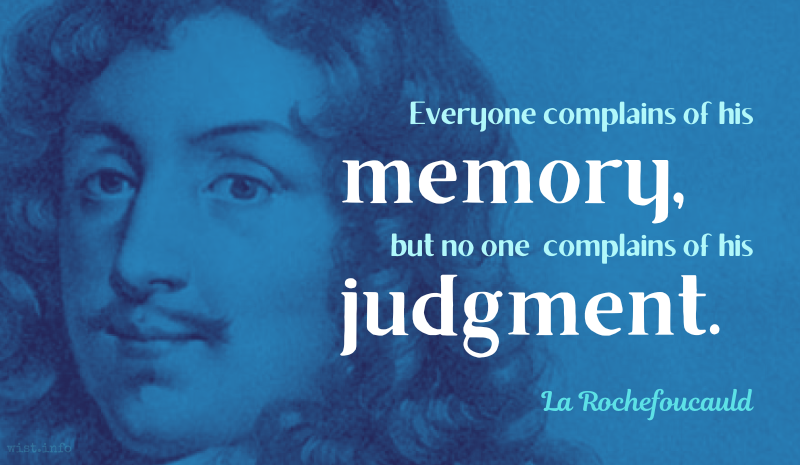
Everyone complains of his memory, but no one complains of his judgment.
[Tout le monde se plaint de sa mémoire, et personne ne se plaint de son jugement.]
François VI, duc de La Rochefoucauld (1613–1680) French epigrammatist, memoirist, noble
Réflexions ou sentences et maximes morales [Reflections; or Sentences and Moral Maxims], ¶89 (1665-1678)
First appeared in the 2nd (1666) edition. The written manuscript adds "because everyone believes they have a lot of it."
See also Montaigne (1578), Franklin (1745).
(Source (French)). Other translations:Every body complains for want of Memory; but you never find any body complain of the Weakness of his Judgment.
[tr. Stanhope (1694), ¶90]Every one complains of the badness of his memory, but nobody of his judgment.
[pub. Donaldson (1783), ¶263; ed. Lepoittevin-Lacroix (1797), ¶86]Of the want of memory every one complains;, but nobody of the want of judgment.
[ed. Carvill (1835), ¶263]Every one complains of his memory, and no one complains of his judgment.
[ed. Gowens (1851), ¶92]Everyone blames his memory, no one blames his judgment.
[tr. Bund/Friswell (1871), ¶89]Everyone blames his memory, no one his judgment.
[tr. Heard (1917), ¶89]Everyone finds fault with his memory, but none with his judgement.
[tr. Stevens (1939), ¶89]Everyone complains of his memory, none of his judgment.
[tr. FitzGibbon (1957), ¶89]Everyone complains of his memory and no one complains of his judgment.
[tr. Kronenberger (1959), ¶89]Everybody complains of his memory, but nobody of his judgment.
[tr. Tancock (1959), ¶89]Everybody complains of his memory; but when did you ever hear anybody complain about his judgement?
[tr. Whichello (2016), ¶89]

“I have been Foolish and Deluded,” said Pooh, “and I am a Bear of No Brain at All.”
“You’re the Best Bear in All the World,” said Christopher Robin soothingly.A. A. Milne (1882–1956) English poet and playwright [Alan Alexander Milne]
Winnie-the-Pooh, ch. 3 “Pooh and Piglet Go Hunting” (1926)
(Source)