So let us look for beauty and grace, for love and friendship, for that which is creative and birth-giving and soul-stretching. Let us dare to laugh at ourselves, healthy, affirmative laughter. Only when we take ourselves lightly can we take ourselves seriously, so that we are given the courage to say, “Yes! I dare disturb the universe.”
Madeleine L'Engle (1918–2007) American writer
Speech (1983-11-16), “Dare To Be Creative,” Lecture, Library of Congress, Washington, DC
(Source)
Quotations about:
self-importance
Note not all quotations have been tagged, so Search may find additional quotes on this topic.

For men ought not to be so elated by the dignity of the affairs which they have undertaken to manage, as to have no regard to their ease; nor ought they to dwell with fondness on any sort of ease which is inconsistent with dignity.
[Neque enim rerum gerendarum dignitate homines ecferri ita convenit ut otio non prospiciant, neque ullum amplexari otium quod abhorreat a dignitate.]
Marcus Tullius Cicero (106–43 BC) Roman orator, statesman, philosopher
Pro Sestio [For Publius Sestius], ch. 45 / sec. 98 (56-02 BC) [tr. Yonge (1891)]
(Source)
Part of Cicero's discussion of otium cum dignitate ("peace with dignity"), an idealized active private life after retiring from public service. See here for more.
(Source (Latin)). Other translations:For neither is it fitting that men be so carried away by political freedom as to make no provision for tranquility, nor to accept any tranquility which is inconsistent with freedom.
[tr. Hickie (1888)]For just as it ill befits men to be so carried away by the dignity of a public career that they are indifferent in peace, so too it is unfitting for them to welcome a peace which is inconsistent with dignity.
[tr. Gardner (Loeb) (1958)]
These illustrations suggest four general maxims, which will prove an adequate preventative of persecution mania if their truth is sufficiently realized. The first is: remember that your motives are not always as altruistic as they seem to yourself. The second is: Don’t overestimate your own merits. The third is: don’t expect others to take as much interest in you as you do yourself. And the fourth is: don’t imagine that most people give enough thought to you to have any desire to persecute you.
Bertrand Russell (1872–1970) English mathematician and philosopher
Conquest of Happiness, Part 1, ch. 8 “Persecution Mania” (1930)
(Source)
How menny people thare iz whoze importance depends entirely upon the size ov their hotel bills.
[How many people there are whose importance depends entirely upon the size of their hotel bills.]
Josh Billings (1818–1885) American humorist, aphorist [pseud. of Henry Wheeler Shaw]
Everybody’s Friend, Or; Josh Billing’s Encyclopedia and Proverbial Philosophy of Wit and Humor, ch. 156 “Affurisms: Embers on the Harth” (1874)
(Source)

We all ov us beleave that we are the espeshall favourites ov fortune, but fortune don’t beleave enny sutch thing.
[We all of us believe that we are the especial favorites of fortune, but fortune don’t believe any such thing.]Josh Billings (1818–1885) American humorist, aphorist [pseud. of Henry Wheeler Shaw]
Josh Billings’ Trump Kards, ch. 8 “Lager Beer and Spruce Gum” (1874)
(Source)
To sacrifice the principles of manners, which require compassion and respect, and bat people over the head with their ignorance of etiquette rules they cannot be expected to know is both bad manners and poor etiquette. That social climbers and twits have misused etiquette throughout history should not be used as an argument for doing away with it.
Judith Martin (b. 1938) American author, journalist, etiquette expert [a.k.a. Miss Manners]
Miss Manners Rescues Civilization, ch. 1 “The Case Against Etiquette” (1996)
(Source)

I don’t believe any man ever existed without vanity, and if he did he would be an extremely uncomfortable person to have anything to do with. He would, of course, be a very good man, and we should respect him very much. He would be a very admirable man — a man to be put under a glass case and shown round as a specimen — a man to be stuck upon a pedestal and copied, like a school exercise — a man to be reverenced, but not a man to be loved, not a human brother whose hand we should care to grip. Angels may be very excellent sort of folk in their way, but we, poor mortals, in our present state, would probably find them precious slow company. Even mere good people are rather depressing.
Jerome K. Jerome (1859–1927) English writer, humorist [Jerome Klapka Jerome]
Idle Thoughts of an Idle Fellow, “On Vanity and Vanities” (1886)
(Source)

So let’s be honest with ourselves and not take ourselves too serious, and never condemn the other fellow for doing what we are doing every day, only in a different way.
Will Rogers (1879–1935) American humorist
Article (1926-07-31), “Letter of a Self-Made Diplomat to His President,” Saturday Evening Post
(Source)
Collected in Letters of a Self-Made Diplomat to His President (1926).
But why speak of others? Let me now return to myself.
[Sed quid ego alios? Ad me ipsum iam revertar.]
Marcus Tullius Cicero (106–43 BC) Roman orator, statesman, philosopher
De Senectute [Cato Maior; On Old Age], ch. 13 / sec. 45 (13.45) (44 BC) [tr. Falconer (1923)]
(Source)
(Source (Latin)). Other translations:But it is not nede also to remembre in what thynges the othir olde men tokyn their honeste delectacyons. Therfor I shall come ayen to speke of myself.
[tr. Worcester/Worcester/Scrope (1481)]But wherefore speak I so much of others? I will now returne to my selfe.
[tr. Austin (1648)]But what have I to do with others, let me return now to myself.
[tr. J. D. (1744)]But why should I quote others, and not rather return and speak of myself?
[tr. Logan (1744)]But to pass from the practice of others to my own ....
[tr. Melmoth (1773)]But why do I mention others? I will now return to myself.
[Cornish Bros. ed. (1847)]But why do I refer to others? let me now return to myself.
[tr. Edmonds (1874)]But why am I talking about others? I now return to my own case.
[tr. Peabody (1884)]But why mention others? I will come back to my own case.
[tr. Shuckburgh (1895)]Why speak of these?
Let's take myself.
[tr. Allison (1916)]But enough of others -- let me return to myself!
[tr. Grant (1960, 1971 ed.)]But why speak of other men? Let me revert to my own case.
[tr. Copley (1967)]Enough of other people. Let me speak now of my own experience.
[tr. Cobbold (2012)]But again I don't have to talk about the world famous. I can provide personal examples.
[tr. Gerberding (2014)]I’ll now revert only to myself,
And put all the others on the shelf.
[tr. Bozzi (2015)]
No one is exempt from talking nonsense. The great misfortune is to do it solemnly.
Anthony de Mello (1931–1987) Indian psychotherapist, writer, Jesuit priest
One Minute Nonsense, Introduction [The Master] (1992)
(Source)
An awareness of our smallness may help to redeem us from the arrogance which is the besetting sin of the scientists.
Freeman Dyson (1923–2020) English-American theoretical physicist, mathematician, futurist
Infinite in All Directions, Part 1, ch. 1 “In Praise of Diversity” (1988)
(Source)
Based on a lecture on "Science and Religion," National Conference of Catholic Bishops, Detroit (Sep 1986).
A good scientist is a person with original ideas. A good engineer is a person who makes a design that works with as few original ideas as possible. There are no prima donnas in engineering.
Freeman Dyson (1923–2020) English-American theoretical physicist, mathematician, futurist
Disturbing the Universe, ch. 10 (1979)
(Source)
So you pretend to fear you may be hit
By pointed epigrams, the shafts of wit?
To seem a worthy foeman you aspire,
How vain alike the fear and the desire!
Against fiercest bulls the lion’s wrath may rise,
He scorns to war with puny butterflies.[Versus et breve vividumque carmen
in te ne faciam times, Ligurra,
et dignus cupis hoc metu videri.
sed frustra metuis cupisque frustra.
in tauros Libyci fremunt leones,
non sunt papilionibus molesti.]Martial (AD c.39-c.103) Spanish Roman poet, satirist, epigrammatist [Marcus Valerius Martialis]
Epigrams [Epigrammata], Book 12, epigram 61 (12.61.1-6) (AD 101) [tr. Pott & Wright (1921)]
(Source)
"To Ligurra". (Source (Latin)). Other translations:You dread my verse, and sting of wit,
Which put you in a shaking fit:
Would seem of rank to entertain
Such fears: your fears and hopes are vain.
'Tis at the bull that lions fly,
While rats run unregarded by.
[tr. Hay (1755)]Lest a little living song
Make thy fame, Ligurra, long;
Thou would'st have thy terror seen:
Vain thy wish as fear, I ween.
At the bulls the lions rise,
Never rush on butterflies.
[tr. Elphinston (1782), Book 3, ep. 31]You are afraid, Ligurra, lest I should compose verses on you, some short and pungent epigram, and you wish to be thought a proper object of such rear. But vain is your fear. and vain your desire! Libyan lions rush upon bulls; they do not hurt butterflies.
[tr. Bohn's Classical (1859)]You fear, Ligurra -- above all, you long --
That I should smite you with a singing song,
This dreadful honour you both fear and hope:
Both quite in vain: you fall below my scope.
The Libyan lion tears the roaring bull,
He does not harm the midge along the pool.
[tr. Stevenson (1884)]You are afraid, Ligurra, I should write verses on you, and some short and lively poem, and you long to be thought a man that justifies such fear. But vain is your fear, and your longing is vain. Against bulls Libyan lions rage, they are not hostile to butterflies.
[tr. Ker (1919)]You say you're scared I'm going to aim
A lampoon at you, something brief
And lurid, and half proudly claim
You're a marked man. Wishful belief!
Misapprehended apprehension!
African lions pay attention
To bulls, they don't hunt butterflies.
[tr. Michie (1972)]Ligurra's fearful I'll contrive
Some pungent piece, some sprightly ditty,
And longs to be considered worth it.
Longings baseless! Baseless fears!
The Libyan lion paws the Libyan bull
But does not bat the butterfly.
[tr. Whigham (1987)]You are afraid, Ligurra, of my writing verses against you, a brief, lively poem, and you long to seem worthy of such an apprehension. But idle is your fear and idle your desire. Libyan lions roar at bulls, they do not trouble butterflies.
[tr. Shackleton Bailey (1993)]Ah Ligurra, you’re quite afraid that I might write
About you. Some nasty, pithy, diamond-shard of spite
As is my wont. In fact, you quite like the idea.
Well, don’t get your hopes up I’ll gratify that fear.
I may be beastly but I claw with discretion,
No stepping on insects, flattered to be flattened.
[tr. Ynys-Mon (2007)]You fear I'll write a brief and lively poem
attacking you, Ligurra, and you yearn
to seem one who would merit such a fear.
Your wish is vain and so is your concern.
Lions of Libya roar at bulls; they leave
butterflies unmolested.
[tr. McLean (2014)]Ligurra, you fear that I might compose
Verses against you, a brief, intense poem --
Oh how you long to seem worthy of this fear.
But you fear in vain, in vain you long.
The Libyan lions growl at bulls;
They do not pester butterflies.
[tr. @sentantiq (2018)]
See also Ben Jonson (1572-1637):Sir Inigo doth fear it, as I hear,
And labors to seem worthy of that fear,
That I should write upon him some sharpe verse,
Able to eat into his bones, and pierce
Their marrow. Wretch! I quit thee of thy pain,
Thou'rt too ambitious, and dost fear in vain:
The Lybian lion hunts no butterflies,
He makes the camel and dull ass his prize.
“There are two types of people in this world,” Pete volunteers helpfully, “those who think there are only two types of people in the world, and everybody else.” He sips his wine thoughtfully. “But the first kind don’t put it that way. They usually think in terms of the saved and the damned, with themselves sitting pretty in the lifeboat.”
Charles "Charlie" Stross (b. 1964) British writer
The Apocalypse Codex (2012)

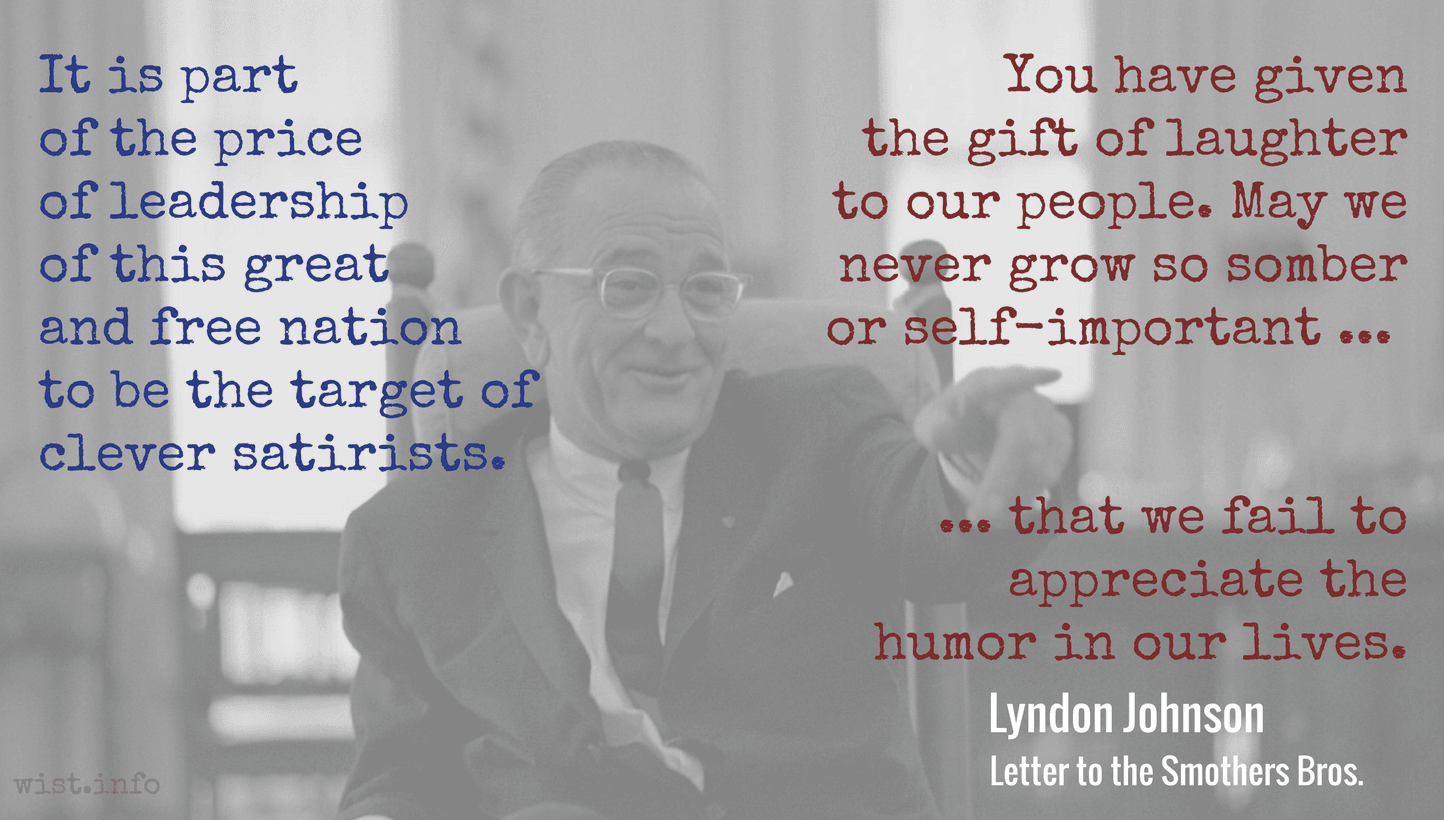
It is part of the price of leadership of this great and free nation to be the target of clever satirists. You have given the gift of laughter to our people. May we never grow so somber or self-important that we fail to appreciate the humor in our lives.

Jesus also told this parable to people who were sure of their own goodness and despised everybody else. “Once there were two men who went up to the Temple to pray: one was a Pharisee, the other a tax collector.
“The Pharisee stood apart by himself and prayed, ‘I thank you, God, that I am not greedy, dishonest, or an adulterer, like everybody else. I thank you that I am not like that tax collector over there. I fast two days a week, and I give you one tenth of all my income.’
“But the tax collector stood at a distance and would not even raise his face to heaven, but beat on his breast and said, ‘God, have pity on me, a sinner!’
“I tell you,” said Jesus, “the tax collector, and not the Pharisee, was in the right with God when he went home. For those who make themselves great will be humbled, and those who humble themselves will be made great.”[Εἶπεν δὲ καὶ πρός τινας τοὺς πεποιθότας ἐφ᾽ ἑαυτοῖς ὅτι εἰσὶν δίκαιοι καὶ ἐξουθενοῦντας τοὺς λοιποὺς τὴν παραβολὴν ταύτην· Ἄνθρωποι δύο ἀνέβησαν εἰς τὸ ἱερὸν προσεύξασθαι, ὁ εἷς Φαρισαῖος καὶ ὁ ἕτερος τελώνης.
ὁ Φαρισαῖος σταθεὶς πρὸς ἑαυτὸν ταῦτα προσηύχετο, Ὁ θεός, εὐχαριστῶ σοι ὅτι οὐκ εἰμὶ ὥσπερ οἱ λοιποὶ τῶν ἀνθρώπων, ἅρπαγες, ἄδικοι, μοιχοί, ἢ καὶ ὡς οὗτος ὁ τελώνης· νηστεύω δὶς τοῦ σαββάτου, ἀποδεκατῶ πάντα ὅσα κτῶμαι.
ὁ δὲ τελώνης μακρόθεν ἑστὼς οὐκ ἤθελεν οὐδὲ τοὺς ὀφθαλμοὺς ἐπᾶραι εἰς τὸν οὐρανόν, ἀλλ᾽ ἔτυπτεν τὸ στῆθος αὐτοῦ λέγων, Ὁ θεός, ἱλάσθητί μοι τῷ ἁμαρτωλῷ.
λέγω ὑμῖν, κατέβη οὗτος δεδικαιωμένος εἰς τὸν οἶκον αὐτοῦ παρ᾽ ἐκεῖνον· ὅτι πᾶς ὁ ὑψῶν ἑαυτὸν ταπεινωθήσεται, ὁ δὲ ταπεινῶν ἑαυτὸν ὑψωθήσεται.]The Bible (The New Testament) (AD 1st - 2nd C) Christian sacred scripture
Book 3. Gospel of Luke 18: 9ff (Luke 18:9–14), “The Parable of the Pharisee and the Tax Collector” [GNT (1992 ed.)]
(Source)
No Synoptic parallels.
(Source (Greek)). Other translations:And he spake this parable unto certain which trusted in themselves that they were righteous, and despised others: Two men went up into the temple to pray; the one a Pharisee, and the other a publican.
The Pharisee stood and prayed thus with himself, God, I thank thee, that I am not as other men are, extortioners, unjust, adulterers, or even as this publican. I fast twice in the week, I give tithes of all that I possess.
And the publican, standing afar off, would not lift up so much as his eyes unto heaven, but smote upon his breast, saying, God be merciful to me a sinner.
I tell you, this man went down to his house justified rather than the other: for every one that exalteth himself shall be abased; and he that humbleth himself shall be exalted.
[KJV (1611)]He spoke the following parable to some people who prided themselves on being virtuous and despised everyone else, "Two men went up to the Temple to pray, one a Pharisee, the other a tax collector.
"The Pharisee stood there and said this prayer to himself, 'I thank you, God, that I am not grasping, unjust, adulterous like the rest of mankind, and particularly that I am not like this tax collector here. I fast twice a week; I pay tithes on all I get.'
"The tax collector stood some distance away, not daring even to raise his eyes to heaven; but he beat his breast and said, 'God, be merciful to me, a sinner.'
"This man, I tell you, went home again at rights with God; the other did not. For everyone who exalts himself will be humbled, but the man who humbles himself will be exalted."
[JB (1966)]He spoke the following parable to some people who prided themselves on being upright and despised everyone else, "Two men went up to the Temple to pray, one a Pharisee, the other a tax collector.
"The Pharisee stood there and said this prayer to himself, 'I thank you, God, that I am not grasping, unjust, adulterous like everyone else, and particularly that I am not like this tax collector here. I fast twice a week; I pay tithes on all I get.'
"The tax collector stood some distance away, not daring even to raise his eyes to heaven; but he beat his breast and said, 'God, be merciful to me, a sinner.'
"This man, I tell you, went home again justified; the other did not. For everyone who raises himself up will be humbled, but anyone who humbles himself will be raised up."
[NJB (1985)]Jesus told this parable to certain people who had convinced themselves that they were righteous and who looked on everyone else with disgust: “Two people went up to the temple to pray. One was a Pharisee and the other a tax collector.
"The Pharisee stood and prayed about himself with these words, ‘God, I thank you that I’m not like everyone else—crooks, evildoers, adulterers—or even like this tax collector. I fast twice a week. I give a tenth of everything I receive.’
"But the tax collector stood at a distance. He wouldn’t even lift his eyes to look toward heaven. Rather, he struck his chest and said, ‘God, show mercy to me, a sinner.’
"I tell you, this person went down to his home justified rather than the Pharisee. All who lift themselves up will be brought low, and those who make themselves low will be lifted up.”
[CEB (2011)]He also told this parable to some who trusted in themselves that they were righteous and regarded others with contempt: “Two men went up to the temple to pray, one a Pharisee and the other a tax collector.
"The Pharisee, standing by himself, was praying thus, ‘God, I thank you that I am not like other people: thieves, rogues, adulterers, or even like this tax collector. I fast twice a week; I give a tenth of all my income.’
"But the tax collector, standing far off, would not even lift up his eyes to heaven but was beating his breast and saying, ‘God, be merciful to me, a sinner!’
"I tell you, this man went down to his home justified rather than the other, for all who exalt themselves will be humbled, but all who humble themselves will be exalted.”
[NRSV (2021 ed.)]
A harmless hilarity and a buoyant cheerfulness are not infrequent concomitants of genius; and we are never more deceived than when we mistake gravity for greatness, solemnity for science, and pomposity for erudition.
Charles Caleb "C. C." Colton (1780–1832) English cleric, writer, aphorist
Lacon: Or, Many Things in Few Words, Vol. 1, § 202 (1820)
(Source)
Apologizing. — A very desperate habit, — one that is rarely cured. Apology is only egotism wrong side out. Nine times out of ten, the first thing a man’s companion knows of his shortcoming is from his apology. It is mighty presumptuous on your part to suppose your small failures of so much consequence that you must make a talk about them.
Methinks a Man cannot, without a secret Satisfaction, consider the Glory of the present Age, which will shine as bright as any other in the History of Mankind. It is still big with great Events, and has already produced Changes and Revolutions which will be as much admired by Posterity, as any that have happened in the Days of our Fathers, or in the old Times before them.
Richard Steele (1672–1729) Anglo-Irish writer, journalist, playwright, politician
Essay (1710-02-06), The Tatler, No. 130
(Source)
All is vanity and everybody’s vain. Women are terribly vain. So are men — more so, if possible.
Jerome K. Jerome (1859–1927) English writer, humorist [Jerome Klapka Jerome]
Idle Thoughts of an Idle Fellow, “On Vanity and Vanities” (1886)
(Source)
The least pain in our little finger gives more concern and uneasiness than the destruction of millions of our fellow beings.
William Hazlitt (1778–1830) English writer
Essay (1829-10), “American Literature — Dr. Channing,” Edinburgh Review, Vol. 50, No. 99, Art. 7
(Source)

When he noticed how the guests chose the places of honor, he told them a parable. “When you are invited by someone to a wedding banquet, do not sit down at the place of honor, in case someone more distinguished than you has been invited by your host, and the host who invited both of you may come and say to you, ‘Give this person your place,’ and then in disgrace you would start to take the lowest place.
“But when you are invited, go and sit down at the lowest place, so that when your host comes, he may say to you, ‘Friend, move up higher’; then you will be honored in the presence of all who sit at the table with you.
“For all who exalt themselves will be humbled, and those who humble themselves will be exalted.”[Ἔλεγεν δὲ πρὸς τοὺς κεκλημένους παραβολήν, ἐπέχων πῶς τὰς πρωτοκλισίας ἐξελέγοντο, λέγων πρὸς αὐτούς, Ὅταν κληθῇς ὑπό τινος εἰς γάμους, μὴ κατακλιθῇς εἰς τὴν πρωτοκλισίαν, μήποτε ἐντιμότερός σου ᾖ κεκλημένος ὑπ᾽ αὐτοῦ, καὶ ἐλθὼν ὁ σὲ καὶ αὐτὸν καλέσας ἐρεῖ σοι, Δὸς τούτῳ τόπον, καὶ τότε ἄρξῃ μετὰ αἰσχύνης τὸν ἔσχατον τόπον κατέχειν.
ἀλλ᾽ ὅταν κληθῇς, πορευθεὶς ἀνάπεσε εἰς τὸν ἔσχατον τόπον, ἵνα ὅταν ἔλθῃ ὁ κεκληκώς σε ἐρεῖ σοι, Φίλε, προσανάβηθι ἀνώτερον· τότε ἔσται σοι δόξα ἐνώπιον πάντων τῶν συνανακειμένων σοι.
ὅτι πᾶς ὁ ὑψῶν ἑαυτὸν ταπεινωθήσεται, καὶ ὁ ταπεινῶν ἑαυτὸν ὑψωθήσεται.]The Bible (The New Testament) (AD 1st - 2nd C) Christian sacred scripture
Book 3. Gospel of Luke 14: 7ff (Luke 14:7–11) (Jesus) [NRSV (2021 ed.)]
(Source)
No Synoptic parallels.
(Source (Greek)). Other translations:And he put forth a parable to those which were bidden, when he marked how they chose out the chief rooms; saying unto them, 8 When thou art bidden of any man to a wedding, sit not down in the highest room; lest a more honourable man than thou be bidden of him; and he that bade thee and him come and say to thee, Give this man place; and thou begin with shame to take the lowest room.
But when thou art bidden, go and sit down in the lowest room; that when he that bade thee cometh, he may say unto thee, Friend, go up higher: then shalt thou have worship in the presence of them that sit at meat with thee.
For whosoever exalteth himself shall be abased; and he that humbleth himself shall be exalted.
[KJV (1611)]He then told the guests a parable, because he had noticed how they picked the places of honour. He said this, "When someone invites you to a wedding feast, do not take your seat in the place of honour. A more distinguished person than you may have been invited, and the person who invited you both may come and say, 'Give up your place to this man.' And then, to your embarrassment, you would have to go and take the lowest place.
"No; when you are a guest, make your way to the lowest place and sit there, so that, when your host comes, he may say, 'My friend, move up higher.' In that way, everyone with you at the table will see you honoured.
"For everyone who exalts himself will be humbled, and the man who humbles himself will be exalted."
[JB (1966)]He then told the guests a parable, because he had noticed how they picked the places of honour. He said this, "When someone invites you to a wedding feast, do not take your seat in the place of honour. A more distinguished person than you may have been invited, and the person who invited you both may come and say, 'Give up your place to this man.' And then, to your embarrassment, you will have to go and take the lowest place.
"No; when you are a guest, make your way to the lowest place and sit there, so that, when your host comes, he may say, 'My friend, move up higher.' Then, everyone with you at the table will see you honoured.
"For everyone who raises himself up will be humbled, and the one who humbles himself will be raised up."
[NJB (1985)]Jesus noticed how some of the guests were choosing the best places, so he told this parable to all of them: “When someone invites you to a wedding feast, do not sit down in the best place. It could happen that someone more important than you has been invited, and your host, who invited both of you, would have to come and say to you, ‘Let him have this place.’ Then you would be embarrassed and have to sit in the lowest place.
"Instead, when you are invited, go and sit in the lowest place, so that your host will come to you and say, ‘Come on up, my friend, to a better place.’ This will bring you honor in the presence of all the other guests.
"For those who make themselves great will be humbled, and those who humble themselves will be made great.”
[GNT (1992 ed.)]When Jesus noticed how the guests sought out the best seats at the table, he told them a parable. “When someone invites you to a wedding celebration, don’t take your seat in the place of honor. Someone more highly regarded than you could have been invited by your host. The host who invited both of you will come and say to you, ‘Give your seat to this other person.’ Embarrassed, you will take your seat in the least important place.
"Instead, when you receive an invitation, go and sit in the least important place. When your host approaches you, he will say, ‘Friend, move up here to a better seat.’ Then you will be honored in the presence of all your fellow guests.
"All who lift themselves up will be brought low, and those who make themselves low will be lifted up."
[CEB (2011)]
Anyone who takes himself too seriously always runs the risk of looking ridiculous; anyone who can consistently laugh at himself does not.
Václav Havel (1936–2011) Czech playwright, essayist, dissident, politician
Disturbing the Peace, ch. 2 “Writing for the Stage” (1986) [tr. Wilson (1990)]
(Source)

Those who have not lost the ability to recognize that which is laughable in themselves, or their own nothingness, are not arrogant, nor are they enemies of an Open Society. Its enemy is a person with a fiercely serious countenance and burning eyes.
Václav Havel (1936–2011) Czech playwright, essayist, dissident, politician
Speech, accepting the “Open Society” Prize, Central European University (24 Jun 1999)
(Source)
A cock has great influence on his own dunghill.
[In sterculino plurimum gallus potest.]
Publilius Syrus (d. 42 BC) Assyrian slave, writer, philosopher [less correctly Publius Syrus]
Sententiae [Moral Sayings], # 357