

Another principle for successful application of a sophisticated technology is to resist the human inclination to hope that things will work out, despite evidence or suspicions to the contrary. This may seem obvious, but it is a human factor you must be conscious of and actively guard against. It can affect you in subtle ways, particularly when you have spent a lot of time and energy on a project and feel personally responsible for it, and thus somewhat possessive. It is a common human problem and it is not easy to admit what you thought was correct did not turn out that way.
Hyman Rickover (1900–1986) Polish-American naval engineer, admiral [b. Chaim Gdala Rykower]
Essay (1979-05-24), Statement before the Subcommittee on Energy Research and Production, Committee on Science and Technology, US House of Representatives
(Source)
Quotations about:
engineering
Note not all quotations have been tagged, so Search may find additional quotes on this topic.

The great liability of the engineer compared to men of other professions is that his works are out in the open where all can see them. His acts, step by step, are in hard substance. He cannot bury his mistakes in the grave like the doctors. He cannot argue them into thin air or blame the judge like the lawyers. He cannot, like the architects, cover his failures with trees and vines. He cannot, like the politicians, screen his shortcomings by blaming his opponents and hope that the people will forget. The engineer simply cannot deny that he did it. If his works do not work, he is damned.
Herbert Hoover (1874–1964) American engineer, bureaucrat, US President (1929–33)
Memoirs: Years of Adventure, 1874–1920, ch. 11 “The Profession of Engineering” (1952)
(Source)
While treating this as the definitive version of this litany, a number of variations can be found in Hoover's writing and speaking prior to this. The earliest is same text is found in his essay (1916), "Engineering as a Profession" (reprinted as a 1954 article in Engineer's Week). Some of the other variants follow.
Speech (1950-02-09), "Engineering Society of the Moles," New York City:The engineer has certain disadvantages compared to the other professions. His works are out in the open where all men can see them. He cannot deny he did it. The doctors’ mistakes are buried in the grave. The voters forget when the politician changes the alphabetical names of his failing projects. The trees and ivy may cover the architects’ failures. The lawyers can blame the Judge or the Jury. Unlike the clergyman, the engineer cannot blame his failures on the devil.
Moreover, if his works do not work, he is damned.
Speech (1951-11-07), "Engineers," Columbia University Engineering Campaign Center, New York City:The engineer’s work is out in the open where all men can see it. If he makes a mistake, he cannot, like the doctor, bury it in a grave. He cannot, like the architect, obscure it by trees and ivy. He cannot, like the lawyer, blame it on the judge or jury. He cannot, like the politician, claim his constituents demanded it. Nor can he, like the public official, change the name of it and hope the voters will forget. Unlike the clergyman, he cannot blame it on the devil. Worse still, if his works do not work, he is damned.
For more discussion of possible precursors of this quotation, see: Quote Origin: The Architect Can Only Advise His Client to Plant Vines – Quote Investigator®. (To which end, see also Frank Lloyd Wright (1930).)
Again, we should notice the force, effect, and consequences of inventions, which are nowhere more conspicuous than in those three which were unknown to the ancients; namely, printing, gunpowder, and the compass. For these three have changed the appearance and state of the whole world; first in literature, then in warfare, and lastly in navigation: and innumerable changes have been thence derived, so that no empire, sect, or star, appears to have exercised a greater power and influence on human affairs than these mechanical discoveries.
[Rursus, vim et virtutem et consequentias rerum inventarum notare juvat; quae non in aliis manifestius occurrunt, quam in illis tribus quae antiquis incognitae, et quarum primordia, licet recentia, obscura et ingloria sunt: Artis nimirum Imprimendi, Pulveris Tormentarii, et Acus Nauticae. Haec enim tria rerum faciem et statum in orbe terrarum mutaverunt: primum, in re literaria; secundum, in re bellica; tertium, in navigationibus: unde innumerae rerum mutationes sequutae sunt; ut non imperium aliquod, non secta, non stella, majorem efficaciam et quasi influxum super res humanas exercuisse videatur, quam ista mechanica exercuerunt.]
Francis Bacon (1561–1626) English philosopher, scientist, author, statesman
Instauratio Magna [The Great Instauration], Part 2 “Novum Organum [The New Organon],” Book 1, Aphorism # 129 (1620) [tr. Wood (1831)]
(Source)
(Source (Latin)). Other translations:Again, it is well to observe the force and virtue and consequences of discoveries; and these are to be seen nowhere more conspicuously than in those three which were unknown to the ancients, and of which the origin, though recent, is obscure and inglorious; namely, printing, gunpowder, and the magnet. For these three have changed the whole face and state of things throughout the world; the first in literature, the second in warfare, the third in navigation; whence have followed innumerable changes; insomuch that no empire, no sect, no star seems to have exerted greater power and influence in human affairs than these mechanical discoveries.
[tr. Spedding (1858)]Again, it is well to mark the force, virtue, and consequences of discoveries; and these occur nowhere more manifestly than in those which were unknown to the ancients, and whose origin, though recent, is obscure and inglorious; the Arts, namely, of Printing, of Gunpowder, and the Mariner's Compass. For these three have changed the face and condition of things all over the world; the first in letters, the second in war, the third in navigation. And hence numberless changes have followed; so that no government, no sect, no star, seems to have exercised greater power and influence over human affairs than these mechanical discoveries.
[tr. Johnson (1859)]Again, it helps to notice the force, power and consequences of discoveries, which appear at their clearest in three things that were unknown to antiquity, and whose origins, though recent, are obscure and unsung: namely, the art of printing, gunpowder and the nautical compass. In fact these three things have changed the face and condition of things all over the globe: the first in literature; the second in the art of war; the third in navigation; and innumerable changes have followed; so that no empire or sect or star seems to have exercised a greater power and influence on human affairs than those mechanical things.
[tr. Silverthorne (2000)]Notice the vigour of discoveries, their power to generate consequences. This is nowhere more obvious than in three discoveries that the ancients didn’t know and whose origins (all quite recent) were obscure and humdrum. I am talking about the arts of printing, gunpowder, and the nautical compass. These three have changed the whole aspect and state of things throughout the world -- the first in literature, the second in warfare, the third in navigation -- bringing about countless changes; so that there seems to have been no empire, no philosophical system, no star that has exerted greater power and influence in human affairs than these mechanical discoveries.
[tr. Bennett (2017)]

You can have any combination of features the Air Ministry desires, so long as you do not also require that the resulting airplane fly.
[Natürlich können Sie dem Luftfahrtministerium ein Flugzeug mit allen gewünschten Eigenschaften bauen — solange Sie nicht zwingend voraussetzen, dass es dann auch fliegt.]
Wilhelm Emil "Willy" Messerschmitt (1898–1978) German aircraft designer and manufacturer
(Attributed (1934))
Another translation:Of course, you can build the Air Ministry an airplane with whatever characteristics you want -- as long as you don't necessarily expect it to fly.

A good scientist is a person with original ideas. A good engineer is a person who makes a design that works with as few original ideas as possible. There are no prima donnas in engineering.
Freeman Dyson (1923–2020) English-American theoretical physicist, mathematician, futurist
Disturbing the Universe, ch. 10 (1979)
(Source)
Ugly programs are like ugly suspension bridges: they’re much more liable to collapse than pretty ones, because the way humans (especially engineer-humans) perceive beauty is intimately related to our ability to process and understand complexity.
Eric S. Raymond (b. 1957) American software developer, writer [a.k.a. ESR]
The Cathedral & the Bazaar (1999)

Eight years involved with the nuclear industry have taught me that when nothing can possible go wrong and every avenue has been covered, then is the time to buy a house on the next continent.

Anything one man can imagine, other men can make real.
Jules Verne (1828–1905) French novelist, poet, playwright
Around the World in Eighty Days (1873)

The monuments of wit and learning are more durable than the monuments of power, or of the hands. For have not the verses of Homer continued twenty-five hundred years or more, without the loss of a syllable or letter; during which time infinite palaces, temples, castles, cities have been decayed and demolished?
Francis Bacon (1561–1626) English philosopher, scientist, author, statesman
Essex’s Device (1595)
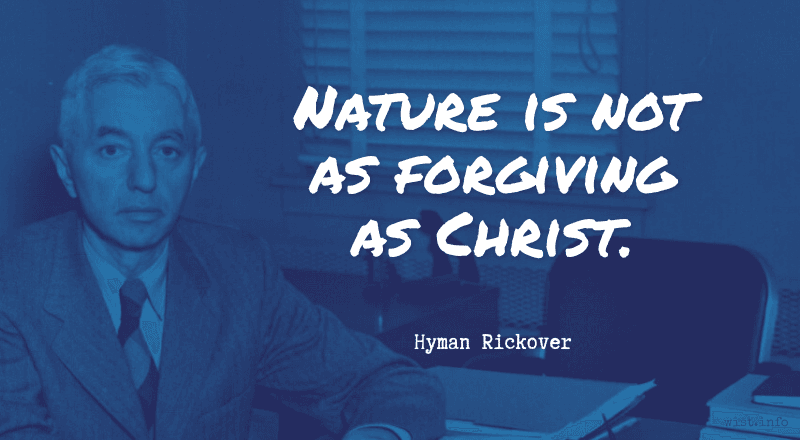
Nature is not as forgiving as Christ.
Hyman Rickover (1900–1986) Polish-American naval engineer, admiral [b. Chaim Gdala Rykower]
(Attributed)
Quoted in Theodore Rockwell, The Rickover Effect, Part 4 "Upgrading Industry Quality (1955-1960)," "The Seawolf" (epigraph) (1992). Rockwell provides no citation, and I can find no other written source; it is likely a verbal catch phrase of Rickover's.
Results! Why, man, I have gotten a lot of results! I know several thousand things that won’t work.
Thomas Edison (1847–1931) American inventor and businessman
(Attributed)
(Source)
When told by an associate, Walter S. Mallory, that it was a shame that several months of work on new battery technology hadn't yielded any results. Recorded in Dyer and Martin, Edison: His Life and Inventions, Vol. 2, ch. 24 (1910) as an anecdote by Mallory.
More discussion about this quotation's origins and variants: I Have Gotten a Lot of Results! I Know Several Thousand Things That Won’t Work – Quote Investigator.
