

Quotations by:
Colton, Charles Caleb
It is almost as difficult to make a man unlearn his errors as his knowledge. Mal-information is more hopeless than non-information; for error is always more busy than ignorance. Ignorance is a blank sheet, on which we may write; but error is a scribbled one, on which we must first erase. Ignorance is contented to stand still with her back to the truth; but error is more presumptuous, and proceeds in the same direction. Ignorance has no light, but error follows a false one. The consequence is, that error, when she retraces her footsteps, has further to go, before she can arrive at the truth, than ignorance.
Charles Caleb "C. C." Colton (1780–1832) English cleric, writer, aphorist
Lacon: Or, Many Things in Few Words, Vol. 1, § 1 (1820)
(Source)
Great minds had rather deserve contemporaneous applause, without obtaining it, than obtain, without deserving it; if it follow them, it is well, but they will not deviate to follow it. With inferior minds the reverse is observable; so that they can command the flattery of knaves while living, they care not for the execrations of honest men, when dead.
Charles Caleb "C. C." Colton (1780–1832) English cleric, writer, aphorist
Lacon: Or, Many Things in Few Words, Vol. 1, § 6 (1820)
(Source)
An upright minister asks, what recommends a man; a corrupt minister, who.
Charles Caleb "C. C." Colton (1780–1832) English cleric, writer, aphorist
Lacon: Or, Many Things in Few Words, Vol. 1, § 9 (1820)
(Source)
Referring to government ministers and office-holders.
Were we as eloquent as angels, yet should we please some men, some women, and some children much more by listening than by talking.
Charles Caleb "C. C." Colton (1780–1832) English cleric, writer, aphorist
Lacon: Or, Many Things in Few Words, Vol. 1, § 13 (1820)
(Source)
Power, like the diamond, dazzles the beholder, and also the wearer; it dignifies meanness; it magnifies littleness; to what is contemptible, it gives authority; to what is low, exaltation.
Charles Caleb "C. C." Colton (1780–1832) English cleric, writer, aphorist
Lacon: Or, Many Things in Few Words, Vol. 1, § 20 (1820)
(Source)
Men will wrangle for religion; write for it; fight for it; die for it; anything but — live for it.
Charles Caleb "C. C." Colton (1780–1832) English cleric, writer, aphorist
Lacon: Or, Many Things in Few Words, Vol. 1, § 25 (1820)
(Source)
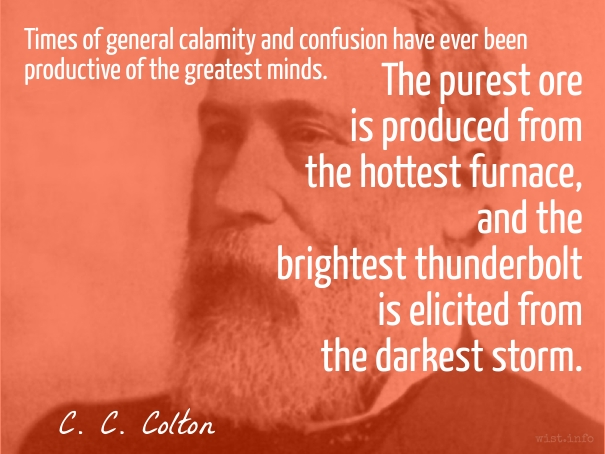
Times of general calamity and confusion have ever been productive of the greatest minds. The purest ore is produced from the hottest furnace, and the brightest thunderbolt is elicited from the darkest storm.
Charles Caleb "C. C." Colton (1780–1832) English cleric, writer, aphorist
Lacon: Or, Many Things in Few Words, Vol. 1, § 28 (1820)
(Source)
The sun should not set upon our anger, neither should he rise upon our confidence. We should freely forgive, but forget rarely. I will not be revenged, and I owe to my enemy; but I will remember, and this I owe to myself.
Charles Caleb "C. C." Colton (1780–1832) English cleric, writer, aphorist
Lacon: Or, Many Things in Few Words, Vol. 1, § 35 (1820)
(Source)
Ambition is to the mind, what the cap is to the falcon; it blinds us first, and then compels us to tower, by reason of our blindness. But alas, when we are at the summit of a vain ambition, we are also at the depth of real misery. We are placed where time cannot improve, but must impair us; where chance and change cannot befriend, but may betray us; in short, by attaining all we wish, and gaining all we want, we have only reached a pinnacle, where we have nothing to hope, but every thing to fear.
Charles Caleb "C. C." Colton (1780–1832) English cleric, writer, aphorist
Lacon: Or, Many Things in Few Words, Vol. 1, § 37 (1820)
(Source)
None are so fond of secrets as those who do not mean to keep them; such persons covet secrets as a spendthrift covets money, for the purpose of circulation.
Charles Caleb "C. C." Colton (1780–1832) English cleric, writer, aphorist
Lacon: Or, Many Things in Few Words, Vol. 1, § 40 (1820)
(Source)
Pedantry prides herself on being wrong by rules; while common sense is contented to be right without them.
Charles Caleb "C. C." Colton (1780–1832) English cleric, writer, aphorist
Lacon: Or, Many Things in Few Words, Vol. 1, § 48 (1820)
(Source)
The only things in which we can be said to have any property are our actions. Our thoughts may be bad, yet produce no poison; they may be good, yet produce no fruit. Our riches may be taken away from us by misfortune, our reputation by malice, our spirits by calamity, our health by disease, our friends by death. But our actions must follow us beyond the grave; with respect to them alone, we can not say that we shall carry nothing with us when we die, neither that we shall go naked out of the world.
Charles Caleb "C. C." Colton (1780–1832) English cleric, writer, aphorist
Lacon: Or, Many Things in Few Words, Vol. 1, § 52 (1820)
(Source)
It was observed of Elizabeth that she was weak herself, but chose wise counsellors; to which it was replied, that to choose wise counsellors was, in a prince, the highest wisdom.
Charles Caleb "C. C." Colton (1780–1832) English cleric, writer, aphorist
Lacon: Or, Many Things in Few Words, Vol. 1, § 57 (1820)
(Source)
An elegant writer has observed, that wit may do very well for a mistress, but that he should prefer reason for a wife. He that deserts the latter, and gives himself up entirely to the guidance of the former, will certainly fall into many pitfalls and quagmires, like him, who walks by flashes of lightning, rather than by the steady beams of the sun.
Charles Caleb "C. C." Colton (1780–1832) English cleric, writer, aphorist
Lacon: Or, Many Things in Few Words, Vol. 1, § 71 (1820)
(Source)
Ambition makes the same mistake concerning power, that avarice makes concerning wealth; she begins by accumulating power, as a mean to happiness, and she finishes by continuing to accumulate it, as an end.
Charles Caleb "C. C." Colton (1780–1832) English cleric, writer, aphorist
Lacon: Or, Many Things in Few Words, Vol. 1, § 148 (1820)
(Source)
The greatest friend of truth is Time, her greatest enemy is Prejudice, and her constant companion is Humility.
Charles Caleb "C. C." Colton (1780–1832) English cleric, writer, aphorist
Lacon: Or, Many Things in Few Words, Vol. 1, § 158 (1820)
(Source)
Did universal charity prevail, earth would be a heaven, and hell a fable.
Charles Caleb "C. C." Colton (1780–1832) English cleric, writer, aphorist
Lacon: Or, Many Things in Few Words, Vol. 1, § 160 (1820)
(Source)
When you have nothing to say, say nothing; a weak defense strengthens your opponent, and silence is less injurious than a bad reply.
Charles Caleb "C. C." Colton (1780–1832) English cleric, writer, aphorist
Lacon: Or, Many Things in Few Words, Vol. 1, § 183 (1820)
(Source)
When the million applaud you, seriously ask yourself what harm you have done; when they censure you, what good!
Charles Caleb "C. C." Colton (1780–1832) English cleric, writer, aphorist
Lacon: Or, Many Things in Few Words, Vol. 1, § 183 (1820)
(Source)
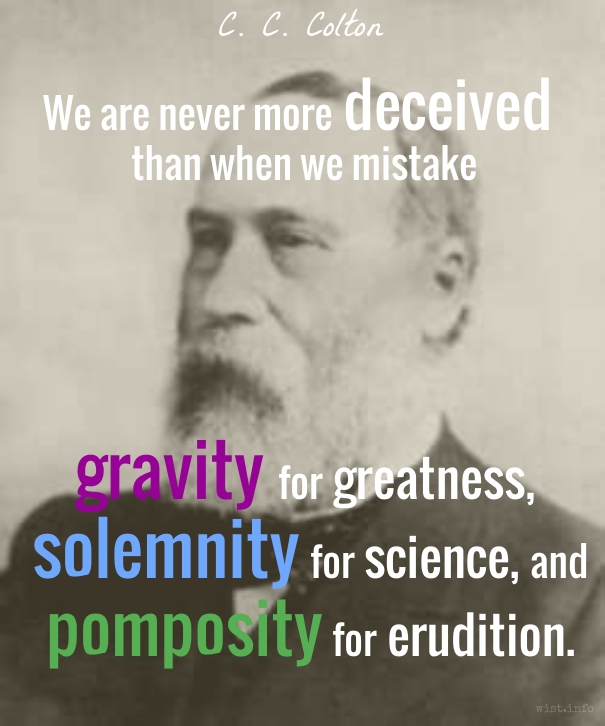
A harmless hilarity and a buoyant cheerfulness are not infrequent concomitants of genius; and we are never more deceived than when we mistake gravity for greatness, solemnity for science, and pomposity for erudition.
Charles Caleb "C. C." Colton (1780–1832) English cleric, writer, aphorist
Lacon: Or, Many Things in Few Words, Vol. 1, § 202 (1820)
(Source)
Imitation is the sincerest of flattery.
Charles Caleb "C. C." Colton (1780–1832) English cleric, writer, aphorist
Lacon: Or, Many Things in Few Words, Vol. 1, § 217 (1820)
(Source)
This reference predates by several decades the (attributed) Oscar Wilde, "Imitation is the sincerest form of flattery that mediocrity can pay to greatness" (1880s) though a variety of thematically similar quotations came about in the interim. By the 1850s "form" had been soundly fit into the common phrase.
More discussion here: Quote Origin: Imitation Is the Sincerest Form of Flattery That Mediocrity Can Pay To Greatness – Quote Investigator®.
There are two modes of establishing our reputation; to be praised by honest men, and to be abused by rogues. It is best, however, to secure the former, because it will be invariably accompanied by the latter.
Charles Caleb "C. C." Colton (1780–1832) English cleric, writer, aphorist
Lacon: Or, Many Things in Few Words, Vol. 1, § 218 (1820)
(Source)
There is no cruelty so inexorable and unrelenting, as that which proceeds from a bigoted and presumptuous supposition of doing service to God. Under the influence of such hallucination, all common modes of reasoning are perverted, and all general principles are destroyed.
Charles Caleb "C. C." Colton (1780–1832) English cleric, writer, aphorist
Lacon: Or, Many Things in Few Words, Vol. 1, § 222 (1820)
(Source)
There is this difference between those two temporal blessings health and money: money is the most envied, but the least enjoyed; health is the most enjoyed, but the least envied; and this superiority of the latter is still more obvious when we reflect that the poorest man would not part with health for money, but that the richest would gladly part with all their money for health.
Charles Caleb "C. C." Colton (1780–1832) English cleric, writer, aphorist
Lacon: Or, Many Things in Few Words, Vol. 1, § 225 (1820)
(Source)
The liberty we obtain by being members of civilized society, would be licentiousness, if it allowed us to harm others, and slavery, if it prevented us from benefiting ourselves. True liberty, therefore, allows each individual to do all the good he can to himself, without injuring his neighbor.
Charles Caleb "C. C." Colton (1780–1832) English cleric, writer, aphorist
Lacon: Or, Many Things in Few Words, Vol. 1, § 226 (1820)
(Source)
That integrity that lives only on opinion would starve without it; and that theatrical kind of virtue, which requires publicity for its stage, and an applauding world for an audience, could not be depended on in the secrecy of solitude, or the retirement of a desert.
Charles Caleb "C. C." Colton (1780–1832) English cleric, writer, aphorist
Lacon: Or, Many Things in Few Words, Vol. 1, § 236 (1820)
(Source)
This is the tax a man must pay to his virtues, — they hold up a torch to his vices, and render those frailties notorious in him which would have passed without observation in another.
Charles Caleb "C. C." Colton (1780–1832) English cleric, writer, aphorist
Lacon: Or, Many Things in Few Words, Vol. 1, § 237 (1820)
(Source)
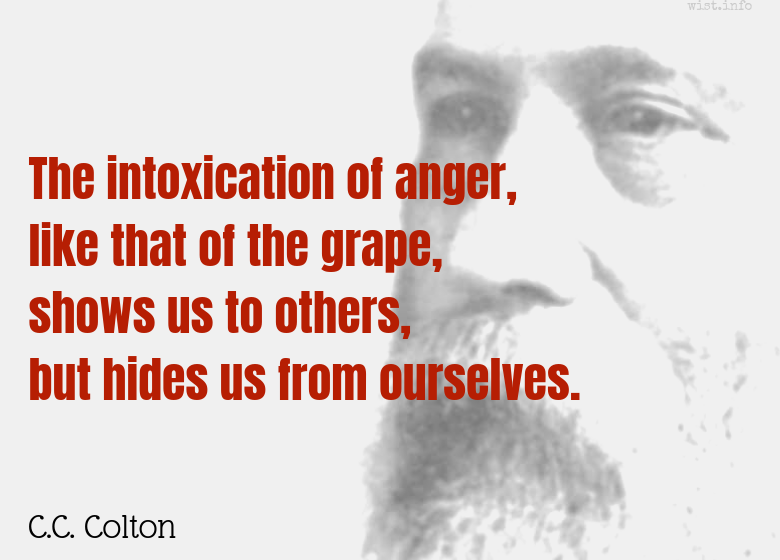
The intoxication of anger, like that of the grape, shows us to others, but hides us from ourselves; and we injure our own cause, in the opinion of the world, when we too passionately and eagerly defend it […] Neither will all men be disposed to view our quarrels precisely in the same light that we do; and a man’s blindness to his own defects will ever increase, in proportion as he is angry with others, or pleased with himself.
Charles Caleb "C. C." Colton (1780–1832) English cleric, writer, aphorist
Lacon: Or, Many Things in Few Words, Vol. 1, § 240 (1820)
(Source)
Mental pleasures never cloy: unlike those of the body, they are increased by repetition, approved of by reflection, and strengthened by enjoyment.
Charles Caleb "C. C." Colton (1780–1832) English cleric, writer, aphorist
Lacon: Or, Many Things in Few Words, Vol. 1, § 246 (1820)
(Source)
Doubt is the vestibule through which all must pass before they can enter into the temple of wisdom.
Charles Caleb "C. C." Colton (1780–1832) English cleric, writer, aphorist
Lacon: Or, Many Things in Few Words, Vol. 1, § 251 (1820)
(Source)
To know a man, observe how he wins his object, rather than how he loses it; for when we fail, our pride supports us; when we succeed, it betrays us.
Charles Caleb "C. C." Colton (1780–1832) English cleric, writer, aphorist
Lacon: Or, Many Things in Few Words, Vol. 1, § 265 (1820)
(Source)
Deliberate with caution, but act with decision; and yield with graciousness, or oppose with firmness.
Charles Caleb "C. C." Colton (1780–1832) English cleric, writer, aphorist
Lacon: Or, Many Things in Few Words, Vol. 1, § 284 (1820)
(Source)
It is always safe to learn, even from our enemies, seldom safe to venture to instruct, even our friends.
Charles Caleb "C. C." Colton (1780–1832) English cleric, writer, aphorist
Lacon: Or, Many Things in Few Words, Vol. 1, § 286 (1820)
(Source)
Posthumous charities are the very essence of selfishness, when bequeathed by those who, when alive, would part with nothing.
Charles Caleb "C. C." Colton (1780–1832) English cleric, writer, aphorist
Lacon: Or, Many Things in Few Words, Vol. 1, § 314 (1820)
(Source)
Examinations are formidable even to the best prepared, for the greatest fool may ask more than the wisest man can answer.
Charles Caleb "C. C." Colton (1780–1832) English cleric, writer, aphorist
Lacon: Or, Many Things in Few Words, Vol. 1, § 322 (1820)
(Source)
When young, we trust ourselves too much, and we trust others too little when old. Rashness is the error of youth, timid caution of age.
Charles Caleb "C. C." Colton (1780–1832) English cleric, writer, aphorist
Lacon: Or, Many Things in Few Words, Vol. 1, § 363 (1820)
(Source)
The firmest friendships have been formed in mutual adversity; as iron is most strongly united by the fiercest flame.
Charles Caleb "C. C." Colton (1780–1832) English cleric, writer, aphorist
Lacon: Or, Many Things in Few Words, Vol. 1, § 365 (1820)
(Source)
There are some truths, the force and validity of which we readily admit, in all cases except our own; and there are other truths so self-evident that we dare not deny them, but so dreadful, that we dare not believe them.
Charles Caleb "C. C." Colton (1780–1832) English cleric, writer, aphorist
Lacon: Or, Many Things in Few Words, Vol. 1, § 370 (1820)
(Source)
Many speak the truth, when they say that they despise riches and preferment, but they mean the riches and preferment possessed by other men.
Charles Caleb "C. C." Colton (1780–1832) English cleric, writer, aphorist
Lacon: Or, Many Things in Few Words, Vol. 1, § 371 (1820)
(Source)
If the weakness of the head were an admissible excuse for the malevolence of the heart, the one-half of mankind would be occupied in aggression, and the other half in forgiveness; but the interests of society peremptorily demand that things should not be so; for a fool is often as dangerous to deal with as a knave, and always more incorrigible.
Rats and conquerors must expect no mercy in misfortune.
Charles Caleb "C. C." Colton (1780–1832) English cleric, writer, aphorist
Lacon: Or, Many Things in Few Words, Vol. 1, § 400 (1820)
(Source)
He that dies a martyr proves that he is not a knave, but by no means that he is not a fool.
Charles Caleb "C. C." Colton (1780–1832) English cleric, writer, aphorist
Lacon: Or, Many Things in Few Words, Vol. 1, § 410 (1820)
(Source)
Of governments, that of the mob is the most sanguinary, that of soldiers the most expensive, and that of civilians the most vexatious.
Charles Caleb "C. C." Colton (1780–1832) English cleric, writer, aphorist
Lacon: Or, Many Things in Few Words, Vol. 1, § 411 (1820)
(Source)
Applause is the spur of noble minds, the end and aim of weak ones.
Charles Caleb "C. C." Colton (1780–1832) English cleric, writer, aphorist
Lacon: Or, Many Things in Few Words, Vol. 1, § 424 (1820)
(Source)
Attempts at reform, when they fail, strengthen despotism; as he that struggles tightens those cords he does not succeed in breaking.
Charles Caleb "C. C." Colton (1780–1832) English cleric, writer, aphorist
Lacon: Or, Many Things in Few Words, Vol. 1, § 440 (1820)
(Source)
A revengeful knave will do more than he will say; a grateful one will say more than he will do.
Charles Caleb "C. C." Colton (1780–1832) English cleric, writer, aphorist
Lacon: Or, Many Things in Few Words, Vol. 1, § 441 (1820)
(Source)
The whole family of pride and ignorance are incestuous, and mutually beget each other.
Charles Caleb "C. C." Colton (1780–1832) English cleric, writer, aphorist
Lacon: Or, Many Things in Few Words, Vol. 1, § 443 (1820)
(Source)
He that is good will infallibly become better, and he that is bad will as certainly become worse; for vice, virtue, and time are three things that never stand still.
Charles Caleb "C. C." Colton (1780–1832) English cleric, writer, aphorist
Lacon: Or, Many Things in Few Words, Vol. 1, § 457 (1820)
(Source)
Despotism can no more exist in a nation until the liberty of the press be destroyed, than night can happen before the sun is set.
Charles Caleb "C. C." Colton (1780–1832) English cleric, writer, aphorist
Lacon: Or, Many Things in Few Words, Vol. 1, § 468 (1820)
(Source)
He that will believe only what he can fully comprehend, must have a very long head, or a very short creed.
Charles Caleb "C. C." Colton (1780–1832) English cleric, writer, aphorist
Lacon: Or, Many Things in Few Words, Vol. 1, § 470 (1820)
(Source)
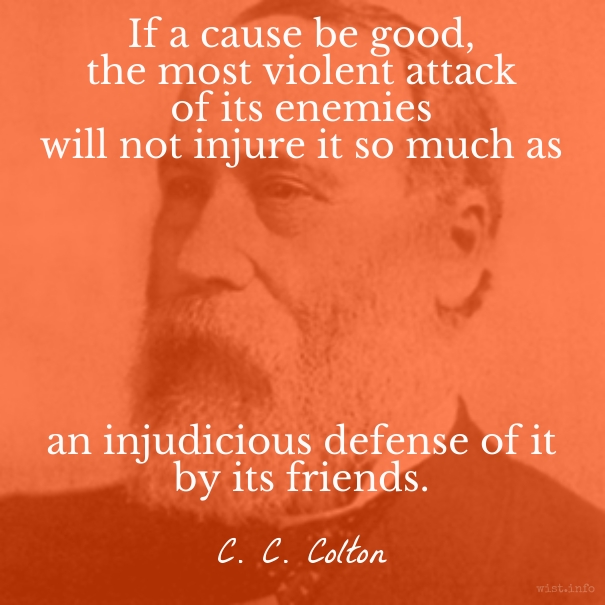
He that has never known adversity is but half acquainted with others, or with himself. Constant success shows us but one side of the world. For, as it surrounds us with friends, who will tell us only our merits, so it silences those enemies from whom alone we can learn our defects.
Charles Caleb "C. C." Colton (1780–1832) English cleric, writer, aphorist
Lacon: Or, Many Things in Few Words, Vol. 1, § 513 (1820)
(Source)
Most of our misfortunes are more supportable than the comments of our friends upon them.
Charles Caleb "C. C." Colton (1780–1832) English cleric, writer, aphorist
Lacon: Or, Many Things in Few Words, Vol. 1, § 517 (1820)
(Source)
Power will intoxicate the best hearts, as wine the strongest heads. No man is wise enough, nor good enough, to be trusted with unlimited power; for, whatever qualifications he may have evinced to entitle him to the possession of so dangerous a privilege, yet when possessed, others can no longer answer for him, because he can no longer answer for himself.
Charles Caleb "C. C." Colton (1780–1832) English cleric, writer, aphorist
Lacon: Or, Many Things in Few Words, Vol. 1, § 522 (1820)
(Source)
There are two things which ought to teach us to think but meanly of human glory: the very best have had their calumniators, the very worst their panegyrists.
Charles Caleb "C. C." Colton (1780–1832) English cleric, writer, aphorist
Lacon: Or, Many Things in Few Words, Vol. 1, § 523 (1820)
(Source)
Most men know what they hate, few what they love.
Charles Caleb "C. C." Colton (1780–1832) English cleric, writer, aphorist
Lacon: Or, Many Things in Few Words, Vol. 1, § 525 (1820)
(Source)
It is only when the rich are sick that they fully feel the impotence of wealth.
Charles Caleb "C. C." Colton (1780–1832) English cleric, writer, aphorist
Lacon: Or, Many Things in Few Words, Vol. 1, § 538 (1820)
(Source)
Custom is the law of one description of fools, and fashion of another; but the two parties often clash; for precedent is the legislator of the first, and novelty of the last.
Charles Caleb "C. C." Colton (1780–1832) English cleric, writer, aphorist
Lacon: Or, Many Things in Few Words, Vol. 1, § 547 (1820)
(Source)
Some read to think, these are rare; some to write, these are common; and some read to talk, and these form the great majority.
Charles Caleb "C. C." Colton (1780–1832) English cleric, writer, aphorist
Lacon: Or, Many Things in Few Words, Vol. 1, § 554 (1820)
(Source)
The two most precious things on this side the grave are our reputation and our life. But it is to be lamented that the most contemptible whisper may deprive us of the one, and the weakest weapon of the other. A wise man, therefore, will be more anxious to deserve a fair name than to possess it, and this will teach him so to live as not to be afraid to die.
Charles Caleb "C. C." Colton (1780–1832) English cleric, writer, aphorist
Lacon: Or, Many Things in Few Words, Vol. 1, § 555 (1820)
(Source)
Habit will reconcile us to every thing but change, and even to change, if it recur not too quickly.
Charles Caleb "C. C." Colton (1780–1832) English cleric, writer, aphorist
Lacon: Or, Many Things in Few Words, Vol. 1, § 558 (1820)
(Source)
There are three difficulties in authorship; — to write any thing worth the publishing — to find honest men to publish it — and to get sensible men to read it.
Charles Caleb "C. C." Colton (1780–1832) English cleric, writer, aphorist
Lacon: Or, Many Things in Few Words, Vol. 1, Preface (1820)
(Source)
We should have a glorious conflagration if all who cannot put fire into their works would only consent to put their works into the fire.
Charles Caleb "C. C." Colton (1780–1832) English cleric, writer, aphorist
Lacon: Or, Many Things in Few Words, Vol. 1, Preface (1820)
(Source)
He that studies books alone, will know how things ought to be; and he that studies men will know how things are.
Charles Caleb "C. C." Colton (1780–1832) English cleric, writer, aphorist
Lacon: Or, Many Things in Few Words, Vol. 1, Preface (1820)
(Source)
If we can advance any propositions that are both true and new, these are indisputably our own, by right of discovery; and if we can repeat what is old more briefly and brightly than others, this also becomes our own, by right of conquest.
Charles Caleb "C. C." Colton (1780–1832) English cleric, writer, aphorist
Lacon: Or, Many Things in Few Words, Vol. 1, Preface (1820)
(Source)
With books, as with companions, it is of more consequence to know which to avoid, than which to chuse; for good books are as scarce as good companions, and in both instances, all that we can learn from bad ones, is, that so much time has been worse than thrown away.
Charles Caleb "C. C." Colton (1780–1832) English cleric, writer, aphorist
Lacon: Or, Many Things in Few Words, Vol. 1, Preface (1820)
(Source)
Although the proportion of those who do think be extremely small, yet every individual flatters himself that he is one of the number.
Charles Caleb "C. C." Colton (1780–1832) English cleric, writer, aphorist
Lacon: Or, Many Things in Few Words, Vol. 1, Preface (1820)
(Source)
Corruption is like a ball of snow, when once set a rolling it must increase. It gives momentum to the activity of the knave, but it chills the honest man, and makes him almost weary of his calling: and all that corruption attracts, it also retains, for it is easier not to fall, than only to fall once, and not to yield a single inch than having yielded to regain it.
Charles Caleb "C. C." Colton (1780–1832) English cleric, writer, aphorist
Lacon: Or, Many Things in Few Words, Vol. 2, § 6 (1822)
(Source)

Pedantry crams our heads with learned lumber, and takes out our brains to make room for it.
Charles Caleb "C. C." Colton (1780–1832) English cleric, writer, aphorist
Lacon: Or, Many Things in Few Words, Vol. 2, § 20 (1822)
(Source)
Power multiplies flatterers, and flatterers multiply our delusions by hiding us from ourselves.
Charles Caleb "C. C." Colton (1780–1832) English cleric, writer, aphorist
Lacon: Or, Many Things in Few Words, Vol. 2, § 25 (1822)
(Source)
Life often presents us with a choice of evils, rather than of goods.
Charles Caleb "C. C." Colton (1780–1832) English cleric, writer, aphorist
Lacon: Or, Many Things in Few Words, Vol. 2, § 102 (1822)
(Source)
Death is like thunder in two particulars; we are alarmed at the sound of it; and it is formidable only from that which preceded it.
Charles Caleb "C. C." Colton (1780–1832) English cleric, writer, aphorist
Lacon: Or, Many Things in Few Words, Vol. 2, § 110 (1822)
(Source)
A prodigal starts with ten thousand pounds, and dies worth nothing; a miser starts with nothing, and does worth ten thousand pounds. It has been asked which has had the best of it? I should presume the prodigal; he has spent a fortune — but the miser has only left one; — he has lived rich, to die poor; the miser has lived poor, to die rich; and if the prodigal quits life in debt to others, the miser quits it, still deeper in debt to himself.
Charles Caleb "C. C." Colton (1780–1832) English cleric, writer, aphorist
Lacon: Or, Many Things in Few Words, Vol. 2, § 131 (1822)
(Source)
Religion has treated knowledge sometimes as an enemy, sometimes as a hostage; often as a captive and more often as a child; but knowledge has become of age and religion must either renounce her acquaintance , or introduce her as a companion and respect her as a friend.
Charles Caleb "C. C." Colton (1780–1832) English cleric, writer, aphorist
Lacon: Or, Many Things in Few Words, Vol. 2, § 141 (1822)
(Source)
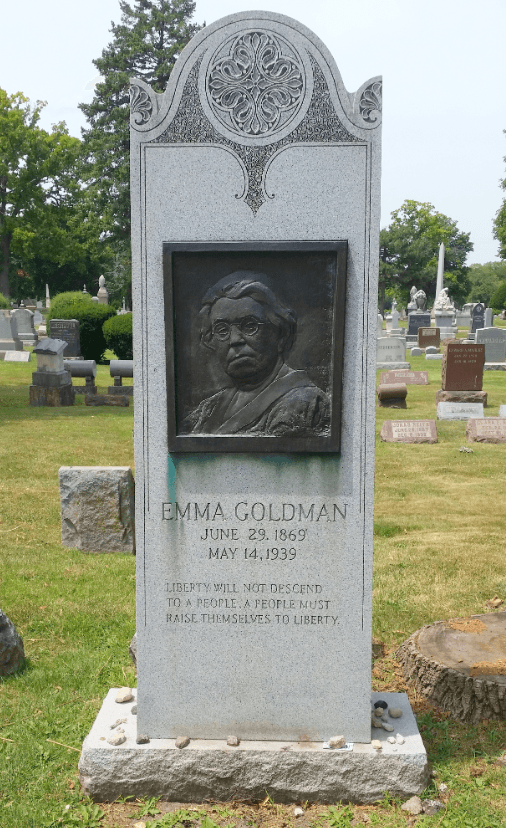
Liberty will not descend to a people; a people must raise themselves to liberty; it is a blessing that must be earned before it can be enjoyed.
Charles Caleb "C. C." Colton (1780–1832) English cleric, writer, aphorist
Lacon: Or, Many Things in Few Words, Vol. 2, § 178 (1822)
(Source)
Epitaph on Emma Goldman's gravestone in Forest Park, Illinois. Often attributed to her (even under the same book name).
Death is the liberator of him whom freedom cannot release, the physician of him whom medicine cannot cure, and the comforter of him whom time cannot console.
Charles Caleb "C. C." Colton (1780–1832) English cleric, writer, aphorist
Lacon: Or, Many Things in Few Words, Vol. 2, § 200 (1822)
(Source)
Pride either finds a desert, or makes one; submission cannot tame its ferocity, nor satiety fill its voracity, and it requires very costly food — Its keeper’s happiness.
Charles Caleb "C. C." Colton (1780–1832) English cleric, writer, aphorist
Lacon: Or, Many Things in Few Words, Vol. 2, § 237 (1822)
(Source)
Evils in the journey of life are like the hills which alarm travelers on their road. Both appear great at a distance, but when we approach them we find they are far less insurmountable than we had conceived.
Charles Caleb "C. C." Colton (1780–1832) English cleric, writer, aphorist
Lacon: Or, Many Things in Few Words, Vol. 2, § 241 (1822)
(Source)
Bed is a bundle of paradoxes; we go to it with reluctance, yet we quit it with regret; and we make up our minds every night to leave it early, but we make up our bodies every morning to keep it late.
Charles Caleb "C. C." Colton (1780–1832) English cleric, writer, aphorist
Lacon: Or, Many Things in Few Words, Vol. 2, § 262 (1822)
(Source)
Of present fame think little, and of future less; the praises that we receive after we are buried, like the posies that are strewed over our grave, may be gratifying to the living, but they are nothing to the dead; the dead are gone, either to a place where they hear them not, or where, if they do, they will despise them.
Charles Caleb "C. C." Colton (1780–1832) English cleric, writer, aphorist
Lacon: Or, Many Things in Few Words, Vol. 2, § 277 (1822)
(Source)