If an idiot were to tell you the same story every day for a year, you would end by believing it.
Edmund Burke (1729–1797) Anglo-Irish statesman, orator, philosopher
(Attributed)
(Source)
Quoted without citation in John Frederick Boyes, Lacon in Council, "Literature, Poetry, Oratory, Genius, &c." (1865). That is the earliest reference I could find for this quote.
Sometimes misattributed to Horace Mann.
Quotations about:
misinformation
Note not all quotations have been tagged, so Search may find additional quotes on this topic.
There’s no excuse for spreading misinformation just because it comes from someone in a high place.
Molly Ivins (1944–2007) American writer, political columnist [Mary Tyler Ivins]
Essay (1973-01), “Pitfalls of Reporting in the Lone Star State,” Houston Journalism Review
(Source)
Collected in Molly Ivins Can't Say That, Can She? (1991).

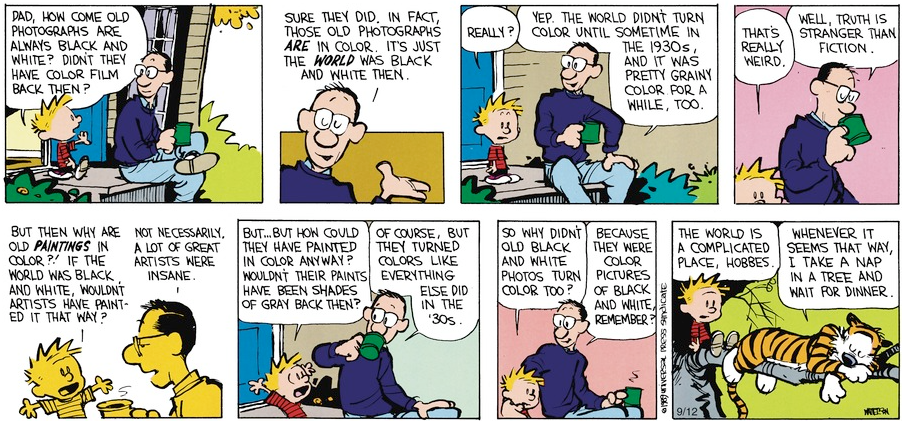
CALVIN: Dad, how come old photographs are always black and white? Didn’t they have color film back then?
CALVIN’S DAD: Sure they did. In fact, those old photographs are in color. It’s just the world was black and white then.
CALVIN: Really?
CALVIN’S DAD: Yep. The world didn’t turn color until sometime in the 1930s, and it was pretty grainy color for a while, too.
CALVIN: That’s really weird.
CALVIN’S DAD: Well, truth is stranger than fiction.
CALVIN: But then why are old paintings in color?! If the world was black and white, wouldn’t artists have painted it that way?
CALVIN’S DAD: Not necessarily. A lot of great artists were insane.
CALVIN: But … but how could they have painted in color anyway? Wouldn’t their paints have been shades of gray back then?
CALVIN’S DAD: Of course, but they turned colors like everything did in the ’30s.
CALVIN: So why didn’t old black and white photos turn color, too?
CALVIN’S DAD: Because they were color pictures of black and white, remember?
CALVIN [Later, in a tree]: The world is a complicated place, Hobbes.
HOBBES: Whenever it seems that way, I take a nap in a tree and wait for dinner.

It is almost as difficult to make a man unlearn his errors as his knowledge. Mal-information is more hopeless than non-information; for error is always more busy than ignorance. Ignorance is a blank sheet, on which we may write; but error is a scribbled one, on which we must first erase. Ignorance is contented to stand still with her back to the truth; but error is more presumptuous, and proceeds in the same direction. Ignorance has no light, but error follows a false one. The consequence is, that error, when she retraces her footsteps, has further to go, before she can arrive at the truth, than ignorance.
Charles Caleb "C. C." Colton (1780–1832) English cleric, writer, aphorist
Lacon: Or, Many Things in Few Words, Vol. 1, § 1 (1820)
(Source)
It is a melancholy truth that a suppression of the press could not more compleatly deprive the nation of its benefits, than is done by its abandoned prostitution to falsehood. Nothing can now be believed which is seen in a newspaper. Truth itself becomes suspicious by being put into that polluted vehicle. […] I will add that the man who never looks into a newspaper is better informed than he who reads them; inasmuch as he who knows nothing is nearer to truth than he whose mind is filled with falsehoods & errors. He who reads nothing will still learn the great facts, and the details are all false.
Thomas Jefferson (1743–1826) American political philosopher, polymath, statesman, US President (1801–09)
Letter (1807-06-11) to John Norvell
(Source)
The people never give up their liberties but under some delusion.
Edmund Burke (1729–1797) Anglo-Irish statesman, orator, philosopher
Speech, Buckinghamshire (1784)
The average “educated” American has been made to believe that, somehow, the United States must lead the world even though hardly anyone has any information at all about those countries we are meant to lead. Worse, we have very little information about our own country and its past.
Gore Vidal (1925–2012) American novelist, dramatist, critic
“William Dean Howells” (1983)

At any given moment, public opinion is a chaos of superstition, misinformation, and prejudice.
Gore Vidal (1925–2012) American novelist, dramatist, critic
“Sex and the Law,” Partisan Review (Summer 1965)
I believe that ignorance is the root of all evil. And that no one knows the truth. I believe that the people is not dumb. Ignorant, bigoted, and mean-minded, maybe, but not stupid. I just think it helps, anything and everything, if the people know. Know what the hell is going on. What they do about it once they know is not my problem.
Molly Ivins (1944–2007) American writer, political columnist [Mary Tyler Ivins]
Essay (1973-01), “Pitfalls of Reporting in the Lone Star State,” Houston Journalism Review
(Source)
Her journalistic credo. Collected in Molly Ivins Can't Say That, Can She? (1991).
I honestly beleave it iz better tew know nothing than two know what ain’t so.
[I honestly believe it is better to know nothing than to know what ain’t so.]
Josh Billings (1818–1885) American humorist, aphorist [pseud. of Henry Wheeler Shaw]
Everybody’s Friend, Or; Josh Billing’s Encyclopedia and Proverbial Philosophy of Wit and Humor, “Sollum Thoughts” (1874)
(Source)
This was Billings signature aphorism, and he used variations on multiple occasions. Variants and evolutions have also been misattributed to Will Rogers, Mark Twain, and Artemus Ward, sometimes from their own paraphrases of Billings. Some variations (usually without specific citations) include:In a similar vein, Billings wrote, "Wisdum don't konsist in knowing more that iz new, but in knowing less that iz false. [Wisdom doesn't consist in knowing more that is new, but in knowing less than is false.]" [Source]
- "The trouble with people is not that they don't know but that they know so much that ain't so."
- "It ain't what you don't know that gets you into trouble. It's what you know for sure that just ain't so."
- "You’d better not know so much, than know so many things that ain’t so."
More discussion about this quotation:
- It Ain’t What You Don’t Know That Gets You Into Trouble. It’s What You Know for Sure That Just Ain’t So – Quote Investigator
- Ralph Keyes, The Quote Verifier (2006)
- Ralph Keyes, Nice Guys Finish Seventh (1992)
- James Billington, Respectfully Yours (1993)
- Daniel Levitin, A Field Guide to Lies, Deluxe Ed. (2016)
Perhaps an editor might begin a reformation in some such way as this. divide his paper into 4. chapters, heading the 1st. Truths. 2d. Probabilities. 3d. Possibilities. 4th. Lies. The 1st. chapter would be very short, as it would contain little more than authentic papers, and information from such sources as the editor would be willing to risk his own reputation for their truth. The 2d. would contain what, from a mature consideration of all circumstances, his judgment should conclude to be probably true. This however should rather contain too little than too much. The 3d. & 4th. should be professedly for those readers who would rather have lies for their money than the blank paper they would occupy.
Thomas Jefferson (1743–1826) American political philosopher, polymath, statesman, US President (1801–09)
Letter (1807-06-14) to John Norvell
(Source)
The history of Western science confirms the aphorism that the great menace to progress is not ignorance but the illusion of knowledge.
Daniel J. Boorstin (1914–2004) American historian, professor, attorney, writer
Speech (1992-08-31), “Realms of Discovery, Old and New,” World Space Congress, Washington, D.C.
(Source)
Collected in his Cleopatra's Nose: Essays on the Unexpected, Part 1, ch. 1 "The Age of Negative Discovery" (1995).
In Carol Krucoff, "The 6 O'Clock Scholar," Washington Post (1984-01-29), he is quoted:The greatest obstacle to discovery is not ignorance -- it is the illusion of knowledge.
See Billings (1874).
Always use the chain of command to issue orders, but if you use the chain of command for information, you’re dead.
Hyman Rickover (1900–1986) Polish-American naval engineer, admiral [b. Chaim Gdala Rykower]
(Attributed)
(Source)
Recalled by James Woolsey, at the time CIA Director (1993-1995), as something said to him by Rickover; in "You've Got To Talk To The Smokers," Newsweek (1994-10-09).
Though this is the form and citation most usually given for this quote, Woolsey had previously attributed a lengthier version to Rickover, though it was not recorded with quotation marks. After having served as Under Secretary of the Navy (1977-1979, during which he presumably interacted with Rickover, who retired in 1983), Woolsey spoke at the "Creativity and Innovation in Bureaucracy" symposium at the National Defense University, Washington, DC, in the panel "Creative Approaches to National Security" (1983-10-27):Hyman G. Rickover used to say, when you give an order in any military circumstance, make sure you use the chain of command. But if you rely on the chain of command for information, you're dead. I think there's a great deal of truth in that.