Talk not much with a fool, and go not to him that hath no understanding: beware of him, lest thou have trouble, and thou shalt never be defiled with his fooleries: depart from him, and thou shalt find rest, and never be disquieted with madness.
[μετὰ ἄφρονος μὴ πληθύνῃς λόγον
καὶ πρὸς ἀσύνετον μὴ πορεύου·
φύλαξαι ἀπ᾽ αὐτοῦ, ἵνα μὴ κόπον ἔχῃς
καὶ οὐ μὴ μολυνθῇς ἐν τῷ ἐντιναγμῷ αὐτοῦ·
ἔκκλινον ἀπ᾽ αὐτοῦ καὶ εὑρήσεις ἀνάπαυσιν
καὶ οὐ μὴ ἀκηδιάσῃς ἐν τῇ ἀπονοίᾳ αὐτοῦ.]The Bible (The Old Testament) (14th - 2nd C BC) Judeo-Christian sacred scripture [Tanakh, Hebrew Bible], incl. the Apocrypha (Deuterocanonicals)
Book 22b. Sirach (Ecclesiasticus) 22:13 (Sir 22:13) [tr. KJV (1611)]
(Source)
Some translations note that the Septuagent includes, after the first sentence, e.g., "When people are senseless, they will bring everything of yours to nothing" or "For being without sense he will despise everything about you."
More on the history and acceptance of this Apocryphal book here and here.
(Source (Greek)). Alternate translations:Talk not much with a fool, and go not with him that hath no sense.
Keep thyself from him, that thou mayst not have trouble, and thou shalt not be defiled with his sin.
Turn away from him, and thou shalt find rest, and shalt not be wearied out with his folly.
[tr. DRA (1899), 22:14-16]Do not waste many words on a stupid man,
do not go near a dolt.
Beware of him, or he will give you trouble;
and will leave you soiled by contact with him.
Avoid him, and you will find rest
and not be exasperated by his folly.
[tr. JB (1966)]Do not waste many words on the stupid,
do not go near a dolt.
Beware of him, or you will have trouble
and be soiled by contact with him;
keep away from him, and you will have peace of mind
and not be exasperated by his folly.
[tr. NJB (1985)]Don't visit stupid people or spend a lot of time talking with them. Avoid them; then they can't contaminate you, and you can live in peace without being troubled or worn down by their foolishness.
[tr. GNT (1992 ed.)]Don’t talk a lot with fools,
and don’t go to the unintelligent.
Be on guard against them
so that you don’t have trouble
and don’t get dirty
when they shake themselves off.
Stay away from them
and you will find rest,
and their senselessness
class="tab">won’t make you weary.[tr. CEB (2011)]Do not talk much with senseless people
or visit unintelligent people.
Stay clear of them, or you may have trouble
and be spattered when they shake themselves off.
Avoid them and you will find rest,
and you will never be wearied by their lack of sense.
[tr. NRSV (2021 ed.)]
Quotations about:
idiocy
Note not all quotations have been tagged, so Search may find additional quotes on this topic.

The effect of continually reading inferior newspapers, or hearing trivial sermons, is not so mischievous by its direct influence upon our thoughts, as it is by gradually making us fancy that the poorest thoughts may be worth public expression.
John Frederick Boyes (1811–1879) English scholar, classicist
Lacon in Council, “Literature, Poetry, Oratory, Genius, &c.” (1865)
(Source)

If an idiot were to tell you the same story every day for a year, you would end by believing it.
Edmund Burke (1729–1797) Anglo-Irish statesman, orator, philosopher
(Attributed)
(Source)
Quoted without citation in John Frederick Boyes, Lacon in Council, "Literature, Poetry, Oratory, Genius, &c." (1865). That is the earliest reference I could find for this quote.
Sometimes misattributed to Horace Mann.

There are more fools than wise men, and even in the wise there is more folly than wisdom.
[Il y a plus de fous que de sages, et dans le sage même, il y a plus de folie que de sagesse.]
Nicolas Chamfort (1741–1794) French writer, epigrammist (b. Nicolas-Sébastien Roch)
Products of Perfected Civilization [Produits de la Civilisation Perfectionée], Part 1 “Maxims and Thoughts [Maximes et Pensées],” ch. 2, ¶ 149 (1795) [tr. Merwin (1969)]
(Source)
(Source (French)). Alternate translations:There are more fools than wise men, and even in the wise man himself there is more folly than wisdom.
[tr. Hutchinson (1902)]There are more fools than wise men, and even in a wise man there is more folly than wisdom.
[tr. Mathers (1926)]There are more fools than wise people, and in wise people themselves there is more folly than wisdom.
[tr. Siniscalchi (1994)]

IDIOT, n. A member of a large and powerful tribe whose influence in human affairs has always been dominant and controlling. The Idiot’s activity is not confined to any special field of thought or action, but “pervades and regulates the whole.” He has the last word in everything; his decision is unappealable. He sets the fashions of opinion and taste, dictates the limitations of speech and circumscribes conduct with a dead-line.
Ambrose Bierce (1842–1914?) American writer and journalist
“Idiot,” The Cynic’s Word Book (1906)
(Source)
Included in The Devil's Dictionary (1911). Originally published in the "Devil's Dictionary" column in the San Francisco Wasp (1885-08-29).

The ratio of damn fools to villains is high.

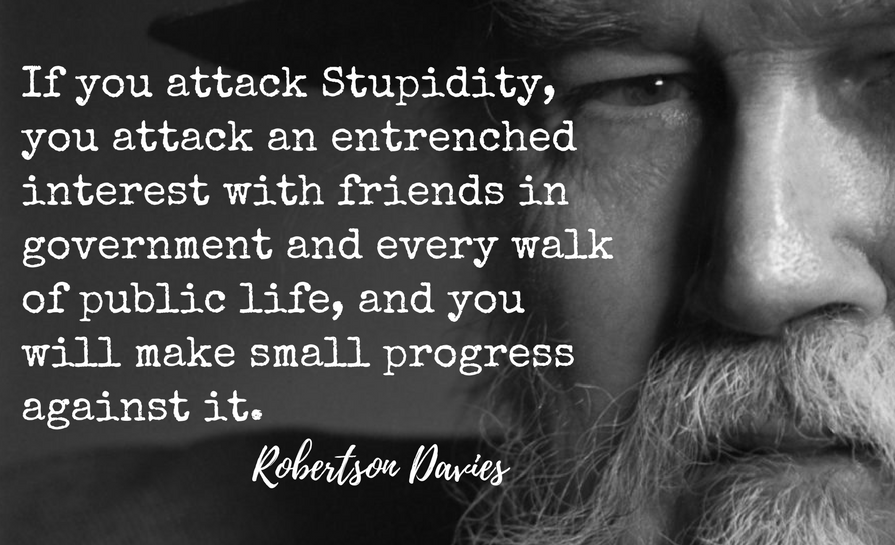
If you attack Stupidity, you attack an entrenched interest with friends in government and every walk of public life, and you will make small progress against it.
Robertson Davies (1913–1995) Canadian author, editor, publisher
The Table Talk of Samuel Marchbanks (1949)
(Source)

It is safe to wager that every public idea and every accepted convention is sheer foolishness, because it has suited the majority.
[Il y a à parier que toute idée publique, toute convention reçue, est une sottise, car elle a convenu au plus grand nombre.]
Nicolas Chamfort (1741–1794) French writer, epigrammist (b. Nicolas-Sébastien Roch)
Products of Perfected Civilization [Produits de la Civilisation Perfectionée], Part 1 “Maxims and Thoughts [Maximes et Pensées],” ch. 2, ¶ 130 (1795) [tr. Mathers (1926)]
(Source)
(Source (French)). Other translations:It may be argued that every public idea, every accepted convention, is a piece of stupidity, for has it not commended itself to the greatest number?
[tr. Hutchinson (1902), "The Cynic's Breviary"]One can be certain that every generally held idea, every received notion, will be an idiocy, because it has been able to appeal to a majority.
[In Botton, Status Anxiety (2004)]It is likely that every public idea, every received convention, is folly, because the majority of men consented to it.
[Siniscalchi (1994)]
There’s a fine line between audacity and idiocy.
Jim Butcher (b. 1971) American author
Turn Coat (2009)

Most Fools think they are only ignorant.
Benjamin Franklin (1706–1790) American statesman, scientist, philosopher, aphorist
Poor Richard Improved (1748 ed.)
(Source)
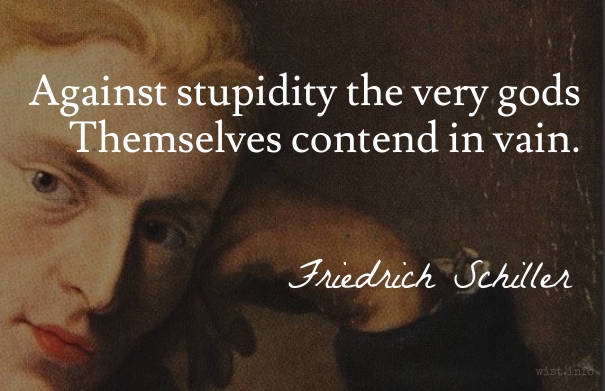
Against stupidity the very gods
Themselves contend in vain.[Mit der Dummheit kämpfen Götter selbst vergebens]
Friedrich Schiller (1759–1805) German poet, playwright, critic [Johann Christoph Friedrich von Schiller]
The Maid of Orleans [Die Jungfrau von Orleans], Act III, sc. vi (1801) [tr. Swanwick]Alt. trans:
- "Against stupidity the gods themselves contend in vain."
- "Against stupidity the gods themselves labor in vain."
- "Against stupidity the gods themselves fight unvictorious."
- "Against stupidity even the gods contend in vain."
- "With stupidity the gods themselves contend in vain."
- "With stupidity the gods themselves struggle in vain."
The word “idiot” comes from a Greek root meaning private person. Idiocy is the female defect: intent on their private lives, women follow their fate through a darkness deep as that cast by malformed cells in the brain. It is no worse than the male defect, which is lunacy: men are so obsessed by public affairs that they see the world as by moonlight, which shows the outlines of every object but not the details indicative of their nature.
Rebecca West (1892–1983) British author, journalist, literary critic, travel writer [pseud. for Cicily Isabel Fairfield]
Black Lamb and Grey Falcon, Prologue (1941)
(Source)
Sometimes oddly paraphrased, "The main difference between men and women is that men are lunatics and women are idiots."

Nothing is more terrible than ignorance in action.
Johann Wolfgang von Goethe (1749–1832) German poet, statesman, scientist
Sprüche in Prosa: Maximen und Reflexionen [Proverbs in Prose: Maxims and Reflections] (1833) [tr. Saunders (1893)]
(Source)
Goethe's use of this phrase comes up twice in the Maxims and Reflections. Other translations:
From Art and Antiquity, Vol. 5, #3, Individual Points (1826):Es ist nichts schrecklicher als eine tätige Unwissenheit.
(Source (German))Nothing is more terrible than ignorance in action.
[tr. Saunders (1893), "Life and Character," sec. 3, #231]There is nothing more frightful than ignorance in action.
[tr. Rönnfeldt (1900)]There is nothing more dreadful than active ignorance.
[tr. Stopp (1995), #367]
From Wilhelm Meister's Journeyman Years (1829):Auch nichts schrecklicher ist, als die Unwissenheit handeln zu sehen.
(Source(German))There is no more terrible sight than ignorance in action.
[tr. Saunders (1893), "Life and Character," sec. 1, #52]There is nothing more terrible than to see ignorance in action.
[tr. Rönnfeldt (1900)]Nothing is more frightful than to see ignorance in action.
[tr. Stopp (1995), #367]

Never attribute to malice that which is adequately explained by stupidity.
(Other Authors and Sources)
Robert J. Hanlon, “Hanlon’s Razor,” Murphy’s Law, Book Two (ed. A. Bloch) (1980)
Cf. Heinlein (again), Napoleon, Taylor, Bonhoeffer, Colton, and Goethe.
See here for more information, including discussion that "Robert J. Hanlon" may be a corruption or obfuscation of "Robert A. Heinlein."
Various variants in combinations with "ascribe," "what can be," and "incompetence."
Variant ("Aerospace saying"): "Never ascribe something to another cause that can be fully explained by stupidity and mediocrity."