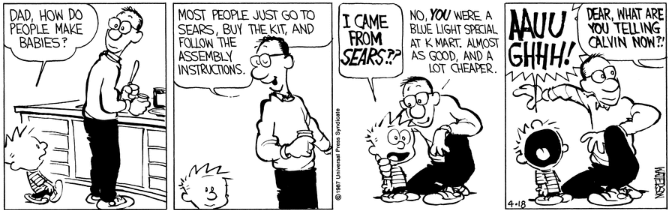
CALVIN: Your polls are slipping Dad. Better get with it.
CALVIN’S DAD: Calvin, being your dad is not an elected position. I don’t have to respond to polls.
CALVIN: Not elected? You mean you can govern with dictatorial impunity?
CALVIN’S DAD: Exactly.
CALVIN: In short, open revolt and exile is the only hope for change?
CALVIN’S DAD: I don’t like the direction this conversation is taking.
Quotations about:
parenting
Note not all quotations have been tagged, so Search may find additional quotes on this topic.
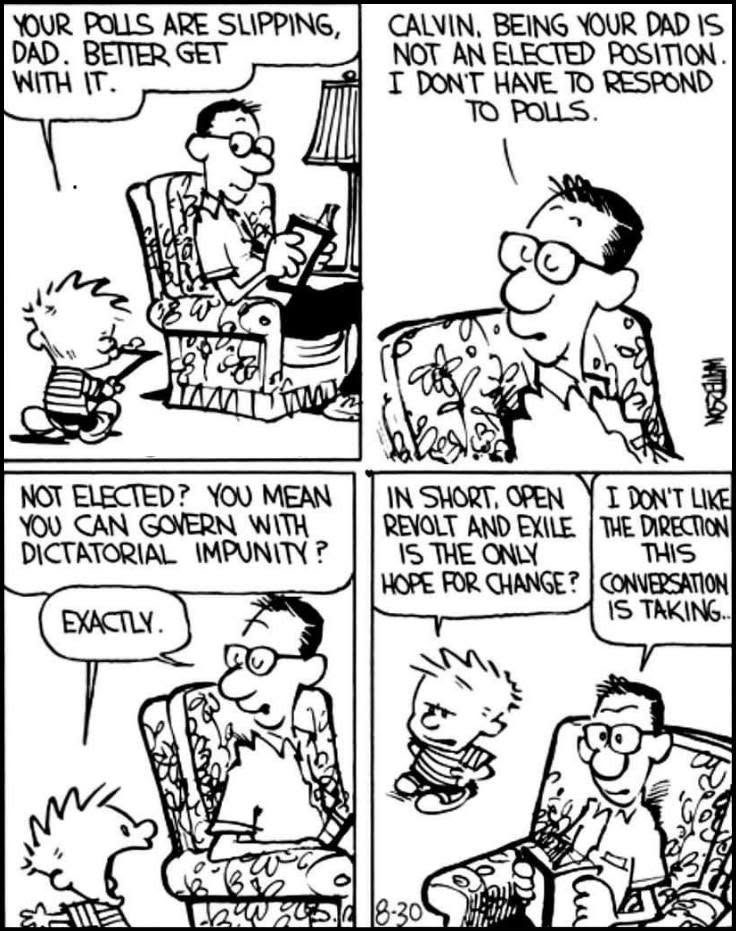

CALVIN: Bad news, Dad. Your polls are way down.
CALVIN’S DAD: My polls?
CALVIN: You rate especially low among tigers and six-year-old white males.
CHORUS: I say that mortals who have no experience
Of and have never had children
Have a better chance for happiness
Than those who bear them.ΚΥΚΛΩΨ: καί φημι βροτῶν οἵτινές εἰσιν
πάμπαν ἄπειροι μηδ᾿ ἐφύτευσαν
παῖδας προφέρειν εἰς εὐτυχίαν
τῶν γειναμένων.Euripides (485?-406? BC) Greek tragic dramatist
Medea [Μήδεια], l. 1090ff (431 BC) [tr. @sentantiq (2020)]
(Source)
By missing out on the burden of how to rear children properly, and bequeathing them an adequate inheritance, all the while not knowing if the children will turn out to be good people or bad ones. Oh, yeah, and they might die prematurely.(Source (Greek)). Other translations:I maintain,
They who in total inexperience live,
Nor ever have been Parents, are more happy
Than they to whom much progeny belongs.
[tr. Wodhull (1782)]This truth to all will I declare,
The free, th' unwedded, those that claim
No title to a father's name,
Uncumber'd with that care,
The paths of life with purer pleasure trace,
Than those that own a numerous race,
Their inexperience yet untaught
Who have no child.
[tr. Potter (1814)]And now I aver that of mortals those
Who have never wed, or known children theirs,
Than parents are happier far.
[tr. Webster (1868)]And amongst mortals I do assert that they who are wholly without experience and have never had children far surpass in happiness those who are parents.
[tr. Coleridge (1891)]And I say that those men who are entirely free from wedlock, and have not begotten children, surpass in happiness those who have families.
[tr. Buckley (1892)]Now this I say — calm bliss, that ne'er
Knew love's wild fever of the blood,
The pains, the joys, of motherhood,
Passeth all parents' joy-blent care.
[tr. Way (Loeb) (1894)]And thus my thought would speak: that she
Who ne'er hath borne a child nor known
Is nearer to felicity.
[tr. Murray (1906)]This I say, that those who have never
Had children, who know nothing of it,
In happiness have the advantage
Over those who are parents.
[tr. Warner (1944)]And this is my opinion: those men or women
Who never had children of their own at all
Enjoy the advantage in good fortune
Over those who are parents.
[tr. Vellacott (1963)]My conclusion is that people
Who’ve never borne children
Are much happier
Than parents.
[tr. Podlecki (1989)]I say that those mortals who are utterly without experience of children and have never borne them have the advantage in good fortune over those who have.
[tr. Kovacs (Loeb) (1994); tr. Kovacs / Zhang / Rogak]And I declare that, in the matter of happiness, those mortals who have produced children are less fortunate than those who have no experience at all of parenthood.
[tr. Davie (1996)]So I have this view that those who have no children, children that they have given birth to and have raised, those people are much happier than those who do have any!
[tr. Theodoridis (2004)]I have come to believe that human beings who
have never had the experience of rearing
children, are much better off than
those of us who are parents.
[tr. Luschnig (2007)]So I can claim that among human beings
those who have no experience of children,
who have never given birth to offspring,
such people have far more happiness
than those who have been parents.
[tr. Johnston (2008)]And I say people who have no experience and no children are far more happy than those who have them.
[tr. Ewans (2022)]I do declare that those among mortals who are wholly without experience of children’s birth far surpass in happiness those who are parents.
[tr. Coleridge / Ceragioli / Nagy / Hour25]
The best way to keep children home is to make it pleasant — and let the air out of the tires.
Dorothy Parker (1893–1967) American writer, poet, wit
(Attributed)
Frequently quoted, but no primary source found or referenced.
When a child enters the world through you, it alters everything on a psychic, psychological and purely practical level. You’re just not free anymore to do what you want to do. And it’s not the same again. Ever.
Jane Fonda (b. 1937) American actress and activist
Interview (1980-11-28) by Danae Brook, “At Home with Tom and Jane,” Los Angeles Weekly
(Source)

Q. Should we discourage children from playing war games?
A. We might wish to discourage them, but it would be utterly useless at the present time, so we might as well give in gracefully and try to see that when war games are played they teach the lessons which we wish our children to learn — fair play, magnanimity in victory, courage in defeat and no hatred of peoples.
Eleanor Roosevelt (1884–1962) American politician, diplomat, activist; First Lady of the US (1933–45)
Column (1942-08), “If You Ask Me,” Ladies’ Home Journal, Vol. 59
(Source)
What do we owe our parents? No man can owe love; none can owe obedience. We owe, I think, chiefly pity; for we are the pledge of their dear and joyful union, we have been the solicitude of their days and the anxiety of their nights, we have made them, though by no will of ours, to carry the burthen of our sins, sorrows, and physical infirmities; and too many of us grow up at length to disappoint the purpose of their lives and requite their care and piety with cruel pangs.
Robert Louis Stevenson (1850–1894) Scottish essayist, novelist, poet
Essay (1880-01/02?), “Reflections and Remarks on Human Life,” § 2.2 “Parent and Child”
(Source)
A collection of aphorisms and musings, first published in the Edinburgh Edition of his Works, vol. 28 (1898).
I have no sympathy with the old idea that children owe such immense gratitude to their parents that they can never fulfill their obligations to them. I think the obligation is all on the other side.
Elizabeth Cady Stanton (1815–1902) American social activist, abolitionist, woman's suffragist
Journal (1880-11-12)
(Source)
No mother is ever, completely, a child’s idea of what a mother should be, and I suppose it works the other way around as well.
Margaret Atwood (b. 1939) Canadian writer, literary critic, environmental activist
The Handmaid’s Tale, ch. 28 (1986)
(Source)

The most assiduous task of parenting is to divine the difference between boundaries and bondage.
Barbara Kingsolver (b. 1955) American novelist, essayist, poet
Essay (1995), “Civil Disobedience at Breakfast,” High Tide in Tucson: Essays from Now or Never
(Source)

Nothing exerts a stronger psychic effect upon the human environment, and especially upon children, than the life which the parents have not lived.
Carl Jung (1875–1961) Swiss psychologist
Lecture (1929-06), “Paracelsus,” Literary Club of Zurich, Paracelsus House, Einsiedeln, Schwyz, Switzerland [tr. Hull (1966)]
(Source)
(Publication notes.) Collected in The Spirit in Man, Art, and Literature, Part 1, "Paracelsus," ¶ 3 (1929).
Come mothers and fathers
Throughout the land
And don’t criticize
What you can’t understand
Your sons and your daughters
Are beyond your command
Your old road is rapidly agin’
Please get out of the new one if you can’t lend your hand
For the times they are a-changin’Bob Dylan (b. 1941) American singer, songwriter
Song (1964), “The Times They Are A-Changin’,” v. 4
(Source)

If you tell children that they ought to be affectionate, you run the risk of producing cant and humbug. But if you make them happy and free, if you surround them with kindness, you will find that they become spontaneously friendly with everybody, and that almost everybody responds by being friendly with them. A trustful affectionate disposition justifies itself, because it gives irresistible charm, and creates the response which it expects. This is one of the most important results to be expected from the right education of character.
Bertrand Russell (1872–1970) English mathematician and philosopher
Education and the Good Life, Part 2, ch. 11 “Affection and Sympathy” (1926)
(Source)

We are being very careful with our children. They’ll never have to pay a psychiatrist twenty-five dollars an hour to find out why we rejected them. We’ll tell them why we rejected them. Because they’re impossible, that’s why.
Jean Kerr (1922–2003) American author and playwright [b. Bridget Jean Collins]
Essay (1957), “Please Don’t Eat the Daisies,” Please Don’t Eat the Daisies
(Source)
The values communicated by status-insecure parents are such that their children learn to put personal success and the acquisition of power above all else. They are taught to judge people for their usefulness rather than their likableness. Their friends, and even future marriage partners, are selected and used in the service of personal advancement; love and affection take second place to knowing the right people. They are taught to eschew weaknesses and passivity, to respect authority, and to despise those who have not made the socio-economic grade. Success is equated with social esteem and material advantage, rather than with more spiritual values.
Norman F. Dixon (1922–2013) British cognitive psychologist, author, military engineer
On the Psychology of Military Incompetence, Part 2, ch. 22 “Authoritarianism” (1976)
(Source)

It’s frightening to think that you mark your children merely by being yourself.
[C’est effrayant de penser qu’on marque ses enfants rien que par ce qu’on est.]
Simone de Beauvoir (1908–1986) French author, existentialist philosopher, feminist theorist
Les Belles Images, ch. 3 (1966) [tr. O’Brian (1968)]
(Source)

To bring up a child in the way he should go, travel that way yourself once in a while.
Josh Billings (1818–1885) American humorist, aphorist [pseud. of Henry Wheeler Shaw]
Josh Billings’ Farmer’s Allminax, 1871-03 “Housekeer’s Guide” (1871 ed.)
(Source)

The fact is, my sweet, every mother spends her time, so soon as her children are out of her sight, in imagining dangers for them. Perhaps it is Armand seizing the razors to play with, or his coat taking fire, or a snake biting him, or he might tumble in running and start and absess on his head, or he might drown himself in a pond. A mother’s life, you see, is one long succession of dramas, now soft and tender, now terrible. Not an hour but has its joys and fears.
[En effet, mon ange, durant le jour, toutes les mères inventent des dangers. Dès que les enfants ne sont plus sous leurs yeux, c’est des rasoirs volés avec lesquels Armand a voulu jouer, le feu qui prend à sa jaquette, un orvet qui peut le mordre, une chute en courant qui peut faire un dépôt à la tête, ou les bassins où il peut se noyer. Comme tu le vois, la maternité comporte une suite de poésies douces ou terribles. Pas une heure qui n’ait ses joies et ses craintes.]
Honoré de Balzac (1799–1850) French novelist, playwright
Letters of Two Brides [Mémoires de deux jeunes mariées], Part 1, letter 45 (1840) [tr. Scott (1897)]
(Source)
(Source (French)). Other translation:To tell the truth, my dearest, during the daytime all mothers invent dangers as soon as the children are out of sight. There are razors for Armand to play with, fire to catch his jacket, a slow-worm to bite him, a fall to bump his head, and ponds to tumble into. So you see that maternity is a series of poems, sweet or terrible as the case may be. There's not an hour which does not have its joys and fears.
[tr. Wormeley (1842), Memoirs of Two Young Married Women]
Tew learn yure offspring to steal, make them beg hard for all that yu giv them.
[To learn your offspring to steal, make them beg hard for all that you give them.]
Josh Billings (1818–1885) American humorist, aphorist [pseud. of Henry Wheeler Shaw]
Josh Billings’ Farmer’s Allminax, 1870-06 “Words Tew Housewifes” (1870 ed.)
(Source)
For my own part, speaking personally, I have found the happiness of parenthood greater than any other that I have experienced.
Bertrand Russell (1872–1970) English mathematician and philosopher
Conquest of Happiness, Part 2, ch. 13 “Family” (1930)
(Source)
Society has always to demand a little more from human beings than it will get in practice. It has to demand faultless discipline and self-sacrifice, it must expect its subjects to work hard, pay their taxes, and be faithful to their wives, it must assume that men think it glorious to die on the battlefield and women want to wear themselves out with child-bearing. The whole of what one may call official literature is founded on such assumptions.
George Orwell (1903–1950) English journalist, essayist, writer [pseud. of Eric Arthur Blair]
Essay (1941-09), “The Art of Donald McGill,” Horizon Magazine
(Source)
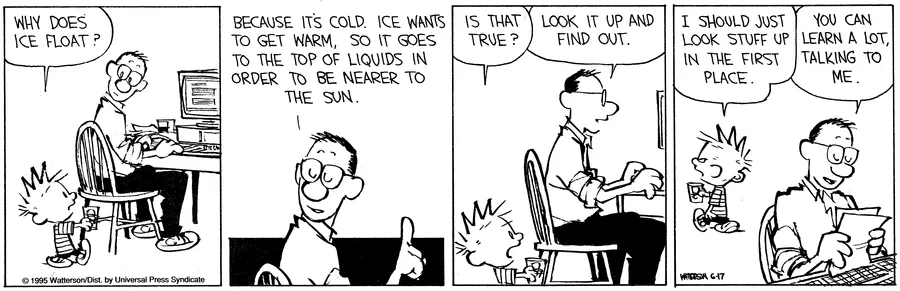
CALVIN: Why does ice float?
CALVIN’S DAD: Because it’s cold. Ice wants to get warm, so it goes to the top of liquids in order to be nearer to the sun.
CALVIN: Is that true?
CALVIN’S DAD: Look it up and find out.
CALVIN: (stomping off, frowning) I should just look stuff up in the first place.
CALVIN’S DAD: You can learn a lot, talking to me.
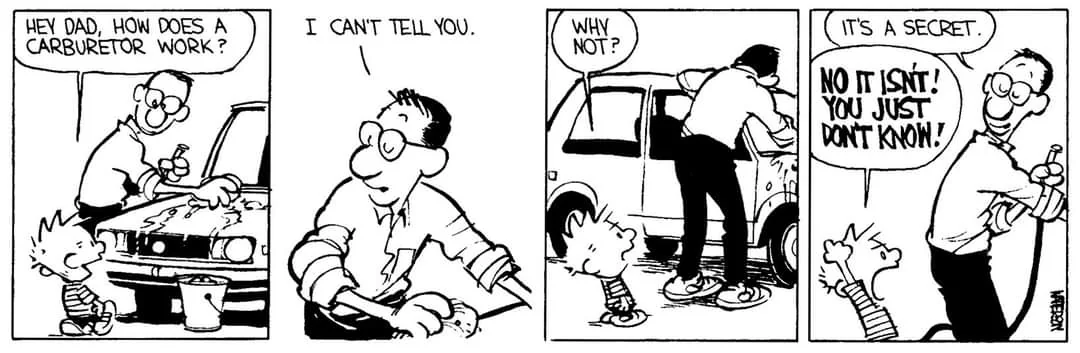
CALVIN: Hey Dad, how does a carburetor work?
CALVIN’S DAD: I can’t tell you.
CALVIN: Why not?
CALVIN’S DAD: It’s a secret.
CALVIN: No it isn’t! You just don’t know!
It should be your care, therefore, and mine, to elevate the minds of our children and exalt their courage; to accelerate and animate their industry and activity; to excite in them an habitual contempt of meanness, abhorrence of injustice and inhumanity, and an ambition to excel in every capacity, faculty, and virtue.
John Adams (1735–1826) American lawyer, Founder, statesman; US President (1797–1801)
Letter (1775-10-29) to Abigail Adams
(Source)

There’s no way to repay a mother’s love, or lack of it.
Mignon McLaughlin (1913–1983) American journalist and author
The Second Neurotic’s Notebook, ch. 2 (1966)
(Source)
If your children spend most of their time in other people’s houses, you’re lucky; if they all congregate at your house, you’re blessed.
Mignon McLaughlin (1913–1983) American journalist and author
The Second Neurotic’s Notebook, ch. 2 (1966)
(Source)
Home education should include not only the etiquette rules necessary to navigate life, but the underlying principles of manners. These include respect (such as addressing people as they wish to be addressed), fairness (granting others the privileges one claims for oneself) and congeniality (not using threats as an argument).
Judith Martin (b. 1938) American author, journalist, etiquette expert [a.k.a. Miss Manners]
“Miss Manners,” syndicated column (2015-03-01)
(Source)
This is often whittled down to "The underlying principles of manners -- respect, fairness, and congeniality."
The ideal home: big enough for you to hear the children, but not very well.
Mignon McLaughlin (1913–1983) American journalist and author
The Second Neurotic’s Notebook, ch. 2 (1966)
(Source)
Your children tell you casually years later what it would have killed you with worry to know at the time.
Mignon McLaughlin (1913–1983) American journalist and author
The Second Neurotic’s Notebook, ch. 2 (1966)
(Source)
Our children know we lie to them, but not — thank God — how much.
Mignon McLaughlin (1913–1983) American journalist and author
The Neurotic’s Notebook, ch. 2 (1963)
(Source)
The fault no child ever loses is the one he was most punished for.
Mignon McLaughlin (1913–1983) American journalist and author
The Neurotic’s Notebook, ch. 2 (1963)
(Source)
Your children are neither as bad nor as good as you imagine. But then, neither are you.
Mignon McLaughlin (1913–1983) American journalist and author
The Neurotic’s Notebook, ch. 2 (1963)
(Source)
We start out determined to see that our children are good; we soon settle for having them nice.
Mignon McLaughlin (1913–1983) American journalist and author
The Neurotic’s Notebook, ch. 2 (1963)
(Source)
“What,” I asked my father once, “what is a concubine?”
“Er‐hum — !” he responded. “Why do you ask?” Clearly, he was playing for time.
“Well, it says in the Bible that David took him more concubines and Solomon had 300.”
He inwardly groaned, but grappled with it. “Well, David was the head of the house, he needed people to look after him and the concubines — er did.”
Three hundred! I thought to myself. One would need a very big house.
“What a pity, father, that you have only two!”
He was astonished. “Two what?”
“Two concubines — Katie and Bella to cook and make beds.”
“Katie and Bella are not my concubines.” Here was a child being childish, which was something he did not like.
“Then, Nelly, what about her?” Nelly was slightly wanting, and came to help with the washing.
“Certainly not.” The idea was repugnant.
“Well, father, who are your concubines?”
“I have no concubines!” he roared and stormed out of the room.
The head of the house and no concubines! Clearly we, as a family, were vastly lower on the social scale than Solomon or David.P. L. Travers (1899–1996) Australian-British writer [Pamela Lyndon Travers; b. Helen Lyndon Goff]
Essay (1978-07-02), “I Never Wrote for Children,” New York Times
(Source)

Whamming someone smaller than oneself in order to teach that person civilized behavior is not within Miss Manners’ concept of propriety, much less logic.
Children when they are little make parents fooles, when they are great they make them mad.
George Herbert (1593–1633) Welsh priest, orator, poet.
Jacula Prudentum, or Outlandish Proverbs, Sentences, &c. (compiler), # 939 (1640 ed.)
(Source)
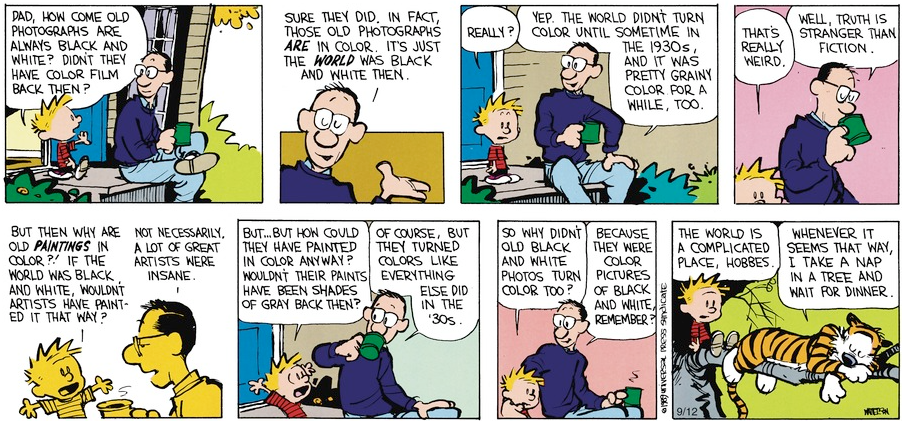
CALVIN: Dad, how come old photographs are always black and white? Didn’t they have color film back then?
CALVIN’S DAD: Sure they did. In fact, those old photographs are in color. It’s just the world was black and white then.
CALVIN: Really?
CALVIN’S DAD: Yep. The world didn’t turn color until sometime in the 1930s, and it was pretty grainy color for a while, too.
CALVIN: That’s really weird.
CALVIN’S DAD: Well, truth is stranger than fiction.
CALVIN: But then why are old paintings in color?! If the world was black and white, wouldn’t artists have painted it that way?
CALVIN’S DAD: Not necessarily. A lot of great artists were insane.
CALVIN: But … but how could they have painted in color anyway? Wouldn’t their paints have been shades of gray back then?
CALVIN’S DAD: Of course, but they turned colors like everything did in the ’30s.
CALVIN: So why didn’t old black and white photos turn color, too?
CALVIN’S DAD: Because they were color pictures of black and white, remember?
CALVIN [Later, in a tree]: The world is a complicated place, Hobbes.
HOBBES: Whenever it seems that way, I take a nap in a tree and wait for dinner.
Someday we will regard our children not as creatures to manipulate or to change but rather as messengers from a world we once deeply knew, but which we have long since forgotten, who can reveal to us more about the true secrets of life, and also our own lives, than our parents were ever able to.
Alice Miller (1923–2010) Polish-Swiss psychologist, psychoanalyst, philosopher
For Your Own Good [Am Anfang war Erziehung], “Preface to the American Edition” (1980) [tr. Hannum/Hannum (1983)]
(Source)
No one is more susceptible to an experts fearmongering than a parent. Fear is in fact a major component of the act of parenting. A parent, after all, is the steward of another creature’s life, a creature who in the beginning is more helpless than the newborn of nearly any other species. This leads a lot of parents to spend a lot of their parenting energy simply being scared.
Steven Levitt (b. 1967) American economist and author
Freakonomics, ch. 5 “What Makes A Perfect Parent?” (2005) [with Stephen Dubner]
(Source)

Children have an uncanny way of living up — or down — to what is expected of them.
Ann Landers (1918–2002) American advice columnist [pseud. for Eppie Lederer]
“Parenthood: What Do You Owe Your Children?” Family Circle (1977-11)
(Source)
Collected in The Ann Landers Encyclopedia (1978).
Like a trained surgeon who is careful where he cuts, parents, too, need to become skilled in the use of words. Because words are like knives. They can inflict, if not physical, many painful emotional wounds.
I don’t think he had known much demonstrative love in his childhood and what a child doesn’t receive he can seldom later give.
P. D. James (1920–2014) British mystery writer [Phyllis Dorothy James White]
Time To Be in Earnest: A Fragment of Autobiography, “Diary 1997” (1999)
(Source)
Writing of her father. Often just the last half of this quote is given ("What a child ...").

What is the goal of parenting? It’s to help a child grow up to be a decent human being, a mensch, a person with compassion, commitment, and caring.
Haim Ginott (1922–1973) Israeli-American school teacher, child psychologist, psychotherapist [b. Haim Ginzburg]
Between Parent and Child, ch. 10 “Summing Up” (2003 ed.) [with A. Ginott and H. W. Goddard]
(Source)
Misbehavior and punishment are not opposites that cancel each other; on the contrary, they breed and reinforce each other. Punishment does not deter misconduct. It makes the offender more skillful in escaping detection. When children are punished they resolve to be more careful, not more obedient or responsible.
Haim Ginott (1922–1973) Israeli-American school teacher, child psychologist, psychotherapist [b. Haim Ginzburg]
Between Parent and Child: Revised and Updated Edition, ch. 5 “Discipline” (2003 ed.) [with A. Ginott and H. W. Goddard]
(Source)
Your responsibility as a parent is not as great as you might imagine. You need not supply the world with the next conqueror of disease or major motion-picture star. If your child simply grows up to be someone who does not use the word “collectible” as a noun, you can consider yourself an unqualified success.
Fran Lebowitz (b. 1950) American journalist, essayist
Social Studies, “Parental Guidance” (1981)
(Source)

Children aren’t coloring books. You don’t get to fill them with your favorite colors.
Khaled Hosseini (b. 1965) Afghan-American novelist, physician [ خالد حسینی]
The Kite Runner, ch. 3 [Rahim Khan] (2003)
(Source)

You are the bows from which your children as living arrows are sent forth.
The Archer sees the mark upon the path of the infinite, and He bends you with His might that His arrows may go swift and far.
Let your bending in the Archer’s hand be for gladness;
For even as He loves the arrow that flies, so He loves also the bow that is stable.Kahlil Gibran (1883–1931) Lebanese-American poet, writer, painter [Gibran Khalil Gibran]
“On Children,” The Prophet (1923)
(Source)
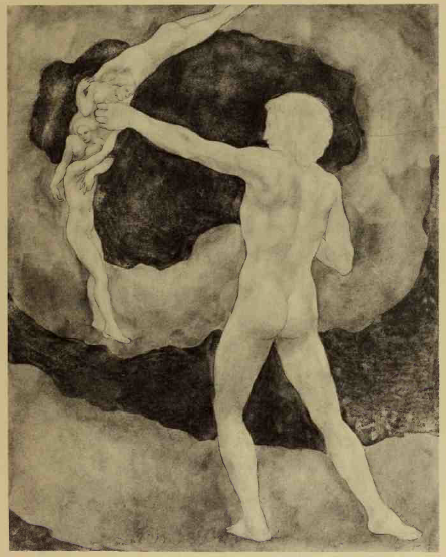
Children hold us hostage; they represent our commitment to the future.
Barbara Grizzuti Harrison (1934–2002) American journalist, essayist, memoirist
Italian Days, ch. 1 (1989)
(Source)

A bitter-tongued parent cannot teach respect for facts. Truth for its own sake can be a deadly weapon in family relations. Truth without compassion can destroy love. Some parents try too hard to prove exactly how, where and why they have been right. This approach will bring bitterness and disappointment. When attitudes are hostile, facts are unconvincing.
Haim Ginott (1922–1973) Israeli-American school teacher, child psychologist, psychotherapist [b. Haim Ginzburg]
Between Parent and Teenager, ch. 2 “Rebellion and Response” (1969)
(Source)
Sometimes mis-cited to the earlier Between Parent and Child (1965).
Children learn what they experience. They are like wet cement. Any word that falls on them makes an impact.
Haim Ginott (1922–1973) Israeli-American school teacher, child psychologist, psychotherapist [b. Haim Ginzburg]
Between Parent and Child: Revised and Updated Edition, ch. 10 “Summing Up” (2003 ed.) [with A. Ginott and H. W. Goddard]
(Source)
Frequently paraphrased (e.g.) as "Children are like wet cement. Whatever falls on them makes an impression."
This is usually cited as being from the original 1965 edition of the book, but cannot be found there. Instead, it appears to be from the 2003 edition, as revised and updated by his wife, Dr Alice Ginott, and Dr H Wallace Goddard. It is unclear if Haim Ginott may have used this phrase in other contexts.
They loved their wives, and were beloved by them. Their entire attention was directed to educating their children in the ways of virtue; the miseries of their fellow countrymen were constantly represented to them and held up as the sorriest of examples. Above all, they were taught that individual interest is always bound to the common interest, that to try to separate them was to invite ruin, that virtue is not something costly to achieve nor painful to exercise, and that justice for others is a blessing for ourselves.
They soon had the consolation of virtuous fathers, seeing their children develop in their image.[Ils aimoient leurs femmes, et ils en étoient tendrement chéris. Toute leur attention étoit d’élever leurs enfants à la vertu. Ils leur représentoient sans cesse les malheurs de leurs compatriotes, et leur mettoient devant les yeux cet exemple si touchant ; ils leur faisoient surtout sentir que l’intérêt des particuliers se trouve toujours dans l’intérêt commun ; que vouloir s’en séparer, c’est vouloir se perdre ; que la vertu n’est point une chose qui doive nous coûter ; qu’il ne faut point la regarder comme un exercice pénible ; et que la justice pour autrui est une charité pour nous.
Ils eurent bientôt la consolation des pères vertueux, qui est d’avoir des enfants qui leur ressemblent.]Charles-Lewis de Secondat, Baron de Montesquieu (1689–1755) French political philosopher
Persian Letters [Lettres Persanes], Letter 12, Usbek to Mirza (1721) [tr. Healy (1964)]
(Source)
In the story of the Troglodytes, a tribe who had been decimated by a plague after years of self-interested anarchy where every person did as they wished. The survivors developed a philosophy of mutual aid and community, and prospered.
(Source (French)). Other translations:They lov'd their Wives, and were tenderly belov'd by them. They were wholly intent upon educating their Children to Virtue. They continually represented to them the Calamities of their Countrymen, and often set that moving Example before their Eyes. They above all things instill'd into them this Principle, that every private Man's Interest is inseparable from the Interest of the Community. To divide it, is Ruin. That Virtue is not a thing which should be troublesome to us, nor ought the Exercise of it to give us pain; and that Justice to another, is Charity to our selves.
They had soon the Consolation of virtuous Fathers; which is, to have Children like themselves.
[tr. Ozell (1736)]They loved their wives, and were affectionately beloved by them. The training up their children to virtue engaged their utmost care. They continually represented to them the miseries of their countrymen, and placed their melancholy example before their eyes. They especially inculcated upon their minds, that the interests of individuals was always to be found in that of the community, and that to attempt to seek it separately was to destroy it; that virtue is by no means a thing that ought to be burdensome to us, nor the practice of it considered as painful; that doing justice to others is acting charitably to ourselves. They soon enjoyed the consolation of virtuous parents, which consists in having children like themselves.
[tr. Floyd (1762)]They loved their wives, and were beloved most tenderly. Their utmost care was given to the virtuous training of their children. They kept before their young minds the misfortunes of their countrymen, and held them up as a most melancholy example. Above all, they led them to see that the interest of the individual was bound up in that of the community; that to isolate oneself was to court ruin; that the cost of virtue should never be counted, nor the practice of it regarded as troublesome; and that in acting justly by others, we bestow blessings on ourselves.
They soon enjoyed the reward of virtuous parents, which consists in having children like themselves.
[tr. Davidson (1891)]They loved their wives, and were in turn tenderly beloved by them. Their whole ambition was to rear their children virtuously. They constantly placed before their eyes the misfortunes of their fellow-countrymen, and proved to them by this thrilling example that the interest of the individual is one with the interest of the community; that to attempt to separate them is to court ruin; that virtue is a thing the practice of which ought to be found easy; that we should never regard its cultivation as a painful exercise, and that justice to others is a blessing to ourselves. They had soon the consolation of virtuous fathers, which is to see their children grow up in their likeness.
[tr. Betts (1897)]They loved their wives, who cherished them tenderly in return; they devoted their whole attention to raising their children in the path of virtue; they told them repeatedly of the misfortunes of their compatriots, and showed them those piteous examples; above all, they made them feel that the interest of the individual is always identical with the common interest, and that to attempt to separate oneself from it is fatal; that we should not find virtue arduous, or regard it as a painful exercise, and that justice to another is a charity to oneself.
Soon they knew the consolation of virtuous fathers, which is to have children like themselves.
[tr. Mauldon (2008)]They loved their wives, who in turn cherished them. Their great aim was to raise their children in the path of virtue. They constantly told them stories about their compatriots, putting that unhappy example before their eyes. Above all, they stressed that one;s self0--interest is always contained within the common interest, and that to separate those two was to take a step toward ruin; they taught also that virtue need cost us nothing, that we must not regard virtue as a painful burden; finally, they taught that to do justice for one is to do good for all.
In time they enjoyed the consolation of virtuous fathers, which is to have children who resemble them.
[tr. MacKenzie (2014)]
Cleaning your house
While your kids are still growing
Is like shoveling the walk
Before it stops snowing.Phyllis Diller (1917–2012) American comedian, actor, author, musician
Phyllis Diller’s Housekeeping Hints, ch. 1, epigraph (1966)
(Source)
Little seedlings never flourish in the soil they have been given, be it ever so excellent, if they are continually pulled up to see if the roots are grateful yet.
Bertha Damon (1881–1975) American humorist, author, lecturer, editor [Bertha Clark Pope Damon]
Grandma Called It Carnal (1938)
A wise woman once said to me that there are only two lasting bequests we can hope to give our children. One of these she said is roots, the other, wings.
Hodding Carter II (1907–1972) American journalist and author [William Hodding Carter II]
Where Main Street Meets the River, “It’s How We Like It” (1953)
(Source)
Almost always quoted without the notes about the "wise woman," e.g.,There are only two lasting bequests we can hope to give our children: one of these is roots, the other, wings.
A Sunday-school is a prison in which children do penance for the evil consciences of their parents.
H. L. Mencken (1880–1956) American writer and journalist [Henry Lewis Mencken]
A Little Book in C Major, ch. 3, § 3 (1916)
(Source)
Variant:SUNDAY SCHOOL. A prison in which children do penance for the evil conscience of their parents.
A Book of Burlesques, "The Jazz Webster" (1924)
As is always the case, parenting is an exercise in unintended consequences.
Stacy Schiff (b. 1961) American editor, essayist, biographer
“Obama’s Mother Ann Dunham Shaped His Success,” Newsweek (2011-05-01)
(Source)

If you want to really hurt your parents, and you don’t have the nerve to be gay, the least you can do is go into the arts. I’m not kidding. The arts are not a way of making a living. They are a very human way of making life more bearable.
Kurt Vonnegut, Jr. (1922–2007) American novelist, journalist
Man Without a Country, ch. 3 “Here Is a Lesson in Creative Writing” (2005)
(Source)

Each generation must watch the next, throwing away its golden opportunities.
Mignon McLaughlin (1913–1983) American journalist and author
The Neurotic’s Notebook, ch. 5 (1963)
One sure way to lose another woman’s friendship is to try to improve her flower arrangements.
Marcelene Cox (1900–1998) American writer, columnist, aphorist
“Ask Any Woman” column, Ladies’ Home Journal (1948-02)
(Source)
This was a regularly revisited aphorism for Cox:One sure way to lose another woman's friendship is to try to improve her husband.
(1955-12)The quickest way to lose another woman's friendship is to endeavor to improve her husband, her children, or her flower arrangements.
(1959-05)One sure way to lose another woman's friendship is to try to improve either her children or her flower arrangements.
(1961-07)
Children in a family are like flowers in a bouquet: there’s always one determined to face in an opposite direction from the way the arranger desires.
Marcelene Cox (1900–1998) American writer, columnist, aphorist
“Ask Any Woman” column, Ladies’ Home Journal (1956-09)
(Source)
Parents should work together as efficiently as two bookends.
Marcelene Cox (1900–1998) American writer, columnist, aphorist
“Ask Any Woman” column, Ladies’ Home Journal (1957-08)
(Source)
The reason some parents really enjoy their children is that they take the time to live with them.
Marcelene Cox (1900–1998) American writer, columnist, aphorist
“Ask Any Woman” column, Ladies’ Home Journal (1946-04)
(Source)
If we have a decent sort of cat to begin with, and have always treated it courteously, and aren’t cursed with meddling, bullying natures, it’s a pleasure to let it do as it pleases. With children, this would be wicked and irresponsible, so raising children involves a lot of effort and friction. They need to be taught how to tie their shoes and multiply fractions, they need to be punished for pocketing candy in the grocery store, they need to be washed and combed and forced to clean up their rooms and say please and thank you.
A cat is our relief and our reward.
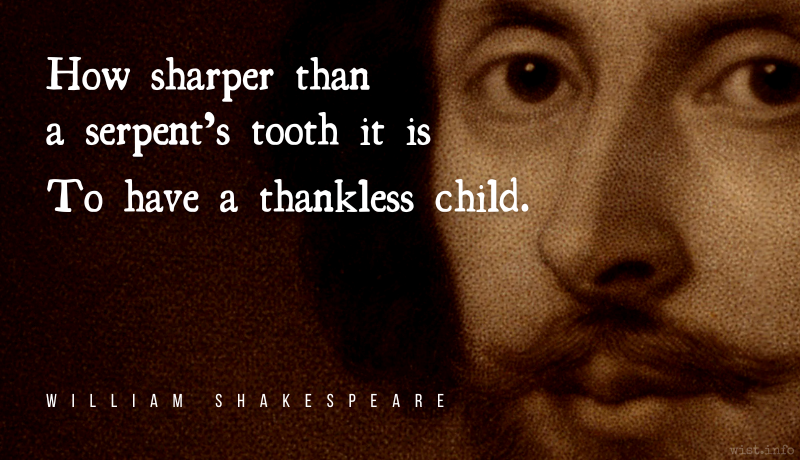
LEAR: How sharper than a serpent’s tooth it is
To have a thankless child.
William Shakespeare (1564–1616) English dramatist and poet
King Lear, Act 1, sc. 4, l. 302ff (1.4.302-303) (1606)
(Source)

No man knows his true character until he has run out of gas, purchased something on the installment plan, and raised an adolescent.
Marcelene Cox (1900–1998) American writer, columnist, aphorist
“Ask Any Woman” column, Ladies’ Home Journal (1955-06)
(Source)
Two things have always been true about human beings. One, the world is always getting better. Two, the people living at that time think it’s getting worse. It’s because you get older, your responsibilities are different. Now I’m taking care of children instead of being a child. It makes the world look scarier. That happens to everyone.
Penn Jillette (b. 1955) American stage magician, actor, musician, author
“Honest Questions with Penn Jillette,” Interview by Glen Beck, CNN (2 Nov 2007)
(Source)

No matter how old a mother is, she watches her middle-aged children for signs of improvement.
Florida Scott-Maxwell (1883–1979) American-British playwright, author, psychologist
The Measure of My Days (1968)
(Source)
Being a father
Is quite a bother,
But I like it, rather.Ogden Nash (1902–1971) American poet
“Soliloquy in Circles,” New Yorker (27 Mar 1948)
(Source)
Reprinted in Versus (1949).

Every parent is at some time the father of the unreturned prodigal, with nothing to do but keep his house open to hope.
John Ciardi (1916–1986) American poet, writer, critic
“Of Time and Chances: A Parental Reverie,” Saturday Review (1972-03-18)
(Source)
Our children give us the opportunity to become the parents we always wished we’d had.
Louise Hart (contemp.) American educator, psychologist, author, speaker
The Winning Family, ch. 1, epigraph (1987)

For high is the price of parenthood,
And daughters may cost you double.
You dare not forget, as you thought you could,
That youth is a plague and a trouble.

Depend upon it, as long as the church is living so much like the world, we cannot expect our children to be brought into the fold.
Dwight Lyman "D. L." Moody (1837–1899) American evangelist and publisher
God’s Good News, “Where Art Thou?” [Gen. 3:9] (1897)
(Source)
The capacity of a human mind to believe devoutly in what seems to me to be the highly improbable — from table tapping to the superiority of their own children — has never been plumbed. Faith strikes me as intellectual laziness, but I don’t argue with it — especially as I am rarely in a position to prove that it is mistaken.
Robert A. Heinlein (1907–1988) American writer
Stranger in a Strange Land, ch. 18 (1960 ed., publ. 1991)
(Source)
An elided version is found in the 1961 published edition, in ch. 13.
Your responsibility as a parent is not as great as you might imagine. You need not supply the world with the next conqueror of disease or a major movie star. If your child simply grows up to be someone who does not use the word “collectible” as a noun, you can consider yourself an unqualified success.
Fran Lebowitz (b. 1950) American journalist, essayist
Social Studies, “Parental Guidance” (1981)
The most influential of all educational factors is the conversation in a child’s home.
William Temple (1881–1944) English Anglican archbishop, teacher, preacher
The Hope of a New World (1940)
Don’t threaten a child; either punish or forgive him.
The Talmud (AD 200–500) Collection of Jewish rabbinical writings
Passage

The world is not always a kind place. That’s something all children learn for themselves, whether we want them to or not, but it’s something they really need our help to understand.
Fred Rogers (1928–2003) American educator, minister, songwriter, television host ["Mister Rogers"]
You Are Special (1994)
If you bungle raising your children I don’t think whatever else you do well matters very much.
Jacqueline Kennedy Onassis (1929–1994) First Lady of the United States (1961–1963), book editor, celebrity
Interview with Sander Vanocur, NBC News (1 Oct 1960)
(Source)
From your parents you learn love and laughter and how to put one foot before the other. But when books are opened you discover you have wings.

Your children are not your children.
They are the sons and daughters of Life’s longing for itself.
They come through you but not from you,
And though they are with you yet they belong not to you.
You may give them your love but not your thoughts,
For they have their own thoughts.
You may house their bodies but not their souls,
For their souls dwell in the house of tomorrow, which you cannot visit, not even in your dreams.
You may strive to be like them, but seek not to make them like you.
For life goes not backward nor tarries with yesterday.Kahlil Gibran (1883–1931) Lebanese-American poet, writer, painter [Gibran Khalil Gibran]
“On Children,” The Prophet (1923)
(Source)
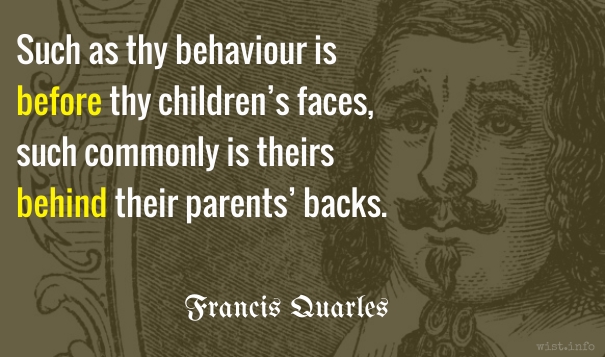
If thou desire to see thy child virtuous, let him not see his father’s vices: thou canst not rebuke that in them, that they behold practiced in thee; till reason be ripe, examples direct more than precepts: such as thy behaviour is before thy children’s faces, such commonly is theirs behind their parents’ backs.
It reminds me of growing up in Chicago and having to shovel snow. I’ll give my dad credit; he never claimed it was to build character or teach me the value of hard work. “Snowblowers are expensive,” he used to say. “You’re free.” Once, I tried to appeal to my mom. “Don’t be such a wuss,” she suggested.
Andy Weir (b. 1972) American programmer and writer
The Martian (2011)

The real menace in dealing with a five-year-old is that in no time at all you begin to sound like a five-year-old.
Jean Kerr (1922–2003) American author and playwright [b. Bridget Jean Collins]
Essay (1957), “How to Get the Best of Your Children,” Please Don’t Eat the Daisies
(Source)
Original magazine publication unknown.
My father had a profound influence on me. He was a lunatic.
Terence Alan "Spike" Milligan (1918–2002) Anglo-Irish comedian, writer, actor
(Attributed)
Nothing you do for children is ever wasted. They seem not to notice us, hovering, averting our eyes, and they seldom offer thanks, but what we do for them is never wasted.
Selective ignorance, a cornerstone of child rearing. You don’t put kids under surveillance: it might frighten you. Parents should sit tall in the saddle and look upon their troops with a noble and benevolent and extremely nearsighted gaze.
Garrison Keillor (b. 1942) American entertainer, author
Leaving Home? (1987)
If we would amend the world, we should mend Ourselves and teach our Children to be not what we are but what they should be.
William Penn (1644–1718) English writer, philosopher, politician, statesman
Some Fruits of Solitude, #214 (1693)
I taught school in the early days of my manhood and I think I know something about mothers. There is a thread of aspiration that runs strong in them. It is the fiber that has formed the most unselfish creatures who inhabit this earth. They want three things only; for their children to be fed, to be healthy, and to make the most of themselves.
Lyndon B. Johnson (1908–1973) American politician, educator, US President (1963–69)
Speech (1963-07-09), Women’s Meeting, Washington, D.C.
I have been unable to find a source for this quotation.

The best thing to give to your enemy is forgiveness; to an opponent, tolerance; to a friend, your heart; to your child, a good example; to a father, deference; to your mother, conduct that will make her proud of you; to yourself, respect; to all men, charity.
Clara Lucas Balfour (1808–1878) English novelist, lecturer, temperance campaigner
Sunbeams for All Seasons: Counsels, Cautions, and Precepts (1861 ed.)
I was a closet pacifier advocate. So were most of my friends. Unknown to our mothers, we owned thirty or forty of those little suckers that were placed strategically around the house so a cry could be silenced in less than thirty seconds. Even though bottles were boiled, rooms disinfected, and germs fought one on one, no one seemed to care where the pacifier had been.
Erma Bombeck (1927–1996) American humorist
Motherhood, the Second Oldest Profession, ch. 7 (1983)
Of all species of silliness the silliest is the assertion sometimes made that the woman whose primary lifework is taking care of her home and children is somehow a “parasite woman.” It is such a ridiculous in version of the truth that it ought not to be necessary even to allude to it.
There are families in which the father will say to his child, “You’ll get a thick ear if you do that again,” while the mother, her eyes brimming over with tears, will take the child to her arms and murmur lovingly, “Now, darling, is it kind to Mummy to do that?” And who would maintain that the second method is less tyrannous than the first?
George Orwell (1903–1950) English journalist, essayist, writer [pseud. of Eric Arthur Blair]
Essay (1947-03), “Lear, Tolstoy and the Fool,” Polemic Magazine, No. 7
(Source)
Collected in Inside the Whale, and Other Essays (1962).
Parents forgive their children least readily for the faults they themselves instilled in them.
[Eltern verzeihen ihren Kindern die Fehler am schwersten, die sie selbst ihnen anerzogen haben.]
Marie von Ebner-Eschenbach (1830–1916) Austrian writer
Aphorisms [Aphorismen], No. 107 (1880) [tr. Scrase/Mieder (1994)]
(Source)
(Source (German)). Other translation:Parents are least ready to forgive in their children faults which result from their own training.
[tr. Wister (1883)]
There never was a child so lovely but his mother was glad to get him asleep.
Ralph Waldo Emerson (1803–1882) American essayist, lecturer, poet
Journal (1837-09-30)
If being a parent consists often of passing along chunks of ourselves to unwitting — often unwilling — recipients, then books are, for me, one of the simplest and most sure-fire ways of doing that. I would be most content if my children grew up to be the kind of people who think decorating consists mostly of building enough bookshelves.

Children aren’t happy with nothing to ignore,
And that’s what parents were created for.
We are all born charming, frank, and spontaneous and must be civilized before we are fit to participate in society.
Par-runts of rugmonkeys everywhere are worrying that their children will want to become Force-wielding breath masked Sithlords? Sweet Cream-of-Jesus on TOAST POINTS, people!! So now we have to fear that every crib-lizard that loves Anakin Skywalker will become Evil Incarnate. It’s been a lovely planet, but I think I need to go, now.
(Other Authors and Sources)
Alan D. Swan

CALVIN: Dad, how do people make babies?
CALVIN’S DAD: Most people just go to Sears, buy the kit, and follow the assembly instructions.
CALVIN: I came from Sears??
CALVIN’S DAD: No, you were a Blue Light Special at K Mart. Almost as good, and a lot cheaper.
CALVIN: AAUUGHHH!
CALVIN’S MOM [off panel]: Dear, what are you telling Calvin now?!