DEMEA: No one has ever plotted out his life’s plan so successfully that he never faces
New challenges and discoveries brought about by circumstances, the passing of time,
Or experience itself. Inevitably, you discover you don’t know what you thought you did,
And the principles we first formed don’t hold up in the face of everyday practice.[Nunquam ita quisquam bene subducta ratione ad vitam fuit
Quia res, Ætas usus semper aliquid apportet novi
Aliquid moneat, ut illa, quæ te scire credas, nescias
Et, quæ tibi putaris prima, in experiundo ut repudies.]Terence (186?-159 BC) African-Roman dramatist [Publius Terentius Afer]
Adelphoe [Adelphoi; Adelphi; The Brothers], Act 5, sc. 4, l. 855ff (160 BC) [tr. Christenson (2010), Sc. 22]
(Source)
Sometimes attributed to Richard Steele, as he used the quote as an epigraph to an essay in The Spectator, No. 544 (1712-11-24).
(Source (Latin)). Other translations:No man was ever so completely skilled in the conduct of life, as not to receive new information from age and experience: insomuch that we find ourselves really ignorant of what we thought we understood, and see cause to reject what we fancied our truest interest.
[tr. Steele (1712)]Never could there be anyone with a method for life so well drawn up, but that circumstance, time, experience ever brings something new, teaches something; so that you know not those things which you think that you know, and that you repudiate in experience the things which you have thought essential for you.
[tr. Giles, c. 1850]Never was there any person of ever such well-trained habits of life, but that experience, age, and custom are always bringing him something new, or suggesting something; so much so, that what you believe you know you don't know, and what you have fancied of first importance to you, on making trial you reject.
[tr. Riley (1874)]However well a man may have calculated his scheme of life, still circumstances, years, experience, always introduce a new element and teach new lessons. You find that you don't know what you thought you did know, and what you thought of primary importance that in practice you reject.
[tr. Sargeaunt (Loeb) (1912), Act 6]You never add things up so well in this life that something unexpected doesn’t turn up and set you wondering -- some money matter, some event, some personal problem. As a result, you find you don’t know what you thought you knew, and things that seemed fine turn out to be worthless when they're put to the test.
[tr. Copley (1967)]No matter how neatly you keep your accounts in life,
experience, age, and circumstance always show up
to toss something new on the books and teach you a lesson.
You find out you don't know what you thought you did, and what seemed
so important in theory turns out to be pointless in practice.
[tr. Berg/Parker (1999)]There never was a person so well-bred
And so refined but that into his head
Come new thoughts springing from experience
And age and custom, so that what you sense
You know you don’t know and what you before
Believed was most important you abhor.
[tr. Kelk (2022)]
Quotations about:
growing up
Note not all quotations have been tagged, so Search may find additional quotes on this topic.
To be happy in this world, especially when youth is past, it is necessary to feel oneself not merely an isolated individual whose day will soon be over, but part of the stream of life flowing on from the first germ to the remote and unknown future.
Bertrand Russell (1872–1970) English mathematician and philosopher
Conquest of Happiness, Part 2, ch. 13 “Family” (1930)
(Source)
The true wisdom is to be always seasonable, and to change with a good grace in changing circumstances. To love playthings well as a child, to lead an adventurous and honourable youth, and to settle when the time arrives, into a green and smiling age, is to be a good artist in life and deserve well of yourself and your neighbour.
And therefore all my trifling Songs adieu,
I now design to seek what’s good and true,
And that alone; I scorn my wanton Muse,
And lay up Precepts, such as I may use.[Nunc itaque et versus et cetera ludicra pono;
quid verum atque decens curo et rogo et omnis in hoc sum;
condo et compono quae mox depromere possim.]Horace (65–8 BC) Roman poet, satirist, soldier, politician [Quintus Horatius Flaccus]
Epistles [Epistularum, Letters], Book 1, ep. 1 “To Maecenas,” l. 10ff (1.1.10-12) (20 BC) [tr. Creech (1684)]
(Source)
This epistle was written when Horace was 45 and decided to quit writing lyric poetry, having finished his third book of Odes.
(Source (Latin)). Other translations:And therefore now I lay my rimes. and other toyes asyde
Devysing things of honestie, and therin holy byde.
That whych may serve to guide my selfe I muse uppon and make.
[tr. Drant (1567)]Therefore Love-songs, and all those toyes adieu,
My work is now to search what's good, what's true:
I lay in precepts, which I straight may draw
Out for my use.
[tr. Fanshawe; ed. Brome (1666)]Then here farewell the amusements of my youth:
Farewell to verses; for the search of truth
And moral decency hath fill'd my breast,
Hath every thought and faculty possest;
And I now form my philosophic lore,
For all my future life a treasur'd store.
[tr. Francis (1747)]Henceforth adieu then to the toys of youth!
Adieu to wit's light sport, and welcome truth!
To con the maxims of the good and wise,
To search where honour and where fitness lies,
Careful to store what after-life may need --
This be my task; for this is wealth indeed!
[tr. Howes (1845)]Now therefore I lay aside both verses, and all other sportive matters; my study and inquiry is after what is true and fitting, and I am wholly engaged in this: I lay up, and collect rules which I may be able hereafter to bring into use.
[tr. Smart/Buckley (1853)]So now I bid my idle songs adieu,
And turn my thoughts to what is right and true;
I search and search, and when I find, I lay
The wisdom up against a rainy day.
[tr. Conington (1874)]So verses now and all such toys I quit,
Work night and day to find the true and fit.
The lore of sages cull where'er I may.
And hive it up for use some future day.
[tr. Martin (1881)]Now, therefore, I resign verse composition and sportive measures. What is true and fitting I care for, and inquire about, and am absorbed in it. I am piling up and arranging what I may presently make public.
[tr. Elgood (1893)]So now I lay aside my verses and all other toys. What is right and seemly is my study and pursuit, and to that am I wholly given. I am putting by and setting in order the stores on which I may some day draw.
[tr. Fairclough (Loeb) (1926)]So now I lay aside
Not only verses but all other toys:
I want to find the true and fitting joys,
And all engrossed in this pursuit am I.
I treasure and arrange what by and by
I may draw forth for guidance from my store.
[tr. Murison; ed. Kraemer (1936)]So I lay down my poems and other toys of my youth
To devote myself to one main subject: the truth.
What is right and honest? This I would like to know.
I am laying up stores, setting them all in a row,
Of the only thing that will keep on helping me grow.
[tr. Palmer Bovie (1959)]So now I lay my verses down, and all my other games,
to study what is true and good, totally involved in that.
I gather and accumulate supplies that I'll soon use.
[tr. Fuchs (1977)]So I've put away poetry
And other games. I study
Right and wrong. I store up,
Now, what someday I'll need, I lay
It all out.
[tr. Raffel (1983)]And so I'm giving up my verses and all
Other foolishness of the sort, and now
Devote myself entirely to the study
Of what is genuine and right for me,
Storing up what I learn for the sake of the future.
[tr. Ferry (2001)]So now I am laying aside my verses and other amusements.
My sole concern is the question "What is right and proper?"
I'm carefully storing things for use in the days ahead.
[tr. Rudd (2005 ed.)]So now I’m setting aside my verse, and other tricks:
My quest and care is what’s right and true, I’m absorbed
In it wholly: I gather, then store for later use.
[tr. Kline (2015)]
In short, if youth is not quite right in its opinions, there is a strong probability that age is not much more so.
Often an opinion, a custom, seems absurd when we are young, and advancing in life, we find the reason. Mustn’t we conclude that certain habits aren’t so ridiculous? One is lead to think sometimes that they were established by people who had read the entire book of life, and that they are judged by people who, despite their esprit, have only read a few pages.
[Souvent une opinion, une coutume commence à paraître absurde dans la première jeunesse, et en avançant dans la vie, on en trouve la raison; elle paraît moins absurde. En faudrait-il conclure que de certaines coutumes sont moins ridicules? On serait porté à penser quelquefois qu’elles ont été établies par des gens qui avaient lu le livre entier de la vie, et qu’elles sont jugées par des gens qui, malgré leur esprit, n’en ont lu que quelques pages.]
Nicolas Chamfort (1741–1794) French writer, epigrammist (b. Nicolas-Sébastien Roch)
Products of Perfected Civilization [Produits de la Civilisation Perfectionée], Part 1 “Maxims and Thoughts [Maximes et Pensées],” ch. 1, ¶ 21 (1795) [tr. Siniscalchi (1994)]
(Source)
Compare to also Chamfort.(Source (French)). Other translations:Often in early youth an opinion or custom seems absurd to us, which, with advancing years, we discover has some justification and so appears less absurd. Ought we to conclude from this that certain customs are not so ridiculous as others? One might sometimes be tempted to think that they were established by people who had read the book of life through, and that they are judged by those who, despite their intelligence, have only glanced at a few pages.
[tr. Hutchinson (1902)]Often an opinion or custom seems absurd to us in early youth; but as we advance in life we see the reason for it, and it appears less fatuous. Must we conclude from this that certain customs actually are less absurd? One is sometimes led to suppose that they have been established by folk who have read the whole of the book of life, and that they are criticized by those who, in spite of their intelligence, have only read a page or two at best.
[tr. Mathers (1926)]Often an opinion, a custom, seems absurd to begin with, when one is very young, and as one advances in life one learns the reason for it, and it seems less so. Must one conclude, then, that certain customs have become less ridiculous? At times one is drawn to the conclusion that they were established by persons who had read the book of life entire, and are judged by others who have read only a few pages.
[tr. Merwin (1969)]Often an opinion, or a custom, begins to seem absurd in one's early youth, and, as life advances, one finds the reason for it; it seems less absurd. Is one ot conclude that certain customs are less ridiculous? One would sometimes be inclined to think that they had been laid down by people who had read the entire book of life, and that they are judged by people who, in spite of their intellect, have only read a few pages of it.
[tr. Pearson (1973)]To the very young some opinions or customs seem absurd, but as you grow older you realize the reason behind them and they seem less absurd. Are we to conclude that certain customs aren't as ridiculous as they seem? There are times when you feel that they've been created by people who've read the book of life from cover to cover and that they're being judged by those who, however intelligent, have read only a few pages.
[tr. Parmée (2003), ¶ 20]

“I am old, Peter. I am ever so much more than twenty. I grew up long ago.”
“You promised not to!”
“I couldn’t help it.”J. M. Barrie (1860–1937) Scottish novelist and dramatist [James Matthew Barrie]
Peter and Wendy, ch. 17 “When Wendy Grew Up” (1911)
(Source)
Wendy speaking to Peter, who has returned many years later, though he is unaware of the interval.
MRS. DARLING: (from the window) Peter, where are you? Let me adopt you too. (She is the loveliest age for a woman, but too old to see PETER clearly.)
PETER: Would you send me to school?
MRS. DARLING: (obligingly) Yes.
PETER: And then to an office?
MRS. DARLING: I suppose so.
PETER: Soon I should be a man?
MRS. DARLING: Very soon.
PETER: (passionately) I don’t want to go to school and learn solemn things. No one is going to catch me, lady, and make me a man. I want always to be a little boy and to have fun.
J. M. Barrie (1860–1937) Scottish novelist and dramatist [James Matthew Barrie]
Peter Pan, Act 5 (1904, pub. 1928)
(Source)
In Barrie's novelization, Peter and Wendy, ch. 17 "When Wendy Grew Up" (1911), this is rendered:Mrs. Darling came to the window, for at present she was keeping a sharp eye on Wendy. She told Peter that she had adopted all the other boys, and would like to adopt him also.
“Would you send me to school?” he inquired craftily.
“Yes.”
“And then to an office?”
“I suppose so.”
“Soon I should be a man?”
“Very soon.”
“I don’t want to go to school and learn solemn things,” he told her passionately. “I don’t want to be a man. O Wendy’s mother, if I was to wake up and feel there was a beard!”
“Peter,” said Wendy the comforter, “I should love you in a beard;” and Mrs. Darling stretched out her arms to him, but he repulsed her.
“Keep back, lady, no one is going to catch me and make me a man.”
The fault no child ever loses is the one he was most punished for.
Mignon McLaughlin (1913–1983) American journalist and author
The Neurotic’s Notebook, ch. 2 (1963)
(Source)
Was it for this I uttered prayers,
And sobbed and cursed and kicked the stairs,
That now, domestic as a plate,
I should retire at half-past eight?Edna St. Vincent Millay (1892–1950) American poet
Poem (1920), “Grown-Up,” A Few Figs from Thistles, (1921, expanded ed.)
(Source)
The poem was not in the original 1920 publication.
PETER: Because I heard father and mother talking of what I was to be when I became a man. I want always to be a little boy and to have fun; so I ran away to Kensington Gardens and lived a long time among the fairies.
J. M. Barrie (1860–1937) Scottish novelist and dramatist [James Matthew Barrie]
Peter Pan, Act 1 (1904, pub. 1928)
(Source)
In Barrie's 1911 novelization, Peter and Wendy, ch. 3 "Come Away, Come Away!" this is rendered:“It was because I heard father and mother,” he explained in a low voice, “talking about what I was to be when I became a man.” He was extraordinarily agitated now. “I don’t want ever to be a man,” he said with passion. “I want always to be a little boy and to have fun. So I ran away to Kensington Gardens and lived a long long time among the fairies.”
Did you ever think what a waste it would be if you burned a man for what he believed at twenty, when what he might believe and write at forty would be hailed as the most blessed of holy writ?
Ellis Peters (1913–1995) English writer, translator [pseud. of Edith Mary Pargeter, who also wrote under the names John Redfern, Jolyon Carr, Peter Benedict]
Cadfael Chronicles No. 17, The Heretic’s Apprentice, ch. 13 [Elave] (1990)
(Source)

All children, except one, grow up. They soon know that they will grow up, and the way Wendy knew was this. One day when she was two years old she was playing in a garden, and she plucked another flower and ran with it to her mother. I suppose she must have looked rather delightful, for Mrs. Darling put her hand to her heart and cried, “Oh, why can’t you remain like this for ever!” This was all that passed between them on the subject, but henceforth Wendy knew that she must grow up. You always know after you are two. Two is the beginning of the end.
J. M. Barrie (1860–1937) Scottish novelist and dramatist [James Matthew Barrie]
Peter and Wendy, ch. 1 “Peter Breaks Through” (1911)
(Source)
Opening words, not included in the play.
PETER: (his pipes more riotous than ever) I just want always to be a little boy and to have fun.
J. M. Barrie (1860–1937) Scottish novelist and dramatist [James Matthew Barrie]
Peter Pan, Act 4 (1904, pub. 1928)
(Source)
Peter's refusal to return to the real world with the other Lost Boys. In Barrie's novelization, Peter and Wendy, ch. 11 "Wendy's Story" (1911), the same language is used.
It is well we cannot see into the future. There are few boys of fourteen who would not feel ashamed of themselves at forty.
Jerome K. Jerome (1859–1927) English writer, humorist [Jerome Klapka Jerome]
Idle Thoughts of an Idle Fellow, “On Memory” (1886)
(Source)
First published in Home Chimes (1885-09-26).

GALE: Childhood is Last Chance Gulch for happiness. After that, you know too much.
Tom Stoppard (1937–2025) Czech-English playwright and screenwriter
Where Are They Now? (1968)
(Source)

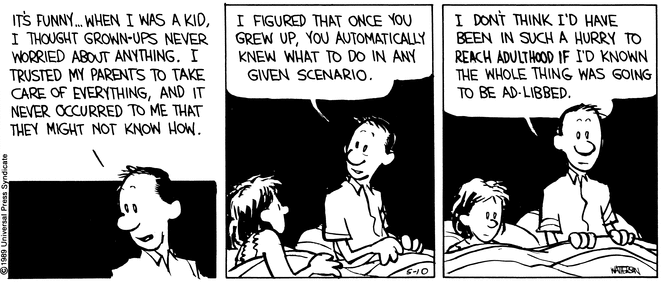
CALVIN’S DAD: It’s funny … when I was a kid, I thought grown-ups never worried about anything. I trusted my parents to take care of everything, and it never occurred to me that they might not know how. I figured that once you grew up, you automatically knew what to do in any given scenario. I don’t think I would have been in such a hurry to reach adulthood if I’d know the whole thing was going to be ad-libbed.
Bill Watterson (b. 1958) American cartoonist
Calvin and Hobbes (1989-05-10)
(Source)
After their house has been burgled.

Children live in occupied territory. The brave and the foolhardy openly rebel against authority, whether harsh or benign. But most tread warily, outwardly accommodating themselves to alien mores and edicts while living in secret their iconoclastic and subversive lives.
P. D. James (1920–2014) British mystery writer [Phyllis Dorothy James White]
Time To Be in Earnest: A Fragment of Autobiography, “Diary 1997” (1999)
(Source)

Children aren’t coloring books. You don’t get to fill them with your favorite colors.
Khaled Hosseini (b. 1965) Afghan-American novelist, physician [ خالد حسینی]
The Kite Runner, ch. 3 [Rahim Khan] (2003)
(Source)

Cleaning your house
While your kids are still growing
Is like shoveling the walk
Before it stops snowing.Phyllis Diller (1917–2012) American comedian, actor, author, musician
Phyllis Diller’s Housekeeping Hints, ch. 1, epigraph (1966)
(Source)

Maturity is a high price to pay for growing up.
Tom Stoppard (1937–2025) Czech-English playwright and screenwriter
Where Are They Now? [Gale] (1970)
(Source)
The line in the play -- originally broadcast on BBC Radio 3 -- was based on an answer Stoppard himself gave in an interview by Peter Evans, reprinted in David Bailey and Peter Evans, Goodbye Baby and Amen: A Saraband for the Sixties (1969):It is a very immature thing to worry about one’s stinking youth, but I don’t care: I think age is a very high price to pay for maturity.
The child thinks of growing old as an almost obscene calamity, which for some mysterious reason will never happen to itself. All who have passed the age of thirty five are joyless grotesques, endlessly fussing about things of no importance and staying alive without, so far as the child can see, having anything to live for. Only child life is real life.
George Orwell (1903–1950) English journalist, essayist, writer [pseud. of Eric Arthur Blair]
Essay (1948-06), “‘Such, Such Were the Joys …’,” Partisan Review (1952-09)
(Source)
This autobiographical essay was drafted around 1939, revised around 1946, and then completed in May or June of 1948. Collected in Such, Such Were the Joys, essay 8 (1953), though the full, unredacted version was not published until 2000.
Helpless lust and unreasoning anxiety were just part of growing up.

When I was a child, I used to talk like a child, and think like a child, and argue like a child, but now I am a man, all childish ways are put behind me.
[Ὅτε ἤμην νήπιος ἐλάλουν ὡς νήπιος ἐφρόνουν ὡς νήπιος ἐλογιζόμην ὡς νήπιος ὅτε γέγονα ἀνήρ κατήργηκα τὰ τοῦ νηπίου.]
The Bible (The New Testament) (AD 1st - 2nd C) Christian sacred scripture
Book 7. 1st Letter to the Corinthians 13:11 (1 Cor 13:11) [JB (1966)]
(Source)
(Source (Greek)). Other translations:When I was a child, I spake as a child, I understood as a child, I thought as a child: but when I became a man, I put away childish things.
[KJV (1611)]When I was a child, my speech, feelings, and thinking were all those of a child; now that I am an adult, I have no more use for childish ways.
[GNT (1976)]When I was a child, I used to talk like a child, and see things as a child does, and think like a child; but now that I have become an adult, I have finished with all childish ways.
[NJB (1985)]When I was a child, I used to speak like a child, reason like a child, think like a child. But now that I have become a man, I’ve put an end to childish things.
[CEB (2011)]When I was a child, I spoke like a child, I thought like a child, I reasoned like a child. When I became an adult, I put an end to childish ways.
[NRSV (2021 ed.)]
Every human being has paid the earth to grow up. Most people don’t grow up. It’s too damn difficult. What happens is most people get older. That’s the truth of it. They honor their credit cards, they find parking spaces, they marry, they have the nerve to have children, but they don’t grow up. Not really. They grow older. But to grow up costs the earth, the earth. It means you take responsibility for the time you take up, for the space you occupy. It’s serious business. And you find out what it costs us to love and to lose, to dare and to fail. And maybe even more, to succeed. What it costs, in truth.
Maya Angelou (1928–2014) American poet, memoirist, activist [b. Marguerite Ann Johnson]
“Maya Angelou, The Art of Fiction No. 119,” Interview with George Plimpton, The Paris Review (Fall 1990)
(Source)
Angelou used the core section (credit cards, parking spaces) a number of times in different interviews.

She was a grown up now, and she discovered that being a grown up was not quite what she had suspected it would be when she was a child. She had thought then that she would make a conscious decision one day to simply put her toys and games and little make-believes away. Now she discovered that was not what happened at all. Instead, she discovered, interest simply faded. It became less and less and less, until a dust of years drew over the bright pleasures of childhood, and they were forgotten.
Stephen King (b. 1947) American author
The Eyes of the Dragon (1987)

The turning point in the process of growing up is when you discover the core of strength within you that survives all hurt.
Maxwell "Max" Lerner (1902–1992) American journalist, columnist, educator
The Unfinished Country (1959)
HAL: Presume not that I am the thing I was;
For God doth know — so shall the world perceive —
That I have turn’d away my former self.William Shakespeare (1564–1616) English dramatist and poet
Henry IV, Part 2, Act 5, sc. 5, l. 60ff (5.5.60-62) (c. 1598)
(Source)

It is as natural and as right for a young man to be imprudent and exaggerated, to live in swoops and circles, and beat about his cage like any other wild thing newly captured, as it is for old men to turn grey, or mothers to love their offspring, or heroes to die for something more valuable than their lives.
To hold the same views at forty as we held at twenty is to have been stupefied for a score of years, and take rank, not as a prophet, but as an unteachable brat, well birched and none the wiser. It is as if a ship captain should sail to India from the Port of London; and having brought a chart of the Thames on deck at his first setting out, should obstinately use no other for the whole voyage.
Robert Louis Stevenson (1850–1894) Scottish essayist, novelist, poet
Essay (1878-03), “Crabbed Age and Youth,” Cornhill Magazine, Vol. 37
(Source)
Collected in Virginibus Puerisque and Other Papers, ch. 2 (1881).
“Why can’t you fly now, mother?”
“Because I am grown up, dearest. When people grow up they forget the way.”
“Why do they forget the way?”
“Because they are no longer gay and innocent and heartless. It is only the gay and innocent and heartless who can fly.”J. M. Barrie (1860–1937) Scottish novelist and dramatist [James Matthew Barrie]
Peter and Wendy, ch. 17 “When Wendy Grew Up” [Jane to Wendy] (1911)
In his 1908 sequel play, When Wendy Grew Up, An Afterthought (some which was eventually folded into the main play (1904, published 1928) in Act 5, though not these lines), this is rendered:JANE: Why can't you fly now, Mother?
WENDY: Because I'm grown up, sweetheart; when people grow up they forget the way.
JANE: Why do they forget the way?
WENDY: Because they are no longer young and innocent. It is only the young and innocent that can fly.
If being a kid is about learning how to live, then being a grown-up is about learning how to die.
Books, you know, Charles, are like lobster shells. We surround ourselves with ’em, and then we grow out of ’em and leave ’em behind, as evidences of our earlier stages of development.
Dorothy Sayers (1893–1957) English author, translator
The Unpleasantness at the Bellona Club, ch. 18 “Picture-cards” [Peter] (1928)
(Source)
SARAH JANE: Doctor, you’re being childish!
THE DOCTOR: Well, of course I am! There’s no point in being grown-up if you can’t be childish sometimes.
Doctor Who (1963–1989) British science fiction television series, original run (BBC)
12×01 “Robot,” Part 4 (1975-01-18) [w. Terrance Dicks]
(Source)

When I was One,
I had just begun.
When I was Two,
I was nearly new.
When I was Three,
I was hardly Me.
When I was Four,
I was not much more.
When I was Five,
I was just alive.But now I am Six, I’m as clever as clever.
So I think I’ll be six now for ever and ever.A. A. Milne (1882–1956) English poet and playwright [Alan Alexander Milne]
Now We Are Six, “The End” (1927)
(Source)