Keep matters for a time in suspense. Admiration at their novelty heightens the value of your achievements, It is both useless and insipid to play with the cards on the table. If you do not declare yourself immediately, you arouse expectation, especially when the importance of your position makes you the object of general attention. Mix a little mystery with everything, and the very mystery arouses veneration. And when you explain, be not too explicit, just as you do not expose your inmost thoughts in ordinary intercourse. Cautious silence is the holy of holies of worldly wisdom. A resolution declared is never highly thought of; it only leaves room for criticism. And if it happens to fail, you are doubly unfortunate.
Besides you imitate the Divine way when you cause men to wonder and watch.[Llevar sus cosas con suspensión. La admiración de la novedad es estimación de los aciertos. El jugar a juego descubierto ni es de utilidad ni de gusto. El no declararse luego suspende, y más donde la sublimidad del empleo da objeto a la universal expectación; amaga misterio en todo, y con su misma arcanidad provoca la veneración. Aun en el darse a entender se ha de huir la llaneza, así como ni en el trato se ha de permitir el interior a todos. Es el recatado silencio sagrado de la cordura. La resolución declarada nunca fue estimada; antes se permite a la censura, y si saliere azar, será dos veces infeliz.
Imítese, pues, el proceder divino para hacer estar a la mira y al desvelo.]Baltasar Gracián y Morales (1601–1658) Spanish Jesuit priest, writer, philosopher
The Art of Worldly Wisdom [Oráculo Manual y Arte de Prudencia], § 3 (1647) [tr. Jacobs (1892)]
(Source)
See also § 253.
(Source (Spanish)). Alternate translations:Not to be too free, nor open. It is the Admiration of Novelty that makes events to be valued. There is neither pleasure nor profit in playing ones Game too openly. Not to declare immediately, is the way to hold minds in suspence, especially in matters of importance, which are the object of universal expectation. That makes every thing to be thought a mystery, and the secret of that raises veneration. In the manner of expression one ought to have a care not to be too plain: and to speak with open heart is not always convenient in conversation. Silence is the Sanctuary of Prudence. A resolution made manifest was never esteemed. He that declares himself, is obnoxious to Censure: and if he succeeds not, he is doubly miserable.
We ought then to imitate the method of God Almighty, who always holds men in suspence.
[Flesher ed. (1685)]Leave people in uncertainty about your purposes. [...] Imitate the heavenly powers in keeping men full of speculation and unrest.
[tr. Duff (1877)]Maintain an air of uncertainty about your business. Admiration for the new is what bestows value upon the accomplished. To play with cards exposed is neither useful, nor in good taste. Create anticipation by not declaring your purpose, and especially where the height of your office commands public attention. Display a bit of mystery about everything, and by it further the respect in which you are held: even when you show your hand escape the obvious, -- just as in the daily round you do not disclose your inner self to everyone. A prudent silence is the sacred vessel of wisdom. Purpose declared was never highly esteemed and commits itself to criticism in advance, -- and should it fail, the misfortune is doubled.
Imitate, therefore, the ways of God in order to keep those about you watchful, and alert.
[tr. Fischer (1937)]Keep matters in suspense. Successes that are novel win admiration. Being too obviouis is neither useful nor tasteful. By not declaring yourself immediately you will keep people guessing, especially if your position is important enough to awaken expectations. Mystery by its very arcaneness causes veneration. Even when revealing yourself, avoid total frankness, and don't let everyone look inside you. Cautious silence is where prudence takes refuge. Once declared, resolutions are never esteemed, and they lie open to criticism. If they turn out badly, you will be twice unfortunate.
If you want people to watch and wait on you, imitate the divinity.
[tr. Maurer (1992)]
Quotations about:
secrecy
Note not all quotations have been tagged, so Search may find additional quotes on this topic.

We easily forget our faults when they are known only to ourselves.
[Nous oublions aisément nos fautes lorsqu’elles ne sont sues que de nous.]
François VI, duc de La Rochefoucauld (1613–1680) French epigrammatist, memoirist, noble
Réflexions ou sentences et maximes morales [Reflections; or Sentences and Moral Maxims], ¶196 (1665-1678) [tr. Stevens (1939)]
(Source)
Included in the 1st (1665) edition, reading "When we alone know of our crimes, they are soon forgotten [Quand il n’y a que nous qui savons nos crimes, ils sont bientôt oubliés]." Another variant is "Nous oublions aisément nos crimes lorsqu’ils ne sont sus que de nous" (bringing in the "crimes" term rather "faults").
See also ¶327.
(Source (French)). Other translations:We easily forget our Faults, when no body knows them but our selves.
[tr. Stanhope (1694), ¶197]We easily forget crimes that are known only to ourselves.
[pub. Donaldson (1783), ¶74]We easily forget crimes which are known only within ourselves.
[ed. Carvill (1835), ¶62]We easily forget our faults when they are only known to ourselves.
[ed. Gowens (1851), ¶205]We easily forget those faults which are known only to ourselves.
[tr. Bund/Friswell (1871), ¶196]Failings known to us alone are easily forgotten.
[tr. Heard (1917), ¶201]Our faults are easily forgotten when they are known only to ourselves.
[tr. FitzGibbon (1957), ¶196]We easily forget our faults when no one but ourselves knows them.
[tr. Kronenberger (1959), ¶196]Our misdeeds are easily forgotten when they are known only to ourselves.
[tr. Tancock (1959), ¶196]We easily forget our faults when they are known to ourselves alone.
[tr. Whichello (2016) ¶196]
A number of translators link this to Seneca, Moral Epistle 3:Most people fancy themselves innocent of those crimes of which they cannot be convicted.
Innocentem quisque se decit, respiciens testem, non conscientiam.

The Founding Fathers cannot have intended a President and his small group of appointed advisors to perform like a monarch surrounded by his court. As if the people’s representatives and the people themselves were a general nuisance, and the job is to keep the whole tiresome bunch quiet: manipulate them.
Martha Gellhorn (1908–1998) American novelist, journalist war correspontent
Letter (1971) to Daniel Ellsberg
(Source)
An open letter Gellhorn wrote to Daniel Ellsberg. In 1971, Ellsberg, a military analyst, leaked the "Pentagon Papers" to the media, a top-secret Defense Department study of US goverment decision-making in the Vietnam War. He was charged under the Espionage Act of 1917, but due to government misconduct and illegal evidence-gathering, all charges were dismissed in 1973.
More importantly, the US government, under Richard Nixon, tried to impose a preemptive injunction to stop the Papers' publication by US media. The Supreme Court ruled in New York Times Co. v. United States that such prior restraint of publication was unconstitutional.

TARTUFFE: Your scruple, then, is easy to allay:
Our secret will be safe with us alone,
And there’s no evil if the thing’s not known.
The one offense lies in the public shame,
And secret sin is sin only in name.[Enfin votre scrupule est facile à détruire.
Vous êtes assurée ici d’un plein secret,
Et le mal n’est jamais que dans l’éclat qu’on fait.
Le scandale du monde est ce qui fait l’offense,
Et ce n’est pas pécher que pécher en silence]Molière (1622–1673) French playwright, actor [stage name for Jean-Baptiste Poquelin]
Tartuffe, or the Hypocrite [Le Tartuffe, ou L’Imposteur], Act 4, sc. 5 (1669) [tr. Frame (1967)]
(Source)
The ostensibly pious Tartuffe trying to seduce Elmire.
(Source (French)). Other translations:In short your Scruple, Madam, is easily overcome. You are sure of its being an inviolable Secret here, and the Harm never consists in any thing but the Noise one makes; the Scandal of the World is what makes the Offence; and Sinning in private is no Sinning at all.
[tr. Clitandre (1672)]In short, your scruples, Madam, are easily overcome. You may be sure of the secret being kept, and there is no harm done unless the thing is bruited about. The scandal which it causes constitutes the offence, and sinning in secret is no sinning at all.
[tr. Van Laun (1876)]In short, your scruples, madam, are easy to remove. You are sure of an inviolable secrecy with me, and it is only publicity which makes the wrong. The scandal is what constitutes the offence, and to sin in secret is not to sin at all.
[tr. Wall (1879)]In short, madame, your scruple is easily overcome. You are sure of absolute secrecy here, and the evil only consists in the noise that is made about it ; the world’s scandal makes the offence, and to sin in private is no sin at all.
[tr. Mathew (1890), 4.4]In short your scruple is easily overcome. You may be sure the secret will be well kept here, and no harm is done unless the thing is noised abroad. The scandal of the world is what makes the offence, and to sin in secret is not to sin at all.
[tr. Waller (1903)]In any case, your scruple's easily
Removed. With me you're sure of secrecy,
And there's no harm unless a thing is known.
The public scandal is what brings offence,
And secret sinning is not sin at all.
[tr. Page (1909)]Well, anyway, I can dispel your scruples.
You are assured that I will keep the secret.
Evil does not exist until it's published;
It's worldly scandal that creates the offense;
And sin in silence is not sin at all.
[tr. Bishop (1957)]If you're still troubled, think of things this way:
No one shall know our joys, save us alone,
And there's no evil till the act is known;
It's scandal, Madam, which makes it an offense,
And it's no sin to sin in confidence.
[tr. Wilbur (1963)]Well, Moses couldn't matter less,
The ten commandments don't apply,
There's no one here -- just you and I,
It's scandal that creates the sin,
This won't get out, so let's begin.
[tr. Bolt (2002)]In the end, I assure you, it's easy to dismiss your scruples. I promise complete secrecy; only when others make a fuss can there be any harm. Something is scandalous only when it is known; sin that no one knows is no sin.
[tr. Steiner (2008)]Look, your scruples are easily dealt with:
You can be quite certain that it will remain secret,
And the sin is only ever in the exposure;
A silent sin is not a sin at all.
[tr. Campbell (2013)]

Whatever thou undertakest, so do it as if it were to come to the Knowledge of all Men.
Thomas Fuller (1654–1734) English physician, preacher, aphorist, writer
Introductio ad Prudentiam, Vol. 1, # 415 (1725)
(Source)

It does not undo harm to acknowledge that we have done it; but it undoes us not to acknowledge it.
Mignon McLaughlin (1913–1983) American journalist and author
The Neurotic’s Notebook, ch. 4 (1963)
(Source)

He that has a secret should not only hide it, but hide that he has it to hide.
Thomas Carlyle (1795–1881) Scottish essayist and historian
The French Revolution: A History, Part 2, Book 1, ch. 7 (2.1.7) (1837)
(Source)
Carlyle puts this in quotes, but he is again apparently quoting himself. He later used the phrase in his history of Friedrich II of Prussia (Frederick the Great).
Children live in occupied territory. The brave and the foolhardy openly rebel against authority, whether harsh or benign. But most tread warily, outwardly accommodating themselves to alien mores and edicts while living in secret their iconoclastic and subversive lives.
P. D. James (1920–2014) British mystery writer [Phyllis Dorothy James White]
Time To Be in Earnest: A Fragment of Autobiography, “Diary 1997” (1999)
(Source)

Children are unreliable, foreigners to discretion.
Anthony Gilbert (1899–1973) English writer (pseud. of Lucy Beatrice Malleson)
Is She Dead Too? (1950)

One knows not whether nature doth not impose some secrecy upon him who has been privy to certain things. At least, it is to be doubted whether it be good to blazon such. If some books are deemed most baneful and their sale forbid, how, then, with deadlier facts, not dreams of doting men? Those whom books will hurt will not be proof against events. Events, not books, should be forbid.

Democracies have no business running secret prisons. That’s what our enemies do. If we are in a battle for the hearts and minds of people around the world, as the administration says we are, I won’t feel very secure if the people around the world believe we are no different than our enemies. […] As Americans, we do believe our system offers a better way. But the only way to convince others of that is if we live by our values. Real security begins with remembering who we are. We gain nothing by adopting the methods of our enemies.
Bob Schieffer (b. 1937) American broadcast journalist
“Free Speech,” CBS Evening News (14 Sep 2006)
(Source)
Every word which goes from me, whether verbally or in writing, becomes the subject of so much malignant distortion, & perverted construction, that I am obliged to caution my friends against admitting the possibility of my letters getting into the public papers, or a copy of them to be taken under any degree of confidence.
Thomas Jefferson (1743–1826) American political philosopher, polymath, statesman, US President (1801–09)
Letter (1903-04-19) to Edward Dowse
(Source)
For virtue, not secrecy, is sought by good men.
[Honesta enim bonis viris, non occulta quaeruntur.]
Marcus Tullius Cicero (106–43 BC) Roman orator, statesman, philosopher
De Officiis [On Duties; On Moral Duty; The Offices], Book 3, ch. 9 (3.9) / sec. 38 (44 BC) [tr. Edmonds (1865)]
(Source)
(Source (Latin)). Other translations:For good men desire to be virtuous and honest, and not to be secret, that so they may sin without danger.
[tr. Cockman (1699)]What is honorable, and not what is concealed, is the object of pursuit with wise men.
[tr. McCartney (1798)]For it is right things, not hidden things, that are sought by good men.
[tr. Peabody (1883)]The good man seeks to do what is right, not to hide what he does.
[tr. Gardiner (1899)]For good men aim to secure not secrecy but the right.
[tr. Miller (1913)]Good men seek right conduct, not conduct that has to remain concealed.
[tr. Edinger (1974)]Honorable things, not secretive things, are sought by good men.
Real power begins where secrecy begins.
Hannah Arendt (1906–1975) German-American philosopher, political theorist
Origins of Totalitarianism, Part 3, ch. 12 “Totalitarianism in Power,” sec. 1 (1951)
(Source)

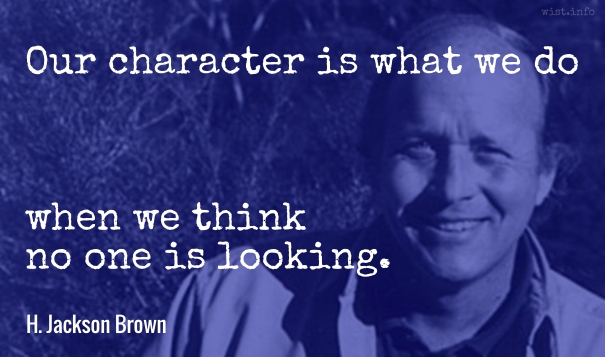
Our character is what we do when we think no one is looking.
H. Jackson "Jack" Brown, Jr. (b. 1940) American writer
P.S. I Love You (1990)
Brown attributed this to a letter his mother wrote him.

CATO: Content thyself to be obscurely good.
When vice prevails, and impious men bear sway,
The post of honour is a private station.Joseph Addison (1672–1719) English essayist, poet, statesman
Cato, Act 4, sc. 4, l. 139ff (1713)
(Source)

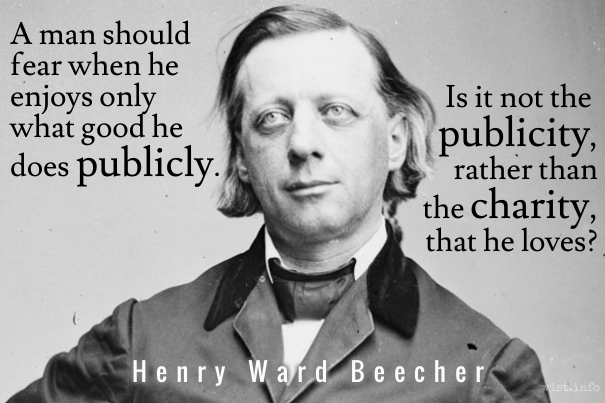
A man should fear when he enjoys only what good he does publicly. Is it not the publicity, rather than the charity, that he loves?
Henry Ward Beecher (1813–1887) American clergyman and orator
In Henry Ward Beecher and Edna Dean Proctor, Life Thoughts: Gathered From the Extemporaneous Discourses of Henry Ward Beecher (1858)
See Matthew.
Were there no hearers, there would be no backbiters.
George Herbert (1593–1633) Welsh priest, orator, poet.
Jacula Prudentum, or Outlandish Proverbs, Sentences, &c. (compiler), # 69 (1640 ed.)
(Source)

The very word “secrecy” is repugnant in a free and open society; and we are as a people inherently and historically opposed to secret societies, to secret oaths and to secret proceedings. We decided long ago that the dangers of excessive and unwarranted concealment of pertinent facts far outweighed the dangers which are cited to justify it. Even today, there is little value in opposing the threat of a closed society by imitating its arbitrary restrictions. Even today, there is little value in insuring the survival of our nation if our traditions do not survive with it. And there is very grave danger that an announced need for increased security will be seized upon by those anxious to expand its meaning to the very limits of official censorship and concealment. That I do not intend to permit to the extent that it is in my control. And no official of my Administration, whether his rank is high or low, civilian or military, should interpret my words here tonight as an excuse to censor the news, to stifle dissent, to cover up our mistakes or to withhold from the press and the public the facts they deserve to know.
John F. Kennedy (1917–1963) American politician, author, journalist, US President (1961–63)
Speech, American Newspaper Publishers Association (27 Apr 1961)
(Source)
You need not tell all the truth, unless to those who have a right to know it all. But let all you tell be truth.
James Burgh (1714–1775) British politician and writer
The Dignity of Human Nature, Sec. 5 “Miscellaneous Thoughts on Prudence in Conversation” (1754)
(Source)

Three may keep a Secret, if two of them are dead.
Benjamin Franklin (1706–1790) American statesman, scientist, philosopher, aphorist
Poor Richard (1735 ed.)
(Source)
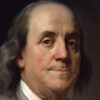
If you would keep your Secret from an enemy, tell it not to a friend.
Benjamin Franklin (1706–1790) American statesman, scientist, philosopher, aphorist
Poor Richard (1741 ed.)
(Source)
To go on with my advice (that is, supposing
You need advice from me): Be careful about
The things you say and the people to whom you say them.
Avoid the man who asks too many questions.
No question but he’ll be a teller of tales;
An ear that eager can’t keep a secret for long,
And once a word slips out it won’t come back.[Protinus ut moneam (si quid monitoris eges tu)
quid de quoque viro et cui dicas, saepe videto,
percontatorem fugito: nam garrulus idem est,
nec retinent patulae commissa fideliter aures,
et semel emissum volat irrevocabile verbum.]Horace (65–8 BC) Roman poet, satirist, soldier, politician [Quintus Horatius Flaccus]
Epistles [Epistularum, Letters], Book 1, ep. 18 “To Lollius,” l. 67ff (1.18.67-71) (20 BC) [tr. Ferry (2001)]
(Source)
(Source (Latin)). Other translations:Further for to admonishe the (If therof thou standst neede)
What, of what men, to whom thou speakest, take ever earnest heede.
A groper after novelties, in any wise do flye.
I warrante the learne this of me the same's a verye pye.
Nor wyde ope eares the thinges of trust can well conceale at all,
And word once scaped, away its gone, and none can it recall.
[tr. Drant (1567)]When thou dost talk of any man, take care
Of whom, to whom, and what thy speeches are.
Shun him that is inquisitive, for he
Will be as guilty of Garrulitie.
And his still gaping ears itch to reveal
What e're his friend intrusts him to conceal.
And 'tis impossible e're to recall
One syllable which we have once let fall.
[tr. A. B.; ed. Brome (1666)]But to advise you, if you want advice,
Take heed of whom you speak, and what it is,
Take heed to whom, avoid the busy Men,
Fly the inquisitive, they'l talk agen,
And tell what you have said, a leaky Ear
Can never hold what it shall chance to hear,
'Twill run all out, and what you once let fall
It flys, and tis impossible to recall.
[tr. Creech (1684)]If my advice regard my claim,
Be tender of another's fame,
And be the man with caution tried.
In whose discretion you confide.
The impertinent be sure to hate;
Who loves to ask, will love to prate.
Ears, that unfold to every tale,
Entrusted secrets ill conceal,
And you shall wish, but wish in vain,
To call the fleeting words again.
[tr. Francis (1747)]But with our sage monitions to proceed,
If peradventure such advice you need --
When of men's characters you speak, beware
Of whom, to whom, and what those speeches are!
Shun the inquisitive: pert fools will prate;
And words once utter'd are recall'd too late.
[tr. Howes (1845)]Moreover, that I may advise you (if in aught you stand in need of an adviser), take great circumspection what you say to any man, and to whom. Avoid an inquisitive impertinent, for such a one is also a tattler, nor do open ears faithfully retain what is intrusted to them; and a word, once sent abroad, flies irrevocably.
[tr. Smart/Buckley (1853)]Well, to proceed; beware, if there is room
For warning, what you mention, and to whom;
Avoid a ceaseless questioner; he burns
To tell the next he talks with what he learns;
Wide ears retain no secrets, and you know
You can't get back a word you once let go.
[tr. Conington (1874)]But with my words of warning to proceed.
If haply you a word of warning need!
Ere of a man you tell a thing, think well
To whom you tell it, also what you tell.
The man that pesters you with questions shun --
Tattlers are dangerous, and he is one.
Wide-gaping ears no secrets can retain.
And words once spoken you woo back in vain.
[tr. Martin (1881)]Further let me advise you, if you need advice, to be careful what you say about anybody and to whom you say it. Avoid a gossip. He is always a tattler; his widespread ears do not keep the secrets committed to them, and a word once spoken never returns.
[tr. Dana/Dana (1911)]To continue my advice, if you need advice in aught — think often of what you say, and of whom, and to whom you say it. Avoid a questioner, for he is also a tattler. Open ears will not keep secrets loyally, and the word once let slip flies beyond recall.
[tr. Fairclough (Loeb) (1926)]If my advice regard may claim,
Be tender of another's fame,
And be the man with caution tried
In whose discretion you confide.
Th' impertinent be sure to hate;
Who loves to ask, will love to prate.
Ears, that unfold to every tale,
Intrusted secrets ill conceal,
And you shall wish, but wish in vain,
To call the fleeting words again.
[tr. Murison (1931); ed. Kraemer (1936)]Let me give you some more advice -- not that you need it.
Becareful of what you say and to whom and of whom.
Steer clear of inquisitive snoopers: they're usually gossips.
Open ears will nto keep safe what's deposited in them,
And a word once launched on its way cannot be revoked.
[tr. Palmer Bovie (1959)]In case you need some more advice, I offer this:
Be careful what you say and to whom, and about whom.
Run from a curious man; he'll love telling others.
Secrets that you trust to open ears won't be well kept,
and once a word escapes, it flies; you can't recall it.
[tr. Fuchs (1977)]Another word of advice -- if in fact you need an adviser:
watch what you say, and of which man, and to whom you say it.
Have nothing to do with inquisitive people -- they're also gossips.
You cannot rely on ready ears to contain a secret,
And once a word escapes, it flies beyond recall.
[tr. Rudd (2005 ed.)]On with the advice (if you need any advice):
Always think what you say to whom, and of whom.
Avoid the inquisitive: they’re also garrulous,
Flapping ears can’t be trusted to keep a secret,
And once the word’s let slip, it flies beyond recall.
[tr. Kline (2015)]
The word “security” is a broad, vague generality whose contours should not be invoked to abrogate the fundamental law embodied in the First Amendment. The guarding of military and diplomatic secrets at the expense of informed representative government provides no real security for our Republic.
Hugo Black (1886–1971) American politician and jurist; US Supreme Court Justice (1937–71)
New York Times Co. v. United States, 403 U.S. 713, 719 (1971) [concurring]
(Source)
I am for frank explanations with friends in cases of affronts. They sometimes save a perishing friendship, and even place it on a firmer basis than at first; but secret discontent must always end badly.
Sydney Smith (1771–1845) English clergyman, essayist, wit
Memoir of the Reverend Sydney Smith, by His Daughter, Lady Holland, Vol. 1, ch. 6 (1855)
(Source)
Don’t write anything you can phone. Don’t phone anything you can talk. Don’t talk anything you can whisper. Don’t whisper anything you can smile. Don’t smile anything you can nod. Don’t nod anything you can wink.
Earl Kemp Long (1895–1960) American politician, orator.
(Attributed)
Advice on political discretion. Widely attributed, but with no primary sourcing or particular context I can find. Quoted in his biography, Michael L. Kurtz, Earl K. Long: The Saga of Uncle Earl and Louisiana Politics, ch. 7 (1990).

Every thing secret degenerates, even the administration of justice; nothing is safe that does not show how it can bear discussion and publicity.
John Dalberg, Lord Acton (1834–1902) British historian, politician, writer
Letter (1861-01-23) to Richard Simpson
(Source)
Never regard something as doing you good if it makes you betray a trust, or lose your sense of shame, or makes you show hatred, suspicion, ill will, or hypocrisy, or a desire for things best done behind closed doors.
[Μὴ τιμήσῃς ποτὲ ὡς συμφέρον σεαυτοῦ, ὃ ἀναγκάσει σέ ποτε τὴν πίστιν παραβῆναι, τὴν αἰδῶ ἐγκαταλιπεῖν, μισῆσαί τινα, ὑποπτεῦσαι, καταράσασθαι, ὑποκρίνασθαι, ἐπιθυμῆσαί τινος τοίχων καὶ παραπετασμάτων δεομένου.]
Marcus Aurelius (AD 121–180) Roman emperor (161–180), Stoic philosopher
Meditations [To Himself; Τὰ εἰς ἑαυτόν], Book 3, ch. 7 (3.7) [tr. Hays (2003)]
(Source)
(Source (Greek)). Other translations:Never esteem of anything as profitable, which shall ever constrain thee either to break thy faith, or to lose thy modesty; to hate any man, to suspect, to curse, to dissemble, to lust after anything, that requireth the secret of walls or veils.
[tr. Casaubon (1634), ch. 8]Don't be fond of any Thing, or think that for your Interest, which makes you break your Word, quit your Modesty, be of a Dissembling, Suspicious, or Outragious Humour; which puts you upon Hating any Person, and enclines you to any Practice, which wont bear the Light, and look the World in the Face.
[tr. Collier (1701)]Never value that as advantageous, which may force you to break your faith; to quit your modesty, or sense of honour; to hate, suspect, or imprecate evil on any one; to dissemble; or to desire any of these things which need walls or curtains to conceal them.
[tr. Hutcheson/Moor (1742)]Never adopt any measure as conducing to your interest, which lays you under a necessity of violating your honour or your modesty; or may excite your hatred or your suspicion, or provoke you to execrate any one, or to practice dissimulation; or, in short, to entertain a wish which will not bear the light, but must be concealed from the world by walls and curtains.
[tr. Graves (1792)]Never value anything as profitable to thyself which shall compel thee to break thy promise, to lose thy self-respect, to hate any man, to suspect, to curse, to act the hypocrite, to desire anything which needs walls and curtains.
[tr. Long (1862)]Think nothing for your interest which makes you break your word, quit your modesty, hate, suspect, or curse any person, or inclines you to any practice which will not bear the light and look the world in the face.
[tr. Collier/Zimmern (1887)]Never esteem anything as of advantage to thee that shall make thee break thy word or lose thy self-respect.
[tr. Morgan, in Bartlett's (1894)]Never prize anything as self-advantage, which will compel you to break faith, to forfeit self-respect, to suspect or hate or execrate another, to play false, to desire anything which requires screens or veils.
[tr. Rendall (1898)]Never esteem aught of advantage which will oblige you to break your faith, or to desert your honour; to hate, to suspect, or to execrate any man; to play a part; or to set your mind on anything that needs to be hidden by wall or curtain.
[tr. Hutcheson/Chrystal (1902)]Prize not anything as being to thine interest that shall ever force thee to break thy troth, to surrender thine honour, to hate, suspect, or curse anyone, to play the hypocrite, to lust after anything that needs walls and curtains.
[tr. Haines (Loeb) (1916)]Never value as an advantage to yourself what will force you one day to break your word, to abandon self-respect, to hate, suspect, execrate another, to act a part, to covet anything that calls for walls or coverings to conceal it.
[tr. Farquharson (1944)]Never value the advantages derived from anything involving breach of faith, loss of self-respect, hatred, suspicion, or execration of others, insincerity, or the desire for something which hast to be veiled and curtained.
[tr. Staniforth (1964)]Never prize as advantageous to yourself anything that will compel you some day to break your word, to offend against propriety, to hate, suspect or curse another, to dissemble, or to desire anything that needs to be veiled behind walls and curtains.
[tr. Hard (1997 ed.)]Never regard as a benefit to yourself anything which will force you at some point to break your faith, to leave integrity behind, to hate, suspect, or curse another, to dissemble, to covet anything needing the secrecy of walls and drapes.
[tr. Hammond (2006)]Never consider anything to be beneficial to you, which could ever compel you to violate your faith in yourself, to abandon your modesty, to hate anybody, to be overly suspicious, cursing, disingenuous, or to lust after anything which must be hidden behind walls or veils.
[tr. Needleman/Piazza (2008)]Never prize as advantageous to yourself anything that will compel you some day to break your word, to offend against propriety, to hate, suspect, or curse another, to pretend, or to desire anything that needs to be veiled behind walls and curtains.
[tr. Hard (2011 ed.)]Never value as beneficial to yourself something that will force you one day to break your word, abandon your sense of shame, hate, suspect, or curse someone else, pretend, or desire something that needs the secrecy of walls or curtains.
[tr. Gill (2013)]Value nothing which compels you to break your promise, to abandon your honor, to hate, suspect or curse anyone, to be a hypocrite, or to lust after anything which needs walls or decorations.
[tr. @sentantiq (2019)]Never value anything you find profitable, to the extent that you have to break a promise, lose your self-respect, hate any person or act the hypocrite.
[tr. McNeill (2019)]Some causes will force you to betray faith, abandon shame, hate or suspect another person, call down curses, put forward explanations, or desire something that requires walls and fences. Do not regard these causes as necessary or beneficial to yourself.
[Source]