It is the mark of a good action that it appears inevitable in the retrospect. We should have been cut-throats to do otherwise. And there’s an end. We ought to know distinctly that we are damned for what we do wrong; but when we have done right, we have only been gentlemen, after all. There is nothing to make a work about.
Robert Louis Stevenson (1850–1894) Scottish essayist, novelist, poet
Essay (1880-01/02?), “Reflections and Remarks on Human Life,” § 6 “Right and Wrong”
(Source)
A collection of aphorisms and musings, first published in the Edinburgh Edition of his Works, vol. 28 (1898).
Quotations about:
good deed
Note not all quotations have been tagged, so Search may find additional quotes on this topic.
He who expekts to be praized every time he duz a virtewous thing will soon git tired of the bizzness.
[He who expects to be praised every time he does a virtuous thing will soon get tired of the business.]
Josh Billings (1818–1885) American humorist, aphorist [pseud. of Henry Wheeler Shaw]
Josh Billings’ Farmer’s Allminax, 1875-07 (1875 ed.)
(Source)

The pleasure we derive from doing favors is partly in the feeling it gives us that we are not altogether worthless. It is a pleasant surprise to ourselves.
Eric Hoffer (1902–1983) American writer, philosopher, longshoreman
Passionate State of Mind, Aphorism 113 (1955)
(Source)
When a noble deed is done, who is likely to appreciate it? They who are noble themselves.
Henry David Thoreau (1817–1862) American philosopher and writer
Speech (1860-07-04), “The Last Days of John Brown,” North Elba, Massachusetts
(Source)
Collected in A Yankee in Canada (1866).
As a horse when he has run, a dog when he has tackled the game, a bee when it has made the honey, so a man when he has done a good act does not call out for others to come and see, but he goes on to another act, as a vine goes on to produce again the grapes in season.
[ἵππος δραμών, κύων ἰχνεύσας, μέλισσα μέλι ποιήσασα, ἄνθρωπος δ̓ εὖ ποιήσας οὐκ ἐπιβοᾶται, ἀλλὰ μεταβαίνει ἐφ̓ ἕτερον, ὡς ἄμπελος ἐπὶ τὸ πάλιν ἐν τῇ ὥρᾳ τὸν βότρυν ἐνεγκεῖν.]
Marcus Aurelius (AD 121–180) Roman emperor (161–180), Stoic philosopher
Meditations [To Himself; Τὰ εἰς ἑαυτόν], Book 5, ch. 6 (5.6) (AD 161-180) [tr. Long (1862)]
(Source)
(Source (Greek)). Other translations:As a horse after a race, and a hunting dog when he hath hunted, and a bee when she hath made her honey, look not for applause and commendation; so neither doth that man that rightly doth understand his own nature when he hath done a good turn: but from one doth proceed to do another, even as the vine after she hath once borne fruit in her own proper season, is ready for another time.
[tr. Casaubon (1634)]A Fleet Horse or Greyhound, don't use to make a Noise when they have perform'd handsomly, nor a Bee neither when she has made a little Hony: And thus a Man that's rightly Kind, never proclaims a Good Turn, but does another as soon as he can; just like a Vine that bears again the next Season.
[tr. Collier (1701)]The horse, when he hath run his course, the hound, when he has followed the track, the bee, when it has made its honey, and the Man, when he hath done good to others, don’t make a noisy boast of it, but go on to repeat the like actions, as the vine in its season produces its new clusters again.
[tr. Hutcheson/Moor (1742)]This same is applicable to the horse that has finished his course, to the hound that has ended his chase, and to the bee that has produced its honey. Let the man, then, who has done a beneficent action, not look for applause; but repeat it the first opportunity; as the vine again yields its fruit at the proper season.
[tr. Graves (1792), 5.5]A fleet horse or greyhound do not make a noise when they have done well, nor a bee neither when she has made a little honey. And thus a man that has done a kindness never proclaims it, but does another as soon as he can, just like a vine that bears again the next season.
[tr. Collier/Zimmern (1887)]As the horse that runs, the hound that hunts, the bee that hives its honey, so the man who does the kindness does not raise a shout, but passes on to the next act, as a vine to the bearing of clusters for next season.
[tr. Rendall (1898)]The horse when he has run his course, the hound when he has followed the track, the bee when it has made its honey, and the man when he has done good to others, make no noisy boast of it, but set out to do the same once more, as the vine in its season produces its new clusters again.
[tr. Hutcheson/Chrystal (1902)][...] a steed when it has run its course, a hound when it has singled out the trail, a bee when she hath made her comb. And so a man when he hath done one thing well, does not cry it abroad, but betakes himself to a second, as a vine to bear afresh her clusters in due season.
[tr. Haines (Loeb) (1916)]A horse runs, a hound tracks, bees make honey, and a man does good, but doesn't know that he has done it and passes on to a second act, like a vine to bear once more its grapes in due season.
[tr. Farquharson (1944)][...] a horse that has run its race, a hound that has tracked his quarry, or a bee that has hived her honey. Like them, the man who has done one good action does not cry it aloud, but passes straight on to a second, as the vine passes on to the bearing of another summer's grapes.
[tr. Staniforth (1964)][...] a horse when it has run its race, or a dog when it has followed a trail, or a bee when it has mades its honey. And so such a person, when he has done a good deed, does not cry it abroad, but passes straight on to the next, as the vine yields new clusters of grapes when the season comes around.
[tr. Hard (1997 ed.)]A horse at the end of the race ...
A dog when the hunt is over ...
A bee with its honey stored ...
And a human being after helping others.
They don't make a fuss about it. They just go on to something else, as the vine looks forward to bearing fruit again in season.
[tr. Hays (2003)]A horse that has raced, a dog that has tracked, a bee that has made honey, and a man that has done good -- none of these knows what they have done, but they pass on to the next action, just as the vine passes on to bear grapes again in due season.
[tr. Hammond (2006)][...] a horse when it has run its race, or a dog when it has followed its trail, or a bee when it has made its honey. And so such a person, when he has done a good deed, does not shout about it, but passes straight on to the next one, as the vine yields new clusters of grapes when the season comes around.
[tr. Hard (2011 ed.)][...] a horse which has run a race, a dog which has followed the scent, or a bee which has made its honey. A person who has done something good does not make a big fuss about it, but goes on to the next action, as a vine goes on to produce grapes again in season.
[tr. Gill (2013), sec. 3-4]A man does not proclaim a good deed, but proceeds to another, as a vine bears grapes again in season.
[ed. Taplin (2016)]
Iz it charity tew giv tew a thankless cuss in need? certainly; jest az mutch az it would be to save a drouning cow.
[Is it charity to give to a thankless cuss in need? Certainly; just as much as it would be to save a drowning cow.]
Josh Billings (1818–1885) American humorist, aphorist [pseud. of Henry Wheeler Shaw]
Everybody’s Friend, Or; Josh Billing’s Encyclopedia and Proverbial Philosophy of Wit and Humor, ch. 132 “Affurisms: Chips” (1874)
(Source)
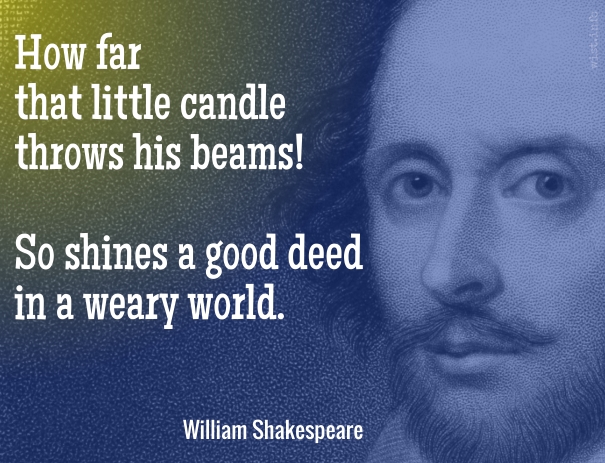
PORTIA: How far that little candle throws his beams!
So shines a good deed in a weary world.
William Shakespeare (1564–1616) English dramatist and poet
Merchant of Venice, Act 5, sc. 1, l. 99ff (5.1.99-100) (1597)
(Source)
In some versions, "So shines a good deed in a naughty world."
Sometimes misattributed to Roald Dahl (or even Gene Wilder); the character Willy Wonka uses the second sentence toward the end of the film Willy Wonka and the Chocolate Factory (1971).

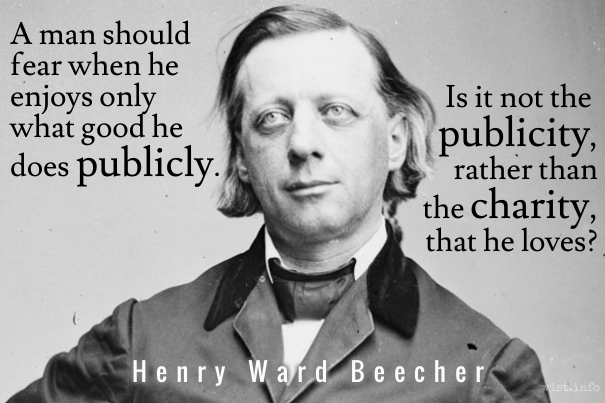
A man should fear when he enjoys only what good he does publicly. Is it not the publicity, rather than the charity, that he loves?
Henry Ward Beecher (1813–1887) American clergyman and orator
In Henry Ward Beecher and Edna Dean Proctor, Life Thoughts: Gathered From the Extemporaneous Discourses of Henry Ward Beecher (1858)
See Matthew.
Anyone, then, who knows the right thing to do and fails to do it, commits sin.
[εἰδότι οὖν καλὸν ποιεῖν καὶ μὴ ποιοῦντι ἁμαρτία αὐτῷ ἐστιν.]
The Bible (The New Testament) (AD 1st - 2nd C) Christian sacred scripture
Book 20. Letter of James 4:17ff (Jas 4:17) [NRSV (2021 ed.)]
(Source)
(Source (Greek)). Other translations:Therefore to him that knoweth to do good, and doeth it not, to him it is sin.
[KJV (1611)]Everyone who knows what is the right thing to do and doesn't do it commits a sin.
[JB (1966)]So then, if we do not do the good we know we should do, we are guilty of sin.
[GNT (1976)]Everyone who knows what is the right thing to do and does not do it commits a sin.
[NJB (1985)]It is a sin when someone knows the right thing to do and doesn’t do it.
[CEB (2011)]If anyone, then, knows the good they ought to do and doesn't do it, it is sin for them.
[NIV (2011 ed.)]

The noblest question in the world is, What Good may I do in it?
Benjamin Franklin (1706–1790) American statesman, scientist, philosopher, aphorist
Poor Richard (1737 ed.)
(Source)
No act of kindness, no matter how small, is ever wasted.
Aesop (620?-560? BC) Legendary Greek storyteller
Fables [Aesopica], “The Lion and the Mouse” (6th C BC)
Another translation: "Kindness is seldom thrown away" [tr. James (1848)]