It is the mark of a good action that it appears inevitable in the retrospect. We should have been cut-throats to do otherwise. And there’s an end. We ought to know distinctly that we are damned for what we do wrong; but when we have done right, we have only been gentlemen, after all. There is nothing to make a work about.
Robert Louis Stevenson (1850–1894) Scottish essayist, novelist, poet
Essay (1880-01/02?), “Reflections and Remarks on Human Life,” § 6 “Right and Wrong”
(Source)
A collection of aphorisms and musings, first published in the Edinburgh Edition of his Works, vol. 28 (1898).
Quotations about:
do the right thing
Note not all quotations have been tagged, so Search may find additional quotes on this topic.

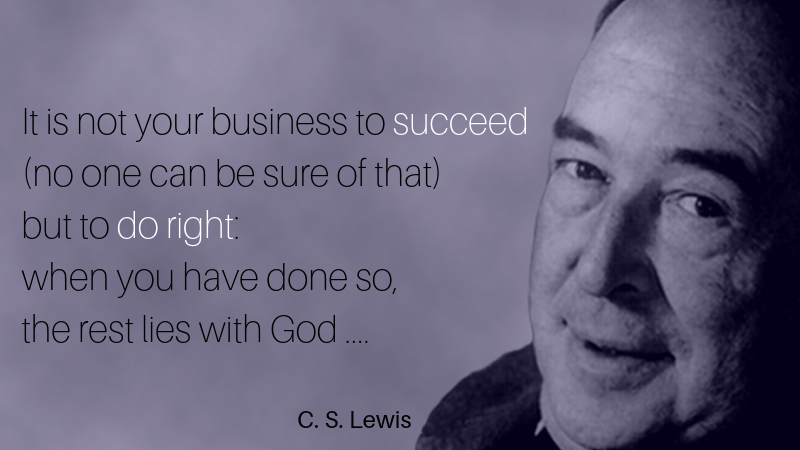
There is always some peace in having submitted to the right. Don’t spoil it by worrying about the results, if you can help it. It is not your business to succeed (no one can be sure of that) but to do right: when you have done so, the rest lies with God ….
C. S. Lewis (1898–1963) English writer, literary scholar, lay theologian [Clive Staples Lewis]
Letter to Arthur Greeves, Collected Letters of C. S. Lewis, Vol. 2: 1931-1949 (2004)
(Source)

I shall stay in jail to the end of my days before I make a butchery of my conscience.
John Bunyan (1628–1688) English Christian writer, preacher
(Attributed)
Quoted in M. L. King, Jr., "Letter from Birmingham City Jail" (16 Apr 1963).

My principle is to do whatever is right, and leave consequences to him who has the disposal of them.
Thomas Jefferson (1743–1826) American political philosopher, polymath, statesman, US President (1801–09)
Letter (1813-10-03) to George Logan
(Source)

After the satisfaction of doing what is right, the greatest is that of having what we do approved by those whose opinions deserve esteem.
Thomas Jefferson (1743–1826) American political philosopher, polymath, statesman, US President (1801–09)
Letter (1779-07-22) to William Phillips
(Source)
Must the citizen ever for a moment, or in the least degree, resign his conscience to the legislator? Why has every man a conscience, then? I think that we should be men first, and subjects afterward.
Henry David Thoreau (1817–1862) American philosopher and writer
Essay (1849-05), “Resistance to Civil Government [On the Duty of Civil Disobedience],” Æsthetic Papers, No. 1, Article 10
(Source)
Based on an 1848 lecture at the Concord Lyceum.