Can people hold on to their anger
against others, and then look for healing from the Lord?
Can they refuse to have mercy
on people like themselves,
and then pray about their own sins?
If they, who are just flesh,
hold on to anger,
who will secure pardon
for their own sins?[ἄνθρωπος ἀνθρώπῳ συντηρεῖ ὀργήν,
καὶ παρὰ κυρίου ζητεῖ ἴασιν;
ἐπ᾽ ἄνθρωπον ὅμοιον αὐτῷ οὐκ ἔχει ἔλεος,
καὶ περὶ τῶν ἁμαρτιῶν αὐτοῦ δεῖται;
αὐτὸς σὰρξ ὢν διατηρεῖ μῆνιν,
τίς ἐξιλάσεται τὰς ἁμαρτίας αὐτοῦ;]The Bible (The Old Testament) (14th - 2nd C BC) Judeo-Christian sacred scripture [Tanakh, Hebrew Bible], incl. the Apocrypha (Deuterocanonicals)
Book 22b. Sirach (Ecclesiasticus) 28: 3ff (Sir 28:3–5) [tr. CEB (2011)]
(Source)
More on the history and acceptance of this Apocryphal book here and here.
(Source (Greek)). Alternate translations:One man beareth hatred against another, and doth he seek pardon from the Lord?
He sheweth no mercy to a man, which is like himself: and doth he ask forgiveness of his own sins?
If he that is but flesh nourish hatred, who will intreat for pardon of his sins?
[tr. KJV (1611)]Man to man reserveth anger, and doth he seek remedy of God?
He hath no mercy on a man like himself, and doth he entreat for his own sins?
He that is but flesh, nourisheth anger, and doth he ask forgiveness of God? who shall obtain pardon for his sins?
[tr. DRA (1899)]If a man nurses anger against another,
can he then demand compassion from the Lord?
Showing no pity for a man like himself,
can he then plead for his own sins?
Mere creature of flesh, he cherishes resentment;
who will forgive him his sins?
[tr. JB (1966)]If anyone nurses anger against another,
can one then demand compassion from the Lord?
Showing no pity for someone like oneself,
can one then plead for one's own sins?
Mere creature of flesh, yet cherishing resentment!
-- who will forgive one for sinning?
[tr. NJB (1985)]You cannot expect the Lord to pardon you while you are holding a grudge against someone else. You yourself are a sinner, and if you won't forgive another person, you have no right to pray that the Lord will forgive your sins. If you cannot get rid of your anger, you have no hope of forgiveness — you are only a human being.
[tr. GNT (1992 ed.)]Does anyone harbor anger against another
and expect healing from the Lord?
If people have no mercy toward those like themselves,
can they then seek pardon for their own sins?
If mere mortals harbor wrath,
who will make an atoning sacrifice for their sins?
[tr. NRSV (2021 ed.)]
Quotations about:
just deserts
Note not all quotations have been tagged, so Search may find additional quotes on this topic.

At its most effective, the censor’s lie actually succeeds in replacing the artist’s truth. That which is censored is thought to have deserved censorship. Boat-rocking is deplored.
Salman Rushdie (b. 1947) Indian novelist
Speech (2012-05-06), Arthur Miller Freedom to Write Lecture, PEN World Voices Festival, New York City
(Source)
Printed as an essay (2012-05-11), "On Censorship," The New Yorker magazine.

Do not envy the sinner his success;
you do not know how that will end.[μὴ ζηλώσῃς δόξαν ἁμαρτωλοῦ·
οὐ γὰρ οἶδας τί ἔσται ἡ καταστροφὴ αὐτοῦ.]The Bible (The Old Testament) (14th - 2nd C BC) Judeo-Christian sacred scripture [Tanakh, Hebrew Bible], incl. the Apocrypha (Deuterocanonicals)
Book 22b. Sirach (Ecclesiasticus) 9:11 (Sir 9:11) [tr. NJB (1985)]
(Source)
More on the history and acceptance of this Apocryphal book here and here.
(Source (Greek)). Alternate translations:Envy not the glory of a sinner: for thou knowest not what shall be his end.
[tr. KJV (1611)]Envy not the glory and riches of a sinner: for thou knowest not what his ruin shall be.
[tr. DRA (1899), 9:16]Do not envy the sinner his success;
you do not know what turn his career will take.
[tr. JB (1966)]Don't be jealous of a sinner's success; you don't know what kind of disaster is in store for him.
[tr. GNT (1992 ed.)]Don’t envy the good reputation
of sinners,
since you don’t know
how sudden their end will be.
[tr. CEB (2011)]Do not envy the notoriety of sinners,
for you do not know what their end will be like.
[tr. NRSV (2021 ed.)]Do not envy a sinner, for you do not know his day of reckoning.
[tr. RJPS (2023 ed.), 9:15]
As I brew, so must I drink.
James Howell (c. 1594–1666) Welsh historian, writer, aphorist
Paroimiographia [Παροιμιογραφία]: Proverbs, or, Old Sayed Sawes & Adages, “English Proverbs” (1659) [compiler]
(Source)

He who expekts to be praized every time he duz a virtewous thing will soon git tired of the bizzness.
[He who expects to be praised every time he does a virtuous thing will soon get tired of the business.]
Josh Billings (1818–1885) American humorist, aphorist [pseud. of Henry Wheeler Shaw]
Josh Billings’ Farmer’s Allminax, 1875-07 (1875 ed.)
(Source)

I hate being so intolerant, and I wouldn’t be if people didn’t deserve it.
Mignon McLaughlin (1913–1983) American journalist and author
The Neurotic’s Notebook, ch. 3 (1963)
(Source)

AGAMEMNON: Perhaps, for you, barbarians, it is easy to kill your guests but for us, Greeks, this is a thing of shame. How, then can I escape blame if I do not judge you guilty? I can’t do it. Since you could endure performing such a dishonourable deed, then you must also endure its awful consequences.
[ἈΓΑΜΈΜΝΩΝ: τάχ᾽ οὖν παρ᾽ ὑμῖν ῥᾴδιον ξενοκτονεῖν:
ἡμῖν δέ γ᾽ αἰσχρὸν τοῖσιν Ἕλλησιν τόδε.
πῶς οὖν σε κρίνας μὴ ἀδικεῖν φύγω ψόγον;
οὐκ ἂν δυναίμην. ἀλλ᾽ ἐπεὶ τὰ μὴ καλὰ
πράσσειν ἐτόλμας, τλῆθι καὶ τὰ μὴ φίλα.]Euripides (485?-406? BC) Greek tragic dramatist
Hecuba [Hekabe; Ἑκάβη], l. 1247ff (c. 424 BC) [tr. Theodoridis (2007)]
(Source)
Passing judgment on Polymestor for the death of Hecuba's son and theft of the Trojan treasure entrusted to him.
(Source (Greek)). Other translations:Perhaps the murder of your guests seems light,
We Greeks esteem it base. If I acquit thee
How shall I scape reproach? Indeed, I cannot:
since thou hast dar'd to perpetrate the crime,
Endure the consequences.
[tr. Wodhull (1809)]Perhaps with you it is a slight thing to kill your guests; but with us Grecians this thing is abhorred. How then, in giving my decision that thou hast not injured, can I escape blame? I can not; but as thou hast dared to do things dishonorable, endure now things unpleasant.
[tr. Edwards (1826)]Haply with you guest-murder is as nought,
But to us which be Greeks foul shame is this.
How can I uncondemned adjudge thee guiltless?
I cannot. Forasmuch as thou hast dared
To do foul deeds, even drain thy bitter cup.
[tr. Way (Loeb) (1894)]Perhaps among you it is a light thing to murder guests, but with us in Hellas it is a disgrace. How can I escape reproach if I judge you not guilty? I could not. No, since you endured your horrid crime, endure as well its painful consequence.
[tr. Coleridge (1938)]Perhaps you think it is a trifling matter
to kill a guest.
We Greeks call it murder.
How, therefore, could I acquit you now
without losing face among men?
I could not do it.
You committed a brutal crime; therefore accept
the consequences of your act.
[tr. Arrowsmith (1958)]Perhaps for lesser breeds it's no great thing to kill a guest, but to us Greeks it is. If I say you did no wrong I can't escape the censure and the blame that I'll incur. Since you were tough enough to do such deeds be tough enough to suffer the results.
[tr. Harrison (2005)]Maybe you think
killing a guest -- in this case a child who’d been
put in your care -- is a small matter in the larger
scheme of things. But we Greeks think of it
as heinous murder. How could I rule you innocent
and maintain a shred of credibility? I can’t.
You committed a brutal crime; be prepared,
therefore, for a justly brutal punishment.
[tr. Karden/Street (2011)]
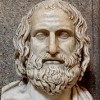
My word, how mortals take the gods to task!
All their afflictions come from us, we hear.
And what of their own failings? Greed and folly
double the suffering in the lot of man.[ὢ πόποι, οἷον δή νυ θεοὺς βροτοὶ αἰτιόωνται.
ἐξ ἡμέων γάρ φασι κάκ’ ἔμμεναι· οἱ δὲ καὶ αὐτοὶ
σφῇσιν ἀτασθαλίῃσιν ὑπὲρ μόρον ἄλγε’ ἔχουσιν.]Homer (fl. 7th-8th C. BC) Greek author
The Odyssey [Ὀδύσσεια], Book 1, l. 32ff (1.32) [Zeus] (c. 700 BC) [tr. Fitzgerald (1961)]
(Source)
Original Greek. Other translations:O how falsely men
Accuse us Gods as authors of their ill!
When, by the bane their own bad lives instill,
They suffer all the mis’ries of their states,
Past our inflictions, and beyond their fates.
[tr. Chapman (1616)]Ha! how dare mortals tax the Gods, and say,
Their harms do all proceed from our decree,
And by our setting; when by their crimes they
Against our wills make their own destiny?
[tr. Hobbes (1675), l. 37ff]Perverse mankind! whose wills, created free,
Charge all their woes on absolute degree;
All to the dooming gods their guilt translate,
And follies are miscall'd the crimes of fate.
[tr. Pope (1725)]Alas! how prone are human-kind to blame
The Pow’rs of Heav’n! From us, they say, proceed
The ills which they endure, yet more than Fate
Herself inflicts, by their own crimes incur.
[tr. Cowper (1792), l. 41ff]Mortals, ye Powers, upbraid us with their voice,
And brand us for the fount of all their ill,
Who, of their own acts, not of fate but choice,
Heap to themselves much toil and sorrow still.
[tr. Worsley (1861), st. 6]Why! what reproach,
Ye gods! do mortals cast on deities!
To us all their calamities they trace,
While they, themselves, through their own senseless acts,
Feel pangs their destiny had ne'er decreed.
[tr. Musgrave (1869)]Oh heavens! how mortals now to blame the gods!
From us they say spring ills! but they themselves
By their own folly bring unfated woes.
[tr. Bigge-Wither (1869)]Lo you now, how vainly mortal men do blame the gods! For of us they say comes evil, whereas they even of themselves, through the blindness of their own hearts, have sorrows beyond that which is ordained.
[tr. Butcher/Lang (1879)]Lo, how men blame the gods! From us, they say, spring troubles. But through their own perversity and more than is their due they meet with sorrow.
[tr. Palmer (1891)]See now, how men lay blame upon us gods for what is after all nothing but their own folly.
[tr. Butler (1898)]Oh my, how mortals hold us gods responsible! For they say that their misfortunes come from us. But they get their sufferings, beyond what is fated, by way of their own acts of recklessness.
[tr. Butler (1898), rev. Kim/McCray/Nagy/Power (2018)]Look you now, how ready mortals are to blame the gods. It is from us, they say, that evils come, but they even of themselves, through their own blind folly, have sorrows beyond that which is ordained.
[tr. Murray (1919)]It vexes me to see how mean are these creatures of a day towards us Gods, when they charge against us the evils (far beyond our worst dooming) which their own exceeding wantonness has heaped upon themselves.
[tr. Lawrence (1932)]What a lamentable thing it is that men should blame the gods and regard us as the source of their troubles, when it is their own wickedness that brings them sufferings worse than any which Destiny allots them.
[tr. Rieu (1946)]Oh for shame, how the mortals put the blame upon us
gods, for they say evils come from us, but it is they, rather,
who by their own recklessness win sorrow beyond what is given.
[tr. Lattimore (1965)]Men are so quick to blame the gods: they say
that we devise their misery. But they
themselves -- in their depravity -- design
grief greater than the griefs that fate assigns.
[tr. Mandelbaum (1990)]Ah how shameless -- the way these mortals blame the gods.
From us alone, they say, come all their miseries, yes,
but they themselves, with their own reckless ways,
compound their pains beyond their proper share.
[tr. Fagles (1996)]Mortals! They are always blaming the gods
For their troubles, when their own witlessness
Causes them more than they were destined for!
[tr. Lombardo (2000), l. 37ff]Strange to behold, what blame these mortals can bring against godhead! For their ills, they assert, are from us, when they themselves by their mad recklessness have pain far past what is fated.
[tr. Merrill (2002)]How surprising that men blame the gods, and say their troubles come from us, though they, through their own un-wisdom, find suffering beyond what is fated.
[tr. Kline (2004)]What a lamentable thing it is that men should blame the gods and regard us as the source of their troubles, when it is their own transgressions which bring them suffering that was not their destiny.
[tr. DCH Rieu (2002)]This is not good! See how mortals find fault with us gods!
They say it is from us that all evil things come, yet it is by their
own recklessness that they suffer hardship beyond their destiny.
[tr. Verity (2016)]This is absurd,
that mortals blame the gods! They say we cause
their suffering, but they themselves increase it
by folly.
[tr. Wilson (2017)]My oh my, the way mortals will fasten blame on the gods!
From us, they say, evils come, yet they themselves
through their own blind recklessness have ills beyond
their fated lot.
[tr. Green (2018)]It’s disgraceful how humans blame the gods.
They say their tribulations come from us,
when they themselves, through their own foolishness,
bring hardships which are not decreed by Fate.
[tr. Johnston (2019), l. 41ff]
MUNNY: It’s a hell of a thing, killing a man. You take away all he’s got, and all he’s ever gonna have.
SCHOFIELD KID: Yeah. Well, I guess they had it coming.
MUNNY: We all have it coming, kid.
!–more–>
(Source (Video); dialog verified)
Will Munny was played by Clint Eastwood. The script was originally written in 1976.
David Peoples (b. 1940) American screenwriter
Unforgiven (1992)
(Source)
(Source (Video); dialog verified)
Will Munny was played by Clint Eastwood. The script was originally written in 1976.