

At Cambridge University I was taught a laudable method of argument: you never personalise, but you have absolutely no respect for people’s opinions. You are never rude to the person, but you can be savagely rude about what the person thinks. That seems to me a crucial distinction: people must be protected from discrimination by virtue of their race, but you cannot ring-fence their ideas. The moment you say that any idea system is sacred, whether it’s a religious belief system or a secular ideology, the moment you declare a set of ideas to be immune from criticism, satire, derision, or contempt, freedom of thought becomes impossible.
Salman Rushdie (b. 1947) Indian novelist
“Do we have to fight the battle for the Enlightenment all over again?” The Independent (22 Jan 2005)
(Source)
Quotations by:
Rushdie, Salman

The idea that any kind of free society can be constructed in which people will never be offended or insulted is absurd. So too is the notion that people should have the right to call on the law to defend them against being offended or insulted. A fundamental decision needs to be made: do we want to live in a free society or not? Democracy is not a tea party where people sit around making polite conversation. In democracies people get extremely upset with each other. They argue vehemently against each other’s positions. (But they don’t shoot.)
Salman Rushdie (b. 1947) Indian novelist
“Do we have to fight the battle for the Enlightenment all over again?” The Independent (22 Jan 2005)
(Source)
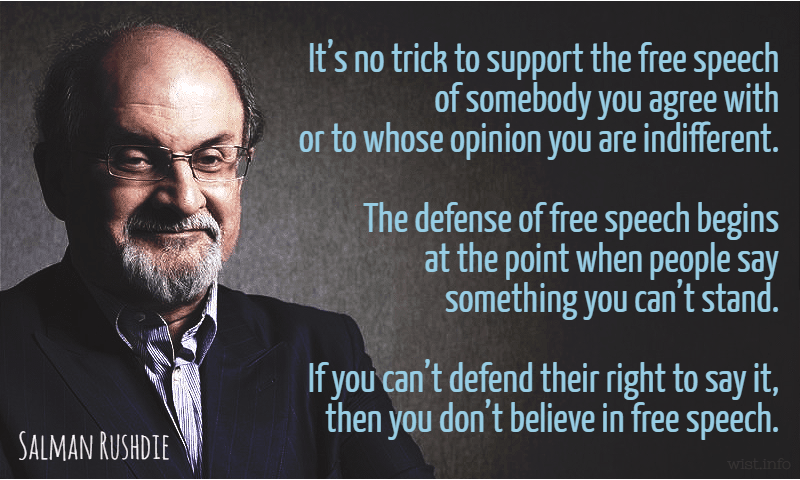
It’s no trick to support the free speech of somebody you agree with or to whose opinion you are indifferent. The defense of free speech begins at the point when people say something you can’t stand. If you can’t defend their right to say it, then you don’t believe in free speech.
Salman Rushdie (b. 1947) Indian novelist
“Do we have to fight the battle for the Enlightenment all over again?” The Independent (22 Jan 2005)
(Source)
A book is a version of the world. If you do not like it, ignore it; or offer your own version in return.
Salman Rushdie (b. 1947) Indian novelist
“In Good Faith” (1990), Imaginary Homelands: Essays and Criticism, 1981-1991 (1992)
(Source)
It always matters to name rubbish as rubbish; … to do otherwise is to legitimize it.
Salman Rushdie (b. 1947) Indian novelist
“Outside the Whale,” Imaginary Homelands (1991)
An attack upon our ability to tell stories is not just censorship — it is a crime against our nature as human beings.
Salman Rushdie (b. 1947) Indian novelist
“Public Event, Private Lives,” speech, University of Colorado, Boulder (2013-04-17)
(Source)
The enemy for the fanatic is pleasure, which makes it extremely important to continue to indulge in pleasure. Dance madly. That is how you get rid of terrorism.
Salman Rushdie (b. 1947) Indian novelist
“Public Event, Private Lives,” speech, University of Colorado, Boulder (2013-04-17)
(Source)
From the beginning men used God to justify the unjustifiable.
What is freedom of expression? Without the freedom to offend, it ceases to exist.
Salman Rushdie (b. 1947) Indian novelist
In Weekend Guardian (10 Feb 1990)
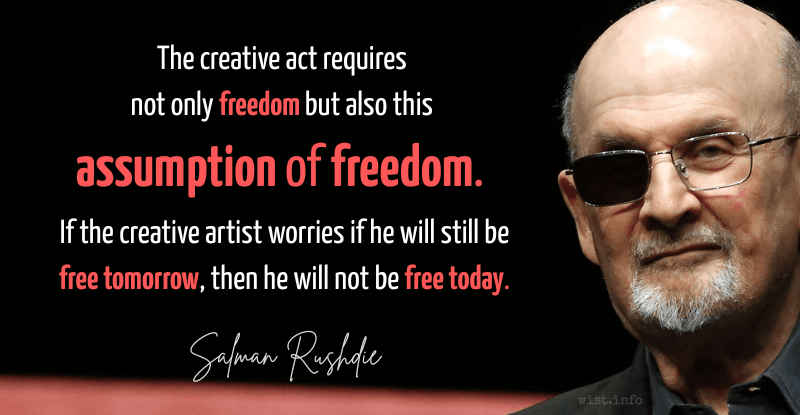
The creative act requires not only freedom but also this assumption of freedom. If the creative artist worries if he will still be free tomorrow, then he will not be free today. If he is afraid of the consequences of his choice of subject or of his manner of treatment of it, then his choices will not be determined by his talent, but by fear. If we are not confident of our freedom, then we are not free.
When censorship intrudes on art, it becomes the subject; the art becomes “censored art,” and that is how the world sees and understands it. The censor labels the work immoral, or blasphemous, or pornographic, or controversial, and those words are forever hung like albatrosses around the necks of those cursed mariners, the censored works. The attack on the work does more than define the work; in a sense, for the general public, it becomes the work.
At its most effective, the censor’s lie actually succeeds in replacing the artist’s truth. That which is censored is thought to have deserved censorship. Boat-rocking is deplored.
Salman Rushdie (b. 1947) Indian novelist
Speech (2012-05-06), Arthur Miller Freedom to Write Lecture, PEN World Voices Festival, New York City
(Source)
Printed as an essay (2012-05-11), "On Censorship," The New Yorker magazine.
Great art, or, let’s just say, more modestly, original art is never created in the safe middle ground, but always at the edge. Originality is dangerous. It challenges, questions, overturns assumptions, unsettles moral codes, disrespects sacred cows or other such entities. It can be shocking, or ugly, or, to use the catch-all term so beloved of the tabloid press, controversial. And if we believe in liberty, if we want the air we breathe to remain plentiful and breathable, this is the art whose right to exist we must not only defend, but celebrate. Art is not entertainment. At its very best, it’s a revolution.