
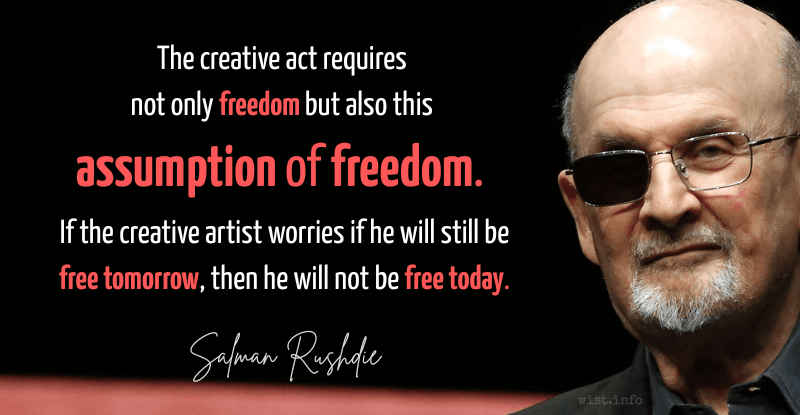
The creative act requires not only freedom but also this assumption of freedom. If the creative artist worries if he will still be free tomorrow, then he will not be free today. If he is afraid of the consequences of his choice of subject or of his manner of treatment of it, then his choices will not be determined by his talent, but by fear. If we are not confident of our freedom, then we are not free.
Quotations about:
self-censorship
Note not all quotations have been tagged, so Search may find additional quotes on this topic.
The point is that when a nation silences criticism and dissent, it deprives itself of the power to correct its errors. The process of silencing need not be as savage as in Nazi Germany or in South Africa today; it is enough that an atmosphere be created where men prefer silence to protest. As has been observed of book-burning, it is not necessary to burn books, it is enough to discourage men from writing them.
Henry Steele Commager (1902–1998) American historian, writer, activist
Essay (1965-12-18), “The Problem of Dissent,” Saturday Review
(Source)
Reprinted in Freedom and Order, Part 6 (1966).
Sections of the essay (including this portion) were read into the Congressional Record, Senate Proceedings (1969-06-26), as part of a speech by former Senator Wayne Morse (D-Oregon) at the commencement of Fairleigh Dickinson University (1969-06-07); Morse's speech was read in by Senator Gary Hart (D-Colo.).

Why is the goose-step not used in England? There are, heaven knows, plenty of army officers who would be only too glad to introduce some such thing. It is not used because the people in the street would laugh. Beyond a certain point, military display is only possible in countries where the common people dare not laugh at the army.
George Orwell (1903–1950) English journalist, essayist, writer [pseud. of Eric Arthur Blair]
Essay (1941-02-19), “The Lion and the Unicorn: Socialism and the English Genius,” Part 1 “England Your England,” sec. 2, The Searchlight Books [ed. Fyvel and Orwell]
(Source)
Part of Part 1, "England Your England" with the title "The Ruling Class" was previously published in Horizon (1940-12).

I have often thought if the minds of men were laid open, we should see but little difference between that of the wise man and that of the fool. There are infinite reveries, numberless extravagances, and a perpetual train of vanities which pass through both. The great difference is, that the first knows how to pick and cull his thoughts for conversation, by suppressing some, and communicating others; whereas the other lets them all indifferently fly out in words.
Joseph Addison (1672–1719) English essayist, poet, statesman
Essay (1711-11-17), The Spectator, No. 225
(Source)

What is going on in the Un-American Activities Committee worries me primarily because little people have become frightened and we find ourselves living in the atmosphere of a police state, where people close doors before they state what they think or look over their shoulders apprehensively before they express an opinion.
Eleanor Roosevelt (1884–1962) American politician, diplomat, activist; First Lady of the US (1933–45)
Column (1947-10-29), “My Day”
(Source)

Q: What would be some examples of what being fully human means to you?
A: Day to day it means engaging, encountering all the different people who cross my path. To recognize another’s humanity is a huge part of finding my own. It means to stop censoring myself so that what comes out of my mouth are only pearls and jewels and perhaps to let some slobbery stuff come out as well. It means worrying less about being perfect, and being concerned more with being authentic or real with other people, maybe in hopes of evoking some of their own realness, because a lot of us are busy pretending to be someone instead of being someone.
Barbara Brown Taylor (b. 1951) American minister, academic, author
Interview (2006-06-08) by Bob Abernathy, PBS
(Source)

Questions are a burden to others
Answers a prison for oneselfGeorge Markstein (1926–1987) British journalist, author, screenwriter
The Prisoner, 01×01 “Arrival” (1967-09-29) [with David Tomblin]
(Source)
Sign in the Labour Exchange office of the Village.

If all Printers were determin’d not to print any thing till they were sure it would offend no body, there would be very little printed.
Benjamin Franklin (1706–1790) American statesman, scientist, philosopher, aphorist
“Apology for Printers,” Philadelphia Gazette (1731-06-10)
(Source)

In this age of censorship I mourn the loss of books that will never be written, I mourn the voices that will be silenced — writers’ voices, teachers’ voices, students’ voices — and all because of fear.
Judy Blume (b. 1938) American writer
“Censorship: A Personal View,” Introduction, Places I Never Meant to Be: Original Stories by Censored Writers (1999) [ed. Blume]
(Source)
A man should learn to detect and watch that gleam of light which flashes across his mind from within, more than the lustre of the firmament of bards and sages. Yet he dismisses without notice his thought, because it is his.
In every work of genius we recognize our own rejected thoughts; they come back to us with a certain alienated majesty. Great works of art have no more affecting lesson for us than this. They teach us to abide by our spontaneous impression with good-humored inflexibility then most when the whole cry of voices is on the other side. Else to-morrow a stranger will say with masterly good sense precisely what we have thought and felt all the time, and we shall be forced to take with shame our own opinion from another.Ralph Waldo Emerson (1803–1882) American essayist, lecturer, poet
Essay (1841), “Self-Reliance,” Essays: First Series, No. 2
(Source)
This essay was inspired by his reading of Walter Savage Landor in 1833, with passages pulled from his lecture "Individualism," last in his course on "The Philosophy of History" (1836–1837), with other passages from the lectures "School," "Genius," and "Duty" in his course on "Human Life" (1838–1839).
A man dies when he refuses to stand up for that which is right. A man dies when he refuses to stand up for justice. A man dies when he refuses to take a stand for that which is true.
Martin Luther King, Jr. (1929–1968) American clergyman, civil rights leader, social activist, preacher
Sermon, Selma, Alabama (8 Mar 1965)
Possibly the source of the uncited attributions (or variants) "Our lives begin to end the day we become silent about things that matter" and "The day we see the truth and cease to speak is the day we begin to die."
COLE: We were supposed to draw a picture. Anything we wanted. I drew a man. He got hurt in the neck by another man with a screwdriver.
MALCOLM: You saw that on TV, Cole?
COLE: Everyone got upset. They had a meeting. Mom started crying. I don’t draw like that anymore.
MALCOLM: How do you draw now?
COLE: I draw — people smiling, dogs running, rainbows. They don’t have meetings about rainbows.
M. Night Shyamalan (b. 1970) Indian-American screenwriter, director
The Sixth Sense (1999)
(Source)
(Source (Video); dialog confirmed)