No one can stand a person who talks too long and will not give others a chance to speak.
ὁ πλεονάζων λόγῳ βδελυχθήσεται,
καὶ ὁ ἐνεξουσιαζόμενος μισηθήσεται.The Bible (The Old Testament) (14th - 2nd C BC) Judeo-Christian sacred scripture [Tanakh, Hebrew Bible], incl. the Apocrypha (Deuterocanonicals)
Book 22b. Sirach (Ecclesiasticus) 20: 8ff (Sir 20:8) [tr. GNT (1992 ed.)]
(Source)
More on the history and acceptance of this Apocryphal book here and here.
(Source (Greek)). Alternate translations:He that useth many words shall be abhorred; and he that taketh to himself authority therein shall be hated.
[tr. KJV (1611)]He that useth many words shall hurt his own soul: and he that taketh authority to himself unjustly shall be hated.
[tr. DRA (1899)]The man who talks too much will get himself disliked,
and the self-appointed oracle will make himself hated.
[tr. JB (1966)]Someone who talks too much will earn dislike,
and someone who usurps authority will earn hatred.
[tr. NJB (1985)]Those who talk excessively will be loathed,
and those who pretend
to have authority will be hated.
[tr. CEB (2011)]Whoever talks too much is detested,
and whoever pretends to authority is hated.
[tr. NRSV (2021 ed.)]
Quotations about:
chatter
Note not all quotations have been tagged, so Search may find additional quotes on this topic.

I have often thought if the minds of men were laid open, we should see but little difference between that of the wise man and that of the fool. There are infinite reveries, numberless extravagances, and a perpetual train of vanities which pass through both. The great difference is, that the first knows how to pick and cull his thoughts for conversation, by suppressing some, and communicating others; whereas the other lets them all indifferently fly out in words.
Joseph Addison (1672–1719) English essayist, poet, statesman
Essay (1711-11-17), The Spectator, No. 225
(Source)

Speech is too often not, as the Frenchman defined it, the art of concealing Thought; but of quite stifling and suspending Thought, so that there is none to conceal.
Thomas Carlyle (1795–1881) Scottish essayist and historian
Sartor Resartus, Book 3, ch. 3 (1834)
(Source)
Referring to Talleyrand. Quoting Herr Teufelsdröckh.
This passage first appeared in Fraser's Magazine for Town and Country, Vol. 9, No. 54 (1834-06).
CÉLIMÈNE:Yes, he’s a wonderful talker, who has the art of telling you nothing in a great harangue. There’s never any point to what he says; ‘t is only noise to which we listen.
[C’est un parleur étrange, et qui trouve toujours
L’art de ne vous rien dire avec de grands discours:
Dans les propos qu’il tient on ne voit jamais goutte,
Et ce n’est que du bruit que tout ce qu’on écoute.]Molière (1622–1673) French playwright, actor [stage name for Jean-Baptiste Poquelin]
Le Misanthrope, Act 2, sc. 4, l. 579ff (1666) [tr. Wormeley (1894), 2.5]
(Source)
(Source (French)). Other translations:He is a strange talker, and one who always finds the means of telling you nothing with a great flow of words. There is no sense at all in his tittle-tattle, and all that we hear is but noise.
[tr. Van Laun (1878), 2.5]He is a strange tattler, and then he had always the art of saying nothing at great length. One can never see anything in the arguments which he holds, and all we hear is nothing but noise.
[tr. Mathew (1890), 2.3]He is a strange tattler, and he has the art of telling you nothing with an abundance of words. There is not an atom of sense in what he says: it is nothing but noise.
[tr. Waller (1903)]He is a marvelous talker -- one who finds
The art of saying naught with many words.
You can't make head or tail of his discourse,
And what you listen to is only noise.
[tr. Page (1913), 2.5]Oh, he's a wondrous talker, and has the power
To tell you nothing hour after hour:
If, by mistake, he ever came to the point,
The shock would put his jawbone out of joint.
[tr. Wilbur (1954), 2.5]He's perfect in his way. He has learned the art
Of saying all and signifying nothing.
Since he achieves a total lack of meaning,
His words are properly a social noise.
[tr. Bishop (1957)]Yes, his strange mania for reasoning
Makes him talk on, and never say a thing:
His discourse in obscurity abounds
And all you listen to is merely sounds.
[tr. Frame (1967), 2.4]
Table talk, lovers’ talk — both are equally elusive. Lovers’ talk is castlebuilding, table talk is pipe-dreaming.
[Propos de table et propos d’amour; les uns sont aussi insaisissables que les autres; les propos d’amour sont des nuées, les propos de table sont des fumées.]
Victor Hugo (1802–1885) French writer, journalist, human rights activist, politician
Les Misérables, Part 1 “Fantine,” Book 3 “The Year 1817,” ch. 6 (1.3.6) (1862) [tr. Donougher (2013)]
(Source)
(Source (French)). Other translations:Table talk and lovers' talk equally elude the grasp; lovers' talk is clouds, table talk is smoke.
[tr. Wilbour (1862)]Love talk and table talk are equally indescribable, for the first is cloud, the second smoke.
[tr. Wraxall (1862)]Chat at table, the chat of love; it is as impossible to reproduce one as the other; the chat of love is a cloud; the chat at table is smoke.
[tr. Hapgood (1887)]Table-talk and lovers’ talk, both fleeting as air. Lovers’ talk is the mist and table-talk the scent.
[tr. Denny (1976)]Table talk and lovers' talk are equally elusive; lovers' talk is clouds, table talk is smoke.
[tr. Wilbour/Fahnestock/MacAfee (1987)]
It is easier not to speak a word at all, than not to speak more words than we should.
[Facilius est enim tacere quam in verbo non excedere.]
Thomas à Kempis (c. 1380–1471) German-Dutch priest, author
The Imitation of Christ [De Imitatione Christi], Book 1, ch. 20, v. 2 (1.20.2) (c. 1418-27) [ed. Parker (1841)]
(Source)
(Source (Latin)). Other translations:For it is not so hard to keep always silence, as it is not to exceed in words when we speak much.
[tr. Whitford/Raynal (1530/1871)]For it is not so hard always to keep silence as it is not to exceed in words when we speak much.
[tr. Whitford/Gardiner (1530/1955)]It is easier not to speak a word at all, then not to speake more words then we should.
[tr. Page (1639), 1.20.6]'Tis certainly much easier for a Man to restrain himself from Talking at all, than to enter into Discourse, and not say more than becomes him.
[tr. Stanhope (1696; 1706 ed.)]For it is much easier to be wholly silent, than not to exceed in word.
[tr. Payne (1803), 1.20.3]It is much easier to be wholly silent, than not to exceed in talk.
[tr. Dibdin (1851)]It is easier to be altogether silent, than not to go to excess in speaking.
[ed. Bagster (1860)]For it is easier to be altogether silent than it is not to exceed in word.
[tr. Benham (1874)]It is easier not to speak at all, than not to exceed in speech.
[tr. Anon. (1901)]It is easier to be silent altogether than not to speak too much.
[tr. Croft/Bolton (1940)]It is easier to be quite silent than not to say a word too much.
[tr. Daplyn (1952)]It is easier to keep silence altogether than not to talk more than we should.
[tr. Sherley-Price (1952)]Easier to keep your mouth shut than to talk without saying too much.
[tr. Knox-Oakley (1959)]It is easier to keep quiet altogether than not to say a word too much.
[tr. Knott (1962)]To remain entirely silent is easier than not to talk too much.
[tr. Rooney (1979)]It is easier to be completely silent than not to be long-winded.
[tr. Creasy (1989)]
I cannot guess why it is so, but those who know the least speak the most.
[E non so io indovinare donde ciò proceda, che chi meno sa più ragioni.]
Giovanni della Casa (1503–1556) Florentine poet, author, diplomat, bishop
Galateo: Or, A Treatise on Politeness and Delicacy of Manners [Il Galateo overo de’ costumi], ch. 24 (1558) [tr. Einsenbichler/Bartlett (1986)]
(Source)
(Source (Italian)). Other translations:Nor can I guess at the cause, (though it is certainly fact) why he that knows the least, should always talk the most.
[tr. Graves (1774)]I cannot divine how it happens that the man who knows the least is the most argumentative.
[Source]

A sick man that gets talking about himself, a woman that gets talking about her baby, and an author that begins reading out of his own book, never know when to stop.
To a talkative fellow, who poured out a torrent of words and then said, “Let’s hope I haven’t been boring you with my chatter!” he replied, “No, by Zeus, I haven’t been listening.”
[πρὸς τὸν εἰπόντα ἀδολέσχην, ἐπειδὴ αὐτοῦ πολλὰ κατήντλησε, “μήτι σου κατεφλυάρησα;” “μὰ Δί᾽,” εἶπεν: “οὐ γάρ σοι προσεῖχον.]
Aristotle (384–322 BC) Greek philosopher
Attributed in Diogenes Laërtius, Lives and Opinions of Eminent Philosophers [Vitae Philosophorum], Book 5, sec. 11 [tr. Mensch (2018)]
(Source)
(Source (Greek)). Other translations:A chattering fellow, who had been abusing him, said to him, “Have not I been jeering you properly?” “Not that I know of,” said he, “for I have not been listening to you.”
[tr. Yonge (1853)]To the chatterbox who poured out a flood of talk upon him and then inquired, "Have I bored you to death with my chatter?" he replied, "No, indeed; for I was not attending to you."
[tr. Hicks (1925), sec. 20]To the man talking endlessly when he assailed him with words and asked “Have I worn you out with nonsense”, he said “By Zeus, no! I wasn’t listening to you.”
[tr. @sentantiq (2016)]
Alcohol: A liquid good for preserving almost everything except secrets.
(Other Authors and Sources)
Charles Wayland Towne, The Foolish Dictionary (1905)

The noisiest streams are the shallowest.
Proverbs, Sayings, and Adages
English proverb

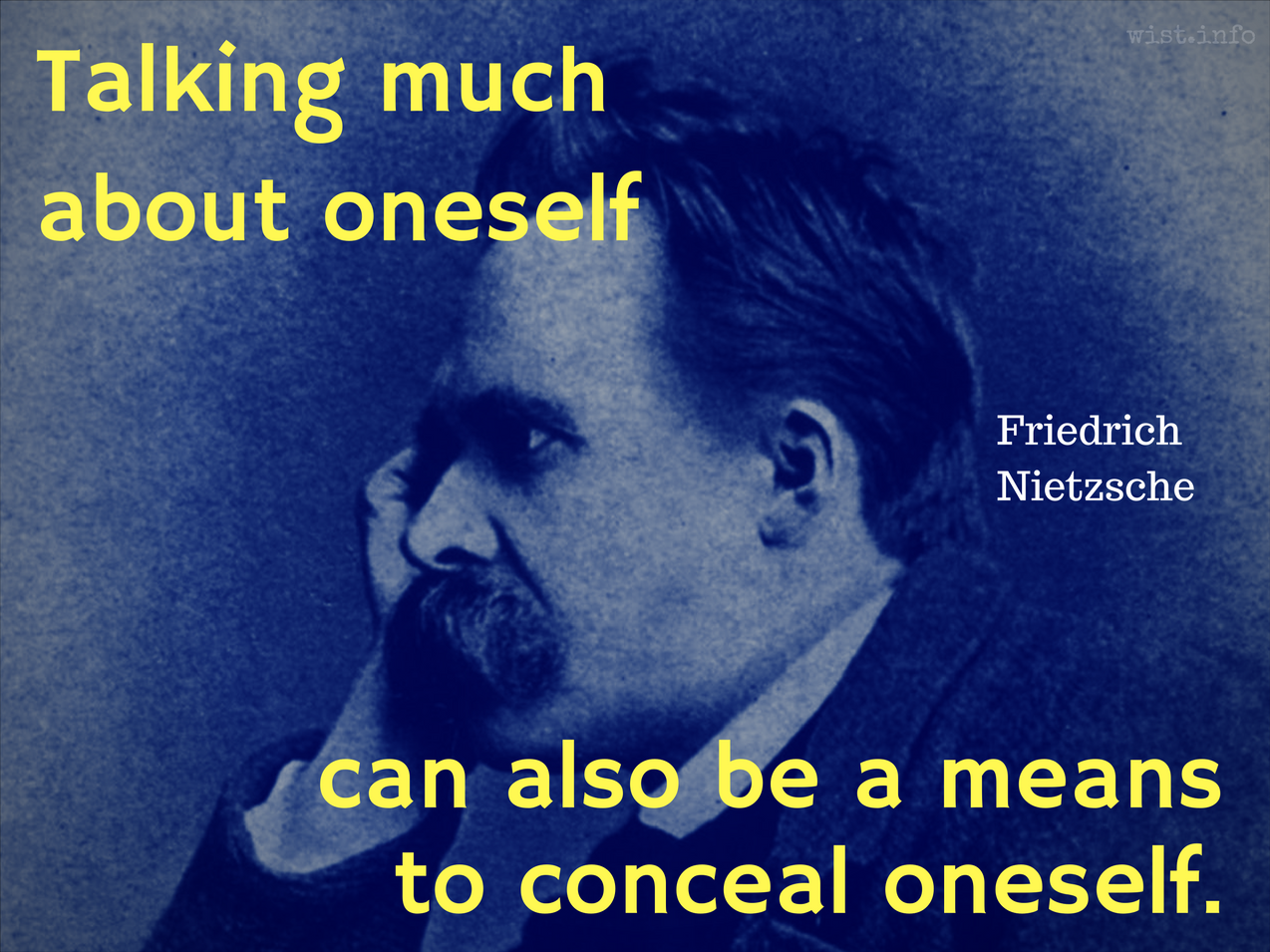
Talking much about oneself can also be a means to conceal oneself.
Friedrich Nietzsche (1844–1900) German philosopher and poet
Beyond Good and Evil, 169 (1886) [tr. Kaufmann (1966)]
As great minds can express much in a few words, so small minds have the contrary talent of talking a great deal without saying anything at all.
[Comme c’est le caractère des grands esprits de faire entendre en peu de paroles beaucoup de choses, les petits esprits, au contraire, ont le don de beaucoup parler, et de ne rien dire.]
François VI, duc de La Rochefoucauld (1613–1680) French epigrammatist, memoirist, noble
Réflexions ou sentences et maximes morales [Reflections; or Sentences and Moral Maxims], ¶142 (1665-1678) [tr. FitzGibbon (1957)]
(Source)
Present in the 1st (1665) ed. A 1665 variant:[Comme c’est le caractère des grands esprits de faire entendre avec peu de paroles beaucoup de choses, les petits esprits, en revanche, ont le don de beaucoup parler, et de ne dire rien.]
(Source (French)). Other translations:As great Wits have a peculiar Faculty of saying a great deal in a little; so half witted Fellows have a Talent of talking much, and yet saying nothing.
[tr. Stanhope (1694), ¶143]As it is the characteristic of great wits to say much in few words, so small wits seem to have the gift of speaking much and saying nothing.
[pub. Donaldson (1783), ¶414; ed. Lepoittevin-Lacroix (1797), ¶137]It is the characteristic of great wits to say much in a few words; small wits seem to have the gift of speaking much and saying nothing.
[ed. Carvill (1835), ¶419]As it is the characteristic of great wits; to convey a great deal in a few words, so, on the contrary, small wits have the gift of speaking much and saying nothing.
[ed. Gowens (1851), ¶145]As it is the mark of great minds to say many things in a few words, so it is that of little minds to use many words to say nothing.
[tr. Bund/Friswell (1871), ¶142]As it is a trait of powerful intellects to express much in a few words; inversely, small minds talk much and say little.
[tr. Heard (1917), ¶142]It is a mark of great minds to say much in a few words. On the other hand, small minds possess the gift of talking much and saying nothing.
[tr. Stevens (1939), ¶142]As it is the mark of great minds to convey much in few words, so small minds are skilled at talking at length and saying little.
[tr. Kronenberger (1959), ¶142]As the stamp of great minds is to suggest much in a few words, so, contrariwise, little minds have the gift of talking a great deal and saying nothing.
[tr. Tancock (1959), ¶142]As it is the character of great minds to make many things understood in few words; so small minds, on the contrary, have the gift of speaking much, and saying nothing.
[tr. Siniscalchi (1994)]Just as great spirits make much understood with few words, small ones have the gift of speaking very much without saying anything.
[tr. Whichello (2016)]

We seldom regret talking too little, but very often talking too much. This is a well-known maxim which everybody knows and nobody practices.
[L’on se repent rarement de parler peu, très souvent de trop parler: maxime usée et triviale que tout le monde sait, et que tout le monde ne pratique pas.]
Jean de La Bruyère (1645–1696) French essayist, moralist
The Characters [Les Caractères], ch. 11 “Of Mankind [De l’Homme],” § 149 (11.149) (1688) [tr. Van Laun (1885)]
(Source)
(Source (French)). Other translations:We seldom repent talking too little, but very often talking too much, a common and trivial maxim which every body knows, and no body practices.
[Bullord ed. (1696) and Curll ed. (1713)]We seldom repent talking too little, but very often talking too much; a common obsolete Maxim, which every body knows, and no body practices.
[Browne ed. (1752)]We seldom repent of speaking little, and very often of speaking too much; a well-worn and familiar maxim, that everyone knows but that not everyone practices.
[tr. Stewart (1970)]

Far more numerous was the herd of such,
Who think too little, and who talk too much.John Dryden (1631–1700) English poet, dramatist, critic
Absalom and Achitophel, l. 533 (1681)

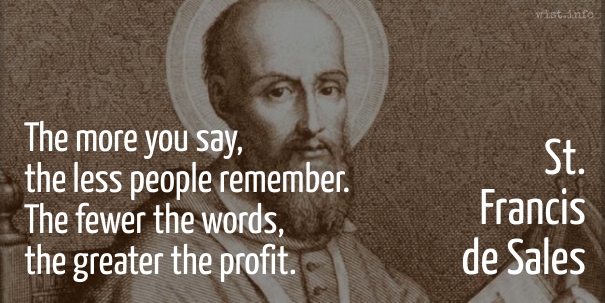
The more you say, the less people remember.
The fewer the words, the greater the profit.
François de Sales (1567–1622) French bishop, saint, writer [a.k.a. Francis de Sales, b. François de Boisy]
(Attributed)
In S.A. Bent, comp., Familiar Short Sayings of Great Men (1887). Usually attributed, due to structure of that reference, to Francois Fénelon.

Many talk like Philosophers, and live like Fools.
Thomas Fuller (1654–1734) English physician, preacher, aphorist, writer
Gnomologia: Adages and Proverbs (compiler), # 3358 (1732)
(Source)
God gave us teeth to hold back our tongue.
Proverbs, Sayings, and Adages
Greek proverb
I talk half the time to find out my own thoughts, as a school-boy turns his pockets inside out to see what is in them. One brings to light all sorts of personal property he had forgotten in his inventory.
Nobody talks much that does n’t say unwise things, — things he did not mean to say; as no person plays much without striking a false note sometimes. Talk, to me, is only spading up the ground for crops of thought. I can’t answer for what will turn up.
Keep close behind me. Let them say their say.
Stand straight, a mighty tower unwavering,
its height unshaken by such breaths of wind.[Vien dietro a me, e lascia dir le genti:
sta come torre ferma, che non crolla
già mai la cima per soffiar di venti.]Dante Alighieri (1265–1321) Italian poet
The Divine Comedy [Divina Commedia], Book 2 “Purgatorio,” Canto 5, l. 13ff (5.13-15) [Virgil] (1314) [tr. Kirkpatrick (2007)]
(Source)
Virgil scolding Dante for slowing down when other spirits are pointing and murmuring about him having a shadow, unlike them.
(Source (Italian)). Other translations:Can murmurs move you? Let them whisper on,
And bid your Reason firmly keep its throne,
and o'er the fortress of the mind preside.
[tr. Boyd (1802), st. 2]Come after me, and to their babblings leave
The crowd. Be as a tower, that, firmly set,
Shakes not its top for any blast that blows!
[tr. Cary (1814)]Come thou behind me, let the people talk;
Stand like a steadfast tower, whose lofty crest
Ne'er quaked obedient to the rocking blast.
[tr. Bannerman (1850)]Come after me, and let the people talk;
Stand like a steadfast tower, that never wags
Its top for all the blowing of the winds;
[tr. Longfellow (1867)]Come behind me, and let the folk talk; stand like a firm tower which never shakes its top for blast of winds.
[tr. Butler (1885)]Follow thou me, and let the people talk:
Stand like a solid tower, that doth not bow
Its crest at any time, though wild winds stalk.
[tr. Minchin (1885)]Come after me, and let the people talk. Stand as a tower firm, that never wags its top for blowing of the winds.
[tr. Norton (1892)]Follow me and let the people talk; stand thou as a firm tower which never shakes its summit for blast of winds.
[tr. Okey (1901)]Come after me and let the people talk. Stand like a firm tower that never shakes its top for blast of wind.
[tr. Sinclair (1939)]Follow behind me and let them talk their fill:
Stand like a tower whose summit never shakes
For the wind's blowing, and stays immovable.
[tr. Binyon (1943)]Follow thou me, and let the people chatter;
Stand as a tower stands firm in time of trouble,
Nor bends its head, though winds may bawl and batter.
[tr. Sayers (1955)]Follow my steps, though all such whisper of you:
be as a tower of stone, its lofty crown
unswayed by anything the winds may do.
[tr. Ciardi (1961)]Follow me and let the people talk.
Stand as a firm tower which never
shakes its summit for blast of winds.
[tr. Singleton (1973)]Keep up with me and let the people talk!
Be like a solid tower whose brave height
remains unmoved by all the winds that blow.
[tr. Musa (1981)]Come on behind me, let those people talk:
Stand like a solid tower which does not shake
Its top whatever winds are blowing on it.
[tr. Sisson (1981)]Come, follow me, and let these people talk:
stand like a sturdy tower that does not shake
its summit though the winds may blast.
[tr. Mandelbaum (1982)]Come after me, and let the people talk:
be like a strong tower whose top never falls,
however hard the winds may blow.
[tr. Durling (2003)]Follow me close behind, and let the people talk: stand like a steady tower, that never shakes at the top, in the blasts of wind.
[tr. Kline (2002)]Just follow me and let the people talk.
Why can't you be like a sturdy tower
that does not tremble in the fiercest wind.
[tr. Hollander/Hollander (2007)]Just follow me and let the people talk:
Stand steady as a tower, which doesn't shake
Its top whenever the winds decide to blow.
[tr. Raffel (2010)]
Karl Marx paraphrased the first line of this tercet in the conclusion of his Author's Preface to the First Edition of Das Kapital (1867), crediting Dante:Every opinion based on scientific criticism I welcome. As to the prejudices of so-called public opinion, to which I have never made concessions, now as aforetime the maxim of the great Florentine is mine: "Segui il tuo corso, e lascia dir le genti."
Which reads something like "Follow your own course, and let the people talk." The phrase is given in Italian even in the original German edition.

One of the lessons of history is that nothing is often a good thing to do and always a clever thing to say.
William James (Will) Durant (1885–1981) American historian, teacher, philosopher
NY World-Telegram & Sun (6 Jun 1958)