MEDEA: I think the unjust man who can speak cleverly
incurs the greatest penalty for, feeling confident
to cloak injustice in fair speech,
he dares the utmost villainy.[ΜΉΔΕΙΑ: ἐμοὶ γὰρ ὅστις ἄδικος ὢν σοφὸς λέγειν
πέφυκε, πλείστην ζημίαν ὀφλισκάνει:
γλώσσῃ γὰρ αὐχῶν τἄδικ᾽ εὖ περιστελεῖν
τολμᾷ πανουργεῖν.]Euripides (485?-406? BC) Greek tragic dramatist
Medea [Μήδεια], l. 580ff (431 BC) [tr. Ewans (2022)]
(Source)
(Source (Greek)). Other translations:In my judgement, he
Who tramples on the laws, but can express
His thoughts with plausibility, deserves
Severest punishment: for that injustice
On which he glories, with his artful tongue.
That he a fair appearance can bestow,
He dares to practise.
[tr. Wodhull (1782)]Th' injurious man, whose tongue
Flows with pernicious rhetoric, I hold
To merit the severest punishment.
For confident his speech can varnish o'er
The blackest deeds, his craft dares venture on them.
[tr. Potter (1814)]For him who does wrong and is wise to gloze it
I hold worth worser doom. For making sure
He'll show wrong gracious with his tongue, he's bold
To every crime.
[tr. Webster (1868)]To my mind, whoso hath skill to fence with words in an unjust cause, incurs the heaviest penalty; for such an one, confident that he can cast a decent veil of words o'er his injustice, dares to practise it.
[tr. Coleridge (1891)]In my judgment, whatever man being unjust, is deeply skilled in argument, merits the severest punishment. For vaunting that with his tongue he can well gloze over injustice, he dares to work deceit.
[tr. Buckley (1892)]For in my sight the villain subtle-tongued
Getteth himself for gain exceeding loss,
Who, confident his tongue can gloze the wrong,
Becomes a bold knave.
[tr. Way (Loeb) (1894)]To me it seemeth, when
A crafty tongue is given to evil men
'Tis like to wreck, not help them. Their own brain
Tempts them with lies to dare and dare again,
Till .... [tr. Murray (1906)]I think that the plausible speaker
Who is a villain deserves the greatest punishment.
Confident in his tongue’s power to adorn evil,
He stops at nothing.
[tr. Warner (1944)]To me, a wicked man who is also eloquent
Seems the most guilty of them all. He’ll cut your throat
As bold as brass, because he knows he can dress up murder
In handsome words.
[tr. Vellacott (1963)]For me, the man who is a villain, but clever
In speech, would have to pay the highest fine;
Confident of cloaking his villainy in fine words,
He dares anything.
[tr. Podlecki (1989)]To my mind, the plausible speaker who is a scoundrel incurs the greatest punishment. For since he is confident that he can cleverly cloak injustice with his words, his boldness stops at no knavery.
[tr. Kovacs (Loeb) (1994)]For in my eyes the criminal with a gift for speaking deserves the worst of punishments. So confident is he in his tongue’s ability to dress his foul thoughts in fair words, there is nothing he dares not do.
[tr. Davie (1996)]What I believe, for example is the more eloquent the misfit, the greater the punishment he deserves because, thinking that his eloquence and his pretty words will get him out of any injustice, he has the audacity to commit even greater evils.
[tr. Theodoridis (2004)]In my opinion,
the unjust man who speaks so plausibly
brings on himself the harshest punishment.
Since he’s sure his tongue can hide injustice,
he dares anything.
[tr. Johnston (2008), l. 689ff]To my mind, whoever is naturally sophos in speaking but has no dikē deserves the heaviest punishment. Such a man boasts that he can cast a decent veil of words over his unjust deeds, and boldly proceeds to wickedness.
[tr. Coleridge / Ceragioli / Nagy / Hour25]To my mind, the plausible speaker who is a scoundrel incurs the greatest punishment. For since he is confident that he can cleverly cloak injustice with his words, his boldness stops at no dishonesty.
[tr. Kovacs / Zhang / Rogak]
Quotations about:
glibness
Note not all quotations have been tagged, so Search may find additional quotes on this topic.
HECUBA: The clear actions of a man,
Agamemnon, should speak louder than any words.
Good words should get their goodness from our lives
and nowhere else; the evil we do should show,
a rottenness that festers in our speech
and what we say, in capable of being glozed
with a film of pretty words.
There are men, I know,
sophists who make a science of persuasion,
glozing evil with the slick of loveliness;
but in the end a speciousness will show.
The imposters are punished; not one escapes
his death.[ἙΚΆΒΗ: Ἀγάμεμνον, ἀνθρώποισιν οὐκ ἐχρῆν ποτε
τῶν πραγμάτων τὴν γλῶσσαν ἰσχύειν πλέον:
ἀλλ᾽, εἴτε χρήστ᾽ ἔδρασε, χρήστ᾽ ἔδει λέγειν,
εἴτ᾽ αὖ πονηρά, τοὺς λόγους εἶναι σαθρούς,
καὶ μὴ δύνασθαι τἄδικ᾽ εὖ λέγειν ποτέ.
σοφοὶ μὲν οὖν εἰσ᾽ οἱ τάδ᾽ ἠκριβωκότες,
ἀλλ᾽ οὐ δύνανται διὰ τέλους εἶναι σοφοί,
κακῶς δ᾽ ἀπώλοντ᾽: οὔτις ἐξήλυξέ πω.]Euripides (485?-406? BC) Greek tragic dramatist
Hecuba [Hekabe; Ἑκάβη], l. 1186ff (c. 424 BC) [tr. Arrowsmith (1958)]
(Source)
Hecuba to Agamemnon, after Polymestor tried to defend his actions in murdering her son and stealing the Trojan treasure.
(Source (Greek)). Other translations:O Agamemnon, never ought the tongue
To have a greater influence o'er mankind
Than actions; but whoever hath done well
Ought to speak well; and he whose deeds are base,
To use unseemly language, nor find means
By specious words to colour o'er injustice.
Full wise indeed are they to whom such art
Is most familiar: but to stand the test
Of time not wise enough; for they all perish,
Not one of them e'er scapes.
[tr. Wodhull (1809)]Agamemnon, it never were fitting among men that the tongue should have greater force than actions. But if a man has acted well, well should he speak; if on the other hand basely, his words likewise should be unsound, and never ought he to be capable of speaking unjust things well. Perhaps indeed they who have brought these things to a pitch of accuracy are accounted wise, but they can not endure wise unto the end, but perish vilely, nor has any one yet escaped this.
[tr. Edwards (1826)]Agamemnon, never should this thing have been,
That words with men should more avail than deeds,
But good deeds should with reasonings good be paired,
And caitiff deed be ranged by baseless plea,
And none avail to gloze injustice o'er.
There be whose craft such art hath perfected;
Yet cannot they be cunning to the end:
Foully they perish: never one hath 'scaped.
[tr. Way (Loeb) (1894)]Agamemnon, never ought the tongues of men
To plead more eloquently than the truth.
Good men should prove good speakers, and the bad,
Their very argument grown rank, should find
No specious words to colour evil deeds.
Oh, they are strict professors of the art,
And they are wise; yet in the end of all,
Not wise enough. They perish. None escapes.
[tr. Sheppard (1924)]Never ought words to have outweighed deeds in this world, Agamemnon. No! if a man's deeds were good, so should his words have been; if, on the other hand, evil, his words should have been unsound, instead of its being possible at times to speak injustice well. There are, it is true, clever persons, who have made a science of this, but their cleverness cannot last for ever; a miserable end awaits them; no one ever yet escaped.
[tr. Coleridge (1938)]Agamemnon,
A man should talk as he acts.
Good speaks for itself --
The best make bad liars.
The opposite is also true,
Though it ought not to be.
Men with brains can conceal
Whatever they want concealed.
But the brain grows weary.
A bad end's in.
[tr. McGuinness (2004)]Agamemnon, men shouldn't believe a speech counts for far more than actions ever did. If a man is good in deed, he's good in word. But bad deeds make a man's word rotten, too, and he can't give his injustice a fair gloss. They're clever with their tongues so finely tuned but you couldn't call them clever in the end. Their punishment will come. No one escapes.
[tr. Harrison (2005)]Never, Agamemnon, should words have greater sway for men than do their deeds. When a man does good, his words ought to be good; when he does evil then his words should be unsound. No one should speak well of injustice. About this last thing, there are those clever fellows who have performed it to perfection but they will all, in the end, be destroyed. None of them have escaped so far.
[tr. Theodoridis (2007)]Agamemnon, never in the affairs of men
Should the tongue have more power than facts,
Rather, when someone acts well, he should speak well,
And if the opposite, his words should be rotten.
Glib rhetoric may win us over for a while,
but in the end the smooth talkers die foully.
[tr. Karden/Street (2011)]
When a sensible man
has a good cause to defend, to be eloquent
is no great feat. Your tongue is so nimble
one might think you had some sense, but your words
contain none at all. The powerful man
who matches insolence with glibness is worst than a fool.
He is a public danger![ὅταν λάβῃ τις τῶν λόγων ἀνὴρ σοφὸς
καλὰς ἀφορμάς, οὐ μέγ᾽ ἔργον εὖ λέγειν:
σὺ δ᾽ εὔτροχον μὲν γλῶσσαν ὡς φρονῶν ἔχεις,
ἐν τοῖς λόγοισι δ᾽ οὐκ ἔνεισί σοι φρένες.
θράσει δὲ δυνατὸς καὶ λέγειν οἷός τ᾽ ἀνὴρ
κακὸς πολίτης γίγνεται νοῦν οὐκ ἔχων.]Euripides (485?-406? BC) Greek tragic dramatist
Bacchæ [Βάκχαι], l. 266ff [Tiresias/Τειρεσίας] (405 BC) [tr. Cacoyannis (1982)]
(Source)
To Pentheus. (Source (Greek)). Other translations:When the wise man hath found a specious topic
On which to argue, he with ease may frame
An eloquent harangue. Your tongue indeed
Is voluble like theirs who reason well,
But in your language no discretion reigns.
He who possesses courage, sovereign power. A
And fluency of speech, if not endued
With wisdom, is an evil citizen.
[tr. Wodhull (1809)]Whenever a wise man takes a good occasion for his speech, it is not a great task to speak well. You have a rapid tongue as though you were sensible, but there is no sense in your words. A man powerful in his boldness, one capable of speaking well, becomes a bad citizen in his lack of sense.
[tr. Buckley (1850)]'Tis easy to be eloquent, for him
That's skilled in speech, and hath a stirring theme.
Thou hast the flowing tongue of a wise man,
But there's no wisdom in thy fluent words;
For the bold demagogue, powerful in speech,
Is but a dangerous citizen lacking sense.
[tr. Milman (1865)]When wise men reason from sound principles,
They find it no hard task to reason well.
Thy tongue’s as fluent as the wisest man’s,
And yet thy argument is void of sense.
[tr. Rogers (1872), l. 253ff]Whenso a man of wisdom finds a good topic for argument, it is no difficult matter to speak well; but thou, though possessing a glib tongue as if endowed with sense, art yet devoid thereof in all thou sayest. A headstrong man, if he have influence and a capacity for speaking, makes a bad citizen because he lacks sense.
[tr. Coleridge (1891)]Whene'er a wise man finds a noble theme
For speech, 'tis easy to be eloquent.
Thou -- roundly runs thy tongue, as thou wert wise;
But in these words of thine sense is there none.
The rash man, armed with power and ready of speech,
Is a bad citizen, as void of sense.
[tr. Way (1898)]Good words, my son, come easily, when he
That speaks is wise, and speaks but for the right.
Else come they never! Swift are thine, and bright
As though with thought, yet have no thought at all.
[tr. Murray (1902)]Give a wise man an honest brief to plead
and his eloquence is no remarkable achievement.
But you are glib; your phrases come rolling out
smoothly on the tongue, as though your words were wise
instead of foolish. The man whose glibness flows
from his conceit of speech declares the thing he is:
a worthless and a stupid citizen.
[tr. Arrowsmith (1960)]When a wise man chooses a sane basis
for his arguments, it is no great task to speak well;
but you have a glib tongue, as though in your right mind,
yet in your words there is no real sense.
The man who is influential by sheer aggressiveness, and knows how to speak,
proves to be a bad citizen -- for he lacks sanity.
[tr. Kirk (1970)]When a clever man has a plausible theme to argue, to be eloquent is no great feat. But though you seem, by your glib tongue, to be intelligent, yet your words are foolish. Power and eloquence in a headstrong man can only lead to folly; and such a man is a danger to the state.
[tr. Vellacott (1973)]Oh it's so easy for some to make speeches.
They pick a soft target and the words rush out.
Now listen you. Your tongue runs loose
Makes a plausible sound and might
Almost be taken for sense. But you have none.
Your glibness flows from sheer conceit.
Arrogant, over-confident and a gift -- yes --
A gift for phrases, and that makes you a great
Danger to your fellow men.
[tr. Soyinka (1973)]A man who takes a fair basis for speaking,
a wise man, has no trouble speaking well;
you have a well-wheeled tongue, as though thinking,
but in the words you speak there is no thought.
A man empowered by daring and able to speak
becomes a bad citizen, devoid of reason.
[tr. Neuburg (1988)]When some wise man has a fair cause
o present, to speak well is easy.
You have a tongue, glib like thought,
But no sense lies in your words.
The man that rashness prompts to speak
Proves an evil citizen and senseless.
[tr. Blessington (1993)]Whenever a wise man sets out to argue an honest case
it's no great undertaking to argue well.
Your tongue runs smooth like a wheel, as if you were a man of reason,
but your words reveal no reason.
If he behaves recklessly, an able and articulate man
turns out to be a bad citizen because he lacks good sense.
[tr. Esposito (1998)]When a prudent speaker takes up a noble cause, he’ll have no great trouble to speak well. You, on the other hand, have a tongue that runs on smoothly and sounds intelligent. But what it says is brainless. True, boldness can help a man speak powerfully, but he’ll turn out bad for the city because he'll have no sense.
[tr. Woodruff (1999)]It's no great task to speak well, when a man's
Intelligent and starts well with good words.
But you: your tongue runs smoothly, as if you had
Some understanding. Yet your words are senseless.
A man like you, whose strength is that he's bold,
Who's good at speaking, too, can only make
a bad citizen -- for he lacks good sense.
[tr. Gibbons/Segal (2000)]When a wise man has a good case to argue, eloquence is easy. As for you, though you think yourself clever and have a ready tongue, there is no intelligence in what you say. [A man whose power lies in brashness and who is a fluent speaker becomes a bad citizen if he lacks sense.]
[tr. Kovacs (2002)]As for you -- your tongue is quick and your talk runs as if you had wit, but there is none in what you say. A man who confuses impudence with strength is a fool.
[tr. Rao/Wolf (2004)]When a wise man is given the opportunity to speak, it’s no big problem to speak the truth. You, Pentheus, you are, of course an articulate man, or so you think, but your words lack logic. Audacity, strength and eloquence all on their own, make for a bad citizen -- a stupid one.
[tr. Theodoridis (2005)]When a man who's wise in words starts his speech
from a proper course, it is no great task to speak well;
and you, spinning a tricky tongue, seem to make sense,
but there is no sense in what you are saying;
and a man who is bold, powerful and a clever speaker
makes for a bad citizen, if he has not the proper mind.
[tr. Valerie (2005)]When a man of wisdom has good occasion to speak out and takes the opportunity, it's not that hard to give an excellent speech. You've got a quick tongue and seem intelligent, but your words don't make any sense at all. A fluent orator whose power comes from self-assurance and from nothing else makes a bad citizen, for he lacks sense.
[tr. Johnston (2008)]When a wise man has an honest case to plead, then eloquence, I find, is very easy to achieve. You think yourself clever, and have a smooth tongue, but, your words are foolish. The man whose power lies in his conceit does not make a good citizen.
[tr. Robertson (2014)]It’s no great task for a wise man to speak well when the time comes, if he picks it carefully. You hold yourself as if you’re one of these ready-tongued individuals. You’re not. Your words lack sense behind them. Even the boldest speaker fails as a citizen when his words lack sense.
[tr. Pauly (2019)]Wisdom from the wise surprises no one. But your clever tongue makes yuou seem wise when you have no understanding. Rash eloquence is society's disaster.
[tr. Behr/Foster (2019)]Whenever a sophos man takes a good occasion for his speech, it is not a great task to speak well. You have a fluent tongue as though you are sensible, but there is no sense in your words. A bold and powerful man, one capable of speaking well, becomes a kakos citizen if he lacks sense.
[tr. Buckley/Sens/Nagy (2020)]
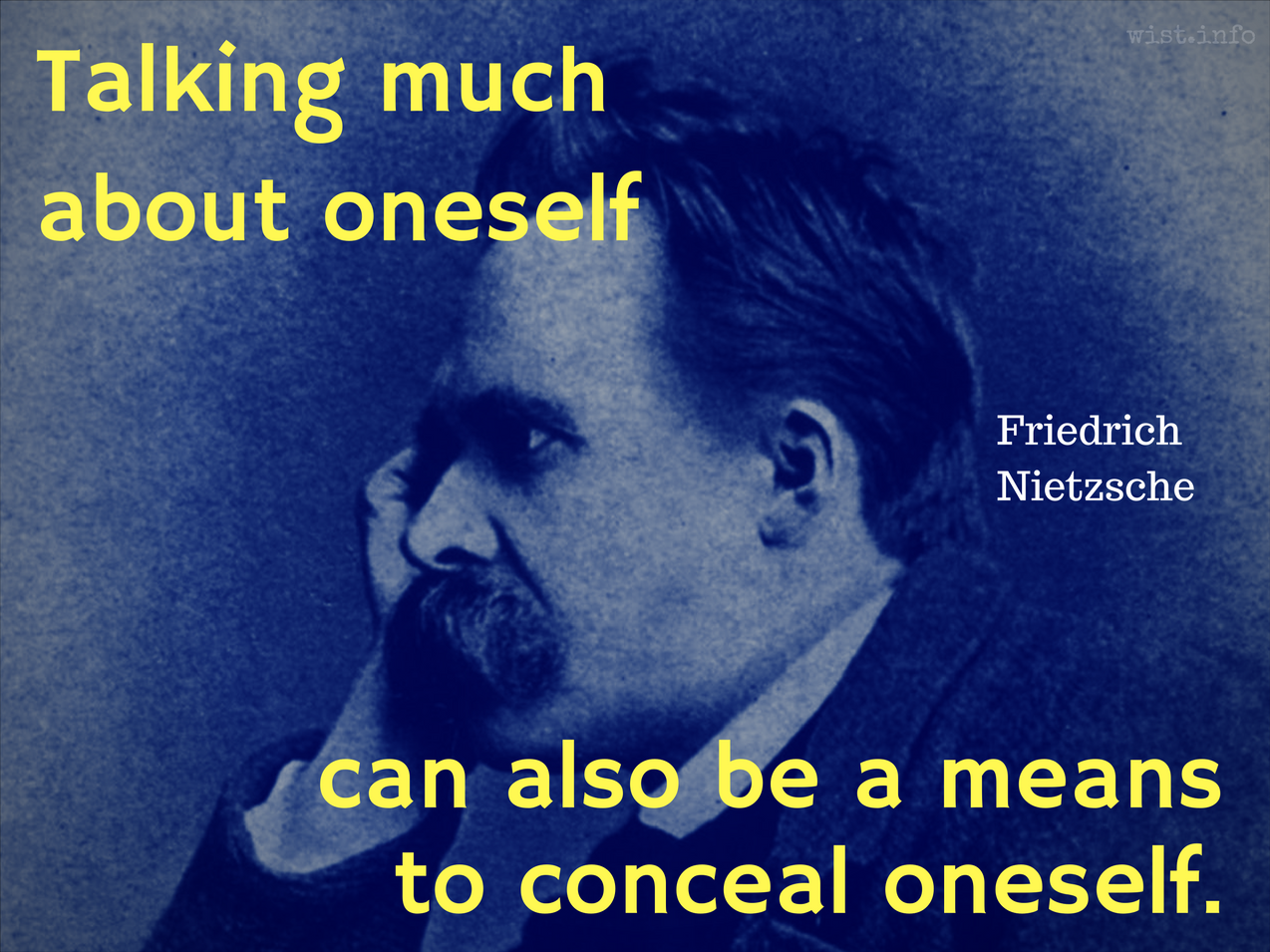
Talking much about oneself can also be a means to conceal oneself.
Friedrich Nietzsche (1844–1900) German philosopher and poet
Beyond Good and Evil, 169 (1886) [tr. Kaufmann (1966)]
When you write easily, you always think you have more talent than you really do.
[Quand on écrit avec facilité, on croit toujours avoir plus de talent qu’on n’en a.]
Joseph Joubert (1754–1824) French moralist, philosopher, essayist, poet
Pensées [Thoughts], ch. 23 “Des Qualités de l’Écrivain [Of the Qualities of Writers],” ¶ 45 (1804 entry) (1850 ed.) [tr. Auster (1983)]
(Source)
(Source (French)). Other translations:He who writes with ease always thinks that he has more talent than he really has.
[tr. Calvert (1866), ch. 15]When anyone writes with ease, he always believes himself to have more talent than he has.
[tr. Lyttelton (1899), ch. 22, ¶ 13]The fluent author always seems to have more talent than he has.
[tr. Collins (1928), ch. 22]