

At bottom every man knows well enough that he is a unique human being, only once on this earth; and by no extraordinary chance will such a marvelously picturesque piece of diversity in unity as he is ever be put together a second time.
Friedrich Nietzsche (1844–1900) German philosopher and poet
“Schopenhauer as Educator,” ch. 1 (1874) [tr. Collins]
(Source)
Quotations by:
Nietzsche, Friedrich
We should consider every day lost on which we have not danced at least once. And we should call every truth false which was not accompanied by at least one laugh.
Friedrich Nietzsche (1844–1900) German philosopher and poet
(Attributed)
A very popular error — having the courage of your convictions. Rather, it is a matter of having the courage for an attack upon one’s convictions.
Friedrich Nietzsche (1844–1900) German philosopher and poet
(Attributed)
A casual stroll through the lunatic asylum shows that faith does not prove anything.
Friedrich Nietzsche (1844–1900) German philosopher and poet
(Attributed)
He who has a strong enough why to live for, can bear almost any how.
Friedrich Nietzsche (1844–1900) German philosopher and poet
(Attributed)
In large states public education will always be mediocre, for the same reason that in large kitchens the cooking is usually bad.
Friedrich Nietzsche (1844–1900) German philosopher and poet
(Attributed)
He who does not need to lie is proud of not being a liar.
Friedrich Nietzsche (1844–1900) German philosopher and poet
(Attributed)
‘Every man has his price.’ This is not true. But for every man there exists a bait which he cannot resist swallowing. To win over certain people to something, it is only necessary to give it a gloss of love of humanity, nobility, gentleness, self-sacrifice – and there is nothing you cannot get them to swallow. To their souls, these are the icing, the tidbit; other kinds of souls have others.
Friedrich Nietzsche (1844–1900) German philosopher and poet
(Attributed)
It is not so much the suffering as the senselessness of it that is unendurable.
Friedrich Nietzsche (1844–1900) German philosopher and poet
(Attributed)
Paraphrased by Nicolas Berdyaev, The Destiny of Man, 2.2.5 (1931) [tr. Duddington (1955)]
The most common sort of lie is the one uttered to one’s self.
Friedrich Nietzsche (1844–1900) German philosopher and poet
(Attributed)
I could not believe in a God that could not dance.
Friedrich Nietzsche (1844–1900) German philosopher and poet
(Attributed)
One is healthy when one can laugh at the earnestness and zeal with which one has been hypnotized by any single detail of one’s life.
Friedrich Nietzsche (1844–1900) German philosopher and poet
(Attributed)
It is not lack of love but lack of friendship that makes unhappy marriages.
Friedrich Nietzsche (1844–1900) German philosopher and poet
(Attributed)
It is hard enough to remember my opinions, without also remembering my reasons for them!
Friedrich Nietzsche (1844–1900) German philosopher and poet
(Attributed)
The visionary lies to himself, the liar only to others.
Friedrich Nietzsche (1844–1900) German philosopher and poet
(Attributed)
When we are tired, we are attacked by ideas we conquered long ago.
Friedrich Nietzsche (1844–1900) German philosopher and poet
(Attributed)
Frequently attributed to Nietzsche, starting in the late 1950s, but never cited and not found in any of his writings. More discussion here.
A politician divides mankind into two classes: tools and enemies. That means he knows only one class: enemies.
Friedrich Nietzsche (1844–1900) German philosopher and poet
(Attributed)
(Source)
This is frequently attributed to Nietzsche, without citation -- a clue that it is a paraphrase of a more complex or nuanced passage. I found only one reference online that mentioned a source -- Nietzsche's Human, All Too Human (1880) -- but a search through multiple translations did not uncover this sentiment.
“I did this,” says my Memory. “I cannot have done this,” says my Pride, and remains inexorable. In the end — Memory yields.
Friedrich Nietzsche (1844–1900) German philosopher and poet
Beyond Good and Evil [Jenseits von Gut und Böse], No. 68 (1886)
Frequently quoted by Freud.
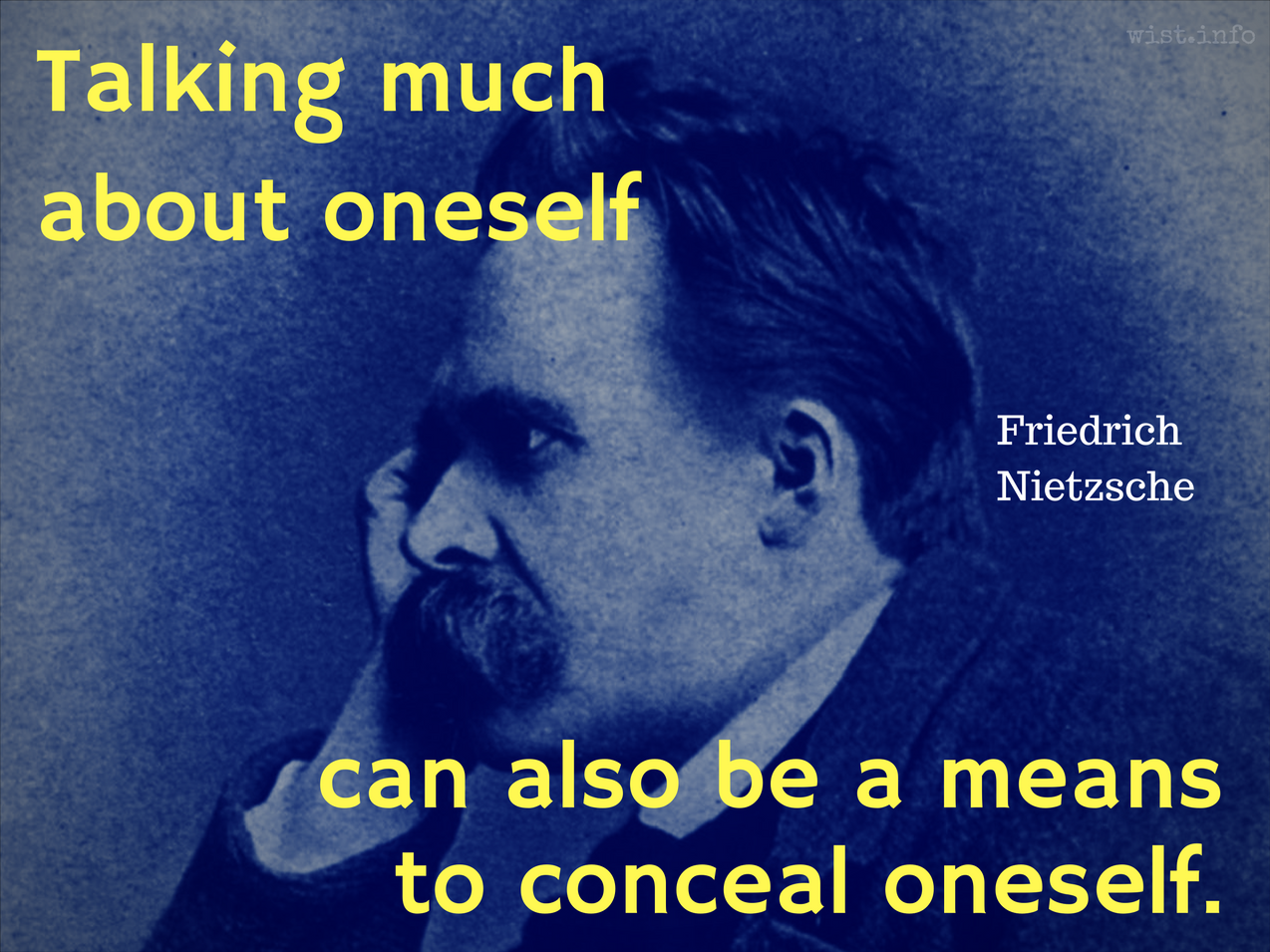
Talking much about oneself can also be a means to conceal oneself.
Friedrich Nietzsche (1844–1900) German philosopher and poet
Beyond Good and Evil, 169 (1886) [tr. Kaufmann (1966)]
The abdomen is the reason why man does not easily take himself for a god.
Friedrich Nietzsche (1844–1900) German philosopher and poet
Beyond Good and Evil, ch. 4 “Apophthegms and Interludes,” #141 (1886)
Alt. trans.: "The belly is the reason why man does not so readily take himself for a God." [tr. Zimmern]
Democratic institutions are quarantine arrangements to combat that ancient pestilence, lust for tyranny: as such they are very useful and very boring.
[Die demokratischen Einrichtungen sind Quarantäne-Anstalten gegen die alte Pest tyrannenhafter Gelüste: als solche sehr nützlich und sehr langweilig.]
Friedrich Nietzsche (1844–1900) German philosopher and poet
Human, All Too Human [Menschliches, Allzumenschliches], Vol. 2, Part 2 “The Wanderer and His Shadow [Der Wanderer und sein Schatten],” aphorism 289 (1880) [tr. Holingdale (1986)]
(Source)
(Source (German)). Other translations:Democratic institutions are centres of quarantine against the old plague of tyrannical desires. As such they are extremely useful and extremely tedious.
[tr. Cohn (1913)]Democratic institutions are quarantine mechanisms for that old pestilence, tyrannic lust. As such they are very useful and very boring.
Many are stubborn in pursuit of the path they have chosen, few in pursuit of the goal.
[Viele sind hartnäckig in Bezug auf den einmal eingeschlagenen Weg, Wenige in Bezug auf das Ziel.]
Friedrich Nietzsche (1844–1900) German philosopher and poet
Human, All Too Human [Menschliches, Allzummenschliches], Part 1, ch. 9 “Man Alone with Himself [Der Mensch mit sich allein],” ¶ 494 (1878)
(Source)
This is a frequent translation of this passage, but I cannot find the original translator.
(Source (German)). Other translations:Many are obstinate with regard to the once-chosen path, few with regard to the goal.
[tr. Zimmern (1909)]Many people are obstinate about the path once it is taken, few people about the destination.
(tr. Faber/Lehmann (1984)]Many are obstinate with regard to the path once they have entered upon it, few with regard to the goal.
[tr. Hollingdale (1986)]
Convictions are more dangerous foes of truth than lies.
Friedrich Nietzsche (1844–1900) German philosopher and poet
Human, All Too Human (1878-86)
Whoever lives for the sake of combating an enemy has an interest in the enemy’s staying alive.
Friedrich Nietzsche (1844–1900) German philosopher and poet
Human, All Too Human, 531 (1878) [tr. M. Faber (1984)]
Any man who has once decared the other man to be a fool, a bad fellow, is annoyed when that man ends by showing that he is not.
Friedrich Nietzsche (1844–1900) German philosopher and poet
Human, All Too Human, ch. 90 (1878) [tr Faber (1984)]
At times one remains faithful to a cause only because its opponents do not cease to be insipid.
Friedrich Nietzsche (1844–1900) German philosopher and poet
Human, All-Too-Human [Menschliches, Allzumenschliches], #536 (1878)
(Source)
He who fights with monsters should look to it that he himself does not become a monster. And when you gaze long into an abyss, the abyss gazes also into you.
[Wer mit Ungeheuern kämpft, mag zusehn, dass er nicht dabei zum Ungeheuer wird. Und wenn du lange in einen Abgrund blickst, blickt der Abgrund auch in dich hinein.]
Friedrich Nietzsche (1844–1900) German philosopher and poet
Jenseits von Gut und Böse [Beyond Good and Evil], Aphorism 146 (1886) [tr. Hollingdale (1973, 1990)]
(Source)
Other translations:He who fights with monsters should be careful lest he thereby becomes a monster. And if thou gaze long into an abyss, the abyss will also gaze into thee.
[tr. Zimmern (1906)]Whoever fights monsters should see to it that in the process he does not become a monster. And when you look long into an abyss, the abyss also looks into you.
[tr. Kaufmann (1966)]
Blessed are the forgetful: for they “get the better” even of their blunders.
[Selig sind die Vergesslichen: denn sie werden auch mit ihren Dummheiten “fertig”.]
Friedrich Nietzsche (1844–1900) German philosopher and poet
Jenseits von Gut und Böse [Beyond Good and Evil], Aphorism 217 (1886) [tr. Zimmern (1906)]
(Source)
Quoted by Mary Svevo (Kirsten Dunst) in Eternal Sunshine of the Spotless Mind (2004). The character says she found it in Bartlett's.
(Source (German)). Other translations:Blessed are the forgetful: for they get over their stupidities.
[tr. Kaufmann (1966)]Blessed are the forgetful: for they shall "have done" with their stupidities too.
[tr. Hollingdale (1973, 1990)]Blessed are the forgetful, for they are "done" with their stupidities as well.
[tr. Johnston]
Having stripped myself of all illusions, I have gone mad.
Friedrich Nietzsche (1844–1900) German philosopher and poet
My Sister and I, 5.12 [tr. Levi (1951)]
Written in an asylum.
Contumely always falls upon those who break through some custom or convention. Such men, in fact, are called criminals. Everyone who overthrows an existing law is, at the start, regarded as a wicket man. Long afterward, when it is found that this law was bad and so cannot be re-established, the epithet is changed. All history treats almost exclusively of wicked men who, in the course of time, have come to be looked upon as good men. All progress is the result of successful crimes.
Friedrich Nietzsche (1844–1900) German philosopher and poet
The Dawn [Morgenröte], sec. 20 (1881) [Mencken (1907)]
(Source)
Other translations:We have to make good a great deal of the contumely which has fallen on all those who, by their actions, have broken through the conventionality of some custom -- such people generally have been called criminals. Everybody who overthrew the existing moral law has hitherto, at least in the beginning, been considered a wicked man; but when afterwards, as sometimes happened, the old law could not be re-established and had to be abandoned, the epithet was gradually changed. History almost exclusively treats of such wicked men who, in the course of time, have been declared good men.
[tr. Volz (1903)]One has to take back much of the defamation which people have cast upon all those who broke through the spell of a custom by means of a deed -- in general, they are called criminals. Whoever has overthrown an existing law of custom has hitherto always first been accounted a bad man: but when, as did happen the laws could not afterwards be reinstated and this fact was accepted, the predicate gradually changed -- history treats almost exclusively of these bad men who subsequently became good men!
[tr. Hollingdale (1997)]
The surest way to corrupt a youth is to instruct him to hold in higher esteem those who think alike than those who think differently.
Friedrich Nietzsche (1844–1900) German philosopher and poet
The Dawn (1881)
Other translation:The surest way of ruining a youth is to teach him to respect those who think as he does more highly than those who think differently from him.
[tr. Hollingdale (1982)]

Man has gradually become a fanciful animal, who has one more condition of existence to fulfil than any other animals: from time to time, man must think he knows why he exists; the human race cannot flourish without periodically renewed trust in life! Without believing in the reason in life!
[Der Mensch ist allmählich zu einem phantastischen Thiere geworden, welches eine Existenz -Bedingung mehr, als jedes andere Thier, zu erfüllen hat: der Mensch muss von Zeit zu Zeit glauben, zu wissen, warum er existirt, seine Gattung kann nicht gedeihen ohne ein periodisches Zutrauen zu dem Leben! Ohne Glauben an die Vernunft im Leben!]
Friedrich Nietzsche (1844–1900) German philosopher and poet
The Gay Science [Die fröhliche Wissenschaft], Book 1, § 1 (1882) [tr. Hill (2018)]
(Source)
Also known as La Gaya Scienza, The Joyful Wisdom, or The Joyous Science.
(Source (German)). Alternate translations:Man has gradually become a visionary animal, who has to fulfil one more condition of existence than the other animals: man must from time to time believe that he knows why he exists; his species cannot flourish without periodically confiding in life! Without the belief in reason in life!
[tr. Common (1911)]Gradually, man has become a fantastic animal that has to fulfil one more condition of existence than any other animal: man has to believe, to know, from time to time why he exists; his race cannot flourish without a periodic trust in life -- without faith in reason in life.
[tr. Kaufmann (1974)]Man has gradually become a fantastic animal that must fulfil one condition of existence more than any other animal: man must from time tot time believes he knows why he exists; his race cannot thrive without a periodic trust in life -- without faith in the reason in life!
[tr. Nauckhoff (2001)]
Gradually we become tired of the old, of what we safely possess, and we stretch out our hands again. Even the most beautiful scenery is no longer assured of our love after we have lived in it for three months, and some more distant coast attracts our avarice: possessions are generally diminished by possession.
[Wir werden des Alten, sicher Besessenen allmählich überdrüssig und strecken die Hände wieder aus; selbst die schönste Landschaft, in der wir drei Monate leben, ist unserer Liebe nicht mehr gewiss, und irgend eine fernere Küste reizt unsere Habsucht an: der Besitz wird durch das Besitzen zumeist geringer.]Friedrich Nietzsche (1844–1900) German philosopher and poet
The Gay Science [Die fröhliche Wissenschaft], Book 1, § 14 (1882) [tr. Kaufmann (1974)]
(Source)
Also known as La Gaya Scienza, The Joyful Wisdom, or The Joyous Science.
(Source (German)). Alternate translations:We gradually become satiated with the old, the securely possessed, and again stretch out our hands; even the finest landscape in which we live for three months is no longer certain of our love, and any kind of more distant coast excites our covetousness: the possession for the most part becomes smaller through possessing.
[tr. Common (1911)]We slowly grow tired of the old, of what we safely possess, and we stretch our our hands again; even the most beautiful landscape is no longer sure of our love after we have lived in it for three months, and some more distant coast excites our greed: possession usually diminishes the possession.
[tr. Nauckhoff (2001)]We gradually grow weary of the old, familiar things we securely hold, and again stretch forth our hands; even the most beautiful landscape lived in for three months is no longer assured of our love, and some more distant shore excites our avarice: what is had loses much in the having.
[tr. Hill (2018)]
The thinker sees his own actions as experiments and questions, as seeking explanations of something: to him, success and failure are primarily answers.
[Der Denker sieht in seinen eigenen Handlungen Versuche und Fragen, irgend worüber Aufschluss zu erhalten: Erfolg und Misserfolg sind ihm zu allererst Antworten.]Friedrich Nietzsche (1844–1900) German philosopher and poet
The Gay Science [Die fröhliche Wissenschaft], Book 1, § 41 (1882) [tr. Nauckhoff (2001)]
(Source)
Also known as La Gaya Scienza, The Joyful Wisdom, or The Joyous Science.
(Source (German)). Other translations:The thinker sees in his own actions attempts and questionings to obtain information about something or other; success and failure are answers to him first and foremost.
[tr. Common (1911)]A thinker sees his own actions as experiments and questions -- as attempts to find out something. Success and failure are for him answers above all.
[tr. Kaufmann (1974)]In his own actions, the thinker sees experiments and enquiries from which he seeks to obtain insight: to him, success and failure are, first of all, answers.
[tr. Hill (2018)]
Lightning and thunder need time, the light of the stars needs time, deeds need time, even after they are done, to be seen and heard.
[Blitz und Donner brauchen Zeit, das Licht der Gestirne braucht Zeit, Thaten brauchen Zeit, auch nachdem sie gethan sind, um gesehen und gehört zu werden.]
Friedrich Nietzsche (1844–1900) German philosopher and poet
The Gay Science [Die fröhliche Wissenschaft], Book 3, § 125 (1882) [tr. Common (1911)]
(Source)
On the death (murder) of God.
The book is also known as La Gaya Scienza, The Joyful Wisdom, or The Joyous Science.
(Source (German)). Alternate translations:Lightning and thunder require time; the light of the stars requires time; deeds, though done, still require time to be seen and heard.
[tr. Kaufmann (1974)]Lightning and thunder need time; the light of the stars needs time; deeds need time, even after they are done, in order to be seen and heard.
[tr. Nauckhoff (2001)]Even after they are over and done with, thunder and lightning take time, the light of the stars takes time, and deeds too take time, before they can be seen and heard.
[tr. Hill (2018)]
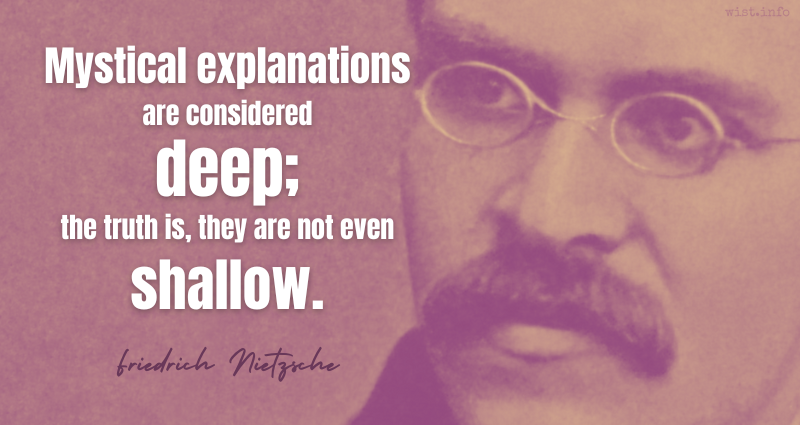
Mystical explanations are considered deep; the truth is, they are not even shallow.
[Die mystischen Erklärungen gelten für tief; die Wahrheit ist, dass sie noch nicht einmal oberflächlich sind.]
Friedrich Nietzsche (1844–1900) German philosopher and poet
The Gay Science [Die fröhliche Wissenschaft], Book 3, § 126 (1882) [tr. Nauckhoff (2001)]
(Source)
Also known as La Gaya Scienza, The Joyful Wisdom, or The Joyous Science.
(Source (German)). Other translations:Mystical explanations are regarded as profound; the truth is that they do not even go the length of being superficial.
[tr. Common (1911)]Mystical explanations are considered deep. The truth is that they are not even superficial.
[tr. Kaufmann (1974)]Mystical explanations are considered deep; the truth is they are not even shallow.
[tr. Hill (2018)]
The Christian determination to find the world ugly and bad has made the world ugly and bad.
[Der christliche Entschluss, die Welt hässlich und schlecht zu finden, hat die Welt hässlich und schlecht gemacht.]
Friedrich Nietzsche (1844–1900) German philosopher and poet
The Gay Science [Die fröhliche Wissenschaft], Book 3, § 130 (1882) [tr. Hill (2018)]
(Source)
Also known as La Gaya Scienza, The Joyful Wisdom, or The Joyous Science.
(Source (German)). Other translations:The Christian resolution to find the world ugly and bad, has made the world ugly and bad.
[tr. Common (1911)]The Christian resolve to find the world ugly and bad, has made the world ugly and bad.
[tr. Kaufmann (1974)]The Christian decision to find the world ugly and bad has made the world ugly and bad.
[tr. Nauckhoff (2001)]
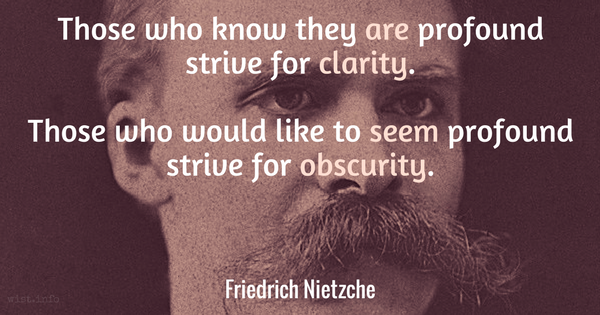
Those who know they are profound strive for clarity. Those who would like to seem profound strive for obscurity. For the crowd believes that if it cannot see to the bottom of something it must be profound. It is timid and dislikes going into the water.
[Tief sein und tief scheinen. — Wer sich tief weiss, bemüht sich um Klarheit; wer der Menge tief scheinen möchte, bemüht sich um Dunkelheit. Denn die Menge hält Alles für tief, dessen Grund sie nicht sehen kann: sie ist so furchtsam und geht so ungern in’s Wasser.]
Friedrich Nietzsche (1844–1900) German philosopher and poet
The Gay Science [Die fröhliche Wissenschaft], Book 3, § 173 (1882) [tr. Kaufmann (1974)]
(Source)
Also known as La Gaya Scienza, The Joyful Wisdom, or The Joyous Science. (Source (German)). Other translations:To Be Profound and to Appear Profound. -- He who knows that he is profound strives for clearness; he who would like to appear profound to the multitude strives for obscurity. The multitude thinks everything profound of which it cannot see the bottom; it is so timid and goes so unwillingly into the water.
[tr. Common (1911)]Being Deep and Seeming Deep. -- Those who know they are deep strive for clarity. Those who would like to seem deep to the crowd strive for obscurity. For the crowd takes everything whose ground it cannot see to be deep; it is so timid and so reluctant to go into the water.
[tr. Nauckhoff (2001)]Being Profound and Being Thought Profound -- Whoever knows that he is profound strives for clarity; whoever would like the crowd to think he is profound strives for obscurity. The reason for this is that the crowd thinks something is profound whenever it cannot see to the bottom of it; it is afraid of the water and hates to get its feet wet.
[tr. Hill (2018)]Being Deep and Appearing Deep -- Whoever knows he is deep, strives for clarity; whoever would like to appear deep to the crowd, strives for obscurity. For the crowd considers anything deep if only it cannot see to the bottom: the crowd is so timid and afraid of going into the water.
[Source]Whoever knows himself to be deep strives for clarity; whoever wants to appear deep to the masses strives for obscurity. For the masses consider anything to be deep that they cannot see the bottom of.
[Source]
Thoughts are the shadows of our feelings — always darker, emptier, and simpler.
[Gedanken sind die Schatten unserer Empfindungen, — immer dunkler, leerer, einfacher, als diese.]
Friedrich Nietzsche (1844–1900) German philosopher and poet
The Gay Science [Die fröhliche Wissenschaft], Book 3, § 179 (1882) [tr. Kaufmann (1974)]
(Source)
Also known as La Gaya Scienza, The Joyful Wisdom, or The Joyous Science.
(Source (German)). Other translations:Thoughts are the shadows of our sentiments -- always, however, obscurer, emptier, and simpler.
[tr. Common (1911)]Thoughts are the shadows of our sensations -- always darker, emptier, simpler.
[tr. Nauckhoff (2001)]Thoughts are shadows of our feelings -- always darker, emptier and simpler than these.
[tr. Hill (2018)]
The most perfidious way of damaging a cause is deliberately to defend it with faulty arguments.
[Die perfideste Art, einer Sache zu schaden ist, sie absichtlich mit fehlerhaften Gründen vertheidigen.]
Friedrich Nietzsche (1844–1900) German philosopher and poet
The Gay Science [Die fröhliche Wissenschaft], Book 3, § 191 (1882) [tr. Nauckhoff (2001)]
(Source)
Also known as La Gaya Scienza, The Joyful Wisdom, or The Joyous Science.
(Source (German)). Other translations:The most perfidious manner of injuring a cause is to vindicate it intentionally with fallacious arguments.
[tr. Common (1911)]The most perfidious way of harming a cause consists of defending it deliberately with faulty arguments.
[tr. Kaufmann (1974)]One injures a cause in the most perfidious manner by deliberately defending it with erroneous reasons.
[tr. Hill (2018)]
No victor believes in chance.
[Kein Sieger glaubt an den Zufall.]
Friedrich Nietzsche (1844–1900) German philosopher and poet
The Gay Science [Die fröhliche Wissenschaft], Book 3, § 258 (1882) [tr. Kaufmann (1974)]
(Source)
Also known as La Gaya Scienza, The Joyful Wisdom, or The Joyous Science.
(Source (German)). Other translations:No conqueror believes in chance.
[tr. Common (1911)]No victor believes in chance.
[tr. Nauckhoff (2001)]
What we do is never understood but always only praised or censured.
[Was wir thun, wird nie verstanden, sondern immer nur gelobt und getadelt.]
Friedrich Nietzsche (1844–1900) German philosopher and poet
The Gay Science [Die fröhliche Wissenschaft], Book 3, § 264 (1882) [tr. Kaufmann (1974)]
(Source)
Also known as La Gaya Scienza, The Joyful Wisdom, or The Joyous Science.
(Source (German)). Other translations:What we do is never understood, but only praised and blamed.
[tr. Common (1911)]What we do is never understood but always merely praised and reproached.
[tr. Nauckhoff (2001)]
In the end, what are man’s truths? His irrefutable errors.
[Was sind denn zuletzt die Wahrheiten des Menschen? — Es sind die unwiderlegbaren Irrthümer des Menschen.]
Friedrich Nietzsche (1844–1900) German philosopher and poet
The Gay Science [Die fröhliche Wissenschaft], Book 3, § 265 (1882) [tr. Hill (2018)]
(Source)
Also known as La Gaya Scienza, The Joyful Wisdom, or The Joyous Science.
(Source (German)). Other translations:But what after all are man's truths? -- They are his irrefutable errors.
[tr. Common (1911)]What are man's truths ultimately? Merely his irrefutable errors.
[tr. Kaufmann (1974)]What, then, are man's truths ultimately? -- They are the irrefutable errors of man.
[tr. Nauckhoff (2001)]
What does your conscience say? You should become who you are.
[Was sagt dein Gewissen? — „Du sollst der werden, der du bist.”]Friedrich Nietzsche (1844–1900) German philosopher and poet
The Gay Science [Die fröhliche Wissenschaft], Book 3, § 270 (1882) [tr. Nauckhoff (2001)]
(Source)
Also known as La Gaya Scienza, The Joyful Wisdom, or The Joyous Science.
(Source (German)). Alternate translations:What Saith thy Conscience? -- "Thou shalt become what thou art."
[tr. Common (1911)]What does your conscience say? -- "You shall become the person you are."
[tr. Kaufmann (1974)]What does your conscience say? "You shall become who you are."
[tr. Hill (2018)]
There is something laughable about the sight of authors who enjoy the rustling folds of long and involved sentences: they are trying to cover up their feet.
[Man hat Etwas zum Lachen, diese Schriftsteller zu sehen, welche die faltigen Gewänder der Periode um sich rauschen machen: sie wollen so ihre Füsse verdecken.]
Friedrich Nietzsche (1844–1900) German philosopher and poet
The Gay Science [Die fröhliche Wissenschaft], Book 4, § 282 (1882) [tr. Kaufmann (1974)]
(Source)
Also known as La Gaya Scienza, The Joyful Wisdom, or The Joyous Science.
(Source (German)). Other translations:It is something laughable to see those writers who make the folding robes of their periods rustle around them: they want to cover their feet.
[tr. Common (1911)]There is something laughable about those writers who make the folded drapery of their period rustle around them; they want to hide their feet.
[tr. Hill (2018)]
But the mere fact that you hear this or that judgement as the voice of conscience, and that consequently you feel a thing to be right, may be due to the fact that you have never given the matter much thought, and have blindly accepted from your childhood whatever you were told was right.
[Dass du aber diess und jenes Urtheil als Sprache des Gewissens hörst, also, dass du Etwas als recht empfindest, kann seine Ursache darin haben, dass du nie über dich nachgedacht hast und blindlings annahmst, was dir als recht von Kindheit an bezeichnet worden ist.]Friedrich Nietzsche (1844–1900) German philosopher and poet
The Gay Science [Die fröhliche Wissenschaft], Book 4, § 335 (1882) [tr. Hill (2018)]
(Source)
Also known as La Gaya Scienza, The Joyful Wisdom, or The Joyous Science.
(Source (German)). Alternate translations:But that you hear this or that judgment as the voice of conscience, consequently, that you feel a thing to be right -- may have its cause in the fact that you have never reflected about yourself, and have blindly accepted from your childhood what has been designated to you as right.
[tr. Common (1911)]But that you take this or that judgment for the voice of conscience -- in other words, that you feel something to be right -- may be due to the fact that you have never thought much about yourself and simply have accepted blindly that what you had been told ever since your childhood was right.
[tr. Kaufmann (1974)]But that you hear this or that judgement as the words of conscience, i.e., that you feel something to be right may have its cause in your never having thought much about yourself and in blindly having accepted what has been labeled right since your childhood.
[tr. Nauckhoff (2001)]
Better perish than hate and fear, and twice rather perish than make oneself hated and feared — this must someday become the highest maxim for every single commonwealth.
Friedrich Nietzsche (1844–1900) German philosopher and poet
The Wanderer and His Shadow (1880)
Perhaps I know best why man alone laughs: he alone suffers so deeply that he had to invent laughter.
[Vielleicht weiss ich am besten, warum der Mensch allein lacht: er allein leidet so tief, dass er das Lachen erfinden musste.]
Friedrich Nietzsche (1844–1900) German philosopher and poet
The Will to Power [Der Wille zur Macht], Book 1, Part 2, ch. 2/b, § 91 (1901) [ed. Elisabeth Förster-Nietzsche] [tr. Kaufmann/Hollingdale (1967)]
(Source)
(Source (German)). Other translations:Perhaps I know best why man is the only animal that laughs : he alone suffers so excruciatingly that he was compelled to invent laughter.
[tr. Ludovici (1910)]Perhaps I know best why it is man alone who laughs; he alone suffers so deeply that he had to invent laughter.
[Common, e.g.]Perhaps I know best why man alone laughs: only he suffers so profoundly that he was bound to invent laughter.
[tr. Hill/Scarpitti (2017)]
Spiritual strength and passion, when accompanied by bad manners, only provoke loathing.
Friedrich Nietzsche (1844–1900) German philosopher and poet
The Will to Power, Part 1, “Critique of Religion,” Sec. 175 [tr. Ludovici] (1888)
(Source)
With whom does the greatest danger for the whole human future lie? Is it not with the good and just? — with those who say and feel in their hearts: “We already know what is good and just, we possess it, too; woe to those who are still searching for it!”
Friedrich Nietzsche (1844–1900) German philosopher and poet
Thus Spoke Zarathustra [Also sprach Zarathustra], “Of Old and New Law-Tables” (26) (1883-85) [tr. Hollingdale (1961)]
We are the most unfair, not towards him whom we do not like, but toward him for whom we feel nothing at all.
Friedrich Nietzsche (1844–1900) German philosopher and poet
Thus Spoke Zarathustra [Also Sprach Zarathustra], Part 2, “Of the Compassionate [Von den Mitleidigen]” (1892) [tr. Hollingdale (1961)]
(Source)
If ye would go up high, then use your own legs! Do not get yourselves carried aloft; do not seat yourselves on other people’s backs and heads!
Friedrich Nietzsche (1844–1900) German philosopher and poet
Thus Spoke Zarathustra [Also sprach Zarathustra], Part 4, ch. 73 (1883-85)
Mistrust all in whom the urge to punish is strong!
Friedrich Nietzsche (1844–1900) German philosopher and poet
Thus Spoke Zarathustra, “Of the Tarantulas” (1892) [tr. Hollingdale (1961)]
Which is it? Is man one of God’s blunders? Or is God one of man’s blunders?
[Wie? ist der Mensch nur ein Fehlgriff Gottes? Oder Gott nur ein Fehlgriff des Menschen?]
Friedrich Nietzsche (1844–1900) German philosopher and poet
Twilight of the Idols [Die Götzen-Dämmerung], “Apophthegms and Darts [Sprüche und Pfeile]” #7 (1889)
Other translations:
- "How is it? Is man only a mistake of God? Or God only a mistake of man? --" [tr. Common (1896)]
- "What? Is man just one of God's mistakes? Or is God just one of man's? --" [tr. Large (1998),"Maxims and Barbs"]
- "What? Is man just God's mistake? Or is God just man's mistake?" [tr. Norman (2005), "Arrows and Epigrams"]
- "What? Is man merely a mistake of God's? Or God merely a mistake of man's?" [tr. Hollingdale (1968)]
- "Which is it? Is man only a blunder of God? Or is God only a blunder of man?" [tr. Ludovici (1911), "Maxims and Missiles"]
Out of life’s school of war: What does not destroy me, makes me stronger.
[Aus der Kriegsschule des Lebens. — Was mich nicht umbringt, macht mich stärker.]
Friedrich Nietzsche (1844–1900) German philosopher and poet
Twilight of the Idols [Die Götzen-Dämmerung], “Maxims and Arrows [Sprüche und Pfeile]” #8 (1889) [tr. Hollingdale (1968)]
(Source)
Other translations:
- "From the military school of life. -- What does not kill me, strengthens me." [tr. Common (1896)]
- "From the Military School of Life: Whatever does not kill me, makes me stronger. [tr. Large (1998), "Maxims and Barbs"]
- "From life's school of war. -- What doesn't kill me makes me stronger." [tr. Norman (2005), "Arrows and Epigrams"]
- "From the military school of life. -- That which does not kill me, makes me stronger." [tr. Ludovici (1911), "Maxims and Missiles"]