No matter how full a reservoir of maxims one may possess, and no matter how good one’s sentiments may be, if one has not taken advantage of every concrete opportunity to act, one’s character may remain entirely unaffected for the better. With mere good intentions, hell is proverbially paved.
William James (1842–1910) American psychologist and philosopher
The Principles of Psychology, Vol. 1, ch. 4 “Habit” (1890)
(Source)
This chapter originally published in Popular Science Monthly (Feb 1887).
Quotations about:
moralizing
Note not all quotations have been tagged, so Search may find additional quotes on this topic.


The cultivation of wide sympathies, given the instinctive germ, is mainly an intellectual matter: it depends upon the right direction of attention, and the realization of facts which militarists and authoritarians suppress. Take, for example, Tolstoy’s description of Napoleon going round the battlefield of Austerlitz after the victory. Most histories leave the battlefield as soon as the battle is over; by the simple expedient of lingering on it for another twelve hours, a completely different picture of war is produced. This is done, not by suppressing facts, but by giving more facts. And what applies to battles applies equally to other forms of cruelty. In all cases, it should be quite unnecessary to point the moral; the right telling of the story should be sufficient. Do not moralize, but let the facts produce their own moral in the child’s mind.
Bertrand Russell (1872–1970) English mathematician and philosopher
Education and the Good Life, Part 2, ch. 11 “Affection and Sympathy” (1926)
(Source)
Whene’er you lecture, be concise: the soul
Takes in short maxims, and retains them whole:
But pour in water when the vessel’s filled,
It simply dribbles over and is spilled.[Quidquid praecipies, esto brevis, ut cito dicta
percipiant animi dociles teneantque fideles:
omne supervacuum pleno de pectore manat.]Horace (65–8 BC) Roman poet, satirist, soldier, politician [Quintus Horatius Flaccus]
Epistles [Epistularum, Letters], Book 2, ep. 3 “Art of Poetry [Ars Poetica; To the Pisos],” l. 335ff (2.3.335-337) (19 BC) [tr. Conington (1874)]
(Source)
On teaching moral lessons when writing.
(Source (Latin)). Other translations:In all thy preceptes be thou briefe that learners quicklye maie
Conceive thy words, and that the same in faithfull mynde to staye.
What s'euer is superfluose, to muche, and oftens tould,
Doth fill the hearer paste the brim that long he cannot hould.
[tr. Drant (1567)]Be briefe in what thou wouldst command, that so.
The docill mind may soon thy precepts know,
And hold them faithfully; for nothing rests
But flowes out, that ore swelleth in full brests.
[tr. Jonson (1640)]Let all your precepts be succinct and clear,
That ready wits may comprehend them soon,
And faithfull memories retain them long;
For superfluities are soon forgot.
[tr. Roscommon (1680)]Short be the precept, which with ease is gain'd,
By docile minds, and faithfully retain'd.
If in dull length your moral is exprest,
The tedious wisdom overflows the breast.
[tr. Francis (1747)]Short be your precepts, and th' impression strong,
That minds may catch them quick, and hold them long!
The bosom full, and satisfied the taste,
All that runs over will but run to waste.
[tr. Coleman (1783)]Whatever the lesson you would convey, be brief, that your hearers may catch quickly what is said and faithfully retain it. Every superfluous word is spilled from the too-full memory.
[tr. Blakeney (1828)]In precept be concise: what thus is told
The mind shall grasp with ease, with firmness hold:
While all, that's heap'd superfluous, shocks the taste,
From memory's tablet fades, and runs to waste.
[tr. Howes (1845)]Whatever precepts you give, be concise; that docile minds may soon comprehend what is said, and faithfully retain it. All superfluous instructions flow from the too full memory.
[tr. Smart/Buckley (1853)]Let all your precepts be concise, for these
Stick to men's minds, and they are grasped with ease;
But tax too much their memory or their taste,
And all your surplus words run off to waste!
[tr. Martin (1881)]Whenever you instruct, be brief, so that what is quickly said the mind may readily grasp and faithfully hold: every word in excess flows away from the full mind.
[tr. Fairclough (Loeb) (1926)]But when you instruct, be brief, so the mind can clearly
Perceive and firmly retain. When the mind is full,
Everything else that you say just trickles away
[tr. Palmer Bovie (1959)]Be concise in all you teach, so that attentive minds
can quickly see your point and remember it correctly;
everything poured into a full memory will flow back out.
[tr. Fuchs (1977)]Whichever,
Say it quickly, so he who runs can listen, and hear, and learn,
And be better for learning. A bursting head
Opens like a bladder, and leaks away.
[tr. Raffel (1983 ed.)]As for instruction, make it succinct, so the mind
Can quickly seize on what's being taught and hold it;
Every superfluous word spills out of a full mind.
[tr. Ferry (2001)]When you are giving advice, be brief, to allow the learner
quickly to seize the point and then retain it firmly.
If the mind is full, every superfluous word is spilt.
[tr. Rudd (2005)]When you give instruction, be brief, what’s quickly
Said the spirit grasps easily, faithfully retains:
Everything superfluous flows out of a full mind.
[tr. Kline (2015)]
Mistrust all in whom the urge to punish is strong!
Friedrich Nietzsche (1844–1900) German philosopher and poet
Thus Spoke Zarathustra, “Of the Tarantulas” (1892) [tr. Hollingdale (1961)]
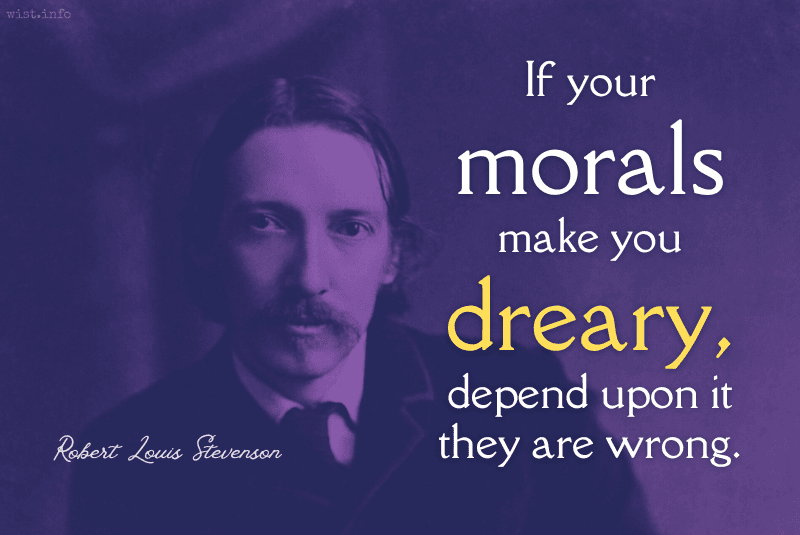
If your morals make you dreary, depend upon it they are wrong. I do not say “give them up,” for they may be all you have; but conceal them like a vice, lest they should spoil the lives of better and simpler people.
Robert Louis Stevenson (1850–1894) Scottish essayist, novelist, poet
Essay (1888-12), “A Christmas Sermon,” sec. 2, Scribner’s Magazine, Vol. 4
(Source)
Originally written in the winter of 1887-88. Collected in Across the Plains, ch. 12 (1892).