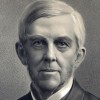
We all need to look into the dark side of our nature — that’s where the energy is, the passion. People are afraid of that because it holds pieces of us we’re busy denying.
Sue Grafton (1940–2017) American novelist, screenwriter
Interview (1997-02-07) by Jeffrey Zaslow, “Straight Talk,” USA Weekend magazine
(Source)
Quotations about:
darkness
Note not all quotations have been tagged, so Search may find additional quotes on this topic.

I am one who has come up out of the depths. My lords, you are rich and powerful. Therein lies your danger. You profit by the night; but beware! The Dawn is all-powerful. You cannot prevail over that. It is coming. Nay! it is already come. Within it is the day-spring of irresistible light. And who shall hinder that sling from hurling the sun into the sky? The sun I speak of is Right. You are Privilege. Tremble!
[Je suis celui qui vient des profondeurs. Mylords, vous êtes les grands et les riches. C’est périlleux. Vous profitez de la nuit. Mais prenez garde, il y a une grande puissance, l’aurore. L’aube ne peut être vaincue. Elle arrivera. Elle arrive. Elle a en elle le jet du jour irrésistible. Et qui empêchera cette fronde de jeter le soleil dans le ciel? Le soleil, c’est le droit. Vous, vous êtes le privilège. Ayez peur.]
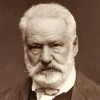
Victor Hugo (1802–1885) French writer, journalist, human rights activist, politician
The Man Who Laughs [L’Homme qui rit; The Laughing Man; By Order of the King], Part 2, Book 8, ch. 7 (2.8.7) (1869) [tr. Unknown (1869)]
(Source)
Gwynplaine addressing the House of Lords.
(Source (French)). Other translations:I am he who cometh out of the depths. My lords, you are great and rich. There lies your danger. You profit by the night; but beware! The Dawn is all-powerful. You cannot prevail over it. It is coming. Nay! it is come. Within it is the day-spring of irresistible light. And who shall hinder that sling from hurling the sun into the sky? The sun I speak of is Right. You are Privilege. Tremble!
[tr. Unknown, Authorized (1871)]I am he who comes from the depths. My Lords, you are the great and the rich. This is perilous. You profit by the night. But have a care, there is a great power, -- the dawn. The dawn cannot be vanquished. It will come. It is coming. It has within it the irresistable light of day. And who shall prevent this sling from hurling the sun into the sky? The sun means the Right. You are Privilege. Be afraid.
[tr. Hapgood (1888)]I am he who comes from the depths. My Lords, you are the great and the rich. That is perilous. You take advantage of darkness. But take care, there is a great power, dawn. Daybreak cannot be conquered. It will come. It is coming. The irresistable ray of daylight is within it. And who will hinder that sling from hurling the sun into the sky? The sun, is Man's Right. You -- you are Privilege. You may well be afraid.
[tr. Phillips (1894)]I am he who comes from the depths. My lords, you are the great and the rich. It is perilous. You take advantage of the night. But beware, there is a great power, the dawn. The dawn cannot be defeated. It will come. It is coming. It has in it the irresistible throw of the day. And who will stop this slingshot from throwing the sun into the sky? The sun is the right. You, you are the privilege. Be afraid.
[tr. Lavelle (2003)]
He that gropes in the dark, finds that which he would not.
James Howell (c. 1594–1666) Welsh historian, writer, aphorist
Paroimiographia [Παροιμιογραφία]: Proverbs, or, Old Sayed Sawes & Adages, “English Proverbs” (1659) [compiler]
(Source)
The man who wont beleave enny thing he kant see, aint so wize az a mule, for they will kick at a thing in the dark.
[The man who won’t believe anything he can’t see, ain’t so wise as a mule, for they will kick at a thing in the dark.]
Josh Billings (1818–1885) American humorist, aphorist [pseud. of Henry Wheeler Shaw]
Josh Billings’ Farmer’s Allminax, 1871-06 (1871 ed.)
(Source)

Truly, I live in dark times!
The guileless word is folly. A smooth forehead
Suggests insensitivity. The man who laughs
Has simply not yet had
The terrible news.
–
What kind of times are they, when
A talk about trees is almost a crime
Because it implies silence about so many horrors?
That man there calmly crossing the street
Is already perhaps beyond the reach of his friends
Who are in need?[Wirklich, ich lebe in finsteren Zeiten!
Das arglose Wort ist töricht. Eine glatte Stirn
Deutet auf Unempfindlichkeit hin. Der Lachende
Hat die furchtbare Nachricht
Nur noch nicht empfangen.
–
Was sind das für Zeiten, wo
Ein Gespräch über Bäume fast ein Verbrechen ist
Weil es ein Schweigen über so viele Untaten einschließt!
Der dort ruhig über die Straße geht
Ist wohl nicht mehr erreichbar für seine Freunde
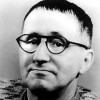
Die in Not sind?]Bertolt Brecht (1898–1956) German poet, playwright, director, dramaturgist
Poem (1938 ca.), “To Those Born Later [An die Nachgeborenen],” sec. 1, Svendborger Gedichte (1939) [tr. Willet / Manheim / Fried (1976)]
(Source)
Also translated as "To Those Who Follow in Our Wake" and "To Later Generations." Written while Brecht had left Germany for Denmark ("crossing the street").
An audio recording of the poem by Brecht.
(Source (German)). Other translations:Truly, I live in dark times
The innocent word is suspect.
An unwrinkled forehead
suggests insensitivity.
He who laughs
simply has not heard
the terrible news.
-
What times are these when
a conversation about trees
is almost a crime
because it includes
so much silence
about so many outrages!
[tr. Lettau (1978)]Truly, I live in dark times!
An artless word is foolish. A smooth forehead
Points to insensitivity. He who laughs
Has not yet received
The terrible news.
-
What times are these, in which
A conversation about trees is almost a crime
For in doing so we maintain our silence about so much wrongdoing!
And he who walks quietly across the street,
Passes out of the reach of his friends
Who are in danger?
[tr. Horton (2008)]Really, I live in dark times!
Innocent words are foolish. A smooth brow
Betrays insensitivity. Anyone left laughing
Simply has not yet heard
The terrible news.
-
What are these for times, where
A discussion about trees is almost a crime
Because it involves a silence about so many misdeeds!
He there peacefully crossing the street
Is probably no longer reachable for his friends
Who are in need?
[tr. Rienas (2009)]Really, I live in dark times!
Innocent words are foolish. An unfurrowed brow
Indicates apathy. He who laughs
Just hasn’t yet received
The terrible news.
-
What times are these, in which
A conversation about trees is almost a crime
Because it implies silence about so many misdeeds!
He who quietly crosses the street
Is probably no longer within reach of his friends
Who are in need?
[tr. Renaud (2016)]Truly, I live in dark times!
Innocent words are foolish. A smooth forehead
shows insensitivity. The guy laughing
has just not received
the terrible news yet.
-
What kind of times are these, where
talking about trees is almost a crime
when it means silence about so many atrocities!
That man calmly crossing the street
is probably no longer reachable by his friends
who need help.
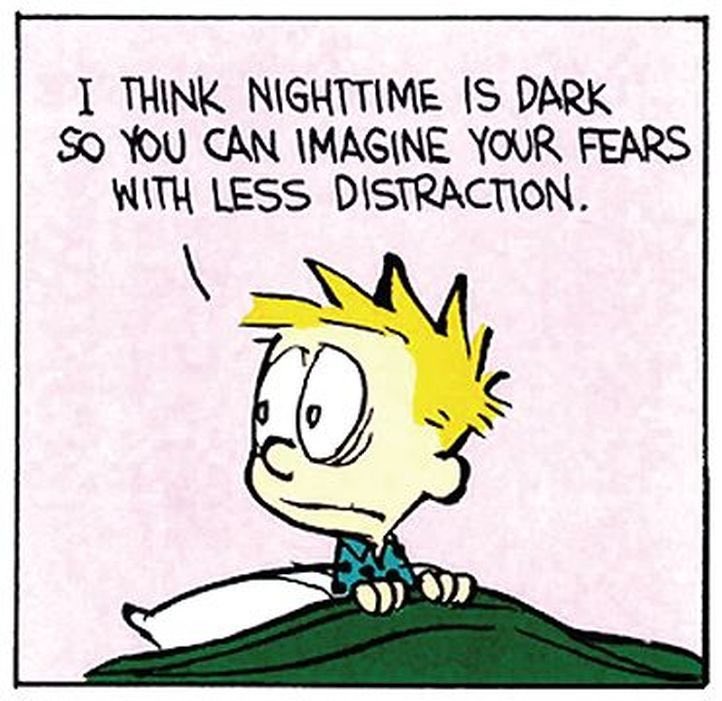
CALVIN: I think nighttime is dark so you can imagine your fears with less distraction.
They say rather than cursing the darkness, one should light a candle. They don’t mention anything about cursing a lack of candles.
George Carlin (1937–2008) American comedian
Book (2004), When Will Jesus Bring the Pork Chops?, “Bits and Pieces”
(Source)
It is better to light a candle than to curse the darkness.
W. L. Watkinson (1838–1925) English Methodist minister and preacher [William Lonsdale Watkinson]
Sermon (1907), “The Invincible Strategy,” The Supreme Conquest and other Sermons Preached in America, Sermon 14
(Source)
The sermon was written around Romans 12:21 ("Be not overcome of evil, but overcome evil with good.").
Often attributed as a Chinese proverb, or a quotation from Confucius or Eleanor Roosevelt.
For more information on this quote's origin and variations, see:See also Kennedy (1960), Pratchett (1993), and Carlin (2004).
- Quote Origin: Better to Light a Candle Than to Curse the Darkness – Quote Investigator®
- Eleanor Roosevelt: "It's Better to Light a Candle than to Curse the Darkness." Quote or No Quote? Professor Buzzkill

The Marquis de Carabas looked up at him. His eyes were very white in the moonlight. And he whispered, “What’s it like being dead? It’s very cold, my friend. Very dark, and very cold.”
HECUBA: For from darkness and the endearments of the night mortals have their keenest joys.
[ἙΚΆΒΗ: ἐκ τοῦ σκότου τε τῶν τε νυκτερησίων
φίλτρων μεγίστη γίγνεται βροτοῖς χάρις.]Euripides (485?-406? BC) Greek tragic dramatist
Hecuba [Hekabe; Ἑκάβη], l. 831ff (c. 424 BC) [tr. Coleridge (1938)]
(Source)
Reminding a reluctant Agamemnon that he's been sleeping with her daughter, Cassandra, to enlist him in avenging the death of her son, Polydorus.
This passage of the text is elided in some translations. Where present, it is sometimes noted as a speculated or fragmentary insertion.
(Source (Greek)). Alternate translations:In the soul of man
The endearments of the night, by darkness veil'd,
Create the strongest interest.
[tr. Wodhull (1809)]For from the secret shade, and from night's joys, the greatest delight is wont to spring to mortals.
[tr. Edwards (1826)]For of the darkness and the night's love-spells
Cometh on men the chiefest claim for thank.
[tr. Way (Loeb) (1894)]I know how men adore the dark of night.
[tr. McGuinness (2004)]The greatest benefit to humans springs from the night and the delights of love within it.
[tr. Theodoridis (2007)]
At home we read Pinocchio instead. We read Black Beauty, Doctor Dolittle, Little Women, The Adventures of Huckleberry Finn. What I learned about darkness from stories, I learned from books like these — and also from the unedited works of the Brothers Grimm and Hans Christian Andersen.
According to a recent article in the New York Times, few parents expose their children to those works in the original these days, and some of their reasons make sense. Who wants children growing up with the idea that stepmothers are wicked, ugly people are evil, women can get by on their beauty, and princesses are all white? At the same time, I worry about children who grow up thinking that every story has a happy ending and no one gets permanently hurt along the way.Barbara Brown Taylor (b. 1951) American minister, academic, author
Learning to Walk in the Dark, ch. 1 (2014)
(Source)

In winter I get up at night
And dress by yellow candle-light.
In summer quite the other way,
I have to go to bed by day.Robert Louis Stevenson (1850–1894) Scottish essayist, novelist, poet
Poem (1885), “Bed in Summer,” st. 1, A Child’s Garden of Verses
(Source)
As dark misery settles down on us, and our refuges of lies fall in pieces one after one, the hearts of men, now at last serious, will turn to refuges of truth. The eternal stars shine out again, so soon as it is dark enough.
Thomas Carlyle (1795–1881) Scottish essayist and historian
Past and Present, Book 4, ch. 8 “The Didactic” (1843)
(Source)
More discussion of this imagery and quotation here: Quote Origin: The Eternal Stars Shine Out Again, So Soon As It Is Dark Enough – Quote Investigator®.
If the soul is left in darkness, sins will be committed. The guilty one is not he who commits the sin, but he who causes the darkness.
[Cette âme est pleine d’ombre, le péché s’y commet. Le coupable n’est pas celui qui y fait le péché, mais celui qui y a fait l’ombre.]Victor Hugo (1802–1885) French writer, journalist, human rights activist, politician
Les Misérables, Part 1 “Fantine,” Book 1 “An Upright Man,” ch. 4 (1.1.4) [Bishop Myriel] (1862) [tr. Wilbour (1862)]
(Source)
(Source (French)). Alternate translations:This soul is full of darkness, and sin is committed, but the guilty person is not the man who commits the sin, but he who produces the darkness.
[tr. Wraxall (1862)]This soul is full of shadow; sin is therein committed. The guilty one is not the person who has committed the sin, but the person who has created the shadow.
[tr. Hapgood (1887)]The soul in darkness sins, but the real sinner is he who caused the darkness.
[tr. Denny (1976)]If the soul is left in darkness, sins will be committed. The guilty one is not he who commits the sin, but the one who causes the darkness.
[tr. Wilbour/Fahnestock/MacAfee (1987)]In any benighted soul -- that's where sin will be committed. It's not he who commits the sin that's to blame, but he who causes the darkness to prevail.
[tr. Donougher (2013)]
MACBETH: Good things of day begin to droop and drowse,
While night’s black agents to their preys do rouse.William Shakespeare (1564–1616) English dramatist and poet
Macbeth, Act 3, sc. 2, l. 58ff (3.2.58-60) (1606)
(Source)

MACBETH:Stars, hide your fires;
Let not light see my black and deep desires.William Shakespeare (1564–1616) English dramatist and poet
Macbeth, Act 1, sc. 4, l. 57ff (1.4.57-58) (1606)
Even so, one step from my grave,
I believe that cruelty, spite,
The powers of darkness will in time
Be crushed by the spirit of light.[Но и так, почти у гроба,
Верю я, придет пора —
Силу подлости и злобы
Одолеет дух добра.]Boris Pasternak (1890–1960) Russian poet, novelist, and literary translator
“Nobel Prize [Нобелевская Премия]” st. 4 (1959) [tr. Stallworthy/France (1982)]
(Source)
On his persecution for winning the 1958 Nobel Prize for Literature for Doctor Zhivago, which had been condemned by the Communist Party and the Soviet government. The poem was not published until Selected Poems (1983).
This upbeat ending is how the poem officially ends. Two more, darker, stanzas were attached to the manuscript by Pasternak, but it is unclear if they were meant to be added (and, if so, where), or if Pasternak ever wanted the poem published.
(Source (Russian)). Other translations:Even now, at the edge of the tomb,
I believe in the virtuous fate, --
And the spirit of goodness will soon
overcome all the malice and hate.
[tr. Kneller]But even as my grave awaits,
the time will come. I've believed --
The forces of meanness and hate
will be vanquished by the spirit of good.
[tr. Mager]Yet, as I approach my passing,
I believe the day is near,
When the heart of good surpasses
rage and baseness -- even here.
[tr. Moreton]Even in my dying hour
I believe it still stronger:
Malice will be overpowered
By the spirit of Good Will.
[tr. Astrakhan]
Don’t spurn sweet love,
my child, and don’t you be neglectful
of the choir of love, or the dancing feet,
while life is still green, and your white-haired old age
is far away with all its moroseness. Now,
find the Campus again, and the squares,
soft whispers at night, at the hour agreed,
and the pleasing laugh that betrays her, the girl
who’s hiding away in the darkest corner,
and the pledge that’s retrieved from her arm,
or from a lightly resisting finger.
[Nec dulcis amores
sperne puer neque tu choreas,
donec virenti canities abest
morosa. Nunc et campus et areae
lenesque sub noctem susurri
conposita repetantur hora,
nunc et latentis proditor intumo
gratus puellae risus ab angulo
pignusque dereptum lacertis
aut digito male pertinaci.]Horace (65–8 BC) Roman poet, satirist, soldier, politician [Quintus Horatius Flaccus]
Odes [Carmina], Book 1, # 9, l. 15ff (1.9.15-24) (23 BC) [tr. Kline (2015)]
(Source)
"To Thaliarchus." (Source (Latin)). Other translations:Till testy Age gray Hairs shall snow
Upon thy Head, lose Mask, nor Show:
Soft whispers now delight
At a set hour by Night:
And Maids that gigle to discover
Where they are hidden to a Lover;
And Bracelets or some toy
Snatcht from the willing Coy.
[tr. Fanshaw (Brome (1666))]Secure those golden early joys,
That youth unsoured with sorrow bears,
Ere withering time the taste destroys,
With sickness and unwieldy years.
For active sports, for pleasing rest,
This is the time to be possest;
The best is but in season best.
The appointed hour of promised bliss,
The pleasing whisper in the dark,
The half unwilling willing kiss,
The laugh that guides thee to the mark;
When the kind nymph would coyness feign,
And hides but to be found again;
These, these are joys the gods for youth ordain.
[tr. Dryden (c. 1685)]Whilst Thou art green, and gay, and Young,
E're dull Age comes, and strength decays,
Let mirth, and humor, dance, and song
Be all the trouble of thy days.
The Court, the Mall, the Park, and Stage,
With eager thoughts of Love pursue;
Gay Evening whispers fit thy Age,
And be to Assignation true.
Now Love to hear the hiding Maid,
Whom Youth hath fir'd, and Beauty charms
By her own tittering laugh betray'd,
And forc'd into her Lover's Arms.
Go dally with thy wanton Miss,
And from the Willing seeming Coy,
Or force a Ring, or steal a Kiss;
For Age will come, and then farewell to joy.
[tr. Creech (1684)]Sport in life's young spring,
Nor scorn sweet love, nor merry dance,
While years are green, while sullen eld
Is distant. Now the walk, the game,
The whisper'd talk at sunset held,
Each in its hour, prefer their claim.
Sweet too the laugh, whose feign'd alarm
The hiding-place of beauty tells,
The token, ravish'd from the arm
Or finger, that but ill rebels.
[tr. Conington (1872)]Nor disdain, being a young fellow, pleasant loves, nor dances, as long as ill-natured hoariness keeps off from your blooming age. Now let both the Campus Martius and the public walks, and soft whispers at the approach of evening be repeated at the appointed hour: now, too, the delightful laugh, the betrayer of the lurking damsel from some secret corner, and the token ravished from her arms or fingers, pretendingly tenacious of it.
[tr. Smart/Buckley (1853)]Let beauty's glance
Engage thee, and the merry dance,
Nor deem such pleasures vain!
Gloom is for age. Young hearts should glow
With fancies bright and free,
Should court the crowded walk, the show,
And at dim eve love's murmurs low
Beneath the trysting tree;
The laugh from the sly corner, where
Our girl is hiding fast,
The struggle for the lock of hair,
The half well pleased, half angry air,
The yielded kiss at last.
[tr. Martin (1864)]Spurn not, thou, who art young, dulcet loves;
Spurn not, thou, choral dances and song
While the hoar-frost morose keeps aloof from thy verdure.
Thine the sports of the Campus, the gay public gardens;
Thine at twilight the words whispered low;
Each in turn has its own happy hour:
And thine the sweet laugh of the girl -- which betrays her
Hiding slyly within the dim nook of the threshold,
And the love-token snatched from the wrist,
Or the finger's not obstinate hold.
[tr. Bulwer-Lytton (1870)]Youth must not spurn
Sweet loves, nor yet the dance forsake,
While grudging Age thy prime shall spare.
The Plain, the Squares, be now thy care,
And lounges, dear at nightfall, where
By concert love may whisper 'Hist!'
From inner nook a winsome smile
Betrays the girl that sculks the while,
And keepsakes, deftly filched by guile
From yielding finger, or from wrist.
[tr. Gladstone (1894)]Nor, while thy vigour lasts, despise thou
Pleasures of love, nor the joys of dancing.
While the moroseness due to advancing age
Whitens not yet thy head, let the walks and park
And gentle whispers heard at nightfall
Each be repeated at fitting seasons.
Now, too, the pleasant laughter be heard, that tells
How lurking beauty hides in the corner-nook,
And token ravish'd from the arm, or
Finger, that daintily seems unwilling.
[tr. Phelps (1897)]Being but yet a youth, contemn
Neither the sweets of love nor of the dance,
While from your bloom crabbed greyness holds aloof.
Now let the Campus and the city squares,
And whispers low, be sought at nightfall,
On the appointed hour of tryst;
And now the fascinating laugh from some recess
Secluded, the betrayer of a maid
In hiding, and the pledge snatched off
An arm or finger ill retaining it.
[tr. Garnsey (1907)]Spurn not the dance,
Or in sweet loves to bask,
While surly age mars not thy morning's flower.
Seek now the athlete's training field or court;
See gentle lovers' whispered sport,
At nightfalls's trysted hour;
Seek the gay laught that from her ambush borne
Betrays the merry maiden huddled warm,
And forfeit from her hand or arm
Half given, half playful torn.
[tr. Marshall (1908)]Nor in thy youth neglect sweet love nor dances, whilst life is still in its bloom and crabbed age is far away! Now let the Campus be sought and the squares, with low whispers at the trysting-hour as night draws on, and the merry tell-tale laugh of maiden hiding in farthest comer, and the forfeit snatched from her arm or finger that but feigns resistance.
[tr. Bennett (Loeb) (1912)]Scorn not, while still
A boy, sweet loves; scorn not the dance.
Life in its Spring, and crabbed eld
Far off -- that is the time; then hey
For Park, Square, whispered concerts held
At a set hour at close of day:
For the sweet laugh whose soft alarm
Tells in what nook the maid lies hid:
For the love-token snatched from arm,
Of fingers that but half-forbid.
[tr. Mills (1924)]Now that you're young, and peevish
Grey hairs are still far distant, attend to the
Dance-floor, the heart's sweet business; for now is the
Right time for midnight assignations,
whispers and murmurs in Rome's piazzas
And fields, and soft, low laughter that gives away
The girl who plays love's games in a hiding-place --
Off comes a ring coaxed down an arm or
Pulled from a faintly resisting finger.
[tr. Michie (1963)]Take love while you're young and you can,
Laugh, dance,
Before time takes your chances
Away. Stroll where baths, where theaters
Bring Romans to walk, to talk, where whispers
Flit through the darkness as lovers meet,
And girls laugh from hidden corners,
Happy as favors
Are snatched in the darkness, laugh
And pretend to say no.
[tr. Raffel (1983)]While you're still young,
And while morose old age is far away,
There's love, there are parties, there's dancing and there's music,
There are young people out in the city squares together
As evening comes on, there are whispers of lovers, there's laughter.
[tr. Ferry (1997)]Do not disdain, boy, sweet love; and dance
while you are yet in bloom, and crabbed age far away.
Now frequent the Campus Martius
and public ways, and pizzas where soft whispers
are repeated at the trysting hour
and where the suffocated laughter of a girl
lurking in a corner reveals
secret betrayal and the forfeit
snatched away from a wrist
or from a finger, scarcely resisting.
[tr. Alexander (1999)]And while you're young don't scorn
sweet love affairs and dances,
so long as crabbed old age is far from
your vigor. Now let the playing field and the
public squares and soft whisperings at nightfall
(the appointed hour) be your pursuits;
now too the sweet laughter of a girl hiding
in a secret corner, which gives her away,
and a pledge snatched from her wrists
or her feebly resisting finger.
[tr. Wikisource (2021)]
There are three things all wise men fear: the sea in storm, a night with no moon, and the anger of a gentle man.
Patrick Rothfuss (b. 1973) American author
The Name of the Wind, ch. 43 “The Flickering Way” (2007)
(Source)

One may not reach the dawn save by the path of the night.
Kahlil Gibran (1883–1931) Lebanese-American poet, writer, painter [Gibran Khalil Gibran]
Sand and Foam (1946)
(Source)
As many years as I have been listening to Easter sermons, I have never heard anyone talk about that part. Resurrection is always announced with Easter lilies, the sound of trumpets, bright streaming light. But it did not happen that way. If it happened in a cave, it happened in complete silence, in absolute darkness, with the smell of damp stone and dug earth in the air. Sitting deep in the heart of Organ Cave, I let this sink in: new life starts in the dark. Whether it is a seed in the ground, a baby in the womb, or Jesus in the tomb, it starts in the dark.
Barbara Brown Taylor (b. 1951) American minister, academic, author
Learning to Walk in the Dark, ch. 6 (2014)
(Source)
“Darkness” is shorthand for anything that scares me — that I want no part of — either because I am sure that I do not have the resources to survive it or because I do not want to find out. The absence of God is in there, along with the fear of dementia and the loss of those nearest and dearest to me. So is the melting of polar ice caps, the suffering of children, and the nagging question of what it will feel like to die. If I had my way, I would eliminate everything from chronic back pain to the fear of the devil from my life and the lives of those I love — if I could just find the right night-lights to leave on.
At least I think I would. The problem is this: when, despite all my best efforts, the lights have gone off in my life (literally or figuratively, take your pick), plunging me into the kind of darkness that turns my knees to water, nonetheless I have not died. The monsters have not dragged me out of bed and taken me back to their lair. The witches have not turned me into a bat. Instead, I have learned things in the dark that I could never have learned in the light, things that have saved my life over and over again, so that there is really only one logical conclusion. I need darkness as much as I need light.Barbara Brown Taylor (b. 1951) American minister, academic, author
Learning to Walk in the Dark, Introduction (2014)
(Source)
One cloud is enough to eclipse all the sun.
Thomas Fuller (1654–1734) English physician, preacher, aphorist, writer
Gnomologia: Adages and Proverbs (compiler), # 3743 (1732)
Without darkness, nothing comes to birth,
As without light, nothing flowers.May Sarton (1912–1995) Belgian-American poet, novelist, memoirist [pen name of Eleanore Marie Sarton]
“The Invocation to Kali,” Part 5, Poetry (Feb 1971)
(Source)
It is so much easier to tell intimate things in the dark.
Sometimes it’s better to light a flamethrower than to curse the darkness.

Night poured over the desert. It came suddenly, in purple. In the clear air, the stars drilled down out of the sky, reminding any thoughtful watcher that it is in the deserts and high places that religions are generated. When men see nothing but bottomless infinity over their heads they have always had a driving and desperate urge to find someone to put in the way.
In relation to his public, the artist of to-day […] walks at first with his companions, till one day he falls through a hole in the brambles, and from that moment is following the dark rapids of an underground river which may sometimes flow so near the surface that the laughing picnic parties are heard above, only to re-immerse itself in the solitude of the limestone and carry him along its winding tunnel, until it gushes out through the misty creeper-hung cave which he has always believed to exist, and sets him back in the sun.
Cyril Connolly (1903–1974) English intellectual, literary critic and writer.
“Writers and Society, 1940-3” (1943), The Condemned Playground (1946)
(Source)
Abide with me: fast falls the eventide;
The darkness deepens; Lord, with me abide.
Light thinks it travels faster than anything but it is wrong. No matter how fast light travels it finds the darkness has always got there first, and is waiting for it.
Night makes no difference ‘twixt the priest and clerk;
Joan as my lady is as good i’ th’ dark.Robert Herrick (1591–1674) English poet
“No Difference i’ th’ Dark,” Hesperides, # 864 (1648)
(Source)
There is nothing in the dark that isn’t there when the lights are on.
George Clayton Johnson (1929–2015) American writer
Twilight Zone, 3×16 “Nothing in the Dark”, closing narration (5 Jan 1962)
Often attributed to Rod Serling, who read the narration and produced the show.
If you ever want to feel like you’re on the verge of total, abject bowel-releasing terror, try making your way a klick or two out of a forest, at night, with the certain feeling you’re being hunted. It makes you feel alive, it really does, but not in a way you want to feel alive.
John Scalzi (b. 1969) American writer
Zoe’s Tale (2008)

Lead, kindly Light, amid the encircling gloom,
Lead Thou me on;
The night is dark, and I am far from home;
Lead Thou me on!
Keep Thou my feet; I do not ask to see
The distant scene; — one step enough for me.John Henry Newman (1801–1890) English prelate, Catholic Cardinal, theologian
“Lead, Kindly Light” (16 Jun 1833)
(Source)
She walks in beauty, like the night
Of cloudless climes and starry skies;
And all that’s best of dark and bright
Meet in her aspect and her eyes:
Thus mellow’d to that tender light
Which heaven to gaudy day denies.George Gordon, Lord Byron (1788–1824) English poet
“She Walks in Beauty,” st. 1 (1814), Hebrew Melodies (1815)
(Source)
Richard looked at the woman in leather. “Is there anything, really, to be scared of?”
“Only the night on the bridge,” she said.
“The kind in armor?”
“The kind that comes when the day is over.”
There’s power in the night. There’s terror in the darkness. Despite all our accumulated history, learning, and experience, we remember. We remember times when we were too small to reach the light switch on the wall, and when the darkness itself was enough to make us cry out in fear. Get a good ways out from civilization — say, miles and miles away on a lightless lake — and the darkness is there, waiting. Twilight means more than just time to call the children in from playing outside. Fading light means more than just the end of another day. Night is when terrible things emerge from their sleep and seek soft flesh and hot blood. Night is when unseen beings with no regard for what our people have built and no place in what we have deemed the natural order look in at our world from outside, and think dark and alien thoughts. And sometimes, just sometimes, they do things.

People are like stained-glass windows. They sparkle and shine when the sun is out, but when the darkness sets in, their true beauty is revealed only if there is a light from within.
Elisabeth Kübler-Ross (1926–2004) Swiss-American psychiatrist, author
(Attributed)
(Source)
Attributed to her by the Elisabeth Kübler-Ross Foundation.
The quotation is often cited to Jim Clemmer, The Leader's Digest (2003), but Clemmer simply attributes it to Kübler-Ross. I have been unable to find an primary source.
Darkness cannot drive out darkness; only light can do that. Hate cannot drive out hate; only love can do that. Hate multiplies hate, violence multiplies violence, and toughness multiplies toughness in a descending spiral of destruction […] The chain reaction of evil — hate begetting hate, wars producing more wars — must be broken, or we shall be plunged into the dark abyss of annihilation.
There, peeping among the cloud-wrack above a dark tor high up in the mountains, Sam saw a white star twinkle for a while. The beauty of it smote his heart, as he looked up out of the forsaken land, and hope returned to him. For like a shaft, clear and cold, the thought pierced him that in the end the Shadow was only a small and passing thing: there was light and high beauty for ever beyond its reach.
J.R.R. Tolkien (1892–1973) English writer, fabulist, philologist, academic [John Ronald Reuel Tolkien]
The Lord of the Rings, Vol. 3: The Return of the King, Book 6, ch. 2 “The Land of Shadow” (1954)
(Source)
Gil-galad was an Elven-king.
Of him the harpers sadly sing:
the last whose realm was fair and free
between the Mountains and the Sea.His sword was long, his lance was keen,
his shining helm afar was seen;
the countless stars of heaven’s field
were mirrored in his silver shield.But long ago he rode away
and where he dwelleth none can say;
for into darkness fell his star
in Mordor where the shadows are.J.R.R. Tolkien (1892–1973) English writer, fabulist, philologist, academic [John Ronald Reuel Tolkien]
The Lord of the Rings, Vol. 1: The Fellowship of the Ring, Book 1, ch. 11 “A Knife in the Dark” [Sam] (1954)
(Source)
Sam says he was taught it by Bilbo, who claimed to have written it. Aragorn corrects him, saying it is part of a lay called "The Fall of Gil-galad," though Bilbo appears to have translated it from the Elvish.
It is always darkest just before the Day dawneth.
Thomas Fuller (1608–1661) English churchman, historian
A Pisgah-Sight of Palestine, ii. xi (1650)
IVANOVA: I’ve always had a hard time getting up when it’s dark outside.
SINCLAIR: But in space, it’s always dark.
IVANOVA: I know. I know.J. Michael (Joe) Straczynski (b. 1954) American screenwriter, producer, author [a/k/a "JMS"]
Babylon 5, 1×13 “Signs and Portents” (8 May 1994)

He who fights with monsters should look to it that he himself does not become a monster. And when you gaze long into an abyss, the abyss gazes also into you.
[Wer mit Ungeheuern kämpft, mag zusehn, dass er nicht dabei zum Ungeheuer wird. Und wenn du lange in einen Abgrund blickst, blickt der Abgrund auch in dich hinein.]
Friedrich Nietzsche (1844–1900) German philosopher and poet
Jenseits von Gut und Böse [Beyond Good and Evil], Aphorism 146 (1886) [tr. Hollingdale (1973, 1990)]
(Source)
Other translations:He who fights with monsters should be careful lest he thereby becomes a monster. And if thou gaze long into an abyss, the abyss will also gaze into thee.
[tr. Zimmern (1906)]Whoever fights monsters should see to it that in the process he does not become a monster. And when you look long into an abyss, the abyss also looks into you.
[tr. Kaufmann (1966)]
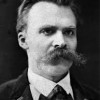
The ultimate weakness of violence is that it is a descending spiral, begetting the very thing it seeks to destroy. Instead of diminishing evil, it multiplies it. Through violence you may murder the liar, but you cannot murder the lie, nor establish the truth. Through violence you may murder the hater, but you do not murder hate. In fact, violence merely increases hate. So it goes. Returning violence for violence multiplies violence, adding deeper darkness to a night already devoid of stars. Darkness cannot drive out darkness; only light can do that. Hate cannot drive out hate: only love can do that.
Martin Luther King, Jr. (1929–1968) American clergyman, civil rights leader, social activist, preacher
Where Do We Go from Here: Chaos or Community? (1967)
(Source)
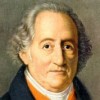
Where there is much light, the shadows are deepest.
[Wo viel Licht is, ist starker Schatten.]
Johann Wolfgang von Goethe (1749–1832) German poet, statesman, scientist
Gotz von Berlichingen, I, 24 (1773)
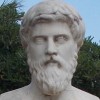
When the candles are out, all women are fair.
Plutarch (AD 46–127) Greek historian, biographer, essayist [Mestrius Plutarchos]
Morals [Moralia], “Conjugal Precepts” #46
(Source)
Other translations: "All women are alike when the lamp is put out."
FOOL: There is no darkness but ignorance.
William Shakespeare (1564–1616) English dramatist and poet
Twelfth Night, Act 4, sc. 2, l. 44 (4.2.44) (1601)
(Source)
I made a comparison at table some time since, which has often been quoted, and received many compliments. It was that of the mind of a bigot to the pupil of the eye; the more light you pour on it, the more it contracts.
Oliver Wendell Holmes, Sr. (1809–1894) American poet, essayist, scholar
Article (1858-04), “The Autocrat of the Breakfast-Table,” Atlantic Monthly
(Source)
Often trimmed/paraphrased to "The mind of a bigot is like the pupil of the eye; the more light you pour upon it, the more it will contract." Frequently misattributed to his son, Oliver Wendell Holmes, Jr.
The Autocrat himself correctly comments that a similar phrase appears in Thomas Moore, Preface to the poems "Corruption" and "Intolerance":The minds of some of our statesmen, like the pupil of the human eye, contract themselves the more the stronger light there is shed upon them.
The Autocrat goes on to note, "When a person of fair character for literary honesty uses an image such as another has employed before him, the presumption is, that he has struck upon it independently, or unconsciously recalled it, supposing it his own."
Collected in The Autocrat of the Breakfast Table, ch. 6 (1858)