Note not all quotations have been tagged, so Search may find additional quotes on this topic.
HELEN: From the moment my mother bore me I was pointed at for a freak. It’s not usual in Hellas or anywhere else for a woman to produce her young enclosed in a white shell — which is the way Leda is said to have borne me, with Zeus for my father!
Euripides (485?-406? BC) Greek tragic dramatist Helen [Ἑλένη], l. 256ff (412 BC) [tr. Vellacott (1954)]
(Source)
The egg-laying passage here is bracketed or elided by some translators, indicating it is possibly spurious or not in all manuscript traditions.
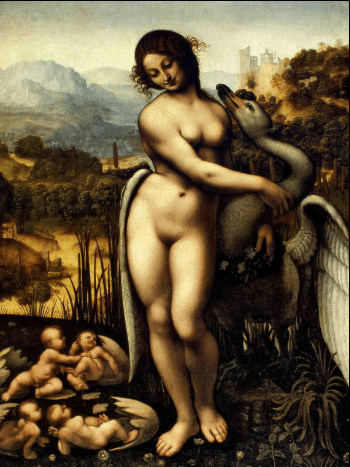
Leda was Helen's mother, with Zeus, the father, having seduced/raped her while disguised as a swan. Leda then lay a clutch of eggs (one with Helen, one containing the twins Castor and Pollux, another Clytemnestra). The ravishment of Leda is a common theme in art; showing the resulting eggs is much more rare (da Vinci being an exception).
Was not my birth a prodigy to men?
For never Grecian or Barbaric dame
From the white shell her young ones gave to light,
As Leda brought me forth, fame says, to Jove.
[tr. Potter (1783), l. 286ff]
Did not my mother, as a prodigy
Which wondering mortals gaze at, bring me forth?
For neither Greician nor barbaric dame
Till then produced an egg, in which her children
Enveloped lay, as they report, from Jove
Leda engendered.
[tr. Wodhull (1809)]
Did not my mother bring me forth as a prodigy to men? For neither Greek nor barbarian woman has given birth to a white vessel of younglings, in which they say Leda begot me by Jove.
[tr. Buckley (1850)]
Did my mother bear me as a wonder to mankind? [For no other woman, Hellene or barbarian, gives birth to a white vessel of chicks, in which they say Leda bore me to Zeus.]
[tr. Coleridge (1891)]
Bore not my mother a portent unto men?
For never Hellene nor barbarian dame
Brought forth white vial of a fledgling brood,
Wherein to Zeus men say that Leda bare me.
[tr. Way (Loeb) (1912)]
My very birth
A portent -- for it is not known in nature
That any woman, Greek or barbarous,
Should bear her children as they say that I
Was born to Zeus by Leda, cased about
In a white hollow shell.
[tr. Sheppard (1925)]
And did my mother bear me as some kind of monster?
For certainly no Greek or foreign woman yet
travailed with the white circle of an egg for birds,
as Leda bore me, so they say, from Zeus.
[tr. Warner (1951)]
Was I born a monster among mankind?
[No woman, neither in Greece nor yet in Barbary,
is hatched from the white envelope that contains young birds,
yet thus Leda bore me to Zeus, or so they say.]
[tr. Lattimore (1956)]
Was I born to be some kind of freak, carrion for men's scavenging eyes?
I am a freak ... a monster, and I lead a monstrous life.
[tr. Meagher (1986)]
Did my mother bring me into the world for people to stare at as a freak? My life has certainly been grotesque.
[tr. Davie (2002)]
Did not my mother bear me to be a monster to the world? For no woman, Hellene or barbarian, gives birth to babes in eggs inclosed, as they say Leda bare me to Zeus.
[tr. Athenian Society (2006)]
I've been handicapped -- to judge by the way people stare --
Since birth; and all my life I've lived under the shadow
Of my deformity.
[tr. A. Wilson (2007)]
My mother has brought me to this world to be nothing more than a monstrous freak! No woman -- neither Greek nor barbarian -- has given birth to the egg of a white bird, yet, they say, that this is what my mother has done. Leda, they say, delivered me inside the shell of a bird’s egg. Zeus is my father.
[tr. Theodoridis (2011)]
Did my mother bear me as a freak among mankind?
No woman -- no Greek, no barbarian -- gives birth to
her baby in an eggshell cask,
they say Leda bore me to Zeus.
[tr. Ambrose et al. (2018)]
Did my mother bear me as a wonder to mankind? [For no other woman, Hellene or barbarian, gives birth to a white vessel of chicks, in which they say Leda bore me to Zeus.]
[tr. Coleridge / Helen Heroization Team]
But I now indulge in dreams of bliss that cannot be realized. What I ask of you is reasonable and moderate; I demand a creature of another sex, but as hideous as myself: the gratification is small, but it is all that I can receive, and it shall content me. It is true, we shall be monsters, cut off from all the world; but on that account we shall be more attached to one another. Our lives will not be happy, but they will be harmless, and free from the misery I now feel. Oh! my creator, make me happy; let me feel gratitude towards you for one benefit! Let me see that I excite the sympathy of some existing thing; do not deny me my request!
Mary Wollstonecraft Shelley (1797–1851) English novelist Frankenstein, or, The Modern Prometheus, Vol. 2, ch. 9 [The Creature] (1818)
(Source)
I suggest that what has happened to white Southerners is in some ways, after all, much worse than what has happened to Negroes there because Sheriff Clark in Selma, Alabama, cannot be considered — you know, no one can be dismissed as a total monster. I’m sure he loves his wife, his children. I’m sure, you know, he likes to get drunk. You know, after all, one’s got to assume he is visibly a man like me. But he doesn’t know what drives him to use the club, to menace with the gun and to use the cattle prod. Something awful must have happened to a human being to be able to put a cattle prod against a woman’s breasts, for example. What happens to the woman is ghastly. What happens to the man who does it is in some ways much, much worse.
James Baldwin (1924–1987) American novelist, playwright, activist
Speech (1965-02-17), Opening Comments, “The American Dream is at the Expense of the American Negro,” debate with William F. Buckley, Jr., Cambridge University, England
(Source)
If I had lived in that wild early world
When each day saw new monstrosities,
I would have fawned upon a giantess, curled
Voluptuous as a cat around her knees.
[Du temps que la Nature en sa verve puissante
Concevait chaque jour des enfants monstrueux,
J’eusse aimé vivre auprès d’une jeune géante,
Comme aux pieds d’une reine un chat voluptueux.]
Charles Baudelaire (1821–1867) French poet, essayist, art critic Les Fleurs du Mal [The Flowers of Evil], # 19 “La Géante [The Giantess],” st. 1 (1857) [tr. Lerner (1999)]
(Source)
Also in in the 1861 ed. (# 19) and 1868 (# 20). (Source (French)). Other translations:
When Nature in her lavish lustiness
Bred day by day new, strange monstrosities,
Would I had lived with a young giantess
Like a warm cat who at a queen's feet lies.
[tr. Squire (1909)]
I should have loved -- erewhile when Heaven conceived
Each day, some child abnormal and obscene,
Beside a maiden giantess to have lived,
Like a luxurious cat at the feet of a queen
[tr. Scott (1909)]
From the time when Nature in her furious fancy
Conceived each day monstrosities obscene,
I had loved to live near a young Giantess of Necromancy,
Like a voluptuous cat before the knees of a Queen.
[tr. Symons (1913)]
In times of old when Nature in her glad excess
Brought forth such living marvels as no more are seen,
I should have loved to dwell with a young giantess,
Like a voluptuous cat about the feet of a queen.
[tr. Dillon (1936)]
When Nature once in lustful hot undress
Conceived gargantuan offspring, then would I
Have loved to live near a young giantess,
Like a voluptuous cat at a queen's feet.
[tr. Shapiro (1942)]
Of old when Nature, in her verve defiant,
Conceived each day some birth of monstrous mien,
I would have lived near some young female giant
Like a voluptuous cat beside a queen,
[tr. Campbell (1952)]
At the time when Nature with a lusty spirit
Was conceiving monstrous children each day,
I should have liked to live near a young giantess,
Like a voluptuous cat at the feet of a queen.
[tr. Aggeler (1954)]
In times when Nature, lusty to excess,
Bred monstrous children, would that I had been
Living beside a youthful giantess,
Like a voluptuous cat beside a queen
[tr. LeClercq (1958)]
In those times when Nature in powerful zest
Conceived each day monstrous children,
I would have loved to live near a young giantess,
A voluptuous cat at the feet of a queen.
[tr. Wagner (1974)]
Had I been there when primal Nature teemed
with monstrous progeny, I would have tried
to live beside some mammoth girl, the way
a cat will sprawl at the feet of a queen
[tr. Howard (1982)]
In olden days when Nature in her lusty exuberance daily conceived monstrous offspring, I would gladly have lived beside some youthful giantess, like a voluptuous cat at the feet of a queen.
[tr. Scarfe (1986)]
In times when madcap Nature in her verve
conceived each day a hatch of monstrous spawn,
I might have lived near some young giantess,
Like a voluptuous cat before a queen.
[tr. McGowan (1993)]
In the days when Nature, in her playful power,
conceived every day some new, monstrous children,
I should have liked to live with a young giantess,
like a voluptuous cat at the feet of a queen.
[tr. Clark (1995)]
Back when Nature in her zestful sway daily brought forth child monsters, I would like to have lived with a young giantess, like a voluptuous cat at the queen's feet.
[tr. Waldrop (2006)]
In those days when Nature's overwhelming Lust
Engendered infant-monsters day by day
I'd love to have lived with a young giantess.
Like a lazy cat at the foot of my queen I'd lay.
[tr. Underhill]
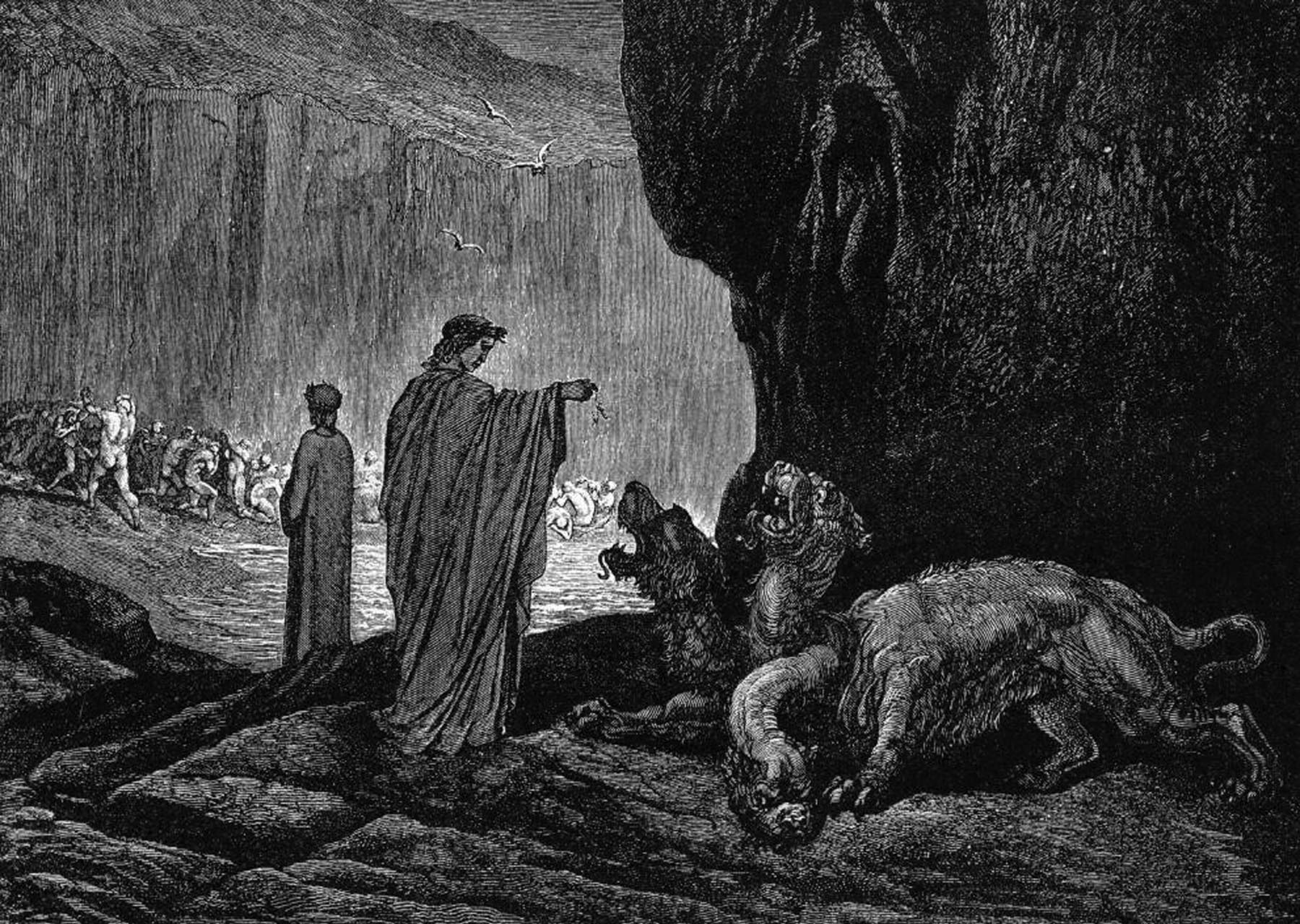
Cerberus, cruel and uncouth monster, there Stretches his three throats out and hound-like bays Over the people embogged about his lair.
His beard is slobbered black, his red eyes blaze, His belly is big, his hands clawed; and with growl The spirits he clutches, rends piecemeal and flays.
[Cerbero, fiera crudele e diversa, con tre gole caninamente latra sovra la gente che quivi è sommersa.
Li occhi ha vermigli, la barba unta e atra, e ’l ventre largo, e unghiate le mani; graffia li spirti ed iscoia ed isquatra.]
Dante Alighieri (1265–1321) Italian poet The Divine Comedy [Divina Commedia], Book 1 “Inferno,” Canto 6, l. 13ff (6.13-18) (1309) [tr. Binyon (1943)]
(Source)
Inspired by Virgil's description of Cerberus in Aeneid, Book 6, l. 417ff, colored by the beast's role over the Gluttonous in this circle of Hell. (
Cerb'rus, a beast implacable and fierce,
Incessant's barking with his triple throat
At the poor wretches who are here confin'd.
His eyes are fiery read, his greasy Beard
Is black and nasty, and his Belly's swoln.
He the Sprites scratches with his hooked claws,
Flays off their skins, and into quarters tears.
[tr. Rogers (1782), l. 12ff]
Hell's bloodhound there his triple form extends. And ever and anon the savage rends Some wand'ring wretch, and dyes his fangs in gore;
His flaming eyes the troubled deep survey. Loud gnash his teeth and hold the damn'd at bay, Whose captive bands in vain his rage deplore.
[tr. Boyd (1802), st. 3]
Cerberus, cruel monster, fierce and strange, Through his wide threefold throat barks as a dog Over the multitude immers’d beneath.
His eyes glare crimson, black his unctuous beard, His belly large, and claw’d the hands, with which He tears the spirits, flays them, and their limbs
Piecemeal disparts.
[tr. Cary (1814)]
Cerberus, a ruthless beast of uncouth mould, Barks hell-hound like, with triple gorge and grim, O'er those whom yonder slough engulphed doth hold.
Red are his eyes, black and of greasy trim His beard, and huge his paunch ; his clawed hands quell The mangled sprites; he flays, and limb from limb
Rends them.
[tr. Dayman (1843)]
Cerberus, a monster fierce and strange, with three throats, barks dog-like over those that are immersed in it. His eyes are red, his beard [greasy] and black, his belly wide, and clawed his hands; he clutches the spirits, flalys, and piecemeal rends them.
[tr. Carlyle (1849)]
Cerberus -- wild beast, cruel, monstrous -- While as three throats the dog of famine urge, To bark o'er those the waters thus submerge:
His eyes vermilion, unctuous beard and black; His belly large, and claws upon each hand -- Cuts, flays, and quarters spirits at command.
[tr. Bannerman (1850)]
The monster Cerberus, cruel, fierce and strange, Barks like a dog from out his triple throat over the multitude sumergèd there.
With eyes vermilion, black and filthy beard, With belly large, with sharp and piercing claws He tears those spirits, flays, dismembers them.
[tr. Johnston (1867)]
Cerberus, monster cruel and uncouth,
With his three gullets like a dog is barking Over the people that are there submerged.
Red eyes he has, and unctuous beard and black, And belly large, and armed with claws his hands; He rends the spirits, flays, and quarters them.
[tr. Longfellow (1867)]
Cerberus, beast cruel and uncouth, with three throats barks in dog-wise over the folk that there is submerged. Scarlet eyes has he, and his beard greasy and black, and his belly large, and his paws armed with nails. He claws the spirits, mouths them and tears them up.
[tr. Butler (1885)]
Wild Cerberus, of twofold nature rare. With three throats hurleth out the doglike bark Upon the people that are cowering there.
His eyes are red, his greasy beard is dark. His belly large and fingers armed with nails; He tears, and flays, and rends the spirits stark.
[tr. Minchin (1885)]
Cerberus, a beast cruel and monstrous, with three throats barks doglike above the people that are here submerged. He has vermilion eyes, and a greasy and black beard, and a big belly, and hands armed with claws: he tears the spirits, flays them, and rends them.
[tr. Norton (1892)]
Cerberus, the pitiless and outlandish beast, barks in dog-like fashion through triple throat above the souls that lie immersed there. Red are the eyes he hath, his beard foul and black, his belly gross, and his paws armed with talons. He claws the shades, he flayeth and he teareth them.
[tr. Sullivan (1893)]
Cerberus, cruel and misshapen monster, Barketh with triple throat in doglike fashion Over the folk which in that place is sunken.
Vermilion eyes he hath, beard black and greasy. And belly wide, and hands arrayed with talons. The spirits he doth scratch, and flay and quarter.
[tr. Griffith (1908)]
Cerberus, a beast fierce and hideous, with three throats barks like a dog over the people that are immersed there; he has red eyes, a beard greasy and black, a great belly, and clawed hands, and he scars and flays and rends the spirits.
[tr. Sinclair (1939)]
Cerberus, the cruel, misshapen monster, there Bays in his triple gullet and doglike growls Over the wallowing shades; his eyeballs glare
A bloodshot crimson, and his bearded jowls Are greasy and black; pot-bellied, talon-heeled, He clutches and flays and rips and rends the souls.
[tr. Sayers (1949)]
Here monstrous Cerberus, the ravening beast, howls through his triple throats like a mad dog over the spirits sunk in that foul paste.
His eyes are red, his beard is greased with phlegm, His belly is swollen, and his hands are claws to rip the wretches and flay and mangle them.
[tr. Ciardi (1954)]
Cerberus, monstrous beast and cruel, with three throats barks doglike over the people who are here submerged. His eyes are red, his beard greasy and black, his belly wide and his hands taloned; he claws the spirits, flays and quarters them.
[tr. Singleton (1970)]
Cerberus, a ruthless and fantastic beast, with all three throats howls out his dog-like sounds above the drowning sinners of this place.
His eyes are red, his beard is slobbered black, his belly swollen, and he has claws for hands; he rips the spirits, flays and mangles them.
[tr. Musa (1971)]
Over the souls of those submerged beneath that mess, is an outlandish, vicious beast, his three throats barking, doglike: Cerberus.
His eyes are blood red; greasy, black, his beard; his belly bulges, and his hands are claws; his talons tear and flay and rend the shades.
[tr. Mandelbaum (1980)]
Cerberus, a cruel and outlandish beast, Barks like a dog, from his three throats, at those Who, under that downpour, are there submerged.
His eyes are red, his beard greasy and black, His belly huge, and his fingers are clawed. He scratches the spirits, skins them, pulls them to bits.
[tr. Sisson (1981)]
Three-headed Cerberus, monstrous and cruel,
Barks doglike at the souls immersed here, louder For his triple throat. His eyes are red, his beard Grease-black, he has the belly of a meat-feeder
And talons on his hands: he claws the horde Of spirits, he flays and quarters them in the rain.
[tr. Pinsky (1994)]
Cerberus, cruel, monstrous beast, with three throats barks doglike over the people submerged there. His eyes are red, his beard greasy and black, his belly large, and his hands have talons; he claws the spirits, flays and quarters them.
[tr. Durling (1996)]
Cerberus, the fierce and strange monster, triple-throated, barks dog-like over the people submerged in it. His eyes are crimson, his beard is foul and black, his belly vast, and his limbs are clawed: he snatches the spirits, flays, and quarters them.
[tr. Kline (2002)]
Here Cerberus conducts his strange assize: with all three throats he barks and slabbers at the muck-bound prisoners he triple-tries.
His eyes are red, his jowls black, his belly fat; he takes each soul and skins it with his claws then rips it into little bits thereat.
[tr. Carson (2002)]
Cerberus, weird and monstrously cruel, barks from his triple throats in cur-like yowls over the heads of those who lie here, drowned.
His eyes vermilion, beard a greasy black, his belly broad, his fingers all sharp-nailed, he mauls and skins, then hacks in four, these souls.
[tr. Kirkpatrick (2006)]
Cerberus, fierce and monstrous beast, barks from three gullets like a dog over the people underneath that muck.
His eyes are red, his beard a greasy black, his belly swollen. With his taloned hands he claws the spirits, flays and quarters them.
[tr. Hollander/Hollander (2007)]
Three-headed Cerberus, monstrous beast, roams here; A cruel creature who barks, dog-like, out Of each of his mouths, at people half-drowned, submerged.
His eyes are red, his beard is black and foul, His belly broad, there are talons on his hands; He claws the spirits, rips at their skin, bites holes.
[tr. Raffel (2010)]
Savage and bestial Cerberus, three-headed freak, Barks like a Doberman -- through each of his three throats -- Over those who are forced to wallow in the slop.
Red eyes, filthy bilious whiskers, swollen belly; With his claws hge excoriates the ghosts -- Then rips their skin off and quarters them.
[tr. Bang (2012)]
The people stuck in it have Cerberus
To guard them. Overhead, that creature shrieks
In anger with three mouths, each hideous
As a mad dog's. Beards greasy black, eyes red,
Big belly, fingers well supplied with nails,
Hed scores and scrapes and tears them to a shred.
[tr. James (2013), l. 14ff]
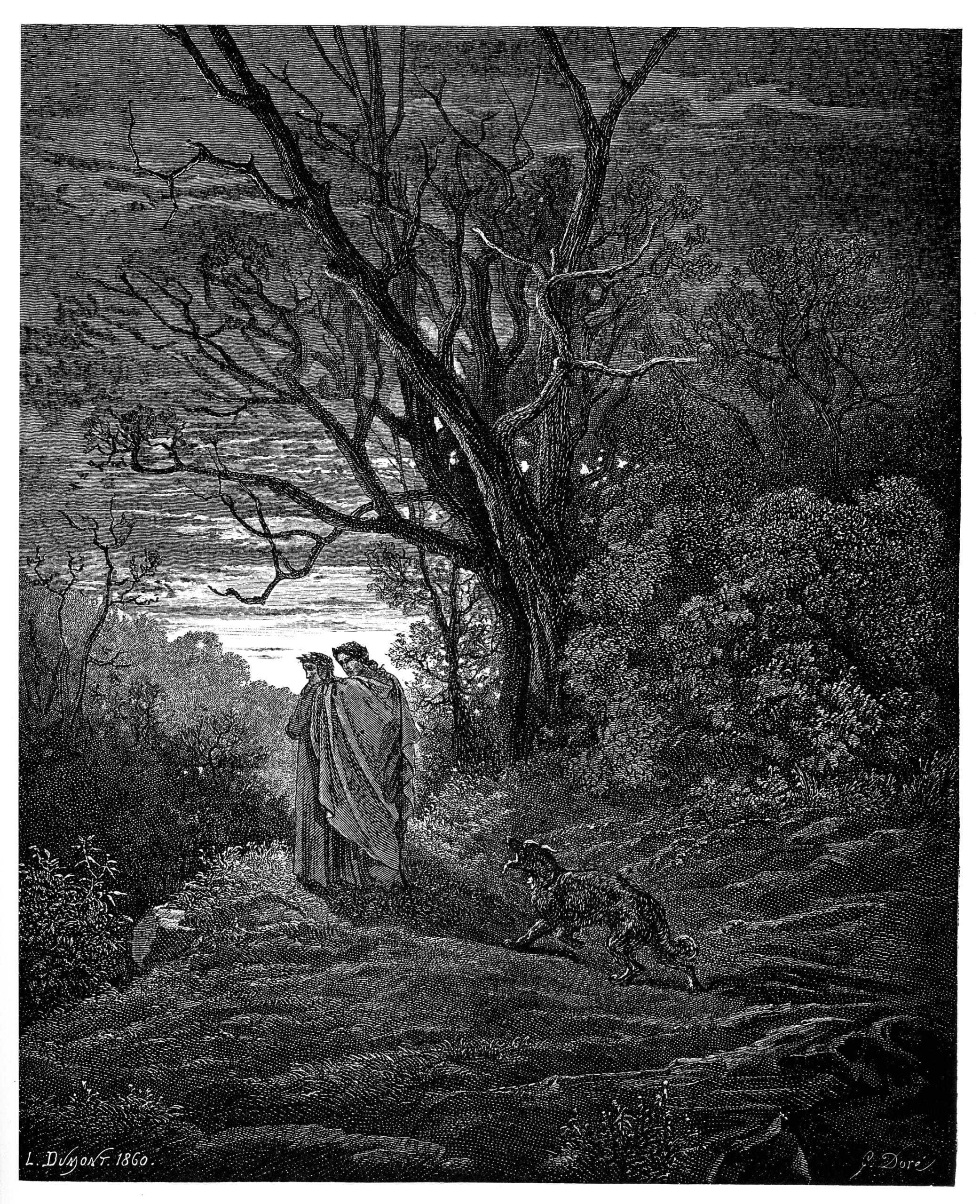
The savage brute that makes thee cry for dread Lets no man pass this road of hers, but still Trammels him, till at last she lays him dead.
Vicious her nature is, and framed for ill; When crammed she craves more fiercely than before; Her raging greed can never gorge its fill.
[Chè questa bestia, per la qual tu gride, Non lascia altrui passar per la sua via, Ma tanto lo impedisce, che l’ uccide:
E ha natura sì malvagia e ria, Che mai non empie la bramosa voglia, E dopo il pasto ha più fame che pria.]
Dante Alighieri (1265–1321) Italian poet The Divine Comedy [Divina Commedia], Book 1 “Inferno,” Canto 1, l. 94ff (1.94-99) [Virgil] (1309) [tr. Sayers (1949)]
(Source)
The she-wolf (lupa) of incontinence/wantonness, though some associate her with wrath, or with avarice. (Source (Italian)). Other translations:
This raging Beast, which here you so much dread Permits not any to pass on their way, And never leaves them 'till their death she gains:
Her nature so perversely is dispos'd That she never satisfies her greedy will; But with each meal her hunger is increas'd.
[tr. Rogers (1782), l. 84ff]
Monster so fell, Numidia never bore, As she, who riots there in human gore, By inextinguishable famine stung.
The Fiend her hunger tries to sate in vain. Still grows her appetite with growing pain. And ceaseless rapine feeds the rising blaze.
[tr. Boyd (1802), st. 17-18]
This beast,
At whom thou criest, her way will suffer none
To pass, and no less hindrance makes than death:
So bad and so accursed in her kind,
That never sated is her ravenous will,
Still after food more craving than before.
[tr. Cary (1814)]
For the fell beast who late, thy steps waylaying, Caused thee to shriek, lets none a passage find Across her walk, but hindereth e'en to slaying.
Baleful she is, and of so curst a kind. Her ravenous maw no glut can satisfy. But eats and leaves a hungrier greed behind.
[tr. Dayman (1843)]
Because this beast, for which thou criest, lets not men pass her way; but so entangles that she slays them; and has a nature so perverse and vicious, that she never satiates her craving appetite; and after feeding, she is hungrier than before.
[tr. Carlyle (1849)]
The beast for which you utter such a cry Suffers none else to pass her way, and will Obstruct so far their passage as to kill:
Of nature so malignant to the core, Insatiate hungers, ever longs for more; And after eating hungrier than before.
[tr. Bannerman (1850)]
For lo! this creature, cause of thy great cry, Lets none pass her, but so bars the way, And with such deadly malice, that she slays.
So evil is her nature and so foul, Her lustful appetite is never quench'd And after eating she still craves the more.
[tr. Johnston (1867)]
Because this beast, at which thou criest out, Suffers not any one to pass her way, But so doth harass him, that she destroys him;
And has a nature so malign and ruthless, That never doth she glut her greedy will, And after food is hungrier than before.
[tr. Longfellow (1867)]
Because this beast, for the which thou criest out, lets not any pass by her way, but hinders him in such wise that she slays him. And she has a nature so evil and guilty that she never fulfils her greedy will, and after her repast has more hunger than before.
[tr. Butler (1885)]
That beast, at which thou criest, by this way Permits not one to pass, for evermore, But bars the passage so, that she will slay.
Of wickedness her nature has such store That her keen craving ne'er is satisfied, But after food she's hungrier than before.
[tr. Minchin (1885)]
For this beast, because of which thou criest out, lets not any one pass along her way, but so hinders him that she kills him! and she has a nature so malign and evil that she never sates her greedy will, and after food is hungrier than before.
[tr. Norton (1892)]
Because this beast, by reason of which thou criest aloud, suffereth none to come her way, but hindereth so rudely, that she slayeth them. So baneful and accursed is her nature, that she can never glut her ravening greed ; and after feeding she is hungrier than before.
[tr. Sullivan (1893)]
For this same beast, for cause whereof thou criest. To pass along her way allows no stranger, But hindereth him so far that she doth slay him.
Nature hath she so wicked and malicious That never doth she sate her ravenous craving, And after food is hungrier than before it.
[tr. Griffith (1908)]
For this beast on account of which thou criest lets no man pass her way, but hinders them till she takes their life, and she has a nature so vicious and malignant that her greedy appetite is never satisfied and after good she is hungrier than before.
[tr. Sinclair (1939)]
Because this beast, at which thou criest still, Suffereth none to go upon her path, But hindereth and entangleth till she kill,
And hath a nature so perverse in wrath, Her craving maw never is satiated But after food the fiercer hunger hath.
[tr. Binyon (1943)]
For that mad beast that leers
before you there, suffers no man to pass. She tracks down all, kills all, and knows no glut, but, feeding, she grows hungrier than she was.
[tr. Ciardi (1954), l. 90ff]
For this beast, the cause of your complaint, lets no man pass her way, but so besets him that she slays him; and she has a nature so vicious and malign that she never sates her greedy appetite and after feeding is hungrier than before.
[tr. Singleton (1970)]
This beast, the one you cry about in fear, allows no soul to succeed along her path, she blocks his way and puts an end to him.
She is by nature so perverse and vicious, her craving belly is never satisfied, still hungering for food the more she eats.
[tr. Musa (1971)]
The beast that is the cause of your outcry allows no man to pass along her track, but blocks him even to the point of death;
her nature is so squalid, so malicious that she can never sate her greedy will; when she has fed, she's hungrier than ever.
[tr. Mandelbaum (1980)]
For that beast, which has made you so call out, Does not allow others to pass her way, But holds them up, and in the end destroys them;
And is by nature so wayward and perverted That she never satisfies her willful desires, But, after a meal, is hungrier than before.
[tr. Sisson (1981)]
This beast,
The cause of your complaint, lets no one pass
Her way -- but harries all to death. Her nature
Is so malign and vicious she cannot appease
Her voracity, for feeding makes her hungrier.
[tr. Pinsky (1994), l. 72ff]
For this beast at which you cry out lets no one pass by her way, but so much impedes him that she kills him; and she has a nature so evil and cruel that her greedy desire is never satisfied, and after feeding she is hungrier than before.
[tr. Durling (1996)]
This creature, that distresses you, allows no man to cross her path, but obstructs him, to destroy him, and she has so vicious and perverse a nature, that she never sates her greedy appetite, and after food is hungrier than before.
[tr. Kline (2002)]
That beast -- you cry out at the very sight -- lets no one through who passes on her way. She blocks their progress; and there they all die.
She is by her nature cruel, so vicious she can never sate her voracious will, but, feasting well, is hungrier than before.
[tr. Kirkpatrick (2006)]
For the beast that moves you to cry out lets no man pass her way, but so besets him that she slays him.
Her nature is so vicious and malign her greedy appetite is never sated -- after she feeds she is hungrier than ever.
[tr. Hollander/Hollander (2007)]
Because this beast you complain of never lets Anyone pass her along this road, harassing And hindering them until she sees them dead,
Her nature being so malign and savage That she is never able to finish her feasting, Hungrier after she eats than before.
[tr. Raffel (2010)]
You're bound to lose:
Bound by the spell of this beast pledged to keep
you crying, you or anyone else who tries
To get by. In a bad mood it can kill,
And it's never in a good mood. See those eyes?
So great a hunger nothing can fulfil.
It eats, it wants more, like the many men
Infected by its bite.
[tr. James (2013)]
The cat that drove you back and made you cry Ends the life to any who try To pass her on their way through.
She's insane and insatiable. She eats more And that just makes her more malignant with craving. She kills all she comes in contact with. All with whom she comes.
[tr. Bang (2013)]
Rumor, quicksilver afoot
and swift on the wing, a monster, horrific, huge
and under every feather on her body — what a marvel —
an eye that never sleeps and as many tongues as eyes
and as many raucous mouths and ears pricked up for news.
By night she flies aloft, between the earth and sky,
whirring across the dark, never closing her lids
in soothing sleep. By day she keeps her watch,
crouched on a peaked roof or palace turret,
terrorizing the great cities, clinging as fast
to her twisted lies as she clings to words of truth.
[… [P]edibus celerem et pernicibus alis,
monstrum horrendum, ingens, cui, quot sunt corpore plumae
tot vigiles oculi subter, mirabile dictu,
tot linguae, totidem ora sonant, tot subrigit aures.
Nocte volat caeli medio terraeque per umbram,
stridens, nec dulci declinat lumina somno;
luce sedet custos aut summi culmine tecti,
turribus aut altis, et magnas territat urbes;
tam ficti pravique tenax, quam nuntia veri.]
Virgil (70–19 BC) Roman poet [b. Publius Vergilius Maro; also Vergil] The Aeneid [Ænē̆is], Book 4, l. 180ff (4.180-188) (29-19 BC) [tr. Fagles (2006), l. 226ff]
(Source)
Swift footed, quick she flyes,
A huge fowle Monster, in each feather lies
A watching eye conceal'd, (and strange) she bears
As many tongues, loud mouths, and list'ning ears.
A watch by day, on battlements she lights,
Or lofty towers, and mighty towns affrights.
Falshoods, and lyes, of as the truth she tells,
And Nations then with various rumours swells.
Things feign'd and reall, glad alike she sung.
[tr. Ogilby (1649)]
Swift is her walk, more swift her winged haste:
A monstrous phantom, horrible and vast.
As many plumes as raise her lofty flight,
So many piercing eyes enlarge her sight;
Millions of opening mouths to Fame belong,
And ev'ry mouth is furnish'd with a tongue,
And round with list'ning ears the flying plague is hung.
She fills the peaceful universe with cries;
No slumbers ever close her wakeful eyes;
By day, from lofty tow'rs her head she shews,
And spreads thro' trembling crowds disastrous news;
With court informers haunts, and royal spies;
Things done relates, not done she feigns, and mingles truth with lies.
Talk is her business, and her chief delight
To tell of prodigies and cause affright.
[tr. Dryden (1697)]
Swift to move with feet and persevering wings: a monster hideous, immense; who (wondrous to relate!) for as many plumes as are in her body, numbers so many wakeful eyes beneath, so many tongues, so many babblingmouths, pricks up so many listening ears. By night, through the mid regions of the sky, and through the shades of earth, she flies buzzing, nor inclines her eyes to balmy rest. Watchful by day, she perches either on some high house-top, or on lofty turrets, and fills mighty cities with dismay; as obstinately bent on falsehood and iniquity as on reporting truth.
[tr. Davidson/Buckley (1854)]
... With feet and rapid wings for flight.
Huge, terrible, gigantic Fame!
For every plume that clothes her frame
An eye beneath the feather peeps,
A tongue rings loud, an ear upleaps.
Hurtling 'twixt earth and heaven she flies
By night, nor bows to sleep her eyes:
Perched on a roof or tower by day
She fills great cities with dismay;
How oft soe'er the truth she tell,
She loves a falsehood all too well.
[tr. Conington (1866)]
With nimble feet, and swift persistent wings,
A monster huge and terrible is she.
As many feathers as her body bears,
So many watchful eyes beneath them lurk,
So many tongues and mouths, and ears erect.
By night 'twixt heaven and earth she flies, through shades,
With rushing wings, nor shuts her eyes in sleep.
By day she watches from the roofs or towers;
And the great cities fills with haunting fears;
As prone to crime and falsehood as to truth ...
[tr. Cranch (1872), l. 236ff]
Fleet-footed and swift of wing, ominous, awful, vast; for every feather on her body is a waking eye beneath, wonderful to tell, and a tongue, and as many loud lips and straining ears. By night she flits between sky and land, shrilling through the dusk, and droops not her lids in sweet slumber; in daylight she sits on guard upon tall towers or the ridge of the house-roof, and makes great cities afraid; obstinate in perverseness and forgery no less than messenger of truth.
[tr. Mackail (1885)]
Swift are her wings to cleave the air, swift-foot she treads the earth:
A monster dread and huge, on whom so many as there lie
The feathers, under each there lurks, O strange! a watchful eye;
And there wag tongues, and babble mouths, and hearkening ears upstand
As many: all a-dusk by night she flies 'twixt sky and land
Loud clattering, never shutting eye in rest of slumber sweet.
By day she keepeth watch high-set on houses of the street,
Or on the towers aloft she sits for mighty cities' fear!
And lies and ill she loves no less than sooth which she must bear.
[tr. Morris (1900)]
Swift-winged, swift-footed, of enormous girth,
Huge, horrible, deformed, a giantess from birth.
As many feathers as her form surround,
Strange sight! peep forth so many watchful eyes,
So many mouths and tattling tongues resound,
So many ears among the plumes uprise.
By night with shrieks 'twixt heaven and earth she flies,
Nor suffers sleep her eyelids to subdue;
By day, the terror of great towns, she spies
From towers and housetops, perched aloft in view,
Fond of the false and foul, yet herald of the true.
[tr. Taylor (1907), st. 23-24, l. 206ff]
Feet swift to run and pinions like the wind
the dreadful monster wears; her carcase huge
is feathered, and at root of every plume
a peering eye abides; and, strange to tell,
an equal number of vociferous tongues,
foul, whispering lips, and ears, that catch at all.
At night she spreads midway 'twixt earth and heaven
her pinions in the darkness, hissing loud,
nor e'er to happy slumber gives her eyes:
but with the morn she takes her watchful throne
high on the housetops or on lofty towers,
to terrify the nations. She can cling
to vile invention and malignant wrong,
or mingle with her word some tidings true.
[tr. Williams (1910)]
Swift of foot and fleet of wing, a monster awful and huge, who for the many feathers in her body has as many watchful eyes below -- wondrous to tell -- as many tongues, as many sounding mouths, as many pricked-up ears. By night, midway between heaven and earth, she flies through the gloom, screeching, nor droops her eyes in sweet sleep; by day she sits on guard on high roof-top or lofty turrets, and affrights great cities, clinging to the false and wrong, yet heralding truth.
[tr. Fairclough (1916)]
Swift of foot,
Deadly of wing, a huge and terrible monster,
With an eye below each feather in her body,
A tongue, a mouth, for every eye, and ears
Double that number; in the night she flies
Above the earth, below the sky, in shadow
Noisy and shrill; her eyes are never closed
In slumber; and by day she perches, watching
From tower or battlement, frightening great cities.
She heralds truth, and clings to lies and falsehood,
[tr. Humphries (1951)]
A swift-footed creature, a winged angel of ruin,
A terrible, grotesque monster, each feather upon whose body --
Incredible though it sounds -- has a sleepless eye beneath it,
And for every eye she has also a tongue, a voice and a pricked ear.
At night she flits midway between earth and sky, through the gloom
Screeching, and never closes her eyelids in sweet slumber:
By day she is perched like a look-out either upon a roof-top
Or some high turret; so she terrorises whole cities,
Loud-speaker of truth, hoarder of mischievous falsehood, equally.
[tr. Day Lewis (1952)]
Fast-footed
and lithe of wing, she is a terrifying
enormous monster with as many feathers
as she has sleepless eyes beneath each feather
(amazingly), as many sounding tongues
and mouths, and raises up as many ears.
Between the earth and skies she flies by night,
screeching across the darkness, and she never
closes her eyes in gentle sleep. By day
She sits as sentinel on some steep roof
or on high towers, frightening vast cities;
for she holds fast to falsehood and distortion
as often as to messages of truth.
[tr. Mandelbaum (1971), l. 237ff]
... [G]iving her speed on foot and on the wing:
Monstrous, deformed, titanic. Pinioned, with
An eye beneath for every body feather,
And, strange to say, as many tongues and buzzing
Mouths as eyes, as many pricked-up ears,
By night she flies between the earth and heaven
Shrieking through darkness, and she never turns
Her eye-lids down to sleep. by day she broods,
On the alert, on rooftops or on towers,
Bringing great cities fear, harping on lies
And slander evenhandedly with truth.
[tr. Fitzgerald (1981), l. 248ff]
Rumour is quick of foot and swift on the wing, a huge and terrible monster, and under every feather of her body, strange to tell, there lies an eye that never sleeps, a mouth and a tongue that are never silent, and an ear always pricked. by night she flies between earth and sky, squawking through the darkness, and never lowers her eyelids in sweet sleep. By day she keeps watch perched on the tops of gables or on high towers and causes fear in great cities, holding fast to her lies and distortions as often as she tells the truth.
[tr. West (1990)]
A monster, vast and terrible, fleet-winged
and swift-footed, sister to Coeus and Enceladus,
who for every feather on her body has as many
watchful eyes below (marvelous to tell), as many
tongues speaking, as many listening ears.
She flies, screeching, by night through the shadows
between earth and sky, never closing her eyelids
in sweet sleep: by day she sits on guard on tall roof-tops
or high towers, and scares great cities, as tenacious
of lies and evil, as she is messenger of truth.
[tr. Kline (2002)]
Fast on her feet, her beating wings a blur,
She is a dread, looming monster. Under every feather
On her body she has -- strange to say -- a watchful eye,
A tongue, a shouting mouth, and pricked-up ears.
By night she wheels through the dark skies, screeching,
And never closes her shining eyes in sleep.
By day she perches on rooftops or towers,
Watching, and she throws whole cities into panic,
As much a hardened liar as a herald of truth.
[tr. Lombardo (2005), l. 205ff]
Her feet are swift and her wings are hateful,
A dread creation whose huge body bristles with feathers.
And beneath them all are watchful eyes, chilling to describe
And as many tongues within whispering mouths and between attentive ears.
At night she flights mid-sky and over the shadowed earth,
Hissing, refusing to rest her eyes in sweet sleep.
At day she stands guard at the highest roof-peak
Or on looming towers as she brings the cities terror.
She sticks at times to base lies and other times to truth.
[tr. @sentantiq (2015)]
She's fast of foot and fleet of wing, a huge horrific monster.
Under all her feathers lurk (amazingly)
as many watching eyes and tongues,
as many talking mouths and pricked-up ears.
She flies by night, between the sky and earth, screeching through the dark.
Her eyes don't close in welcome sleep.
By day she perches as a lookout on high roofs
or towers and alarms great cities.
She's as fond of fiction and perversity as truth.
[tr. Bartsch (2021)]
Cain Mongfish’s masterpiece, A Reasoned Diatribe Regarding thee Methods and Required Madnesses Towards the Manipulation of ye Stuffe of Life and thee Entertaining Consequences Thereof and How Best to Avoid Them is regarded as the seminal work that gathered and codified all of the then-known processes for reanimating, bending, warping, and subjugating life as we know it. Cain died while researching a sequel, which according to his notes was to be entitled How to Promote and Manipulate thee Natural Fealty and Gratitude That Thine Creation Will Express Towards Thou, Their Creator. For some reason, that never works.
—
Phil Foglio (b. 1956) American writer, cartoonist Agatha H and the Voice of the Castle (2014) [with Kaja Foglio]
(Source)
His father wasn’t the monster he could have been with the power he held over his slaves. He wasn’t a monster at all. Just an ordinary man who sometimes did the monstrous things his society said were legal and proper.
Octavia Butler (1947–2006) American writer Kindred, ch. 4, sec. 6 (1979)
(Source)
Molly served as the Folly’s housekeeper, cook, and rodent exterminator. She never speaks, has too many teeth and a taste for raw meat, but I try never to hold that against her or let her get between me and the exit.
Ben Aaronovitch (b. 1964) British author Moon Over Soho (2011)
There was an old telephone in the corner of the room, an antique, two-part telephone, unused in the hospital since the 1920s, made of wood and Bakelite. Mr. Croup picked up the earpiece, which was on a long, cloth-wrapped cord, and spoke into the mouthpiece, which was attached to the base. “Croup and Vandemar,” he said, smoothly, “the Old Firm. Obstacles obliterated, nuisances eradicated, bothersome limbs removed, and tutelary dentistry.”
Neil Gaiman (b. 1960) British author, screenwriter, fabulist Neverwhere, ch. 4 (1996)
(Source)
There’s power in the night. There’s terror in the darkness. Despite all our accumulated history, learning, and experience, we remember. We remember times when we were too small to reach the light switch on the wall, and when the darkness itself was enough to make us cry out in fear. Get a good ways out from civilization — say, miles and miles away on a lightless lake — and the darkness is there, waiting. Twilight means more than just time to call the children in from playing outside. Fading light means more than just the end of another day. Night is when terrible things emerge from their sleep and seek soft flesh and hot blood. Night is when unseen beings with no regard for what our people have built and no place in what we have deemed the natural order look in at our world from outside, and think dark and alien thoughts. And sometimes, just sometimes, they do things.
Jim Butcher (b. 1971) American author Turn Coat, ch. 40 (2009)
(Source)
He who fights with monsters should look to it that he himself does not become a monster. And when you gaze long into an abyss, the abyss gazes also into you.
[Wer mit Ungeheuern kämpft, mag zusehn, dass er nicht dabei zum Ungeheuer wird. Und wenn du lange in einen Abgrund blickst, blickt der Abgrund auch in dich hinein.]
Friedrich Nietzsche (1844–1900) German philosopher and poet Jenseits von Gut und Böse [Beyond Good and Evil], Aphorism 146 (1886) [tr. Hollingdale (1973, 1990)]
(Source)
Other translations:
He who fights with monsters should be careful lest he thereby becomes a monster. And if thou gaze long into an abyss, the abyss will also gaze into thee.
[tr. Zimmern (1906)]
Whoever fights monsters should see to it that in the process he does not become a monster. And when you look long into an abyss, the abyss also looks into you.
[tr. Kaufmann (1966)]
Godzilla’s approach
My mouth agape in horror
I just bought that car
(Other Authors and Sources)
Donald A. Macpherson
Added on 1-Feb-04 | Last updated 13-Apr-14 Link to this post | No comments Topics: monster More quotes by ~Other
As I was finishing, I heard a crashing noise. A horned and tusked purple thing went racing along the ridge to my right pursued by a hairless orange-skinned creature with long claws and a forked tail. Both were wailing in different keys. I nodded. It was just one damned thing after another.
Roger Zelazny (1937–1995) American writer Trumps of Doom, ch. 9 (1985)
(Source)
The thing about monsters is, you want to kill them until you meet them, and when you meet them they don’t seem monstrous, and killing them begins to seem unkind.
Robert B. Parker (1932–2010) American writer Crimson Joy (1988)


Leda was Helen's mother, with Zeus, the father, having seduced/raped her while disguised as a swan. Leda then lay a clutch of eggs (one with Helen, one containing the twins Castor and Pollux, another Clytemnestra). The ravishment of Leda is a common theme in art; showing the resulting eggs is much more rare (da Vinci being an exception).