IAGO: I am one, sir, that comes to tell you your daughter and the Moor are now making the beast with two backs.
William Shakespeare (1564–1616) English dramatist and poet
Othello, Act 1, sc. 1, l. 129ff (1.1.129-131) (1603)
(Source)
Speaking to Desdemona's father, the senator Brabantio. Earliest recorded use of "beast with two backs" in English; though Rabelais used it in Gargantua and Pantagruel (c. 1532), but that is not known to have been translated to English until the late 17th Century. (More info here).
Quotations about:
lovemaking
Note not all quotations have been tagged, so Search may find additional quotes on this topic.

HECUBA: For from darkness and the endearments of the night mortals have their keenest joys.
[ἙΚΆΒΗ: ἐκ τοῦ σκότου τε τῶν τε νυκτερησίων
φίλτρων μεγίστη γίγνεται βροτοῖς χάρις.]Euripides (485?-406? BC) Greek tragic dramatist
Hecuba [Hekabe; Ἑκάβη], l. 831ff (c. 424 BC) [tr. Coleridge (1938)]
(Source)
Reminding a reluctant Agamemnon that he's been sleeping with her daughter, Cassandra, to enlist him in avenging the death of her son, Polydorus.
This passage of the text is elided in some translations. Where present, it is sometimes noted as a speculated or fragmentary insertion.
(Source (Greek)). Alternate translations:In the soul of man
The endearments of the night, by darkness veil'd,
Create the strongest interest.
[tr. Wodhull (1809)]For from the secret shade, and from night's joys, the greatest delight is wont to spring to mortals.
[tr. Edwards (1826)]For of the darkness and the night's love-spells
Cometh on men the chiefest claim for thank.
[tr. Way (Loeb) (1894)]I know how men adore the dark of night.
[tr. McGuinness (2004)]The greatest benefit to humans springs from the night and the delights of love within it.
[tr. Theodoridis (2007)]
I feel more alive when I’m writing than I do at any other time — except when I’m making love. Two things when you forget time, when nothing exists except the moment — the moment of the writing, the moment of love. That perfect concentration is bliss.
May Sarton (1912–1995) Belgian-American poet, novelist, memoirist [pen name of Eleanore Marie Sarton]
Interview (1983)
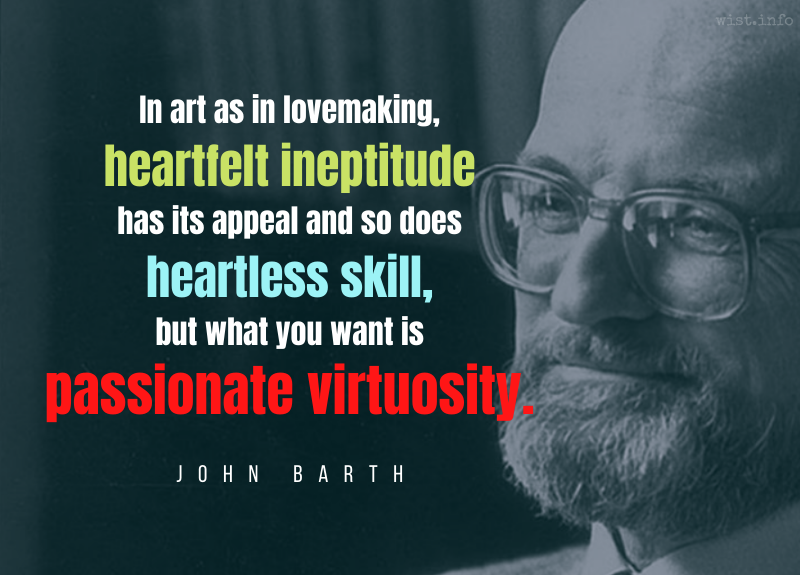
My feeling about technique in art is that it has about the same value as technique in love-making. That is to say, on the one hand, heartfelt ineptitude has its appeal and, on the other hand, so does heartless skill; but what you want is passionate virtuosity.
John Barth (1930–2024) American writer
“An Interview with John Barth,” by Alan Prince and Ian Carruthers, Prism (Spring 1968)
(Source)
The quotation from the interview (originally credited only to Prince) was also included in the inside dust cover of Barth's short story collection, Lost in the Funhouse (1968), and is sometimes cited to that book.
The longer quote was paraphrased to the form in the graphic above on the dust cover of Charles B. Harris, Passionate Virtuosity: The Fiction of John Barth (1983):In art as in lovemaking, heartfelt ineptitude has its appeal and so does heartless skill, but what you want is passionate virtuosity.
Harris later gives the full quotation inside his book.
Also used by Barth in "Dunyazadiad," Esquire (1972-07-01), reprinted in Chimera (1972):Heartfelt ineptitude has its appeal, Dunyazade; so does heartless skill. But what you want is passionate virtuosity.

Night makes no difference ‘twixt the priest and clerk;
Joan as my lady is as good i’ th’ dark.Robert Herrick (1591–1674) English poet
“No Difference i’ th’ Dark,” Hesperides, # 864 (1648)
(Source)