

Our readiness to think ill of people without sufficiently examining the matter is based on laziness and pride. We want to find people guilty, we don’t want the bother of studying their crimes.
[La promptitude à croire le mal, sans l’avoir assez examiné, est un effet de l’orgueil et de la paresse: on veut trouver des coupables, et on ne veut pas se donner la peine d’examiner les crimes.]
François VI, duc de La Rochefoucauld (1613–1680) French epigrammatist, memoirist, noble
Réflexions ou sentences et maximes morales [Reflections; or Sentences and Moral Maxims], ¶267 (1665-1678) [tr. Kronenberger (1959)]
(Source)
Present in the 1st Edition. Variant: "... un effet de la paresse et de l'orguieil."
Another 1665 variant:La promptitude avec laquelle nous croyons le mal, sans l’avoir assez examiné, est un effet de la paresse et de l’orgueil.
[The readiness with which we believe evil, without having examined it sufficiently, is an effect of laziness and pride.]
Manuscript variant: "... est souvent un effet de paresse, qui se joint à l’orgueil [... is often an effect of laziness, combined with pride]."
(Source (French)). Other translations:A readiness to believe Ill, before we have duly Examined it, is the Effect of Laziness and Pride. Men are pleased to find Others to Blame and loth to give Themselves the Trouble of Enquiring, how far, and whether they are so, or not.
[tr. Stanhope (1694), ¶268]A readiness to believe ill without examination is the effect of pride and laziness. We are willing to find people guilty, and unwilling to be at the trouble of examining into the accusation.
[pub. Donaldson (1783), ¶245; ed. Lepoittevin-Lacroix (1797), ¶250]A willingness to believe ill, without examination, is the effect of pride and idleness. We are ready to suppose guilt, but unwilling to be at the trouble of examining into the accusation.
[ed. Carvill (1835), ¶214]Readiness; to believe evil without sufficient examination is the result of pride and indolence. We wish to find people guilty, and we do not wish to give ourselves the trouble of examining into the crimes.
[ed. Gowens (1851), ¶278]A quickness in believing evil without having sufficiently examined it, is the effect of pride and laziness. We wish to find the guilty, and we do not wish to trouble ourselves in examining the crime.
[tr. Bund/Friswell (1871), ¶267]A ready belief of evil without examining the facts is a form of pride, or of indolence. We are anxious to ferret out criminals without taking the pains of examining their crimes.
[tr. Heard (1917), ¶275]Readiness to believe evil without adequate inquiry is the result of pride and indolence. We like detecting criminals, but we dislike the labor of investigating crimes.
[tr. Stevens (1939), ¶267]The promptitude with which we will believe evil of others, without an adequate examination of the facts, is an effect of pride working with laziness. We wish to find the guilty men, and cannot be be bothered to study the crime.
[tr. FitzGibbon (1957), ¶267]Readiness to believe the worst without adequate examination comes from pride and laziness; we want to find culprits but cannot be bothered to investigate the crimes.
[tr. Tancock (1959), ¶267]A readiness to believe evil without sufficient examination, it is an effect both of pride and of idleness. On the one hand, we desire to find other people guilty; and on the other, we do not wish to take the pains necessary to examine their crimes.
[tr. Whichello (2016) ¶267]
Quotations about:
examination
Note not all quotations have been tagged, so Search may find additional quotes on this topic.
CALVIN: Today at school, I tried to decide whether to cheat on my test or not. I wondered, is it better to do the right thing and fail … or is it better to do the wrong thing and succeed?
On the one hand, underserved success gives no satisfaction … but on the other hand, well-deserved failure gives no satisfaction either.
Of course, most everybody cheats some time or other. People always bend the rules if they think they can get away with it. … then again, that doesn’t justify my cheating.
Then I thought, look, cheating on one little test isn’t such a big deal. It doesn’t hurt anyone … but then I wondered if I was just rationalizing my unwillingness to accept the consequence of my not studying.
Still, in the real world, people care about success, not principles … then again, maybe that’s why the world is in such a mess. What a dilemma!HOBBES: So what did you decide?
CALVIN: Nothing. I ran out of time and had to turn in a blank paper.
HOBBES: Anymore, simply acknowledging the issue is a moral victory.
CALVIN: Well, it just seemed wrong to cheat on an ethics test.

I have learned yet again (this has been going on all my life) what folly it is to take anything for granted without examining it skeptically.
Joseph Jacobs (1854–1916) Australian folklorist, literary critic, historian writer
Dark Age Ahead, “Notes and Comments” (2004)
(Source)
If you do not expect the unexpected, you will not find it; for it is hard to be sought out and difficult.
[ἐὰν μὴ ἔλπηται ἀνέλπιστον οὐκ ἐξευρήσει, ἀνεξερεύνητον ἐὸν καὶ ἄπορον]Heraclitus of Ephesus (c.540-c.480 BC) Greek philosopher [Ἡράκλειτος, Herákleitos, Heracleitus]
Fragment 18 [tr. Burnet (1920), DK B18]
(Source)
(Source (Greek)). Other translations:He who does not expect will not find out the unexpected, for it is trackless and unexplored.
[tr. Kahn (1981), VI (D. 18)]He who does not expect the unexpected will not find it out.
[tr. Kahn (1981), VI (D. 18), variant]He who does not expect the unexpected will not find it, since it is trackless and unexplored.
[tr. Allan (2008)]Unless you expect the unexpected, you will not find it, for it is hidden and thickly tangled.
[tr. Jenks (2014)]
Racism in America is like dust in the air. It seems invisible — even if you’re choking on it — until you let the sun in. Then you see it’s everywhere.
Kareem Abdul-Jabbar (b. 1947) American athlete [b. Lew Alcindor]
“Don’t understand the protests? What you’re seeing is people pushed to the edge,” op-ed, Los Angeles Times (30 May 2020)
(Source)
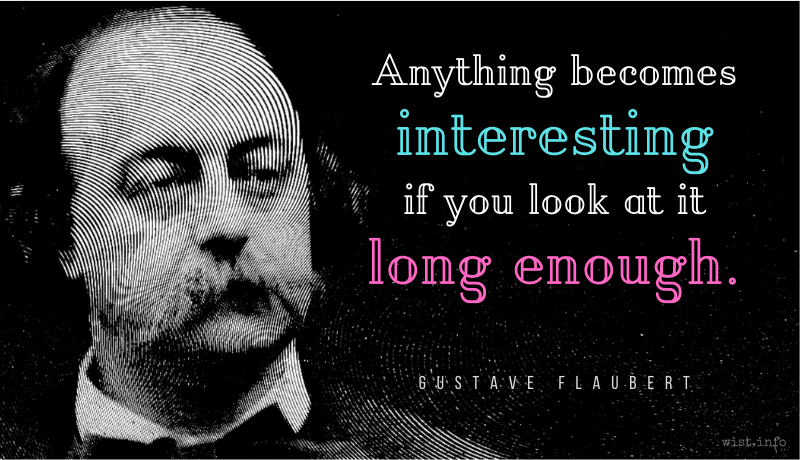
Anything becomes interesting if you look at it long enough.
[Pour qu’une chose soit intéressante, il suffit de la regarder longtemps.]
Gustave Flaubert (1821–1880) French writer, novelist
Letter to Alfred Le Poittevin (16 Sep 1845)
(Source)
Other translations: "To make something interesting, just look at it for a long time."
Anger blows out the lamp of the mind. In the examination of a great and important question, every one should be serene, slow-pulsed and calm.
Robert Green Ingersoll (1833–1899) American lawyer, freethinker, orator
Essay (1881-11) “The Christian Religion,” “Part 2” North American Review, Vol. 133, No. 300
(Source)
Now I understand one of the important reasons for going to college and getting an education is to learn that the things you’ve believed in all your life aren’t true, and that nothing is what it appears to be.
Daniel F. Keyes (1927–2014) American author
Flowers for Algernon (novel) (1966)
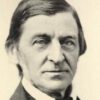
Value of the Skeptic is the resistance to premature conclusions.
Ralph Waldo Emerson (1803–1882) American essayist, lecturer, poet
Journal (1845)
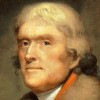
Read the bible then, as you would read Livy or Tacitus. The facts which are within the ordinary course of nature you will believe on the authority of the writer, as you do those of the same kind in Livy and Tacitus. The testimony of the writer weighs in their favor in one scale, and their not being against the laws of nature does not weigh against them. But those facts in the bible which contradict the laws of nature, must be examined with more care, and under a variety of faces. Here you must recur to the pretensions of the writer to inspiration from god. Examine upon what evidence his pretensions are founded, and whether that evidence is so strong as that it’s falshood would be more improbable than a change of the laws of nature in the case he relates For example in the book of Joshua we are told the sun stood still several hours. Were we to read that fact in Livy or Tacitus we should class it with their showers of blood, speaking of statues, beasts &c., but it is said that the writer of that book was inspired. Examine therefore candidly what evidence there is of his having been inspired. The pretension is entitled to your enquiry, because millions believe it. On the other hand you are Astronomer enough to know how contrary it is to the law of nature that a body revolving on it’s axis, as the earth does, should have stopped, should not by that sudden stoppage have prostrated animals, trees, buildings, and should after a certain time have resumed it’s revolution, and that without a second general prostration. Is this arrest of the earth’s motion, or the evidence which affirms it, most within the law of probabilities?
Thomas Jefferson (1743–1826) American political philosopher, polymath, statesman, US President (1801–09)
Letter (1787-08-10) to Peter Carr
(Source)
Religions are kept alive by heresies, which are really sudden explosions of faith. Dead religions do not produce them.
Gerald Brenan (1894–1987) British writer and Hispanist [Edward FitzGerald Brenan]
Thoughts in a Dry Season (1978)
It seems to me what is called for is an exquisite balance between two conflicting needs: the most skeptical scrutiny of all hypotheses that are served up to us and at the same time a great openness to new ideas. Obviously those two modes of thought are in some tension. But if you are able to exercise only one of these modes, whichever one it is, you’re in deep trouble.
If you are only skeptical, then no new ideas make it through to you. You never learn anything new. You become a crotchety old person convinced that nonsense is ruling the world. (There is, of course, much data to support you.) But every now and then, maybe once in a hundred cases, a new idea turns out to be on the mark, valid and wonderful. If you are too much in the habit of being skeptical about everything, you are going to miss or resent it, and either way you will be standing in the way of understanding and progress.
On the other hand, if you are open to the point of gullibility and have not an ounce of skeptical sense in you, then you cannot distinguish useful ideas from the worthless ones. If all ideas have equal validity then you are lost, because then, it seems to me, no ideas have any validity at all.
Carl Sagan (1934–1996) American scientist and writer
“The Burden of Skepticism,” Pasadena lecture (1987)
(Source)
Reprinted in The Skeptical Inquirer (Fall 1987).
I made a comparison at table some time since, which has often been quoted, and received many compliments. It was that of the mind of a bigot to the pupil of the eye; the more light you pour on it, the more it contracts.
Oliver Wendell Holmes, Sr. (1809–1894) American poet, essayist, scholar
Article (1858-04), “The Autocrat of the Breakfast-Table,” Atlantic Monthly
(Source)
Often trimmed/paraphrased to "The mind of a bigot is like the pupil of the eye; the more light you pour upon it, the more it will contract." Frequently misattributed to his son, Oliver Wendell Holmes, Jr.
The Autocrat himself correctly comments that a similar phrase appears in Thomas Moore, Preface to the poems "Corruption" and "Intolerance":The minds of some of our statesmen, like the pupil of the human eye, contract themselves the more the stronger light there is shed upon them.
The Autocrat goes on to note, "When a person of fair character for literary honesty uses an image such as another has employed before him, the presumption is, that he has struck upon it independently, or unconsciously recalled it, supposing it his own."
Collected in The Autocrat of the Breakfast Table, ch. 6 (1858)
Examinations are formidable even to the best prepared, for the greatest fool may ask more than the wisest man can answer.
Charles Caleb "C. C." Colton (1780–1832) English cleric, writer, aphorist
Lacon: Or, Many Things in Few Words, Vol. 1, § 322 (1820)
(Source)
Doubt is the vestibule through which all must pass before they can enter into the temple of wisdom.
Charles Caleb "C. C." Colton (1780–1832) English cleric, writer, aphorist
Lacon: Or, Many Things in Few Words, Vol. 1, § 251 (1820)
(Source)