Sometimes people grieve when they find old age coming upon them, when they find their vehicles not so strong as they used to be. They desire the strength and the faculties that they once had. It is wise for them to repress that desire, to realize that their bodies have done good work, and if they can no longer do the same amount as of yore, they should do gently and peacefully what they can, but not worry themselves over the change. Presently they will have new bodies; and the way to ensure a good vehicle is to make such use as one can of the old one, but in any case to be serene and calm and unruffled. The only way to do that is to forget self, to let all selfish desires cease, and to turn the thought outward to the helping of others as far as one’s capabilities go.
C. W. Leadbeater (1846–1934) English clergyman, theosophist, author [Charles Webster Leadbeater]
The Masters and the Path, ch. 14 (1925)
(Source)
Quotations about:
serenity
Note not all quotations have been tagged, so Search may find additional quotes on this topic.
Wherein, then, is your grievance? You are not ejected from the city [life] by any unjust judge or tyrant, but by the selfsame Nature which brought you into it; just as when an actor is dismissed by the manager who engaged him.
“But I have played no more than three of the five acts.” Just so; in your drama of life, three acts are all the play. Its point of completeness is determined by him who formerly sanctioned your creation, and today sanctions your dissolution. Neither of those decisions lay within yourself.
Pass on your way, then, with a smiling face, under the smile of him who bids you go.[τί οὖν δεινόν, εἰ τῆς πόλεως ἀποπέμπει σε οὐ τύραννος οὐδὲ δικαστὴς ἄδικος, ἀλλ̓ ἡ φύσις ἡ εἰσαγαγοῦσα, οἷον εἰ κωμῳδὸν ἀπολύοι τῆς σκηνῆς ὁ παραλαβὼν στρατηγός;—ἀλλ̓ οὐκ εἶπον τὰ πέντε μέρη, ἀλλὰ τὰ τρία.—καλῶς εἶπας: ἐν μέντοι τῷ βίῳ τὰ τρία ὅλον τὸ δρᾶμά ἐστι. τὸ γὰρ τέλειον ἐκεῖνος ὁρίζει ὁ τότε μὲν τῆς συγκρίσεως. νῦν δὲ τῆς διαλύσεως αἴτιος: σὺ δὲ ἀναίτιος ἀμφοτέρων. ἄπιθι οὖν ἵλεως: καὶ γὰρ ὁ ἀπολύων ἵλεως.]
Marcus Aurelius (AD 121–180) Roman emperor (161–180), Stoic philosopher
Meditations [To Himself; Τὰ εἰς ἑαυτόν], Book 12, ch. 36 (12.36) (AD 161-180) [tr. Staniforth (1964)]
(Source)
Concluding words of the Meditations. See Cicero (44 BC).
(Source (Greek)). Other translations:Why then should it be grievous unto thee, if (not a tyrant, nor an unjust judge, but) the same nature that brought thee in, doth now send thee out of the world? As if the praetor should fairly dismiss him from the stage, whom he had taken in to act a while.
Oh, but the play is not yet at an end, there are but three acts yet acted of it? Thou hast well said: for in matter of life, three acts is the whole play. Now to set a certain time to every man's acting, belongs unto him only, who as first he was of thy composition, so is now the cause of thy dissolution. As for thyself; thou hast to do with neither.
Go thy ways then well pleased and contented: for so is He that dismisseth thee.
[tr. Casaubon (1634), 12.27]You can't say you are sent off by a Tyrannical, and Unrighteous Sentence; No, you quit the Stage as fairly as a Player does that has his Discharge from the Master of the Revels:
But I have only gone through three Acts, and not held out to the End of the Fifth. You say well; but in Life three Acts make the Play entire. He that appoints the Entertainment is the best Judge of the length on't; and as he ordered the opening of the first Scene, so now he gives the sign for shutting up the last: You are neither accountable for one or to'ther;
Therefore retire in good Humour, for He by whom you are dismiss'd means you no harm.
[tr. Collier (1701)]What is there terrible in this, that you are sent out, not by a tyrant, or an unjust judge, but by that nature, which at first introduced you? As if the praetor who employed the player, should dismiss him again from the scene.
But, say you, I have not finished the five acts, but only three. You say true; but, in life, three acts make a complete play. For, ’tis he who appoints the end to it, who, as he was the cause of the composition, is now the cause of the dissolution. Neither of them are chargeable on you:
Depart, therefore, contented, and in good humour; for, he is propitious and kind, who dismisses you.
[tr. Hutcheson/Moor (1742)]Is it any hardship that you are sent out of the world, not by a tyrant, or an unjust judge, but by that Being which first introduced you? As the magistrate who engages an actor for the stage, dismisses him again at his pleasure.
"But I have performed only three acts of the play, and not the whole five."
Very true; but in life, even three acts may complete the whole drama. He determines the duration of the piece, who first cause it to be composed, and now orders its conclusion. You are not accountable for either.
Depart, therefore, with a good grace; for he who dismisses you is a gracious and benevolent Being.
[tr. Graves (1792)]Where is the hardship then, if no tyrant nor yet an unjust judge sends thee away from the state, but nature, who brought thee into it? the same as if a praetor who has employed an actor dismisses him from the stage.
-- "But I have not finished the five acts, but only three of them." -- Thou sayest well, but in life the three acts are the whole drama; for what shall be a complete drama is determined by him who was once the cause of its composition, and now of its dissolution: but thou art the cause of neither.
Depart then satisfied, for he also who releases thee is satisfied.
[tr. Long (1862)]Where is the hardship then if nature, that planted you here, orders your removal? You cannot say you are sent off by a tyrant or unjust judge. No; you quit the stage as fairly as a player does that has his discharge from the master of the revels.
But I have only gone through three acts, and not held out to the end of the fifth. You say well; but in life three acts make the play entire. He that ordered the opening of the first scene now gives the sign for shutting up the last; you are neither accountable for one nor the other;
Therefore retire well satisfied, for He, by whom you are dismissed, is satisfied too.
[tr. Collier/Zimmern (1887)]Why then protest? No tyrant gives you your dismissal, no unjust judge, but nature who gave you the admission. It is like the praetor discharging some player whom he has engaged.
-- "But the five acts are not complete; I have played but three." -- Good: life's drama, look you, is complete in three. The completeness is in his hands, who first authorized your composition, and now your dissolution; neither was your work.
Serenely take your leave; serene as he who gives you discharge.
[tr. Rendall (1898)]Where then is the calamity, if you are sent out of the city, by no tyrant or unjust judge, but Nature herself who at first introduced you, just as the praetor who engaged the actor again dismisses him from the stage?
“But,” say you, “I have not spoken my five acts, but only three.” True, but in life three acts make up the play. For he sets the end who was responsible for its composition at the first, and for its present dissolution. You are responsible for neither.
Depart then graciously; for he who dismisses you is gracious.
[tr. Hutcheson/Chrystal (1902)]What hardship then is there in being banished from the city, not by a tyrant or an unjust judge but by Nature who settled thee in it? So might a praetor who commissions a comic actor, dismiss him from the stage.
But I have not played my five acts, but only three. Very possibly, but in life three acts count as a full play. For he, that is responsible for thy composition originally and thy dissolution now, decides when it is complete. But thou art responsible for neither.
Depart then with a good grace, for he that dismisses thee is gracious.
[tr. Haines (Loeb) (1916)]Why is it hard, then, if Nature who brought you in, and no despot nor unjust judge, sends you out of the City -- as though the master of the show, who engaged an actor, were to dismiss him from the stage?
"But I have not spoken my five acts, only three." "What you say is true, but in life three acts are the whole play." For He determines the perfect whole, the cause yesterday of your composition, to-day of your dissolution; you are the cause of neither.
Leave the stage, therefore, and be reconciled, for He also who lets his servant depart is reconciled.
[tr. Farquharson (1944)]Where is the hardship, then, if it is no tyrant or unjust judge who sends you out of the city, but nature who brought you into it? It is just as if the director of a show, after first engaging an actor, were dismissing him from the stage.
"But I haven't played all five acts, only three!" Very well; but in life three can make up a full play. For the one who determines when it is complete is he who once arranged for your composition and now arranges for your dissolution, while you for your part are responsible for neither.
So make your departure with good grace, as he who is releasing you shows a good grace.
[tr. Hard (1997 ed.; 2011 ed.)]And to be sent away from it, not by a tyrant or a dishonest judge, but by Nature, who first invited you in -- why is that so terrible?
Like the impresario ringing down the curtain on an actor:
“But I’ve only gotten through three acts ...!”
Yes. This will be a drama in three acts, the length fixed by the power that directed your creation, and now directs your dissolution. Neither was yours to determine.
So make your exit with grace -- the same grace shown to you.
[tr. Hays (2003)]So what is there to fear in your dismissal from the city? This is no tyrant or corrupt judge who dismisses you, but the very same nature that brought you in. It is like the officer who engaged a comic actor dismissing him from the stage.
"But I have not played my five acts, only three." "True, but in life three acts can be the whole play." Completion is determined by that being who caused first your composition and now your dissolution. You have no part in either causation.
Go then in peace: the god who lets you go is at peace with you.
[tr. Hammond (2006)]

Having many cats is good. If you feel bad, you look at the cats and you feel better, because they know that everything is just the way it is. You don’t have to be nervous about anything. And they know it. They are saviors. The more cats you have, the longer you will live. If you have a hundred cats, you will live ten times longer than if you have ten. One day, this will be known and people will have thousands of cats. It’s truly ridiculous.
Charles Bukowski (1920–1994) German-American author, poet
Interview (1987-09) by Sean Penn, “Tough Guys Write Poetry,” Interview Magazine, Vol. 17, No. 19
(Source)
Collected in Bukowski, Sunlight Here I Am (2003) [ed. David Calonne].

Upon the whole, a contented mind is the greatest blessing a man can enjoy in this world.
Joseph Addison (1672–1719) English essayist, poet, statesman
Essay (1714-07-30), The Spectator, No. 574
(Source)

JANE: Some people think that external beauty comes from inner tranquility. Of course, some people think it comes from drinking the blood of virgins, so there’s quite a range there.
Steven Moffat (b. 1961) Scottish television writer, producer
Coupling, 03×01 “Split” (2002-09-23)
(Source)

A good conscience is to the Soul what health is to the body; it preserves a constant ease and serenity within us, and more than countervails all the calamities and afflictions which can possibly befall us.
Joseph Addison (1672–1719) English essayist, poet, statesman
Essay (1713-08-15), The Guardian, No. 135
(Source)
A good conscience is to the Soul what health is to the body; it preserves constant ease and serenity within us; and more than countervails all the calamities and afflictions which can befall us from without.
Joseph Addison (1672–1719) English essayist, poet, statesman
Essay (1713-08-15), The Guardian, No. 135
(Source)
“Ah, I expect you’ll be wanting to pay for that paper, then, won’t you, Mr. Dirk, sir?” said the newsagent, trotting gently after him.
“Ah, Bates,” said Dirk loftily, “you and your expectations. Always expecting this and expecting that. May I recommend serenity to you? A life that is burdened with expectations is a heavy life. Its fruit is sorrow and disappointment. Learn to be one with the joy of the moment.”Douglas Adams (1952–2001) English author, humorist, screenwriter
Dirk Gently No. 2, The Long Dark Tea-Time of the Soul, ch. 4 (1988)
(Source)

Bless us Lord, this Christmas, with quietness of mind;
Teach us to be patient and always to be kind.Helen Steiner Rice (1900–1981) American poet, businesswoman
(Attributed)

We therefore say once more that a strong mind is not one that is merely capable of strong emotions, but one that under stress of the strongest emotions keeps its balance, so that in spite for the storms within the breast, judgment and conviction can act with perfect freedom, like the needle of the compass on a storm-tossed ship.
[Wir sagen es also noch einmal: Ein starkes Gemüth ist nicht ein solches, welches bloss starker Regungen fähig ist, sondern dasjenige, welches bei den stärksten Regungen im Gleichgewicht bleibt, so dass trotz den Stürmen in der Brust der Einsicht und Ueberzeugung wie der Nadel des Kompasses auf dem sturmbewegten Schiff das feinste Spiel gestattet ist.]
Karl von Clausewitz (1780–1831) Prussian soldier, historian, military theorist
On War [Vom Kriege], Book 1, ch. 3 “On Military Genius [Der Kriegerische Genius],” (1.3) (1832) [tr. Jolles (1943)]
(Source)
(Source (German)). Other translations:We, therefore, say once more a strong mind is not one that is merely susceptible of strong excitement, but one which can maintain its serenity under the most powerful excitement; so that, in spite of the storm in the breast, the perception and judgment can act with perfect freedom, like the needle of the compass in the storm-tossed ship.
[tr. Graham (1873)]We repeat: strength of character does not consist solely in having powerful feelings, but in maintaining one’s balance in spite of them. Even with the violence of emotion, judgment and principle must still function like a ship’s compass, which records the slightest variations however rough the sea.
[tr. Howard & Paret (1976)]

Age puzzles me. I thought it was a quiet time. My seventies were interesting and fairly serene, but my eighties are passionate. I grow more intense as I age.
Florida Scott-Maxwell (1883–1979) American-British playwright, author, psychologist
The Measure of My Days (1968)
(Source)
I feel my heart glow with an enthusiasm which elevates me to heaven, for nothing contributes so much to tranquillize the mind as a steady purpose — a point on which the soul may fix its intellectual eye.

Anger blows out the lamp of the mind. In the examination of a great and important question, every one should be serene, slow-pulsed and calm.
Robert Green Ingersoll (1833–1899) American lawyer, freethinker, orator
Essay (1881-11) “The Christian Religion,” “Part 2” North American Review, Vol. 133, No. 300
(Source)
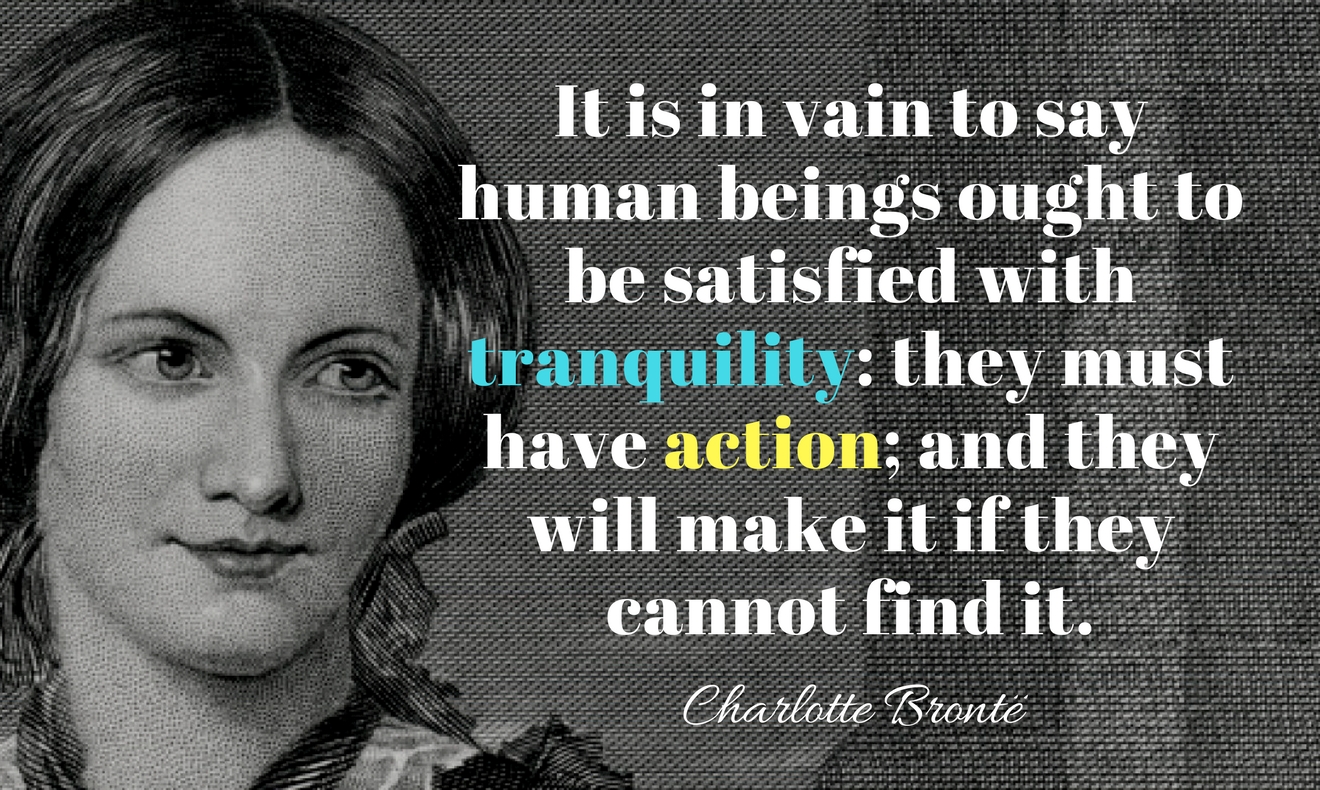
It is in vain to say human beings ought to be satisfied with tranquility: they must have action; and they will make it if they cannot find it.
Charlotte Brontë (1816–1855) British novelist [pseud. Currer Bell]
Jane Eyre, ch. 12 [Jane] (1847)
(Source)

There is no such thing as inner peace. There is only nervousness or death.
I have always preferred cheerfulness to mirth. The latter I consider as an act, the former as an habit of mind. Mirth is short and transient, cheerfulness fixed and permanent. Those are often raised into the greatest transports of mirth who are subject to the greatest depressions of melancholy. On the contrary, cheerfulness, though it does not give the mind such an exquisite gladness, prevents us from falling into any depths of sorrow. Mirth is like a flash of lightning, that breaks through a gloom of clouds, and glitters for a moment; cheerfulness keeps up a kind of daylight in the mind, and fills it with a steady and perpetual serenity.
Joseph Addison (1672–1719) English essayist, poet, statesman
Essay (1712-05-17), The Spectator, No. 381
(Source)
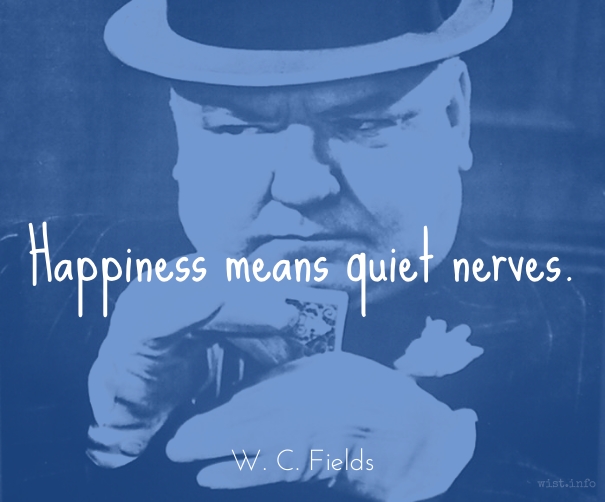
Happiness means quiet nerves.
W. C. Fields (1880–1946) American entertainer [b. William Claude Dukenfield]
(Attributed)
Quoted in Robert Lewis Taylor, W.C. Fields, His Follies and Fortunes (1949).
Always behave as if nothing had happened, no matter what has happened.
Arnold Bennett (1867–1931) English writer, novelist, journalist
Denry the Audacious, ch. 10 “His Infamy” (1911)

Ah, Bates, you and your expectations. Always expecting this and expecting that. May I recommend serenity to you? A life that is burdened with expectations is a heavy life. Its fruit is sorrow and disappointment. Learn to be one with the joy of the moment.
Douglas Adams (1952–2001) English author, humorist, screenwriter
Dirk Gently No. 2, The Long Dark Tea-Time of the Soul, ch. 4 [Dirk] (1988)
(Source)
Q. I find that people’s ideas of religion vary so greatly that I think you ought to define what is religion.
A. I do not know that there is any real reason why I should define what religion is. That has been done by many people far better qualified to do so. I can only give my own personal definition, which has no foundation in theology. Religion to me is simply the conviction that all human beings must hold some belief in a Power greater than themselves, and that whatever their religious belief may be, it must move them to live better in this world and to approach whatever the future holds with serenity.
Eleanor Roosevelt (1884–1962) American politician, diplomat, activist; First Lady of the US (1933–45)
Column (1941-10), “If You Ask Me,” Ladies’ Home Journal, Vol. 58
(Source)

It is one of the most difficult yet necessary things in life to learn to disdain. Disdain protects and crushes. It is a breastplate and a club. You have enemies? Why, it is the story of every man who has done a great deed or created a new idea. It is the cloud which thunders around everything, which shines. Fame must have enemies, as light must have gnats. Do not bother yourself about it; disdain. Keep your mind serene as you keep your life clear. Do not give your enemies the satisfaction of thinking that they cause you grief or pain. Be happy, be cheerful, be disdainful, be firm.
[C’est une des choses les plus difficiles et les plus nécessaires de la vie que d’apprendre à dédaigner. Le dédain protège et écrase. C’est une cuirasse et une massue. Vous avez des ennemis? Mais c’est l’histoire de tout homme qui a fait une action grande ou créé une idée neuve. C’est la nuée qui bruit autour de tout ce qui brille. Il faut que la renommée ait des ennemis comme il faut que la lumière ait des moucherons. Ne vous en inquiétez pas; dédaignez! Ayez la sérénité dans votre esprit comme vous avez la limpidité dans votre vie. Ne donnez pas à vos ennemis cette joie de penser qu’ils vous affligent et qu’ils vous troublent. Soyez content, soyez joyeux, soyez dédaigneux, soyez fort.]
Victor Hugo (1802–1885) French writer, journalist, human rights activist, politician
Diary (1845-12-07), “Villemain,” Things Seen [Choses Vues], Vol. 1 (1887)
(Source)
Dictated 1845-12-03 by Hugo to Juliette Drouet.
Sometimes attributed (in a shortened form) to Winston Churchill.
(Source (French)). Another translation:One of the hardest and most important things in life is learning to treat things with disdain. Disdain can protect, it can crush; it’s a breastplate and a club. You’ve got enemies? Why, that’s the story of every man who has done a great deed or come up with a new idea. It’s the thundercloud around everything that shines. Fame will attract enemies just as light will attract insects. Don’t fret about it. Treat it with disdain. Keep your mind calm, just as you keep your life clean. Don’t give your enemies the satisfaction of thinking that they’re hurting you and upsetting you. Be happy and cheerful and disdainful and strong.
[tr. Blackmore (2004)]

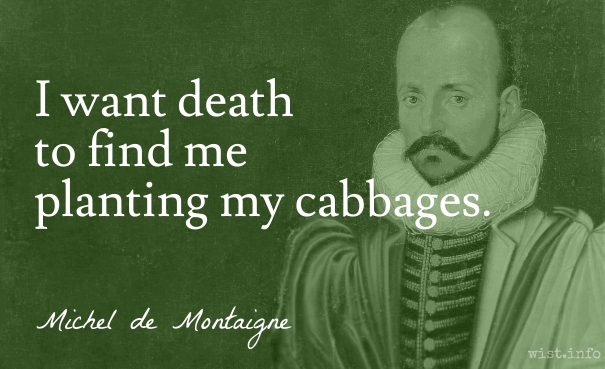
I want a man to act, and to prolong the functions of life as long as he can; and I want death to find me planting my cabbages, but careless of death, and still more of my unfinished garden.
[Je veux qu’on agisse, et qu’on allonge les offices de la vie, tant qu’on peut: et que la mort me trouve plantant mes choux ; mais nonchallant d’elle, et encore plus de mon jardin imparfait.]
Michel de Montaigne (1533–1592) French essayist
Essays, Book 1, ch. 19 (1.19), “That to Philosophize Is to Learn to Die [Que Philosopher, c’est apprendre à mourir]” (1572-03) [tr. Frame (1943)]
(Source)
Published in the 1580 ed.; the second clause (on prolonging the normal activities of life as long as possible) was added in the 1595 ed.
(Source (French)). Other translations:I would have a man to be doing, and to prolong his lives offices, as much as lieth in him, and let death seize upon me, whilst I am setting my cabiges, carelesse of her darte, but more of my unperfect garden.
[tr. Florio (1603)]I would always have a man to be doing, and, as much as in him lies, to extend, and spin out the Offices of life; and then let Death take me planting Cabages, but without any careful thought of him, and much less of my Garden’s not being finished.
[tr. Cotton (1686)]I would always have a man to be doing, and spinning out the offices of life as far as possible; and though death should seize me planting my cabbages, I should not be concerned at it, much less for leaving my garden unfinished.
[tr. Friswell (1868)]I would always have a man to be doing, and, as much as in him lies, to extend and spin out the offices of life; and then let death take me planting my cabbages, indifferent to him, and still less of my gardens not being finished.
[tr. Cotton/Hazlitt (1877)]I desire that a man should act, and prolong the employments of life as long as he can, and that death may find me planting my cabbages, but indifferent regarding it, and even more regarding my unfinished garden.
[tr. Ives (1925)]I want death to find me planting my cabbages, but caring little for it, and even less about the imperfections of my garden.
[tr. Rat (1958)]I want us to be doing things, prolonging life’s duties as much as we can; I want Death to find me planting my cabbages, neither worrying about it nor the unfinished gardening.
[tr. Screech (1987)]I wish for us to be doing, and to carry on with our responsibilities in life while we still can. I want death to find me planting my cabbages, indifferent to it, with my garden still a work in progress.
[tr. HyperEssays (2024)]


Serenely full, the epicure would say,
Fate cannot harm me, I have dined to-day.Sydney Smith (1771–1845) English clergyman, essayist, wit
Memoir of the Reverend Sydney Smith, by His Daughter, Lady Holland, Vol. 1, ch. 11 (1855)
(Source)
At the end of a recipe for highly praised potato salad dressing.

CALVIN: I’m at peace with the world. I’m completely serene.
HOBBES: Why is that?
CALVIN: I’ve discoved my purpose in life. I know why I was put here and why everything exists.
HOBBES: Oh, really?
CALVIN: Yes. I am here so everybody can do what I want.
HOBBES: It’s nice to have that cleared up.
CALVIN: Once everyone accepts it, they’ll be serene, too.


Cheerfulness keeps up a kind of daylight in the mind, and fills it with a steady and perpetual serenity.
Joseph Addison (1672–1719) English essayist, poet, statesman
Essay (1712-05-17), The Spectator, No. 381
(Source)
Nothing can bring you peace but yourself. Nothing can bring you peace but the triumph of principles.
Ralph Waldo Emerson (1803–1882) American essayist, lecturer, poet
Essay (1841), “Self-Reliance,” Essays: First Series, No. 2
(Source)
Closing words.
This essay was inspired by his reading of Walter Savage Landor in 1833, with passages pulled from his lecture "Individualism," last in his course on "The Philosophy of History" (1836–1837), with other passages from the lectures "School," "Genius," and "Duty" in his course on "Human Life" (1838–1839).