Feasts are made for laughter,
wine gladdens life,
and money meets every need.לִשְׂחוֹק֙ עֹשִׂ֣ים לֶ֔חֶם וְיַ֖יִן יְשַׂמַּ֣ח חַיִּ֑ים וְהַכֶּ֖סֶף יַעֲנֶ֥ה אֶת־הַכֹּֽל׃
The Bible (The Old Testament) (14th - 2nd C BC) Judeo-Christian sacred scripture [Tanakh, Hebrew Bible], incl. the Apocrypha (Deuterocanonicals)
Book 21. Ecclesiastes 10:19ff (Eccl 10:19) [tr. NRSV (2021 ed.)]
(Source)
An odd text for the Bible, it seems to refer back to 10:16-17, which bemoans royalty and their ministers feasting and drinking at all hours.
(Source (Hebrew)). Other translations:A feast is made for laughter, and wine maketh merry:
but money answereth all things.
[tr. KJV (1611)]But meals are made for laughter. Wine gives joy to life. Money is the answer to everything.
[tr. JB (1966)]We give parties to enjoy ourselves, wine makes us cheerful, and money has an answer for everything.
[tr. NJB (1985)]Feasting makes you happy and wine cheers you up, but you can't have either without money.
[tr. GNT (1992 ed.)]Feasts are made for laughter,
wine cheers the living,
and money answers everything.
[tr. CEB (2011)]They make a banquet for revelry; wine makes life merry, and money answers every need.
[tr. RJPS (2023 ed.)]
Quotations about:
cheerfulness
Note not all quotations have been tagged, so Search may find additional quotes on this topic.

Kindness is invincible, if it be sincere and not hypocritical or a mere facade. For what can the most insulting of people do to you if you are consistently kind to him, and, when the occasion allows, gently advise him and quietly put him on the proper course at the very time when he is attempting to do you a mischief. “No, my son, we were born for something other than this; it is not I who am harmed, it is you, my son, who are causing harm to yourself.”
[τὸ εὐμενὲς ἀνίκητον, ἐὰν γνήσιον ᾖ καὶ μὴ σεσηρὸς μηδὲ ὑπόκρισις. τί γάρ σοι ποιήσει ὁ ὑβριστικώτατος, ἐὰν διατελῇς εὐμενὴς αὐτῷ καί, εἰ οὕτως ἔτυχε, πρᾴως παραινῇς καὶ μεταδιδάσκῃς εὐσχολῶν παῤ αὐτὸν ἐκεῖνον τὸν καιρὸν ὅτε κακοποιεῖν σε ἐπιχειρεῖ: ῾μή, τέκνον: πρὸς ἄλλο πεφύκαμεν. ἐγὼ μὲν οὐ μὴ βλαβῶ, σὺ δὲ βλάπτῃ, τέκνον.᾿]
Marcus Aurelius (AD 121–180) Roman emperor (161–180), Stoic philosopher
Meditations [To Himself; Τὰ εἰς ἑαυτόν], Book 11, ch. 18 (11.18) (AD 161-180) [tr. Hard (1997 ed.)]
(Source)
Marcus' 9th point to remember when aggravated by another's actions. Graves comments, "The good Emperor, I am afraid, had too good an opinion of human nature in general."
Hard uses the same translation in their 2011 edition.
(Source (Greek)). Alternate translations:Meekness is a thing unconquerable, if it be true and natural, and not affected or hypocritical. For how shall even the most fierce and malicious that thou shalt conceive, be able to hold on against thee, if thou shalt still continue meek and loving unto him; and that even at that time, when he is about to do thee wrong, thou shalt be well disposed, and in good temper, with all meekness to teach him, and to instruct him better? As for example; My son, we were not born for this, to hurt and annoy one another; it will be thy hurt not mine, my son.
[tr. Casaubon (1634)]Gentleness and Good Humour are invincible, provided they are of the right Stamp, without any thing of Hypocrisy, or Grimace. This is the way to Disarm the most Barbarous, and Savage: A constancy in Obliging Behaviour, will make the most Outragious Person asham'd of his Malice : The worst Body imaginable can't find in his heart to do you any Mischief, if you continue kind and unmov'd under ill Usage, if you strike in with the right opportunity for Advice; If when he is going to do you an ill Turn, you endeavour to recover his Understanding, and retrieve his Temper in such gentle Language as this. Prethee Child be quiet, Men were never made to worry one another; In earnest if you go on, my dear Friend, you'l have the worst on't; As for my part, I'm proof against every Thing, but my own Folly.
[tr. Collier (1701)]Meekness is invincible, where it is genuine, and sincere without hypocrisy. For, what can the most insolent do to you, if you steadfastly persist in kindness to him, and, upon occasion, mildly admonish and instruct him thus, at the very time he is attempting to do you an injury? “Don’t do so, my son! Nature formed us for a quite different conduct. You cannot hurt me; you hurt yourself, my son!”
[tr. Hutcheson/Moor (1742)]Consider that benevolence is invincible, if it be genuine, without affectation or hypocrisy. For what can the most brutishly injurious person do to you, if you persevere in your kindness to them, and when an opportunity offers, tenderly admonish him, and at the very time when he is going to do you an injury, thus calmly instruct him: "Forbear, my son, we were formed by nature for quite a different purpose; you cannot injure me, but you hurt yourself my son."
[tr. Graves (1792)]Consider that a good disposition is invincible if it be genuine, and not an affected smile and acting a part. For what will the most violent man do to thee, if thou continuest to be of a kind disposition towards him, and if, as opportunity offers, thou gently admonishest him and calmly correctest his errors at the very time when he is trying to do thee harm, saying, Not so, my child: we are constituted by nature for something else: I shall certainly not be injured, but thou art injuring thyself, my child.
[tr. Long (1862)]Gentleness is invincible, provided it is of the right stamp, without anything of hypocrisy or malice. This is the way to disarm the most insolent, if you continue kind and unmoved under ill usage, if you strike in with the right opportunity for advice. If when he is going to do you an ill turn you endeavour to recover his undertsanding, and retrieve his temper by such language as this: I pray you, child, be quiet, men were never made to worry one another. I shall not be injured, but you are injuring yourself, child.
[tr. Collier/Zimmern (1887)]Kindness is invincible if only it is honest, not fawning or insincere. What can the most aggressive do, if you keep persistently kind, and as ocasion offers gently remonstrate, and seize the moment when he is bent on mischief, for trying quietly to convert him to a better frame of mind. "Not so, my son, we are made for other ends; you cannot hurt me, you hurt yourself, my son."
[tr. Rendall (1898)]Meekness is invincible if it be genuine, without simper or hypocrisy. For what can the most insolent of men do to you, if you persist in civility towards him; and, if occasion offers, admonish him gently and deliberately, shew him the better way at the very moment that he is endeavouring to harm you? “Nay, my son; we were born for something better. No hurt can come to me; it is yourself you hurt, my son.”
[tr. Hutcheson/Chrystal (1902)]Kindness is irresistible, be it but sincere and no mock smile or a mask assumed. For what can the most unconscionable of men do to thee, if thou persist in being kindly to him, and when a chance is given exhort him mildly and, at the very time when he is trying to do thee harm, quietly teach him a better way thus: Nay, my child, we have been made for other things. I shall be in no wise harmed, but thou art harming thyself, my child.
[tr. Haines (Loeb) (1916)]Gentleness is invincible, if it be genuine and not sneering or hypocritical. For what can the most insolent do to you, if you continue gentle to him, and, if opportunity allows, mildly admonish him and quietly show him a better way at the very moment when he attempts to do you injury: "No, my child; we came into the world for other ends. It is not I that am harmed, but you are harmed, my child."
[tr. Farquharson (1944)]Kindness is irresistible, so long as it be genuine and without false smiles or duplicity. The most consummate impudence can do nothing, if you remain persistently kind to the offender, give him a gentle word of admonition when opportunity offers, and at the moment when he is about to vent his malice upon you bring him round quietly with "No, my son; it was not for this that we were made. I shall not be hurt; it is yourself you are hurting."
[tr. Staniforth (1964)]Kindness is invincible, provided it’s sincere -- not ironic or an act. What can even the most vicious person do if you keep treating him with kindness and gently set him straight -- if you get the chance -- correcting him cheerfully at the exact moment that he’s trying to do you harm. "No, no, my friend. That isn’t what we’re here for. It isn’t me who’s harmed by that. It’s you."
[tr. Hays (2003)]Kindness is invincible — if it is sincere, not fawning or pretense. What can the most aggressive man do to you if you continue to be kind to him? If, as opportunity arises, you gently admonish him and take your time to re-educate him at the very moment when he is trying to do you harm? "No, son, we were born for other purposes than this. There is no way that I can be harmed, but you are harming yourself, son."
[tr. Hammond (2006)]Kindness is unconquerable, so long as it is without flattery or hypocrisy. For what can the most insolent man do to you, if you continue to be kind to him and, if you have the chance, gently advise and calmly show him what is right at the very moment he is trying to harm you, saying: "No, my son. We were born for something else. I am certainly not harmed, but you bring harm to yourself?"
[tr. Needleman/Piazza (2008)]

Cheerfulness is, in the first place, the best promoter of health. Repinings, and secret murmurs of heart, give imperceptible strokes to those delicate fibres of which the vital parts are composed, and wear out the machine insensibly; not to mention those violent ferments which they stir up in the blood, and those irregular disturbed motions which they raise in the animal spirits.
Joseph Addison (1672–1719) English essayist, poet, statesman
Essay (1712-05-24), The Spectator, No. 387
(Source)

I felt an earnest and humble desire, and shall do till I die, to increase the stock of harmless cheerfulness.
Charles Dickens (1812–1870) English writer and social critic
Speech (1841-06-25), Shakespeare Club Dinner, Waterloo Rooms, Edinburgh, Scotland
(Source)

Cheerfullness makes the plainest features butiful, the severest winter agreeable; it elevates the lowly, and adds a charm tew grateness, all its own.
[Cheerfulness makes the plainest features beautiful, the severest winter agreeable; it elevates the lowly, and adds a charm to greatness.]
Josh Billings (1818–1885) American humorist, aphorist [pseud. of Henry Wheeler Shaw]
Everybody’s Friend, Or; Josh Billing’s Encyclopedia and Proverbial Philosophy of Wit and Humor, ch. 281 “Variety: Bred and Butter” (1874)
(Source)

No man who has once heartily and wholly laughed can be altogether irreclaimably bad.
Thomas Carlyle (1795–1881) Scottish essayist and historian
Sartor Resartus, Book 1, ch. 4 (1834)
(Source)
This chapter first appeared in Fraser's Magazine for Town and Country, Vol. 8, No. 47 (1883-11).

And know, reader, that an ounce of mirth, with the same degree of grace, will serve God farther than a pound of sadness.
Thomas Fuller (1608–1661) English churchman, historian
The History of the Worthies of England, “Worthies of Hertfordshire,” “Writers” (1662)
(Source)
Writing of Jeremiah Dike. By the late 19th Century, Fuller's comment had been paraphrased into something simpler, though still attributed to him:An ounce of cheerfulness is worth a pound of sadness to serve God with.
[Source 1872, 1895, 1867]
This sentiment is not unique to Fuller. In Richard Baxter's A Treatise of Self-Denial (1659), in "A Dialog of Self-Denial" between Flesh and Spirit, Flesh says:Why should I think of what will be tomorrow?
An ounce of mirth is worth a pound of sorrow.
The second line here may have been a common English aphorism prior to Fuller and Baxter.

A cheerful life is what the Muses love,
A soaring spirit is their prime delight.William Wordsworth (1770–1850) English poet
“From the Dark Chambers of Dejection Freed,” ll. 13-14 (1814)
(Source)

Cheerfulness is to the spiritual atmosphere what sunshine is to the earthly landscape. I am resolved to cherish cheerfulness with might and main.
Lydia Maria Child (1802–1880) American abolitionist, activist, journalist, suffragist
Letter to Lucy Osgood (1865)
(Source)
A good laugh overcomes more difficulties and dissipates more dark clouds than any other one thing.
Laura Ingalls Wilder (1867–1957) American writer
“‘Thoughts are Things,'” Missouri Ruralist (5 Nov 1917)
(Source)
Reprinted in Stephen Hines, ed., Laura Ingalls Wilder - Farm Journalist (2007).

To laughter! The bright coinage of the bank of good will.
Minna Antrim (1861–1950) American epigrammatist, writer
Naked Truth and Veiled Allusions (1901)

Because society would rather we always wore a pretty face, women have been trained to cut off anger.

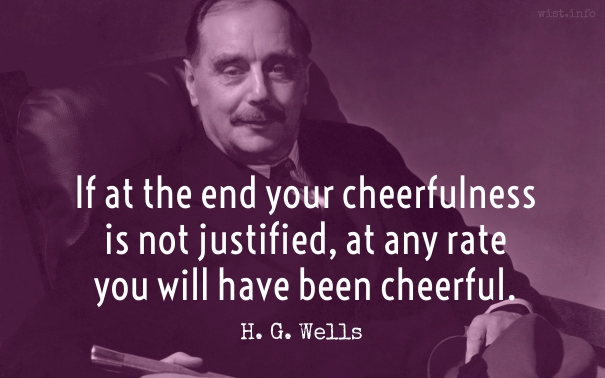
While there is a chance of the world getting through its troubles I hold that a reasonable man has to behave as though he was sure of it. If at the end your cheerfulness is not justified, at any rate you will have been cheerful.
H. G. Wells (1866–1946) British writer [Herbert George Wells]
Apropos of Dolores, ch. 2 (1938)
(Source)
I have always preferred cheerfulness to mirth. The latter I consider as an act, the former as an habit of mind. Mirth is short and transient, cheerfulness fixed and permanent. Those are often raised into the greatest transports of mirth who are subject to the greatest depressions of melancholy. On the contrary, cheerfulness, though it does not give the mind such an exquisite gladness, prevents us from falling into any depths of sorrow. Mirth is like a flash of lightning, that breaks through a gloom of clouds, and glitters for a moment; cheerfulness keeps up a kind of daylight in the mind, and fills it with a steady and perpetual serenity.
Joseph Addison (1672–1719) English essayist, poet, statesman
Essay (1712-05-17), The Spectator, No. 381
(Source)
KATHERINE: He made her melancholy, sad, and heavy,
And so she died. Had she been light like you,
Of such a merry, nimble, stirring spirit,
She might ha’ been a grandam ere she died.
And so may you, for a light heart lives long.William Shakespeare (1564–1616) English dramatist and poet
Love’s Labour’s Lost, Act 5, sc. 2, l. 15ff (5.2.15-19) (c. 1595)
(Source)
To Rosaline.

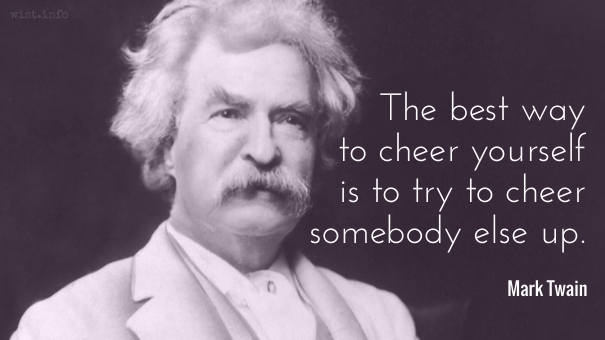
The best way to cheer yourself is to try to cheer somebody else up.
Mark Twain (1835–1910) American writer [pseud. of Samuel Clemens]
Note (1896-11-26), Mark Twain’s Notebook, ch. 27 “England” (1935) [ed. Albert Bigelow Paine]
(Source)
Written while in Guilford, England, shortly after the death of his daughter Susy in America.
Often given as "The best way to cheer yourself up is to try to cheer somebody else up." More discussion here.

You find yourself refreshed by the presence of cheerful people. Why not make earnest efforts to confer that pleasure on others? You will find half the battle is gained, if you never allow yourself to say anything gloomy.
Lydia Maria Child (1802–1880) American abolitionist, activist, journalist, suffragist
Looking Toward Sunset (1874, 10th ed.)
A cheerful, easy countenance and behavior are very useful: they make fools think you a good-natured man, and they make designing men think you an undesigning one.

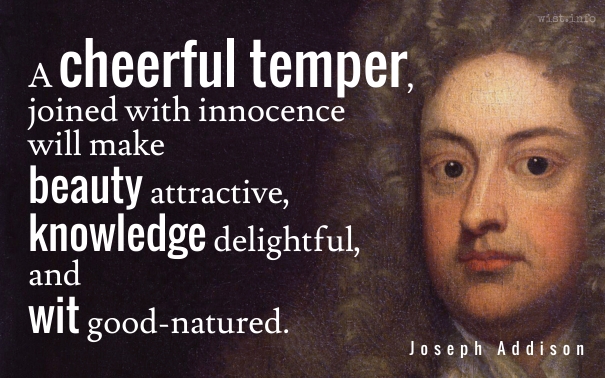
A cheerful temper, joined with innocence, will make beauty attractive, knowledge delightful, and wit good-natured.
Joseph Addison (1672–1719) English essayist, poet, statesman
Essay (1710-07-01), The Tatler, No. 192
(Source)
Let the world slide, let the world go:
A fig for care, and a fig for woe!
If I can’t pay, why, I can owe;
And death makes equal the high and low.
Be merry, friends!John Heywood (1497?-1580?) English playwright and epigrammist
Ballad (1576), “Be Merry Friends,” st. 17
(Source)
Collected in John Payne Collier (ed.), A Book of Roxburghe Ballads (1847), which includes more history about it.
This quote from the final stanza of the ballad (as reconstructed) was popularized when quoted in Bartlett's Familiar Quotations, 5th Ed. (1870) and subsequent editions.
The ballad also shows up in a collection of James Orchard Halliwell (ed.), The Moral Play of Wit and Science (1848) for the Shakespeare Society. This has an earlier version of the ballad, which does not include this stanza. (It also wavers in spelling between "mery" / "merye" and "frends" / "freendes.") This is in turn endnoted with five contemporary English stanzas, replacing the last two given, which includes that quoted above.
"Let the world slide" is used by the Beggar (Sly) in Shakespeare's Taming of the Shrew, Induction, sc. 1 (c. 1590).

Gentleness and cheerfulness, these come before all morality; they are the perfect duties.
Robert Louis Stevenson (1850–1894) Scottish essayist, novelist, poet
Essay (1888-12), “A Christmas Sermon,” sec. 2, Scribner’s Magazine, Vol. 4
(Source)
In context, Stevenson is using "morality" in terms of legalistic religion.
Originally written in the winter of 1887-88. Collected in Across the Plains, ch. 12 (1892).
A happy man or woman is a better thing to find than a five-pound note. He or she is a radiating focus of goodwill; and their entrance into a room is as though another candle had been lighted. We need not care whether they could prove the forty-seventh proposition; they do a better thing than that, they practically demonstrate the great Theorem of the Liveableness of Life.
Robert Louis Stevenson (1850–1894) Scottish essayist, novelist, poet
Essay (1877-07), “An Apology for Idlers,” Cornhill Magazine, Vol. 36
(Source)
Euclid's 47th Proposition (in his Elements, Book 1) is the Pythagorean Theorem.Collected in Virginibus Puerisque and Other Papers, ch. 3 (1881).
Good-nature is more agreeable in conversation than wit, and gives a certain air to the countenance which is more amiable than beauty. It shows virtue in the fairest light, takes off in some measure from the deformity of vice, and makes even folly and impertinence supportable.
Joseph Addison (1672–1719) English essayist, poet, statesman
Essay (1711-09-13), The Spectator, No. 169
(Source)
Cheerfulness keeps up a kind of daylight in the mind, and fills it with a steady and perpetual serenity.
Joseph Addison (1672–1719) English essayist, poet, statesman
Essay (1712-05-17), The Spectator, No. 381
(Source)
There is no duty we so much underrate as the duty of being happy. By being happy, we sow anonymous benefits upon the world, which remain unknown even to ourselves, or when they are disclosed, surprise nobody so much as the benefactor.

Mirth is God’s medicine. Everybody ought to bathe in it. Grim care, moroseness, anxiety — all this rust of life ought to be scoured off by the oil of mirth. It is better than emery. Every man ought to rub himself with it.