Quotations about:
charm
Note not all quotations have been tagged, so Search may find additional quotes on this topic.
FORBIDDEN, pp. Invested with a new and irresistible charm.
Ambrose Bierce (1842–1914?) American writer and journalist
“Forbidden,” “Devil’s Dictionary” column, San Francisco
Wasp (1884-12-13)
(
Source)
Added on 29-Sep-26 | Last updated 12-Sep-26
Link to this post
Topics: attractiveness, charm, desire, forbid, forbidden fruit, incentive, prohibit, Prohibition
More quotes by Bierce, Ambrose It isn’t enough for poems to be things of beauty:
Let them stun the hearer and lead his heart where they will.
[Non satis est pulchra esse poemata; dulcia sunto
Et, quocumque uolent, animum auditoris agunto.]
Horace (65–8 BC) Roman poet, satirist, soldier, politician [Quintus Horatius Flaccus]
Epistles [Epistularum, Letters], Book 2, ep. 3 “Art of Poetry
[Ars Poetica; To the Pisos],” l. 99ff (2.3.99-100) (19 BC) [tr. Palmer Bovie (1959)]
(
Source)
One of the most famous lines in the
Ars Poetica.
(
Source (Latin)). Other translations:
Not lore enough in Poesis, let them be sweetlye fynde,
And let them leade to where them liste the hearers plyante mynde.
[tr. Drant (1567)]
Tis not enough the labouring Muse affords
Her Poëms beauty, but a sweet delight,
To worke the hearers minds, still to the plight.
[tr. Jonson (1640); l. 140ff]
He that would have Spectators share his Grief,
Must write not only well, but movingly,
And raise Mens Passions to what height he will.
[tr. Roscommon (1680)]
'Tis not enough, ye writers, that ye charm
With ease and elegance; a play should warm
With soft concernment; should possess the soul,
And, as it wills, the listening crowd controul.
[tr. Francis (1747)]
'Tis not enough that Plays are polish'd, chaste,
Or trickt in all the harlotry of taste,
They must have passion too; beyond controul
Transporting where they please the hearer's soul.
[tr. Coleman (1783)]
It is not enough for poems to be fine; they must charm, and draw the mind of the listener at will.
[tr. Blakeney (1828)]
'Tis not enough that poetry combine
All fancy's charms in every sounding line:
Empassion'd let her be, and melt at will
The soul to pity or with horror thrill.
[tr. Howes (1845)]
It is not enough that poems be beautiful; let them be tender and affecting, and bear away the soul of the auditor whithersoever they please.
[tr. Smart/Buckley (1853)]
Mere grace is not enough: a play should thrill
The hearer's soul, and move it at its will.
[tr. Conington (1874)]
Fine things won't make a drama: it must thrill
The hearers' souls, and sway them at its will.
[tr. Martin (1881)]
Nor is it enough that poems possess beauty in the construction. They must please and, in whatsoever direction they will, send there the feelings of the auditors.
[tr. Elgood (1893)]
Not enough is it for poems to have beauty: they must have charm, and lead the hearer's soul where they will.
[tr. Fairclough (Loeb) (1926)]
It isn't enough to make lines pretty; they must move,
and affect the hearer's soul exactly as the poet wants.
[tr. Fuchs (1977)]
Poems (oh)
can be (oh)
so beautiful
And (oh) so dull.
Poets need charm, too, to seduce our minds.
[tr. Raffel (1983 ed.)]
Sheer abstract beauty isn't enough in a poem;
Its language must so persuade the listener
And act upon his soul that he'll respond
As the poem intends.
[tr. Ferry (2001)]
Correctness is not enough in a poem; it must be attractive,
leading the listener's emotions in whatever way it wishes.
[tr. Rudd (2005 ed.)]
It’s not enough for poems to have beauty: they must have
Charm, leading their hearer’s heart wherever they wish.
[tr. Kline (2015)]
Added on 3-Apr-26 | Last updated 2-Oct-26
Link to this post
Topics: beauty, charm, craft, drama, emotion, engagement, feelings, form, impact, influence, message, moving, passion, play, poem, polish, prettiness, substance, theater, writing
More quotes by Horace Cheerfullness makes the plainest features butiful, the severest winter agreeable; it elevates the lowly, and adds a charm tew grateness, all its own.
[Cheerfulness makes the plainest features beautiful, the severest winter agreeable; it elevates the lowly, and adds a charm to greatness.]
Josh Billings (1818–1885) American humorist, aphorist [pseud. of Henry Wheeler Shaw]
Everybody’s Friend, Or; Josh Billing’s Encyclopedia and Proverbial Philosophy of Wit and Humor, ch. 281 “Variety: Bred and Butter” (1874)
(
Source)
Added on 31-Jul-25 | Last updated 31-Jul-25
Link to this post
Topics: attitude, beauty, charm, cheer, cheerfulness, exuberance, good cheer, good nature, greatness, hardship, mirth
More quotes by Billings, Josh FALSTAFF:Setting the attractions of
my good parts aside, I have no other charms.
William Shakespeare (1564–1616) English dramatist and poet
Merry Wives of Windsor, Act 2, sc. 2, l. 105ff (2.2.105-106) (1597)
(
Source)
Added on 27-Jan-25 | Last updated 27-Jan-25
Link to this post
Topics: attractiveness, beauty, charm, ego, handsomeness, self-regard
More quotes by Shakespeare, William MACBETH: I bear a charmèd life, which must not yield
To one of woman born.
MACDUFF: Despair thy charm,
And let the angel whom thou still hast served
Tell thee Macduff was from his mother’s womb
Untimely ripped.
MACBETH: Accursèd be that tongue that tells me so,
For it hath cowed my better part of man!
William Shakespeare (1564–1616) English dramatist and poet
Macbeth, Act 5, sc. 8, l. 15ff (5.8.15-22) (1606)
(
Source)
Added on 13-Jan-25 | Last updated 13-Jan-25
Link to this post
Topics: cesarean, charm, expectations, invulnerability, loophole, magic, protection
More quotes by Shakespeare, William Children ask better questions than do adults. “May I have a cookie?” “Why is the sky blue?” and “What does a cow say?” are far more likely to elicit a cheerful response than “Where is your manuscript?” “Why haven’t you called?” and “Who’s your lawyer?”
Fran Lebowitz (b. 1950) American journalist, essayist
“Children: Pro or Con,”
Metropolitan Life (1978)
(
Source)
Added on 15-May-24 | Last updated 15-May-24
Link to this post
Topics: adults, challenge, charm, children, inquiry, question
More quotes by Lebowitz, Fran In the theater, as in life, we prefer a villain with a sense of humor to a hero without one.
Mignon McLaughlin (1913–1983) American journalist and author
The Neurotic’s Notebook, ch. 7 (1963)
(
Source)
Added on 27-Apr-23 | Last updated 27-Apr-23
Link to this post
Topics: character, charisma, charm, evil, good, hero, personality, sense of humor, sympathy, villain
More quotes by McLaughlin, Mignon Charming villains have always had a decided social advantage over well-meaning people who chew with their mouths open.
Judith Martin (b. 1938) American author, journalist, etiquette expert [a.k.a. Miss Manners]
Essay (1984), “In the Quest for Equality, Civilization Itself Is Maligned,”
The New Republic
(
Source)
Added on 3-Aug-21 | Last updated 14-Jul-25
Link to this post
Topics: appearances, bad person, charm, facade, good person, impression, manners, politeness, prentence, sophistication, villain
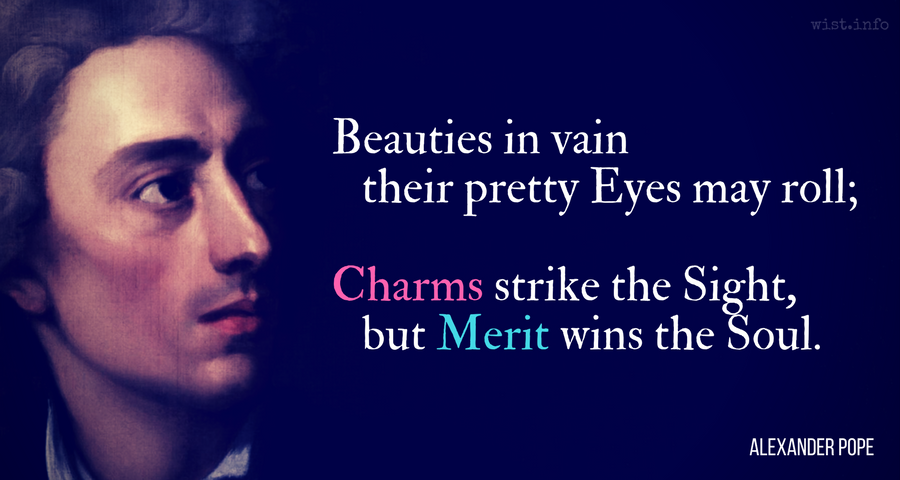
More quotes by Martin, Judith Beauties in vain their pretty Eyes may roll;
Charms strike the Sight, but Merit wins the Soul.

Alexander Pope (1688–1744) English poet
The Rape of the Lock, Canto 5, l. 33 (1712)
(
Source)
Added on 3-Oct-17 | Last updated 3-Oct-17
Link to this post
Topics: attraction, attractiveness, beauty, charm, meme, merit, seduction, value, worth
More quotes by Pope, Alexander Civility costs nothing, and buys everything.
Mary Wortley Montagu (1689–1762) English aristocrat, letter writer, poet [née Pierrepont]
Letter to Mary, Countess of Bute (30 May 1756)
(
Source)
Added on 17-Apr-17 | Last updated 11-Apr-22
Link to this post
Topics: charisma, charm, civility, influence, politeness
More quotes by Montagu, Mary Wortley To be agreeable while disagreeing — that’s an art.
Malcolm Forbes (1919–1990) American billionaire
The Sayings of Chairman Malcolm, “Arrived” (1978)
Added on 19-Dec-16 | Last updated 19-Dec-16
Link to this post
Topics: agree, charm, diplomacy, disagree, tact
More quotes by Forbes, Malcolm It must be added, lest we be reproached for leaving out details important to our readers’ understanding of subsequent events, that the lady seemed to have all the attributes of beauty, grace and charm that make a young man’s heart beat faster and cause his eyes to widen, lest they miss the least nuance of expression or gesture. It need hardly be added that Khaavren was just of the type to appreciate all of these qualities; that is to say, he was young and a man, and had, moreover, a vivid imagination which allowed his thoughts to penetrate, if not the mind of the lady opposite him, at least the folds and angles of her gown.
Steven Brust (b. 1955) American writer, systems programmer
The Phoenix Guards (1991)
Added on 21-Oct-16 | Last updated 21-Oct-16
Link to this post
Topics: attraction, beauty, charm, imagination, lust, woman, youth
More quotes by Brust, Steven It’s innocence when it charms us, ignorance when it doesn’t.
Mignon McLaughlin (1913–1983) American journalist and author
The Second Neurotic’s Notebook, ch. 10 (1966)
(
Source)
Added on 22-Aug-16 | Last updated 10-Mar-22
Link to this post
Topics: charm, ignorance, innocence, naivete
More quotes by McLaughlin, Mignon After sitting next to Mr. Gladstone I thought he was the cleverest man in England. But after sitting next to Mr. Disraeli I thought I was the cleverest woman in England.
(Other Authors and Sources)
Princess Marie Louise of Schleswig-Holstein (1872-1956) (Attributed)
Added on 15-Aug-16 | Last updated 15-Aug-16
Link to this post
Topics: charisma, charm, cleverness, complement, flattery, greatness, leadership
More quotes by ~Other Oozing charm from every pore,
He oiled his way around the floor.
Alan Jay Lerner (1918–1986) American dramatist, lyricist, composer
“You Did It,”
My Fair Lady (1956)
Added on 8-Aug-16 | Last updated 8-Aug-16
Link to this post
Topics: charm, oily, slick, smooth
More quotes by Lerner, Alan Jay “Charm” — which means the power to effect work without employing brute force — is indispensable to women. Charm is a woman’s strength just as strength is a man’s charm.
Havelock Ellis (1859–1939) British sexologist, physician, social reformer [Henry Havelock Ellis]
The Task of Social Hygiene (1912)
Added on 1-Aug-16 | Last updated 1-Aug-16
Link to this post
Topics: charisma, charm, men, strength, women
More quotes by Ellis, Havelock When a rogue kisses you, count your teeth.
[Ven a ganef kusht, darf men zikh di tseyn ibertseyln.]
[װען אַ גנבֿ קושט, דאַרף מען זיך די צײן איבערצײלן.]
Proverbs, Sayings, and Adages
Yiddish proverb
(
Source)
Alt. trans.: "When a thief kisses you, count your teeth."
Added on 17-Jun-16 | Last updated 22-Sep-25
Link to this post
Topics: caution, charlatan, charm, mistrust, rogue, thief
More quotes by ~Proverbs and Sayings The only wa tu pleze evra boddy, is tu make evry boddy think yu ar a bigger fule than tha ar.
[The only way to please everybody is to make everybody think you are a bigger fool than they are.]
Josh Billings (1818–1885) American humorist, aphorist [pseud. of Henry Wheeler Shaw]
His Sayings, ch. 45 (1867)
Added on 7-Aug-15 | Last updated 7-Aug-15
Link to this post
Topics: charm, dissemble, folly, foolishness, humble, please, self-deprecating
More quotes by Billings, Josh For if he wou’d try effectually to acquire the real Science or TASTE of Life; he wou’d certainly discover, “That a RIGHT MIND, and GENEROUS AFFECTION, had more Beauty and Charm, than all other Symmetrys in the World besides.”
Anthony Cooper, 3rd Earl of Shaftesbury (1671–1713) English politician and philosopher
Characteristicks of Men, Manners, Opinions, Times, Vol. 3, “Miscellany III,” ch. 3 (1711)
(
Source)
Added on 23-Jan-15 | Last updated 23-Jan-15
Link to this post
Topics: attraction, beauty, charisma, charm, inner beauty, taste
More quotes by Shaftesbury, Earl of Only actions give life strength; only moderation gives it a charm.
[Nur Taten geben dem Leben Stärke, nur Maß ihm Reiz.]
Jean Paul Richter (1763–1825) German writer, art historian, philosopher, littérateur [Johann Paul Friedrich Richter; pseud. Jean Paul]
Titan, Jubilee 35, cycle 145 (1803) [tr. Brooks (1863)]
(
Source)
Often only the first part is given as a quotation (or even just as a "German proverb").
(
Source (German)). Other translations:
Only deeds give strength to life, and only measure gives it charm.
[Source (1858)]
Only deeds give strength to life, only moderation gives it charm.
[Source (1896)]
Added on 8-Sep-09 | Last updated 17-Aug-24
Link to this post
Topics: action, charm, deeds, life, meaning of life, moderation, strength
More quotes by Richter, Jean-Paul All charming people have something to conceal, usually their total dependence on the appreciation of others.
Cyril Connolly (1903–1974) English intellectual, literary critic and writer.
Enemies of Promise, ch. 16 (1938)
Added on 17-Oct-05 | Last updated 16-Aug-21
Link to this post
Topics: appreciation, audience, charm, ego, insecurity
More quotes by Connolly, Cyril It is absurd to divide people into good and bad. People are either charming or tedious.
Oscar Wilde (1854–1900) Irish poet, wit, dramatist
Lady Windemere’s Fan, Act 1 [Lord Darlington] (1892)
(
Source)
Added on 1-Feb-04 | Last updated 9-Aug-21
Link to this post
Topics: bad people, boredom, charm, engagement, good people, morality, socializing, tediium
More quotes by Wilde, Oscar We are all born charming, frank, and spontaneous and must be civilized before we are fit to participate in society.
Judith Martin (b. 1938) American author, journalist, etiquette expert [a.k.a. Miss Manners]
“Miss Manners,” syndicated column (1978-04-23)
(
Source)
Reprinted in
Miss Manners' Guide to Excruciatingly Correct Behavior, Part 2 "Basic Civilization," "Concerning Children" (1983).
Added on 1-Feb-04 | Last updated 11-Jul-23
Link to this post
Topics: charm, child rearing, children, civilization, frankness, parenting, society, spontaneity, taming, teaching, training
More quotes by Martin, Judith 
CALVIN: You know, Hobbes, some days even my lucky rocketship underpants don’t help.
Bill Watterson (b. 1958) American cartoonist
Calvin and Hobbes (1995-05-14)
(
Source)
Added on 1-Feb-04 | Last updated 7-Jan-25
Link to this post
Topics: bad luck, charm, curse, jinx, misfortune, talisman
More quotes by Watterson, Bill