It is easier to build strong children than to repair broken men.
Frederick Douglass (1817–1895) American abolitionist, orator, writer
(Spurious)
This quotation only begins being associated with Douglass in the early 1990s. It may be related to some of his writings, but not clearly. For more information about the quote's origins and associations see Happy 200th Birthday to Frederick Douglass.
Quotations about:
adults
Note not all quotations have been tagged, so Search may find additional quotes on this topic.
The writer whose words are going to be read by children has a heavy responsibility. And yet, despite the undeniable fact that the children’s minds are tender, they are also far more tough than many people realize, and they have an openness and an ability to grapple with difficult concepts which many adults have lost. Writers of children’s literature are set apart by their willingness to confront difficult questions.
Madeleine L'Engle (1918–2007) American writer
Speech (1983-11-16), “Dare To Be Creative,” Lecture, Library of Congress, Washington, DC
(Source)

It is not the young people that degenerate: they are not spoilt till those of maturer age are already sunk into corruption.
[Ce n’est point le peuple naissant qui dégénere ; il ne se perd que lorsque les hommes faits sont déja corrompus.]
Charles-Lewis de Secondat, Baron de Montesquieu (1689–1755) French political philosopher
Spirit of Laws [The Spirit of the Laws; De l’esprit des lois], Book 4, ch. 5 (4.5) (1748) [tr. Nugent (1750)]
(Source)
On society's need to educate the young into a love for the republic.
(Source (French)). Other translations:It is not young people who degenerate; they are ruined only when grown men have already been corrupted.
[tr. Cohler/Miller/Stone (1989)]It is not the rising people that degenerates ; it only declines when the fully-formed men are already corrupted.
[tr. Stewart (2018)]

Grown-ups never understand anything by themselves, and it is tiresome for children to be always explaining things to them.
[Les grandes personnes ne comprennent jamais rien toutes seules, et c’est fatigant, pour les enfants, de toujours et toujours leur donner des explications.]
Antoine de Saint-Exupéry (1900–1944) French writer, aviator
Le Petit Prince [The Little Prince], ch. 1 (1943) [tr. Wood (1945)]
(Source)
(Source (French)). Other translation:Grown-ups never understand anything by themselves, and it is exhausting for children to have to provide explanations over and over again.
[tr. Howard (2000)]

Old dorgs nuss their grudges, but yung purps fite, and then frolick.
[Old dogs nurse their grudges, but young pups fight and then frolic.]
Josh Billings (1818–1885) American humorist, aphorist [pseud. of Henry Wheeler Shaw]
Josh Billings’ Farmer’s Allminax, 1870-06 (1870 ed.)
(Source)
This aphorism shows up again in Everybody's Friend, Or; Josh Billing's Encyclopedia and Proverbial Philosophy of Wit and Humor, ch. 156 "Affurisms: Embers on the Harth" (1874), with slight spelling changes:Old dorgs nuss their grudges, but yung pupps fight and then frolik.

Children ask better questions than do adults. “May I have a cookie?” “Why is the sky blue?” and “What does a cow say?” are far more likely to elicit a cheerful response than “Where is your manuscript?” “Why haven’t you called?” and “Who’s your lawyer?”
Fran Lebowitz (b. 1950) American journalist, essayist
“Children: Pro or Con,” Metropolitan Life (1978)
(Source)

A toddling little girl is a centre of common feeling which makes the most dissimilar people understand each other.
George Eliot (1819–1880) English novelist [pseud. of Mary Ann Evans]
Scenes of Clerical Life, “Janet’s Repentance,” ch. 8 (1857)
(Source)
The rules are only barriers to keep children from falling.
[Ces règles ne sont que des barrières pour empêcher les enfants de tomber.]
Germaine de Staël (1766–1817) Swiss-French writer, woman of letters, critic, salonist [Anne Louise Germaine de Staël-Holstein, Madame de Staël, Madame Necker]
Germany [De l’Allemagne], Part 4, ch. 9 (1813)

Teenagers can be idiotic and stupid, but teenagers also model their behavior from the signals they get from adults.
John Scalzi (b. 1969) American writer
The Last Colony, ch. 4 (2007)

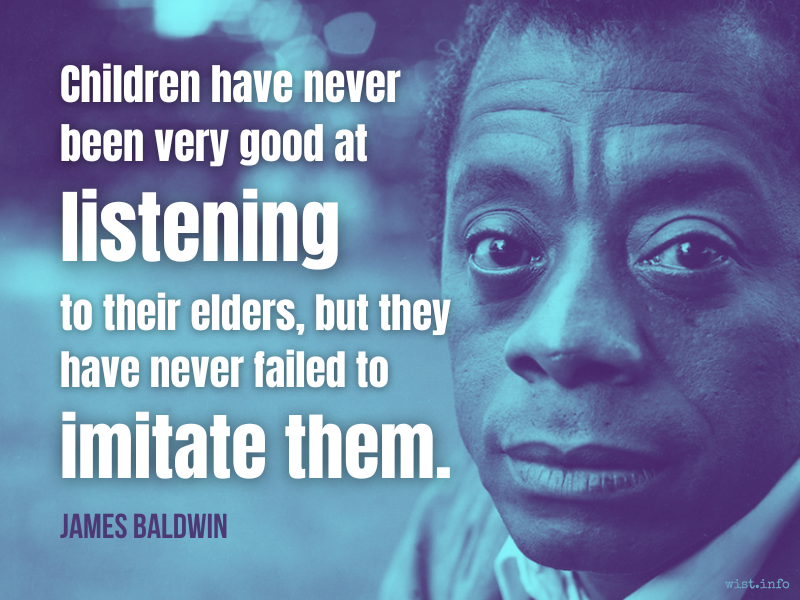
Children have never been very good at listening to their elders, but they have never failed to imitate them.