

To suppress free speech is a double wrong. It violates the rights of the hearer as well as those of the speaker.
Frederick Douglass (1817–1895) American abolitionist, orator, writer
“A Plea for Freedom of Speech in Boston,” speech (9 Dec 1860)
Quotations by:
Douglass, Frederick
Liberty is meaningless where the right to utter one’s thoughts and opinions has ceased to exist. That, of all rights, is the dread of tyrants. It is the right which they first of all strike down. They know its power. Thrones, dominions, principalities, and powers, founded in injustice and wrong, are sure to tremble, if men are allowed to reason of righteousness, temperance, and of a judgment to come in their presence.
Frederick Douglass (1817–1895) American abolitionist, orator, writer
“A Plea for Freedom of Speech in Boston,” speech (9 Dec 1860)
(Source)
Equally clear is the right to hear. To suppress free speech is a double wrong. It violates the rights of the hearer as well as those of the speaker. It is just as criminal to rob a man of his right to speak and hear as it would be to rob him of his money.
Frederick Douglass (1817–1895) American abolitionist, orator, writer
“A Plea for Freedom of Speech in Boston” (9 Dec 1880)
(Source)
The thing worse than rebellion is the thing that causes rebellion.
Frederick Douglass (1817–1895) American abolitionist, orator, writer
“Reconstruction,” Atlantic (Dec 1866)
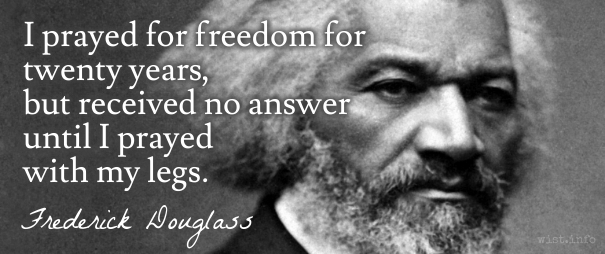
I prayed for freedom for twenty years, but received no answer until I prayed with my legs.
Frederick Douglass (1817–1895) American abolitionist, orator, writer
(Attributed)
Mentioned frequently as being part of his earlier speeches, but unsourced. Also found as "failed to see the slightest scintillation of an answer until I prayed with my legs."
It is easier to build strong children than to repair broken men.
Frederick Douglass (1817–1895) American abolitionist, orator, writer
(Spurious)
This quotation only begins being associated with Douglass in the early 1990s. It may be related to some of his writings, but not clearly. For more information about the quote's origins and associations see Happy 200th Birthday to Frederick Douglass.
You are not judged by the height you have risen, but from the depth you have climbed.
Frederick Douglass (1817–1895) American abolitionist, orator, writer
Life and Times of Frederick Douglass (1881)
I love the pure, peaceable, and impartial Christianity of Christ: I therefore hate the corrupt, slaveholding, women-whipping, cradle-plundering, partial and hypocritical Christianity of this land. Indeed, I can see no reason, but the most deceitful one, for calling the religion of this land Christianity. I look upon it as the climax of all misnomers, the boldest of all frauds, and the grossest of all libels.
Frederick Douglass (1817–1895) American abolitionist, orator, writer
Narrative of the Life of Frederick Douglass, An American Slave, Appendix (1845)
(Source)
“If you give a nigger an inch, he will take an ell. A nigger should know nothing but to obey his master — to do as he is told to do. Learning will spoil the best nigger in the world. Now, if you teach that nigger how to read, there would be no keeping him. It would forever unfit him to be a slave. He would at once become unmanageable, and of no value to his master. As to himself, it could do him no good, but a great deal of harm. It would make him discontented and unhappy.”
Frederick Douglass (1817–1895) American abolitionist, orator, writer
Narrative of the Life of Frederick Douglass, ch. 6 [Mr. Auld] (1845)
(Source)
Quoting his master, Auld, chastising Mrs. Auld for teaching Douglass to read. Frequently paraphrased down to "Knowledge makes a man unfit to be a slave."
Power concedes nothing without a demand. It never did, and it never will.
Frederick Douglass (1817–1895) American abolitionist, orator, writer
Letter to Gerrit Smith (30 Mar 1849)
The 4th of July is the first great fact in your nation’s history — the very ring-bolt in the chain of your yet undeveloped destiny. Pride and patriotism, not less than gratitude, prompt you to celebrate and to hold it in perpetual remembrance. I have said that the Declaration of Independence is the ring-bolt to the chain of your nation’s destiny; so, indeed, I regard it. The principles contained in that instrument are saving principles. Stand by those principles, be true to them on all occasions, in all places, against all foes, and at whatever cost.
Frederick Douglass (1817–1895) American abolitionist, orator, writer
Speech (1852-07-05), “What to the Slave is the Fourth of July?” Corinthian Hall, Rochester, New York
(Source)
I am not included within the pale of this glorious anniversary! Your high independence only reveals the immeasurable distance between us. The blessings in which you, this day, rejoice, are not enjoyed in common. — The rich inheritance of justice, liberty, prosperity and independence, bequeathed by your fathers, is shared by you, not by me. The sunlight that brought life and healing to you, has brought stripes and death to me. This Fourth July is yours, not mine.
Frederick Douglass (1817–1895) American abolitionist, orator, writer
Speech (1852-07-05), “What to the Slave is the Fourth of July?” Corinthian Hall, Rochester, New York
(Source)
What, am I to argue that it is wrong to make men brutes, to rob them of their liberty, to work them without wages, to keep them ignorant of their relations to their fellow men, to beat them with sticks, to flay their flesh with the lash, to load their limbs with irons, to hunt them with dogs, to sell them at auction, to sunder their families, to knock out their teeth, to burn their flesh, to starve them into obedience and submission to their masters? Must I argue that a system thus marked with blood, and stained with pollution, is wrong? No! I will not. I have better employment for my time and strength, than such arguments would imply.
Frederick Douglass (1817–1895) American abolitionist, orator, writer
Speech (1852-07-05), “What to the Slave is the Fourth of July?” Corinthian Hall, Rochester, New York
(Source)
What, to the American slave, is your 4th of July? I answer: a day that reveals to him, more than all other days in the year, the gross injustice and cruelty to which he is the constant victim. To him, your celebration is a sham; your boasted liberty, an unholy license; your national greatness, swelling vanity; your sounds of rejoicing are empty and heartless; your denunciations of tyrants, brass fronted impudence; your shouts of liberty and equality, hollow mockery; your prayers and hymns, your sermons and thanksgivings, with all your religious parade, and solemnity, are, to him, mere bombast, fraud, deception, impiety, and hypocrisy — a thin veil to cover up crimes which would disgrace a nation of savages.
Frederick Douglass (1817–1895) American abolitionist, orator, writer
Speech (1852-07-05), “What to the Slave is the Fourth of July?” Corinthian Hall, Rochester, New York
(Source)
But the church of this country is not only indifferent to the wrongs of the slave, it actually takes sides with the oppressors. It has made itself the bulwark of American slavery, and the shield of American slave-hunters. Many of its most eloquent Divines, who stand as the very lights of the church, have shamelessly given the sanction of religion and the Bible to the whole slave system. — They have taught that man may, properly, be a slave; that the relation of master and slave is ordained of God; that to send back an escaped bondman to his master is clearly the duty of all the followers of the Lord Jesus Christ; and this horrible blasphemy is palmed off upon the world for Christianity.
For my part, I would say, welcome infidelity! welcome atheism! welcome anything! in preference to the gospel, as preached by those Divines!Frederick Douglass (1817–1895) American abolitionist, orator, writer
Speech (1852-07-05), “What to the Slave is the Fourth of July?” Corinthian Hall, Rochester, New York
(Source)
Americans! your republican politics, not less than your republican religion, are flagrantly inconsistent. You boast of your love of liberty, your superior civilization, and your pure Christianity, while the whole political power of the nation (as embodied in the two great political parties), is solemnly pledged to support and perpetuate the enslavement of three millions of your countrymen. You hurl your anathemas at the crowned headed tyrants of Russia and Austria, and pride yourselves on your Democratic institutions, while you yourselves consent to be the mere tools and body-guards of the tyrants of Virginia and Carolina.
Frederick Douglass (1817–1895) American abolitionist, orator, writer
Speech (1852-07-05), “What to the Slave is the Fourth of July?” Corinthian Hall, Rochester, New York
(Source)
Let me give you a word of the philosophy of reform. The whole history of the progress of human liberty shows that all concessions yet made to her august claims, have been born of earnest struggle. The conflict has been exciting, agitating, all-absorbing, and for the time being, putting all other tumults to silence. It must do this or it does nothing. If there is no struggle, there is no progress.
Those who profess to favor freedom, and yet depreciate agitation, are men who want crops without plowing up the ground. They want rain without thunder and lightning. They want the ocean without the awful roar of its many waters. This struggle may be a moral one; or it may be a physical one; or it may be both moral and physical; but it must be a struggle.Frederick Douglass (1817–1895) American abolitionist, orator, writer
Speech (1857-08-04) on West India Emancipation, Ontario County Agricultural Society Fairgrounds, Canandaigua, New York
(Source)
Power concedes nothing without a demand. It never did and it never will. Find out just what any people will quietly submit to and you have found out the exact measure of injustice and wrong which will be imposed upon them. and these will continue till they are resisted with either words or blows, or with both. The limits of tyrants are prescribed by the endurance of those whom they oppress.
Frederick Douglass (1817–1895) American abolitionist, orator, writer
Speech (1857-08-04) on West India Emancipation, Ontario County Agricultural Society fairgrounds, Canandaigua, New York
(Source)
Commemorating the anniversary of the emancipation of British West Indian slaves in 1834.
The American people have this lesson to learn: That where justice is denied, where poverty is enforced, where ignorance prevails, and where any one class is made to feel that society is an organized conspiracy to oppress, rob, and degrade them, neither persons nor property will be safe.
Frederick Douglass (1817–1895) American abolitionist, orator, writer
Speech (1886-04-16), “Strong to Suffer, and Yet Strong to Strive,” Israel Bethel Colored Methodist Episcopal Church, Washington, D.C.
(Source)
Men might not get all they work for in this world, but they must certainly work for all they get. If we ever get free from the oppressions and wrongs heaped upon us, we must pay for their removal. We must do this by labor, by suffering, by sacrifice, and if needs be, by our lives and the lives of others.
Frederick Douglass (1817–1895) American abolitionist, orator, writer
Speech on West India Emancipation (4 Aug 1857)
No man can put a chain about the ankle of his fellow man without at last finding the other end fastened about his own neck.
Frederick Douglass (1817–1895) American abolitionist, orator, writer
Speech, Civil Rights Mass Meeting, Washington, D.C. (1883)
I expose slavery in this country, because to expose it is to kill it. Slavery is one of the monsters of darkness to whom the light of truth is death.
Frederick Douglass (1817–1895) American abolitionist, orator, writer
Speech, Moorfields, England (22 May 1846)
(Source)
For he is a lover of his country who rebukes and does not excuse its sins.
Frederick Douglass (1817–1895) American abolitionist, orator, writer
Speech, Syracue, New York (24 Sep 1847)
Full text.