[T]he citizen who thinks he sees that the commonwealth’s political clothes are worn out, and yet holds his peace and does not agitate for a new suit, is disloyal; he is a traitor. That he may be the only one who thinks he sees this decay, does not excuse him; it is his duty to agitate anyway, and it is the duty of the others to vote him down if they do not see the matter as he does.
Mark Twain (1835–1910) American writer [pseud. of Samuel Clemens]
Novel (1889), A Connecticut Yankee in King Arthur’s Court, Part 3 “The Tale of the Lost Land,” ch. 13 “Freemen!”
(Source)
Quotations about:
agitation
Note not all quotations have been tagged, so Search may find additional quotes on this topic.
These [social questions] have all been kept alive in the cauldron of our agitation, and earned us properly, deservedly, the title of “infidel” and “traitor.” “Infidel” to a church that could be at peace in the presence of sin! “Traitor” to a state that was a magnificent conspiracy against justice.
Wendell Phillips (1811–1884) American abolitionist, orator, social activist
Speech (1857-01-02), 25th Anniversary of the Massachusetts Anti-Slavery Society, Faneuil Hall, Boston
(Source)
As recorded in The Liberator, Vol. 27, No. 2 (1857-01-09), and the National Anti-Slavery Standard, Vol. 17, No. 35 (1857-01-17).
This is the closest to primary source for a variation of a quote more commonly cited to Phillips:Write on my gravestone: "Infidel, Traitor" -- infidel to every church that compromises with wrong; traitor to every government that oppresses the people.”
The earliest I can find this version of the quote in print is in the late 1920s (1927, 1927, 1929) in various Labor / Socialist publications, standing alone as column filler without citation.
Prior to this, I can find examples of a form closer to the one given above:When I die I wish but two words written on my tombstone -- "Infidel" -- "Traitor." Infidel to a church that can be at peace in the presence of sin; Traitor to a government that is a magnificent conspiracy against justice.
The earliest I find this version is in Oliver Johnson, William Lloyd Garrison and His Time (1879), a quotation from Johnson of a (the same?) speech at Faneuil Hall. It's also mentioned, in whole or in part in:While it is possible that Phillips used variations of the same quotation on different occasions (as many orators and lecturers of that time and this do), the clustering of dates with versions suggests to me failures of memory (e.g., Johnson), or intentional tweakings of the text (in the 1920s) to prefer more contemporary language or political usage.
- The Cube (1897-05), mentioned as a quotation from Phillips.
- The Advocate of Peace, Vol. 60, No. 9 (1898-10), printing a pacifism speech by William Lloyd Garrison (1898-08-25).
- The Labour Annual (1899), as column filler.
Rufus King Noyes (comp.), Views of Religion (1908), is a list of quotations about (and generally critical of) religion, in the format of giving the name, and then the quotation after this. It includes, attributed in this fashion to Phillips:When I die, I wish but two words written on my tombstone -- "Infidel" and "Traitor."
The next quotation -- with its name immediately below the above, is from William Dean Howells. I did find misattributions to this and the longer quote made to Howells, probably from a misreading of this book's format.
As a final note, Phillips' gravestone did not end up including either of those words.
We do not need to fear ideas, but the censorship of ideas. We do not need to fear criticism, but the silencing of criticism. We do not need to fear excitement or agitation in the academic community, but timidity and apathy. We do not need to fear resistance to political leaders, but unquestioning acquiescence in whatever policies those leaders adopt.
Henry Steele Commager (1902–1998) American historian, writer, activist
Essay (1965-12-18), “The Problem of Dissent,” Saturday Review
(Source)
Reprinted in Freedom and Order, Part 6 (1966).
So too with our minds. If we do not keep them busy with some particular subject which can serve as a bridle to rein them in, they charge ungovernably about, ranging to and fro over the wastelands of our thoughts. Then, there is no madness, no raving lunacy, which such agitations do not bring forth.
[Ainsi est-il des esprits, si on ne les occupe à certain sujet, qui les bride & contraigne, ils se jettent desreglez, par-ci par là, dans le vague champ des imaginations. Et n’est follie ny réverie, qu’ils ne produisent en cette agitation.]
Michel de Montaigne (1533–1592) French essayist
Essays, Book 1, ch. 8 (1.8), “Of Idleness [De l’Oisiveté]” (1572) [tr. Screech (1987)]
(Source)
This essay was in the 1st ed. (1595); though the essay was revised for later editions, this text was not. The Essays themselves were begun to cure the melancholy and unrestrained thoughts caused by Montaigne's moving to his country estates, retiring from public life, and isolating himself in the château library for some time. This essay speaks to that experience.
(Source (French)). Alternate translations:So is it of minds, which except they be busied about some subject, that may bridle and keepe them under, they will here and there wildely scatter themselves through the vaste field of imaginations. And there is no follie, or extravagant raving, they produce not in that agitation.
[tr. Florio (1603)]So it is with Wits, which if not applyed to some certain Study that may fix and restrain them, run into a thousand Extravagancies, and are eternally roving here and there in the inextricable Labyrinth of restless Imagination. In which wild and irregular Agitation, there is no Folly, nor idle Fancy they do not light upon.
[tr. Cotton (1686)]So it is with our minds, which, if not applied to some particular subject to check and restrain them, rove about confusedly in the vague expanse of imagination. In which agitation there is no folly nor idle fancy which they do not create.
[tr. Friswell (1868)]So it is with minds, which if not applied to some certain study that may fix and restrain them, run into a thousand extravagances, eternally roving here and there in the vague expanse of the imagination -- in which wild agitation there is no folly, nor idle fancy they do not light upon.
[tr. Cotton/Hazlitt (1877)]So it is with our minds. If we do not apply them to some sort of study that will fix and restrain them, they will drift into a thousand extravagances, and will sternly run here and there in an inextricable labyrinth of restless imagination. In this wild and irregular agitation there is no folly nor idle fancy they do not touch upon.
[tr. Rector (1899)]So it is with our minds: if we do not keep them occupied with a distinct subject, which curbs and restrains them, they run aimlessly to and fro, in the undefined field of imagination. And there is no folly or fantasy to which they do not give birth in this agitation.
[tr. Ives (1925)]So it is with minds. Unless you keep them busy with some definite subject that will bridle and control them, they throw themselves in disorder hither and yon in the vague field of imagination. And there is no mad or idle fancy that they do not bring forth in this agitation.
[tr. Frame (1943)]So it is with our minds. If we do not occupy them with some definite subject which curbs and restrains them, they rush wildly to and fro in the ill-defined field of the imagination. And there is no folly or fantasy that they will not produce in this restless state.
[tr. Cohen (1958)]If [minds] have no object to busy themselves with, something to check and restrain them, they will run free and ramble through the open field of their imagination. And in this state of excitement, minds will come up with all kinds of foolishness and fantasies.
[tr. HyperEssays (2025)]

Do nothing, only keep agitating, debating; and things will destroy themselves.
Thomas Carlyle (1795–1881) Scottish essayist and historian
The French Revolution: A History, Part 1, Book 6, ch. 3 (1.6.3) (1837)
(Source)
On the inactivity of the elected National Assembly leading up to the Revolution.
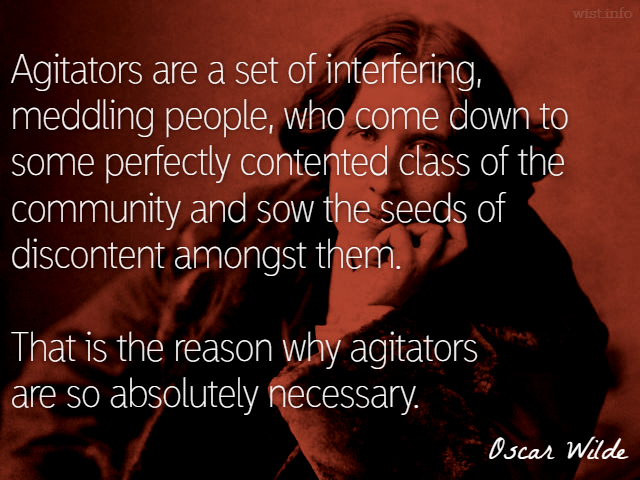
What is said by great employers of labor against agitators is unquestionably true. Agitators are a set of interfering, meddling people, who come down to some perfectly contented class of the community and sow the seeds of discontent amongst them. That is the reason why agitators are so absolutely necessary. Without them, in our incomplete state, there would be no advance towards civilization.
Oscar Wilde (1854–1900) Irish poet, wit, dramatist
“The Soul of Man Under Socialism” (1891)
(Source)

Agitation is the marshalling of the conscience of a nation to mold its laws.
Robert Peel (1788–1850) British statesman, Prime Minister (1834–35, 1841–46)
(Attributed)
(Source)
Sometimes quoted as "conscience of a people." Widely quoted without source in the late 19th Century (earliest ref. 1881).

A strong mind is one which does not lose its balance even under the most violent excitement.
[Ein starkes Gemüt ist ein solches, welches auch bei den heftigsten Regungen nicht aus dem Gleichgewicht kommt.]
Karl von Clausewitz (1780–1831) Prussian soldier, historian, military theorist
On War [Vom Kriege], Book 1, ch. 3 “On Military Genius [Der Kriegerische Genius],” (1.3) (1832) [tr. Graham (1873)]
(Source)
(Source (German)). Other translations:A stout heart is one which does not lose its balance even under the most violent excitement.
[tr. Jolles (1943)]A strong character is one that will not be unbalanced by the most powerful emotions.
[tr. Howard & Paret (1976)]

Intelligent discontent is the mainspring of civilization. Progress is born of agitation. It is agitation or stagnation.
Eugene V. Debs (1855–1926) American union leader, activist, socialist, politician
Speech (1908-05-23), “The Issue,” Girard, Kansas
(Source)
Impromptu speech in the town Debs was living in after his third nomination for President on the Socialist Democratic ticket.
Let me give you a word of the philosophy of reform. The whole history of the progress of human liberty shows that all concessions yet made to her august claims, have been born of earnest struggle. The conflict has been exciting, agitating, all-absorbing, and for the time being, putting all other tumults to silence. It must do this or it does nothing. If there is no struggle, there is no progress.
Those who profess to favor freedom, and yet depreciate agitation, are men who want crops without plowing up the ground. They want rain without thunder and lightning. They want the ocean without the awful roar of its many waters. This struggle may be a moral one; or it may be a physical one; or it may be both moral and physical; but it must be a struggle.Frederick Douglass (1817–1895) American abolitionist, orator, writer
Speech (1857-08-04) on West India Emancipation, Ontario County Agricultural Society Fairgrounds, Canandaigua, New York
(Source)