

MARCUS: There is naturally in our minds a quite insatiable longing to discover truth.
[Natura inest in mentibus nostris insatiabilis quaedam cupiditas veri.]
Marcus Tullius Cicero (106–43 BC) Roman orator, statesman, philosopher
Tusculan Disputations [Tusculanae Disputationes], Book 1, ch. 19 (1.19.) / sec. 44 (1.44) (45 BC) [tr. Douglas (1985)]
(Source)
On how the soul, after death, will find happiness in contemplation of the universe.
(Source (Latin)). Other translations:Our minds have naturally inplanted in them, an insatiable longing to come at the sight of Truth.
[tr. Wase (1643)]There is naturally in our minds a certain insatiable desire of seeing truth.
[tr. Main (1824)]By nature there exists in our minds a sort of insatiable thirst of seeing the truth.
[tr. Otis (1839)]There is naturally in our minds a certain insatiable desire to know the truth.
[tr. Yonge (1853)]There is in our minds an insatiable desire to behold the truth.
[tr. Peabody (1886)]There is naturally implanted in all minds the insatiable desire of being face to face with what is true.
[tr. Black (1889)]Nature has implanted in our minds a certain insatiable desire to behold the truth.
[ed. Harbottle (1897)]Our minds by nature have an insatiable longing to see the truth.
[tr. Habinek (1996)]There exists naturally in our minds a positively insatiable longing to discover the truth.
[tr. Davie (2017)]
Quotations about:
mind
Note not all quotations have been tagged, so Search may find additional quotes on this topic.
Soliloquy is the smoke exhaled by the inmost fires of the soul.
[Le monologue est la fumée des feux intérieurs de l’esprit.]
Victor Hugo (1802–1885) French writer, journalist, human rights activist, politician
The Man Who Laughs [L’Homme qui rit; The Laughing Man; By Order of the King], Part 1, Book 2, ch. 4 (1.2.4) (1869) [tr. Unknown (1869)]
(Source)
The same wording was used in the Authorized translation (1871).
(Source (French)). Other translations:Monologue is the smoke of the internal fires of the soul.
[tr. Hapgood (1888); Phillips (1894)]The monologue is the smoke of the inner fires of the mind.
[tr. Lavelle (2003)]
Knowledge is, indeed, that which, next to virtue, truly and essentially raises one man above another. It finishes one half of the human Soul. It makes Being pleasant to us, fills the mind with entertaining views and administers to it a perpetual series of gratifications. It gives ease to fortitude, and gracefulness to retirement. It fills a publick station with suitable abilities, and adds a lustre to those who are in the possession of them.
Joseph Addison (1672–1719) English essayist, poet, statesman
Essay (1713-07-18), The Guardian, No. 111
(Source)

I wrote somewhere once that the third-rate mind was only happy when it was thinking with the majority, the second-rate mind was only happy when it was thinking with the minority, and the first-rate mind was only happy when it was thinking. With equal truth it may be said that a first-rate mind is not one which does not remember the past, nor is it one which cannot forget the past; it is a mind which will use the past but not be ordered by it. It is a mind independent of everybody and everything but the facts in front of it. It is as little perturbed to find itself sharing a thought with the simple as it is elated to find itself sharing a thought with the subtle.
A. A. Milne (1882–1956) English poet and playwright [Alan Alexander Milne]
War with Honour, Macmillan War Pamphlets, Issue 2 (1940)
(Source)
Milne wrote this work in repudiation (or perhaps emendation) of his 1934 book, Peace with Honour, which argued that, given the tragedy of World War 1, that similar saber-rattling about the rise of Hitler's Germany was irresponsible and immoral. Having seen the course of fascism in the first years of World War 2, while still espousing pacifist principles, he saw Hitler as an evil that must be defeated.
If thought corrupts language, language can also corrupt thought.
George Orwell (1903–1950) English journalist, essayist, writer [pseud. of Eric Arthur Blair]
Essay (1946-04), “Politics and the English Language,” Horizon Magazine
(Source)
You see, I consider that a man’s brain originally is like a little empty attic, and you have to stock it with such furniture as you choose. A fool takes in all the lumber of every sort that he comes across, so that the knowledge which might be useful to him gets crowded out, or at best is jumbled up with a lot of other things, so that he has a difficulty in laying his hands upon it. Now the skilful workman is very careful indeed as to what he takes into his brain-attic. He will have nothing but the tools which may help him in doing his work, but of these he has a large assortment, and all in the most perfect order. It is a mistake to think that that little room has elastic walls and can distend to any extent. Depend upon it there comes a time when for every addition of knowledge you forget something that you knew before. It is of the highest importance, therefore, not to have useless facts elbowing out the useful ones.
Arthur Conan Doyle (1859–1930) British writer and physician
Story (1886-04), “A Study in Scarlet,” Part 1, ch. 2 [Holmes], Beeton’s Christmas Annual, Vol. 28 (1887-11-21)
(Source)
Connected to this passage.
Published in novel form 1888-07. See also "The Five Orange Pips."
In the Sherlock TV episode 01x03 "The Great Game" (w. Mark Gatiss) (2010-08-08), this explanation is reworked:SHERLOCK: Listen: (points to his head) This is my hard-drive, and it only makes sense to put things in there that are useful. Really useful. Ordinary people fill their heads with all kinds of rubbish, and that makes it hard to get at the stuff that matters! Do you see?
The mind is a strange machine which can combine the materials offered to it in the most astonishing ways, but without materials from the external world it is powerless.
Bertrand Russell (1872–1970) English mathematician and philosopher
Conquest of Happiness, Part 2, ch. 11 “Zest” (1930)
(Source)
The stars have not dealt me the worst they could do:
My pleasures are plenty, my troubles are two.
But oh, my two troubles they reave me of rest,
The brains in my head and the heart in my breast.A. E. Housman (1859–1936) English scholar and poet [Alfred Edward Housman]
“Additional Poems,” No. 17 (pub. 1937)
(Source)
It was his subconscious which told him this — that infuriating part of a person’s brain which never responds to interrogation, merely gives little meaningful nudges and then sits humming quietly to itself, saying nothing.
Douglas Adams (1952–2001) English author, humorist, screenwriter
Dirk Gently No. 2, The Long Dark Tea-Time of the Soul, ch. 17 (1988)
(Source)

HENRIETTE: Heaven, that orders all with sovereign power,
Forms us at birth for different uses, sister.
Not every spirit, if it would, can furnish
The stuff of which philosophers are made.[Le ciel, dont nous voyons que l’ordre est tout-puissant,
Pour différents emplois nous fabrique en naissant ;
Et tout esprit n’est pas composé d’une étoffe
Qui se trouve taillée à faire un philosophe.]Molière (1622–1673) French playwright, actor [stage name for Jean-Baptiste Poquelin]
Les Femmes Savantes [The Learned Ladies], Act 1, sc. 1, (1692) [tr. Page (1908)]
(Source)
(Source (French)). Other translations:Heav'n, whose Order we perceive to be almighty, forms us in our Birth for different Offices, and every Mind is not compos'd of Materials to fit it for making a Philosopher.
[tr. Clitandre (1739)]Heaven, whose commands we see to be all-powerful, fits us at our birth for different functions; and every mind is not composed of the stuff cut out to make a philosopher.
[tr. Van Laun (1876)]Heaven, whose will is supreme, forms us at our birth to fill different spheres; and it is not every mind which is composed of materials fit to make a philosopher.
[tr. Wall (1879), The Learned Women]Heaven, whose order we own to be almighty, forms us at birth for different occupations, and every mind is not composed of the stuff to make a philosopher.
[tr. Matthew (1890), The Blue-Stockings]But Heaven, whose laws we know to be all-powerful, formed us at birth for different vocations. All minds are not of the same stuff, cut out to make philosophers.
[tr. Wormeley (1895), The Female Pedants]Heaven, whose decree is omnipotent, forms us at our birth for different functions; not every mind is made of the material from which a philosopher is made.
[tr. Waller (1903)]Heaven, whose order of course is all-powerful,
Creates us at birth for different functions;
And every mind is not composed of the stuff
That’s right for fashioning philosophers.
[tr. Marks (2018)]
So long as the body is affected through the mind, no audacious device, even of the most manifestly dishonest character, can fail of producing occasional good to those who yield it an implicit or even a partial faith.
Oliver Wendell Holmes, Sr. (1809–1894) American poet, essayist, scholar
Lecture (1842), “Homœopathy and Its Kindred Delusions,” Boston Society for the Diffusion of Useful Knowledge
(Source)
Collected in Medical Essays, 1842-1882, ch. 1 (1891 ed.).
A little flesh, a little breath, and a Reason to rule all — that is myself.
[Ὅ τί ποτε τοῦτό εἰμι, σαρκία ἐστὶ καὶ πνευμάτιον καὶ τὸ ἡγεμονικόν.]
Marcus Aurelius (AD 121–180) Roman emperor (161–180), Stoic philosopher
Meditations [To Himself; Τὰ εἰς ἑαυτόν], Book 2, ch. 2 (2.2) (AD 161-180) [tr. Staniforth (1964)]
(Source)
(Source (Greek)). Other translations:Whatsoever I am, is either flesh, or life, or that which we commonly call the mistress and overruling part of man; reason.
[tr. Casaubon (1634), 1.16]This Being of mine, all that's on't, consists of Body, Breath, and that Part which governs.
[tr. Collier (1701)]Whatsoever I am, is either this poor flesh, or the animal spirit, or the governing part.
[tr. Hutcheson/Moor (1742)]This whole person of mine, whatever I may think of it, consists only of a body, the vital spirit, and the rational soul or governing principle.
[tr. Graves (1792)]Whatever this is that I am, it is a little flesh and breath, and the ruling part.
[tr. Long (1862)]This being of mine, all there is of it, consists of flesh, breaht, and the ruling part.
[tr. Collier/Zimmern (1887)]Flesh, breath, and the Inner Self -- that is all.
[tr. Rendall (1898)]All that I am is either flesh, breath, or the ruling part.
[tr. Hutcheson/Chrystal (1902)]This that I am, whatever it be, is mere flesh and a little breath and the ruling Reason.
[tr. Haines (Loeb) (1916)]This whatever it is that I am, is flesh and vital spirit and the governing self.
[tr. Farquharson (1944)]This thing, whate4ver it is, that I am, is mere flesh, and some breath, and the governing faculty.
[tr. Hard (1997 ed.)]Whatever this is that I am, it is flesh and a little spirit and an intelligence.
[tr. Hays (2003)]Whatever it is, this being of mine is made up of flesh, breath, and directing mind.
[tr. Hammond (2006)]Whatever it is that I am is flesh and a bit of breath and the ruling centre.
[tr. Hard (2011 ed.)]What makes up this being of mine is flesh, and a bit of breath, and the ruling centre.
[tr. Gill (2013)]All you are is a little flesh, a little breath, and whatever it is that rules these things.
[tr. McNeill (2019)]
MORE: Now listen, Will. And, Meg, you know I know you well, you listen too. God made the angels to show him splendour — as he made animals for innocence and plants for their simplicity. But Man he made to serve him wittily, in the tangle of his mind! If he suffers us to fall to such a case that there is no escaping, then we may stand to our tackle as best we can, and yes, Will, then we may clamour like champions — if we have the spittle for it. And no doubt it delights God to see splendour where he only looked for complexity. But it’s God’s part, not our own, to bring ourselves to that extremity! Our natural business lies in escaping.
Robert Bolt (1924–1995) English dramatist
A Man for All Seasons, play, Act 2 (1960)
(Source)
In Bolt's 1966 film adaptation, this takes place in a slightly different and is slightly shortened:MORE: Listen, Meg, God made the angels to show Him splendor, as He made animals for innocence and plants for their simplicity. But Man He made to serve Him wittily, in the tangle of his mind. If He suffers us to come to such a case that there is no escaping, then we may stand to our tackle as best we can, and, yes, Meg, then we can clamor like champions, if we have the spittle for it. But it's God's part, not our own, to bring ourselves to such a pass. Our natural business lies in escaping.
In fact, were it given to our human eye to see into the consciences of others, we would judge a man much more surely from what he dreams than from what he thinks.
[En effet, s’il était donné à nos yeux de chair de voir dans la conscience d’autrui, on jugerait bien plus sûrement un homme d’après ce qu’il rêve que d’après ce qu’il pense.]
Victor Hugo (1802–1885) French writer, journalist, human rights activist, politician
Les Misérables, Part 3 “Marius,” Book 5 “The Excellence of Misfortune,” ch. 5 (3.5.5) (1862) [tr. Wilbour/Fahnestock/MacAfee (1987)]
(Source)
(Source (French)). Other translations:In fact, were it given to our eye of flesh to see into the consciences of others, we should judge a man much more surely from what he dreams than from what he thinks.
[tr. Wilbour (1862)]In fact, if our eyes of the flesh were allowed to peer into the consciences of our neighbor, a man could be judged far more surely from what he dreams than from what he thinks.
[tr. Wraxall (1862)]In fact, had it been given to our eyes of the flesh to gaze into the consciences of others, we should be able to judge a man much more surely according to what he dreams, than according to what he thinks.
[tr. Hapgood (1887)]Indeed, if our earthly eyes possessed this power of seeing into the hearts of others, we would judge men far more surely by their dreams than by their thoughts.
[tr. Denny (1976)]For had it been given to our eyes of flesh to see into the conscience of others, our judgment of a man would be much sounder were it based on what he dreams rather than on what he thinks.
[tr. Donougher (2013)]
I don’t know whether you have ever seen a map of a person’s mind. Doctors sometimes draw maps of other parts of you, and your own map can become intensely interesting, but catch them trying to draw a map of a child’s mind, which is not only confused, but keeps going round all the time. There are zigzag lines on it, just like your temperature on a card, and these are probably roads in the island, for the Neverland is always more or less an island, with astonishing splashes of colour here and there, and coral reefs and rakish-looking craft in the offing, and savages and lonely lairs, and gnomes who are mostly tailors, and caves through which a river runs, and princes with six elder brothers, and a hut fast going to decay, and one very small old lady with a hooked nose. It would be an easy map if that were all, but there is also first day at school, religion, fathers, the round pond, needle-work, murders, hangings, verbs that take the dative, chocolate pudding day, getting into braces, say ninety-nine, threepence for pulling out your tooth yourself, and so on, and either these are part of the island or they are another map showing through, and it is all rather confusing, especially as nothing will stand still.
Of course the Neverlands vary a good deal. John’s, for instance, had a lagoon with flamingoes flying over it at which John was shooting, while Michael, who was very small, had a flamingo with lagoons flying over it. John lived in a boat turned upside down on the sands, Michael in a wigwam, Wendy in a house of leaves deftly sewn together. John had no friends, Michael had friends at night, Wendy had a pet wolf forsaken by its parents, but on the whole the Neverlands have a family resemblance, and if they stood still in a row you could say of them that they have each other’s nose, and so forth. On these magic shores children at play are for ever beaching their coracles. We too have been there; we can still hear the sound of the surf, though we shall land no more.J. M. Barrie (1860–1937) Scottish novelist and dramatist [James Matthew Barrie]
Peter and Wendy, ch. 1 “Peter Breaks Through” (1911)
(Source)
Not included in the play.
We welcome passion, for the mind is briefly let off duty.
Mignon McLaughlin (1913–1983) American journalist and author
The Neurotic’s Notebook, ch. 1 (1963)
(Source)

We humans, facing limits of knowledge, and things we do not observe, the unseen and the unknown, resolve the tension by squeezing life and the world into crisp commoditized ideas, reductive categories, specific vocabularies, and prepackaged narratives, which, on the occasion, has explosive consequences.
Nassim Nicholas Taleb (b. 1960) Lebanese-American essayist, statistician, risk analyst, aphorist
The Bed of Procrustes: Philosophical and Practical Aphorisms, Introduction (2010)
(Source)

Because our minds need to reduce information, we are more likely to try to squeeze a phenomenon into the Procrustean bed of a crisp and known category (amputating the unknown), rather than suspend categorization, and make it tangible. Thanks to our detections of false patterns, along with real ones, what is random will appear less random and more certain — our overactive brains are more likely to impose the wrong, simplistic, narrative than no narrative at all.
Nassim Nicholas Taleb (b. 1960) Lebanese-American essayist, statistician, risk analyst, aphorist
The Bed of Procrustes: Philosophical and Practical Aphorisms, “Postface” (2010)
(Source)
I won’t say, the more intellect, the less capacity for loving; for that would do wrong to the understanding and reason; — but, on the other hand, that the brain often runs away with the heart’s best blood, which gives the world a few pages of wisdom or sentiment or poetry, instead of making one other heart happy, I have no question.
Oliver Wendell Holmes, Sr. (1809–1894) American poet, essayist, scholar
Article (1858-04), “Autocrat of the Breakfast-Table,” Atlantic Monthly
(Source)
Collected in Autocrat of the Breakfast-Table, ch. 6 (1858).
What does your conscience say? You should become who you are.
[Was sagt dein Gewissen? — „Du sollst der werden, der du bist.”]Friedrich Nietzsche (1844–1900) German philosopher and poet
The Gay Science [Die fröhliche Wissenschaft], Book 3, § 270 (1882) [tr. Nauckhoff (2001)]
(Source)
Also known as La Gaya Scienza, The Joyful Wisdom, or The Joyous Science.
(Source (German)). Alternate translations:What Saith thy Conscience? -- "Thou shalt become what thou art."
[tr. Common (1911)]What does your conscience say? -- "You shall become the person you are."
[tr. Kaufmann (1974)]What does your conscience say? "You shall become who you are."
[tr. Hill (2018)]
Her mind lives tidily, apart
From cold and noise and pain,
And bolts the door against her heart,
Out wailing in the rain.
Idleness is a necessity for the mind, as much as work. Talent is ruined by writing too much, and rusted by not writing at all.
[L’oisiveté est nécessaire aux esprits, aussi bien que le travail. On se ruine l’esprit à trop écrire; on se rouille à n’écrire pas.]Joseph Joubert (1754–1824) French moralist, philosopher, essayist, poet
Pensées [Thoughts], ch. 23 “Des Qualités de l’Écrivain [Of the Qualities of Writers],” ¶ 53 (1805) (1850 ed.) [tr. Lyttelton (1899), ch. 22, ¶ 20]
(Source)
(Source (French)). Other translations:The mind must rest as well as work. To write too much ruins it; to leave off writing rusts it.
[tr. Attwell (1896), ¶ 336]One ruins the mind with too much writing. One rusts it by not writing at all.
[tr. Auster (1983), 1805 entry]
Mental pleasures never cloy: unlike those of the body, they are increased by repetition, approved of by reflection, and strengthened by enjoyment.
Charles Caleb "C. C." Colton (1780–1832) English cleric, writer, aphorist
Lacon: Or, Many Things in Few Words, Vol. 1, § 246 (1820)
(Source)
Foolish people, I say, then, who have never experienced much of either, will tell you that mental distress is far more agonizing than bodily. Romantic and touching theory! so comforting to the love-sick young sprig who looks down patronizingly at some poor devil with a white starved face and thinks to himself, “Ah, how happy you are compared with me!” — so soothing to fat old gentlemen who cackle about the superiority of poverty over riches. But it is all nonsense — all cant. An aching head soon makes one forget an aching heart. A broken finger will drive away all recollections of an empty chair. And when a man feels really hungry he does not feel anything else.
Jerome K. Jerome (1859–1927) English writer, humorist [Jerome Klapka Jerome]
Idle Thoughts of an Idle Fellow, “On Eating and Drinking” (1886)
(Source)

You must admit that it might be confusing to have one brain and two bodies.
Edgar Rice Burroughs (1875–1950) American writer
Synthetic Men of Mars, ch. 14 [Vor Daj] (1940)
(Source)
Alas, how right the ancient saying is:
We, who are old, are nothing else but noise
And shape. Like mimicries of dreams we go,
And have no wits, although we think us wise.
[φεῦ φεῦ, παλαιὸς αἶνος ὡς καλῶς ἔχει·
γέροντες οὐδέν ἐσμεν ἄλλο πλὴν ψόφος
καὶ σχῆμ’, ὀνείρων δ’ ἕρπομεν μιμήματα·
νοῦς δ’ οὐκ ἔνεστιν, οἰόμεσθα δ’ εὖ φρονεῖν.]Euripides (485?-406? BC) Greek tragic dramatist
Æolus [Αἴολος], frag. 25 (TGF) [tr. Bowra (1938)]
(Source)
Nauck frag. 25, Barnes frag. 56, Musgrave frag. 18. (Source (Greek)). Other translations:How true this antient saying; we old men
Are nought but trouble, and an empty shadow,
We crawl about, the semblances of dreams.
And of our mental faculties deprived.
Still fancy we with wisdom are endued.
[tr. Wodhull (1809)]Oh, alas, how true the ancient saying is: we old men are nothing but noise and mere shapes, and we move as imitations of dreams; there is no intelligence in us, yet we think we have good sense.
[tr. Collard & Cropp (2008)]Alas, the ancient proverb holds well:
We old men are nothing other than a sound
and an image, lurking imitations of dreams.
We have no mind and but we think we know how to think well.
[tr. @sentantiq (2014)]
We are afraid of having and showing a small mind, and we are not afraid of having and showing a small heart.
Joseph Joubert (1754–1824) French moralist, philosopher, essayist, poet
Pensées [Thoughts], 1805 entry [tr. Auster (1983)]
(Source)
I could not find an analog in other translations of the Pensées.
A thought is often original, though you have uttered it a hundred times. It has come to you over a new route, by a new and express train of associations.
And now I understand
something so frightening, and wonderful —
how the mind clings to the road it knows, rushing
through crossroads, sticking
like lint to the familiar.

Although our intellect always feels itself urged towards clearness and certainty, still our mind often feels itself attracted by uncertainty. Instead of threading its way with the understanding along the narrow path of philosophical investigations and logical conclusions, in order almost unconscious of itself, to arrive in spaces where it feels itself a stranger, and where it seems to part from all well known objects, it prefers to remain with the imagination in the realms of chance and luck.
[Obgleich sich unser Verstand immer zur Klarheit und Gewißheit hingedrängt fühlt, so fühlt sich doch unser Geist oft von der Ungewißheit angezogen. Statt sich mit dem Verstande auf dem engen Pfade philosophischer Untersuchung und logischer Schlußfolgen durchzuwinden, um, seiner selbst sich kaum bewußt, in Räumen anzukommen, wo er sich fremd fühlt, und wo ihn alle bekannten Gegenstände zu verlassen scheinen, weilt er lieber mit der Einbildungskraft im Reiche der Zufälle und des Glücks.]
Karl von Clausewitz (1780–1831) Prussian soldier, historian, military theorist
On War [Vom Kriege], Book 1, ch. 1 “What Is War? [Was ist der Krieg?],” § 22 (1.1.22) (1832) [tr. Graham (1873)]
(Source)
(Source (German)). Other translations:Although our intellect always feels itself urged toward clarity and certainty, our mind still often feels itself attracted by uncertainty. Instead of threading its way with the intellect along the narrow path of philosophical investigation and logical deduction, in order almost unconsciously, to arrive in spaces where it finds itself a stranger and where all familiar objects seem to abandon it, it prefers to linger with imagination in the realms of chance and luck.
[tr. Jolles (1943)]Although our intellect always longs for clarity and certainty, our nature often finds uncertainty fascinating. It prefers to day-dream in the realms of chance and luck rather than accompany the intellect on its narrow and tortuous path of philosophical enquiry and logical deduction only to arrive -- hardly knowing how -- in unfamiliar surroundings where all the usual landmarks seem to have disappeared.
[tr. Howard & Paret (1976)]
Atoms in the laboratory are weird stuff, behaving like active agents rather than inert substances. They make unpredictable choices between alternative possibilities according to the laws of quantum mechanics. It appears that mind, as manifested by the capacity to make choices, is to some extent inherent in every atom.
Freeman Dyson (1923–2020) English-American theoretical physicist, mathematician, futurist
“Progress in Religion,” Templeton Prize acceptance speech, Washington National Cathedral (9 May 2000)
(Source)
To be kind is more important than to be right. Many times, what people need is not a brilliant mind that speaks but a special heart that listens.
F. Scott Fitzgerald (1896–1940) American writer [Francis Scott Key Fitzgerald]
(Attributed)
No actual citation found. Also often attributed (also without citation) to Menachem Mendel Schneerson.
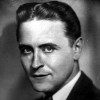
The Intellect engages us in the pursuit of Truth. The Passions impel us to Action.
[Cogitatio in vero exquirendo maxime versatur, appetitus impellit ad agendum.]
Marcus Tullius Cicero (106–43 BC) Roman orator, statesman, philosopher
De Officiis [On Duties; On Moral Duty; The Offices], Book 1, ch. 35 (1.35) / sec. 132 (44 BC) [Barnes (1814)]
(Source (Latin)). Other translation:Reflection is chiefly employed in the investigation of truth, appetite impels to action.
[tr. McCartney (1798)]Reflection chiefly applies itself in the search of truth. Appetite prompts us to action.
[tr. Edmonds (1865)]Thought is occupied chiefly in seeking the truth; impulse urges to action.
[tr. Peabody (1883)]Thought is employed in the discovery of truth, appetite impels to action.
[tr. Gardiner (1899)]Thought is occupied chiefly with the discovery of truth; impulse prompts to action.
[tr. Miller (1913)]Thought is mostly expended in seeking out the truth, passion urges men to action.
[tr. Edinger (1974)]
The mind is like a well-endowed museum, only a small fraction of its holdings on view at any one time.
James Richardson (b. 1950) American poet
Vectors: Aphorisms and Ten-Second Essays, #407 (2001)
(Source)

Habit is stronger than reason.
George Santayana (1863–1952) Spanish-American poet and philosopher [Jorge Agustín Nicolás Ruíz de Santayana y Borrás]
Interpretations of Poetry and Religion, ch. 9 (1900)
(Source)
MARCUS: As a field, though fertile, cannot yield a harvest without cultivation, no more can the mind without learning.
[Ut ager quamvis fertilis sine cultura fructuosus esse non potest, sic sine doctrina animus.]
Marcus Tullius Cicero (106–43 BC) Roman orator, statesman, philosopher
Tusculan Disputations [Tusculanae Disputationes], Book 2, ch. 5 (2.5) / sec. 13 (2.13) (45 BC) [tr. Peabody (1886)]
(Source)
Often rendered in reverse order (see Harbottle, below).
Original Latin. Other translations:As a Field, though it be Fruitful, without Tillage cannot bring a good Crop, so the Soul without Learning.
[tr. Wase (1643)]As the field naturally fruitful cannot produce a crop, without dressing, so neither can the mind, without improvement.
[tr. Main (1824)]As the field, however fertile, cannot be fruitful without culture, so with the mind, without learning.
[tr. Otis (1839)]As a field, although it may be naturally fruitful cannot produce a crop, without dressing, so neither can the mind, without education.
[tr. Yonge (1853)]A mind without instruction can no more bear fruit than can a field, however fertile, without cultivation.
[ed. Harbottle (1897)]Just as a field however fertile cannot be fruitful without cultivation, neither can the soul without instruction.
[tr. Douglas (1990)]Just as a field, however fertile, cannot be productive without cultivation, so the soul cannot be without teaching.
[tr. Davie (2017)]
Just as most soldiers believe bullets will hit only others, not themselves, most citizens like to think that their own minds and thought processes are invulnerable. “Other people can be manipulated, but not me,” they declare. People like to think that their opinions, values and ideas are inviolate and totally self-regulated. They may admit grudgingly that they are influenced slightly by advertising. Beyond that, they want to preserve a myth in which other persons are weak-minded and easily influenced, but they are strong-minded.
Margaret Singer (1921–2003) American clinical psychologist and researcher
“The ‘Not Me’ Myth: Orwell and the Mind,” Idea (19 Jan 1996)
(Source)

MARCUS: For such is the work of philosophy. It cures souls, draws off vain anxieties, confers freedom from desires, drives away fears.
[Nam efficit hoc philosophia: medetur animis, inanes sollicitudines detrahit, cupiditatibus liberat, pellit timores.]
Marcus Tullius Cicero (106–43 BC) Roman orator, statesman, philosopher
Tusculan Disputations [Tusculanae Disputationes], Book 2, ch. 4 (2.4) / sec. 11 (2.11) (45 BC) [tr. Peabody (1886)]
(Source)
(Source (Latin)). Other translations:This is the proper work of Philosophy, it healeth the Distempers of the mind, removeth vain Disquiets, sets free from impetuous Desires, banisheth Fears
[tr. Wase (1643)]For it is the effect of philosophy, which is the medicine of our souls; it discharges all groundless apprehensions, frees us from desires, drives away fears.
[tr. Main (1824)]For such is the effect of philosophy. She heals the mind, banishes its vain solicitudes, delivers it from the chains of cupidity, expels its fearful apprehensions.
[tr. Otis (1839)]It is the effect of philosophy, which is the medicine of our souls; it banishes all groundless apprehensions, frees us from desires, and drives away fears.
[tr. Yonge (1853)]It is the effect of philosophy. It provides medicine for the soul, takes away futile worries, frees us from desires, banishes fears.
[tr. Davie (2017)]
The years come when the mind, like an old mill, ceases to grind; when weeds grow on the wall; and through every crack and leak in dam and sluice, spouts the useless water.
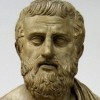
And speech he has learned, and thought
So swift, and the temper of mind
To dwell within cities, and not to lie bare
Amid the keen, biting frosts
Or cower beneath pelting rain;
Full of resource against all that comes to him
is Man. Against Death alone
He is left with no defence.[καὶ φθέγμα καὶ ἀνεμόεν φρόνημα καὶ ἀστυνόμους
ὀργὰς ἐδιδάξατο καὶ δυσαύλων
πάγων ὑπαίθρεια καὶ δύσομβρα φεύγειν βέλη
παντοπόρος: ἄπορος ἐπ᾽ οὐδὲν ἔρχεται
τὸ μέλλον: Ἅιδα μόνον φεῦξιν οὐκ ἐπάξεται.]Sophocles (496–406 BC) Greek tragic playwright
Antigone, l. 354ff, Stasimon 1, Strophe 2 [Chorus] (441 BC) [tr. Kitto (1962)]
(Source)
Original Greek. Other translations:Language and lofty thought,
And dispositions meet for order'd cities,
These he hath taught himself; -- and how to shun
The shafts of comfortless winter, --
Both those which smite when the sky is clear,
And those which fall in showers; --
with plans for all things,
Planless in nothing, meets he the future!
Of death alone the avoidance
No foreign aid will bring.
[tr. Donaldson (1848)]Speech and the wind-swift speed of counsel and civic wit,
He hath learnt for himself all these; and the arrowy rain to fly
And the nipping airs that freeze, 'neath the open winter sky.
He hath provision for all: fell plague he hath learnt to endure;
Safe whate'er may befall: yet for death he hath found no cure.
[tr. Storr (1859)]Wise utterance and wind-swift thought, and city-moulding mind,
And shelter from the clear-eyed power of biting frost,
He hath taught him, and to shun the sharp, roof-penetrating rain, --
Full of resource, without device he meets no coming time;
From Death alone he shall not find reprieve;
No league may gain him that relief.
[tr. Campbell (1873)]Speech and thought fast as the wind and the moods that give order to a city he has taught himself, and how to flee the arrows of the inhospitable frost under clear skies and the arrows of the storming rain. He has resource for everything. Lacking resource in nothing he strides towards what must come. From Death alone he shall procure no escape.
[tr. Jebb (1891)]And speech, and wind-swift thought, and all the moods that mould a state, hath he taught himself; and how to flee the arrows of the frost, when 'tis hard lodging under the clear sky, and the arrows of the rushing rain; yea, he hath resource for all; without resource he meets nothing that must come: only against Death shall he call for aid in vain.
[tr. Jebb (1917)]Words also, and thought as rapid as air,
He fashions to his good use; statecraft is his,
And his the skill that deflects the arrows of snow,
The spears of winter rain: from every wind
He has made himself secure -- from all but one:
In the late wind of death he cannot stand.
[tr. Fitts/Fitzgerald (1939)]The use of language, the wind-swift motion of brain
He learnt; found out the laws of living together
In cities, building him shelter against the rain
And wintry weather.
There is nothing beyond his power. His subtlety
Meeteth all chance, all danger conquereth.
For every ill he hath found its remedy,
Save only death.
[tr. Watling (1947), l. 295ff]Language, and thought like the wind
and the feelings that make the town,
he has taught himself, and shelter against the cold,
refuge from rain. He can always help himself.
He faces no future helpless. There's only death
that he cannot find an escape from.
[tr. Wyckoff (1954)]And speech and thought, quick as the wind
and the mood and mind for law that rules the city --
all these he has taught himself
and shelter from the arrows of the frost
when there's rough lodging under the cold clear sky
and the shafts of lashing rain --
ready, resourceful man!
Never without resources
never an impasse as he marches on the future --
only Death, from Death alone he will find no rescue.
[tr. Fagles (1982)]Language and a mind swift as the wind
For making plans --
These he has taught himself --
And the character to live in cities under law.
He's learned to take cover from a frost
And escape sharp arrows of sleet.
He has the means to handle every need,
Never steps toward the future without the means.
Except for Death: He's got no relief from that.
[tr. Woodruff (2001)]Both language and thought swift as wind
and impulses that govern cities,
he has taught himself, as well as how
to escape the shafts of rain
while encamped beneath open skies.
All resourceful, he approaches no future thing
to come without resource. From Hades alone
he will not contrive escape.
[tr. Tyrell/Bennett (2002)]And man has learnt speech and thought, swifter than the wind he mastered
And learnt to govern his cities well
And this omniscient being has learnt how to avoid the blasts of the wild open air: the arrows of the freezing night, the dreadful wind driven piercing gale!
He’s prepared for all events bar Death and from Death he can find no escape.
[tr. Theodoridis (2004)]He’s taught himself speech and wind-swift thought,
trained his feelings for communal civic life,
learning to escape the icy shafts of frost,
volleys of pelting rain in winter storms,
the harsh life lived under the open sky.
That’s man -- so resourceful in all he does.
There’s no event his skill cannot confront --
other than death -- that alone he cannot shun.
[tr. Johnston (2005), l. 405ff]He taught himself language and wind-like thought and city-ruling urges, how to flee the slings of frost under winter's clear sky and the arrows of stormy rain, ever-resourceful. Against no possibility is he at a loss. For death alone he finds no aid.
[tr. Thomas (2005)]
Intellect needs to be understood not as some kind of a claim against the other human excellences for which a fatally high price has to be paid, but rather as a complement to them without which they cannot be fully consummated.
Richard Hofstadter (1916–1970) American historian and intellectual
Anti-Intellectualism in American Life, Part 1, ch. 2 “On the Unpopularity of Intellect” (1962)
(Source)
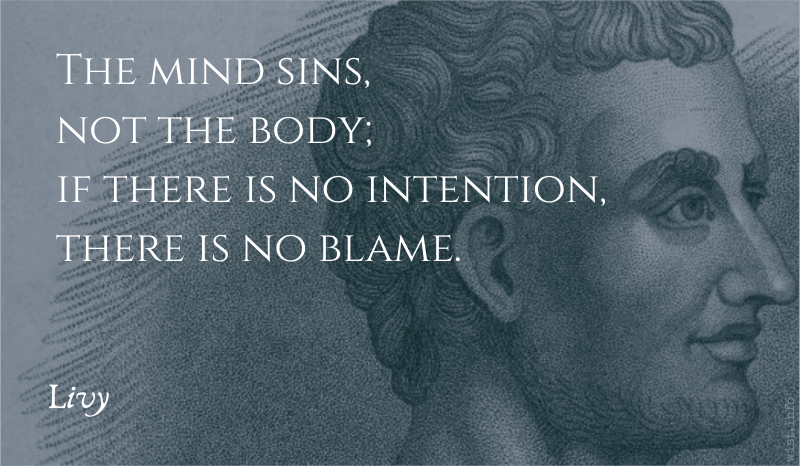
The mind sins, not the body; if there is no intention, there is no blame.
[Mentem peccare, non corpus, et unde consilium abfuerit, culpam abesse.]
Livy (59 BC-AD 17) Roman historian [Titus Livius]
Ab Urbe Condita [From the Founding of the City; The History of Rome], Book 1, ch. 58 (27-9 BC)
Reassurances given to Lucretia, wife of Collatinus, after her rape by Sextus Tarquin. She still kills herself.
Different sources use abfuerit or afuerit. Restated as a legal term, it's usually given as Mens peccat, non corpus, et unde consilium abfuit, culpa abest.
Other translations:
- "That it is the mind sins, not the body; and that where intention was wanting guilt could not be." [tr. Spillan (1896)]
- "The mind sins, not the body, and there is no guilt when intent is absent." [tr. Luce]
- "The mind sins, not the body; and where the power of judgment has been absent, guilt is absent." [Source]
- "The mind alone was capable of sinning, not the body, and that where there was no such intention, there could be no guilt." [tr. Baker (1823)]
- "It is the mind that sins, not the body, and where there has been no consent there is no guilt." [tr. Roberts (1905)]
- "It is the mind that sins, not the body; and that where purpose has been wanting there is no guilt." [tr. Foster (1919)]
- "It is the will only that is capable of sinning, not the body; and where there is no intention, there can be no guilt." [Source]
Such as are thy habitual thoughts, such also will be the character of thy mind; for the soul is dyed by the thoughts.
[Οἷα ἂν πολλάκις φαντασθῇς, τοιαύτη σοι ἔσται ἡ διάνοια: βάπτεται γὰρ ὑπὸ τῶν φαντασιῶν ἡ ψυχή.]
Marcus Aurelius (AD 121–180) Roman emperor (161–180), Stoic philosopher
Meditations [To Himself; Τὰ εἰς ἑαυτόν], Book 5, ch. 16 (2.5) (AD 161-180) [tr. Long (1862)]
(Source)
(Source (Greek)). Other translations:Such as thy thoughts and ordinary cogitations are, such will thy mind be in time. For the soul doth as it were receive its tincture from the fancies, and imaginations.
[tr. Casaubon (1634), 5.15]Your Manners will depend very much upon the Quality of what you frequently think on; For the Soul is as it were Tinged with the Colour, and Complexion of Thought.
[tr. Collier (1701)]Such as the imaginations are which you frequently dwell upon, such will be the disposition of your soul. The soul receives a tincture from the imagination.
[tr. Hutcheson/Moor (1742)]Such as are the objects on which your thoughts are most frequently employed, such will be the state of your mind. For the soul takes a tincture from the usual current of its ideas.
[tr. Graves (1792)]Your manners will depend very much upon the quality of what you frequently think on; for the soul is as it were tinged with the color and complexion of thought.
[tr. Collier/Zimmern (1887)]Repeat impressions, and your understanding will assimilate itself to them; for the soul takes the dye of its impressions.
[tr. Rendall (1898)]The character of your most frequent impressions will be the character of your mind. The soul takes colour from its impressions.
[tr. Hutcheson/Chrystal (1902)]The character of thy mind will be such as is the character of thy frequent thoughts, for the soul takes its dye from the thoughts.
[tr. Haines (Loeb) (1916)]As are your repeated imaginations so will your mind be, for the soul is dyed by its imaginations.
[tr. Farquharson (1944)]Your mind will be like its habitual thoughts; for the soul becomes dyed with the colour of its thoughts.
[tr. Staniforth (1964)]As are your regular impressions, so will your mind be also; for the soul takes its colouring from its impressions.
[tr. Hard (1997 ed.)]The things you think about determine the quality of your mind. Your soul takes on the color of your thoughts.
[tr. Hays (2003)]Your mind will take on the character of your most frequent thoughts: souls are dyed by thoughts.
[tr. Hammond (2006)]Whatever kind of impressions you receive most often, so too will be your mind, for the soul is dyed with the color of one's impressions.
[tr. Needleman/Piazza (2008)]As are your habitual conceptions, so will your mind be also; for the soul takes its colouring from its conceptions.
[tr. Hard (2011 ed.)]As your most frequent impressions are, so will your mind be: your character is coloured by its impressions.
[tr. Gill (2013)]
He says, You have to study and learn so that you can make up your own mind about history and everything else but you can’t make up an empty mind. Stock your mind, stock your mind. It is your house of treasure and no one in the world can interfere with it. If you won the Irish Sweepstakes and bought a house that needed furniture would you fill it with bits and pieces of rubbish? Your mind is your house and if you fill it with rubbish from the cinemas it will rot in your head. You might be poor, your shoes might be broken, but your mind is a palace.
Psychiatry is all biological and all social. there is no mental function without brain and social context. To ask how much of mind is biological and how much social is as meaningless as to ask how much of the area of a rectangle is due to its width and how much to its height, or how much of the phenotype is due to genes and how much to environment.
Leon Eisenberg (1922–2009) American psychiatrist and medical educator
“The social construction of the human brain,” American Journal of Psychiatry (Nov 1995)
(Source)
The most merciful thing in the world, I think, is the inability of the human mind to correlate all its contents. We live on a placid island of ignorance in the midst of black seas of infinity, and it was not meant that we should voyage far. The sciences, each straining in its own direction, have hitherto harmed us little; but some day the piecing together of dissociated knowledge will open up such terrifying vistas of reality, and of our frightful position therein, that we shall either go mad from the revelation or flee from the deadly light into the peace and safety of a new dark age.
H. P. Lovecraft (1890–1937) American fabulist [Howard Phillips Lovecraft]
“The Call of Cthulhu,” ch. 1, opening words (1928)
(Source)

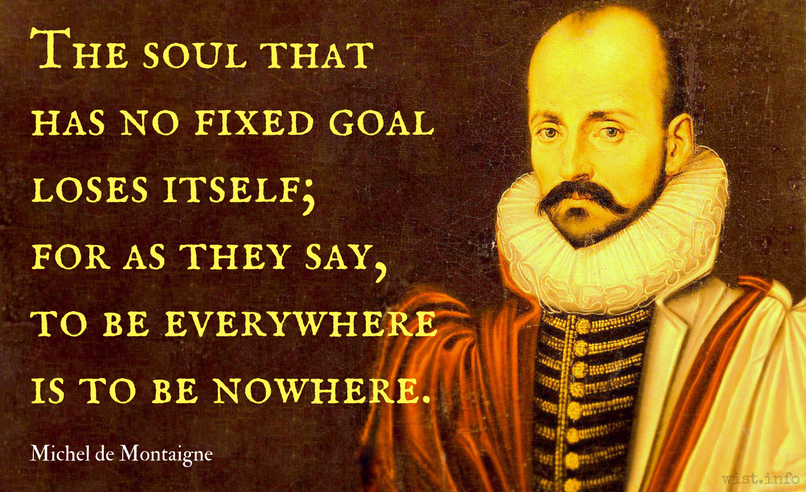
The mind that has no fixed goal loses itself; for as they say, to be everywhere is to be nowhere.
[L’âme qui n’a point de but établi, elle se perd: car comme on dit, c;est n’ètre en aucun lieu que d’être partout.]
Michel de Montaigne (1533–1592) French essayist
Essays, Book 1, ch. 8 (1.8), “Of Idleness [De l’Oisiveté]” (1572) [tr. Ives (1925)]
(Source)
This essay appeared in the 1st ed. (1580), and was modified in each of the following.
The proverb referenced is from Martial (ep. 7.73); it was paraphrased as indicated in the 1st ed., and then the actual Latin quotation ("Quisquis ubique habitat, Maxime, nusquam habitat") was added in the 2nd ed. (1588).
(Source (French)). Other translations:The minde that hath no fixed bound, will easilie loose it selfe: For, as wee say, To be everie where, is to be no where.
[tr. Florio (1603)]The Soul that has no establish’d Limit to circumscribe it, loses it self, as the Epigrammist says, He that lives every where, does no where live.
[tr. Cotton (1686)]The soul that has no established aim loses itself, for, as it is said -- "Quisquis ubique habitat, Maxime, nusquam habitat."
[tr. Cotton/Hazlitt (1877)]The soul that has no established limits to circumscribe itself, loses itself. As the epigrammatist says, "He that is everywhere is nowhere."
[tr. Rector (1899)]The soul that has no fixed goal loses itself; for as they say, to be everywhere is to be nowhere.
[tr. Frame (1943)]When the soul is without a definite aim, she gets lost; for, as they say, if you are everywhere you are nowhere.
[tr. Screech (1987)]The mind that has no fixed aim loses itelf, for, as they say, to be everywhere is to be nowhere.
[tr. Cohen (1993)]A soul with no fixed goal is sure to lose its way for, as they say, to be everywhere is to be nowhere.
[tr. HyperEssays (2023)]
It’s probably wrong to believe there can be any limit to the horror which the human mind can experience. On the contrary, it seems that some exponential effect begins to obtain as deeper and deeper darkness falls — as little as one may like to support the idea that when the nightmare grows black enough, horror spawns horror, one coincidental evil begets other, often more deliberate evils, until finally blackness seems to cover everything.
And the most terrifying question of all may be just how much horror the human mind can stand and still maintain a wakeful, staring, unrelenting sanity. That such events have their own Rube Goldberg absurdity goes almost without saying. At some point, it all starts to become rather funny. That may be the point at which sanity begins either to save itself or to buckle and break down; that point at which one’s sense of humor begins to reassert itself.
Stephen King (b. 1947) American author
Pet Sematary (1983)

Happiness is beneficial for the body but it is grief that develops the powers of the mind.
Marcel Proust (1871–1922) French author
Remembrance of Things Past (1913-27)
Philosophy directs us first to seek the goods of the mind, and the rest will either be supplied, or are not much wanted.
Francis Bacon (1561–1626) English philosopher, scientist, author, statesman
Advancement of Learning, 8.2 (1605)

No state can be more destitute than that of a him who, when the delites of sense forsake him, has no pleasures of the mind.
Samuel Johnson (1709–1784) English writer, lexicographer, critic
The Plays of William Shakespeare, “Cymbeline” (1765)
Men, as well as women, are much oftener led by their hearts than by their understandings.
Lord Chesterfield (1694–1773) English statesman, wit [Philip Dormer Stanhope]
Letter to his son, #154 (21 Jan 1748)
(Source)
The great business of study is to form a mind adapted and adequate to all times and all occasions; to which all nature is then laid open, and which may be said to possess the key of her inexhaustible riches.
Joshua Reynolds (1723–1792) British painter, critic
“Discourse Eleven” (10 Dec 1782)

Lock up your libraries if you like; but there is no gate, no lock, no bolt that you can set upon the freedom of my mind.
Virginia Woolf (1882–1941) English modernist writer [b. Adeline Virginia Stephen]
A Room of One’s Own, ch. 4 (1929)
(Source)
It behooves all men who wish to excel the other animals to strive with might and main not to pass through life unheralded, like the beasts, which Nature has fashioned groveling and slaves to the belly. All our power, on the contrary, lies in both mind and body; we employ the mind to rule, the body rather to serve; the one we have in common with the Gods, the other with the brutes. Therefore I find it becoming, in seeking renown, that we should employ the resources of the intellect rather than those of brute strength, to the end that, since the span of life which we enjoy is short, we may make the memory of our lives as long as possible.
[Omnis homines qui sese student praestare ceteris animalibus summa ope niti decet ne vitam silentio transeant veluti pecora, quae natura prona atque ventri oboedientia finxit. Sed nostra omnis vis in animo et corpore sita est; animi imperio, corporis servitio magis utimur; alterum nobis cum dis, alterum cum beluis commune est. Quo mihi rectius videtur ingeni quam virium opibus gloriam quaerere et, quoniam vita ipsa qua fruimur brevis est, memoriam nostri quam maxume longam efficere.]
Sallust (c. 86–35 BC) Roman historian and politician [Gaius Sallustius Crispus]
Bellum Catilinae [The War of Catiline; The Conspiracy of Catiline], ch. 1, sent. 1-3 [tr. Rolfe (1931)]
(Source)
Original Latin. Other translations:"To maintain the dignity of human nature is the true ambition of man; and to that end it becomes the duty of all, who aspire to distinguish themselves from the race of inferior animals, to exert their most strenuous efforts, lest they pass their days in silence, like the herds of the field, formed by nature prone to the earth, and governed altogether by the incitements of appetite. Man is composed of mind and body, and in the exercise of both consists the energy of his nature. The mind is the directing principle; the body is subservient. The former we participate with the gods; the latter we hold in common with the brute creation. Hence the fame acquired by our intellectual powers has ever appeared to me the truest glory, far superior to all that can be achieved by mere corporeal vigor; and since the life we enjoy is frail and transitory, it should be the endeavour of every man to extend his fame, and leave a lasting memorial of his existence." [tr. Murphy (1807)]"Men who would act up to the dignity of their nature ought not to pass their lives in obscurity, like the beasts of the field, formed with bodies prone to the earth, and under necessary subjection to their appetites. Now, our faculties are twofold; those of the soul, and those of the body: the soul was designed for sovereign command, the body for subjection: the former we enjoy in common with the gods, the latter with the brute creation. So that to me it appears more agreeable to nature to pursue glory by the abilities of the mind than those of the body; and as our lives are but of short duration, it should be our study to render our memory immortal." [tr. Rose (1831)]"It becomes all men, who are anxious that they should excel other animals, to strive with their utmost might that they may not pass their life in silence like cattle, which nature has formed with their faces downwards, and slaves to their belly. But all our vigour is placed in the mind and in the body. We for the most part make use of the government of the mind, the submission of the body. The one we have in common with the gods, and the other with brutes. Wherefore it appears to me more proper to seek for glory by the abilities of the mind rather than by those of mere force; and since that life which we enjoy is short, to make the memory of ourselves as lasting as possible." [Source (1841)]"It becomes all men, who desire to excel other animals, to strive, to the utmost of their power, not to pass through life in obscurity, like the beasts of the field, which nature has formed groveling and subservient to appetite. All our power is situated in the mind and in the body. Of the mind we rather employ the government; of the body, the service. The one is common to us with the gods; the other with the brutes. It appears to me, therefore, more reasonable to pursue glory by means of the intellect than of bodily strength, and, since the life which we enjoy is short, to make the remembrance of us as lasting as possible." [tr. Watson (1867)]"Every man who is anxious to excel the lower animals should strive with all his power not to pass his life in obscurity like the brute beasts, whom nature has made the grovelling slaves of their belly. Now our whole ability resides jointly in our mind and body. In the case of the mind it is its power of guidance, in the case of the body its obedient service that we rather use, sharing the former faculty with the gods, the latter with the brute creation. This being so, I think it right to seek repute by my powers rather of intellect than of strength, and since the very life which we enjoy is short, to make the memory of us as abiding as may be." [tr. Pollard (1882)]"All persons who are enthusiastic that they should transcend the other animals ought to strive with the utmost effort not to pass through a life of silence like the cattle, which nature has fashioned to be prone and obedient to their stomachs. Our entire power resides in the mind as well as the body: we use the mind to command, the body to serve; the former we share wit the gods, the latter with the beasts. Therefore it seems to me more correct to seek glory with our intellectual rather than with our physical resources, and, because the very life that we enjoy is short, to ensure that a recollection of ourselves lasts as long as possible. [tr. Woodman (2007)]
For the renown which riches or beauty confer is fleeting and frail; mental excellence is a splendid and lasting possession.
[Nam divitiarum et formae gloria fluxa atque fragilis est, virtus clara aeternaque habetur.]
Sallust (c. 86–35 BC) Roman historian and politician [Gaius Sallustius Crispus]
Bellum Catilinae [The War of Catiline; The Conspiracy of Catiline], ch. 1, sent. 4 [tr. Rolfe (1931)]
(Source)
Original Latin. Other translations:
- "For what are all the advantages of wealth, and all the graces of form and feature? mere precarious gifts, that soon fade and moulder away. It is virtue, and virtue only, that ennobles the human character, and lives in the memory of the after-times." [tr. Murphy (1807)]
- "For the splendour derived from riches and beauty is short-lived and frail, virtue alone confers immortality." [tr. Rose (1831)
- "For the glory of riches and beauty is fickle and frail; virtue is accounted bright and everlasting." [Source (1841)]
- "For the glory of wealth and beauty is fleeting and perishable; that of intellectual power is illustrious and immortal." [tr. Watson (1867)]
- "The glory of wealth and beauty is fleeting and frail, but personal merit is held in eternal honour." [tr. Pollard (1882)]
- "The glory of riches and appearance is fleeting and fragile, but to have prowess is something distinguished and everlasting. [tr. Woodman (2007)]
- "For the fame of riches and beauty is fickle and frail, while virtue is eternally excellent."
The present state of civilized nations and their past history bear witness on the same side. So far as any nation recognises, or has recognised, the great truth, that every dictum, every belief, must be tested and tried to the uttermost, and swept ruthlessly away if it be not in accordance with right reason, so far is that nation prosperous and healthy; and so far as a nation has allowed itself to be hood-winked and fettered, and the free application of its intellect, as the criterion of all truth, restricted, so far is it sinking and rotten within. There is one restriction, and only one, so far as I know, placed upon our supreme arbiter. It is, that it shall be actuated by an uncompromising and unswerving love of truth. With that, the human intellect is the nearest in personification of the Divine; without that, it is, in my apprehension, the worst of conceivable devils.
T. H. Huxley (1825–1895) English biologist [Thomas Henry Huxley]
“Science and Religion,” lecture (Dec 1858)
(Source)
Quoted in The Government School of Mines, The Builder (Jan 1859)
The only difference between me and most people is that I’m perfectly aware that all my important decisions are made for me by my subconscious. My frontal lobes are just kidding themselves that they decide anything at all. All they do is think up reasons for the decisions that are already made.
Rex Stout (1886–1975) American writer
In “Author Rex Stout vs. the FBI,” Interview with Sandra Schmidt, Life (10 Dec 1965)
Yet for a long time mortal men have discussed the question whether success in arms depends more on strength of body or excellence of mind; for before you begin, deliberation is necessary, when you have deliberated, prompt action. Thus each of these, being incomplete of itself, requires the other’s aid.
[Sed diu magnum inter mortalis certamen fuit vine corporis an virtute animi res militaris magis procederet. Nam et prius quam incipias, consulto, et ubi consulueris, mature facto opus est. Ita utrumque per se indigens alterum alterius auxilio eget.]
Sallust (c. 86–35 BC) Roman historian and politician [Gaius Sallustius Crispus]
Bellum Catilinae [The War of Catiline; The Conspiracy of Catiline], ch. 1, sent. 5-7 [tr. Rolfe (1931)]
(Source)
Original Latin. Other translations:"But a just estimate of our mental and bodily faculties was not easily made. Which of them was most conducive to the success of military operations, was in former times a question much agitated, and long undecided. It is evident, however, that before the undertaking of a warlike enterprise, judgment is required to concert and plan the necessary measures; vigor in execution is equally necessary. The powers of man, in their separate functions feeble and ineffectual, demand each other's aid, and flourish by mutual assistance." [tr. Murphy (1807)]"It has, however, been a great and long debate, whether success in war is most owing to bodily strength or mental abilities: for, as counsel is necessary before we enter on action, after measures are duly concerted, speedy execution is equally necessary; so that neither of these being sufficient singly, they prevail only by the assistance of each other." [tr. Rose (1831)]"But there has been for a long time a great debate amongst mortals, whether the science of war advanced more by the strength of body or by the abilities of the mind. For both before you begin there is need of counsel; and when you have counselled, there is need of vigorous execution. So whilst both by themselves are defective, the one is strengthened by the assistance of the other." [Source (1841)]"Yet it was long a subject of dispute among mankind, whether military efforts were more advanced by strength of body, or by force of intellect. For, in affairs of war, it is necessary to plan before beginning to act, and, after planning, to act with promptitude and vigor. Thus, each being insufficient of itself, the one requires the assistance of the other." [tr. Watson (1867)]"Not it was long hotly contested among men whether military success was more advanced by mental ability or by bodily strength, for what we need is deliberation before we begin, and after deliberation, then well-timed action; either of itself is deficient and lacks the other's help." [tr. Pollard (1882)]"Yet for a long time there was considerable dispute amongst mortals as to whether it was through the power of the body or the prowess of the mind that military affairs made greater progress. For, before you begin, deliberation is necessary, and, when you have deliberated, speedy action: hence each element, deficient on its own, requires the help of the other." [tr. Woodman (2007)]
Questions show the mind’s range, and answers, its subtlety.
[Les questions montrent l’étendue de l’esprit, et les réponses sa finesse.]Joseph Joubert (1754–1824) French moralist, philosopher, essayist, poet
Pensées [Thoughts], ch. 4 “De la Nature des Esprits [On the Nature of Minds],” ¶ 62 (1850 ed.) [tr. Lyttelton (1899), ch. 3, ¶ 21]
(Source)
(Source (French))
While confirmed as an entry in the French, I was unable to find translations other than Lyttelton's in my various sources.
Reading is to the mind, what exercise is to the body: as by the one, health is preserved, strengthened and invigorated; by the other, virtue, which is the health of the mind, is kept alive, cherished and confirmed. But as exercise becomes tedious and painful when we make use of it only as the means of health, so reading is apt to grow uneasy and burdensome, when we apply ourselves to it only for our improvement in virtue. For this reason, the virtue which we gather from a sable, or an allegory, is like the health we get by hunting; as we are engaged in an agreeable pursuit that draws us on with pleasure, and makes us insensible of the fatigues that accompany it.
Richard Steele (1672–1729) Anglo-Irish writer, journalist, playwright, politician
Essay (1709-03-17), The Tatler, No. 147
(Source)
There is a doom inexorable and a law inviolable, or there is a providence that can be merciful, or else there is a chaos that is purposeless and ungoverned. If a resistless fate, why try to struggle against it? If a providence willing to show mercy, do your best to deserve its divine succour. If a chaos undirected, give thanks that amid such stormy seas you have within you a mind at the helm.
[Ἤτοι ἀνάγκη εἱμαρμένης καὶ ἀπαράβατος τάξις ἢ πρόνοια ἱλάσιμος ἢ φυρμὸς εἰκαιότητος ἀπροστάτητος. εἰ μὲν οὖν ἀπαράβατος ἀνάγκη, τί ἀντιτείνεις; εἰ δὲ πρόνοια ἐπιδεχομένη τὸ ἱλάσκεσθαι, ἄξιον σαυτὸν ποίησον τῆς ἐκ τοῦ θείου βοηθείας. εἰ δὲ φυρμὸς ἀνηγεμόνευτος, ἀσμένιζε ὅτι ἐν τοιούτῳ κλύδωνι αὐτὸς ἔχεις ἐν σαυτῷ τινα νοῦν ἡγεμονικόν.]
Marcus Aurelius (AD 121–180) Roman emperor (161–180), Stoic philosopher
Meditations [To Himself; Τὰ εἰς ἑαυτόν], Book 12, ch. 14 (12.14) (AD 161-180) [tr. Staniforth (1964)]
(Source)
Original Greek. Other translations:Either fate, (and that either an absolute necessity, and unavoidable decree; or a placable and flexible Providence) or all is a mere casual confusion, void of all order and government. If an absolute and unavoidable necessity, why doest thou resist? If a placable and exorable Providence, make thyself worthy of the divine help and assistance. If all be a mere confusion without any moderator, or governor, then hast thou reason to congratulate thyself; that in such a general flood of confusion thou thyself hast obtained a reasonable faculty, whereby thou mayest govern thine own life and actions.
[tr. Casaubon (1634), #11]Either the Order of Things are fixed by irrevocable Fate, or Providence may be worked into Compassion, or else the World Floats at Random without any Steerage. Now if nature lies under immovable Necessity, to what purpose should you struggle against it? If the favor of Providence is to be gained, qualify your self for the Divine Assistance: But if Chance, and Confusion carry it, and no body sits at the Helm; be you contented and Ride out the Storm patiently, for you have a Governor within you , though the World has none.
[tr. Collier (1701)]There is either a fatal necessity, and an unalterably fixed order; or a kind and benign providence; or a blind confusion, without a governor. If there be an unalterable necessity, why strive against it? If there is a kind providence, which can be appeased; make yourself worthy of the divine aids. If there is an ungoverned confusion; yet compose yourself with this, that, amidst these tempestuous waves, you have a presiding intelligence within yourself.
[tr. Hutcheson/Moor (1742)]Either all things are fixed by a fatal necessity and an inviolable order; or they are governed by a benevolent providence; or they proceed at random, without any one to direct them.
Now, if there be an immutable necessity, why do we struggle against it? If a kind and merciful Providence presides, make yourself worthy of the divine assistance: if the world is all confusion, without any one to conduct it, comfort yourself however that, amidst these tempestuous waves, you have an intelligent guide within your breast.
[tr. Graves (1792)]Either there is a fatal necessity and invincible order, or a kind providence, or a confusion without a purpose and without a director. If then there is an invincible necessity, why dost thou resist? But if there is a providence which allows itself to be propitiated, make thyself worthy of the help of the divinity. But if there is a confusion without a governor, be content that in such a tempest thou hast in thyself a certain ruling intelligence.
[tr. Long (1862)]Either the order of things is fixed by irrevocable fate, or providence may be worked into compassion, or else the world floats at random without any steerage. Now if nature lies under an immovable necessity, to what purpose should you struggle against it? If the favor of providence is to be gained, qualify yourself for divine assistance; but if chance and confusion prevail, be you contented that in such a storm you have a governing intelligence within you.
[tr. Collier/Zimmern (1887)]Either fixed necessity and inviolable order, or a merciful providence, or a random and ungoverned medley. If an inviolable necessity, why resist? If a providence waiting to be merciful, make yourself worthy of divine aid. If a chaos uncontrolled, be thankful that amid the wild waters you have yourself an Inner governing mind.
[tr. Rendall (1898)]There is either a fatal necessity, an unalterable order, or a placable Providence, or a blind confusion without a governor. If there be an unalterable necessity, why strive against it? If there be a Providence admitting of propitiation, make yourself worthy of the divine aid. If there be an ungoverned confusion, be comforted; seeing that in this tempest you have within yourself a guiding intelligence.
[tr. Hutcheson/Chrystal (1902)]There must be either a predestined Necessity and inviolable plan, or a gracious Providence, or a chaos without design or director. If then there be an inevitable Necessity, why kick against the pricks? If a Providence that is ready to be gracious, render thyself worthy of divine succour. But if a chaos without guide, congratulate thyself that amid such a surging sea thou hast a guiding Reason.
[tr. Haines (Loeb) (1916)]Either the Necessity of destiny and an order none may transgress, or Providence that hears intercession, or an ungoverned welter without a purpose. If then a Necessity which none may transgress, why do you resist? If a Providence admitting intercession, make yourself worthy of assistance from the Godhead. If an undirected welter, be glad that in so great a flood of waves you have yourself within you a directing mind.
[tr. Farquharson (1944)]Either an ineluctable destiny and an order that none may overstep, or a providence that can be appeased, or an ungoverned confusion subject to nothing but chance. If, then, an inexorable necessity, why struggle against it? If a providence that allows itself to be appeased, make yourself worthy of aid from the divine. And if an ungoverned confusion, be glad that in such a swirl you have a mind that provides leadership.
[tr. Hard (1997 ed.; 2011 ed.)]Fatal necessity, and inescapable order. Or benevolent Providence. Or confusion -- random and undirected.
If it's an inescapable necessity, why resist it?
If it's Providence, admits of being worshipped, then try to be worthy of God's aid.
If it's confusion and anarchy, then be grateful that on this raging sea you have a mind to guide you.
[tr. Hays (2003)]Either the compulsion of destiny and an order allowing no deviation, or a providence open to prayer, or a random welter without direction. Now if undeviating compulsion, why resist it? If a providence admitting the placation of prayer, make yourself worthy of divine assistance. If an ungoverned welter, be glad that in such a maelstrom you have within yourself a directing mind of your own.
[tr. Hammond (2006)]Either predetermined necessity and unalterable cosmic order, or a gracious providence, or a chaotic ungoverned mixture. If a predetermined necessity, why do you resist? If it is a gracious Providence that can hear our prayers, then make yourself worthy of divine assistance. If a chaotic ungoverned mixture, be satisfied that in the midst of this storm, you have within yourself a mind whose nature it is to govern and command.
[tr. Needleman/Piazza (2008)]
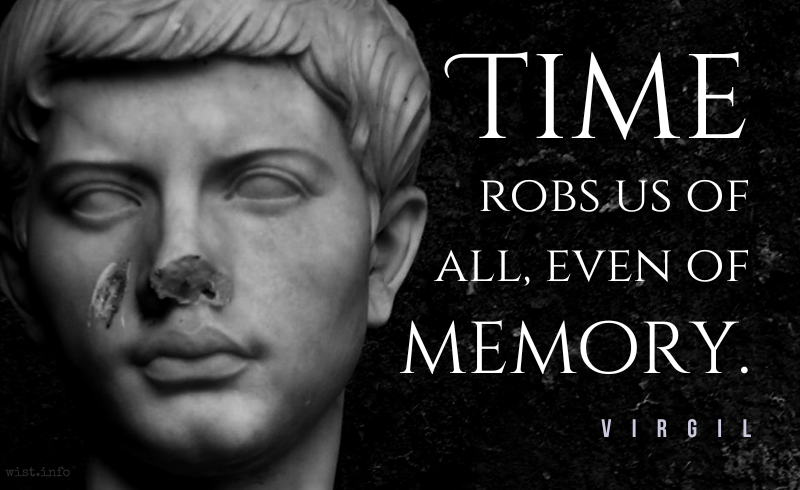
Time robs us of all, even of memory.
[Omnia fert aetas, animum quoque.]
Virgil (70–19 BC) Roman poet [b. Publius Vergilius Maro; also Vergil]
Eclogues [Eclogae, Bucolics, Pastorals], No. 9 “Lycidas and Moeris,” l. 51 (9.51) [Moeris] (42-38 BC) [tr. Fairclough (Loeb) (1916)]
(Source)
(Source (Latin)). Other translations:Age all things wasts: the minde too.
[tr. Ogilby (1649)]The rest I have forgot, for Cares and Time
Change all things, and untune my Soul to Rhyme.
[tr. Dryden (1709), ll. 70-71]Ah! age, which pilfers all, not e'en the memory spares!
[tr. Wrangham (1830), l. 60]Age bears away all things, even the mind itself.
[tr. Davidson (1854)]Time carries all -- our memories e'en -- away.
[tr. Calverley (c. 1871)]Time steals everything, memory among the rest.
[tr. Wilkins (1873)]Now memory scarce can aught recall;
The note is lost, the voice, the all.
[tr. King (1882), ll. 901-902]Alas! Old age bears hard on everything;
On memory most.
[tr. Palmer (1883)]Time carries all things, even our wits, away.
[tr. Greenough (1895)]Age bears away all things, even the memory itself.
[tr. Bryce (1897)]Time runs away with all things, the mind too.
[tr. Mackail (1899)]How time wears all things out!
Even the memory.
[tr. Mackail/Cardew (1908)]Ah, time takes all we have, the memory too.
[tr. Williams (1915)]Time bears away
All things, even the mind.
[tr. Royds (1922)]Time carries everything away, even our memory.
[tr. Rieu (1949)]Age robs us of all things,
Even the mind.
[tr. Johnson (1960)]Time bears all away, even memory.
[tr. Day Lewis (1963)]Time takes all we have away from us.
[tr. Ferry (1999)]Time takes away all things, memory too.
[tr. Kline (2001)]
Whoso would be a man, must be a nonconformist. He who would gather immortal palms must not be hindered by the name of goodness, but must explore if it be goodness. Nothing is at last sacred but the integrity of your own mind.
Ralph Waldo Emerson (1803–1882) American essayist, lecturer, poet
Essay (1841), “Self-Reliance,” Essays: First Series, No. 2
(Source)
This essay was inspired by his reading of Walter Savage Landor in 1833, with passages pulled from his lecture "Individualism," last in his course on "The Philosophy of History" (1836–1837), with other passages from the lectures "School," "Genius," and "Duty" in his course on "Human Life" (1838–1839).
The mind is the expression of the soul, which belongs to God and must be let alone by government.
Adlai Stevenson II (1900–1965) American politician, diplomat, statesman
Speech (1952-10-14), “On Liberty of Conscience,” Mormon Tabernacle, Salt Lake City, Utah
(Source)
It often happens that things come into the mind in a more finished form than could have been achieved after much study.
[Il arrive souvent que des choses se présentent plus achevées à notre esprit qu’il ne les pourrait faire avec beaucoup d’art.]François VI, duc de La Rochefoucauld (1613–1680) French epigrammatist, memoirist, noble
Réflexions ou sentences et maximes morales [Reflections; or Sentences and Moral Maxims], ¶101 (1665-1678) [tr. Tancock (1959)]
(Source)
Present in the 1st (1665) edition, where variants included the phrase:There are pretty things that the mind does not seek, and that it finds all completed in itself; it seems that they are hidden there, like gold and diamonds in the bosom of the earth.
[Il y a des jolies choses que l’esprit ne cherche point, et qu’il trouve toutes achevées en lui-même; il semble qu’elles y soient cachées, comme l’or et les diamants dans le sein de la terre.]
(Source (French)). Other translations:There are certain ingenious things which the mind seeks not after, but finds brought to their full perfection in it self; so that it should seem they lay hid there, as Gold and Diamonds do in the bosom of the earth.
[tr. Davies (1669), ¶190]It often happens, that some things offer themselves to our Wit, and are finer description in the very first thought, than it is possible for a man to make them by the Additions of Art and Study.
[tr. Stanhope (1694), ¶102]It often happens, that some Things offer themselves finer in the very first Thought, than it were possible for a Man to have made them by Art and Study.
[pub. Donaldson (1783)]It often happens, that things present themselves to the mind; more finished, than we, with much labour, can make them.
[ed. Gowens (1851), ¶391]It often happens; that things present themselves to our minds in a more complete state than we could by much art make them arrive at.
[tr. Bund/Friswell (1871), ¶104]Ideas often flash across our minds more complete than we could make them after much labour.
[tr. Heard (1917), ¶101]It often happens that ideas reach our mind in a state of perfection exceeding that which our intellect, with all the resources of art, could fashion.
[tr. FitzGibbon (1957), ¶101]Things often spring spontaneously to mind in a more finished form than could be achieved with great labor and thought.
[tr. Kronenberger (1959), ¶101]
A strong mind is one which does not lose its balance even under the most violent excitement.
[Ein starkes Gemüt ist ein solches, welches auch bei den heftigsten Regungen nicht aus dem Gleichgewicht kommt.]
Karl von Clausewitz (1780–1831) Prussian soldier, historian, military theorist
On War [Vom Kriege], Book 1, ch. 3 “On Military Genius [Der Kriegerische Genius],” (1.3) (1832) [tr. Graham (1873)]
(Source)
(Source (German)). Other translations:A stout heart is one which does not lose its balance even under the most violent excitement.
[tr. Jolles (1943)]A strong character is one that will not be unbalanced by the most powerful emotions.
[tr. Howard & Paret (1976)]
No man lives in the external truth among salts and acids, but in the warm, phantasmagoric chamber of his brain, with the painted windows and the storied wall.
Robert Louis Stevenson (1850–1894) Scottish essayist, novelist, poet
Essay (1888-02), “The Lantern-Bearers,” sec. 3 Scribner’s Magazine, Vol. 3, No. 2
(Source)
Collected in Across the Plains, ch. 7 (1892).
The first of the four cardinal virtues of the Roman Catholic Church is “prudentia,” which basically means damn good thinking. Christ came to take away our sins, not our minds.
William Sloane Coffin, Jr. (1924–2006) American minister, social activist
Credo, “Faith, Hope, Love” (2004)
(Source)
It is by no means certain that our individual personality is the single inhabitant of these our corporeal frames […] We all do things both awake and asleep which surprise us. Perhaps we have cotenants in this house we live in.
ANTONIO: In nature there’s no blemish but the mind;
None can be called deformed but the unkind.William Shakespeare (1564–1616) English dramatist and poet
Twelfth Night, Act 3, sc. 4, l. 386ff (3.4.386-387) (1601)
(Source)

This is in fact the test and use of a man’s education, that he finds pleasure in the exercise of his mind.
Jacques Barzun (1907–2012) French-American historian, educator, polymath
Essay (1950-10-15), “The Educated Man,” Life Magazine
(Source)
More commonly given as "The test and use of a man's education is that he finds pleasure in the exercise of his mind."
Essay collected, under the same name, in Barzun, Begin Here: The Forgotten Conditions of Teaching and Learning, ch. 15 (1991).
For it is not enough to have a good mind; the main thing is to apply it well. The greatest souls are capable of the greatest vices as well as the greatest virtues; and those who proceed but very slowly can make much greater progress, if they always follow the right path, than those who hurry and stray from it.
[Car ce n’est pas assez d’avoir l’esprit bon, mais le principal est de l’appliquer bien. Les plus grandes âmes sont capables des plus grands vices aussi bien que des plus grandes vertus; et ceux qui ne marchent que fort lentement peuvent avancer beaucoup davantage, s’ils suivent toujours le droit chemin, que ne font ceux qui courent et qui s’en éloignent.]
René Descartes (1596–1650) French philosopher, mathematician
Discourse on Method [Discours de la méthode], Part 1 (1637) [tr. Cottingham, Stoothoff (1985)]
(Source)
Sometimes quoted "the main thing is to use it well." (Source (French)). Other translations:For ’tis not enough to have good faculties, but the principal is, to apply them well. The greatest Souls are as capable of the greatest Vices, as of the most eminent Vertues: And those who move but very slowly, may advance much farther, if they always follow the right way; then those who run and straggle from it.
[tr. Newcombe ed. (1649)]For to be possessed of a vigorous mind is not enough; the prime requisite is rightly to apply it. The greatest minds, as they are capable of the highest excellences, are open likewise to the greatest aberrations; and those who travel very slowly may yet make far greater progress, provided they keep always to the straight road, than those who, while they run, forsake it.
[tr. Veitch (1901)For to be possessed of good mental powers is not sufficient; the principal matter is to apply them well. The greatest minds are capable of the greatest vices as well as of the greatest virtues, and those who proceed very slowly may, provided they always follow the straight road, really advance much faster than those who, though they run, forsake it.
[tr. Haldane, Ross (1911)]
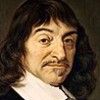
It is the mark of an educated mind to be able to entertain a thought without accepting it.
Aristotle (384–322 BC) Greek philosopher
(Spurious)
First attributed to Aristotle in Lowell L. Bennion, Religion and the Pursuit of Truth (1959). Unfound as such.
Sometimes thought (though I feel it's a bit of a stretch) a misinterpretation of Nicomachean Ethics 1.3.4 (1094b): "For it is the mark of an educated person to search for the same kind of clarity in each topic to the extent that the nature of the matter accepts it."
More discussion of this quotation:
Thought is the work of the intellect, reverie is its self-indulgence. To substitute day-dreaming for thought is to confuse a poison with a source of nourishment.
[La pensée est le labeur de l’intelligence, la rêverie en est la volupté. Remplacer la pensée par la rêverie, c’est confondre un poison avec une nourriture.]
Victor Hugo (1802–1885) French writer, journalist, human rights activist, politician
Les Misérables, Part 4 “Saint Denis,” Book 2 “Eponine,” ch. 1 (4.2.1) (1862) [tr. Denny (1976)]
(Source)
(Source (French)). Other translations:Thought is the labour of the intellect, reverie is its pleasure. To replace thought by reverie is to confound poison with nourishment.
[tr. Wilbour (1862)]Thought is the labor of the intellect, reveries its voluptuousness; substituting reverie for thought is like confounding poison with nutriment.
[tr. Wraxall (1862)]Thought is the toil of the intelligence, revery its voluptuousness. To replace thought with revery is to confound a poison with a food.
[tr. Hapgood (1887)]Thought is the labor of the intellect, reverie its pleasure. To replace thought with reverie is to confound poison with nourishment.
[tr. Wilbour/Fahnestock/MacAfee (1987)]Thought is the exertion of the intellect, daydreaming is its indulgence. To replace thought with daydreaming is to mistake a poison for sustenance.
[tr. Donougher (2013)]