MARY: Some people have such a talent for making the best of a bad situation that they go around creating bad situations so they can make the best of them.
Jean Kerr (1922–2003) American author and playwright [b. Bridget Jean Collins]
Play (1961), Mary, Mary, Act 3
(Source)
Quotations about:
problem-solving
Note not all quotations have been tagged, so Search may find additional quotes on this topic.
The children must be taught how to think, not what to think.
Margaret Mead (1901–1978) American anthropologist
Coming of Age in Samoa, ch. 14 (1928)
(Source)
Often given without the initial "The".
Writing of the need for parents educating children at home to avoid pushing "an ethical cause or a religious belief" through smiles or frowns.
LEELA: Never mind, Doctor, I’ve found the answer.
DOCTOR: You have?
LEELA: Knife them in the neck!
Doctor Who (1963–1989) British science fiction television series, original run (BBC)
15×02 “The Invisible Enemy,” Part 4 (1977-10-22) [w. Bob Baker, Dave Martin]
(Source)
(Source (Video), dialog verified). Sometimes paraphrased: "Don't worry, Doctor. I found the answer: knife them in the neck!"

The way one solves problems obviously influences not only the outcome, but the kinds of problems one faces after the immediate problem is settled.
Molly Ivins (1944–2007) American writer, political columnist [Mary Tyler Ivins]
Essay (2002-11-19), “Blast from the Past,” Creators Syndicate column
(Source)
On use of war and military force to fight terrorism.

If we want to solve a problem that we have never solved before, we must leave the door to the unknown ajar.
Richard Feynman (1918–1988) American physicist
Speech (1955-11), “The Value of Science,” National Academy of Sciences Autumn Meeting, California Institute of Technology, Pasadena
(Source)
Reprinted in What Do You Care What Other People Think? (1988).
Feyman used this general construction on multiple occasions, e.g., in a speech (1964-09), "What Is and What Should Be the Role of Scientific Culture in Modern Society," Galileo Symposium, Florence, Italy (reprinted in The Pleasure of Finding Things Out, ch. 4 (1999) [ed. Jeffrey Robbins]):In order to make progress, one must leave the door to the unknown ajar -- ajar only.
Unfortunately, in real life there are no exact or final answers. In a job which must go ahead at a rapid pace we cannot withhold judgment “until all the facts are in.” Rarely is all the evidence at hand. Decisions must be made, and action taken, before complete knowledge can be acquired.
Hyman Rickover (1900–1986) Polish-American naval engineer, admiral [b. Chaim Gdala Rykower]
Speech (1954-03-16), “Administering a Large Military Development Project,” US Naval Postgraduate School, Monterey, California
(Source)
CHORUS: Fools who fain would carve a name
Of honour in the fields of fame,
Valiant in the press of war,
Men and fighters — fools they are!
How shall death and wounds and shame
Heal the world’s distrated life?
Vain endeavour! Strife of strife
Misbegotten bringeth no release,
Nor by conquest shall man conquer peace.[ΧΟΡΟΣ: ἄφρονες ὅσοι τὰς ἀρετὰς πολέμῳ
λόγχαισί τ᾽ ἀλκαίου δορὸς
κτᾶσθε, πόνους ἀμαθῶς θνα-
τῶν καταπαυόμενοι:
εἰ γὰρ ἅμιλλα κρινεῖ νιν
αἵματος, οὔποτ᾽ ἔρις
λείψει κατ᾽ ἀνθρώπων πόλεις]Euripides (485?-406? BC) Greek tragic dramatist
Helen [Ἑλένη], l. 1151ff, Stasimon 1, Antistrophe 2 (412 BC) [tr. Sheppard (1925)]
(Source)
(Source (Greek)). Other translations:Think you, fond men, whose martial pride
Glows 'midst the bleeding ranks of war,
By the couragous spear
The strife of mortals to decide?
Vain are your thoughts: should rage abhor'd
That glories in the purple flood,
The contest only end with blood,
Unsheath'd through angry states would flame the sword.
[tr. Potter (1783)]Frantic are ye who seek renown
Amid the horrors of th' embattled field,
Who masking guile beneath a laurel crown
With nervous arm the falchion wield,
Not slaughtered thousands can your fury state.
If still success the judgment guide,
If bloody battle right and wrong decide,
Incessant strive must vex each rival state.
[tr. Wodhull (1809)]Foolish ye, as many as obtain [the renown of] valor by war, foolishly resting form the toils of mortals in the spears of valiant war. For if the contest of blood is to determine [men's quarrels], never will strife leave the cities of men.
[tr. Buckley (1850)]You are fools, who try to win a reputation for virtue through war and marshalled lines of spears, senselessly putting an end to mortal troubles; for if a bloody quarrel is to decide it, strife will never leave off in the towns of men.
[tr. Coleridge (1891)]O fools! all ye who try to win the meed of valour through war and serried ranks of chivalry, seeking thus to still this mortal coil, in senselessness; for if bloody contests are to decide, there will never be any lack of strife in the towns of men.
[tr. Coleridge (alt.)]Madmen, all ye who strive for manhood's guerdons
Battling with shock of lances, seeking ease
Senselessly so from galling of life's burdens!
Never, if blood be arbitress of peace,
Strife between towns of men shall find an ending.
[tr. Way (Loeb) (1912)]Madness it is to attempt to find virtue in war
and the blades of the spear in the fight,
so ignorantly to relieve the misfortunes of men.
For if a contest of blood is the arbiter, then there will always
be strife in the cities of men.
[tr. Warner (1951)]You who in earnest ignorance
Would check the deeds of lawless men,
And in the clash of spear on spear
Gain honour -- you are all stark mad!
If men, to settle each dispute
Must needs compete in bloodshed, when
Shall violence vanish, hate be soothed,
Or men and cities live in peace?
[tr. Vellacott (1954), Strophe 2]Mindless, all of you, who in the strength of spears
and the tearing edge win your valors
by war, thus stupidly trying
to halt the grief of the world.
For if bloody debate shall settle
the issue, never again
shall hate be gone out of the cities of men.
[tr. Lattimore (1956)]What fools you are, all who seek to gain honour in war and the clash of spear on spear, stupidly trying to solve men’s troubles by death! If they are to be settled by contest of blood, never will strife end among the cities of men.
[tr. Davie (2002)]You are mad,
You men
Who think that war's
The proof of manhood,
Squabbling with spears and lances --
A futile way
To solve man's problems.
If we settle things
By seeing who can bleed the most,
War will always
Haunt our cities.
[tr. A. Wilson (2007)]Men! What fools they are when they look for glory with spears on the harsh battlefield!
How foolish your efforts to end men’s pains through slaughter!
If it is blood you wish to be the judge of right or wrong in the arguments between men, then war will never leave the cities.
[tr. Theodoridis (2011)]You are fools who would acquire virtue in war
and sharpened point of mighty spear --
stupidly coming to terms with toil -- but your death is the price.
And if a conflict of blood decide, then the strife never will
forsake the cities of mankind.
[tr. Ambrose et al. (2018)]You are fools, who try to win a reputation for virtue [aretē] through war and marshalled lines of spears, senselessly putting an end to mortal troubles [ponos]; for if a bloody quarrel is to decide [krinein] it, strife [eris] will never leave off in the cities [polis] of men
[tr. Coleridge / Helen Heroization Team]
“I don’t see much sense in that,” said Rabbit.
“No,” said Pooh humbly, “there isn’t. But there was going to be when I began it. It’s just that something happened to it on the way.”A. A. Milne (1882–1956) English poet and playwright [Alan Alexander Milne]
House at Pooh Corner, ch. 7 “Tigger Is Unbounced” (1928)
(Source)
Our minds are better employed in bearing the misfortunes that do befall us than in foreseeing those that may.
[Il vaut mieux employer notre esprit à supporter les infortunes qui nous arrivent qu’à prévoir celles qui nous peuvent arriver.]
François VI, duc de La Rochefoucauld (1613–1680) French epigrammatist, memoirist, noble
Réflexions ou sentences et maximes morales [Reflections; or Sentences and Moral Maxims], ¶174 (1665-1678) [tr. Tancock (1959)]
(Source)
Appeared in the 1st edition as this variant:[Il vaut mieux employer notre son esprit à supporter les infortunes qui arrivent qu’à pénétrer celles qui peuvent arriver.]
(Source (French)). Other translations:A mans Wits are Employed to better purpose in bearing up under the misfortunes that lie upon him at present, than in foreseeing those that may come upon him hereafter.
[tr. Stanhope (1694), ¶175]It is a better employment of the understanding to bear the misfortunes that actually befal us, than to penetrate into those that may.
[pub. Donaldson (1783), ¶463; ed. Lepoittevin-Lacroix (1797), ¶167]The understanding is better employed in bearing actual misfortune, than in penetrating into that which possibly may befal us.
[ed. Carvill (1835), ¶393]It is better to employ; our minds in supporting the misfortunes which actually happen, than in anticipating those which may happen to us.
[ed. Gowens (1851), ¶177]It is far better to accustom our mind to bear the ills we have than to speculate on those which may befall us.
[tr. Bund/Friswell (1871), ¶174]We make better use of our abilities by endeavoring to bear our misfortunes, than in seeking to forestall possible catastrophes.
[tr. Heard (1917), ¶174]It is better to devote our minds to endurance of present misfortunes than to anticipation of those which the future may bring.
[tr. Stevens (1939), ¶174]Our wits are better employed in helping us endure present misfortunes than in anticipating those that may yet be to come.
[tr. FitzGibbon (1957), ¶174]It is better for our minds to help us bear existing misfortunes than prevent possible future ones.
[tr. Kronenberger (1959), ¶174]It is better to employ our mind in bearing misfortunes which actually happen to us, than in predicting those which could occur in future.
[tr. Whichello (2016) ¶174]


The War on Drugs is the perfect substitute for the Cold War. We can continue to pursue policies that don’t work on the cheerful assumption that if we just do more of what doesn’t work, it will solve the problem.
Molly Ivins (1944–2007) American writer, political columnist [Mary Tyler Ivins]
Essay (1990-02), “The Czar is Hooked,” The Progressive
(Source)
Collected in Molly Ivins Can't Say That, Can She? (1991).
The wise man thinks about his troubles only when there is some purpose in doing so; at other times he thinks about other things, or, if it is night, about nothing at all.
Bertrand Russell (1872–1970) English mathematician and philosopher
Conquest of Happiness, Part 1, ch. 5 “Fatigue” (1930)
(Source)
Almost everything will work again if you unplug it for a few minutes, including you.
Anne Lamott (b. 1954) American novelist and non-fiction writer
Post (2015-04-08), Facebook
(Source)
Reprinted in her essay (2015-04-10), "Anne Lamott shares all that she knows," Salon.
Collected in Almost Everything, ch. 4 "Unplugged" (2018). (The quote is the full chapter.)



Bean longed to be able to talk these things over with someone — with Nikolai, or even with one of the teachers. It slowed him down to have his own thoughts move around in circles — without outside stimulation it was hard to break free of his own assumptions. One mind can think only of its own questions; it rarely surprises itself.

However, it is my judgment in these things that when you see something that is technically sweet, you go ahead and do it and you argue about what to do about it only after you have had your technical success. That is the way it was with the atomic bomb.
J. Robert Oppenheimer (1904–1967) American theoretical physicist, "Father of the Atomic Bomb" [Julius Robert Oppenheimer]
“In the matter of J. Robert Oppenheimer,” testimony transcript, US Atomic Energy Commission, Personnel Security Board (1954-04-13)
(Source)

No problem of any consequence can be tackled head on.
Mignon McLaughlin (1913–1983) American journalist and author
The Neurotic’s Notebook, ch. 9 (1963)
(Source)

Fear tends to come from ignorance. Once I knew what the problem was, it was just a problem, nothing to fear.
Patrick Rothfuss (b. 1973) American author
The Name of the Wind, ch. 32 “Coppers, Cobblers and Crowds” (2007)
(Source)

We cannot learn what causes violence and how we could prevent it as long as we are thinking in the traditional moral and legal terms. The only questions that this way of thinking can ask take the form: “How evil (or heroic) was this particular act of violence, and how much punishment (or reward) does the person who did it deserve?” But even if it were possible to gain the knowledge that would be necessary to answer those questions (which it is not), answers would still not help us in the least to understand what causes violence or how we could prevent it — these are empirical not moral questions.
James Gilligan (b. c. 1936) American psychiatrist and author
Preventing Violence, Introduction (2001)
(Source)

HELENA: Our remedies oft in ourselves do lie,
Which we ascribe to Heaven.William Shakespeare (1564–1616) English dramatist and poet
All’s Well That Ends Well, Act 1, sc. 1, l. 222ff (1.1.222-223) (1602?)
(Source)

To be kind is more important than to be right. Many times, what people need is not a brilliant mind that speaks but a special heart that listens.
F. Scott Fitzgerald (1896–1940) American writer [Francis Scott Key Fitzgerald]
(Attributed)
No actual citation found. Also often attributed (also without citation) to Menachem Mendel Schneerson.
… To divide each of the difficulties under examination into as many parts as possible, and as might be necessary for its adequate solution.
[… De diviser chacune des difficultés que j’examinerais, en autant de parcelles qu’il se pourroit, et qu’il seroit requis pour les mieux résoudre.]
René Descartes (1596–1650) French philosopher, mathematician
Discourse on Method [Discours de la méthode], Part 2 (1637) [tr. Veitch (1850)]
(Source)
(Source (French)). Other translations:... To divide every One of these difficulties, which I was to examine into as many parcels as could be, and, as was requisite the better to resolve them.
[Newcombe ed. (1649)]... To divide up each of the difficulties which I examined into as many parts as possible, and as seemed requisite in order that it might be resolved in the best manner possible.
[tr. Haldane & Ross (1911)]... To divide each problem I examined into as many parts as was feasible, and as was requisite for its better solution.
[tr. Ascombe & Geach (1971)]... To divide each of the difficulties I examined into as many parts as possible, and as may be required in order to resolve them better.
[tr. Cottingham, Stoothoff (1985)]Divide each difficulty into as many parts as is feasible and necessary to resolve it.

People often ask, “What is the single most important environmental / population problem facing the world today?” A flip answer would be, “The single most important problem is our misguided focus on identifying the single most important problem!”
Jared Diamond (b. 1937) American geographer, historian, ornithologist, author
Collapse: How Societies Choose to Fail or Succeed (2005)
(Source)

Women are good listeners, but it’s a waste of time telling your troubles to a man unless there is something specific you want him to do.
Mignon McLaughlin (1913–1983) American journalist and author
The Neurotic’s Notebook, ch. 3 (1963)
(Source)
At least there are more forms of escapism than those who bandy that word about are always aware of. An artist, for instance, may escape from the problems of his art — which are hard to solve — into a consideration of the problems of society which he sometimes seems to think require of him only that he complain about them. Even the ordinary citizen is not always guiltless of similar techniques and it is, for example, sometimes easier to head an institute for the study of child guidance than it is to turn one brat into a decent human being.

To solve an interesting problem, start by finding a problem that is interesting to you.
Eric S. Raymond (b. 1957) American software developer, writer [a.k.a. ESR]
The Cathedral and the Bazaar, ch. 2, Rule 18 (1999)
(Source)

The dramatic art is particularly satisfying for any writer with a polemical bent; and I am at heart a propagandist, a tremendous hater, a tiresome nag, complacently positive that there is no human problem which could not be solved if people would simply do as I advise.
Gore Vidal (1925–2012) American novelist, dramatist, critic
Visit to a Small Planet and Other Television Plays, Preface (1956)
(Source)
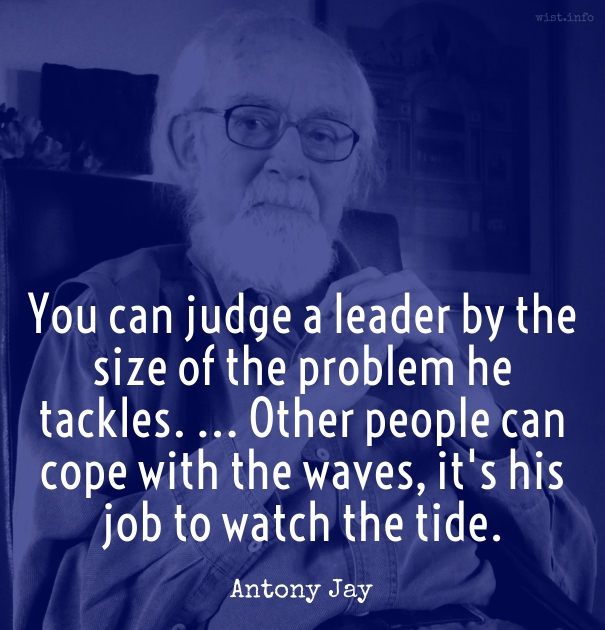
You can judge a leader by the size of the problem he tackles — people nearly always pick a problem their own size, and ignore or leave to others the bigger or smaller ones. The chief executive should be thinking about the long-term changes which will bring growth or decay to different parts of the enterprise, not fussing over day-to-day problems. Other people can cope with the waves, it’s his job to watch the tide.
Antony Jay (1930–2016) English writer, broadcaster, director
Management and Machiavelli: An Inquiry into the Politics of Corporate Life, ch. 17 (1967)

One lesson the arts teach is that there can be more than one answer to a question and more than one solution to a problem; variability of outcome is okay. […] The arts teach children that their personal signature is important and that answers to questions and solutions to problems need not be identical. There is, in the arts, more than one interpretation to a musical score, more than one way to describe a painting or a sculpture, more than one appropriate form for a dance performance, more than one meaning for a poetic rendering of a person or a situation. In the arts diversity and variability are made central. That is one lesson that education can learn from the arts.
Elliot Eisner (1933–2014) Academic, researcher, professor of art and education
The Arts and the Creation of Mind, ch. 8 (2002)
(Source)
Variant: "The arts teach children that problems can have more than one solution; questions can have more than one answer. If they do anything, the arts embrace diversity of outcome."
Solutions nearly always come from the direction you least expect, which means there’s no point trying to look in that direction because it won’t be coming from there.
Douglas Adams (1952–2001) English author, humorist, screenwriter
The Salmon of Doubt, Part 3 “And Everything,” “The Salmon of Doubt,” ch. 5 (2002) [ed. Peter Guzzardi]
(Source)
Noted as an observation Dirk Gently "mentioned a lot to people."

If this stone won’t budge at present and is wedged in, move some of the other stones around it first.
Ludwig Wittgenstein (1889–1951) Austrian-English philosopher
Culture and Value, 1940 (1977) [tr. Winch (1980)]
The older I get, the more wisdom I find in the ancient rule of taking first things first — a process which often reduces the most complex human problems to manageable proportions.
Dwight David Eisenhower (1890–1969) American general, US President (1953–61)
“Let’s Be Honest with Ourselves,” Reader’s Digest (Dec 1963)

To ask the right question is already half the solution of a problem.
Carl Jung (1875–1961) Swiss psychologist
Archetypes of the Collective Unconscious (1934) [tr. Hull (1959)]
In reactive problem solving we walk into the future facing the past — we move away from, rather than toward, something. This often results in unforeseen consequences that are more distasteful than the deficiencies removed.
Russell L. Ackoff (1919–2009) American organizational theorist, consultant, management scientist
The Art of Problem Solving (1978)
If ever you find yourself environed with difficulties and perplexing circumstances out of which you are at a loss how to extricate yourself, do what is right, and be assured that that will extricate you the best out of the worst situations. Though you cannot see when you take one step what will be the next, yet follow truth, justice and plain dealing, and never fear their leading you out of the labyrinth in the easiest manner possible. The knot which you thought a Gordian one will untie itself before you. Nothing is so mistaken as the supposition that a person is to extricate himself from a difficulty by intrigue, by chicanery, by dissimulation, by trimming, by an untruth, by an injustice. This increases the difficulties tenfold; and those who pursue these methods get themselves so involved at length that they can turn no way but their infamy becomes more exposed.
Thomas Jefferson (1743–1826) American political philosopher, polymath, statesman, US President (1801–09)
Letter (1785-08-19) to Peter Carr
(Source)

Politics is the art of looking for trouble, finding it everywhere, diagnosing it incorrectly and applying the wrong remedies.
Groucho Marx (1890–1977) American comedian [b. Julius Henry Marx]
(Misattributed)
Variant 1: "Politics is the art of looking for trouble, finding it whether it exists or not, diagnosing it incorrectly and applying the wrong remedies."
Variant 2: "Politics is the art of looking for trouble, finding it everywhere, diagnosing it wrongly, and applying unsuitable remedies."
While popularly attributed to Groucho, there is no clear evidence he used it. The earliest reference I could find attributing the main quote to him (without citation) is in Victor Braude, Braude's Second Encyclopedia of Stories, Quotations, and Anecdotes (1957).
While Bennett Cerf include a similar reference in his syndicated "Try and Stop Me" column in November 1964, it does not show up in his earlier anecdote books such as Try and Stop Me (1944), nor in his meta-collection of anecdotes, Bennett Cerf's Bumper Crop (1958).
Variant 2 above is attributed (without citation) to Sir Ernest Benn in Henry Powell Spring, What Is Truth? (1944). Wikiquote indicates reference to this can be found in a July 1930 newspaper, though without an actual confirming link.
It seems most likely (though not yet fully confirmed) that Benn used his version of the line first, then, with some slight tweaking of the words to fit American sensibilities ("wrongly" to "incorrectly," "unsuitable" to "wrong"), it was applied to a known wit of the period.
Anyone can hold the helm when the sea is calm.
[In tranquillo esse quisque gubernator potest.]
Publilius Syrus (d. 42 BC) Assyrian slave, writer, philosopher [less correctly Publius Syrus]
Sententiae [Moral Sayings], # 358
The secret of getting ahead is getting started. The secret of getting started is breaking your complex overwhelming tasks into small manageable tasks, and then starting on the first one.
Mark Twain (1835–1910) American writer [pseud. of Samuel Clemens]
(Spurious)
It is not always by plugging away at a difficulty and sticking at it that one overcomes it; but, rather, often by working on the one next to it. Certain people and certain things require to be approached on an angle.
André Gide (1869–1951) French author, Nobel laureate
Journal (26 Oct 1924) [tr. O’Brien (1951)]
The country needs and, unless I mistake its temper, the country demands bold, persistent experimentation. It is common sense to take a method and try it: If it fails, admit it frankly and try another. But above all, try something.
Franklin Delano Roosevelt (1882–1945) American lawyer, politician, statesman; US President (1933–45)
Speech (1932-05-22), Commencement, Oglethorpe University, Atlanta, Georgia
(Source)
Never let your head hang down. Never give up and sit down and grieve. Find another way. And don’t pray when it rains if you don’t pray when the sun shines.
Satchel Paige (1906–1982) American baseball player [Leroy Robert Paige]
Quoted in “Hal Boyle Says –” syndicated AP column, New York Post (1959-10-04)
Boyle was a Pulitzer-prize-winning journalist working for the AP. This is usually cited to the New York Post appearance. Other examples include the Oswego Palladium-Times (1959-10-02), and the Key West Citizen (1959-10-07).
People talk about the middle of the road as though it were unacceptable. Actually, all human problems, excepting morals, come into the gray areas. Things are not all black and white. There have to be compromises. The middle of the road is all of the usable surface. The extremes, right and left, are in the gutters.
Dwight David Eisenhower (1890–1969) American general, US President (1953–61)
Interview (1963-11-05) by William Stringer, “Midroad View at Gettysburg,” Christian Science Monitor
(Source)