

When you blame others, you give up your power to change.
Douglas Adams (1952–2001) English author, humorist, screenwriter
(Attributed)
Quotations by:
Adams, Douglas

FORD: And you’d better be prepared for the jump into hyperspace. It’s unpleasantly like being drunk.
ARTHUR: Well what’s so unpleasant about being drunk?
FORD: You ask a glass of water.
Douglas Adams (1952–2001) English author, humorist, screenwriter
Hitchhiker’s Guide to the Galaxy, Phase 1, “Fit the 1st” (BBC Radio) (1978-03-08)
(Source)
This was adapted into the novelization, The Hitchhiker's Guide to the Galaxy, ch. 6 (1979), in close to the same language:"No, don't move," he added as Arthur began to uncurl himself, "you'd better be prepared for the jump into hyperspace. It's unpleasantly like being drunk."
"What's so unpleasant about being drunk?"
"You ask a glass of water."
NARRATOR: This planet has, or had, a problem which was this: most of the people living on it were unhappy for pretty much of the time. Many solutions were suggested for this problem, but most of these were largely concerned with the movements of small green pieces of paper, which is odd because on the whole it wasn’t the small green pieces of paper that were unhappy.
Douglas Adams (1952–2001) English author, humorist, screenwriter
Hitchhiker’s Guide to the Galaxy, Phase 1, “Fit the 2nd” (BBC Radio) (1978-03-15)
(Source)
Though in the second episode of the radio play, this material was moved in the book, The Hitchhiker's Guide to the Galaxy (1979), into an introduction. The text was left unchanged, except that the first line reads "This planet has -- or rather had -- a problem ...."
ARTHUR: You know, it’s at times like this, when I’m trapped in a Vogon airlock with a man from Betelgeuse, and about to die of asphyxiation in deep space that I really wish I’d listened to what my mother told me when I was young.
FORD: Why, what did she tell you?
ARTHUR: I don’t know, I didn’t listen.
Douglas Adams (1952–2001) English author, humorist, screenwriter
Hitchhiker’s Guide to the Galaxy, Phase 1, “Fit the 2nd” (BBC Radio) (1978-03-15)
(Source)
Adapted into book form in Hitchhiker's Guide to the Galaxy No. 1, The Hitchhiker's Guide to the Galaxy, ch. 7 (1979), with identical dialog. The only difference between the two is that after these lines, in the radio play Ford replies, "Huh! Terrific," while in the book he says, "Oh," and carries on humming.
ARTHUR: I don’t want to die now, I’ve still got a headache! I don’t want to go to heaven with a headache, I’d be all cross and wouldn’t enjoy it.
Douglas Adams (1952–2001) English author, humorist, screenwriter
Hitchhiker’s Guide to the Galaxy, Phase 1, “Fit the 2nd” (BBC radio) (1978-03-15)
(Source)
The adaptation into the original novelization, Hitchhiker's Guide to the Galaxy, ch. 7 (1979), is nearly the same:"I don't want to die now!" he yelled. "I've still got a headache! I don't want to go to heaven with a headache, I'd be all cross and wouldn't enjoy it!"
NARRATOR: And then one day, nearly two thousand years after one man had been nailed to a tree for saying how great it would be to be nice to people for a change a girl sitting on her own in a small cafe in Rickmansworth suddenly realized what it was that had been going wrong all this time, and she finally knew how the world could be made a good and happy place. This time it was right, it would work, and no one would have to get nailed to anything. Sadly however, before she could get to a phone to tell anyone, the Earth was unexpectedly demolished to make way for a new hyperspace bypass and so the idea was lost forever.
Douglas Adams (1952–2001) English author, humorist, screenwriter
Hitchhiker’s Guide to the Galaxy, Phase 1, “Fit the 2nd” (BBC Radio) (1978-03-15)
(Source)
Though in the second radio episode, when adapted into the book The Hitchhiker's Guide to the Galaxy (1979), this passage was moved into the Introduction:And then, one Thursday, nearly two thousand years after one man had been nailed to a tree for saying how great it would be to be nice to people for a change a girl sitting on her own in a small cafe in Rickmansworth suddenly realized what it was that had been going wrong all this time, and she finally knew how the world could be made a good and happy place. This time it was right, it would work, and no one would have to get nailed to anything.
Sadly however, before she could get to a phone to tell anyone, a terrible stupid catastrophe occurred, and the idea was lost forever.
NARRATOR: For instance, on the planet Earth Man had always assumed that he was more intelligent than dolphins because he had achieved so much … the wheel, New York, wars, and so on, whilst all the dolphins had ever done was muck about in the water having a good time. But conversely the dolphins believed themselves to be more intelligent than man for precisely the same reasons.
Douglas Adams (1952–2001) English author, humorist, screenwriter
Hitchhiker’s Guide to the Galaxy, Phase 1, “Fit the 3rd” (BBC Radio) (1978-03-22)
(Source)
This is rendered the same (save for some punctuation polishing) in the novel form, Hitchhiker's Guide to the Galaxy No. 1, The Hitchhiker's Guide to the Galaxy, ch. 23 (1979):For instance, on the planet Earth, man had always assumed that he was more intelligent than dolphins because he had achieved so much -- the wheel, New York, wars and so on -- whilst all the dolphins had ever done was muck about in the water having a good time. But conversely, the dolphins had always believed that they were far more intelligent than man -- for precisely the same reasons.
SLARTIBARTFAST: Perhaps I’m old and tired, but I always think that the chances of finding out what really is going on are so absurdly remote that the only thing to do is say hang the sense of it and just keep yourself occupied.
Douglas Adams (1952–2001) English author, humorist, screenwriter
Hitchhiker’s Guide to the Galaxy, Phase 1, “Fit the 4th” (BBC Radio) (1978-03-29)
The same text is found in the book form, The Hitchhiker's Guide to the Galaxy, ch. 30 (1979).
SLARTIBARTFAST: I’d far rather be happy than right any day.
ARTHUR: And are you?
SLARTIBARTFAST: No, that’s where it all falls down, of course.
ARTHUR: Pity, It sounded like quite a good lifestyle otherwise.
MARVIN: The first ten million years were the worst. And the second ten million, they were the worst too. The third ten million I didn’t enjoy at all. After that I went into a bit of a decline.
Douglas Adams (1952–2001) English author, humorist, screenwriter
Hitchhiker’s Guide to the Galaxy, Phase 1, “Fit the 5th” (BBC Radio) (1978-04-05)
(Source)
When adapted as a novel, Hitchhiker's Guide No. 2, The Restaurant at the End of the Universe, ch. 18 (1980), this line by Marvin the Paranoid Android remained the same.
NARRATOR: In the beginning the Universe was created. This has made a lot of people very angry and been widely regarded as a bad move.
Douglas Adams (1952–2001) English author, humorist, screenwriter
Hitchhiker’s Guide to the Galaxy, Phase 1, “Fit the 5th” (BBC radio) (1978-04-05)
(Source)
This passage, without change, appears in the second novelization, The Restaurant at the End of the Universe, ch. 1 (1980).
NARRATOR: There is a theory which states that if ever anyone discovers exactly what the Universe is for and why it is here, it will instantly disappear and be replaced by something even more bizarrely inexplicable. There is another theory which states that this has already happened.
Douglas Adams (1952–2001) English author, humorist, screenwriter
Hitchhiker’s Guide to the Galaxy, Phase 2, “Fit the 7th” (BBC radio) (1978-12-24)
(Source)
The Narrator then adds:There is yet a third theory which suggests that both of the first two theories were concocted by a wily editor of The Hitchhiker’s Guide to the Galaxy in order to increase the level of universal uncertainty and paranoia and so boost the sales of the Guide. This last theory is of course the most convincing, because The Hitchhiker’s Guide to the Galaxy is the only book in the whole of the known Universe to have the words DON’T PANIC inscribed in large friendly letters on the cover.
This quotation was brought back to be the epigraph for the second Hitchhiker book, The Restaurant at the End of the Universe (1980), each paragraph on a different page:There is a theory which states that if ever anyone discovers exactly what the Universe is for and why it is here, it will instantly disappear and be replaced by something even more bizarre and inexplicable.
There is another theory which states that this has already happened.
I am rarely happier than when spending entire day programming my computer to perform automatically a task that it would otherwise take me a good ten seconds to do by hand.
Douglas Adams (1952–2001) English author, humorist, screenwriter
Last Chance to See, ch. 2 (1990) [with Mark Carwardine]
(Source)
The source BBC Radio documentary (1989-11-01) can no longer be played at the BBC site.
Adams reading the 1992 audiobook can be heard here.
“So what do we do if we get bitten by something deadly, then?” I asked.
He blinked at me as if I were stupid.
“Well what do you think you do?” he said. “You die of course. That’s what deadly means.”Douglas Adams (1952–2001) English author, humorist, screenwriter
Last Chance to See, ch. 2 (1990) [with Mark Carwardine]
(Source)
Talking to a herpetologist before traveling to Komodo, Indonesia.
The source BBC Radio documentary (1989-11-01) can no longer be played at the BBC site. Adams reading the 1992 audiobook can be heard here.
The villagers sold us some [coconuts] and split them open for us. They are almost perfectly designed. You first make a hole and drink the milk, and then you split open the nut with a machete and slice off a segment of the shell, which forms a perfect implement for scooping out the coconut flesh inside. What makes you wonder about the nature of this god character is that he creates something that is so perfectly designed to be of benefit to human beings and then hangs it twenty feet above their heads on a tree with no branches.
Douglas Adams (1952–2001) English author, humorist, screenwriter
Last Chance to See, ch. 2 (1990) [with Mark Carwardine]
(Source)
The source BBC Radio documentary (1989-11-01) can no longer be played at the BBC site.
Adams reading the 1992 audiobook can be heard here.
The system by which Zaire works […] is very simple. Every official you encounter will make life as unpleasant for you as he possibly can until you pay him to stop it. In US dollars. He then passes you on to the next official who will be unpleasant to you all over again.
Douglas Adams (1952–2001) English author, humorist, screenwriter
Last Chance to See, ch. 3 (1990) [with Mark Carwardine]
(Source)
Though the trip to see the northern white rhino was taken, and the chapter about it is in the book, it was not included in the BBC Radio series (1989).
Adams reading the 1992 audiobook can be heard here.
Most of the other shops were in fact impossible to identify. When a shop appeared to sell a mixture of ghetto blasters, socks, soap and chickens, it didn’t seem unreasonable to go in and ask if they’d got any paper or toothpaste stuck away in one of their shelves as well, but they looked at me as if I was completely mad. Couldn’t I see that this was a ghetto blaster, socks, soap and chicken shop?
Douglas Adams (1952–2001) English author, humorist, screenwriter
Last Chance to See, ch. 3 (1990) [with Mark Carwardine]
(Source)
Shopping in Kinshasa, Zaire.
Though the trip to see the northern white rhino was taken, and the chapter about it is in the book, it was not included in the BBC Radio series (1989).
Adams reading the 1992 audiobook can be heard here.
You can’t help but try and follow an animal’s thought processes, and you can’t help, when faced with an animal like a three ton rhinoceros with nasal passages bigger than its brain, but fail.
Douglas Adams (1952–2001) English author, humorist, screenwriter
Last Chance to See, ch. 3 (1990) [with Mark Carwardine]
Though the trip to see the northern white rhino was taken, and the chapter about it is in the book, it was not included in the BBC Radio series (1989).
Adams reading the 1992 audiobook can be heard here.
Human beings, who are almost unique in having the ability to learn from the experiences of others, are also remarkable for their apparent disinclination to do so.
Douglas Adams (1952–2001) English author, humorist, screenwriter
Last Chance to See, ch. 4 (1990) [with Mark Carwardine]
(Source)
The source BBC Radio documentary (1989-10-04) can no longer be played at the BBC site.
Adams reading the 1992 audiobook can be heard here.
I’ve never understood all this fuss people make about the dawn. I’ve seen a few and they’re never as good as the photographs, which have the additional advantage of being things you can look at when you’re in the right frame of mind, which is usually around lunchtime.
Douglas Adams (1952–2001) English author, humorist, screenwriter
Last Chance to See, ch. 4 (1990) [with Mark Carwardine]
(Source)
It’s easy to think that as a result of the extinction of the dodo, we are now sadder and wiser, but there’s a lot of evidence to suggest that we are merely sadder and better informed.
Douglas Adams (1952–2001) English author, humorist, screenwriter
Last Chance to See, ch. 6 (1990) [with Mark Carwardine]
(Source)
The source BBC Radio documentary (1989-10-25) can no longer be played at the BBC site.
Adams reading the 1992 audiobook can be heard here.
The major difference between a thing that might go wrong and a thing that cannot possibly go wrong is that when a thing that cannot possibly go wrong goes wrong it usually turns out to be impossible to get at and repair.
Douglas Adams (1952–2001) English author, humorist, screenwriter
Mostly Harmless (1992)
He was constantly reminded of how startlingly different a place the world was when viewed from a point only three feet to the left.
Douglas Adams (1952–2001) English author, humorist, screenwriter
The Salmon of Doubt, “The Salmon of Doubt,” ch. 4 (2002) [ed. Peter Guzzardi]
(Source)
You will need to know the difference between Friday and a fried egg. It’s quite a simple difference, but an important one. Friday comes at the end of the week, whereas a fried egg comes out of a chicken. Like most things, of course, it isn’t quite that simple. The fried egg isn’t properly a fried egg until it’s been put in a frying pan and fried. This is something you wouldn’t do to a Friday, of course, though you might do it on a Friday. You can also fry eggs on a Thursday, if you like, or on a cooker. It’s all rather complicated, but it makes a kind of sense if you think about it for a while.
Douglas Adams (1952–2001) English author, humorist, screenwriter
The Salmon of Doubt, Part 1 “Life,” “For Children Only” (2002) [ed. Peter Guzzardi]
(Source)
We are stuck with technology when what we really want is just stuff that works.
Douglas Adams (1952–2001) English author, humorist, screenwriter
The Salmon of Doubt, Part 2 “The Universe,” Aside (2002) [ed. Peter Guzzardi]
(Source)
I’ve come up with a set of rules that describe our reactions to technologies:
- Anything that is in the world when you’re born is normal and ordinary and is just a natural part of the way the world works.
- Anything that’s invented between when you’re fifteen and thirty-five is new and exciting and revolutionary and you can probably get a career in it.
- Anything invented after you’re thirty-five is against the natural order of things.
Douglas Adams (1952–2001) English author, humorist, screenwriter
The Salmon of Doubt, Part 2 “The Universe” (2002) [ed. Peter Guzzardi]
(Source)
Solutions nearly always come from the direction you least expect, which means there’s no point trying to look in that direction because it won’t be coming from there.
Douglas Adams (1952–2001) English author, humorist, screenwriter
The Salmon of Doubt, Part 3 “And Everything,” “The Salmon of Doubt,” ch. 5 (2002) [ed. Peter Guzzardi]
(Source)
Noted as an observation Dirk Gently "mentioned a lot to people."
I love deadlines. I love the whooshing noise they make as they go by.
Douglas Adams (1952–2001) English author, humorist, screenwriter
Attributed in Richard Dawkins, “A Lament for Douglas Adams,” The Guardian (2001-05-13)
(Source)
Memorial to his friend, Adams; later collected in The Salmon of Doubt, Part 4 "Epilogue" (2002) [ed. Peter Guzzardi]. Many variants exist, e.g., "What I love the most about deadlines is the whooshing sound they make as they go by."

Generally, old media don’t die. They just have to grow old gracefully. Guess what, we still have stone masons. They haven’t been the primary purveyors of the written word for a while now of course, but they still have a role because you wouldn’t want a TV screen on your headstone.
Douglas Adams (1952–2001) English author, humorist, screenwriter
Broadcast (2010-10-11), Hitchhiker’s Guide to the Future, ep. 2, “Publishing,” BBC Radio 4
This was a four-episode panel discussion, led by Adams, on the future of media. Adams died shortly after the final episode aired. The archived BBC Radio 4 website for the show is still online, but (ironically) requires RealPlayer.
It’s important to remember that the relationship between different media tends to be complementary. When new media arrive they don’t necessarily replace or eradicate previous types. Though we should perhaps observe a half second silence for the eight-track — there that’s done. What usually happens is that older media have to shuffle about a bit to make space for the new one and its particular advantages. Radio did not kill books and television did not kill radio or movies — what television did kill was the cinema newsreel.
Douglas Adams (1952–2001) English author, humorist, screenwriter
Broadcast (2010-10-11), Hitchhiker’s Guide to the Future, ep. 2, “Publishing,” BBC Radio 4
(Source)
This was a four-episode panel discussion, led by Adams, on the future of media. Adams died shortly after the final episode aired. The archived BBC Radio 4 website for the show is still online, but (ironically) requires RealPlayer.
What I mean is that if you really want to understand something, the best way is to try and explain it to someone else. That forces you to sort it out in your mind. And the more slow and dim-witted your pupil, the more you have to break things down into more and more simple ideas. And that’s really the essence of programming. By the time you’ve sorted out a complicated idea into little steps that even a stupid machine can deal with, you’ve learned something about it yourself.
Douglas Adams (1952–2001) English author, humorist, screenwriter
Dirk Gently No. 1, Dirk Gently’s Holistic Detective Agency, ch. 4 [Richard] (1987)
(Source)
Gordon Way’s astonishment at being suddenly shot dead was nothing to his astonishment at what happened next.
Douglas Adams (1952–2001) English author, humorist, screenwriter
Dirk Gently No. 1, Dirk Gently’s Holistic Detective Agency, ch. 7 (1987)
(Source)
Let us think the unthinkable, let us do the undoable, let us prepare to grapple with the ineffable itself, and see if we may not eff it after all.
Douglas Adams (1952–2001) English author, humorist, screenwriter
Dirk Gently No. 1, Dirk Gently’s Holistic Detective Agency, ch. 20 [Dirk] (1987)
(Source)
Only a child sees things with perfect clarity, because it hasn’t developed all those filters which prevent us from seeing things that we don’t expect to see.
Douglas Adams (1952–2001) English author, humorist, screenwriter
Dirk Gently No. 1, Dirk Gently’s Holistic Detective Agency, ch. 23 [Dirk] (1987)
(Source)
If it looks like a duck, and quacks like a duck, we have at least to consider the possibility that we have a small aquatic bird of the family Anatidae on our hands.
Douglas Adams (1952–2001) English author, humorist, screenwriter
Dirk Gently No. 1, Dirk Gently’s Holistic Detective Agency, ch. 30 [Dirk] (1987)
(Source)
In the great debate that has raged for centuries about what, if anything, happens to you after death, be it heaven, hell, purgatory or extinction, one thing has never been in doubt — that you would at least know the answer when you were dead.
Gordon Way was dead, but he simply hadn’t the slightest idea what he was meant to do about it. It wasn’t a situation he had encountered before.Douglas Adams (1952–2001) English author, humorist, screenwriter
Dirk Gently No. 1, Dirk Gently’s Holistic Detective Agency, ch. 9 (1987)
(Source)
It can hardly be a coincidence that no language on Earth has ever produced the expression “as pretty as an airport.” Airports are ugly. Some are very ugly. Some attain a degree of ugliness that can only be the result of a special effort. This ugliness arises because airports are full of people who are tired, cross, and have just discovered that their luggage has landed in Murmansk (Murmansk airport is the only exception of this otherwise infallible rule), and architects have on the whole tried to reflect this in their designs.
Douglas Adams (1952–2001) English author, humorist, screenwriter
Dirk Gently No. 2, The Long Dark Tea-Time of the Soul, ch. 1 (1988)
(Source)
Opening words.
Variant: "It's no coincidence that in no known language does the phrase 'As pretty as an airport' appear."
“Ah, I expect you’ll be wanting to pay for that paper, then, won’t you, Mr. Dirk, sir?” said the newsagent, trotting gently after him.
“Ah, Bates,” said Dirk loftily, “you and your expectations. Always expecting this and expecting that. May I recommend serenity to you? A life that is burdened with expectations is a heavy life. Its fruit is sorrow and disappointment. Learn to be one with the joy of the moment.”Douglas Adams (1952–2001) English author, humorist, screenwriter
Dirk Gently No. 2, The Long Dark Tea-Time of the Soul, ch. 4 (1988)
(Source)
He had a tremendous propensity for getting lost when driving. This was largely because of his “Zen” method of navigation, which was simply to find any car that looked as if it knew where it was going and follow it. The results were more often surprising than successful, but he felt it was worth it for the sake of the few occasions when it was both.
Douglas Adams (1952–2001) English author, humorist, screenwriter
Dirk Gently No. 2, The Long Dark Tea-Time of the Soul, ch. 4 (1988)
(Source)
Dirk describes this again later, in ch. 13:My own strategy is to find a car, or the nearest equivalent, which looks as if it knows where it's going and follow it. I rarely end up where I was intending to go, but often I end up somewhere I needed to be.
And again at the end of ch. 13:My methods of navigation have their advantage. I may not have gone where I intended to go, but I think I have ended up where I needed to be.
Ah, Bates, you and your expectations. Always expecting this and expecting that. May I recommend serenity to you? A life that is burdened with expectations is a heavy life. Its fruit is sorrow and disappointment. Learn to be one with the joy of the moment.
Douglas Adams (1952–2001) English author, humorist, screenwriter
Dirk Gently No. 2, The Long Dark Tea-Time of the Soul, ch. 4 [Dirk] (1988)
(Source)
“You,” said Sally Mills, “are very strange.”
“Only,” said Dirk, “as strange as I need to be.”Douglas Adams (1952–2001) English author, humorist, screenwriter
Dirk Gently No. 2, The Long Dark Tea-Time of the Soul, ch. 10 (1988)
(Source)
It was his subconscious which told him this — that infuriating part of a person’s brain which never responds to interrogation, merely gives little meaningful nudges and then sits humming quietly to itself, saying nothing.
Douglas Adams (1952–2001) English author, humorist, screenwriter
Dirk Gently No. 2, The Long Dark Tea-Time of the Soul, ch. 17 (1988)
(Source)
The ships hung in the sky in much the same way that bricks don’t.
Douglas Adams (1952–2001) English author, humorist, screenwriter
Hitchhiker’s Guide No. 1, The Hitchhiker’s Guide to the Galaxy, ch. 3 (1979)
(Source)
This line (and much of its surroundings) are not in the original radio play.
Isn’t it enough to see that a garden is beautiful without having to believe that there are fairies at the bottom of it too?
Douglas Adams (1952–2001) English author, humorist, screenwriter
Hitchhiker’s Guide No. 1, The Hitchhiker’s Guide to the Galaxy, ch. 16 (1979)
(Source)
Musing by Ford Prefect as to Zaphod's overdramatization of their arrival at Magrathea. Not present in the BBC Radio production, where Magrathea is reached during Fit the 3rd.
For a moment, nothing happened. Then, after a second or so, nothing continued to happen.
Douglas Adams (1952–2001) English author, humorist, screenwriter
Hitchhiker’s Guide No. 1, The Hitchhiker’s Guide to the Galaxy, ch. 33 (1979)
(Source)
It is known that there are an infinite number of worlds, simply because there is an infinite amount of space for them to be in. However, not every one of them is inhabited. Therefore, there must be a finite number of inhabited worlds. Any finite number divided by infinity is as near to nothing as makes no odds, so the average population of all the planets in the Universe can be said to be zero. From this it follows that the population of the whole Universe is also zero, and that any people you may meet from time to time are merely the products of a deranged imagination.
Douglas Adams (1952–2001) English author, humorist, screenwriter
Hitchhiker’s Guide No. 2, The Restaurant at the End of the Universe, ch. 19 (1980)
(Source)
He gazed keenly into the distance and looked as if he would quite like the wind to blow his hair back dramatically at that point, but the wind was busy fooling around with some leaves a little way off.
Douglas Adams (1952–2001) English author, humorist, screenwriter
Hitchhiker’s Guide No. 3, Life, the Universe, and Everything, ch. 2 (1982)
(Source)
Describing Ford Prefect.
Grown men, he told himself, in flat contradiction of centuries of accumulated evidence about the way grown men behave, do not behave like this.
Douglas Adams (1952–2001) English author, humorist, screenwriter
Hitchhiker’s Guide No. 4, So Long, and Thanks for All the Fish, ch. 11 [Arthur] (1984)
(Source)
“Life,” he said, “is like a grapefruit.”
“Er, how so?”
“Well, it’s sort of orangey-yellow and dimpled on the outside, wet and squidgy in the middle. It’s got pips inside, too. Oh, and some people have half a one for breakfast.”Douglas Adams (1952–2001) English author, humorist, screenwriter
Hitchhiker’s Guide No. 4, So Long, and Thanks for All the Fish, ch. 23 (1984)
(Source)
Ford Prefect speaking with a creature in his dreams.
“It comes from a very ancient democracy, you see ….”
“You mean, it comes from a world of lizards?”
“No,” said Ford, who by this time was a little more rational and coherent than he had been, having finally had the coffee forced down him, “nothing so simple. Nothing anything like so straightforward. On its world, the people are people. The leaders are lizards. The people hate the lizards and the lizards rule the people.”
“Odd,” said Arthur, “I thought you said it was a democracy.”
“I did,” said Ford. “It is.”
“So,” said Arthur, hoping he wasn’t sounding ridiculously obtuse, “why don’t the people get rid of the lizards?”
“It honestly doesn’t occur to them,” said Ford. “They’ve all got the vote, so they all pretty much assume that the government they’ve voted in more or less approximates to the government they want.”
“You mean they actually vote for the lizards?”
“Oh yes,” said Ford with a shrug, “of course.”
“But,” said Arthur, going for the big one again, “why?”
“Because if they didn’t vote for a lizard,” said Ford, “the wrong lizard might get in.”Douglas Adams (1952–2001) English author, humorist, screenwriter
Hitchhiker’s Guide No. 4, So Long, and Thanks for All the Fish, ch. 36 (1984)
(Source)
“Oh, all right,” said the old man. “Here’s a prayer for you. Got a pencil?”
“Yes,” said Arthur.
“It goes like this. Let’s see now: ‘Protect me from knowing what I don’t need to know. Protect me from even knowing that there are things to know that I don’t know. Protect me from knowing that I decided not to know about the things that I decided not to know about. Amen.’ That’s it. It’s what you say silently inside yourself anyway, so you may as well have it out in the open.”
“Hmmmm,” said Arthur. “Well, thank you –”
“There’s another prayer that goes with it that’s very important,” continued the old man, “so you’d better jot this down, too.”
“Okay.”
“It goes, ‘Lord, lord, lord …’ It’s best to put that bit in, just in case. You can never be too sure. ‘Lord, lord, lord. Protect me from the consequences of the above prayer. Amen.’ And that’s it. Most of the trouble people get into in life comes form leaving out that last part.”Douglas Adams (1952–2001) English author, humorist, screenwriter
Hitchhiker’s Guide No. 5, Mostly Harmless, ch. 9 (1992)
(Source)
Ironically, most quotations of the above prayer leave out the "very important" second part.
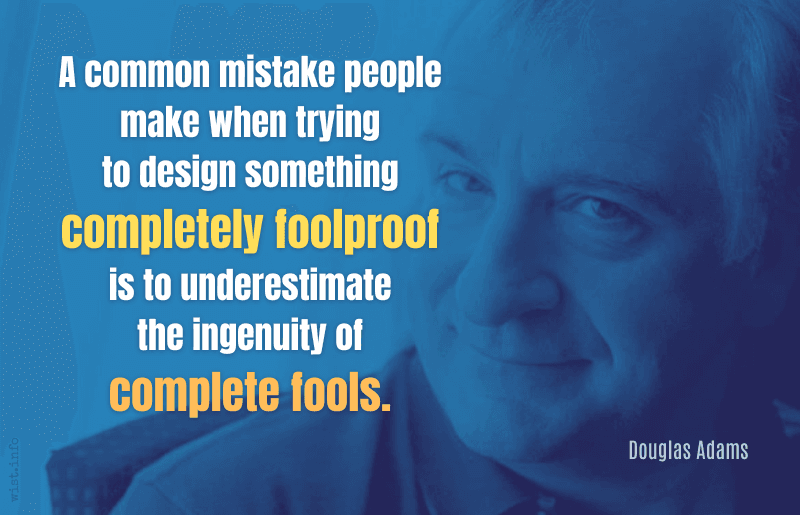
A common mistake people make when trying to design something completely foolproof is to underestimate the ingenuity of complete fools.
Douglas Adams (1952–2001) English author, humorist, screenwriter
Hitchhiker’s Guide No. 5, Mostly Harmless, ch. 12 (1992)
(Source)
It can be very dangerous to see things from somebody else’s point of view without the proper training.
Douglas Adams (1952–2001) English author, humorist, screenwriter
Hitchhiker’s Guide No. 5, Mostly Harmless, ch. 15 (1992)
(Source)
“So what’s the point of showing me something I can’t see?”
“So that you understand that just because you see something, it doesn’t mean to say it’s there. And if you don’t see something, it doesn’t mean to say it’s not there. It’s only what your senses bring to your attention.”Douglas Adams (1952–2001) English author, humorist, screenwriter
Hitchhiker’s Guide No. 5, Mostly Harmless, ch. 17 (1992)
(Source)
Random and the bird Guide.
I’d take the awe of understanding over the awe of ignorance any day.
Douglas Adams (1952–2001) English author, humorist, screenwriter
Interview (1998-99, Winter) with David Silverman, American Atheist magazine
(Source)
Reprinted in The Salmon of Doubt, Part 2 "The Universe," "Interview, American Atheists" (2002) [ed. Peter Guzzardi]
All opinions are not equal. Some are a very great deal more robust, sophisticated and well supported in logic and argument than others.
Douglas Adams (1952–2001) English author, humorist, screenwriter
Interview (1998-99, Winter) with David Silverman, American Atheist magazine
(Source)
Reprinted in The Salmon of Doubt, Part 2 "The Universe," "Interview, American Atheists" (2002) [ed. Peter Guzzardi]
These are life’s little learning experiences. You know what a learning experience is is one of those things that says, “You know that thing you just did? Don’t do that.”
People assume you sit in a room, looking pensive and writing great thoughts. But you mostly sit in a room looking panic-stricken and hoping they haven’t put a guard on the door yet.
There are some oddities in the perspective with which we see the world. The fact that we live at the bottom of a deep gravity well, on the surface of a gas covered planet going around a nuclear fireball 90 million miles away and think this to be normal is obviously some indication of how skewed our perspective tends to be.
Douglas Adams (1952–2001) English author, humorist, screenwriter
Speech (1998-09), “Is There an Artificial God?”, Digital Biota 2 conference, Cambridge, UK
(Source)
Collected in The Salmon of Doubt, Part 2 "The Universe" (2002) [ed. Peter Guzzardi].
If you try and take a cat apart to see how it works, the first thing you have on your hands is a nonworking cat.
Douglas Adams (1952–2001) English author, humorist, screenwriter
Speech (1998-09), “Is There an Artificial God?”, Digital Biota 2 conference, Cambridge, UK
(Source)
Discussing the historical mysteriousness of "life" and why it was (and is) difficult to understand.
Collected in The Salmon of Doubt, Part 2 "The Universe" (2002) [ed. Peter Guzzardi]. This (and other) sections of this extemporaneous speech were also quoted in Richard Dawkins, "Eulogy for Douglas Adams," Church of Saint Martin in the Fields, London (2001-09-17).
Variant: "If you try and take a cat apart to see how it works, you end up with a non-working cat. Do not try this."