The values communicated by status-insecure parents are such that their children learn to put personal success and the acquisition of power above all else. They are taught to judge people for their usefulness rather than their likableness. Their friends, and even future marriage partners, are selected and used in the service of personal advancement; love and affection take second place to knowing the right people. They are taught to eschew weaknesses and passivity, to respect authority, and to despise those who have not made the socio-economic grade. Success is equated with social esteem and material advantage, rather than with more spiritual values.
Norman F. Dixon (1922–2013) British cognitive psychologist, author, military engineer
On the Psychology of Military Incompetence, Part 2, ch. 22 “Authoritarianism” (1976)
(Source)
Quotations about:
advancement
Note not all quotations have been tagged, so Search may find additional quotes on this topic.

Progress is the stride of God.
Victor Hugo (1802–1885) French writer, journalist, human rights activist, politician
(Attributed)
Widely attributed to Hugo, but I cannot find a primary source for it. In a few places it is cited to his William Shakespeare (1864), but not in the two English translations I could find for it, nor could I identify it in the French.
The earliest attribution to Hugo I found was in Day's Collacon (1884), without citation. If this is a loose paraphrase of something in William Shakespeare, I have not tracked it down.
Variants:
- Progress is the stride of God himself.
- Progress is the stride of God, and God never takes a step backward.

Many voices are heard as we face a great decision. Comfort says, “Tarry a while.” Opportunism says, “This is a good spot.” Timidity asks, “How difficult is the road ahead?” […] If I know aught of the spirit and purpose of our Nation, we will not listen to Comfort, Opportunism, and Timidity. We will carry on.
Franklin Delano Roosevelt (1882–1945) American lawyer, politician, statesman; US President (1933–45)
Speech (1937-01-20), Inaugural Address, Washington, D.C.
(Source)
In sharpness of vision you’re no match for Lynceus,
but you don’t despise ointment if you have sore eyes;
and though you’ll never match unbeaten Glycon’s strength,
you guard yourself against attacks of crippling gout.
We advance part way even if we can’t go further.[Non possis oculo quantum contendere Lynceus,
non tamen idcirco contemnas lippus inungui;
nec quia desperes invicti membra Glyconis,
nodosa corpus nolis prohibere cheragra.
Est quadam prodire tenus, si non datur ultra.]Horace (65–8 BC) Roman poet, satirist, soldier, politician [Quintus Horatius Flaccus]
Epistles [Epistularum, Letters], Book 1, ep. 1 “To Maecenas,” l. 28ff (1.1.28-32) (20 BC) [tr. Fuchs (1977)]
(Source)
(Source (Latin)). Other translations:Though one cannot lyke Linceus with pearsing eyesight see,
To mende his sighte he maye not grudge inoynted for to be.
Lyke lustie Glyco thou dispayres in lymmes to be so stoute
Yet maye thou exercyse thy selfe to shun the knottie gowte.
A man maye clim a step, or twayne thoughe he goe not beyonde.
[tr. Drant (1567)]Thy eyes will never pierce like Lynceus eye,
Scorn not to noint them though if sore they are:
Nor, of a Wrastlers strength if thou despair,
Neglect to salve the knotted Gout. If more
'S deni'd, 'tis something to have gon thus fur.
[tr. Fanshawe; ed. Brome (1666)]Yours cannot be as good as Lynceus Eyes,
What then, when Sore must I fit Cures despise?
You cannot Hope to have your Limbs as great
As Glyco's, nor so strong and firmly set,
Yet to prevent the Gout hast Thou no care?
What, if of farther progress you despair,
'Tis somewhat surely to have gone thus far.
[tr. Creech (1684)]You cannot hope for Lynceus' piercing eyes:
But will you then a strengthening salve despise?
You wish for matchless Glycon's limbs, in vain,
Yet why not cure the gout's decrepit pain?
Though of exact perfection you despair,
Yet every step to virtue's worth your care.
[tr. Francis (1747)]Though not a Lynceus, one may sure apply
The lenient salve to a distemper'd eye;
Nor would you scorn from chalk-stones to preserve
Joints that despair of Glycon's lion nerve.
Though hopeless to surmount fair virtue's hill,
To climb a certain height is something still.
[tr. Howes (1845)]Your sight is not so piercing as that of Lynceus; you will not however therefore despise being anointed, if you are sore-eyed: nor because you despair of the muscles of the invincible Glycon, will you be careless of preserving your body from the knotty gout. There is some point to which we may reach, if we can go no further.
[tr. Smart/Buckley (1853)]Your eyes will never see like Lynceus'; still
You rub them with an ointment when they're ill.
You cannot hope for Glyco's stalwart frame,
Yet you'd avoid the gout that makes you lame.
Some point of moral progress each may gain,
Though to aspire beyond it should prove vain.
[tr. Conington (1874)]No Lynceus you, yet will you not despise,
Because of that, a salve for aching eyes.
Glycon in thews may beat you out and out,
Shall you not, therefore, keep at bay the gout?
Fair wisdom's goal may not be reached, but you
May on the road advance a stage or two.
[tr. Martin (1881)]You may be unable to see so far as Lyncæus, yet you do not on this account, being a blear-eyed man, despise ointment. You may despair of possessing limbs like those of the unconquered gladiator Glycon, yet you will endeavour to preserve yourself from the hand-crippling gout. It is permitted us to attain a certain point, though denied us beyond it.
[tr. Elgood (1893)]You may not be able, with your eyes, to see as far as Lynceus, yet you would not on that account scorn to anoint them, if sore. Nor, because you may not hope for unconquered Glycon's strength of limb, would you decline to keep your body free from the gnarls of gout. It is worth while to take some steps forward, though we may not go still further.
[tr. Fairclough (Loeb) (1926)]One's eye may see Less far than Lynceus', yet, if bleared one be,
One won't despise the ointment's soft control;
Nor, since one can't have Glycon's limbs so stark,
Should one be careless to ward off the gout.
There is a point whereto we may reach out,
If yet we cannot go beyond that mark.
[tr. Murrison, ed. Kraemer (1936)]Your eyes aren’t as keen
As Lynceus’, but this doesn’t mean that if they’re inflamed
You shouldn’t put drops in them. Glycon’s muscular limbs
Will never be yours, but still, you ought to take steps
To insure that the gout doesn’t tie your body in knots.
Your strides may be modest: they'll still take you further along.
[tr. Palmer Bovie (1959)]Your eyes will never see as Lynkeus
Saw, riding with Jason, but when your eyes
Hurt, you rub them with slave. Olympic
Winners are stronger, alas, than you
Can ever be, but you too protect
Yourself form the wringing pain of gout.
It pays to go as far as our feet will take us,
Though there's farther to go,
And we can never go that far.
[tr. Raffel (1983)]Suppose you don't have eyes as good as Lynceus;
That doesn't mean that if they're sore you wouldn't
Use salve to make them better; suppose you haen't
A chance int he world of competing with undefeated
Glycon the strongman, that doesn't mean you wouldn't
Try everythihng you could by exercise
To keep away rheumatic aches and pains.
You can't do everything, but you have to do
Everything you can.
[tr. Ferry (2001)]You might not be able to rival Lynceus in length of vision,
but that wouldn’t make you refuse a salve if your eyes were sore.
You'll never enjoy the physique of Glyco the champeon athlete,
but you'd still want to keep your body free from the knots of gout.
We can all make some progress, in spite of our limitations.
[tr. Rudd (2005 ed.)]You mightn’t be able to match Lynceus’ eyesight,
But you wouldn’t not bathe your eyes if they were sore:
And just because you can’t hope to have Glycon’s peerless
Physique, you’d still want your body free of knotty gout.
We should go as far as we can if we can’t go further.
[tr. Kline (2015)]
The great question for our time is, how to make sure that the continuing scientific revolution brings benefits to everybody rather than widening the gap between rich and poor. To lift up poor countries, and poor people in rich countries, from poverty, to give them a chance of a decent life, technology is not enough. Technology must be guided and driven by ethics if it is to do more than provide new toys for the rich.
Freeman Dyson (1923–2020) English-American theoretical physicist, mathematician, futurist
“Progress in Religion,” Templeton Prize acceptance speech, Washington National Cathedral (9 May 2000)
(Source)

Change does not necessarily assure progress, but progress implacably requires change.
Henry Steele Commager (1902–1998) American historian, writer, activist
Essay (1961-04-30), “We Have Changed — and Must,” The New York Times Magazine
(Source)

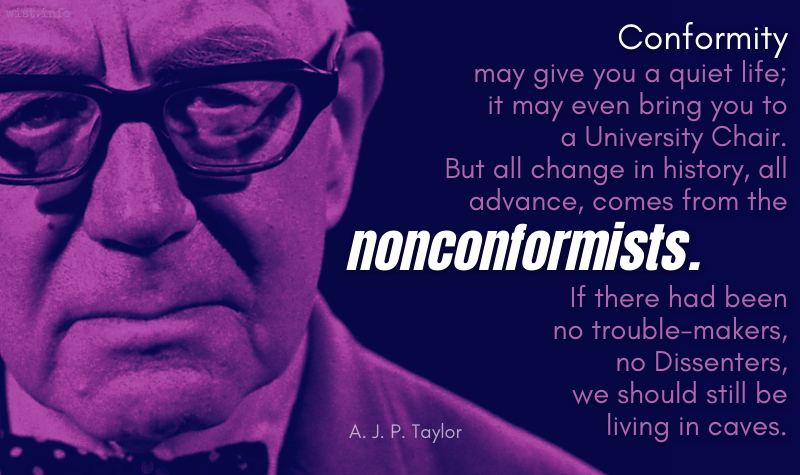
Conformity may give you a quiet life; it may even bring you to a University Chair. But all change in history, all advance, comes from the nonconformists. If there had been no trouble-makers, no Dissenters, we should still be living in caves.
A. J. P. Taylor (1906–1990) British historian, journalist, broadcaster [Alan John Percivale Taylor]
“The Radical Tradition: Fox, Paine, and Cobbett,” The Trouble Makers: Dissent over Foreign Policy, 1792–1939 (1969)

The test of a democracy is not the magnificence of buildings or the speed of automobiles or the efficiency of air transportation, but rather the care given to the welfare of all the people.
Helen Keller (1880–1968) American author and lecturer
“Try Democracy,” The Home Magazine, Vol. 11, # 4 (Apr 1935)


MORDEN: Think about it, Captain. Look at the long history of human struggle. Six thousand years of recorded wars, bloodshed, atrocities beyond description. But look at what came out of all that. We’ve gone to the stars. Split the atom. Written sonnets. We would never have evolved this far if we hadn’t been at each other’s throats, evolving our way up inch by inch.
J. Michael (Joe) Straczynski (b. 1954) American screenwriter, producer, author [a/k/a "JMS"]
Babylon 5, 3×22 “Z’Ha’Dum” (28 Oct 1996)

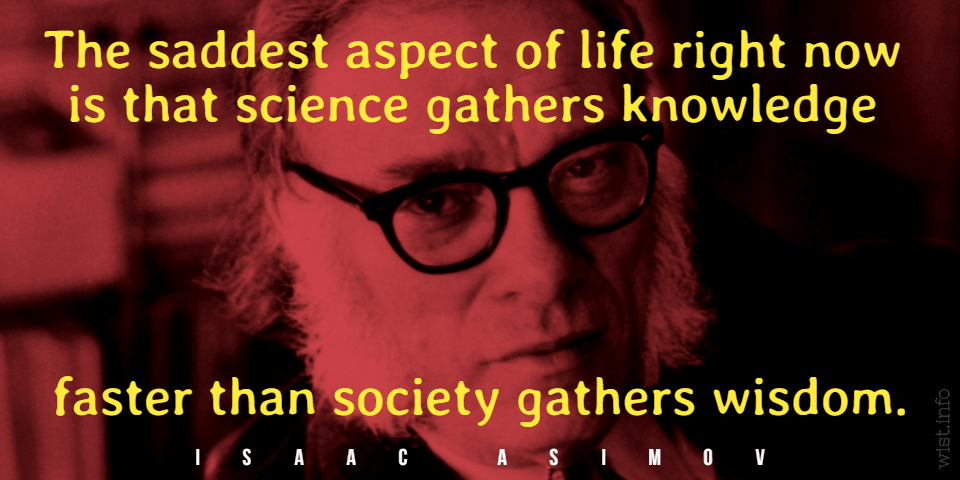
The saddest aspect of life right now is that science gathers knowledge faster than society gathers wisdom.
Isaac Asimov (1920–1992) Russian-American author, polymath, biochemist
Isaac Asimov’s Book of Science and Nature Questions (1988) [with Jason A. Schulman]
There comes now and then a bolder spirit, I should rather say, a more surrendered soul, more informed and led by God, which is much in advance of the rest, quite beyond their sympathy, but predicts what shall soon be the general fullness; as when we stand by the seashore, whilst the tide is coming in, a wave comes up the beach far higher than any foregoing one, and recedes; and for a long while none comes up to that mark; but after some time the whole sea is there and beyond it.
Ralph Waldo Emerson (1803–1882) American essayist, lecturer, poet
“Lecture on the Times,” Boston (1841-12-02)
(Source)

Any sufficiently advanced magic is indistinguishable from technology.
Charles "Charlie" Stross (b. 1964) British writer
The Nightmare Stacks, ch. 18 (2016)
(Source)
A variant of Clarke's Third Law.

All ambitions are lawful except those which climb upward on the miseries or credulities of mankind.
Joseph Conrad (1857–1924) Polish-English novelist [b. Teodor Josef Konrad Korzeniowski]
A Personal Record (1912)

There is something wrong with our world, something fundamentally and basically wrong. I don’t think we have to look too far to see that. I’m sure that most of you would agree with me in making that assertion. And when we stop to analyze the cause of our world’s ills, many things come to mind. We begin to wonder if it is due to the fact that we don’t know enough. But it can’t be that. Because in terms of accumulated knowledge we know more today than men have known in any period of human history. We have the facts at our disposal. We know more about mathematics, about science, about social science, and philosophy than we’ve ever known in any period of the world’s history. So it can’t be because we don’t know enough. And then we wonder if it is due to the fact that our scientific genius lags behind. That is, if we have not made enough progress scientifically. Well then, it can’t be that. For our scientific progress over the past years has been amazing. Man through his scientific genius has been able to warp distance and place time in chains, so that today it’s possible to eat breakfast in New York City and supper in London, England. Back in about 1753 it took a letter three days to go from New York City to Washington, and today you can go from here to China in less time than that. It can’t be because man is stagnant in his scientific progress. Man’s scientific genius has been amazing. I think we have to look much deeper than that if we are to find the real cause of man’s problems and the real cause of the world’s ills today. If we are to really find it I think we will have to look in the hearts and souls of men.
Martin Luther King, Jr. (1929–1968) American clergyman, civil rights leader, social activist, preacher
“Rediscovering Lost Values,” Sermon, Second Baptist Church, Detroit (28 Feb 1954)
(Source)
As the man put it: Any sufficiently advanced technology is indistinguishable from magic. Any sufficiently advanced alien intelligence is indistinguishable from God — the angry monotheistic sadist subtype. And the elder ones … aren’t friendly. (See? I told you I’d rather be an atheist!)
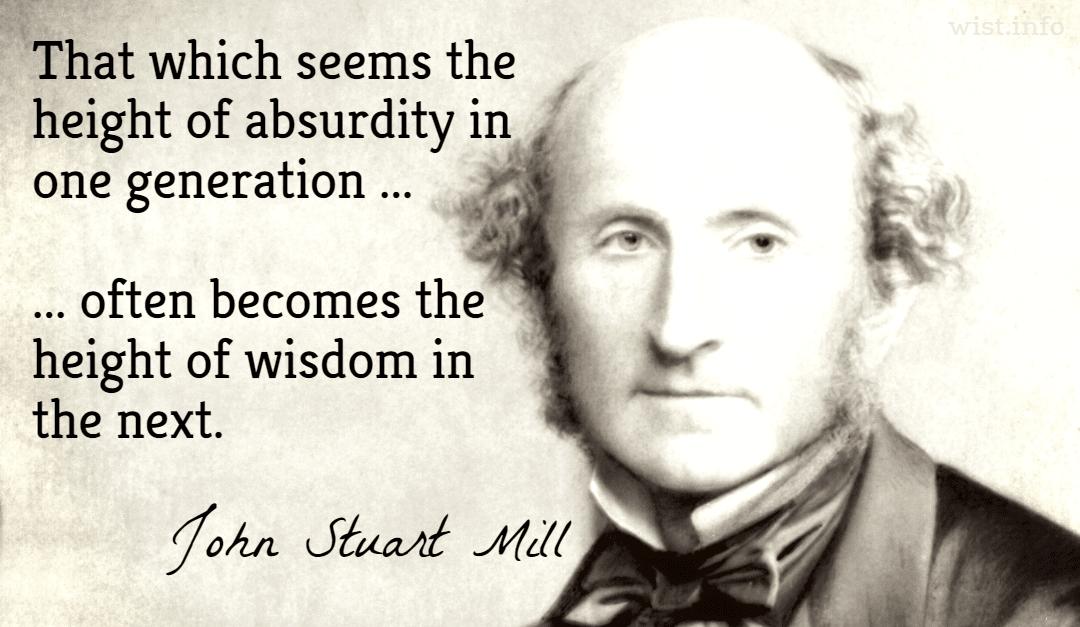
That which seems the height of absurdity in one generation often becomes the height of wisdom in the next.
John Stuart Mill (1806–1873) English philosopher and economist
(Attributed)
(Source)
Often cited from a quote in Adlai Stevenson, Call to Greatness (1954), but appears earlier in, e.g., National Magazine (Nov 1911). Unverified in Mills' writings.
He that is good will infallibly become better, and he that is bad will as certainly become worse; for vice, virtue, and time are three things that never stand still.
Charles Caleb "C. C." Colton (1780–1832) English cleric, writer, aphorist
Lacon: Or, Many Things in Few Words, Vol. 1, § 457 (1820)
(Source)

You convey too great a compliment when you say that I have earned the right to the presidential nomination. No man can establish such an obligation upon any part of the American people. My country owes me no debt. It gave me, as it gives every boy and girl, a chance. It gave me schooling, independence of action, opportunity for service and honor. In no other land could a boy from a country village, without inheritance or influential friends, look forward with unbounded hope. My whole life has taught me what America means. I am indebted to my country beyond any human power to repay.
Herbert Hoover (1874–1964) American engineer, bureaucrat, US President (1929–33)
Letter (1928-06-14) to George Moses
(Source)
On formally learning from Senator Moses of his nomination for President. The open letter was in the form of a return telegram to Moses, the chairman of the Republican National Convention, and was read aloud to that gathering in Convention Hall, Kansas City, Missouri..
What was impossible yesterday is an accomplishment today — while tomorrow heralds the unbelievable.
Percival E. Fansler (1883–1937) American engineer, businessman, entrepreneur
Speech, First Scheduled Commercial Airline Flight, St. Petersburg, Florida (1 Jan 1914)


The future is already here — it’s just not very evenly distributed.
William Gibson (b. 1948) American-Canadian speculative fiction novelist and essayist
Comment (1990s)
Original use is unconfirmed, earliest reference is in 1992. See here.

I look forward to an America which commands respect throughout the world not only for its strength but for its civilization as well. And I look forward to a world which will be safe not only for democracy and diversity but also for personal distinction.
John F. Kennedy (1917–1963) American politician, author, journalist, US President (1961–63)
Speech, Amherst College (26 Oct 1963)
New technologies create new customs, new laws, new ethics, new crimes.
Larry Niven (b. 1938) American writer
The Long Arm of Gil Hamilton (1976)

Many consult their reputation; but few their conscience.
Publilius Syrus (d. 42 BC) Assyrian slave, writer, philosopher [less correctly Publius Syrus]
Sententiae [Moral Sayings], # 254 [tr. Lyman (1862)

Nothing has more retarded the advancement of learning than the disposition of vulgar minds to ridicule and vilify what they cannot comprehend.
Samuel Johnson (1709–1784) English writer, lexicographer, critic
The Rambler, #117 (30 Apr 1751)
(Source)
Presented as a letter from "Hypertatus"

And he gave it for his opinion, that whosoever could make two ears of corn or two blades of grass to grow upon a spot of ground where only one grew before, would deserve better of mankind, and do more essential service to his country, than the whole race of politicians put together.
Jonathan Swift (1667–1745) English writer and churchman
Gulliver’s Travels, Part 2 “Voyage to Brobdingnab,” ch. 7 (1726)
(Source)

A slave has but one master; an ambitious man has as many masters as there are people who may be useful in bettering his position.
[L’esclave n’a qu’un maître; l’ambitieux en a autant qu’il y a de gens utiles à sa fortune.]
Jean de La Bruyère (1645–1696) French essayist, moralist
The Characters [Les Caractères], ch. 8 “Of the Court [De la Cour],” § 70 (8.70) (1688) [tr. Van Laun (1885)]
(Source)
(Source (French)). Other translations:A Slave has but one Master, an ambitious Man a great many, all those who are useful to him in making his fortune.
[Bullord ed. (1696)]A Slave has but one Master; an ambitious Man has as many as there are People useful to him in making his Fortune.
[Curll ed. (1713)]A purchased Slave has but one Master: An ambitious Man must be a Slave to all who may conduce to his Aggrandizement.
[Browne ed. (1752)]A slave has only one master; an ambitious man is enslaved to all those who may help to further his advancement.
[tr. Stewart (1970)]

Humanity has advanced, when it has advanced, not because it has been sober, responsible and cautious, but because it has been playful, rebellious, and immature.

They say the religion of your fathers is good enough. Why should a father object to your inventing a better plow than he had?
Robert Green Ingersoll (1833–1899) American lawyer, freethinker, orator
Speech on Religious Intolerance, Pittsburgh Opera House (14 Oct 1879)
In a hierarchy every employee tends to rise to his level of incompetence.
Lawrence J. Peter (1919–1990) American educator, management theorist
The Peter Principle, ch. 1 (1969)
Any sufficiently advanced technology is indistinguishable from magic.
Arthur C. Clarke (1917–2008) British writer
Profiles of the Future, “Hazards of Prophecy: The Failure of Imagination” (Clarke’s Third Law) (1962; rev. 1973)
You can’t say civilization don’t advance, however, for in every war they kill you in a new way.
Will Rogers (1879–1935) American humorist
Column (1929-12-23), “Daily Telegram: Will Rogers Has An Idea About Disarmament Plans”
(Source)