BOOK-LEARNING, n. The dunce’s derisive term for all knowledge that transcends his own impenitent ignorance.
Ambrose Bierce (1842–1914?) American writer and journalist
“Book-learning,” “Devil’s Dictionary” column, San Francisco Wasp (1881-05-14)
(Source)
Quotations about:
anti-intellectualism
Note not all quotations have been tagged, so Search may find additional quotes on this topic.

Could it be otherwise here? Could any one sect obtain a working majority at the polls and take over the country? Perhaps not — but a combination of a dynamic evangelist, television, enough money, and modern techniques of advertising and propaganda might make Billy Sunday’s efforts look like a corner store compared to Sears Roebuck. Throw in a depression for good measure, promise a material heaven here on earth, add a dash of anti-Semitism, anti-Catholicism, anti-Negroism, and a good large dose of anti-“furriners” in general and anti-intellectuals here at home and the result might be something quite frightening — particularly when one recalls that our voting system is such that a minority distributed as pluralities in enough states can constitute a working majority in Washington.
Robert A. Heinlein (1907–1988) American writer
Essay (1952-10), “Concerning Stories Never Written,” Revolt in 2100, Postscript (1953)
(Source)

History is full of people who out of fear, or ignorance, or lust for power have destroyed treasures of immeasurable value which truly belong to us all. We must not let that happen again.
Carl Sagan (1934–1996) American scientist and writer
Cosmos, ep. 13 “Who Speaks for Earth?” PBS TV (1980)
(Source)
(Source (Video); dialog verified). Referring to the destruction of the Library at Alexandria. This text is not in the Cosmos book (it would fit in roughly here).

The consistent persecution of every higher form of intellectual activity by the new mass leaders springs from more than their natural resentment against everything they cannot understand. Total domination does not allow for free initiative in any field of life, for any activity that is not entirely predictable. Totalitarianism in power invariably replaces all first-rate talents, regardless of their sympathies, with those crackpots and fools whose lack of intelligence and creativity is still the best guarantee of their loyalty.
Hannah Arendt (1906–1975) German-American philosopher, political theorist
The Origins of Totalitarianism, Part 3, ch. 10 “A Classless Soceity” (1958 ed.)
(Source)

If we turn away from knowledge and truth, we will not succeed. If we believe the worst and suspect the best, we alone will suffer. If we deny our progress, if we are against all of it, if we tear down our accomplishments, we will fill the world with sorrow, and we will blemish our own name with shame.
But if we are courageous and farsighted and farseeing, if we have no fear of the truth, if we seek only after light, then we and our children and our children’s children shall know the greatness of this wonderful, beautiful land we call America.Lyndon B. Johnson (1908–1973) American politician, educator, US President (1963–69)
Speech (1964-09-28), Convocation, Brown University
(Source)
On government support of higher education, research, and scholarship.

The case against intellect is founded upon a set of fictional and wholly abstract antagonisms. Intellect is pitted against feeling, on the ground it is somehow inconsistent with warm emotion. It is pitted against character, because it is widely believed that intellect stands for mere cleverness, which transmutes easily into the sly or the diabolical. It is pitted against practicality, since theory is held to be opposed to practice, and the “purely” theoretical mind is so much disesteemed. It is pitted against democracy, since intellect is felt to be a form of distinction that defies egalitarianism. Once the validity of these antagonisms is accepted, then the case for intellect, and by extension for the intellectual, is lost. Who cares to risk sacrificing warmth of emotion, solidity of character, practical capacity, or democratic sentiment in order to pay deference to a type of man who at best is deemed to be merely clever and at worst may even be dangerous?
Richard Hofstadter (1916–1970) American historian and intellectual
Anti-Intellectualism in American Life, Part 1, ch. 2 “On the Unpopularity of Intellect” (1962)
(Source)

To rebel against a powerful political, economic, religious, or social establishment is very dangerous and very few people do it, except, perhaps, as part of a mob. To rebel against the “scientific” establishment, however, is the easiest thing in the world, and anyone can do it and feel enormously brave, without risking as much as a hangnail. Thus, the vast majority, who believe in astrology and think that the planets have nothing better to do than form a code that will tell them whether tomorrow is a good day to close a business deal or not, become all the more excited and enthusiastic about the bilge when a group of astronomers denounces it.
Isaac Asimov (1920–1992) Russian-American author, polymath, biochemist
(Attributed)

You know I’ve noticed a certain anti-intellectualism going around this country ever since around 1980, coincidentally enough. I was in Nashville, Tennessee last weekend and after the show I went to a Waffle House, and I’m sitting there and I’m eating and reading a book. I don’t know anybody, I’m alone, I’m eating and I’m reading a book. This waitress comes over to me (mocks chewing gum) “What you readin’ for?” Wow, I’ve never been asked that; not “What am I reading,” “What am I reading for?” Well, goddammit, you stumped me. I guess I read for a lot of reasons — the main one is so I don’t end up being a fuckin’ waffle waitress. Yeah, that would be pretty high on the list. Then this trucker in the booth next to me gets up, stands over me and says [mocks Southern drawl] “Well, looks like we got ourselves a readah.” What the fuck’s going on? It’s like I walked into a Klan rally in a Boy George costume or something. Am I stepping out of some intellectual closet here? I read, there I said it. I feel better.
Bill Hicks (1961–1994) American stand-up comedian, social critic, satirist, musician [William Melvin "Bill" Hicks]
Sane Man (1989)

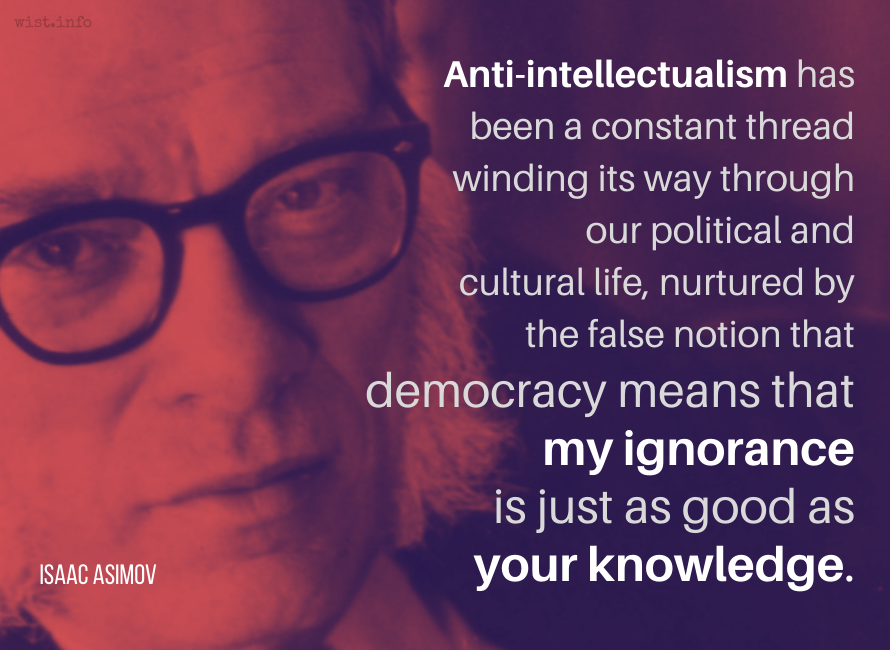
There is a cult of ignorance in the United States, and there always has been. Anti-intellectualism has been a constant thread winding its way through our political and cultural life, nurtured by the false notion that democracy means that “my ignorance is just as good as your knowledge.”
Beating up “intellectuals” is the last refuge of demagogues.
Anthony Lewis (1927–2013) American journalist, political critic, intellectual, writer
“The Czar’s New Clothes,” New York Times (14 Dec 1989)
After Johnson.

Democracy is the theory that intelligence is dangerous. It assumes that no idea can be safe until those who can’t understand it have approved it. It defines truth as anything which at least fifty-one men in every hundred believe. Thus it is firmly committed to the doctrines that one bath a week is enough, that “I seen” is the past tense of “I see,” and that Friday is an unlucky day.
H. L. Mencken (1880–1956) American writer and journalist [Henry Lewis Mencken]
“Pertinent and Impertinent,” Smart Set (Jun 1913) [as Owen Hatteras]
(Source)

Nothing has more retarded the advancement of learning than the disposition of vulgar minds to ridicule and vilify what they cannot comprehend.
Samuel Johnson (1709–1784) English writer, lexicographer, critic
The Rambler, #117 (30 Apr 1751)
(Source)
Presented as a letter from "Hypertatus"

Unreason and anti-intellectualism abominate thought. Thinking implies disagreement; and disagreement implies nonconformity; and nonconformity implies heresy; and heresy implies disloyalty — so, obviously, thinking must be stopped. But shouting is not a substitute for thinking and reason is not the subversion but the salvation of freedom.
Adlai Stevenson II (1900–1965) American politician, diplomat, statesman
Call to Greatness, ch. 3 “America’s Burden” (1954)
(Source)
Adapted from his "A Troubled World," Godkin Lectures, Harvard University (1954-03-17 - 1954-03-20)

It saddens me that literacy has become suspect, and degraded, given how many millions of years of evolution spent developing the ability to create language. The quality of our thoughts is bordered on all sides by our facility with language. The less precise the usage, the less clear the process of language, the less you can achieve what you want to achieve when you open you mouth to say something. We have slowly bastardized and degraded and weakened the language, abetted and abided by a growing cultural disdain for literacy, a cyclical trend toward anti-intellectualism.
J. Michael (Joe) Straczynski (b. 1954) American screenwriter, producer, author [a/k/a "JMS"]
rec.arts.sf.tv.babylon5.moderated, “ATTN JMS: Influences?” (27 Oct 1995)
(Source)