

Any established church is an established crime, an established slave pen.
Mark Twain (1835–1910) American writer [pseud. of Samuel Clemens]
Novel (1889), A Connecticut Yankee in King Arthur’s Court, Part 3 “The Tale of the Lost Land,” ch. 16 “Morgan Le Fay”
(Source)
Quotations about:
establishment
Note not all quotations have been tagged, so Search may find additional quotes on this topic.
I could have given my own sect the preference and made everybody a Presbyterian without any trouble, but that would have been to affront a law of human nature: spiritual wants and instincts are as various in the human family as are physical appetites, complexions, and features, and a man is only at his best, morally, when he is equipped with the religious garment whose color and shape and size most nicely accommodate themselves to the spiritual complexion, angularities, and stature of the individual who wears it.
Mark Twain (1835–1910) American writer [pseud. of Samuel Clemens]
Novel (1889), A Connecticut Yankee in King Arthur’s Court, Part 3 “The Tale of the Lost Land,” ch. 10 “Beginnings of Civilization”
(Source)
What was the crime? To complain. What was the crime? To suffer. Let misery hide and be silent, otherwise it is lèse-majesté.
[Quel était l’attentat? se plaindre. Quel était le crime? souffrir. Que la misère se cache et se taise, sinon elle est lèse-majesté.]
Victor Hugo (1802–1885) French writer, journalist, human rights activist, politician
The Man Who Laughs [L’Homme qui rit; The Laughing Man; By Order of the King], Part 2, Book 9, ch. 2 (.2.9.2) (1869) [tr. Lavelle (2003)]
(Source)
The attitude of the powerful and the courts when confronted by suffering and injustice.
(Source (French)). Other translations:What was the outrage? Disfigurement. What was the crime? Suffering. Let misery hide itself in silence, otherwise it becomes treason.
[tr. Unknown (1869)]What was the outrage? Complaint. What was the crime? Suffering. Let misery hide itself in silence, otherwise it becomes treason.
[tr. Unknown, Authorized (1871)]What was the outrage? -- Complaint. What was the crime? -- Suffering. Let misery hide itself in silence, otherwise it becomes treason.
[tr. Hapgood (1888)]Which was the outrage? The complaint. Which was the crime? The suffering. Let misery hide and be silent; otherwise it becomes high treason.
[tr. Phillips (1894)]
It was as dark a day as ever I saw. The injury done to the cause of Christ [by disestablishment], as we then supposed, was irreparable. For several days I suffered what no tongue can tell for the best thing that ever happened to the State of Connecticut. It cut the churches loose from dependence on state support. It threw them wholly on their own resources and on God.
Lyman Beecher (1775–1863) American minister, preacher, abolitionist
Autobiography, Vol. 1, ch. 51 “Downfall of the Standing Order” (1864) [ed. Charles Beecher]
(Source)
Regarding the 1918 disestablishment of the Congregational Church in Connecticut, which Beecher had fought against. Prior to that the Congregational Church had been receiving direct tax funding by the state, which was the source of growing protest from other denominations.
Beecher went on to write about the disestablishment:They say ministers have lost their influence; the fact is, they have gained. By voluntary efforts, societies, missions, and revivals, they exert a deeper influence than ever they could by queues, and shoe-buckles, and cocked hats, and gold-headed canes.

Older men declare war. But it is youth who must fight and die. And it is youth who must inherit the tribulation, the sorrow, and the triumphs that are the aftermath of war.
Herbert Hoover (1874–1964) American engineer, bureaucrat, US President (1929–33)
Speech (1944-06-27), “Freedom in America and the World,” Republican National Convention, Chicago
(Source)
There are people who are convinced of the wickedness both of armies and of police forces, but who are nevertheless much more intolerant and inquisitorial in outlook than the normal person who believes that it is necessary to use violence in certain circumstances. They will not say to somebody else, “Do this, that and the other or you will go to prison”, but they will, if they can, get inside his brain and dictate his thoughts for him in the minutest particulars.
George Orwell (1903–1950) English journalist, essayist, writer [pseud. of Eric Arthur Blair]
Essay (1947-03), “Lear, Tolstoy and the Fool,” Polemic Magazine, No. 7
(Source)
Collected in Inside the Whale, and Other Essays (1962).

That’s why it’s called Establishment journalism. You concentrate on the people at the top, the people with power; you watch, you study how they make their moves, you get fascinated by it, and pretty soon you can’t see anything else — just the top, just the power. And the others, the people, the readers, matter so little that you don’t even bother to let them know what’s going on. You start to think like the people you cover. It can happen on any beat — business, police, politics, education. The stuff you want is from the top — you want to quote the chief, the superintendent, the chairman of the board. There are no reliable sources who earn less than $10,000 a year.
Molly Ivins (1944–2007) American writer, political columnist [Mary Tyler Ivins]
Essay (1973-01), “Pitfalls of Reporting in the Lone Star State,” Houston Journalism Review
(Source)
Collected in Molly Ivins Can't Say That, Can She? (1991).

Men generally, under such a government as this, think that they ought to wait until they have persuaded the majority to alter [unjust laws]. They think that, if they should resist, the remedy would be worse than the evil. But it is the fault of the government itself that the remedy is worse than the evil. It makes it worse. Why is it not more apt to anticipate and provide for reform? Why does it not cherish its wise minority? Why does it cry and resist before it is hurt? Why does it not encourage its citizens to be on the alert to point out its faults, and do better than it would have them? Why does it always crucify Christ, and excommunicate Copernicus and Luther, and pronounce Washington and Franklin rebels?
Henry David Thoreau (1817–1862) American philosopher and writer
Essay (1849-05), “Resistance to Civil Government [On the Duty of Civil Disobedience],” Æsthetic Papers, No. 1, Article 10
(Source)
Based on an 1848 lecture at the Concord Lyceum.
The Establishment is enlightened, tolerant, even well-meaning. It has never been exclusive, rather drawing in recruits from outside, as soon as they are ready to conform to its standards and become respectable. There is nothing more agreeable in this life than to make peace with the Establishment — and nothing more corrupting.
A. J. P. Taylor (1906–1990) British historian, journalist, broadcaster [Alan John Percivale Taylor]
“William Cobbett,” The New Statesman (1953-08-29)
(Source)
Taylor is often credited with coining the term "the Establishment" (what Cobbett called "the Thing"). The article, reviewing a biography of Cobbett, was collected in Taylor's Englishmen and Others (1956).
I never saw, heard, nor read, that the clergy were beloved in any nation where Christianity was the religion of the country. Nothing can render them popular, but some degree of persecution.
When it gets down to having to use violence, then you are playing the system’s game. The establishment will irritate you — pull your beard, flick your face — to make you fight. Because once they’ve got you violent, then they know how to handle you. The only thing they don’t know how to handle is non-violence and humor.
John Lennon (1940–1980) English rock musician, singer, songwriter
Interview, Bed-Ins for Peace, Montreal, Canada (1 Jun 1969)
(Source)

No man shall be compelled to frequent or support any religious worship, place, or ministry whatsoever, nor shall be enforced, restrained, molested, or burthened in his body or goods, nor shall otherwise suffer, on account of his religious opinions or belief; but that all men shall be free to profess, and by argument to maintain, their opinions in matters of religion, and that the same shall in no wise diminish, enlarge, or affect their civil capacities.
Thomas Jefferson (1743–1826) American political philosopher, polymath, statesman, US President (1801–09)
Document (1776-06-18), “Virginia Statute for Religious Freedom,” Preamble (enacted 1786-01-16)
(Source)
If you are bored and disgusted by politics and don’t bother to vote, you are in effect voting for the entrenched Establishments of the two major parties, who please rest assured are not dumb, and who are keenly aware that it is in their interests to keep you disgusted and bored and cynical and to give you every possible psychological reason to stay at home doing one-hitters and watching MTV on primary day. By all means stay home if you want, but don’t bullshit yourself that you’re not voting. In reality, there is no such thing as not voting: you either vote by voting, or you vote by staying home and tacitly doubling the value of some Diehard’s vote.

There is nothing more agreeable in life than to make peace with the Establishment — and nothing more corrupting.
A. J. P. Taylor (1906–1990) British historian, journalist, broadcaster [Alan John Percivale Taylor]
“William Cobbett” (1953), Essays in English History (1976)
Others, as most legislators, politicians, lawyers, ministers, and office-holders, serve the state chiefly with their heads; and, as they rarely make any moral distinctions, they are as likely to serve the devil, without intending it, as God.
Henry David Thoreau (1817–1862) American philosopher and writer
Essay (1849-05), “Resistance to Civil Government [On the Duty of Civil Disobedience],” Æsthetic Papers, No. 1, Article 10
(Source)
Based on an 1848 lecture at the Concord Lyceum.
If you attack the establishment long enough and hard enough, they will make you a member of it.
Art Buchwald (1925–2007) American humorist, columnist
Speech, Horatio Alger Award Dinner, Washington, DC (May 1989)
Buchwald used a number of variations of this phrase; this particular one was reported a week later in the International Herald Tribune (24 May 1989), but other versions go back to the 1960s (e.g., "Woe to the person in this country who attacks the establishment. It isn’t jail, nor even physical harm, that he must fear. His main problem is that by attacking the Establishment, he automatically becomes a member of it, and there is no greater punishment in the world," from his column of 7 May 1968). See here for more info.
To rebel against a powerful political, economic, religious, or social establishment is very dangerous and very few people do it, except, perhaps, as part of a mob. To rebel against the “scientific” establishment, however, is the easiest thing in the world, and anyone can do it and feel enormously brave, without risking as much as a hangnail. Thus, the vast majority, who believe in astrology and think that the planets have nothing better to do than form a code that will tell them whether tomorrow is a good day to close a business deal or not, become all the more excited and enthusiastic about the bilge when a group of astronomers denounces it.
Isaac Asimov (1920–1992) Russian-American author, polymath, biochemist
(Attributed)
Christian establishments tend to great ignorance and corruption, all of which facilitate the execution of mischievous projects.
James Madison (1751–1836) American statesman, political theorist, US President (1809–17)
Letter to William Bradford, Jr. (1774)
Nothing is more dreaded than the national government meddling with religion.
John Adams (1735–1826) American lawyer, Founder, statesman; US President (1797–1801)
Letter to Benjamin Rush (1812)
A man of abilities and character, of any sect whatever, may be admitted to any office or public trust under the United States. I am a friend to a variety of sects, because they keep one another in order. How many different sects are we composed of throughout the United States? How many different sects will be in congress? We cannot enumerate the sects that may be in congress. And there are so many now in the United States that they will prevent the establishment of any one sect in prejudice to the rest, and will forever oppose all attempts to infringe religious liberty. If such an attempt be made, will not the alarm be sounded throughout America? If congress be as wicked as we are foretold they will, they would not run the risk of exciting the resentment of all, or most of the religious sects in America.
Edmund Randolph (1753–1813) American attorney, politician
Speech, Virginia Ratifying Committee (10 Jun 1788)
When the gap between the ideal and real becomes too wide, the system breaks down.
Barbara W. Tuchman (1912–1989) American historian and author
A Distant Mirror: The Calamitous 14th Century, Foreward (1978)
(Source)

Way down deep the American people are afraid of an entangling relationship between formal religions — or whole bodies of religious belief — and government. Apart from constitutional law and religious doctrine, there is a sense that tells us it’s wrong to presume to speak for God or to claim God’s sanction of our particular legislation and His rejection of all other positions. Most of us are offended when we see religion being trivialized by its appearance in political throw-away pamphlets. The American people need no course in philosophy or political science or church history to know that God should not be made into a celestial party chairman.
Mario Cuomo (1932–2015) American politician
“Religious Belief and Public Morality,” John A. O’Brien Lecture, U. of Notre Dame (13 Sep 1984)
(Source)

There comes a time when the operation of the machine becomes so odious, makes you so sick at heart, that you can’t take part, you can’t even passively take part; and you’ve got to put your bodies upon the gears and upon the wheels, upon all the apparatus, and you’ve got to make it stop, And you’ve got to indicate to the people who run it, the people who own it, that unless you’re free the machine will be prevented from working at all.
Mario Savio (1942–1996) American political activist
“Sproul Hall Sit-In Address” (2 Dec 1964)
(Source)
Of course it is quite a different matter if we consider the utility of religion as a prop of thrones; for where these are held “by the grace of God,” throne and altar are intimately associated; and every wise prince who loves his throne and his family will appear at the head of his people as an exemplar of true religion.
[Anders freilich stellt sich die Sache, wenn wir den Nutzen der Religionen als Stützen der Throne in Erwägung ziehen: denn sofern diese von Gottes Gnaden verliehen sind, stehn Altar und Thron in genauer Verwandtschaft. Auch wird demnach jeder weise Fürst, der seinen Thron und seine Familie liebt, stets als ein Muster wahrer Religiosität seinem Volke vorangehn.]
Arthur Schopenhauer (1788–1860) German philosopher
Parerga and Paralipomena, Vol. 2, ch. 15 “On Religion [Ueber Religion],” § 174 “A Dialogue [Ein Dialog]” (1851) [tr. Saunders (1890)]
(Source)
(Source (German)). Another translation:Of course the matter becomes quite different if we consider the utility of religion as a mainstay of thrones; for in so far as these are bestowed "by the grace of God," altar and throne are closely related. Accordingly, every wise prince who loves his throne and his family will walk before his people as a type of true religion.
[tr. Dircks]Of course, it is quite a different matter if we take into consideration the use of religions as supports to thrones; for in so far as these are granted by the grace of God, throne and altar are intimately associated. Accordingly, every wise prince who loves his throne and family, will always appear at the head of his people as a paragon of true religious feeling.
[tr. Payne (1974)]

I am for freedom of religion, & against all maneuvres to bring about a legal ascendancy of one sect over another.
Thomas Jefferson (1743–1826) American political philosopher, polymath, statesman, US President (1801–09)
Letter (1799-01-26) to Elbridge Gerry
(Source)
The clergy, by getting themselves established by law, & ingrafted into the machine of government, have been a very formidable engine against the civil & religious rights of man.
Thomas Jefferson (1743–1826) American political philosopher, polymath, statesman, US President (1801–09)
Letter (1800-08-189) to Jeremiah Moor
(Source)
Another purpose of the Establishment Clause rested upon an awareness of the historical fact that governmentally established religions and religious persecutions go hand in hand. The Founders knew that only a few years after the Book of Common Prayer became the only accepted form of religious services in the established Church of England, an Act of Uniformity was passed to compel all Englishmen to attend those services and to make it a criminal offense to conduct or attend religious gatherings of any other kind — a law which was consistently flouted by dissenting religious groups in England and which contributed to widespread persecutions of people like John Bunyan who persisted in holding “unlawful [religious] meetings … to the great disturbance and distraction of the good subjects of this kingdom ….” And they knew that similar persecutions had received the sanction of law in several of the colonies in this country soon after the establishment of official religions in those colonies. It was in large part to get completely away from this sort of systematic religious persecution that the Founders brought into being our Nation, our Constitution, and our Bill of Rights with its prohibition against any governmental establishment of religion.
Hugo Black (1886–1971) American politician and jurist; US Supreme Court Justice (1937–71)
Engel v. Vitale, 370 U.S. 421, 424–425 (1962) [majority opinion]
(Source)
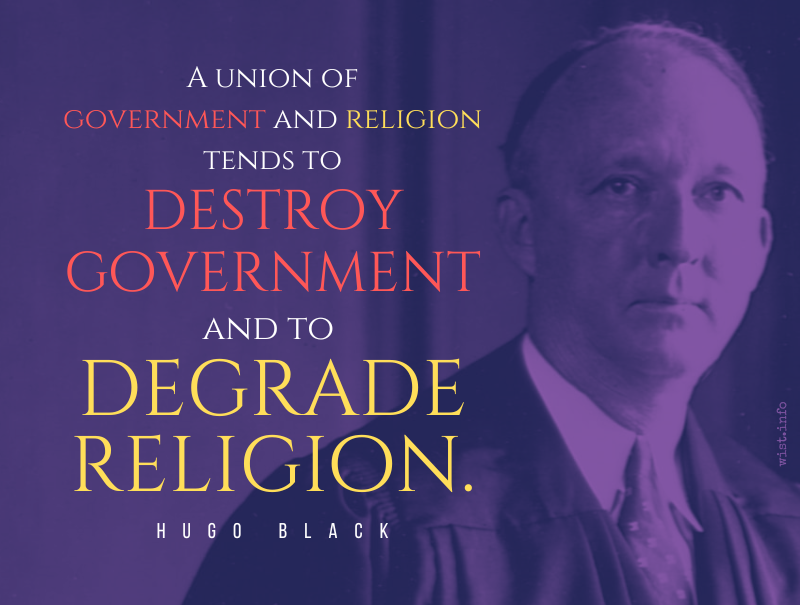
But the purposes underlying the Establishment Clause go much further than that. Its first and most immediate purpose rested on the belief that a union of government and religion tends to destroy government and to degrade religion. The history of governmentally established religion, both in England and in this country, showed that whenever government had allied itself with one particular form of religion, the inevitable result had been that it had incurred the hatred, disrespect and even contempt of those who held contrary beliefs. That same history showed that many people had lost their respect for any religion that had relied upon the support of government to spread its faith.
The Establishment Clause thus stands as an expression of principle on the part of the Founders of our Constitution that religion is too personal, too sacred, too holy, to permit its “unhallowed perversion” by a civil magistrate.
Hugo Black (1886–1971) American politician and jurist; US Supreme Court Justice (1937–71)
Engel v. Vitale, 370 U.S. 421, 431–432 (1962) [majority opinion]
(Source)
Churches are becoming political organizations … It probably will not be long until the churches will divide as sharply upon political, as upon theological questions; and when that day comes, if there are not liberals enough to hold the balance of power, this Government will be destroyed.
Robert Green Ingersoll (1833–1899) American lawyer, freethinker, orator
Some Mistakes of Moses, Sec. 3 “The Politicians” (1879)
(Source)
The “establishment of religion” clause of the First Amendment means at least this: Neither a state nor the Federal Government can set up a church. Neither can pass laws which aid one religion, aid all religions, or prefer one religion over another. Neither can force nor influence a person to go to or to remain away from church against his will or force him to profess a belief or disbelief in any religion. No person can be punished for entertaining or professing religious beliefs or disbeliefs, for church attendance or non-attendance. No tax in any amount, large or small, can be levied to support any religious activities or institutions, whatever they may be called, or whatever form they may adopt to teach or practice religion. Neither a state nor the Federal Government can, openly or secretly, participate in the affairs of any religious organizations or groups and vice versa. In the words of Jefferson, the clause against establishment of religion by law was intended to erect “a wall of separation between Church and State.”
I believe in one God, and no more; and I hope for happiness beyond this life.
I believe in the equality of man; and I believe that religious duties consist in doing justice, loving mercy, and endeavouring to make our fellow-creatures happy.
But, lest it should be supposed that I believe many other things in addition to these, I shall, in the progress of this work, declare the things I do not believe, and my reasons for not believing them.
I do not believe in the creed professed by the Jewish Church, by the Roman Church, by the Greek Church, by the Turkish Church, by the Protestant Church, nor by any church that I know of. My own mind is my own church.
All national institutions of churches, whether Jewish, Christian or Turkish, appear to me no other than human inventions, set up to terrify and enslave mankind, and monopolize power and profit.
Thomas Paine (1737–1809) American political philosopher and writer
The Age of Reason, Part 1, ch. 1 (1794)
(Source)
If nowhere else, in the relation between Church and State, “good fences make good neighbors.”
Felix Frankfurter (1882–1965) American jurist, teacher; US Supreme Court Justice (1939–62)
McCollum v. Board of Education, 333 U.S. 232 (1948) [concurring]
(Source)
Ruling that public schools could not let religious groups use their property for religious education to children.
The quoted reference is to a poem by Robert Frost.
The settled opinion here is, that religion is essentially distinct from Civil Govt., and exempt from its cognizance; that a connexion between them is injurious to both; that there are causes in the human breast which ensure the perpetuity of religion without the aid of the law; that rival sects, with equal rights, exercise mutual censorships in favor of good morals; that if new sects arise with absurd opinions or over-heated imaginations, the proper remedies lie in time, forbearance, and example; that a legal establishment of religion without a toleration could not be thought of, and with a toleration, is no security for public quiet & harmony, but rather a source of discord & animosity; and, finally, that these opinions are supported by experience, which has shewn that every relaxation of the alliance between Law & religion, from the partial example of Holland to its consummation in Pennsylvania, Delaware, New Jersey, &c., has been found as safe in practice as it is sound in theory.
James Madison (1751–1836) American statesman, political theorist, US President (1809–17)
Letter to Edward Everett (18 Mar 1823)
I consider the Government of the United States as interdicted by the Constitution of the United States from meddling with religious institutions, their doctrines, discipline, or exercises [….] But it is only proposed that I should recommend, not prescribe, a day of fasting and praying. That is, I should indirectly assume to the United States an authority over religious exercises, which the Constitution has directly precluded them from. It must be meant, too, that this recommendation is to carry some authority and to be sanctioned by some penalty on those who disregard it; not indeed of fine and imprisonment, but of some degree of proscription perhaps in public opinion. And does the change in the nature of the penalty make the recommendation less a law of conduct for those to whom it is directed? […] Every one must act according to the dictates of his own reason and mine tells me that civil powers alone have been given the President of the United States, and no authority to direct the religious exercise of his constituents.
Thomas Jefferson (1743–1826) American political philosopher, polymath, statesman, US President (1801–09)
Letter (1808-01-23) to Samuel Miller
(Source)
On refusing to issue a Thanksgiving proclamation during his presidency.
[I]t is contrary to the principles of reason and justice that any should be compelled to contribute to the maintenance of a church with which their consciences will not permit them to join, and from which they can derive no benefit; for remedy whereof, and that equal liberty as well religious as civil, may be universally extended to all the good people of this commonwealth.
George Mason (1725–1792) American statesman, Founding Father [George Mason IV]
Virginia Declaration of Rights (1776)
That to compel a man to furnish contributions of money for the propagation of opinions which he disbelieves [and abhors], is sinful and tyrannical; that even the forcing him to support this or that teacher of his own religious persuasion, is depriving him of the comfortable liberty of giving his contributions to the particular pastor whose morals he would make his pattern, and whose powers he feels most persuasive to righteousness; and is withdrawing from the ministry those temporal rewards, which proceeding from an approbation of their personal conduct, are an additional incitement to earnest and unremitting labours for the instruction of mankind.
Thomas Jefferson (1743–1826) American political philosopher, polymath, statesman, US President (1801–09)
Document (1776-06-18), “Virginia Statute for Religious Freedom,” Preamble (enacted 1786-01-16)
(Source)
The words in [brackets] were removed before final passage. The term "temporal rewards" was mistranscribed into statute as "temporary rewards."
It is well known that the most radical revolutionary will become a conservative the day after the revolution.
Hannah Arendt (1906–1975) German-American philosopher, political theorist
Essay (1970-09-12), “Civil Disobedience,” The New Yorker
(Source)
Revised and collected in Crises of the Republic (1972).

Bureaucracy defends the status quo long past the time when the quo has lost its status.
Lawrence J. Peter (1919–1990) American educator, management theorist
Peter’s Quotations: Ideas for Our Time (1977)
All censorships exist to prevent any one from challenging current conceptions and existing institutions. All progress is initiated by challenging current conceptions, and executed by supplanting existing institutions. Consequently the first condition of progress is the removal of censorships.
George Bernard Shaw (1856–1950) Irish playwright and critic
Mrs. Warren’s Profession, Preface (1893)
(Source)
The clergy … believe that any portion of power confided to me will be exerted in opposition to their schemes. And they believe rightly: for I have sworn upon the altar of god eternal hostility against every form of tyranny over the mind of man. But this is all they have to fear from me: and enough, too, in their opinion ….
Thomas Jefferson (1743–1826) American political philosopher, polymath, statesman, US President (1801–09)
Letter (1800-09-23) to Benjamin Rush
(Source)
On members of the clergy who had "a very favorite hope of obtaining an establishment of a particular form of Christianity thro' the U. S.; and as every sect believes its own form the true one, every one perhaps hoped for his own, but especially the Episcopalians & Congregationalists."
Usually elided to: "I have sworn upon the altar of God, eternal hostility against every form of tyranny over the mind of man."