

Separation means separation, not something less. Jefferson’s metaphor in describing the relation between Church and State speaks of a “wall of separation,” not of a fine line easily overstepped. The public school is at once the symbol of our democracy and the most pervasive means for promoting our common destiny. In no activity of the State is it more vital to keep out divisive forces than in its schools, to avoid confusing, not to say fusing, what the Constitution sought to keep strictly apart.
Felix Frankfurter (1882–1965) American jurist, teacher; US Supreme Court Justice (1939–62)
McCollum v. Board of Education 333 U.S. 231 (1948) [concurring]
(Source)
Quotations about:
religious freedom
Note not all quotations have been tagged, so Search may find additional quotes on this topic.
The preservation of the community from divisive conflicts, of Government from irreconcilable pressures by religious groups, of religion from censorship and coercion, however subtly exercised, requires strict confinement of the State to instruction other than religious, leaving to the individual’s church and home indoctrination in the faith of his choice.
Felix Frankfurter (1882–1965) American jurist, teacher; US Supreme Court Justice (1939–62)
McCollum v. Board of Education 333 U.S. 217 (1948) [concurring]
(Source)
The nonsectarian or secular public school was the means of reconciling freedom in general with religious freedom. The sharp confinement of the public schools to secular education was a recognition of the need of a democratic society to educate its children, insofar as the State undertook to do so, in an atmosphere free from pressures in a realm in which pressures are most resisted and where conflicts are most easily and most bitterly engendered. Designed to serve as perhaps the most powerful agency for promoting cohesion among a heterogeneous democratic people, the public school must keep scrupulously free from entanglement in the strife of sects.
Felix Frankfurter (1882–1965) American jurist, teacher; US Supreme Court Justice (1939–62)
McCollum v. Board of Education 333 U.S. 216–217 (1948) [concurring]
(Source)
Any established church is an established crime, an established slave pen.
Mark Twain (1835–1910) American writer [pseud. of Samuel Clemens]
Novel (1889), A Connecticut Yankee in King Arthur’s Court, Part 3 “The Tale of the Lost Land,” ch. 16 “Morgan Le Fay”
(Source)
It is, I am afraid, true that frequently various religious groups endeavor to exert pressures and control over different legislative and educational fields. It is the job of all of us to be alert for such infringement of our prerogatives and prevent any such attempts from being successful. Like all our freedoms, this freedom from religious-group pressure must be constantly defended.
Eleanor Roosevelt (1884–1962) American politician, diplomat, activist; First Lady of the US (1933–45)
Memoir (1961), The Autobiography of Eleanor Roosevelt, Part 4, ch. 43 “Unfinished Business”
(Source)
This text was not in her previous memoirs, but new to her compiled Autobiography.

I could have given my own sect the preference and made everybody a Presbyterian without any trouble, but that would have been to affront a law of human nature: spiritual wants and instincts are as various in the human family as are physical appetites, complexions, and features, and a man is only at his best, morally, when he is equipped with the religious garment whose color and shape and size most nicely accommodate themselves to the spiritual complexion, angularities, and stature of the individual who wears it.
Mark Twain (1835–1910) American writer [pseud. of Samuel Clemens]
Novel (1889), A Connecticut Yankee in King Arthur’s Court, Part 3 “The Tale of the Lost Land,” ch. 10 “Beginnings of Civilization”
(Source)
It was as dark a day as ever I saw. The injury done to the cause of Christ [by disestablishment], as we then supposed, was irreparable. For several days I suffered what no tongue can tell for the best thing that ever happened to the State of Connecticut. It cut the churches loose from dependence on state support. It threw them wholly on their own resources and on God.
Lyman Beecher (1775–1863) American minister, preacher, abolitionist
Autobiography, Vol. 1, ch. 51 “Downfall of the Standing Order” (1864) [ed. Charles Beecher]
(Source)
Regarding the 1918 disestablishment of the Congregational Church in Connecticut, which Beecher had fought against. Prior to that the Congregational Church had been receiving direct tax funding by the state, which was the source of growing protest from other denominations.
Beecher went on to write about the disestablishment:They say ministers have lost their influence; the fact is, they have gained. By voluntary efforts, societies, missions, and revivals, they exert a deeper influence than ever they could by queues, and shoe-buckles, and cocked hats, and gold-headed canes.

I thank Luther for protesting against the abuses of the church, and I denounce him because he was the enemy of liberty. I thank Calvin for writing a book in favor of religious freedom, and I abhor him because he burned Servetus. I thank Knox for resisting Episcopal persecution, and I hate him because he persecuted in his turn. I thank the Puritans for saying “Resistance to tyrants is obedience to God,” and yet I am compelled to say that they were tyrants themselves.
When a fact can be demonstrated, force is unnecessary; when it cannot be demonstrated, an appeal to force is infamous. In the presence of the unknown all have an equal right to think.
Robert Green Ingersoll (1833–1899) American lawyer, freethinker, orator
Lecture (1873-12) “Individuality,” Chicago Free Religious Society
(Source)
Full title "Arraignment of the Church and a Plea for Individuality." Collected in The Gods and Other Lectures (1876).
There can be nothing more utterly subversive of all that is really valuable than the suppression of honest thought. No man, worthy of the form he bears, will at the command of church or state solemnly repeat a creed his reason scorns.
Robert Green Ingersoll (1833–1899) American lawyer, freethinker, orator
Lecture (1873-12) “Individuality,” Chicago Free Religious Society
(Source)
Full title "Arraignment of the Church and a Plea for Individuality." Collected in The Gods and Other Lectures (1876)
To Paine, Jefferson, and Franklin, are we indebted, more than to all others, for a human government, and for a Constitution in which no God is recognized superior to the legally expressed will of the people.
They knew that to put God in the Constitution was to put man out. They knew that the recognition of a Deity would be seized upon by fanatics and zealots as a pretext for destroying the liberty of thought. They knew the terrible history of the church too well to place in her keeping, or in the keeping of her God, the sacred rights of man. They intended that all should have the right to worship, or not to worship; that our laws should make no distinction on account of creed. They intended to found and frame a government for man, and for man alone. They wished to preserve the individuality and liberty of all; to prevent the few from governing the many, and the many from persecuting and destroying the few.Robert Green Ingersoll (1833–1899) American lawyer, freethinker, orator
Lecture (1873-12) “Individuality,” Chicago Free Religious Society
(Source)
Full title "Arraignment of the Church and a Plea for Individuality." Collected in The Gods and Other Lectures (1876).
In the future days, which we seek to make secure, we look forward to a world founded upon four essential human freedoms.
The first is freedom of speech and expression — everywhere in the world.
The second is freedom of every person to worship God in his own way — everywhere in the world.
The third is freedom from want — which, translated into world terms, means economic understandings which will secure to every nation a healthy peacetime life for its inhabitants — everywhere in the world.
The fourth is freedom from fear — which, translated into world terms, means a world-wide reduction of armaments to such a point and in such a thorough fashion that no nation will be in a position to commit an act of physical aggression against any neighbor — anywhere in the world.
That is no vision of a distant millennium. It is a definite basis for a kind of world attainable in our own time and generation. That kind of world is the very antithesis of the so-called new order of tyranny which the dictators seek to create with the crash of a bomb.Franklin Delano Roosevelt (1882–1945) American lawyer, politician, statesman; US President (1933–45)
Speech (1941-01-06) to Congress, Annual Message (State of the Union), “Four Freedoms,” Washington, D. C.
(Source)
FDR's first presentation of his "Four Freedoms" framework.
So our fathers said: “We will form a secular government, and under the flag with which we are going to enrich the air, we will allow every man to worship God as he thinks best.” They said: “Religion is an individual thing between each man and his creator, and he can worship as he pleases and as he desires.” And why did they do this? The history of the world warned them that the liberty of man was not safe in the clutch and grasp of any church. They had read of and seen the thumbscrews, the racks, and the dungeons of the Inquisition. They knew all about the hypocrisy of the olden time. They knew that the church had stood side by side with the throne; that the high priests were hypocrites, and that the kings were robbers. They also knew that if they gave power to any church, it would corrupt the best church in the world. And so they said that power must not reside in a church, or in a sect, but power must be wherever humanity is — in the great body of the people.
Robert Green Ingersoll (1833–1899) American lawyer, freethinker, orator
Speech (1876-07-04), “Centennial Oration [The Declaration of Independence],” Peoria, Illinois
(Source)
Our fathers founded the first secular government that was ever founded in this world. Recollect that. The first secular government; the first government that said every church has exactly the same rights and no more; every religion has the same rights, and no more. In other words, our fathers were the first men who had the sense, had the genius, to know that no church should be allowed to have a sword; that it should be allowed only to exert its moral influence.
Robert Green Ingersoll (1833–1899) American lawyer, freethinker, orator
Speech (1876-07-04), “Centennial Oration [The Declaration of Independence],” Peoria, Illinois
(Source)
Not only should there be complete liberty in matters of religion and opinion, but complete liberty for each man to lead his life as he desires, provided only that in so doing he does not wrong his neighbors.
Theodore Roosevelt (1858–1919) American politician, statesman, conservationist, writer; US President (1901–09)
Speech (1910-04-23), “Citizenship in a Republic [The Man in the Arena],” Sorbonne, Paris
(Source)

In fact, even were it not inhuman to trouble another man’s conscience, even were there none of the bad effects that spring up by the thousands, one would have to be deranged to engage in such a purpose. He who tries to make me change my religion only does so, presumably, because he would never change his own, even were someone to try to force him to do so; so how can he find it strange that I should refuse to do something that he himself would not do, even perhaps were he offered the world as his empire?
[Car, enfin, quand il n’y auroit pas de l’inhumanité à affliger la conscience des autres, quand il n’en résulteroit aucun des mauvais effets qui en germent à milliers, il faudroit être fou pour s’en aviser. Celui qui veut me faire changer de religion ne le fait sans doute que parce qu’il ne changeroit pas la sienne, quand on voudroit l’y forcer : il trouve donc étrange que je ne fasse pas une chose qu’il ne feroit pas lui-même, peut-être pour l’empire du monde.]
Charles-Lewis de Secondat, Baron de Montesquieu (1689–1755) French political philosopher
Persian Letters [Lettres Persanes], Letter 86, Usbek to Mirza (1721) [tr. Mauldon (2008), # 83]
(Source)
(Source (French)). Other translations:For, in short, though there was nothing of inhumanity in forcing the consciences of others; though it occasioned none of those ill effects which spring up from it by thousands; a man must be a fool to offer at it. He that would have me change my religion, does it, no doubt, because he would not change his own if he were to be forced to it: so that he wonders I will not do a thing, which perhaps he would not do himself for the empire of the universe.
[tr. Ozell (1760 ed.)]For indeed, if there was nothing of inhumanity in forcing the conscience of another, though there did not arise from it any of those bad effects which spring from it by thousands, it would be folly to advise it. He who would have me change my religion, no doubt, desires me to do so, because he would not change his own if he were forced to do it: he yet thinks it strange, that I will not do a thing which he himself would not do, perhaps, for the empire of the world.
[tr. Floyd (1762), # 85]In conclusion, even if there were no inhumanity in distressing the consciences of others, even if there did not result from such a course any of the evil effects which do spring from it in thousands, it would still be foolish to advise it. He who would have me change my religion is led to that, without doubt, because he would not change his own although force were employed; and yet he finds it strange that I will not do a thing which he himself would not do, perhaps for the empire of the world.
[tr. Davidson (1891)]For, in fine, even if the attempt to trouble the conscience of our neighbor was not in itself inhuman, if the manifold evil effects which spring from it had no existence, the mere contemplation of such a course would be an evidence of mental unsoundness.
The man who would have me change my religion does so doubtless because he would never change his own, no matter what force was brought to bear upon him: yet he thinks it strange that I should refuse to do a thing he would not himself do for the empire of the whole world!
[tr. Betts (1897)]Finally, even if it were not inhumane to afflict another’s conscience, and even if there did not result from such an act those bad effects which spring up by the thousands, it would still be foolish to advise it. Whoever would have me change my religion doubtlessly acts as he does because he would not change his, however he was forced; yet he finds it strange that I will not do something which he would not do himself, perhaps for the entire world.
[tr. Healy (1964), # 85]Finally, even if it were inhumane to make such an assault on the consciences of others, with its thousands of self-replicating evil consequences, one would have to be mad to advise it. The man who wants me to change my religion does so only because he would never change his, no matter how much he was forced. And thus he thinks it strange that I will not do a thing he would not do for all the kingdoms of the world.
[tr. MacKenzie (2014), # 85]
The civil rights of none shall be abridged on account of religious belief or worship, nor shall any national religion be established, nor shall the full and equal rights of conscience be in any manner, or on any pretext, infringed.
The people shall not be deprived or abridged of their right to speak, to write, or to publish their sentiments; and the freedom of the press, as one of the great bulwarks of liberty, shall be inviolable.
The people shall not be restrained from peaceably assembling and consulting for their common good; nor from applying to the Legislature by petitions, or remonstrances, for redress of their grievances.
James Madison (1751–1836) American statesman, political theorist, US President (1809–17)
Speech Introducing Proposed Constitutional Amendments (1789-06-08)
(Source)
Speech before the House of Representatives, proposing a Bill of Rights amending the US Constitution. This was the first draft of the text that would go on to become the First Amendment.
The First Amendment is truly the heart of the Bill of Rights. The Framers balanced its freedoms of religion, speech, press, assembly and petition against the needs of a powerful central government, and decided that in those freedoms lies this nation’s only true security. They were not afraid for men to be free. We should not be.
Hugo Black (1886–1971) American politician and jurist; US Supreme Court Justice (1937–71)
James Madison Lecture, NYU School of Law (1960-02-17)
(Source)
The inaugural Madison lecture. Reprinted as "The Bill of Rights," NYU Law Review, Vol. 35 (1960-04).
Unfortunately, our own colonial history also provided ample reasons for people to be afraid to vest too much power in the national government. There had been bills of attainder here; women had been convicted and sentenced to death as “witches”; Quakers, Baptists, and various Protestant sects had been persecuted from time to time. Roger Williams left Massachusetts to breathe the free air of new Rhode Island. Catholics were barred from holding office in many places. Test oaths were required in some of the colonies to bar any but “Christians” from holding office. In New England Quakers suffered death for their faith. Baptists were sent to jail in Virginia for preaching, which caused Madison, while a very young man, to deplore what he called that “diabolical hell-conceived principle of persecution.”
Hugo Black (1886–1971) American politician and jurist; US Supreme Court Justice (1937–71)
James Madison Lecture, NYU School of Law (1960-02-17)
(Source)
The inaugural Madison lecture. Reprinted as "The Bill of Rights," NYU Law Review, Vol. 35 (Apr 1960). The Madison reference is in a letter to William Bradford (24 Jan 1774).
You may force men, by interest or punishment, to say or swear they believe, and to act as if they believed; you can go no farther.
Had the doctrines of Jesus been preached always as pure as they came from his lips, the whole civilized world would now have been Christian. I rejoice that in this blessed country of free inquiry and belief, which has surrendered its creed and conscience to neither kings nor priests, the genuine doctrine of one only God is reviving, and I trust that there is not a young man now living in the United States who will not die an Unitarian.
Thomas Jefferson (1743–1826) American political philosopher, polymath, statesman, US President (1801–09)
Letter (1822-06-26) to Benjamin Waterhouse
(Source)
The prayer of each man from his soul must be his and his alone. This is the genius of the First Amendment. If there is anything clear in the First Amendment, it is that the right of the people to pray in their own way is not be controlled by the election return.
Hugo Black (1886–1971) American politician and jurist; US Supreme Court Justice (1937–71)
Engel v. Vitale, 370 U.S. 421, 425 (1962) [extemporaneous remarks]
(Source)
Added by Black during his reading of the majority opinion, and not part of the written ruling. The passage follows, "It is no part of the business of government to compose official prayers for any group of the American people to recite as a part of a religious program carried on by government."
There can, of course, be no doubt that New York’s program of daily classroom invocation of God’s blessings as prescribed in the Regents’ prayer is a religious activity. […] We think that the constitutional prohibition against laws respecting an establishment of religion must at least mean that, in this country, it is no part of the business of government to compose official prayers for any group of the American people to recite as a part of a religious program carried on by government.
Hugo Black (1886–1971) American politician and jurist; US Supreme Court Justice (1937–71)
Engel v. Vitale, 370 U.S. 421, 424–425 (1962) [majority opinion]
(Source)
This case ruled that organized school prayer was unconstitutional. The prayer in question, to be recited by each class before their teacher each day, read: "Almighty God, we acknowledge our dependence upon Thee, and we beg Thy blessings upon us, our parents, our teachers and our Country."
It is true that many Americans find the Commandments in accord with their personal beliefs. But we do not count heads before enforcing the First Amendment.
Sandra Day O'Connor (b. 1930) American attorney, politician, Supreme Court justice (1981–2006)
McCreary County v. American Civil Liberties Union, 545 U.S. 844 (2005) [concurring]
(Source)
Declaring Ten Commandments displays in two Kentucky county courthouses to be unconstitutional.
Reasonable minds can disagree about how to apply the Religion Clauses in a given case. But the goal of the Clauses is clear: to carry out the Founders’ plan of preserving religious liberty to the fullest extent possible in a pluralistic society. By enforcing the Clauses, we have kept religion a matter for the individual conscience, not for the prosecutor or bureaucrat. At a time when we see around the world the violent consequences of the assumption of religious authority by government, Americans may count themselves fortunate: Our regard for constitutional boundaries has protected us from similar travails, while allowing private religious exercise to flourish. […] Those who would renegotiate the boundaries between church and state must therefore answer a difficult question: Why would we trade a system that has served us so well for one that has served others so poorly?
Sandra Day O'Connor (b. 1930) American attorney, politician, Supreme Court justice (1981–2006)
McCreary County v. American Civil Liberties Union, 545 U.S. 844 (2005) (concurring)
(Source)
No man shall be compelled to frequent or support any religious worship, place, or ministry whatsoever, nor shall be enforced, restrained, molested, or burthened in his body or goods, nor shall otherwise suffer, on account of his religious opinions or belief; but that all men shall be free to profess, and by argument to maintain, their opinions in matters of religion, and that the same shall in no wise diminish, enlarge, or affect their civil capacities.
Thomas Jefferson (1743–1826) American political philosopher, polymath, statesman, US President (1801–09)
Document (1776-06-18), “Virginia Statute for Religious Freedom,” Preamble (enacted 1786-01-16)
(Source)
Our secularism is hard-won, the product of centuries of political, intellectual, and sometimes physical courage. Secularism is the institutionalization of doubt, or more precisely of respect for doubt. It is harder to love doubt than to love freedom. So we are grudging about our secularism, and some of us are a little ashamed of it. Maybe it takes Rushdie’s nightmare and Khomeini’s rage to remind us how precious it is, and how fiercely it must be guarded.
Hendrik Hertzberg (b. 1943) American journalist, editor, speech writer, political commentator
“TRB from Washington,” The New Republic (20 Mar 1989)
(Source)

Where is it written that if you don’t like religion you are somehow disqualified from being a legitimate American? What was Mark Twain, a Russian?
Hendrik Hertzberg (b. 1943) American journalist, editor, speech writer, political commentator
“Antidisestablishmentarianism,” The New Republic (1985-09-16)
(Source)
Reprinted in Politics: Observations and Arguments, 1966-2004 (2005). Responding to a speech from William Bennett, Secretary of Education, about liberals having an "aversion to religion," thus requiring government promotion of "Judeo-Christian tradition."
Who are those who are really disloyal? Those who inflame racial hatreds, who sow religious and class dissensions. Those who subvert the Constitution by violating the freedom of the ballot box. Those who make a mockery of majority rule by the use of the filibuster. Those who impair democracy by denying equal educational facilities. Those who frustrate justice by lynch law or by making a farce of jury trials. Those who deny freedom of speech and of the press and of assembly. Those who press for special favors against the interest of the commonwealth. Those who regard public office as a source of private gain. Those who would exalt the military over the civil. Those who for selfish and private purposes stir up national antagonisms and expose the world to the ruin of war.
Religious freedom should work two ways: we should be free to practice the religion of our choice, but we must also be free from having someone else’s religion practiced on us.
John Irving (b. 1942) American-Canadian novelist and screenwriter [b. John Wallace Blunt Jr.]
My Movie Business, ch. 8 (1999)
(Source)

If today you can take a thing like evolution and make it a crime to teach it in the public school, tomorrow you can make it a crime to teach it in the private schools, and the next year you can make it a crime to teach it to the hustings or in the church. At the next session you may ban books and the newspapers. Soon you may set Catholic against Protestant and Protestant against Protestant, and try to foist your own religion upon the minds of men. If you can do one you can do the other. Ignorance and fanaticism is ever busy and needs feeding. Always it is feeding and gloating for more. Today it is the public school teachers, tomorrow the private. The next day the preachers and the lectures, the magazines, the books, the newspapers. After a while, your honor, it is the setting of man against man and creed against creed until with flying banners and beating drums we are marching backward to the glorious ages of the sixteenth century when bigots lighted fagots to burn the men who dared to bring any intelligence and enlightenment and culture to the human mind.
Democracy means that people can say what they want to. All the people. It means that they can vote as they wish. All the people. It means that they can worship God in any way they feel right, and that includes Christians and Jews and voodoo doctors as well.
Dalton Trumbo (1905–1976) American screenwriter and novelist [James Dalton Trumbo]
The Remarkable Andrew (1942)
Based on Trumbo's 1941 book of the same name. Parallel text.
The government’s ability to enforce generally applicable prohibitions of socially harmful conduct, like its ability to carry out other aspects of public policy, “cannot depend on measuring the effects of a governmental action on a religious objector’s spiritual development.” To make an individual’s obligation to obey such a law contingent upon the law’s coincidence with his religious beliefs, except where the State’s interest is “compelling” — permitting him, by virtue of his beliefs, “to become a law unto himself” — contradicts both constitutional tradition and common sense.
Antonin Scalia (1936–2016) US Supreme Court justice
Employment Division v. Smith, 494 U.S. 872, majority opinion (1990)
(Source)
Opinion holding that the state could prohibit religious-based peyote use.
Religious discord has lost her sting; the cumbrous weapons of theological warfare are antiquated: the field of politics supplies the alchymists of our times with materials of more fatal explosion, and the butchers of mankind no longer travel to another world for instruments of cruelty and destruction. Our age is too enlightened to contend upon topics, which concern only the interests of eternity; and men who hold in proper contempt all controversies about trifles, except such as inflame their own passions, have made it a common-place censure against your ancestors, that their zeal was enkindled by subjects of trivial importance; and that however aggrieved by the intolerance of others, they were alike intolerant themselves. Against these objections, your candid judgment will not require an unqualified justification; but your respect and gratitude for the founders of the State may boldly claim an ample apology. The original grounds of their separation from the church of England, were not objects of a magnitude to dissolve the bonds of communion; much less those of charity, between Christian brethren of the same essential principles.
John Quincy Adams (1767–1848) US President (1825–29)
Speech, Plymouth (22 Dec 1802)
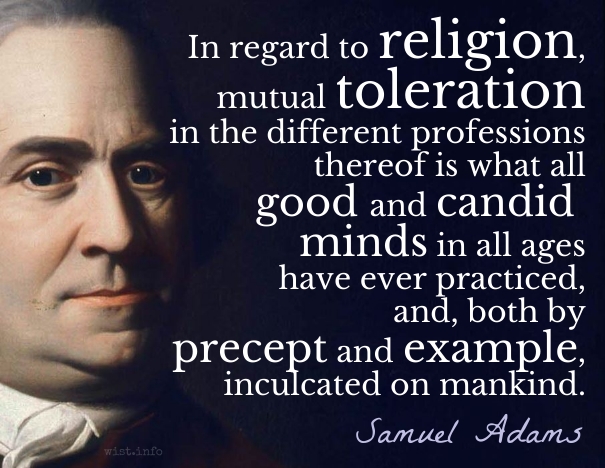
In regard to religion, mutual toleration in the different professions thereof is what all good and candid minds in all ages have ever practiced, and, both by precept and example, inculcated on mankind.
Samuel Adams (1722–1803) American revolutionary, statesman
“The Rights of the Colonists,” Report of the Committee of Correspondence to the Boston Town Meeting (1772-11-20)
(Source)
Whatever crushes individuality is despotism, by whatever name it may be called and whether it professes to be enforcing the will of God or the injunctions of men.
John Stuart Mill (1806–1873) English philosopher and economist
On Liberty, ch. 3 “Of Individuality, as One of the Elements of Well-Being” (1859)
(Source)
Nothing is more dreaded than the national government meddling with religion.
John Adams (1735–1826) American lawyer, Founder, statesman; US President (1797–1801)
Letter to Benjamin Rush (1812)
I also give it in charge to you to avoid all disrespect of the religion of the country, and its ceremonies. Prudence, policy, and a true Christian spirit, will lead us to look with compassion up their errors without insulting them. While we are contending for our own liberty, we should be very cautious not to violate the rights of conscience in others, ever considering that God alone is the judge of the hearts of men, and to him only in this case are they answerable.
George Washington (1732–1799) American military leader, Founding Father, US President (1789–1797)
Letter (1775-09-14) to Benedict Arnold, “Charge to the Northern Expeditionary Force”
(Source)
Regarding the invasion of (Catholic) Quebec, Canada.
Some very worthy persons, who have not had great advantages for information, have objected against that clause in the constitution which provides, that no religious test shall ever be required as a qualification to any office or public trust under the United States. They have been afraid that this clause is unfavorable to religion. But my countrymen, the sole purpose and effect of it is to exclude persecution, and to secure to you the important right of religious liberty. We are almost the only people in the world, who have a full enjoyment of this important right of human nature. In our country every man has a right to worship God in that way which is most agreeable to his conscience. If he be a good and peaceable person he is liable to no penalties or incapacities on account of his religious sentiments; or in other words, he is not subject to persecution. But in other parts of the world, it has been, and still is, far different. Systems of religious error have been adopted, in times of ignorance. It has been the interest of tyrannical kings, popes, and prelates, to maintain these errors. When the clouds of ignorance began to vanish, and the people grew more enlightened, there was no other way to keep them in error, but to prohibit their altering their religious opinions by severe persecuting laws. In this way persecution became general throughout Europe.
Oliver Ellsworth (1745–1807) American lawyer, politician, Founder; US Supreme Court Chief Justice (1796–1800)
Essay (1787-12-17)
(Source)
Ultimately, therefore, the question “whether or not we admit religious values into our public affairs” is too broad to yield a single answer. “Yes,” we create our public morality through consensus and in this country that consensus reflects to some extent religious values of a great majority of Americans. But “no,” all religiously based values don’t have an a priori place in our public morality. The community must decide if what is being proposed would be better left to private discretion than public policy; whether it restricts freedoms, and if so to what end, to whose benefit; whether it will produce a good or bad result; whether overall it will help the community or merely divide it.
Mario Cuomo (1932–2015) American politician
“Religious Belief and Public Morality,” John A. O’Brien Lecture, U. of Notre Dame (13 Sep 1984)
(Source)
I am happy to find myself perfectly agreed with you, that we should begin by setting conscience free. When all men of all religions consistent with morals and property, shall enjoy equal liberty, property, or rather security of property, and an equal chance for honor and power, and when government shall be considered as having in it nothing more mysterious or divine than other arts or sciences, we may expect that improvements will be made in the human character and the state of society.
John Adams (1735–1826) American lawyer, Founder, statesman; US President (1797–1801)
Letter (1785-04-08) to Dr. Price
(Source)
This quote is almost always given in the following, paraphrased form:We should begin by setting conscience free. When all men of all religions shall enjoy equal liberty, property, and an equal chance for honors and power we may expect that improvements will be made in the human character and the state of society.
This simplifies his statement for religious tolerance (indeed, full social integration of all religions "consistent with morals and property"), but omits his stance (which he speaks to in the rest of the letter) on government properly being a secular organization, rather than sovereign rulers being being imbued with divine right from God.
The arguments start when religious values are used to support positions which would impose on other people restrictions they find unacceptable. Some people do object to Catholic demands for an end to abortion, seeing it as a violation of the separation of church and state. And some others, while they have no compunction about invoking the authority of the Catholic bishops in regard to birth control and abortion, might reject out of hand their teaching on war and peace and social policy.
Mario Cuomo (1932–2015) American politician
“Religious Belief and Public Morality,” John A. O’Brien Lecture, U. of Notre Dame (13 Sep 1984)
(Source)
The American states have gone far in assisting the progress of truth; but they have stopped short of perfection. They ought to have given every honest citizen an equal right to enjoy his religion and an equal title to all civil emoluments, without obliging him to tell his religion. Every interference of the civil power in regulating opinion, is an impious attempt to take the business of the Deity out of his own hands; and every preference given to any religious denomination, is so far slavery and bigotry.
Noah Webster, Jr. (1758–1843) American lexicographer and author
Sketches of American Policy (1785)
Of all the animosities which have existed among mankind, those which are caused by a difference of sentiments in religion appear to be the most inveterate and distressing, and ought to be deprecated. I was in hopes that the enlightened and liberal policy, which has marked the present age, would at least have reconciled Christians of every denomination so far that we should never again see the religious disputes carried to such a pitch as to endanger the peace of society.
George Washington (1732–1799) American military leader, Founding Father, US President (1789–1797)
Letter to Edward Newenham (30 Oct 1792)
Our public morality, then — the moral standards we maintain for everyone, not just the ones we insist on in our private lives — depends on a consensus view of right and wrong. The values derived from religious belief will not — and should not — be accepted as part of the public morality unless they are shared by the pluralistic community at large, by consensus. That values happen to be religious values does not deny them acceptability as a part of this consensus. But it does not require their acceptability, either.
Mario Cuomo (1932–2015) American politician
“Religious Belief and Public Morality,” John A. O’Brien Lecture, U. of Notre Dame (13 Sep 1984)
(Source)
If I could conceive that the general government might ever be so administered as to render the liberty of conscience insecure, I beg you will be persuaded, that no one would be more zealous than myself to establish effectual barriers against the horrors of spiritual tyranny, and every species of religious persecution.
George Washington (1732–1799) American military leader, Founding Father, US President (1789–1797)
Letter to the United Baptist Chamber of Virginia (May 1789)
Persecution is not an original feature in any religion; but it is always the strongly marked feature of all religions established by law. Take away the law-establishment, and every religion re-assumes its original benignity.
Thomas Paine (1737–1809) American political philosopher and writer
The Rights of Man (1791)
The Catholic public official lives the political truth most Catholics through most of American history have accepted and insisted on: the truth that to assure our freedom we must allow others the same freedom, even if occasionally it produces conduct by them which we would hold to be sinful. I protect my right to be a Catholic by preserving your right to believe as a Jew, a Protestant or non-believer, or as anything else you choose.
Mario Cuomo (1932–2015) American politician
“Religious Belief and Public Morality,” John A. O’Brien Lecture, U. of Notre Dame (13 Sep 1984)
(Source)
In addition to all the weaknesses, dilemmas and temptations that impede every pilgrim’s progress, the Catholic who holds political office in a pluralistic democracy — who is elected to serve Jews and Muslims, atheists and Protestants, as well as Catholics — bears special responsibility. He or she undertakes to help create conditions under which all can live with a maximum of dignity and with a reasonable degree of freedom; where everyone who chooses may hold beliefs different from specifically Catholic ones — sometimes contradictory to them; where the laws protect people’s right to divorce, to use birth control and even to choose abortion. In fact, Catholic public officials take an oath to preserve the Constitution that guarantees this freedom. And they do so gladly. Not because they love what others do with their freedom, but because they realize that in guaranteeing freedom for all, they guarantee our right to be Catholics: our right to pray, to use the sacraments, to refuse birth control devices, to reject abortion, not to divorce and remarry if we believe it to be wrong.
Mario Cuomo (1932–2015) American politician
“Religious Belief and Public Morality,” John A. O’Brien Lecture, U. of Notre Dame (13 Sep 1984)
(Source)
All of us, no matter from what land our parents came, no matter in what way we may severally worship our Creator, must stand shoulder to shoulder in a united America for the elimination of race and religious prejudice. We must stand for a reign of equal justice to both big and small.
Theodore Roosevelt (1858–1919) American politician, statesman, conservationist, writer; US President (1901–09)
Speech (1915-10-12), “Americanism,” Knights of Columbus, Carnegie Hall, New York City
(Source)
I believe we are descendid from the Puritins, who nobly fled from a land of despitism to a land of freedim, where they could not only enjoy their own religion, but prevent everybody else from enjoyin his.
[I believe we are descended from the Puritans, who nobly fled from a land of despotism to a land of freedom, where they could not only enjoy their own religion, but prevent everybody else from enjoying his.]
Artemus Ward (1834–1867) American humorist, editor, lecturer [pseud. of Charles Farrar Browne]
“Is Introduced at the Club,” The Complete Works of Artemus Ward (1898)
It is not difficult to show, by abundant instances, that to extend the bounds of what may be called moral police, until it encroaches on the most unquestionably legitimate liberty of the individual, is one of the most universal of all human propensities.
John Stuart Mill (1806–1873) English philosopher and economist
On Liberty, ch. 4 “Of the Limits to the Authority of Society Over the Individual” (1859)
(Source)
Money? He will say: “Take my money, since you can, and it is so desirable to you; take it, — and take yourself away with it; and leave me alone to my work here. I am still here; can still work, after all the money you have taken from me!” But if they come to him, and say, “Acknowledge a Lie; pretend to say you are worshipping God, when you are not doing it: believe not the thing that you find true, but the thing that I find, or pretend to find true!” He will answer: “No; by God’s help, no! You may take my purse; but I cannot have my moral Self annihilated. The purse is any Highwayman’s who might meet me with a loaded pistol: but the Self is mine and God my Maker’s; it is not yours; and I will resist you to the death, and revolt against you, and, on the whole, front all manner of extremities, accusations and confusions, in defence of that!”
Thomas Carlyle (1795–1881) Scottish essayist and historian
Lecture (1840-05-22), “The Hero as King,” Home House, Portman Square, London
(Source)
The lecture notes were collected by Carlyle into On Heroes, Hero-Worship, & the Heroic in History, Lecture 6 (1841).
We who hold public office are enjoined by our Constitution against enacting laws to tell the people when or where or how to pray.
All our experience and all our knowledge proves that injunction is good. for, if government could ordain the people’s prayers, government could also ordain its own worship — and that must never be.
The separation of church and state has served our freedom well because men of state have not separated themselves from church and faith and prayer.Lyndon B. Johnson (1908–1973) American politician, educator, US President (1963–69)
Speech (1964-02-05), Presidential Prayer Breakfast, Washington, D.C.
(Source)
This was at the 12th Annual Presidential Prayer Breakfast.
In the Proceedings of the Illinois State AFL-CIO Convention (1968), there is (a) a reference to a note that the state president of the AFL/CIO, Reuben G. Soderstrom, attending the 16th such Prayer Breakfast, and then (b) a passage on the next page "U. S. President Lyndon B. Johnson's statement to a tremendous audience contained the following comment:"Our Constitution separates church and state. We know that separation is a source of our system's strength, but the conscience of our nation does not call for separation between men of state and faith in the Supreme Being.
Johnson does not appear to have included this text in his speech at the 16th Presidential Prayer Breakfast, nor does he appear to have gone to the 1968 Illinois AFL/CIO convention. Is this an odd paraphrase of the comments from four years earlier? Did Johnson speak the above in another venue that was also quoted in the Illinois AFL/CIO Convention proceedings? Is this paraphrase actually what he said in 1964, regardless of the written record of his comments?
While that shorter quote, or further paraphrases of it, are easy to find in quotation collections online, I can find no citation associated with it.
I am for freedom of religion, & against all maneuvres to bring about a legal ascendancy of one sect over another.
Thomas Jefferson (1743–1826) American political philosopher, polymath, statesman, US President (1801–09)
Letter (1799-01-26) to Elbridge Gerry
(Source)
The clergy, by getting themselves established by law, & ingrafted into the machine of government, have been a very formidable engine against the civil & religious rights of man.
Thomas Jefferson (1743–1826) American political philosopher, polymath, statesman, US President (1801–09)
Letter (1800-08-189) to Jeremiah Moor
(Source)
Another purpose of the Establishment Clause rested upon an awareness of the historical fact that governmentally established religions and religious persecutions go hand in hand. The Founders knew that only a few years after the Book of Common Prayer became the only accepted form of religious services in the established Church of England, an Act of Uniformity was passed to compel all Englishmen to attend those services and to make it a criminal offense to conduct or attend religious gatherings of any other kind — a law which was consistently flouted by dissenting religious groups in England and which contributed to widespread persecutions of people like John Bunyan who persisted in holding “unlawful [religious] meetings … to the great disturbance and distraction of the good subjects of this kingdom ….” And they knew that similar persecutions had received the sanction of law in several of the colonies in this country soon after the establishment of official religions in those colonies. It was in large part to get completely away from this sort of systematic religious persecution that the Founders brought into being our Nation, our Constitution, and our Bill of Rights with its prohibition against any governmental establishment of religion.
Hugo Black (1886–1971) American politician and jurist; US Supreme Court Justice (1937–71)
Engel v. Vitale, 370 U.S. 421, 424–425 (1962) [majority opinion]
(Source)
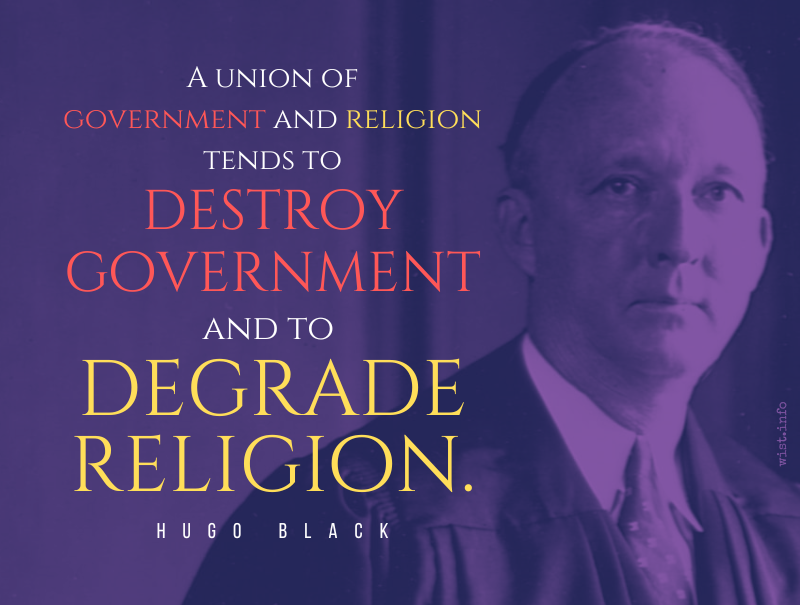
But the purposes underlying the Establishment Clause go much further than that. Its first and most immediate purpose rested on the belief that a union of government and religion tends to destroy government and to degrade religion. The history of governmentally established religion, both in England and in this country, showed that whenever government had allied itself with one particular form of religion, the inevitable result had been that it had incurred the hatred, disrespect and even contempt of those who held contrary beliefs. That same history showed that many people had lost their respect for any religion that had relied upon the support of government to spread its faith.
The Establishment Clause thus stands as an expression of principle on the part of the Founders of our Constitution that religion is too personal, too sacred, too holy, to permit its “unhallowed perversion” by a civil magistrate.
Hugo Black (1886–1971) American politician and jurist; US Supreme Court Justice (1937–71)
Engel v. Vitale, 370 U.S. 421, 431–432 (1962) [majority opinion]
(Source)
I never will, by any word or act, bow to the shrine of intolerance, or admit a right of enquiry into the religious opinions of others. on the contrary we are bound, you, I, & every one, to make common cause, even with error itself, to maintain the common right of freedom of conscience. we ought with one heart and one hand to hew down the daring and dangerous efforts of those who would seduce the public opinion to substitute itself into that tyranny over religious faith which the laws have so justly abdicated.
Thomas Jefferson (1743–1826) American political philosopher, polymath, statesman, US President (1801–09)
Letter (1803-04-19) to Edward Dowse
(Source)
From the dissensions among Sects themselves arise necessarily a right of choosing and necessity of deliberating to which we will conform. But if we choose for ourselves, we must allow others to choose also, and so reciprocally, this establishes religious liberty.
Thomas Jefferson (1743–1826) American political philosopher, polymath, statesman, US President (1801–09)
Essay (1776-10?), “Notes on Religion”
(Source)
Labeled by Jefferson "Scraps Early in the Revolution." Modern rendering. Original:From the dissensions among sects themselves arises necessarily a right of chusing & necessity of deliberating to which we will conform, but if we chuse for ourselves, we must allow others to chuse also, & to reciprocally. This establishes religious liberty.
Our Founders were no more willing to let the content of their prayers and their privilege of praying whenever they pleased be influenced by the ballot box than they were to let these vital matters of personal conscience depend upon the succession of monarchs. The First Amendment was added to the Constitution to stand as a guarantee that neither the power nor the prestige of the Federal Government would be used to control, support or influence the kinds of prayer the American people can say — that the people’s religions must not be subjected to the pressures of government for change each time a new political administration is elected to office. Under that Amendment’s prohibition against governmental establishment of religion, as reinforced by the provisions of the Fourteenth Amendment, government in this country, be it state or federal, is without power to prescribe by law any particular form of prayer which is to be used as an official prayer in carrying on any program of governmentally sponsored religious activity.
Hugo Black (1886–1971) American politician and jurist; US Supreme Court Justice (1937–71)
Engel v. Vitale, 370 U.S. 421, 429–30 (1962) [majority opinion]
(Source)
Another and more special provision has been made by one of the amendments to the Constitution, which expressly declares, that “Congress shall make no law respecting an establishment of religion, or prohibiting the free exercise thereof, or abridging the freedom of speech, or of the press,” thereby guarding, in the same sentence, and under the same words, the freedom of religion, of speech, and of the press, insomuch that whatever violated either throws down the sanctuary which covers the others, — and that libels, falsehood, and defamation, equally with heresy and false religion, are withheld from the cognizance of federal tribunals.
Thomas Jefferson (1743–1826) American political philosopher, polymath, statesman, US President (1801–09)
Document (1798), “Kentucky Resolutions,” Resolution 3
(Source)
In protest of the Alien and Sedition Acts.
Christ’s religion needs no prop of any kind from any worldly source, and to the degree that it is thus supported is a millstone hanged about its neck.
George W. Truett (1867–1944) American minister, writer, and religious leader
Speech, steps of the US Capitol (1920)
Among the most inestimable of our blessings also is that you so justly particularise, of liberty to worship our creator in the way we think most agreeable to his will; a liberty deemed in other countries incompatible with good government, & yet proved by our experience to be it’s best support.
Thomas Jefferson (1743–1826) American political philosopher, polymath, statesman, US President (1801–09)
Letter (1807-11-18) to John Thomas
(Source)
The constitutional freedom of religion [is] the most inalienable and sacred of all human rights.
Thomas Jefferson (1743–1826) American political philosopher, polymath, statesman, US President (1801–09)
Document (1822-10-07), Report by the Board of Visitors to the President and Directors of the Literary fund, University of Virginia
(Source)
That [First] Amendment requires the state to be a neutral in its relations with groups of religious believers and nonbelievers; it does not require the state to be their adversary. State power is no more to be used so as to handicap religions than it is to favor them.
Hugo Black (1886–1971) American politician and jurist; US Supreme Court Justice (1937–71)
Everson v. Board of Education, 330 U.S. 1, 18 (1947) [majority opinion]
(Source)
That therefore the proscribing any citizen as unworthy the public confidence by laying upon him an incapacity of being called to offices of trust and emolument, unless he profess or renounce this or that religious opinion, is depriving him injuriously of those privileges and advantages to which, in common with his fellow citizens, he has a natural right;
That it tends also to corrupt the principles of that very religion it is meant to encourage, by bribing, with a monopoly of worldly honours and emoluments, those who will externally profess and conform to it;
That though indeed these are criminal who do not withstand such temptation, yet neither are those innocent who lay the bait in their way.
Thomas Jefferson (1743–1826) American political philosopher, polymath, statesman, US President (1801–09)
Document (1776-06-18), “Virginia Statute for Religious Freedom,” Preamble (enacted 1786-01-16)
(Source)
Our civil rights have no dependence on our religious opinions any more than our opinions in physics or geometry.
Thomas Jefferson (1743–1826) American political philosopher, polymath, statesman, US President (1801–09)
Document (1776-06-18), “Virginia Statute for Religious Freedom,” Preamble (enacted 1786-01-16)
(Source)
Well aware that the opinions and belief of men depend not on their own will, but follow involuntarily the evidence proposed to their minds; that Almighty God hath created the mind free, and manifested his supreme will that free it shall remain by making it altogether insusceptible of restraint; that all attempts to influence it by temporal punishments, or burthens, or by civil incapacitations, tend only to beget habits of hypocrisy and meanness, and are a departure from the plan of the holy author of our religion, who being lord both of body and mind, yet chose not to propagate it by coercions on either, as was in his Almighty power to do, but to extend it by its influence on reason alone; that the impious presumption of legislators and rulers, civil as well as ecclesiastical, who, being themselves but fallible and uninspired men, have assumed dominion over the faith of others, setting up their own opinions and modes of thinking as the only true and infallible, and as such endeavoring to impose them on others, hath established and maintained false religions over the greatest part of the world and through all time ….
Thomas Jefferson (1743–1826) American political philosopher, polymath, statesman, US President (1801–09)
Document (1776-06-18), “Virginia Statute for Religious Freedom,” Preamble (enacted 1786-01-16)
(Source)
During final debate around the bill's passage:See Jefferson's discussion about a failed amendment to the preamble here.
- the first clause was struck, changing the beginning to "Whereas Almighty God ...."
- the phrase "and manifested his supreme will that free it shall remain by making it altogether insusceptible of restraint" was struck.
- the phrase "but to extend it by its influence on reason alone" was struck.
The “establishment of religion” clause of the First Amendment means at least this: Neither a state nor the Federal Government can set up a church. Neither can pass laws which aid one religion, aid all religions, or prefer one religion over another. Neither can force nor influence a person to go to or to remain away from church against his will or force him to profess a belief or disbelief in any religion. No person can be punished for entertaining or professing religious beliefs or disbeliefs, for church attendance or non-attendance. No tax in any amount, large or small, can be levied to support any religious activities or institutions, whatever they may be called, or whatever form they may adopt to teach or practice religion. Neither a state nor the Federal Government can, openly or secretly, participate in the affairs of any religious organizations or groups and vice versa. In the words of Jefferson, the clause against establishment of religion by law was intended to erect “a wall of separation between Church and State.”
Let us all labor to add all needful guarantees for the more perfect security of free thought, free speech, and free press, pure morals, unfettered religious sentiments, and of equal rights and privileges to all men, irrespective of nationality, color, or religion. Encourage free schools, and resolve that not one dollar of money shall be appropriated to the support of any sectarian school. Resolve that neither the state nor nation, or both combined, shall support institutions of learning other than those sufficient to afford every child growing up in the land the opportunity of a good common school education, unmixed with sectarian, Pagan, or Atheistical tenets. Leave the matter of religion to the family altar, the church, and the private schools, supported entirely by private contributions. Keep the Church and the State forever Separate.
Ulysses S. Grant (1822–1885) American military leader, US President (1869–77)
Speech (1875-09-25), Address to the Army of the Tennessee, Annual Reunion, Des Moines, Iowa
(Source)
This passage of the speech was particularly popular among Protestant folk in the late 19th Century opposed to tax support for Catholic schools (which were considered sectarian), vs. the generally Protestant faith assumed in public schools.
The First Amendment has erected a wall between church and state. That wall must be kept high and impregnable. We could not approve the slightest breach.
Hugo Black (1886–1971) American politician and jurist; US Supreme Court Justice (1937–71)
Everson v. Board of Education, 330 U.S. 1, 18 (1947) [majority opinion]
(Source)
The bill for establishing religious freedom, the principles of which had, to a certain degree, been enacted before, I had drawn in all the latitude of reason and right. It still met with opposition; but, with some mutilations in the preamble, it was finally passed; and a singular proposition proved that its protection of opinion was meant to be universal.
Where the preamble declares, that coercion is a departure from the plan of the holy author of our religion, an amendment was proposed by inserting “Jesus Christ,” so that it would read “A departure from the plan of Jesus Christ, the holy author of our religion;” the insertion was rejected by the great majority, in proof that they meant to comprehend, within the mantle of its protection, the Jew and the Gentile, the Christian and Mohammedan, the Hindoo, and Infidel of every denomination.
We have solved, by fair experiment, the great & interesting question Whether freedom of religion is compatible with order in government and obedience to the laws; & we have experienced the quiet as well as the comfort which results from leaving every one to profess freely & openly those principles of religion which are the inductions of his own reason, & the serious convictions of his own enquiries.
Thomas Jefferson (1743–1826) American political philosopher, polymath, statesman, US President (1801–09)
Letter (1808-11-21) to the Virginia Baptist Associations Meeting in Chesterfield
(Source)
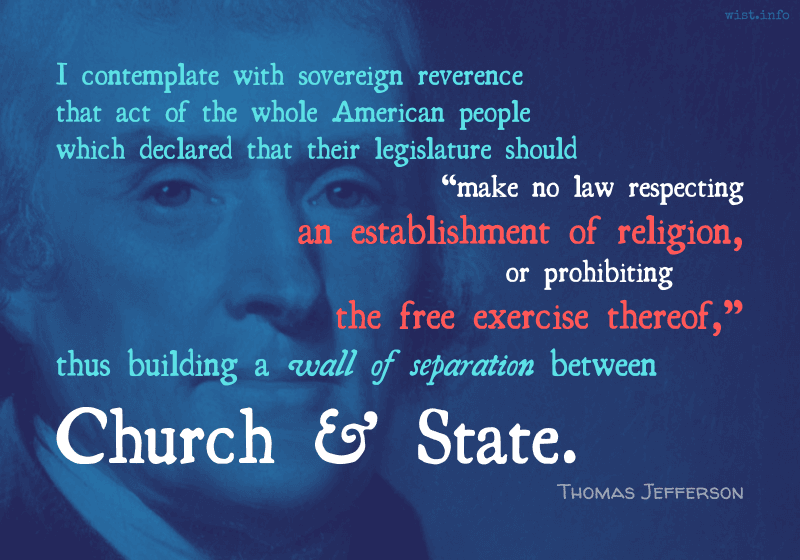
Believing with you that religion is a matter which lies solely between Man & his God, that he owes account to none other for his faith or his worship, that the legitimate powers of government reach actions only, & not opinions, I contemplate with sovereign reverence that act of the whole American people which declared that their legislature should “make no law respecting an establishment of religion, or prohibiting the free exercise thereof,” thus building a wall of separation between Church & State. adhering to this expression of the supreme will of the nation in behalf of the rights of conscience, I shall see with sincere satisfaction the progress of those sentiments which tend to restore to man all his natural rights, convinced he has no natural right in opposition to his social duties.
Thomas Jefferson (1743–1826) American political philosopher, polymath, statesman, US President (1801–09)
Letter (1802-01-01) to the Danbury Baptists
(Source)
Addressed to "messrs. Nehemiah Dodge, Ephraim Robbins, & Stephen S. Nelson, a committee of the Danbury Baptist association in the state of Connecticut."
If nowhere else, in the relation between Church and State, “good fences make good neighbors.”
Felix Frankfurter (1882–1965) American jurist, teacher; US Supreme Court Justice (1939–62)
McCollum v. Board of Education, 333 U.S. 232 (1948) [concurring]
(Source)
Ruling that public schools could not let religious groups use their property for religious education to children.
The quoted reference is to a poem by Robert Frost.
I consider the Government of the United States as interdicted by the Constitution of the United States from meddling with religious institutions, their doctrines, discipline, or exercises [….] But it is only proposed that I should recommend, not prescribe, a day of fasting and praying. That is, I should indirectly assume to the United States an authority over religious exercises, which the Constitution has directly precluded them from. It must be meant, too, that this recommendation is to carry some authority and to be sanctioned by some penalty on those who disregard it; not indeed of fine and imprisonment, but of some degree of proscription perhaps in public opinion. And does the change in the nature of the penalty make the recommendation less a law of conduct for those to whom it is directed? […] Every one must act according to the dictates of his own reason and mine tells me that civil powers alone have been given the President of the United States, and no authority to direct the religious exercise of his constituents.
Thomas Jefferson (1743–1826) American political philosopher, polymath, statesman, US President (1801–09)
Letter (1808-01-23) to Samuel Miller
(Source)
On refusing to issue a Thanksgiving proclamation during his presidency.
The notion of a Christian commonwealth should be exploded forever. … Government should protect every man in thinking and speaking freely, and see that one does not abuse another. The liberty I contend for is more than toleration. The very idea of toleration is despicable; it supposes that some have a pre-eminence above the rest to grant indulgence, whereas all should be equally free, Jews, Turks, Pagans and Christians.
John Leland (1754–1841) American Baptist minister, civil libertarian
A Chronicle of His Time in Virginia (1845)
I don’t say I’ve got much of a soul, but, such as it is, I’m perfectly satisfied with the little chap. I don’t want people fooling about with it. ‘Leave it alone,’ I say. ‘Don’t touch it. I like it the way it is.’
P. G. Wodehouse (1881–1975) Anglo-American humorist, playwright and lyricist [Pelham Grenville Wodehouse]
Joy in the Morning (1947)
No iron chain, or outward force of any kind, could ever compel the soul of a man to believe or to disbelieve: it is his own indefeasible light, that judgment of his; he will reign, and believe there, by the grace of God alone!
Thomas Carlyle (1795–1881) Scottish essayist and historian
Lecture (1840-05-15), “The Hero as Priest,” Home House, Portman Square, London
(Source)
The lecture notes were collected by Carlyle into On Heroes, Hero-Worship, & the Heroic in History, Lecture 4 (1841).
Standing in the presence of the Unknown, all have the same right to think, and all are equally interested in the great question of origin and destiny. All I claim, all I plead for, is liberty of thought and expression. That is all.
Robert Green Ingersoll (1833–1899) American lawyer, freethinker, orator
Lecture (1877-01-31) “The Liberty of Man, Woman, and Child,” Case Hall, Boston
(Source)
Books that cannot bear examination, certainly ought not to be established as divine inspiration by penal laws.
John Adams (1735–1826) American lawyer, Founder, statesman; US President (1797–1801)
Letter (1825-01-23) to Thomas Jefferson
(Source)
Complaining about laws, even in America, that punish people for "blasphemy" in doubting elements of the Bible.
It is not only in war, however, that we fight for freedom. One fights for freedom in personal contacts and in many phases of civilian life. When the war is over, the four freedoms will not have been won, we shall simply have dominated their more aggressive enemies. At all times, day by day, we have to continue fighting for freedom of religion, freedom of speech, freedom from fear, and freedom from want — for these are things that must be gained in peace as well as in war. At all times, day by day, we have to continue fighting for freedom of religion, freedom of speech, and freedom from want — for these are things that must be gained in peace as well as in war.
Eleanor Roosevelt (1884–1962) American politician, diplomat, activist; First Lady of the US (1933–45)
Column (1943-04-15), “My Day”
(Source)
The effect of the religious freedom Amendment to our Constitution was to take every form of propagation of religion out of the realm of things which could directly or indirectly be made public business, and thereby be supported in whole or in part at taxpayers’ expense. That is a difference which the Constitution sets up between religion and almost every other subject matter of legislation, a difference which goes to the very root of religious freedom and which the Court is overlooking today. This freedom was first in the Bill of Rights because it was first in the forefathers’ minds; it was set forth in absolute terms, and its strength is its rigidity. It was intended not only to keep the states’ hands out of religion, but to keep religion’s hands off the state, and, above all, to keep bitter religious controversy out of public life by denying to every denomination any advantage from getting control of public policy or the public purse.
Robert H. Jackson (1892–1954) US Supreme Court Justice (1941–54), lawyer, jurist, politician
Everson v. Board of Education, 330 U.S. 1, 26-27 (1947) [dissent]
(Source)
[I]t is contrary to the principles of reason and justice that any should be compelled to contribute to the maintenance of a church with which their consciences will not permit them to join, and from which they can derive no benefit; for remedy whereof, and that equal liberty as well religious as civil, may be universally extended to all the good people of this commonwealth.
George Mason (1725–1792) American statesman, Founding Father [George Mason IV]
Virginia Declaration of Rights (1776)
That to compel a man to furnish contributions of money for the propagation of opinions which he disbelieves [and abhors], is sinful and tyrannical; that even the forcing him to support this or that teacher of his own religious persuasion, is depriving him of the comfortable liberty of giving his contributions to the particular pastor whose morals he would make his pattern, and whose powers he feels most persuasive to righteousness; and is withdrawing from the ministry those temporal rewards, which proceeding from an approbation of their personal conduct, are an additional incitement to earnest and unremitting labours for the instruction of mankind.
Thomas Jefferson (1743–1826) American political philosopher, polymath, statesman, US President (1801–09)
Document (1776-06-18), “Virginia Statute for Religious Freedom,” Preamble (enacted 1786-01-16)
(Source)
The words in [brackets] were removed before final passage. The term "temporal rewards" was mistranscribed into statute as "temporary rewards."
If the fires of freedom and civil liberties burn low in other lands, they must be made brighter in our own.
If in other lands the press and books and literature of all kinds are censored, we must redouble our efforts here to keep them free.
If in other lands the eternal truths of the past are threatened by intolerance we must provide a safe place for their perpetuation.Franklin Delano Roosevelt (1882–1945) American lawyer, politician, statesman; US President (1933–45)
Speech (1938-06-30), National Education Association, World’s Fair, New York City
(Source)
That religion, or the duty which we owe to our Creator, and the manner of discharging it, can be directed only by reason and conviction, not by force or violence; and therefore all men are equally entitled to the free exercise of religion, according to the dictates of conscience; and that it is the mutual duty of all to practice Christian forbearance, love, and charity towards each other.
George Mason (1725–1792) American statesman, Founding Father [George Mason IV]
Virginia Declaration of Rights (1776)
It is contended by many that ours is a Christian government, founded upon the Bible, and that all who look upon the book as false or foolish are destroying the foundation of our country. The truth is, our government is not founded upon the rights of gods, but upon the rights of men. Our Constitution was framed, not to declare and uphold the deity of Christ, but the sacredness of humanity. Ours is the first government made by the people and for the people. It is the only nation with which the gods have had nothing to do. And yet there are some judges dishonest and cowardly enough to solemnly decide that this is a Christian country, and that our free institutions are based upon the infamous laws of Jehovah.
Robert Green Ingersoll (1833–1899) American lawyer, freethinker, orator
Lecture (1873-12), “Individuality,” Chicago Free Religious Society
(Source)
Full title "Arraignment of the Church and a Plea for Individuality." Collected in The Gods and Other Lectures (1876)
The legitimate powers of government extend to such acts only as are injurious to others. But it does me no injury for my neighbor to say there are twenty Gods, or no God. It neither picks my pocket nor breaks my leg.
Thomas Jefferson (1743–1826) American political philosopher, polymath, statesman, US President (1801–09)
Notes on the State of Virginia, Query 17 (1782)
(Source)
Tolerance implies no lack of commitment to one’s beliefs. Rather it condemns the oppression or persecution of others.
John F. Kennedy (1917–1963) American politician, author, journalist, US President (1961–63)
Letter (1960-10-26) to the National Conference of Christians and Jews Conference)
(Source)
The clergy … believe that any portion of power confided to me will be exerted in opposition to their schemes. And they believe rightly: for I have sworn upon the altar of god eternal hostility against every form of tyranny over the mind of man. But this is all they have to fear from me: and enough, too, in their opinion ….
Thomas Jefferson (1743–1826) American political philosopher, polymath, statesman, US President (1801–09)
Letter (1800-09-23) to Benjamin Rush
(Source)
On members of the clergy who had "a very favorite hope of obtaining an establishment of a particular form of Christianity thro' the U. S.; and as every sect believes its own form the true one, every one perhaps hoped for his own, but especially the Episcopalians & Congregationalists."
Usually elided to: "I have sworn upon the altar of God, eternal hostility against every form of tyranny over the mind of man."