RICHARD: And therefore, since I cannot prove a lover
To entertain these fair well-spoken days,
I am determinèd to prove a villain
And hate the idle pleasures of these days.William Shakespeare (1564–1616) English dramatist and poet
Richard III, Act 1, sc. 1, l. 28ff (1.1.28-31) (1592)
(Source)
Quotations about:
self-direction
Note not all quotations have been tagged, so Search may find additional quotes on this topic.

Time is the coin of your life. It is the only coin you have and only you can determine how it will be spent. Be careful lest you let other people spend it for you.
Carl Sandburg (1878–1967) American poet, biographer
(Attributed)
(Source)
Recalled by journalist Ralph McGill from a 1951 conversation with Sandburg, in a October 1959 syndicated column. In a 1966 column about Sandburg's 88th birthday, he quoted it as:Time is the coin of your life. You spend it. Do not allow others to spend it for you.
For more information on the background and origin of this quotation see Quote Origin: Time Is the Coin of Your Life. It Is the Only Coin You Have – Quote Investigator®.
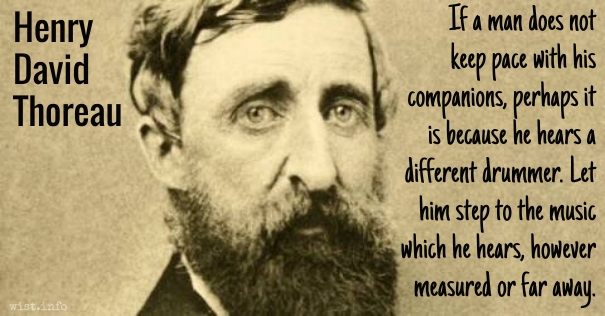
If a man does not keep pace with his companions, perhaps it is because he hears a different drummer. Let him step to the music which he hears, however measured or far away.
Henry David Thoreau (1817–1862) American philosopher and writer
Walden; or, Life in the Woods, ch. 18 “Conclusion” (1854)
(Source)
You will always find those who think they know what is your duty better than you know it.
Ralph Waldo Emerson (1803–1882) American essayist, lecturer, poet
Essay (1841), “Self-Reliance,” Essays: First Series, No. 2
(Source)
This essay was inspired by his reading of Walter Savage Landor in 1833, with passages pulled from his lecture "Individualism," last in his course on "The Philosophy of History" (1836–1837), with other passages from the lectures "School," "Genius," and "Duty" in his course on "Human Life" (1838–1839).

No iron chain, or outward force of any kind, could ever compel the soul of a man to believe or to disbelieve: it is his own indefeasible light, that judgment of his; he will reign, and believe there, by the grace of God alone!
Thomas Carlyle (1795–1881) Scottish essayist and historian
Lecture (1840-05-15), “The Hero as Priest,” Home House, Portman Square, London
(Source)
The lecture notes were collected by Carlyle into On Heroes, Hero-Worship, & the Heroic in History, Lecture 4 (1841).