

ORSINO: These most brisk and giddy-pacèd times.
William Shakespeare (1564–1616) English dramatist and poet
Twelfth Night, Act 2, sc. 4, l. 7 (2.4.7) (1601)
(Source)
Quotations about:
pace
Note not all quotations have been tagged, so Search may find additional quotes on this topic.

The old have nothing to pace themselves for. This is the final sprint. Run. Run. See how far you can get before you fall.
Elizabeth Bear (b. 1971) American author [pseud. for Sarah Bear Elizabeth Wishnevsky]
Bone and Jewel Creatures, ch. 2 [The Artificer] (2010)
(Source)

The man who goes alone can start to-day; but he who travels with another must wait till that other is ready, and it may be a long time before they get off.
Henry David Thoreau (1817–1862) American philosopher and writer
Walden; or, Life in the Woods, ch. 1 “Economy” (1854)
(Source)
See also the Anglo-American proverb (in Kipling's wording) "He travels the fastest who travels alone" and the (possibly) African proverb, "If you want to go fast, go alone; if you want to go far, go together."
Life is not made up of dramatic incidents — even the life of a nation. It is made up of slowly evolving events and processes, which newspapers, by a score of different forms of emphasis, can reasonably attempt to explore from day to day. But television news jerks from incident to incident. For the real world of patient and familiar arrangements, it substitutes an unreal world of constant activity, and the effect is already apparent in the way which the world behaves. It is almost impossible, these days, to consider any problem or any event except as a crisis; and, by this very way of looking at it, it in fact becomes a crisis.
Henry Fairlie (1924–1990) British journalist and social critic
“Can You Believe Your Eyes?” Horizon (Spring 1967)
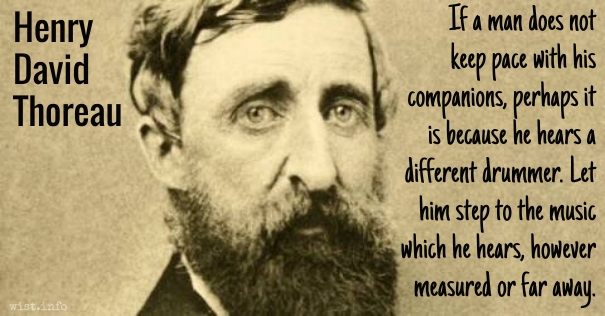
If a man does not keep pace with his companions, perhaps it is because he hears a different drummer. Let him step to the music which he hears, however measured or far away.
Henry David Thoreau (1817–1862) American philosopher and writer
Walden; or, Life in the Woods, ch. 18 “Conclusion” (1854)
(Source)
If you want to go fast, go alone.
If you want to go far, go together.Proverbs, Sayings, and Adages
African proverb
The provenance of this proverb is disputed. See here for more discussion.

Why should we be in such desperate haste to succeed, and in such desperate enterprises? If a man does not keep pace with his companions, perhaps it is because he hears a different drummer. Let him step to the music which he hears, however measured or far away.
Henry David Thoreau (1817–1862) American philosopher and writer
Walden; or, Life in the Woods, ch. 18 “Conclusion” (1854)
(Source)