RICHARD: And therefore, since I cannot prove a lover
To entertain these fair well-spoken days,
I am determinèd to prove a villain
And hate the idle pleasures of these days.William Shakespeare (1564–1616) English dramatist and poet
Richard III, Act 1, sc. 1, l. 28ff (1.1.28-31) (1592)
(Source)
Quotations about:
self-determination
Note not all quotations have been tagged, so Search may find additional quotes on this topic.

War is when the government tells you who the bad guy is. Revolution is when you decide that for yourself.
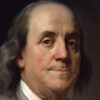
Benjamin Franklin (1706–1790) American statesman, scientist, philosopher, aphorist
(Spurious)
Not found in the recorded works of Franklin, nor of Napoleon Bonaparte (to whom it is also attributed).The number of variants is an indicator this is an unconfirmed attribution:The term "bad guy" is an Americanism from the early 20th Century (the OED dates it to 1932; Dictionary.com to the early 1920s). But even if one uses the "enemy" variant, this sounds unlike either Franklin or Napoleon.
- "... who the enemy is" or "... who your enemy is."
- "... you figure it out ..."
The quotation is occasionally attributed to Susan Sarandon. While she did use it (e.g., at a pro-Palestinian speech), she attributed it in turn to Napoleon.
- Despite his skeptical nature, Franklin did not speak out against propagandistic influences on war (or revolution). Indeed, he was a skilled, if subtle, propagandist himself. Nor did he object to "government" in general (he would have attacked "the Crown" or "Parliament") nor any war that the British government had declared.
- Napoleon, as self-appointed Emperor of France (and war-maker, though most of his conquests were a result of other countries declaring war on him) would not have made the first half of this phrase, as he was the government. Nor, as one whose regime depended on propaganda, would he have suggested people decide for themselves who the true enemy is.
- Neither man, as a rule, wrote their various aphorisms in the second person ("you"). At most they might have used "one"; more often, it would have been "a man" or some third person construction.
The greatest thing in the world is to know how to belong to oneself.
[La plus grande chose du monde c’est de sçavoir estre à soy.]
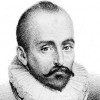
Michel de Montaigne (1533–1592) French essayist
Essays, Book 1, ch. 38 (1.38), “Of Solitude [De la solitude]” (1572) [tr. Frame (1943), 1.39]
(Source)
Present in the 1st (1580) edition.
Some translators use the 1588 sequence of chapters, not the 1595, and so identify this as ch. 39.
(Source (French)). Alternate translations:The greatest thing of the world, is for a man to know how to be his owne.
[tr. Florio (1603)]The greatest thing in the world is for a person to know that he is his own master.
[tr. Cotton (1686)]The greatest thing in the world is for a man to know that he is his own.
[tr. Cotton/Hazlitt (1877)]The greatest thing in the world is to know how to belong to oneself.
[tr. Ives (1925), 1.39]The greatest thing in the world is to know how to be oneself.
[ed. Rat (1958), 1.39]The greatest thing in the world is to know how to live to yourself
[tr. Screech (1987)]The greatest thing in the world is to know how to belong to oneself.
[tr. Atkinson/Sices (2012)]
Nationality is a Janus, facing both ways. So far as it stands for the right of a people to govern itself, it stands for freedom. So far as it stands for the ambition to govern other people, or to destroy them, or to shape them into an alien world, it stands for domination. Throughout history it has stood for both.
G. Lowes Dickinson (1862–1932) British political scientist and philosopher [Goldsworthy "Goldie" Lowes Dickinson]
“The War and the Way Out: A Further Consideration,” sec. 3, Atlantic Monthly (1915-04)
(Source)
Civilization is the progress toward a society of privacy. The savage’s whole existence is public, ruled by the laws of his tribe. Civilization is the process of setting man free from men.
Ayn Rand (1905–1982) Russian-American writer, philosopher
The Fountainhead, ch. 18 [Roark] (1943)
(Source)

Just as most soldiers believe bullets will hit only others, not themselves, most citizens like to think that their own minds and thought processes are invulnerable. “Other people can be manipulated, but not me,” they declare. People like to think that their opinions, values and ideas are inviolate and totally self-regulated. They may admit grudgingly that they are influenced slightly by advertising. Beyond that, they want to preserve a myth in which other persons are weak-minded and easily influenced, but they are strong-minded.
Margaret Singer (1921–2003) American clinical psychologist and researcher
“The ‘Not Me’ Myth: Orwell and the Mind,” Idea (19 Jan 1996)
(Source)

“This I choose to do,” she croaked, her breath leaving little clouds in the air. She cleared her throat and started again. “This I choose to do. If there is a price, this I choose to pay. If it is my death, then I choose to die. Where this takes me, there I choose to go. I choose. This I choose to do.”
It wasn’t a spell, except in her own head, but if you couldn’t make spells work in your own head, you couldn’t make them work at all.Terry Pratchett (1948–2015) English author
Discworld No. 35, Wintersmith, ch. 1 [Tiffany] (2006)
(Source)

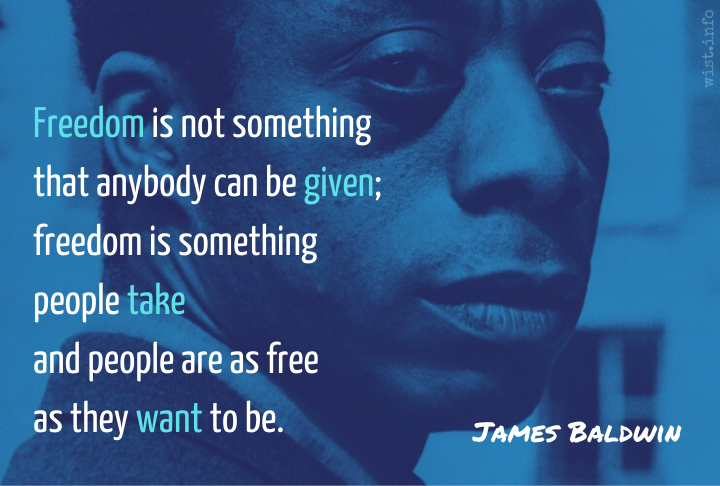
Let me point out to you that freedom is not something that anybody can be given; freedom is something people take and people are as free as they want to be. One hasn’t got to have an enormous military in order to be unfree when it’s simpler to be asleep, when it’s simpler to be apathetic, when it’s simpler, in fact, not to want to be free, to think that something else is more important.
James Baldwin (1924–1987) American novelist, playwright, activist
“Notes for a Hypothetical Novel,” speech, San Francisco College (22 Oct 1960)
(Source)
Later published in Nobody Knows My Name (1961).
A respect for the rights of other people to determine their forms of government and their economy will not weaken our democracy. It will inevitably strengthen it. One of the first things we must get rid of is the idea that democracy is tantamount to capitalism.
Eleanor Roosevelt (1884–1962) American politician, diplomat, activist; First Lady of the US (1933–45)
Tomorrow Is Now (1963)

The basis of our political systems is the right of the people to make and to alter their Constitutions of Government. But the Constitution which at any time exists, ’till changed by an explicit and authentic act of the whole People, is sacredly obligatory upon all. The very idea of the power and the right of the People to establish Government presupposes the duty of every Individual to obey the established Government.
George Washington (1732–1799) American military leader, Founding Father, US President (1789–1797)
Essay (1796-09-17), “Farewell Address,” Claypoole’s American Daily Advertiser, Philadelphia (1796-09-19)
(Source)
What I do say is that no man is good enough to govern another man without that other’s consent. I say this is the leading principle, the sheet-anchor of American republicanism. […] According to our ancient faith, the just powers of governments are derived from the consent of the governed. Now the relation of master and slave is pro tanto a total violation of this principle. The master not only governs the slave without his consent, but he governs him by a set of rules altogether different from those which he prescribes for himself. Allow all the governed an equal voice in the government, and that, and that only, is self-government.
Abraham Lincoln (1809–1865) American lawyer, politician, US President (1861–65)
Speech (1854-10-16), “In Reply to Senator Douglas,” Peoria, Illinois
(Source)
Speaking on the 1854 Kansas-Nebraska Act, which repealed the Missouri Compromise and allowed as "self-government" for residents of those two territories to decide locally whether to allow slavery there.
In the ellipses, Lincoln quotes the beginning of the Declaration of Independence, through "deriving their just powers from the consent of the governed."