

Americans! your republican politics, not less than your republican religion, are flagrantly inconsistent. You boast of your love of liberty, your superior civilization, and your pure Christianity, while the whole political power of the nation (as embodied in the two great political parties), is solemnly pledged to support and perpetuate the enslavement of three millions of your countrymen. You hurl your anathemas at the crowned headed tyrants of Russia and Austria, and pride yourselves on your Democratic institutions, while you yourselves consent to be the mere tools and body-guards of the tyrants of Virginia and Carolina.
Frederick Douglass (1817–1895) American abolitionist, orator, writer
Speech (1852-07-05), “What to the Slave is the Fourth of July?” Corinthian Hall, Rochester, New York
(Source)
Quotations about:
enslavement
Note not all quotations have been tagged, so Search may find additional quotes on this topic.
As you have it in your power, sir, to do some service to letters, I implore you not to clip the wings of our writers so closely, nor to turn into barn-door fowls those who, allowed a start, might become eagles; reasonable liberty permits the mind to soar — slavery makes it creep.
[Puisque vous êtes, monsieur, à portée de rendre service aux belles-lettres, ne rognez pas de si près les ailes à nos écrivains, et ne faites pas des volailles de basse-cour de ceux qui, en prenant l’essor, pourraient devenir des aigles: une liberté honnête élève l’esprit, et l’esclavage le fait ramper.]
Voltaire (1694–1778) French writer [pseud. of Francois-Marie Arouet]
Letter (1733-06-20) to a First Commissioner [Lettre á un premier commis] [tr. Tallentyre (1919)]
(Source)
(Source (French); alternate).
On censorship. The last clause is most often quoted, and has spawned a variety of French and English variants, e.g.:
- [La servitude fait ramper l'esprit, et la liberté le fait voler.]
- Slavery makes the mind creep, and liberty makes it fly.
But the church of this country is not only indifferent to the wrongs of the slave, it actually takes sides with the oppressors. It has made itself the bulwark of American slavery, and the shield of American slave-hunters. Many of its most eloquent Divines, who stand as the very lights of the church, have shamelessly given the sanction of religion and the Bible to the whole slave system. — They have taught that man may, properly, be a slave; that the relation of master and slave is ordained of God; that to send back an escaped bondman to his master is clearly the duty of all the followers of the Lord Jesus Christ; and this horrible blasphemy is palmed off upon the world for Christianity.
For my part, I would say, welcome infidelity! welcome atheism! welcome anything! in preference to the gospel, as preached by those Divines!Frederick Douglass (1817–1895) American abolitionist, orator, writer
Speech (1852-07-05), “What to the Slave is the Fourth of July?” Corinthian Hall, Rochester, New York
(Source)
What, to the American slave, is your 4th of July? I answer: a day that reveals to him, more than all other days in the year, the gross injustice and cruelty to which he is the constant victim. To him, your celebration is a sham; your boasted liberty, an unholy license; your national greatness, swelling vanity; your sounds of rejoicing are empty and heartless; your denunciations of tyrants, brass fronted impudence; your shouts of liberty and equality, hollow mockery; your prayers and hymns, your sermons and thanksgivings, with all your religious parade, and solemnity, are, to him, mere bombast, fraud, deception, impiety, and hypocrisy — a thin veil to cover up crimes which would disgrace a nation of savages.
Frederick Douglass (1817–1895) American abolitionist, orator, writer
Speech (1852-07-05), “What to the Slave is the Fourth of July?” Corinthian Hall, Rochester, New York
(Source)
What, am I to argue that it is wrong to make men brutes, to rob them of their liberty, to work them without wages, to keep them ignorant of their relations to their fellow men, to beat them with sticks, to flay their flesh with the lash, to load their limbs with irons, to hunt them with dogs, to sell them at auction, to sunder their families, to knock out their teeth, to burn their flesh, to starve them into obedience and submission to their masters? Must I argue that a system thus marked with blood, and stained with pollution, is wrong? No! I will not. I have better employment for my time and strength, than such arguments would imply.
Frederick Douglass (1817–1895) American abolitionist, orator, writer
Speech (1852-07-05), “What to the Slave is the Fourth of July?” Corinthian Hall, Rochester, New York
(Source)
At the moment when God in his mercy has blessed the Christian world with a universal peace, there is reason to fear, that, to the disgrace of the Christian name and character, new efforts are making for the extension of this [slave] trade by subjects and citizens of Christian states, in whose hearts there dwell no sentiments of humanity or of justice, and over whom neither the fear of God nor the fear of man exercises a control. In the sight of our law, the African slave-trader is a pirate and a felon; and in the sight of Heaven, an offender beyond the ordinary depth of human guilt.
Daniel Webster (1782–1852) American statesman, lawyer, orator
Speech (1820-12-22), “First Settlement of New England,” Plymouth, Massachusetts
(Source)
On the bicentennial of the Pilgrims' landing in the New World.
And if now (but may the immortal gods avert the omen!) that worst of fates shall befall the republic, then, as brave gladiators take care to perish with honor, let us too, who are the chief men of all countries and nations, take care to fall with dignity rather than to live as slaves with ignominy.
[Quodsi iam, quod di omen avertant! fatum extremum rei publicae venit, quod gladiatores nobiles faciunt, ut honeste decumbant, faciamus nos principes orbis terrarum gentiumque omnium, ut cum dignitate potius cadamus quam cum ignominia serviamus.]
Marcus Tullius Cicero (106–43 BC) Roman orator, statesman, philosopher
Philippics [Philippicae; Antonian Orations], No. 3, ch. 14 / sec. 35 (2.14/3.35.3) (44-12-20 BC) [tr. Yonge (1903)]
(Source)
(Source (Latin)). Other translations:But if already -- may the Gods avert the omen! -- the State has been brought to its latest pass, let us, the leaders of the world and of all nations, do what stout gladiators do to die with honour, let us fall with dignity rather than serve with ignominy. [tr. Ker (Loeb) (1926)]If -- may the Gods avert the omen! -- the final episode in the history of the Res publica has arrived, let us behave like champion gladiators: they meet death honorably; let us, who stand foremost in the world and all nations, see to it that we fall with dignity rather than serve with ignominy.
[tr. Manuwald (2007)]But if, may the Gods avert the omen, final fate has come to the State, let us, leaders of the world and all nations, do what noble gladiators do to die with dignity: let us fall on our sword rather than serve with ignominy.
[tr. Wiseman]
It is not possible for the human imagination to conceive of the horrors of slavery. It has left no possible crime uncommitted, no possible cruelty unperpetrated. It has been practiced and defended by all nations in some form. It has been upheld by all religions. It has been defended by nearly every pulpit. From the profits derived from the slave trade churches have been built, cathedrals reared and priests paid. Slavery has been blessed by bishop, by cardinal, and by pope. It has received the sanction of statesmen, of kings, and of queens. It has been defended by the throne, the pulpit and the bench. Monarchs have shared in the profits. Clergymen have taken their part of the spoils, reciting passages of Scripture in its defence at the same time, and judges have taken their portion in the name of equity and law.
Robert Green Ingersoll (1833–1899) American lawyer, freethinker, orator
Speech (1876-07-04), “Centennial Oration [The Declaration of Independence],” Peoria, Illinois
(Source)
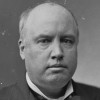
Hee that marries for wealth sells his liberty.
George Herbert (1593–1633) Welsh priest, orator, poet.
Jacula Prudentum, or Outlandish Proverbs, Sentences, &c. (compiler), # 784 (1640 ed.)
(Source)
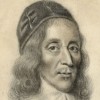
This Sir, was a time in which you clearly saw into the injustice of a State of Slavery, and in which you had just apprehensions of the horrors of its condition, it was now Sir, that your abhorrence thereof was so excited, that you publickly held forth this true and invaluable doctrine, which is worthy to be recorded and remember’d in all Succeeding ages. “We hold these truths to be Self evident, that all men are created equal, and that they are endowed by their creator with certain unalienable rights, that among these are life, liberty, and the pursuit of happyness.”
Here Sir, was a time in which your tender feelings for your selves had engaged you thus to declare, you were then impressed with proper ideas of the great valuation of liberty, and the free possession of those blessings to which you were entitled by nature; but Sir how pitiable is it to reflect, that altho you were so fully convinced of the benevolence of the Father of mankind, and of his equal and impartial distribution of those rights and privileges which he had conferred upon them, that you should at the Same time counteract his mercies, in detaining by fraud and violence so numerous a part of my brethren under groaning captivity and cruel oppression, that you should at the Same time be found guilty of that most criminal act, which you professedly detested in others, with respect to yourselves.
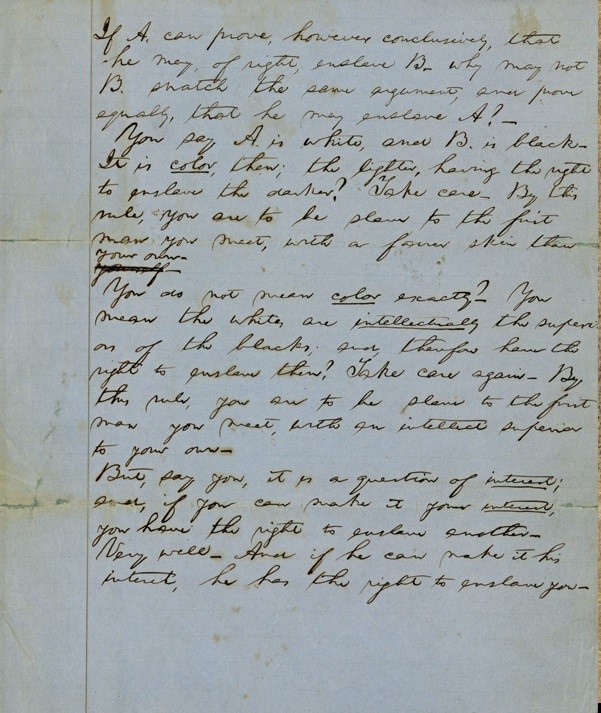
If A. can prove, however conclusively, that he may, of right, enslave B. — why may not B. snatch the same argument, and prove equally, that he may enslave A?
You say A. is white, and B. is black. It is color, then; the lighter having the right to enslave the darker? Take care. By this rule, you are to be slave to the first man you meet, with a fairer skin than your own.
You do not mean color exactly? — You mean the whites are intellectually the superior of blacks, and, therefore, have the right to enslave them? Take care again. By this rule, you are to be slave to the first man you meet, with an intellect superior to your own.
But, say you, it is a question of interest; and, if you can make it your interest, you have the right to enslave another. Very well. And if he can make it his interest, he has the right to enslave you.Abraham Lincoln (1809–1865) American lawyer, politician, US President (1861–65)
Note (1854-07-01?), On Slavery (fragment)
(Source)
The note itself is not dated. The fragment is included in The Collected Works of Abraham Lincoln, Vol. 2 (1953) [ed. Roy P. Basler]. The printed version of the book gives "July 1, 1854?" as the date, as being the date assigned by Nicolay and Hay; the U. of Michigan online version of that work gives "April 1, 1854?" with no explaination. The editors of the Collected Works do note that it likely was written 1858-1859. The Abraham Lincoln Digital Library version suggests the note post-dates the Kansas-Nebraska Act (May 1854), which brought Lincoln back into politics, campaigning for a Whig congressional candidate in the Fall of 1854.

Slavery is doomed, and that within a few years. Even Judge Douglas admits it to be an evil, and an evil can’t stand discussion. In discussing it we have taught a great many thousands of people to hate it who had never given it a thought before. What kills the skunk is the publicity it gives itself. What a skunk wants to do is to keep snug under the barn in daytime, when men are around with shotguns.
Abraham Lincoln (1809–1865) American lawyer, politician, US President (1861–65)
Interview (1859-09-17?) with David R. Locke, Columbus, Ohio
(Source)
After his speech in Columbus (1859-09-16), discussing the effect of drawing attention to the problem of slavery through his speech-making. Recounted by Locke in A. T. Rice (ed.), Reminiscences of Abraham Lincoln by Distinguished Men of His Time, ch. 25 (1883).
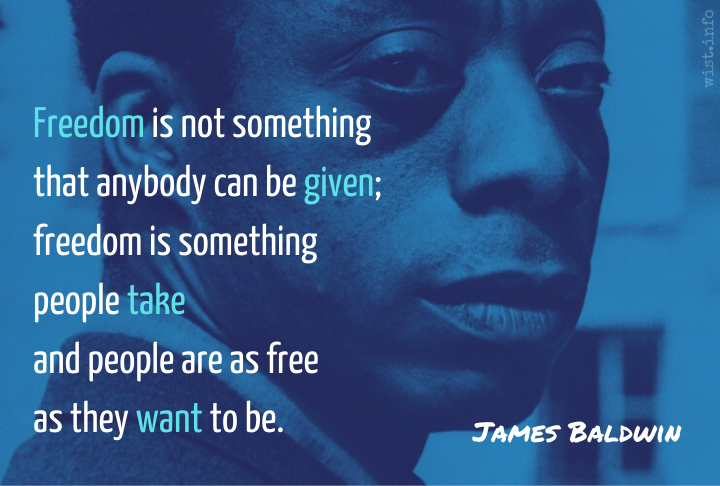
Let me point out to you that freedom is not something that anybody can be given; freedom is something people take and people are as free as they want to be. One hasn’t got to have an enormous military in order to be unfree when it’s simpler to be asleep, when it’s simpler to be apathetic, when it’s simpler, in fact, not to want to be free, to think that something else is more important.
James Baldwin (1924–1987) American novelist, playwright, activist
“Notes for a Hypothetical Novel,” speech, San Francisco College (22 Oct 1960)
(Source)
Later published in Nobody Knows My Name (1961).
Poor and free rather than rich and enslaved. Of course, men want to be both rich and free, and this is what leads them at times to be poor and enslaved.
[Pauvre et libre plutôt que riche et asservi. Bien entendu les hommes veulent être et riches et libres et c’est ce qui les conduit quelquefois à être pauvres et esclaves.]
Albert Camus (1913–1960) Algerian-French novelist, essayist, playwright
Notebooks: 1942-1951, Notebook 4, Jan 1942 – Sep 1945 [tr. O’Brien/Thody (1963)
(Source)

I am naturally anti-slavery. If slavery is not wrong, nothing is wrong.
Abraham Lincoln (1809–1865) American lawyer, politician, US President (1861–65)
Letter (1864-04-04) to Albert G. Hodges
(Source)
Recounting what he had said the previous day at the White House to newspaper publisher Hodges, Governor Thomas Bramlette, and US Senator Archibald Dixon, all of Kentucky.

But a short time elapsed after the death of the great reformer of the Jewish religion before his principles were departed from by those who professed to be his special servants, & perverted into an engine for enslaving mankind, and aggrandizing their oppressors in church & state: that the purest system of morals ever before preached to man has been adulterated & sophisticated, by artificial constructions, into a mere contrivance to filch wealth & power to themselves, that rational men not being able to swallow their impious heresies, in order to force them down their throats, they raise the hue & cry of infidelity, while themselves are the greatest obstacles to the advancement of the real doctrines of Jesus, and do in fact constitute the real Anti-Christ.
Thomas Jefferson (1743–1826) American political philosopher, polymath, statesman, US President (1801–09)
Letter (1810-01-19) to William Baldwin (unsent)
(Source)
As I would not be a slave, so I would not be a master. This expresses my idea of democracy. Whatever differs from this, to the extent of the difference, is no democracy.
Abraham Lincoln (1809–1865) American lawyer, politician, US President (1861–65)
Fragment (1858-08-01?), “Definition of Democracy”
(Source)
The title of this writing fragment, in Lincoln's hand, is notional. It is sometimes referred to as "On Slavery and Democracy." The date is also conjectural, and the manuscript is not connected with any known speech or occasion. The scrap of paper this solitary paragraph is on was given to Mary Todd Lincoln by her friend, Myra Bradwell on Mary's release from the asylum. It was unsigned, but a signature clipped from another document was pasted below the text.