

Moreover, speaking for myself, and without impugning the right of any other person to use the term in another sense, I further say that agnosticism is not properly described as a “negative” creed, nor indeed as a creed of any kind, except in so far as it expresses absolute faith in the validity of a principle which is as much ethical as intellectual. This principle may be stated in various ways, but they all amount to this: that it is wrong for a man to say that he is certain of the objective truth of any proposition unless he can produce evidence which logically justifies that certainty. This is what agnosticism asserts; and, in my opinion, it is all that is essential to agnosticism.
T. H. Huxley (1825–1895) English biologist [Thomas Henry Huxley]
Essay (1889-06), “Agnosticism and Christianity,” The Nineteenth Century magazine, Vol. 25, No. 148
(Source)
Collected in Henry Wace (ed.), Christianity and Agnosticism, ch. 9 (1889), a collection of Huxley essays and replies to them (several by Wace).) The passage is sometimes miscited as coming from his earlier essay "Agnosticism," from the 1889-02 issue (Vol. 25, No. 144) (Collected).
Quotations about:
reasoning
Note not all quotations have been tagged, so Search may find additional quotes on this topic.
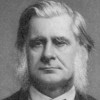
Agnosticism simply means that a man shall not say he knows or believes that for which he has no grounds for professing to know or believe.
T. H. Huxley (1825–1895) English biologist [Thomas Henry Huxley]
(Attributed)
Huxley claimed in later years to have developed this formulation, along with the word "Agnostic," at the 1869 meeting of the Metaphysical Society. The truth regarding the word itself, at least, appears a bit more complex and unresolved than that. I have not been able find when this precise definition of Agnosticism was first published.
Huxley expanded on the definition in a series of essays in 1889. See here and here.
“It is simplicity itself,” said [Holmes]; “my eyes tell me that on the inside of your left shoe, just where the firelight strikes it, the leather is scored by six almost parallel cuts. Obviously they have been caused by someone who has very carelessly scraped round the edges of the sole in order to remove crusted mud from it. Hence, you see, my double deduction that you had been out in vile weather, and that you had a particularly malignant boot-slitting specimen of the London slavey.
“As to your practice, if a gentleman walks into my rooms smelling of iodoform, with a black mark of nitrate of silver upon his right forefinger, and a bulge on the right side of his top-hat to show where he has secreted his stethoscope, I must be dull, indeed, if I do not pronounce him to be an active member of the medical profession.
I could not help laughing at the ease with which he explained his process of deduction. “When I hear you give your reasons,” I remarked, “the thing always appears to me to be so ridiculously simple that I could easily do it myself, though at each successive instance of your reasoning I am baffled until you explain your process. And yet I believe that my eyes are as good as yours.”Arthur Conan Doyle (1859–1930) British writer and physician
Story (1891-07), “A Scandal in Bohemia,” ch. 1, The Strand Magazine, Vol. 2, No. 1
(Source)
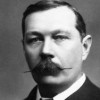
We readily acknowledge in others an advantage in courage, in bodily strength, in experience, in agility, in beauty; but an advantage in judgment we yield to no one. And the arguments that come from simple natural reasoning in others, we think we would have found if we had merely glanced in that direction.
[Nous reconnoissons aysément és autres, l’advantage du courage, de la force corporelle, de l’experience, de la disposition, de la beauté: mais l’advantage du jugement; nous ne le cedons à personne: Et les raisons qui partent du simple discours naturel en autruy, il nous semble qu’il n’a tenu qu’à regarder de ce costé-là, que nous ne les ayons trouvees.]
Michel de Montaigne (1533–1592) French essayist
Essays, Book 2, ch. 17 (2.17), “Of Presumption [De la Presomption]” (1578) [tr. Frame (1943)]
(Source)
This essay was in the 1st (1580) edition, as was this passage (Screech identifies parts of the passage as being part of the final (1595) edition).
See La Rochefoucauld (1666), Franklin (1745).
(Source (French)). Other translations:We easily know in others, the advantage of courage, of bodily strength, of experience, of disposition and of beautie, but we never yeelde the advantage of judgement to any body: And the reasons, which part from the simple naturall discourse in others, we thinke, that had we but looked that way, we had surely found them.
[tr. Florio (1603)]We readily enough confess an advantage of courage, strength, experience, geod-nature, and beauty in others; but an advantage in judgment we yield to none, and the reasons that simply proceed from the natural sense of others, we think, if we had but turned our thoughts that way, we should ourselves have found them out.
[tr. Cotton (1686)]We easily enough confess in others an advantage of courage, strength, experience, activity, and beauty, but an advantage in judgment we yield to none; and the reasons that proceed simply from the natural conclusions of others, we think, if we had but turned our thoughts that way, we should ourselves have found out as well as they.
[tr. Cotton/Hazlitt (1877)]We easily recognise in others superiority of courage, of bodily strength, of experience, of activity, of beauty, of rank; but superiority of judgement we concede to no one; and the reasonings that proceed from simple natural intelligence in another, it seems to us that, had we but looked in that direction, we should have found them.
[tr. Ives (1925)]We readily recognize in others a superiority in courage, physical strength, experience, agility, or beauty. But a superior judgement we concede to nobody. And we think that we could ourselves have discovered the reasons which occur naturally to others, if only we had looked in the same direction.
[tr. Cohen (1958)]In others we readily acknowledge superior courage, physical strength, experience, agility and beauty: but superior judgement we concede to none. And such arguments in another as derive from pure inborn wit we think that we would have discovered too if only we had looked at things from the same angle.
[tr. Screech (1987)]
“You appeared to be surprised when I told you, on our first meeting, that you had come from Afghanistan.”
“You were told, no doubt.”
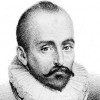
“Nothing of the sort. I knew you came from Afghanistan. From long habit the train of thoughts ran so swiftly through my mind that I arrived at the conclusion without being conscious of intermediate steps. There were such steps, however. The train of reasoning ran, ‘Here is a gentleman of a medical type, but with the air of a military man. Clearly an army doctor, then. He has just come from the tropics, for his face is dark, and that is not the natural tint of his skin, for his wrists are fair. He has undergone hardship and sickness, as his haggard face says clearly. His left arm has been injured. He holds it in a stiff and unnatural manner. Where in the tropics could an English army doctor have seen much hardship and got his arm wounded? Clearly in Afghanistan.’ The whole train of thought did not occupy a second. I then remarked that you came from Afghanistan, and you were astonished.”Arthur Conan Doyle (1859–1930) British writer and physician
Story (1886-04), “A Study in Scarlet,” Part 1, ch. 2, Beeton’s Christmas Annual, Vol. 28 (1887-11-21)
(Source)
Holmes and Watson. Published in novel form 1888-07.
In the Sherlock TV episode 01x01 "A Study in Pink" (w. Steven Moffat) (2010-07-25), this explanation is reworked:HOLMES: When I met you for the first time yesterday, I said "Afghanistan or Iraq?" You looked surprised.
WATSON: How did you know?
HOLMES: I didn't know, I saw. Your haircut, the way you hold yourself, says military. But your conversation as you entered the room said trained at Bart's, so army doctor. Obvious. Your face is tanned, but no tan above the wrists: you've been abroad but not sunbathing. The limp's really bad when you walk, but you don't ask for a chair when you stand, like you've forgotten about it, so it's at least partly psychosomatic. That says the original circumstances of the injury were probably traumatic: wounded in action, then. Wounded in action, suntan: Afghanistan or Iraq.
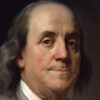
Firmness in decision is often merely a form of stupidity. It indicates an inability to think the same thing out twice.
H. L. Mencken (1880–1956) American writer and journalist [Henry Lewis Mencken]
A Little Book in C Major, ch. 5, § 30 (1916)
(Source)
Variant:FIRMNESS: A form of stupidity: proof of an inability to think the same thing out twice.
[A Book of Burlesques, "The Jazz Webster" (1924)]
Truth that has been merely learned is like an artificial limb, a false tooth, a waxen nose; at best, like a nose made out of another’s flesh; it adheres to us only because it is put on. But truth acquired by thinking of our own is like a natural limb; it alone really belongs to us. This is the fundamental difference between the thinker and the mere man of learning.
[Hingegen klebt die bloß erlernte Wahrheit uns nur an, wie ein angeseßtes Glied, ein falscher Zahn, eine wächserne Nase, oder höchstens wie eine rhinoplastische aus fremdem Fleische. Die durch eigenes Denken erworbene Wahrheit aber gleicht dem natürlichen Gliede: fie allein gehört uns wirklich an. Darauf beruht der Unterschied zwischen dem Denker und dem bloßen Gelehrten.]Arthur Schopenhauer (1788–1860) German philosopher
Parerga and Paralipomena, Vol. 2, ch. 22 “On Thinking for Oneself [Selbstdenken],” § 260 (1851) [tr. Saunders (1890)]
(Source)
Source (German). Other translations:Truth that has been merely learned adheres to us like an artificial limb, a false tooth, a waxen nose, or at best like one made out of another's flesh; truth which is acquired by thinking for oneself is like a natural member: it alone really belongs to us. Here we touch upon the difference between the thinking man and the mere man of learning.
[tr. Dircks (1897)]Truth that has merely been learnt adheres to us only as an artificial limb, a false tooth, a was nose does, or at most like transplanted skin; but a truth won by thinking for ourself is like a natural limb: it alone really belongs to us. This is what determines the difference between a thinker and a mere scholar.
[tr. Hollingdale (1970)]... other hand, the truth acquired through our own thinking is like the natural limb; it alone really belongs to us. On this rests the distinction between the thinker and the mere scholar.
[tr. Payne (1974)]

Those long chains composed of very simple and easy reasonings, which geometers customarily use to arrive at their most difficult demonstrations, had given me occasion to suppose that all the things which come within the scope of human knowledge are interconnected in the same way. And I thought that, provided we refrain froma ccepting anything as true which is not, and always keep to the order required for deducing one thing from another, there can be nothing too remote to be reached in the end or too well hidden to be discovered.
[Ces longues chaînes de raisons, toutes simples et faciles, dont les géomètres ont coutume de se servir pour parvenir à leurs plus difficiles démonstrations, m’avoient donné occasion de m’imaginer que toutes les choses qui peuvent tomber sous la connoissance des hommes s’entresuivent en même façon, et que, pourvu seulement qu’on s’abstienne d’en recevoir aucune pour vraie qui ne le soit, et qu’on garde toujours l’ordre qu’il faut pour les déduire les unes des autres, il n’y en peut avoir de si éloignées auxquelles enfin on ne parvienne, ni de si cachées qu’on ne découvre.]
René Descartes (1596–1650) French philosopher, mathematician
Discourse on Method [Discours de la méthode], Part 2 (1637) [tr. Cottingham, Stoothoff (1985)]
(Source)
(Source (French)). Other translations:Those long chains of reasons, (though simple and easie) which the Geometricians commonly use to lead us to their most difficult demonstrations, gave me occasion to imagine, That all things which may fall under the knowledge of Men, follow one the other in the same manner, and so we doe only abstain from receiving any one for true, which is not so, and observe always the right order of deducing them one from the other, there can be none so remote, to which at last we shall not attain; nor so hid, which we shall not discover.
[Newcombe ed. (1649)]The long chains of simple and easy reasonings by means of which geometers are accustomed to reach the conclusions of their most difficult demonstrations, had led me to imagine that all things, to the knowledge of which man is competent, are mutually connected in the same way, and that there is nothing so far removed from us as to be beyond our reach, or so hidden that we cannot discover it, provided only we abstain from accepting the false for the true, and always preserve in our thoughts the order necessary for the deduction of one truth from another.
[tr. Veitch (1850)]Those long chains of reasoning, simple and easy as they are of which geometricians make use in order to arrive at the most difficult demonstrations, had caused me to imagine that all those things which fall under the cognizance of man might very likely be mutually related in the same fashion; and that, provided only that we abstain from receiving anything as true which is not so, and always retain the order which is necessary in order to deduce the one conclusion from the other, there can be nothing so remote that we cannot reach to it, nor to recondite that we cannot discover it.
[tr. Haldane & Ross (1911)]These long chains of perfectly simple and easy reasonings by means of which geometers are accustomed to carry out their most difficult demonstrations had led me to fancy that everything that can fall under human knowledge forms a similar sequence; and that so long as we avoid accepting as true what it not so, and always preserve the right order for deduction of one thing from another, there can be nothing too remote to be reached in the end, or too well hidden to be discovered.
[tr. Ascombe & Geach (1971)]
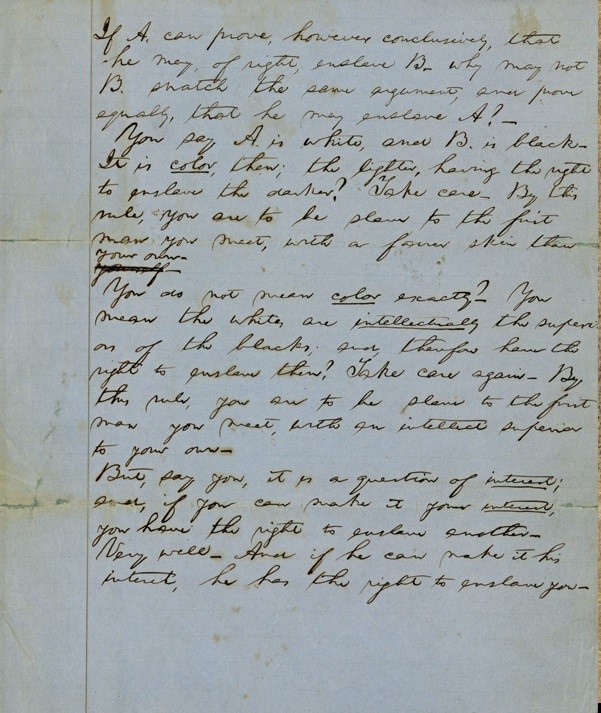
If A. can prove, however conclusively, that he may, of right, enslave B. — why may not B. snatch the same argument, and prove equally, that he may enslave A?
You say A. is white, and B. is black. It is color, then; the lighter having the right to enslave the darker? Take care. By this rule, you are to be slave to the first man you meet, with a fairer skin than your own.
You do not mean color exactly? — You mean the whites are intellectually the superior of blacks, and, therefore, have the right to enslave them? Take care again. By this rule, you are to be slave to the first man you meet, with an intellect superior to your own.
But, say you, it is a question of interest; and, if you can make it your interest, you have the right to enslave another. Very well. And if he can make it his interest, he has the right to enslave you.Abraham Lincoln (1809–1865) American lawyer, politician, US President (1861–65)
Note (1854-07-01?), On Slavery (fragment)
(Source)
The note itself is not dated. The fragment is included in The Collected Works of Abraham Lincoln, Vol. 2 (1953) [ed. Roy P. Basler]. The printed version of the book gives "July 1, 1854?" as the date, as being the date assigned by Nicolay and Hay; the U. of Michigan online version of that work gives "April 1, 1854?" with no explaination. The editors of the Collected Works do note that it likely was written 1858-1859. The Abraham Lincoln Digital Library version suggests the note post-dates the Kansas-Nebraska Act (May 1854), which brought Lincoln back into politics, campaigning for a Whig congressional candidate in the Fall of 1854.
Tut, man, decide promptly, but never give any reasons for your decisions. Your decisions may be right, but your reasons are sure to be wrong.
William Murray, 1st Earl of Mansfield (1705–1793) British barrister, politician, judge, legal reformer
Quoted in John Cordy Jeaffreson, A Book About Lawyers, Vol. 1, ch. 12 (1867)
(Source)
When asked by the new governor of a West Indies island how to apply the law.
At twenty the will rules; at thirty the intellect; at forty the judgment.
[A los veinte años reina la voluntad, a los treinta el ingenio, a los cuarenta el juicio.]
Baltasar Gracián y Morales (1601–1658) Spanish Jesuit priest, writer, philosopher
The Art of Worldly Wisdom [Oráculo Manual y Arte de Prudencia], § 298 (1647) [tr. Jacobs (1892)]
(Source)
(Source (Spanish)). Other translations:At twenty years of age the Will reigns; at thirty the Wit; at fourty, the Judgment.
[Flesher ed. (1685)]At twenty years desire rules us, at thirty, expediency, at forty, judgment.
[tr. Fischer (1937)]When one is twenty, the will reigns; a thirty, the intelligence; at forty, judgment.
[tr. Maurer (1992)]
See also:At 20 years of age the Will reigns; at 30 the Wit; at 40 the Judgment.
[Benjamin Franklin, Poor Richard's Almanack (1741)
The experience of the past two years has proven beyond doubt that no nation can appease the Nazis. No man can tame a tiger into a kitten by stroking it. There can be no appeasement with ruthlessness. There can be no reasoning with an incendiary bomb. We know now that a nation can have peace with the Nazis only at the price of total surrender.
Franklin Delano Roosevelt (1882–1945) American lawyer, politician, statesman; US President (1933–45)
Speech (1940-12-29), “Fireside Chat: Arsenal of Democracy” (radio broadcast)
(Source)
Don’t you believe in flying saucers, they ask me? Don’t you believe in telepathy? — in ancient astronauts? — in the Bermuda triangle? — in life after death?
No, I reply. No, no, no, no, and again no.
One person recently, goaded into desperation by the litany of unrelieved negation, burst out “Don’t you believe in anything?”
“Yes”, I said. “I believe in evidence. I believe in observation, measurement, and reasoning, confirmed by independent observers. I’ll believe anything, no matter how wild and ridiculous, if there is evidence for it. The wilder and more ridiculous something is, however, the firmer and more solid the evidence will have to be.”
Isaac Asimov (1920–1992) Russian-American author, polymath, biochemist
The Roving Mind (1983)
See Carl Sagan.
If it looks like a duck, and quacks like a duck, we have at least to consider the possibility that we have a small aquatic bird of the family Anatidae on our hands.
Douglas Adams (1952–2001) English author, humorist, screenwriter
Dirk Gently No. 1, Dirk Gently’s Holistic Detective Agency, ch. 30 [Dirk] (1987)
(Source)

In our reasonings concerning matter of fact, there are all imaginable degrees of assurance, from the highest certainty to the lowest species of moral evidence. A wise man, therefore, proportions his belief to the evidence. […] No testimony is sufficient to establish a miracle, unless the testimony be of such a kind, that its falsehood would be more miraculous, than the fact, which it endeavors to establish.
David Hume (1711–1776) Scottish philosopher, economist, historian, empiricist
An Enquiry Concerning Human Understanding, Sec. 10 “Of Miracles,” Part 1 (1748)
Often given as just, "A wise man proportions his belief to the evidence."
Value of the Skeptic is the resistance to premature conclusions.
Ralph Waldo Emerson (1803–1882) American essayist, lecturer, poet
Journal (1845)
But in stating prudential rules for our government in society I must not omit the important one of never entering into dispute or argument with another. I never yet saw an instance of one of two disputants convincing the other by argument. I have seen many of their getting warm, becoming rude, & shooting one another. Conviction is the effect of our own dispassionate reasoning, either in solitude, or weighing within ourselves dispassionately what we hear from others standing uncommitted in argument ourselves.
Thomas Jefferson (1743–1826) American political philosopher, polymath, statesman, US President (1801–09)
Letter (1808-11-24) to Thomas Jefferson Randolph
Agnosticism, in fact, is not a creed, but a method, the essence of which lies in the rigorous application of a single principle. That principle is of great antiquity; it is as old as Socrates; as old as the writer who said, “Try all things, hold fast by that which is good”; it is the foundation of the Reformation, which simply illustrated the axiom that every man should be able to give a reason for the faith that is in him, it is the great principle of Descartes; it is the fundamental axiom of modern science. Positively the principle may be expressed: In matters of the intellect, follow your reason as far as it will take you, without regard to any other consideration. And negatively: In matters of the intellect, do not pretend that conclusions are certain which are not demonstrated or demonstrable. That I take to be the agnostic faith, which if a man keep whole and undefiled, he shall not be ashamed to look the universe in the face, whatever the future may have in store for him.
We have not the slightest objection to believe anything you like, if you will give us good grounds for belief; but, if you cannot, we must respectfully refuse, even if that refusal should wreck morality and insure our own damnation several times over. We are quite content to leave that to the decision of the future. The course of the past has impressed us with the firm conviction that no good ever comes of falsehood, and we feel warranted in refusing even to experiment in that direction.
All generous minds have a horror of what are commonly called “facts.” They are the brute beasts of the intellectual domain.
The public buys its opinions as it buys its meat, or takes in its milk, on the principle that it is cheaper to do this than to keep a cow. So it is, but the milk is more likely to be watered.
Samuel Butler (1835–1902) English novelist, satirist, scholar
The Note-Books of Samuel Butler, ch. 17 (1912)
The most perfidious way of damaging a cause is deliberately to defend it with faulty arguments.
[Die perfideste Art, einer Sache zu schaden ist, sie absichtlich mit fehlerhaften Gründen vertheidigen.]
Friedrich Nietzsche (1844–1900) German philosopher and poet
The Gay Science [Die fröhliche Wissenschaft], Book 3, § 191 (1882) [tr. Nauckhoff (2001)]
(Source)
Also known as La Gaya Scienza, The Joyful Wisdom, or The Joyous Science.
(Source (German)). Other translations:The most perfidious manner of injuring a cause is to vindicate it intentionally with fallacious arguments.
[tr. Common (1911)]The most perfidious way of harming a cause consists of defending it deliberately with faulty arguments.
[tr. Kaufmann (1974)]One injures a cause in the most perfidious manner by deliberately defending it with erroneous reasons.
[tr. Hill (2018)]
Just because the other person is obviously, blindingly wrong, doesn’t mean we can be sloppy in our arguments against him. All we do in that case is strengthen his position and weaken our own.
Graham Ericsson (b. 1961) American technologist, writer, aphorist
Journal (undated)

He, who will not reason, is a bigot; he, who cannot, is a fool; and he, who dares not, is a slave.
William Drummond of Logie-Almond (1770–1828) Scottish classical scholar, philosopher, diplomat, politician
Academical Questions, Preface (1805)
(Source)
Sometimes misattributed to Byron.

