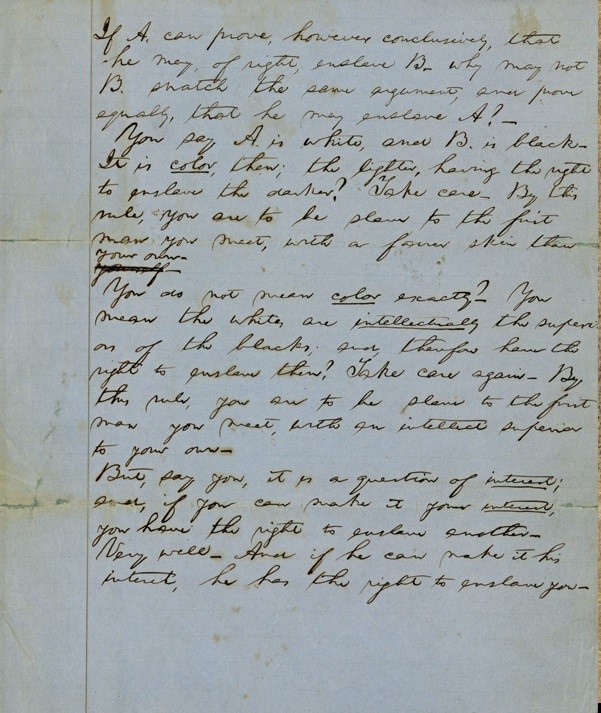
If A. can prove, however conclusively, that he may, of right, enslave B. — why may not B. snatch the same argument, and prove equally, that he may enslave A? You say A. is white, and B. is black. It is color, then; the lighter having the right to enslave the darker? Take care. By this rule, you are to be slave to the first man you meet, with a fairer skin than your own. You do not mean color exactly? — You mean the whites are intellectually the superior of blacks, and, therefore, have the right to enslave them? Take care again. By this rule, you are to be slave to the first man you meet, with an intellect superior to your own. But, say you, it is a question of interest; and, if you can make it your interest, you have the right to enslave another. Very well. And if he can make it his interest, he has the right to enslave you.
Abraham Lincoln (1809-1865) American lawyer, politician, US President (1861-65)
Note (1854-07-01?), On Slavery (fragment)
(Source)
The note itself is not dated. The fragment is included in The Collected Works of Abraham Lincoln, Vol. 2 (1953) [ed. Roy P. Basler]. The printed version of the book gives "July 1, 1854?" as the date, as being the date assigned by Nicolay and Hay; the U. of Michigan online version of that work gives "April 1, 1854?" with no explaination. The editors of the Collected Works do note that it likely was written 1858-1859. The Abraham Lincoln Digital Library version suggests the note post-dates the Kansas-Nebraska Act (May 1854), which brought Lincoln back into politics, campaigning for a Whig congressional candidate in the Fall of 1854.

To provide the best experiences, we use technologies like cookies to store and/or access device information. Consenting to these technologies will allow us to process data such as browsing behavior or unique IDs on this site. Not consenting or withdrawing consent, may adversely affect certain features and functions.
Functional
Always active
The technical storage or access is strictly necessary for the legitimate purpose of enabling the use of a specific service explicitly requested by the subscriber or user, or for the sole purpose of carrying out the transmission of a communication over an electronic communications network.
Preferences
The technical storage or access is necessary for the legitimate purpose of storing preferences that are not requested by the subscriber or user.
Statistics
The technical storage or access that is used exclusively for statistical purposes.The technical storage or access that is used exclusively for anonymous statistical purposes. Without a subpoena, voluntary compliance on the part of your Internet Service Provider, or additional records from a third party, information stored or retrieved for this purpose alone cannot usually be used to identify you.
Marketing
The technical storage or access is required to create user profiles to send advertising, or to track the user on a website or across several websites for similar marketing purposes.
To provide the best experiences, we use technologies like cookies to store and/or access device information. Consenting to these technologies will allow us to process data such as browsing behavior or unique IDs on this site. Not consenting or withdrawing consent, may adversely affect certain features and functions.
Functional
Always active
The technical storage or access is strictly necessary for the legitimate purpose of enabling the use of a specific service explicitly requested by the subscriber or user, or for the sole purpose of carrying out the transmission of a communication over an electronic communications network.
Preferences
The technical storage or access is necessary for the legitimate purpose of storing preferences that are not requested by the subscriber or user.
Statistics
The technical storage or access that is used exclusively for statistical purposes.The technical storage or access that is used exclusively for anonymous statistical purposes. Without a subpoena, voluntary compliance on the part of your Internet Service Provider, or additional records from a third party, information stored or retrieved for this purpose alone cannot usually be used to identify you.
Marketing
The technical storage or access is required to create user profiles to send advertising, or to track the user on a website or across several websites for similar marketing purposes.