

I have, and must have, confidence in the possible virtue of human nature; and although in entertaining this idea, a man must, and will sometimes, be disappointed, yet if it is coupled with a sound judgment and close observations, I believe he could make fewer great mistakes, than one whose principle is the universal rascality of the species.
Quotations about:
misanthropy
Note not all quotations have been tagged, so Search may find additional quotes on this topic.
When I see someone who looks fairly desperate, I would rather give money, on the chance of sometimes giving unwisely, than to withhold it from some one person who might need a helping hand and who deserves it.
Eleanor Roosevelt (1884–1962) American politician, diplomat, activist; First Lady of the US (1933–45)
Column (1942-11), “If You Ask Me,” Ladies’ Home Journal, Vol. 59
(Source)

He who suspekts everyboddy, should be watched by everyboddy.
[He who suspects everybody should be watched by everybody.]
Josh Billings (1818–1885) American humorist, aphorist [pseud. of Henry Wheeler Shaw]
Josh Billings’ Farmer’s Allminax, 1874-11 (1874 ed.)
(Source)
See Johnson (1763).
In his 1879 Allminax (April), Billings provided a similar adage:Whenever yu cum akrost a man who distrusts everyboddy, yu have found one whom it is safe for everyboddy to distrust.
[Whenever you come across a man who distrusts everybody, you have found one whom it is safe for everybody to distrust.]

The greater part of the admirers of solitude, as of all other classes of mankind, have no higher or remoter view, than the present gratification of their passions. Of these, some, haughty and impetuous, fly from society only because they cannot bear to repay to others the regard which themselves exact; and think no state of life eligible, but that which places them out of the reach of censure or control, and affords them opportunities of living in a perpetual compliance with their own inclinations, without the necessity of regulating their actions by any other man’s convenience or opinion.
There are others, of minds more delicate and tender, easily offended by every deviation from rectitude, soon disgusted by ignorance or impertinence, and always expecting from the conversation of mankind more elegance, purity and truth, than the mingled mass of life will easily afford. Such men are in haste to retire from grossness, falsehood and brutality; and hope to find in private habitations at least a negative felicity, an exemption from the shocks and perturbations with which publick scenes are continually distressing them.
To neither of these votaries will solitude afford that content, which she has been taught so lavishly to promise. The man of arrogance will quickly discover, that by escaping from his opponents he has lost his flatterers, that greatness is nothing where it is not seen, and power nothing where it cannot be felt: and he, whose faculties are employed in too close an observation of failings and defects, will find his condition very little mended by transferring his attention from others to himself: he will probably soon come back in quest of new objects, and be glad to keep his captiousness employed on any character rather than his own.Samuel Johnson (1709–1784) English writer, lexicographer, critic
Essay (1754-01-19), The Adventurer, No. 126
(Source)

PIERROT:I love
Humanity; but I hate people.Edna St. Vincent Millay (1892–1950) American poet
Play (1920), Aria da Capo
(Source)
Millay's comment on the socialist movement.
ALCESTE: Some men I hate for being rogues; the others
I hate because they treat the rogues like brothers,
And, lacking a virtuous scorn for what is vile,
Receive the villain with a complaisant smile.
[Je hais tous les hommes:
Les uns, parce qu’ils sont méchants et malfaisants,
Et les autres, pour être aux méchants complaisants,
Et n’avoir pas pour eux ces haines vigoureuses
Que doit donner le vice aux âmes vertueuses.]Molière (1622–1673) French playwright, actor [stage name for Jean-Baptiste Poquelin]
Le Misanthrope, Act 1, sc. 1 (1666) [tr. Wilbur (1954)]
(Source)
(Source (French)). Other translations:I hate all men: some, because they are wicked and mischievous; others because they lend themselves to the wicked, and have not that healthy contempt with which vice ought to inspire all virtuous minds.
[tr. Van Laun (1878)]I hate all men -- some because they are wicked and mischievous, and others for being complaisant to -- the wicked, and not having that vigorous hatred for them which vice ought to excite in all virtuous minds.
[tr. Mathew (1890)]I hate all men: some because they are wicked and evil-doers; others because they fawn upon the wicked, and dare not show that vigorous hatred which virtuous souls should feel to vice.
[tr. Wormeley (1894)]I hate all men: some, because they are wicked and mischievous; others, because they are lenient towards the wicked, and have not that healthy contempt for them with which vice ought to inspire all honest souls.
[tr. Waller (1903)]I hate all men:
A part, because they’re wicked and do evil;
The rest, because they fawn upon the wicked,
And fail to feel for them that healthy hatred
Which vice should always rouse in virtuous hearts.
[tr. Page (1913)]I detest all men;
Some because they are wicked and do evil,
Others because they tolerate the wicked,
Refusing them the active, vigorous scorn
Which vice should stimulate in virtuous minds.
[tr. Bishop (1957)]I hate all men:
For some are wholly bad in thought and deed;
The others, seeing this, pay little heed;
For they are too indulgent and too nice
To share the hate that virtue has for vice.
[tr. Frame (1967)]

ALCESTE: Finding on every hand base flattery,
Injustice, fraud, self-interest, treachery …
Ah, it’s too much; mankind has grown so base,
I mean to break with the whole human race.[Je ne trouve partout que lâche flatterie,
Qu’injustice, intérêt, trahison, fourberie;
Je n’y puis plus tenir, j’enrage, et mon dessein
Est de rompre en visière à tout le genre humain.]Molière (1622–1673) French playwright, actor [stage name for Jean-Baptiste Poquelin]
Le Misanthrope, Act 1, sc. 1 (1666) [tr. Wilbur (1954)]
(Source)
(Source (French)). Alternate translations:Everywhere I find nothing but base flattery, in justice, self-interest, deceit, roguery. I cannot bear it any longer; I am furious; and my intention is to break with all mankind.
[tr. Van Laun (1878)]I find nothing anywhere but base flattery, injustice, interest, treachery, and knavery. I can contain myself no longer; I am. in a rage, and my purpose is to break off all intercourse with all mankind.
[tr. Mathew (1890)]Everywhere I find base flattery, injustice, self-interest, treachery, deceit. I cannot bear it any longer; I am enraged; and my intention is to tell the truth, henceforth, to all the human race.
[tr. Wormeley (1894)]Nothing is to be seen anywhere but base flattery, injustice, self-interest, deceit, roguery. I cannot bear it any longer: I am furious: and it is my intention to break a lance with all mankind.
[tr. Waller (1903)]There's nowhere aught but dastard flattery,
Injustice, treachery, selfishness, deceit;
I can't endure it, I go mad -- and mean
Squarely to break with all the human race.
[tr. Page (1913)]All I see everywhere is flattery,
Injustice, treason, selfishness, deceit.
It makes me furious; I cannot stand it;
I will defy the entire human race.
[tr. Bishop (1957)]Cowardly flattery is all I see,
Injustice, selfishness, fraud, treachery;
I've had my fill; it makes me mad; I plan
To clash head-on with the whole race of man.
[tr. Frame (1967)]
You seem to have great possessions! How else can this be, but that you have preferred your own enjoyment to the consolation of the many? For the more you abound in wealth, the more you lack in love.
[ἀλλὰ μὴν φαίνῃ ἔχων κτήματα πολλά. Πόθεν ταῦτα; ἢ δῆλον ὅτι τὴν οἰκείαν ἀπόλαυσιν προτι μοτέραν τῆς τῶν πολλῶν παραμυθίας ποιούμενος. Ὅσον οὖν πλεονάζεις τῷ πλούτῳ, τοσοῦτον ἐλλείπεις τῇ ἀγάπῃ.]
Basil of Caesarea (AD 330–378) Christian bishop, theologian, monasticist, Doctor of the Church [Saint Basil the Great, Ἅγιος Βασίλειος ὁ Μέγας]
Sermon (368 ca.), “To the Rich [Ὁμιλία πρὸς τοὺς πλουτούντας]” [tr. Schroeder (2009)]
(Source)
In C. Paul Schroeder, ed., Saint Basil on Social Justice (2009).

A democracy is a means whereby we channel our contempt for our fellow man into a lively scorn for those elected to represent him.
Stephen Fry (b. 1957) British actor, writer, comedian
“Trefusis on Any Questions,” Loose Ends, BBC Radio 4 (c. 1987)
(Source)
Reprinted in Paperweight (1992)

There are few people whom I really love, and still fewer of whom I think well. The more I see of the world, the more am I dissatisfied with it; and every day confirms my belief of the inconsistency of all human characters, and of the little dependence that can be placed on the appearance of merit or sense.

Civilization is the progress toward a society of privacy. The savage’s whole existence is public, ruled by the laws of his tribe. Civilization is the process of setting man free from men.
Ayn Rand (1905–1982) Russian-American writer, philosopher
The Fountainhead, ch. 18 [Roark] (1943)
(Source)

I don’t hate people, I just feel better when they aren’t around.
Charles Bukowski (1920–1994) German-American author, poet
Barfly (1987)
(Source)
From the movie screenplay by Bukowski.
This is the way the phrase is usually quoted, but it's actually a series of lines when Henry (a character standing in for Bukowski himself) first meets Wanda.WANDA: I can't stand people. I hate them.
HENRY: Yeah?
WANDA: You hate them?
HENRY: No, but I seem to feel better when they're not around.
Bukowski is actually in the scene as the barfly closest to Wanda before Henry moves next to her. Video clip.

It is just as foolish to complain that people are selfish and treacherous as it is to complain that the magnetic field does not increase unless the electric field has a curl. Both are laws of nature.
John von Neumann (1903–1957) Hungarian-American mathematician, physicist, inventor, polymath [János "Johann" Lajos Neumann]
(Attributed)
(Source)
More in Eugene Wigner, "John von Neumann (1903-1957)," Yearbook of the American Philosophical Society (1958); later collected in Wigner's Symmetries and Reflections.
Many people believe that they are attracted by God, or by Nature, when they are only repelled by man.
William Ralph Inge (1860–1954) English prelate [Dean Inge]
More Lay Thoughts of a Dean, Part 4, ch. 1 (1931)
To believe that man’s aggressiveness or territoriality is in the nature of the beast is to mistake some men for all men, contemporary society for all possible societies, and, by a remarkable transformation, to justify what is as what needs must be; social repression becomes a response to, rather than a cause of, human violence.
Leon Eisenberg (1922–2009) American psychiatrist and medical educator
“The Human Nature of Human Nature,” Science (14 Apr 1972)
(Source)
Based on an address at Faculty of Medicine Day, McGill University Sesquicentennial Celebration, Montreal, Canada (1 Oct 1971).
Phryne was feeling most displeased with a species to which, she reminded herself, she belonged. She took an egg sandwich and a gulp of tea and strove to adjust her philosophy.
Kerry Greenwood (b. 1954) Australian author and lawyer
Phryne Fisher, Book 8, Urn Burial (1996)

Man is a social animal who dislikes his fellow man.
[L’homme es un animal sociable qui déteste ses semblables.]
Eugène Delacroix (1799–1863) French painter [Ferdinand Victor Eugène Delacroix]
The Journal of Eugène Delacroix, 17 November 1852 (1951)
(Source)

That sort of thing wears thin — for when one’s cynicism becomes perfect and absolute, there’s no longer anything amusing in the stupidity and hypocrisy of the herd. It is all to be expected — what else could human nature produce? — so irony annuls itself by means of its own victories!
H. P. Lovecraft (1890–1937) American fabulist [Howard Phillips Lovecraft]
Letter to August W. Derleth (Jan 1928)
Regarding Ambrose Bierce's Devil's Dictionary.
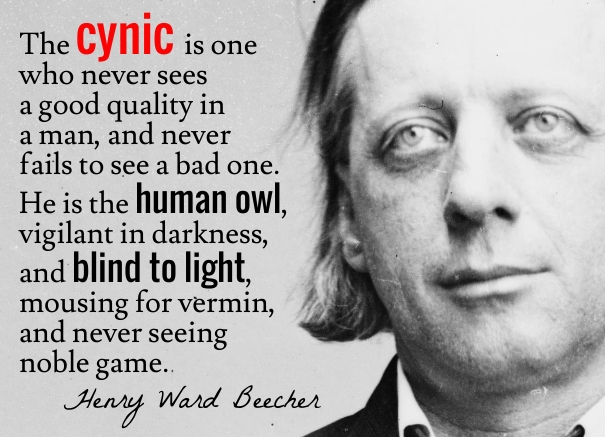
The cynic is one who never sees a good quality in a man, and never fails to see a bad one. He is the human owl, vigilant in darkness, and blind to light, mousing for vermin, and never seeing noble game.
Henry Ward Beecher (1813–1887) American clergyman and orator
Proverbs from Plymouth Pulpit (1870)
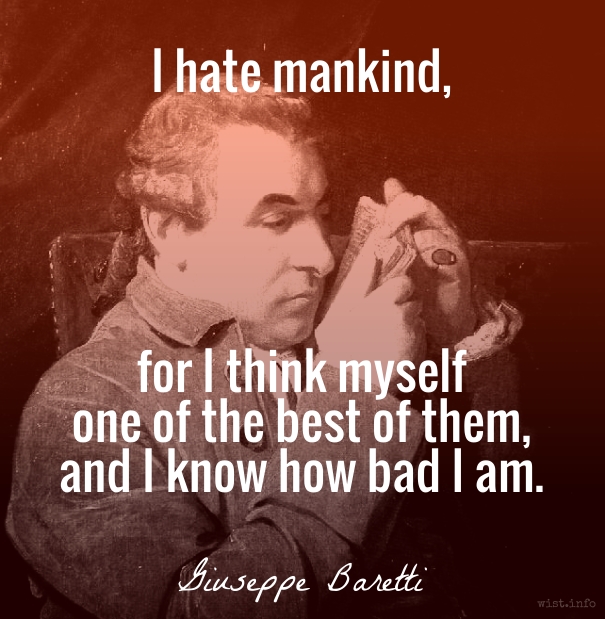
I hate mankind, for I think myself one of the best of them, and I know how bad I am.
Giuseppe Baretti (1719–1789) Italian-English literary critic and translator [a.k.a. Joseph Baretti]
(Attributed)
Quoted in James Boswell, The Life of Samuel Johnson (1791).

A psychologist once asked a group of college students to jot down, in thirty seconds, the initials of the people they disliked. Some of the students taking the test could think of only one person. Others listed as many as fourteen. The interesting fact that came out of this bit of research was this: Those who disliked the largest number were themselves the most widely disliked. When we find ourselves continually disliking others, we ought to bring ourselves up short and ask ourselves the question: “What is wrong with me?”
James Keller (1900–1977) American Catholic priest, inspirational speaker, television personality
Three Minutes a Day (1950)

Yet malice never was his aim;
He lashed the vice but spared the name.
No individual could resent,
Where thousands equally were meant.Jonathan Swift (1667–1745) English writer and churchman
“Verses on the Death of Dr. Swift,” l. 459 (1731)

Man was made at the end of the week’s work, when God was tired.
Mark Twain (1835–1910) American writer [pseud. of Samuel Clemens]
Mark Twain’s Notebook, 23 May 1903 [ed. Paine (1935)]
It is a sin to believe evil of others, but it is seldom a mistake.
H. L. Mencken (1880–1956) American writer and journalist [Henry Lewis Mencken]
A Little Book in C Major, ch. 5, § 23 (1916)
(Source)
Variants:EVIL. That which one believes of others. It is a sin to believe evil of others, but it is seldom a mistake.
A Book of Burlesques, "The Jazz Webster" (1924)Evil is that which one believes of others. It is a sin to believe evil of others, but it is seldom a mistake.
Chrestomathy, ch. 30 "Sententiae" (1949)
The more I see of people, the more I love my dog.
[Je mehr ich von den Menschen sehe, um so lieber habe ich meinen Hund.]
Frederick II (1712–1786) King of Prussia (Frederick the Great, Friedrich der Große)
(Attributed)
This quote is widely attributed to Frederick, but I cannot find a primary or contemporary citation. The earliest attribution to Frederick I find is in a comment attributed to Otto von Bismarck in French historian Constantin de Grünwald, Bismarck (1949):«Je suis comme Frederic II», dit-il à Radowitz: «Plus j'apprends à connaitre les hommes, plus je me mets à aimer les chiens.»
["I am like Frederick II," he told Radowitz: "The more I get to know men, the more I start to love dogs."]
[Google Translate]
As the earliest (unattributed) versions of this quote predate Bismark's adulthood, it is unlikely the formulation is originally his.
The quote is often misattributed to Charles de Gaulle, based on an article (1967-12-08), "Some General Comments, Entre Nous," Time Magazine, on political writer Jean-Raymond Tournoux's best-seller, La Tragédie du Général (1967). The article mistakes a use of the French phrase (translated as "The better I get to know men, the more I find myself loving dogs") as an attribution to De Gaulle, which, in context, it is a reference to the Bismarck quote above (and is in fact footnoted to de Grünwald's Bismarck):Dans le petit parc, la ronde familière continue. Au passage, le chien «Vincam», berger allemand au pédigrée rare, tire sa longue, longue chaine: «Une chose me torture», dit de Gaulle... «Cet animal enchainé ... C’est impossible ... Je ne peux plus le voir ... Donnez-le à l’amiral Ortoli.»
Sur ce terrain, il se sent de plain-pied avec Frederic II, avec Bismarck: «Plus j'apprends à connaitre les hommes, plus je me mets à aimer les chiens.»
[In the small park, the familiar round continues. As we pass, the dog "Vincam," a German shepherd with a rare pedigree, pulls on his long, long chain: "One thing is torturing me," says de Gaulle ... "This chained animal ... It's impossible ... I can't stand it anymore ... Give it to Admiral Ortoli."
On this ground, he feels on the same level as Frederick II, from Bismarck: "The better I get to know men, the more I find myself loving dogs."]
[Google Translate]
The same quote is also attribute to Blaise Pascal ("Plus je vois les hommes, plus j'aime mon chien"). I cannot find a primary source of his saying it, but it is attributed to him in an inscription in the Cimetière des Chiennes in Asnières on the Ile de la Recetre on the Seinne (1, 2, 3).
Similarly, it is often attributed to Madame Germaine de Staël ("The more I know men, the more I love dogs"). Again, I can find only attributions, not a primary souce (1, 2, 3) .
For additional discussion about this quotation and its origins, see:

The human race consists of the damned and the ought-to-be-damned.
Mark Twain (1835–1910) American writer [pseud. of Samuel Clemens]
Mark Twain’s Notebook [ed. Paine (1935)]