We were happy, and wished to make all happy around us. False pleasures make men haughty and severe, and such pleasures are always selfish. But true happiness inspires gentleness and benevolence, and diffuses its influence on very hand.
[Nous étions heureux, & nous voulions vivre avec des gens qui le fussent. Le bonheur faux rend les hommes durs & superbes, & ce bonheur ne se communique point. Le vrai bonheur les rend doux et sensibles, & ce bonheur se partage toujours.]
Charles-Lewis de Secondat, Baron de Montesquieu (1689–1755) French political philosopher
“Arsaces and Ismenia [Arsace et Isménie]” (1742) [tr. 1797]
(Source)
Commonly quoted in isolation, with just the second two sentences; often misattributed to his Pensées.
(Source (French)). Other translations:We were happy ourselves; and were desirous of living with people that were so. False happiness renders men austere and haughty; and this happiness is selfish and unsociable. True felicity, on the contrary, softens them into sensibility and gentleness: it delights in reciprocal communication.
[tr. 1784]We were happy, and we wished to live with people who were happy too. False happiness renders men rigid and haughty; and this happiness has nothing social. True happiness makes them mild, and endues them with sensibility; and this happiness is always shared.
[tr. 1785][...] False happiness renders men stern and proud, and that happiness is never communicated. True happiness renders them kind and sensible, and that happiness is always shared.
[tr. 1854]
Quotations about:
selfishness
Note not all quotations have been tagged, so Search may find additional quotes on this topic.
There are two things that men should never weary of, goodness and humility; we get none too much of them in this rough world among cold, proud people.
Robert Louis Stevenson (1850–1894) Scottish essayist, novelist, poet
Novel (1886), Kidnapped, ch. 16 “The Lad with the Silver Button: Across Morven”
(Source)
This chapter was originally published in Young Folks Paper, Vol. 28, No. 811 (1886-06-12).
Occasionally he took us on a picnic or a camping trip and taught us many valuable lessons. The chief one was to remember that camping was a good way to find out people’s characters. Those who were selfish showed it very soon, in that they wanted the best bed or the best food and did not want to do their share of the work.
Eleanor Roosevelt (1884–1962) American politician, diplomat, activist; First Lady of the US (1933–45)
Memoir (1937), This Is My Story, ch. 2 “Adolescence”
(Source)
Referring to her uncle, Teddy Roosevelt.
The same passage is included in her compiled 1961 Autobiography, Part 1, ch. 2 "Adolescence."

The teaching which I received was genuinely democratic in one way. It was not so democratic in another. I grew into manhood thoroughly imbued with the feeling that a man must be respected for what he made of himself. But I had also, consciously or unconsciously, been taught that socially and industrially pretty much the whole duty of the man lay in thus making the best of himself; that he should be honest in his dealings with others and charitable in the old-fashioned way to the unfortunate; but that it was no part of his business to join with others in trying to make things better for the many by curbing the abnormal and excessive development of individualism in a few.
Theodore Roosevelt (1858–1919) American politician, statesman, conservationist, writer; US President (1901–09)
Autobiography, ch. 1 “Boyhood and Youth” (1913)
(Source)
The concept of loyalty as conformity is a false one. It is narrow and restrictive, denies freedom of thought and of conscience, and is irremediably stained by private and selfish considerations.

Interest, upon which we commonly lay the Blame of all our ill Actions, oftentimes deserves the commendation due to our Good ones.
[L’intérêt, que l’on accuse de tous nos crimes, mérite souvent d’être loué de nos bonnes actions.]
François VI, duc de La Rochefoucauld (1613–1680) French epigrammatist, memoirist, noble
Réflexions ou sentences et maximes morales [Reflections; or Sentences and Moral Maxims], ¶305 (1665-1678) [tr. Stanhope (1694)]
(Source)
This first appeared in the 3rd (1671) edition. See also ¶187, ¶253.
(Source (French)). Other translations:Interest, which is accused of all our crimes, often deserves to be praised for our good actions.
[ed. Gowens (1851), ¶315]Interest, which is accused of all our misdeeds, often should be praised for our good deeds.
[tr. Bund/Friswell (1871), ¶305]Self-interest, to which are ascribed all our crimes, should frequently be given the credit for our good deeds.
[tr. FitzGibbon (1957), ¶305]Selfishness, which we blame for all our crimes, often deserves to be praised for our good deeds.
[tr. Kronenberger (1959), ¶305]Self-interest, blamed for all our misdeeds, often deserves credit for our good actions.
[tr. Tancock (1959), ¶305]Self-interest, which commonly takes the blame for all our crimes, often deserves praise for producing our good actions.
[tr. Whichello (2016) ¶305]

An unconscious, easy, selfish person shocks less, and is more easily loved, than one who is laboriously and egotistically unselfish. There is at least no fuss about the first; but the other parades his sacrifices, and so sells his favours too dear.
Robert Louis Stevenson (1850–1894) Scottish essayist, novelist, poet
Essay (1880-01/02?), “Reflections and Remarks on Human Life,” § 5 “Selfishness and Egoism”
(Source)
A collection of aphorisms and musings, first published in the Edinburgh Edition of his Works, vol. 28 (1898).
They say to me: Eat and drink! Be glad you have it!
But how can I eat and drink if
I snatch what I eat from the starving, and
My glass of water belongs to one dying of thirst?
And yet I eat and drink.[Man sagt mir: Iß und trink du! Sei froh, daß du hast!
Aber wie kann ich essen und trinken, wenn
Ich dem Hungernden entreiße, was ich esse, und
Mein Glas Wasser einem Verdursteten fehlt?
Und doch esse und trinke ich.]Bertolt Brecht (1898–1956) German poet, playwright, director, dramaturgist
Poem (1938 ca.), “To Those Born Later [A die Nachgeborenen],” sec. 1, Svendborger Gedichte (1939) [tr. Willet / Manheim / Fried]
(Source)
Also translated as "To Those Who Follow in Our Wake" and "To Later Generations." Writing not just about sustenance in a world of poverty, but on the use of essentials like food and water by totalitarian regimes to buy loyalty. Written while Brecht had left Germany for Denmark.
An audio recording of the poem by Brecht.
(Source (German)). Other translations:They tell me: eat and drink. Be glad to be among the haves!
But how can I eat and drink
When I take what I eat from the starving
And those who thirst do not have my glass of water?
And yet I eat and drink.
[tr. Horton (2008)]People tell me: Eat and drink! Be happy that you have!
But how can I eat and drink, if
What I eat, I take from the hungry, and if
My glass of water deprives the thirsty?
And yet, eat and drink I do.
[tr. Rienas (2009)]People tell me, Eat and drink! Be glad to have something!
But how can I eat and drink, if
I take what I eat from one who starves
And one dying of thirst needs my glass of water?
And still I eat and drink.
[tr. Renaud (2016)]
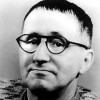
When virtue is banished, ambition invades the hearts of those who are disposed to receive it, and avarice possesses the whole community.
[Lorsque cette vertu cesse, l’ambition entre dans les cœurs qui peuvent la recevoir, & l’avarice entre dans tous.]
Charles-Lewis de Secondat, Baron de Montesquieu (1689–1755) French political philosopher
Spirit of Laws [The Spirit of the Laws; De l’esprit des lois], Book 3, ch. 3 (3.3) (1748) [tr. Nugent (1750)]
(Source)
Speaking of republics. See notes here on Montesquieu's meaning of "virtue": political virtue of love of country and of equality.
(Source (French)). Other translations:When that virtue ceases, ambition enters those hearts that can admit it, and avarice enters them all.
[tr. Cohler/Miller/Stone (1989)]When that virtue ceases, ambition enters the hearts that can receive it, and avarice enters them all.
[tr. Stewart (2018)]
Self-interest will set all sorts of virtues and vices in motion.
[L’intérêt met en œuvre toutes sortes de vertus et de vices.]
François VI, duc de La Rochefoucauld (1613–1680) French epigrammatist, memoirist, noble
Réflexions ou sentences et maximes morales [Reflections; or Sentences and Moral Maxims], ¶253 (1665-1678) [tr. FitzGibbon (1957)]
(Source)
Present in the 1st (1665) edition. In the manuscript form it reads "L’intérêt donne toutes sortes de vertus et de vices."
See also ¶¶ 171, 305.
(Source (French)). Other translations:Interest is the Thing that puts Men upon Exercising their Vertues and Vices of All Kinds.
[tr. Stanhope (1694), ¶254]Interest puts in motion all the virtues and vices.
[pub. Donaldson (1783), ¶258; ed. Lepoittevin-Lacroix (1797), ¶238]The virtues and vices are all set in motion by interest.
[ed. Carvill (1835), ¶225]Interest brings into play every sort of virtue and of vice.
[ed. Gowens (1851), ¶265]Interest sets at work all sorts of virtues and vices.
[tr. Bund/Friswell (1871), ¶253]Selfishness brings into play all manner of vices and virtues.
[tr. Heard (1917), ¶261]Selfishness makes use of virtues and vices of every kind.
[tr. Stevens (1939), ¶253]Self-interest turns to account all kinds of virtues and vices.
[tr. Kronenberger (1959), ¶253]Self-interest sets in motion virtues and vices of all kinds.
[tr. Tancock (1959), ¶253]Self-interest puts in motion every kind of virtue and of vice.
[tr. Whichello (2016) ¶253]
Virtues are lost in self-interest as rivers are lost in the sea.
[Les vertus se perdent dans l’intérêt, comme les fleuves se perdent dans la mer.]
François VI, duc de La Rochefoucauld (1613–1680) French epigrammatist, memoirist, noble
Réflexions ou sentences et maximes morales [Reflections; or Sentences and Moral Maxims], ¶171 (1665-1678) [tr. Whichello (2016)]
(Source)
Present in the 1st (1665) edition, which began the maxim with "Toutes les vertus se perdent [All virtues are lost] ...." See also ¶253.
(Source (French)). Other translations:All the Virtues men so much pretend to, are swallow'd up in Interest, as Rivers lose their names when they fall into the Sea.
[tr. Davies (1669), ¶3]Vertues are lost in Interest, as Rivers are swallowed up in the Sea.
[tr. Stanhope (1694), ¶172]The virtues are lost in interest, as rivers are in the sea.
[pub. Donaldson (1783), ¶448; ed. Lepoittevin-Lacroix (1797), ¶165]The virtues are lost in interest, as rivers are lost in the sea.
[ed. Gowens (1851), ¶174]As rivers are lost in the sea so are virtues in self.
[tr. Bund/Friswell (1871), ¶171]Virtues lose themselves in selfish motives like rivers in the sea.
[tr. Heard (1917), ¶171]Our virtues lose themselves in selfishness as rivers are lost in the sea.
[tr. Stevens (1939), ¶171]Our virtues are drowned in self-interest, as the rivers flow into the sea.
[tr. FitzGibbon (1957), ¶171]Virtues are swallowed up by self-interest as rivers are lost in the sea.
[tr. Kronenberger (1959), ¶171]The virtues lose themselves in self-interest like rivers in the sea.
[tr. Tancock (1959), ¶171]
Contrary to rumor, bridesmaids are not obliged to entertain in honor of the bride, nor to wear clothes that they cannot afford and that make them look stupid.
And no, the bride does not have a “right” to demand either one because it is “her day.” Any sensible person who hears someone speaking in an imperious tone of “her day” would be wise to consider that it therefore isn’t going to be anyone else’s day, and to leave her to enjoy it alone.Judith Martin (b. 1938) American author, journalist, etiquette expert [a.k.a. Miss Manners]
“Miss Manners,” syndicated column (1993-03-07)
(Source)

If all our happiness is bound up entirely in our personal circumstances it is difficult not to demand of life more than it has to give.
Bertrand Russell (1872–1970) English mathematician and philosopher
Conquest of Happiness, Part 2, ch. 10 “Is Happiness Still Possible?” (1930)
(Source)

Will there be a future? We feel we might almost ask ourselves this question when we see so much terrible darkness. Grim confrontation between the selfish and the wretched. In the selfish, prejudices, the ignorance of a superior education, appetite fed by overindulgence, the insensitivity of an indurating prosperity, fear of suffering that in some extends to an aversion to those who suffer, relentless complacency, an ego so inflated it denies access to the soul. In the wretched, greed, envy, a hatred of seeing others enjoying themselves, the convulsions of the human beast within them seeking satisfaction, hearts befogged, sadness, need, fatalism, ignorance impure and simple.
[L’avenir arrivera-t-il? il semble qu’on peut presque se faire cette question quand on voit tant d’ombre terrible. Sombre face-à-face des égoïstes et des misérables. Chez les égoïstes, les préjugés, les ténèbres de l’éducation riche, l’appétit croissant par l’enivrement, un étourdissement de prospérité qui assourdit, la crainte de souffrir qui, dans quelques-uns, va jusqu’à l’aversion des souffrants, une satisfaction implacable, le moi si enflé qu’il ferme l’âme; chez les misérables, la convoitise, l’envie, la haine de voir les autres jouir, les profondes secousses de la bête humaine vers les assouvissements, les cœurs pleins de brume, la tristesse, le besoin, la fatalité, l’ignorance impure et simple.]
Victor Hugo (1802–1885) French writer, journalist, human rights activist, politician
Les Misérables, Part 4 “St. Denis,” Book 7 “Argot,” ch. 4 (4.7.4) (1862) [tr. Donougher (2013)]
(Source)
(Source (French)). Alternate translations:Will the future come? It seems that we may almost ask this question when we see such terrible shadow. Sullen face-to-face of the selfish and the miserable. On the part of the selfish, prejudices, the darkness of the education of wealth, appetite increasing through intoxication, a stupefaction of prosperity which deafens, a dread of suffering which, with some, is carried even to aversion for sufferers, an implacable satisfaction, the me so puffed up that it closes the soul; on the part of the miserable, covetousness, envy, hatred of seeing others enjoy, the deep yearnings of the human animal towards the gratifications, hearts full of gloom, sadness, want, fatality, ignorance impure and simple.
[tr. Wilbour (1862)]Will the future arrive? it seems as we may almost ask this question on seeing so much terrible shadow. There is a somber, face-to-face meeting of the egotists and the wretched. In the egotist we trace prejudices, the cloudiness of a caste education, appetite growing with intoxication, and prosperity that stuns, a fear of suffering which in some goes so far as an aversion from the sufferers, an implacable satisfaction, and the feeling of self so swollen that it closes the soul. In the wretched we find covetousness, envy, the hatred of seeing others successful, the profound bounds of the human wild beast at satisfaction, and hearts full of mist, sorrow, want, fatality, and impure and simple ignorance.
[tr. Wraxall (1862)]Will the future arrive? It seems as though we might almost put this question, when we behold so much terrible darkness. Melancholy face-to-face encounter of selfish and wretched. On the part of the selfish, the prejudices, shadows of costly education, appetite increasing through intoxication, a giddiness of prosperity which dulls, a fear of suffering which, in some, goes as far as an aversion for the suffering, an implacable satisfaction, the I so swollen that it bars the soul; on the side of the wretched covetousness, envy, hatred of seeing others enjoy, the profound impulses of the human beast towards assuaging its desires, hearts full of mist, sadness, need, fatality, impure and simple ignorance.
[tr. Hapgood (1887)]Will the future ever arrive? The question seems almost justified when one considers the shadows looming ahead, the sombre confrontation of egoists and outcasts. On the side of the egoists, prejudice -- that darkness of a rich education -- appetite that grows with intoxication, the bemusement of prosperity which blunts the sense, the fear of suffering which in some cases goes so far as to hate all sufferers, and unshakeable complacency, the ego so inflated it stifles the soul; and on the side of the outcasts, greed and envy, resentment at the happiness of others, the turmoil of the human animal in search of personal fulfilment, hearts filled with fog, misery, needs, and fatalism, and simple, impure ignorance.
[tr. Denny (1976)]Will the future come? We can almost ask this question, it seems, when we see such terrible shadows. Sullen face-to-face encounter of the selfish and the miserable. On the side of the selfish, prejudices, the darkness of the education of wealth, appetite increasing through intoxication, a stultifying of prosperity, which deafens, a dread of suffering taken, for some, as far as an aversion to sufferers, an implacable satisfaction, the self so puffed up it closes the soul; on the side of the miserable, covetousness, envy, hatred of seeing others enjoy, the deep yearnings of the human animal toward gratification, hearts filled with gloom, sadness, want, inevitability, ignorance impure and simple.
[tr. Wilbour/Fahnestock/MacAfee (1987)]
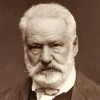
Nothing is so hard to understand as that there are human beings in this world besides one’s self and one’s own set.
William Dean Howells (1837–1920) American author, literary critic, and playwright
Their Wedding Journey, ch. 2 “Midsummer-Day’s Dream” [Basil] (1872)
(Source)
And he went on to say to them all, “Watch out and guard yourselves from every kind of greed; because your true life is not made up of the things you own, no matter how rich you may be.”
Then Jesus told them this parable: “There was once a rich man who had land which bore good crops. He began to think to himself, ‘I don’t have a place to keep all my crops. What can I do? This is what I will do,’ he told himself; ‘I will tear down my barns and build bigger ones, where I will store the grain and all my other goods. Then I will say to myself, Lucky man! You have all the good things you need for many years. Take life easy, eat, drink, and enjoy yourself!’ But God said to him, ‘You fool! This very night you will have to give up your life; then who will get all these things you have kept for yourself?’”
And Jesus concluded, “This is how it is with those who pile up riches for themselves but are not rich in God’s sight.”εἶπεν δὲ πρὸς αὐτούς, Ὁρᾶτε καὶ φυλάσσεσθε ἀπὸ πάσης πλεονεξίας, ὅτι οὐκ ἐν τῷ περισσεύειν τινὶ ἡ ζωὴ αὐτοῦ ἐστιν ἐκ τῶν ὑπαρχόντων αὐτῷ.
Εἶπεν δὲ παραβολὴν πρὸς αὐτοὺς λέγων, Ἀνθρώπου τινὸς πλουσίου εὐφόρησεν ἡ χώρα. καὶ διελογίζετο ἐν ἑαυτῷ λέγων, Τί ποιήσω, ὅτι οὐκ ἔχω ποῦ συνάξω τοὺς καρπούς μου; καὶ εἶπεν, Τοῦτο ποιήσω, καθελῶ μου τὰς ἀποθήκας καὶ μείζονας οἰκοδομήσω καὶ συνάξω ἐκεῖ πάντα τὸν σῖτον καὶ τὰ ἀγαθά μου καὶ ἐρῶ τῇ ψυχῇ μου, Ψυχή, ἔχεις πολλὰ ἀγαθὰ κείμενα εἰς ἔτη πολλά· ἀναπαύου, φάγε, πίε, εὐφραίνου.
εἶπεν δὲ αὐτῷ ὁ θεός, Ἄφρων, ταύτῃ τῇ νυκτὶ τὴν ψυχήν σου ἀπαιτοῦσιν ἀπὸ σοῦ· ἃ δὲ ἡτοίμασας, τίνι ἔσται; οὕτως ὁ θησαυρίζων ἑαυτῷ καὶ μὴ εἰς θεὸν πλουτῶν.The Bible (The New Testament) (AD 1st - 2nd C) Christian sacred scripture
Book 3. Gospel of Luke 12:15ff (Luke 12:15–21) [GNT (1992 ed.)]
(Source)
No Synoptic parallels, but the parable is paralleled in the Gospel of Thomas, saying 63.
(Source (Greek)). Alternate translations:And he said unto them, Take heed, and beware of covetousness: for a man’s life consisteth not in the abundance of the things which he possesseth.
And he spake a parable unto them, saying, The ground of a certain rich man brought forth plentifully: and he thought within himself, saying, What shall I do, because I have no room where to bestow my fruits? And he said, This will I do: I will pull down my barns, and build greater; and there will I bestow all my fruits and my goods. And I will say to my soul, Soul, thou hast much goods laid up for many years; take thine ease, eat, drink, and be merry.
But God said unto him, Thou fool, this night thy soul shall be required of thee: then whose shall those things be, which thou hast provided? So is he that layeth up treasure for himself, and is not rich toward God.
[KJV (1611)]Then he said to them, 'Watch, and be on your guard against avarice of any kind, for a man's life is not made secure by what he owns, even when he has more than he needs'.
Then he told them a parable: 'There was once a rich man who, having had a good harvest from his land, thought to himself, "What am I to do? I have not enough room to store my crops." Then he said, "This is what I will do: I will pull down my barns and build bigger ones, and store all my grain and my goods in them, and I will say to my soul: My soul, you have plenty of good things laid by for many years to come; take things easy, eat, drink, have a good time". 'But God said to him, "Fool! This very night the demand will be made for your soul; and this hoard of yours, whose will it be then?". So it is when a man stores up treasure for himself in place of making himself rich in the sight of God.'
[JB (1966)]Then he said to them, 'Watch, and be on your guard against avarice of any kind, for life does not consist in possessions, even when someone has more than he needs.'
Then he told them a parable, 'There was once a rich man who, having had a good harvest from his land, thought to himself, "What am I to do? I have not enough room to store my crops." Then he said, "This is what I will do: I will pull down my barns and build bigger ones, and store all my grain and my goods in them, and I will say to my soul: My soul, you have plenty of good things laid by for many years to come; take things easy, eat, drink, have a good time." But God said to him, "Fool! This very night the demand will be made for your soul; and this hoard of yours, whose will it be then?" So it is when someone stores up treasure for himself instead of becoming rich in the sight of God.'
[NJB (1985)]Then Jesus said to them, “Watch out! Guard yourself against all kinds of greed. After all, one’s life isn’t determined by one’s possessions, even when someone is very wealthy.”
Then he told them a parable: “A certain rich man’s land produced a bountiful crop. He said to himself, What will I do? I have no place to store my harvest! Then he thought, Here’s what I’ll do. I’ll tear down my barns and build bigger ones. That’s where I’ll store all my grain and goods. 19 I’ll say to myself, You have stored up plenty of goods, enough for several years. Take it easy! Eat, drink, and enjoy yourself.
"But God said to him, ‘Fool, tonight you will die. Now who will get the things you have prepared for yourself?’ This is the way it will be for those who hoard things for themselves and aren’t rich toward God.”
[CEB (2011)]And he said to them, “Take care! Be on your guard against all kinds of greed, for one’s life does not consist in the abundance of possessions.”
Then he told them a parable: “The land of a rich man produced abundantly. And he thought to himself, ‘What should I do, for I have no place to store my crops?’ Then he said, ‘I will do this: I will pull down my barns and build larger ones, and there I will store all my grain and my goods. And I will say to my soul, Soul, you have ample goods laid up for many years; relax, eat, drink, be merry.’
"But God said to him, ‘You fool! This very night your life is being demanded of you. And the things you have prepared, whose will they be?’ So it is with those who store up treasures for themselves but are not rich toward God.”
[NRSV (2021 ed.)]

A dying culture invariably exhibits personal rudeness. Bad manners. Lack of consideration for others in minor matters. A loss of politeness, of gentle manners, is more significant than is a riot. […] This symptom is especially serious in that an individual displaying it never thinks of it as a sign of ill health but as proof of his/her strength.
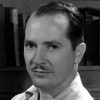
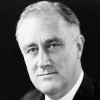
I believe that the recent course of our history has demonstrated that, while we may utilize their expert knowledge of certain problems and the special facilities with which they are familiar, we cannot allow our economic life to be controlled by that small group of men whose chief outlook upon the social welfare is tinctured by the fact that they can make huge profits from the lending of money and the marketing of securities — an outlook which deserves the adjectives “selfish” and “opportunist.”
Franklin Delano Roosevelt (1882–1945) American lawyer, politician, statesman; US President (1933–45)
Speech (1932-05-22), Commencement, Oglethorpe University, Atlanta, Georgia
(Source)
There are no exceptions to the rule that everyone thinks they’re an exception to the rules.
Banksy (b. 1974?) England-based pseudonymous street artist, political activist, film director
Wall and Piece, “Cops” (2005)
(Source)

The enemies of democracy are now trying, by every means, to destroy our unity. The chief weapon they now use against us is propaganda, propaganda that appeals to selfishness, that comes in ever increasing quantities, with ever increasing violence, from across the seas. And it is disseminated within our own borders by agents or innocent dupes of foreign powers.
Franklin Delano Roosevelt (1882–1945) American lawyer, politician, statesman; US President (1933–45)
Speech (1941-03-29), Jackson Day Radio Broadcast, U.S.S. Potomac
(Source)
ALCESTE: Finding on every hand base flattery,
Injustice, fraud, self-interest, treachery …
Ah, it’s too much; mankind has grown so base,
I mean to break with the whole human race.[Je ne trouve partout que lâche flatterie,
Qu’injustice, intérêt, trahison, fourberie;
Je n’y puis plus tenir, j’enrage, et mon dessein
Est de rompre en visière à tout le genre humain.]Molière (1622–1673) French playwright, actor [stage name for Jean-Baptiste Poquelin]
Le Misanthrope, Act 1, sc. 1 (1666) [tr. Wilbur (1954)]
(Source)
(Source (French)). Alternate translations:Everywhere I find nothing but base flattery, in justice, self-interest, deceit, roguery. I cannot bear it any longer; I am furious; and my intention is to break with all mankind.
[tr. Van Laun (1878)]I find nothing anywhere but base flattery, injustice, interest, treachery, and knavery. I can contain myself no longer; I am. in a rage, and my purpose is to break off all intercourse with all mankind.
[tr. Mathew (1890)]Everywhere I find base flattery, injustice, self-interest, treachery, deceit. I cannot bear it any longer; I am enraged; and my intention is to tell the truth, henceforth, to all the human race.
[tr. Wormeley (1894)]Nothing is to be seen anywhere but base flattery, injustice, self-interest, deceit, roguery. I cannot bear it any longer: I am furious: and it is my intention to break a lance with all mankind.
[tr. Waller (1903)]There's nowhere aught but dastard flattery,
Injustice, treachery, selfishness, deceit;
I can't endure it, I go mad -- and mean
Squarely to break with all the human race.
[tr. Page (1913)]All I see everywhere is flattery,
Injustice, treason, selfishness, deceit.
It makes me furious; I cannot stand it;
I will defy the entire human race.
[tr. Bishop (1957)]Cowardly flattery is all I see,
Injustice, selfishness, fraud, treachery;
I've had my fill; it makes me mad; I plan
To clash head-on with the whole race of man.
[tr. Frame (1967)]

Courage, intellect, all the masterful qualities, serve but to make a man more evil if they are used merely for that man’s own advancement, with brutal indifference to the rights of others. It speaks ill for the community if the community worships these qualities and treats their possessors as heroes regardless of whether the qualities are used rightly or wrongly.
Theodore Roosevelt (1858–1919) American politician, statesman, conservationist, writer; US President (1901–09)
Speech (1910-04-23), “Citizenship in a Republic [The Man in the Arena],” Sorbonne, Paris
(Source)
In vain do they think themselves innocent who appropriate to their own use alone those goods which God gave in common; by not giving to others that which they themselves receive, they become homicides and murderers, inasmuch as in keeping for themselves those things which would have alleviated the sufferings of the poor, we may say that they every day cause the death of as many persons as they might have fed and did not.
Gregory I (c. 540 - 604) Bishop of Rome, liturgist, Latin Father, Doctor of the Church [Gregorius I, Saint Gregory the Great, Saint Gregory the Dialogist]
(Attributed)
(Source)
Quoted in George D. Herron, Between Caesar and Jesus, ch. 4 "Christian Doctrine and Private Property" (1899).

You seem to have great possessions! How else can this be, but that you have preferred your own enjoyment to the consolation of the many? For the more you abound in wealth, the more you lack in love.
[ἀλλὰ μὴν φαίνῃ ἔχων κτήματα πολλά. Πόθεν ταῦτα; ἢ δῆλον ὅτι τὴν οἰκείαν ἀπόλαυσιν προτι μοτέραν τῆς τῶν πολλῶν παραμυθίας ποιούμενος. Ὅσον οὖν πλεονάζεις τῷ πλούτῳ, τοσοῦτον ἐλλείπεις τῇ ἀγάπῃ.]
Basil of Caesarea (AD 330–378) Christian bishop, theologian, monasticist, Doctor of the Church [Saint Basil the Great, Ἅγιος Βασίλειος ὁ Μέγας]
Sermon (368 ca.), “To the Rich [Ὁμιλία πρὸς τοὺς πλουτούντας]” [tr. Schroeder (2009)]
(Source)
In C. Paul Schroeder, ed., Saint Basil on Social Justice (2009).

Men can be unjust, because it is in their interest to act so, and they prefer their own satisfaction to that of others. They always act with themselves in mind. No one is gratuitously wicked; there must be a determining cause, and it is always one of self-interest.
[Les hommes peuvent faire des injustices, parce qu’ils ont intérêt de les commettre et qu’ils préfèrent leur propre satisfaction à celle des autres. C’est toujours par un retour sur eux-mêmes qu’ils agissent: nul n’est mauvais gratuitement; il faut qu’il y ait une raison qui détermine, et cette raison est toujours une raison d’intérêt.]
Charles-Lewis de Secondat, Baron de Montesquieu (1689–1755) French political philosopher
Persian Letters [Lettres Persanes], Letter 84, Usbek to Rhédi (1721) [tr. Healy (1964), # 83]
Montesquieu's argues that an omnipotent God must be just, because God has no interest that cannot be satisfied through injustice.
(Source (French)). Other translations:Men may commit injustice, because it is in their interest to do it, and they chuse rather to satisfy themselves and others. It is always with an eye to themselves that they act: no body is wicked gratis: he will have some reason to sway him; and that reason is always a reason of interest.
[tr. Ozell (1760 ed.)]Men may do injustice, because it is in their interest to commit it, and because they prefer their own private satisfaction to that of others. It is always with a view to themselves that they act: nobody is wicked for nothing: he must have some reason that determines himl and this reason is always a reason of interest.
[tr. Floyd (1762), # 83]Men act unjustly, because it is their interest to do so, and because they prefer their own satisfaction to that of others. They act always to secure some advantage to themselves: no one is a villain gratis; there is always a determining motive, and that motive is always an interested one.
[tr. Davidson (1891)]Men act unjustly, because it is their interest to do so, and they prefer their own satisfaction to that of others. In acting they always have in view the effect their action will have on themselves: no one is bad for nothing; every one must have a determining motive, and that motive is self-interest.
[tr. Betts (1897)]Men can commit injustices, because it is in their interest to do so, and they would rather satisfy themselves than others. It is always through thinking of themselves that they act unjustly; no one is gratuitously bad, there must be a reason which determines the act, and that reason is invariably one of self-interest.
[tr. Mauldon (2008)]Men are capable of injustice, because their self-interest leads them toward it, and because they prefer their own satisfaction to that of others. Everything always revolves around themselves. No evil is ever done gratuitously, for there is always a reason behind it, and that reason is always one of self-interest.
[tr. MacKenzie (2014), # 83]
The fiercest fanatics are often selfish people who were forced, by innate shortcomings or external circumstances, to lose faith in their own selves. They separate the excellent instrument of their selfishness from their ineffectual selves and attach it to the service of some holy cause. And though it be a faith of love and humility they adopt, they can be neither loving nor humble.
Eric Hoffer (1902–1983) American writer, philosopher, longshoreman
True Believer: Thoughts on the Nature of Mass Movements, Part 2, ch. 7, § 38 (2.7.38) (1951)
(Source)
There are more who want to be loved than who want to love.
[Y a plus de gens qui veulent être aimés que de gens qui veulent aimer eux-mêmes.]Nicolas Chamfort (1741–1794) French writer, epigrammist (b. Nicolas-Sébastien Roch)
Products of Perfected Civilization [Produits de la Civilisation Perfectionée], Part 1 “Maxims and Thoughts [Maximes et Pensées],” ch. 6, ¶ 360 (1795) [tr. Merwin (1969)]
(Source)
(Source (French)). Other translations:There are more people who wish to be loved than there are who are willing to love.
[Source (<1884)]Men are more eager to be loved than anxious to love.
[tr. Mathers (1926)]There are more people who want to be loved than there are people who want to love.
[tr. Dusinberre (1992)]There are more people who want to be loved than people who want to love.
[tr. Siniscalchi (1994)]

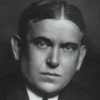
No form of liberty is worth a darn which doesn’t give us the right to do wrong now and then.
H. L. Mencken (1880–1956) American writer and journalist [Henry Lewis Mencken]
A Little Book in C Major, ch. 3, § 16 (1916)
(Source)
To show lack of consideration for those who in any capacity serve us — whether in restaurants, hotels, or stores, or in public places anywhere — is always an evidence of ill-breeding as well as inexcusable selfishness. It is only those who are afraid that someone may encroach upon their exceedingly insecure dignity who show neither courtesy nor consideration except to those whom they think it would be to their advantage to please.
Emily Post (1872–1960) American author, columnist [née Price]
Etiquette: The Blue Book of Social Usage, ch. 8 “Entertaining at a Restaurant” (1922; 1955 10th ed.)
(Source)
See also Paul Eldridge.

Selfishness must always be forgiven, you know, because there is no hope of a cure.

For me you mix Veientian,
While you take Massic wine:
I’d rather smell your goblet
Than to take a drink from mine.[Veientana mihi misces, ubi Massica potas:
Olfacere haec malo pocula, quam bibere.]Martial (AD c.39-c.103) Spanish Roman poet, satirist, epigrammatist [Marcus Valerius Martialis]
Epigrams [Epigrammata], Book 3, epigram 49 (3.49) (AD 87-88) [tr. Nixon (1911), “Let the Cup Pass”]
(Source)
(Source (Latin)). Other translations:You Massick drink, Veientan give to me.
I need not taste; the smell doth satisfie.
[tr. Wright (1663)]You mix Veientan wine for me, while you yourself drink Massic. I would rather smell the cups which you present me, than drink of them.
[tr. Bohn's Classical (1859)]You mix Veientan wine for me, whereas you drink Massic. I would rather smell these cups of mine than drink them.
[tr. Ker (1919)]Yourself you drink a vintage rare
While giving me vin ordinaire.
To smell the heel-taps of your wine
Is better far than drinking mine.
[tr. Pott & Wright (1921), "The Mean Host"]You pour me cheap red wine while you drink Massic.
I'd rather sniff this cup than drink from it.
[tr. Bovie (1970)]You drink the best, yet serve us third-rate wine.
I'd rather sniff your cup than swill from mine.
[tr. Michie (1972)]You serve me plonk, and you drink reservé.
My taste-buds back away from mine’s bouquet.
[tr. Harrison (1981)]You mix Veientan for me and serve Massic for yourself. I had rather smell these cups than drink.
[tr. Shackleton Bailey (1993)]Your cup breathes odors fine
That never came from mine.
Better is what you waft
Than what I'm forced to quaff.
[tr. Wills (2007)]You mix Veientan for me, while you drink Massic wine.
I'd rather smell your cups than drink from mine.
[tr. McLean (2014)]You pour me Blue Nun, while you drink Brunello wine.
I’d rather smell your glass, than take a sip from mine.
[tr. Ynys-Mon (2016)]
All we hear is “What’s the matter with the country?” “What’s the matter with the world?” There ain’t but one thing wrong with every one of us in the world, and that’s selfishness.
Your conscience is the measure of the honesty of your selfishness. Listen to it carefully.
Richard Bach (b. 1936) American writer
Illusions: The Adventures of a Reluctant Messiah, ch. 13, epigraph (1977)
(Source)
It’s like this: if you have one piece of cake, and you eat it, that’s fine. If you have two pieces of cake, you should probably share some with a friend. But maybe not. Occasionally we could all use two pieces of cake. But if you have a whole cake, and you eat all of it, that’s not very cool. It’s not just selfish, it’s kinda sick and unhealthy.
Patrick Rothfuss (b. 1973) American author
“Concerning Cake, Bilbo Baggins and Charity,” Blog Entry (19 Jan 2014)
(Source)

All of us are infected today with an extraordinary egoism. And that is not freedom; freedom means learning to demand only of oneself, not of life and others, and knowing how to give: sacrifice in the name of love.
Andrei Tarkovsky (1932–1986) Russian film director, screenwriter, film theorist [Андрей Арсеньевич Тарковский]
Sculpting in Time (1986) [tr. Hunter-Blair]
(Source)

I have begun in old age to understand just how oddly we are all put together. We are so proud of our autonomy that we seldom if ever realize how generous we are to ourselves, and just how stingy with others. One of the booby traps of freedom — which is bordered on all sides by isolation — is that we think so well of ourselves. I now see that I have helped myself to the best cuts at life’s banquet.

If I had omitted setting down something of that which has appeared to me as clear, so that the knowledge would perish when I perish, as is inevitable, I should have considered that conduct as extremely cowardly with regard to you and everyone who is perplexed. It would have been, as it were, robbing one who deserves the truth of the truth, or grudging an heir his inheritance. And both those traits are blameworthy.
Maimonides (1135–1204) Spanish Jewish philosopher, scholar, astronomer, physician [Moses ben Maimon, Rambam, רמב״ם]
Guide for the Perplexed, Part 3, Introduction (c. 1190) [tr. Pines (1963)]
(Source)
Another translation:But if, on the other hand, I were to abstain from writing on this subject, according to my knowledge of it, when I die, as I shall inevitably do, that knowledge would die with me, and I would thus inflict great injury on you and all those who are perplexed. I would then be guilty of withholding the truth from those to whom it ought to be communicated, and of jealously depriving the heir of his inheritance. I should in either case be guilty of gross misconduct.
[tr. Friedlander (1885)]

But this I can tell you true — until you divest yourself of the notion that you are a collection of needs, an empty vessel that someone else must fill up, there will be no safe place to harbor yourself, no safe shore to reach. As long as you think mostly of getting, you will have nothing real to give.
Merle Shain (1935–1989) Canadian journalist and author
Hearts That We Broke Long Ago, ch. 8 (1985)
(Source)

Precisely in trifles, wherein a man is off his guard, does he show his character, and then we are often able at our leisure to observe in small actions or mere mannerisms the boundless egoism which has not the slightest regard for others and in matters of importance does not afterwards deny itself, although it is disguised. We should never miss such an opportunity. If in the petty affairs and circumstances of everyday life, in the things to which the de minimis lex non curat applies, a man acts inconsiderately, seeking merely his own advantage or convenience to the disadvantage of others; if he appropriates that which exists for everybody; then we may be sure that there is no justice in his heart, but that he would be a scoundrel even on a large scale if his hands were not tied by law and authority; we should not trust him across our threshold. Indeed, whoever boldly breaks the laws of his own circle will also break those of the State whenever he can do so without risk.
[Gerade in Kleinigkeiten, als bei welchen der Mensch sich nicht zusammennimmt, zeigt er seinen Charakter, und da kann man oft, an geringfügigen Handlungen, an bloßen Manieren, den gränzenlosen, nicht die mindeste Rücksicht auf Andere kennenden Egoismus bequem beobachten, der sich nachher im Großen nicht verleugnet, wiewohl verlarvt. Und man versäume solche Gelegenheit nicht. Wenn Einer in dem kleinen täglichen Vorgängen und Verhältnissen des Lebens, in den Dingen, von welchen das de minimis lex non curat gilt, rücksichtslos verfährt, bloß seinen Vertheil oder seine Bequemlichkeit, zum Nachtheil Andere, sucht; wenn er sich angeignet was für Alle da ist u. s. w.; da sei man überzeugt, daß in seinem Herzen keine Gerechtigkeit wohnt, sondern er auch im Großen ein Schuft sein wird, sobald das Gesetz und die Gewalt ihm nicht die Hände binden, und traue ihm nicht über die Schwelle. Ja, wer ohne Scheu die Gesetze seines Klubs bricht, wird auch die des Staates brechen, sobald er es ohne Gefahr kann.]
Arthur Schopenhauer (1788–1860) German philosopher
Parerga and Paralipomena, Vol. 1, “Aphorisms on the Wisdom of Life [Aphorismen zur Lebensweisheit],” ch. 4 “Counsels and Maxims [Paränesen und Maximen],” § 3.29 (1851) [tr. Payne (1974)]
(Source)
The Latin means, "The law is not concerned with trifles." (Source (German)) Other translations:A man shows his character just in the way in which he deals with trifles, -- for then he is off his guard. This will often afford a good opportunity of observing the boundless egoism of man's nature, and his total lack of consideration for others; and if these defects show themselves in small things, or merely in his general demeanor, you will find that they also underlie his action in matters of importance, although he may disguise the fact. This is an opportunity which should not be missed. If in the little affairs of every day, -- the trifles of life, those matters to which the rule de minimis non applies, -- a man is inconsiderate and seeks only what is advantageous or convenient to himself, to the prejudice of others' rights; if he appropriates to himself that which belongs to all alike, you may be sure there is no justice in his heart, and that he would be a scoundrel on a wholesale scale, only that law and compulsion bind his hands. Do not trust him beyond your door. He who is not afraid to break the laws of his own private circle, will break those of the State when he can do so with impunity.
[tr. Saunders (1890)]Men best show their character in trifles, where they are not on their guard. It is in insignificant matters, and in the simplest habits, that we often see the boundless egotism which pays no regard to the feeling of others, and denies nothing to itself.
[In Tryon Edwards, A Dictionary of Thoughts, "Character" (1891); this is the version quoted most often.]

Some people think that evolutionary psychology claims to have discovered that human nature is selfish and wicked. But they are flattering the researchers and anyone who would claim to have discovered the opposite. No one needs a scientist to measure whether humans are prone to knavery. The question has been answered in the history books, the newspapers, the ethnographic record, and the letters to Ann Landers. But people treat it like an open question, as if someday science might discover that it’s all a bad dream and we will wake up to find that it is human nature to love one another.
Steven Pinker (b. 1954) Canadian-American cognitive psychologist, linguist, author
How the Mind Works, ch. 7 (1997)
(Source)

The selfish man believes that by closing his heart against his fellows, and centering in self every thought and feeling, he escapes much suffering. But his egotistical calculations are invariably defeated; for his contracted sympathies being all directed to one focus, he so aggravates the ills he endures, that he expends on self along more painful pity than the most enthusiastic philanthropist devotes to mankind.
Marguerite Gardiner, Countess of Blessington (1789–1849) Irish novelist [Lady Blessington, b. Margaret Power]
Desultory Thoughts and Reflections (1839)
(Source)

It is just as foolish to complain that people are selfish and treacherous as it is to complain that the magnetic field does not increase unless the electric field has a curl. Both are laws of nature.
John von Neumann (1903–1957) Hungarian-American mathematician, physicist, inventor, polymath [János "Johann" Lajos Neumann]
(Attributed)
(Source)
More in Eugene Wigner, "John von Neumann (1903-1957)," Yearbook of the American Philosophical Society (1958); later collected in Wigner's Symmetries and Reflections.
And the great danger facing us today is not so much the atomic bomb that was created by physical science. Not so much that atomic bomb that you can put in an aeroplane and drop on the heads of hundreds and thousands of people — as dangerous as that is. But the real danger confronting civilization today is that atomic bomb which lies in the hearts and souls of men, capable of exploding into the vilest of hate and into the most damaging selfishness — that’s the atomic bomb that we’ve got to fear today. Problem is with the men. Within the heart and the souls of men. That is the real basis of our problem.
Martin Luther King, Jr. (1929–1968) American clergyman, civil rights leader, social activist, preacher
“Rediscovering Lost Values,” Sermon, Second Baptist Church, Detroit (28 Feb 1954)
(Source)
The moral of it is, that if we would build on a sure foundation in friendship, we must love our friends for THEIR sakes rather than OUR OWN; we must look at their truth to THEMSELVES, full as much as their truth to US. In the latter case, every wound to self-love would be a cause of coldness; in the former, only some painful change in the friend’s character and disposition — some frightful breach in his allegiance to his better self — could alienate the heart.
Charlotte Brontë (1816–1855) British novelist [pseud. Currer Bell]
Letter to W S. Williams (21 Jul 1851)
(Source)

Posthumous charities are the very essence of selfishness, when bequeathed by those who, when alive, would part with nothing.
Charles Caleb "C. C." Colton (1780–1832) English cleric, writer, aphorist
Lacon: Or, Many Things in Few Words, Vol. 1, § 314 (1820)
(Source)

It’s okay if you don’t want to feed the hungry, or heal the sick, or house the homeless. Just don’t say you’re doing it for their own good. Don’t say you’d like to help people, but your hands are tied, because if you did it would cause a “culture of dependency,” or “go against the Bible,” or, worst of all, “rob them of their freedom” to be sick and hungry. Just admit you’re selfish, and based on how little your beliefs mirror the actual teachings of Jesus you might as well be worshiping Despicable Me.
William "Bill" Maher (b. 1956) American comedian, political commentator, critic, television host.
Real Time with Bill Maher (8 Nov 2013)

Of great riches there is no real use, except it be in the distribution; the rest is but conceit.
Francis Bacon (1561–1626) English philosopher, scientist, author, statesman
“Of Riches,” Essays, No. 34 (1625)
(Source)

Unrestricted individualism spells ruin to the individual himself. But so does the elimination of individualism, whether by law or custom.
Theodore Roosevelt (1858–1919) American politician, statesman, conservationist, writer; US President (1901–09)
Autobiography, ch. 5 “Applied Idealism” (1913)
(Source)
What human nature does is quite plain. It shows itself in immoral, filthy, and indecent actions; in worship of idols and witchcraft. People become enemies and they fight; they become jealous, angry, and ambitious. They separate into parties and groups; they are envious, get drunk, have orgies, and do other things like these. I warn you now as I have before: those who do these things will not possess the Kingdom of God.
[Φανερὰ δέ ἐστιν τὰ ἔργα τῆς σαρκός ἅτινά ἐστιν πορνεία ἀκαθαρσία ἀσέλγεια εἰδωλολατρία φαρμακεία ἔχθραι ἔρις ζῆλος θυμοί ἐριθεῖαι διχοστασίαι αἱρέσεις φθόνοι μέθαι κῶμοι καὶ τὰ ὅμοια τούτοις ἃ προλέγω ὑμῖν καθὼς προεῖπον ὅτι οἱ τὰ τοιαῦτα πράσσοντες βασιλείαν Θεοῦ οὐ κληρονομήσουσιν.]
The Bible (The New Testament) (AD 1st - 2nd C) Christian sacred scripture
Book 9. Letter to the Galatians 5:19ff (Gal 5:19–21) [GNT (1976)]
(Source)
(Source (Greek)). Other translations:Now the works of the flesh are manifest, which are these; Adultery, fornication, uncleanness, lasciviousness, idolatry, witchcraft, hatred, variance, emulations, wrath, strife, seditions, heresies, envyings, murders, drunkenness, revellings, and such like: of the which I tell you before, as I have also told you in time past, that they which do such things shall not inherit the kingdom of God.
[KJV (1611)]When self-indulgence is at work the results are obvious: fornication, gross indecency and sexual irresponsibility; idolatry and sorcery; feuds and wrangling, jealousy, bad temper and quarrels; disagreements, factions, envy; drunkenness, orgies and similar things. I warn you now, as I warned you before: those who behave like this will not inherit the kingdom of God.
[JB (1966)]When self-indulgence is at work the results are obvious: sexual vice, impurity, and sensuality, the worship of false gods and sorcery; antagonisms and rivalry, jealousy, bad temper and quarrels, disagreements, factions and malice, drunkenness, orgies and all such things. And about these, I tell you now as I have told you in the past, that people who behave in these ways will not inherit the kingdom of God.
[NJB (1985)]The actions that are produced by selfish motives are obvious, since they include sexual immorality, moral corruption, doing whatever feels good, idolatry, drug use and casting spells, hate, fighting, obsession, losing your temper, competitive opposition, conflict, selfishness, group rivalry, jealousy, drunkenness, partying, and other things like that. I warn you as I have already warned you, that those who do these kinds of things won’t inherit God’s kingdom.
[CEB (2011)]Now the works of the flesh are obvious: sexual immorality, impurity, debauchery, idolatry, sorcery, enmities, strife, jealousy, anger, quarrels, dissensions, factions, envy, drunkenness, carousing, and things like these. I am warning you, as I warned you before: those who do such things will not inherit the kingdom of God.
[NRSV (2021 ed.)]
Behind this attitude lurks a rejection of ethics and a rejection of God. Ethics has come to be viewed with a certain scornful derision. It is seen as counterproductive, too human, because it makes money and power relative. It is felt to be a threat, since it condemns the manipulation and debasement of the person. In effect, ethics leads to a God who calls for a committed response which is outside the categories of the marketplace. When these latter are absolutized, God can only be seen as uncontrollable, unmanageable, even dangerous, since he calls human beings to their full realization and to freedom from all forms of enslavement. Ethics — a non-ideological ethics — would make it possible to bring about balance and a more humane social order. With this in mind, I encourage financial experts and political leaders to ponder the words of one of the sages of antiquity: “Not to share one’s wealth with the poor is to steal from them and to take away their livelihood. It is not our own goods which we hold, but theirs.”
Francis I (1936–2025) Argentinian Catholic Pope (2013–2025) [b. Jorge Mario Bergoglio]
Evangelii Gaudium, sec. 57 (24 Nov 2013)
(Source)
Quoting St. John Chrysostom, De Lazaro Concio, II, 6

Nothing is to be done out of jealousy or vanity; instead, out of humility of mind everyone should give preference to others, everyone pursuing not selfish interests but those of others.
[μηδὲν κατ᾽ ἐριθείαν μηδὲ κατὰ κενοδοξίαν ἀλλὰ τῇ ταπεινοφροσύνῃ ἀλλήλους ἡγούμενοι ὑπερέχοντας ἑαυτῶν, μὴ τὰ ἑαυτῶν ἕκαστος σκοποῦντες ἀλλὰ [καὶ] τὰ ἑτέρων ἕκαστοι.]
The Bible (The New Testament) (AD 1st - 2nd C) Christian sacred scripture
Book 11. Letter to the Philippians 2: 3ff (Phil 2:3–4) [NJB (1985)]
(Source)
(Source (Greek)). Other translations:Let nothing be done through strife or vainglory; but in lowliness of mind let each esteem other better than themselves. Look not every man on his own things, but every man also on the things of others.
[KJV (1611)]There must be no competition among you, no conceit; but everybody is to be self-effacing. Always consider the other person to be better than yourself, so that nobody thinks of his own interests first but everybody thinks of other s people's interests instead.
[JB (1966)]Don't do anything from selfish ambition or from a cheap desire to boast, but be humble toward one another, always considering others better than yourselves. And look out for one another's interests, not just for your own.
[GNT (1992 ed.)]Don’t do anything for selfish purposes, but with humility think of others as better than yourselves. Instead of each person watching out for their own good, watch out for what is better for others.
[CEB (2011)]Do nothing from selfishness or empty conceit, but with humility consider one another as more important than yourselves; do not merely look out for your own personal interests, but also for the interests of others.
[NASB (2020 ed)]Do nothing from selfish ambition or empty conceit, but in humility regard others as better than yourselves. Let each of you look not to your own interests but to the interests of others.
[NRSV (2021 ed.)]
Too many people don’t care what happens so long as it doesn’t happen to them.
William Howard Taft (1857–1930) US President (1909–13) and Chief Justice (1921–1930)
(Attributed)
Also, friends, in the interest of the working man himself we need to set our faces like flint against mob-violence just as against corporate greed; against violence and injustice and lawlessness by wage-workers just as much as against lawless cunning and greed and selfish arrogance of employers. If I could ask but one thing of my fellow countrymen, my request would be that, whenever they go in for reform, they remember the two sides, and that they always exact justice from one side as much as from the other. I have small use for the public servant who can always see and denounce the corruption of the capitalist, but who cannot persuade himself, especially before elections, to say a word about lawless mob-violence. And I have equally small use for the man, be he a judge on the bench, or editor of a great paper, or wealthy and influential private citizen, who can see clearly enough and denounce the lawlessness of mob-violence, but whose eyes are closed so that he is blind when the question is one of corruption in business on a gigantic scale.
Theodore Roosevelt (1858–1919) American politician, statesman, conservationist, writer; US President (1901–09)
Speech (1910-08-31), “The New Nationalism,” John Brown Memorial Park dedication, Osawatomie, Kansas
(Source)
There will always be a part, and always a very large part of every community, that have no care but for themselves, and whose care for themselves reaches little further than impatience of immediate pain, and eagerness for the nearest good.
Samuel Johnson (1709–1784) English writer, lexicographer, critic
Essay (1775), “Taxation No Tyranny”
(Source)

We must honestly admit that capitalism has often left a gulf between superfluous wealth and abject poverty, has created conditions permitting necessities to be taken from the many to give luxuries to the few, and has encouraged small-hearted men to become cold and conscienceless so that, like Dives before Lazarus, they are unmoved by suffering, poverty-stricken humanity. The profit motive, when it is the sole basis of an economic system, encourages cutthroat competition and selfish ambition that inspire men to be more I-centered than thou-centered.
Martin Luther King, Jr. (1929–1968) American clergyman, civil rights leader, social activist, preacher
Where Do We Go from Here: Chaos or Community? (1967)
(Source)
But among the Very Rich you will never find a really generous man even by accident. They may give their money away, but they will never give themselves away; they are egotistic, secretive, dry as old bones. To be smart enough to get all that money you must be dull enough to want it.
Gilbert Keith Chesterton (1874–1936) English journalist and writer
A Miscellany of Men, “The Miser and His Friends” (1912)
(Source)
In a similar vein, in "The Paradise of Thieves," The Wisdom of Father Brown (1914), Chesterton has the character Muscari say:To be clever enough to get all that money,
one must be stupid enough to want it.
The least pain in our little finger gives more concern and uneasiness than the destruction of millions of our fellow beings.
William Hazlitt (1778–1830) English writer
Essay (1829-10), “American Literature — Dr. Channing,” Edinburgh Review, Vol. 50, No. 99, Art. 7
(Source)

People often grudge others when they cannot enjoy themselves.
Aesop (620?-560? BC) Legendary Greek storyteller
Fables [Aesopica], “The Dog in the Manger” (6th C BC)
(Source)
Virtue and Simplicity of Manners, are indispensably necessary in a Republic, among all orders and Degrees of Men. But there is So much Rascallity, so much Venality and Corruption, so much Avarice and Ambition, such a Rage for Profit and Commerce among all Ranks and Degrees of Men even in America, that I sometimes doubt whether there is public Virtue enough to support a Republic.
John Adams (1735–1826) American lawyer, Founder, statesman; US President (1797–1801)
Letter (1776-01-08) to Mercy Otis Warren
(Source)

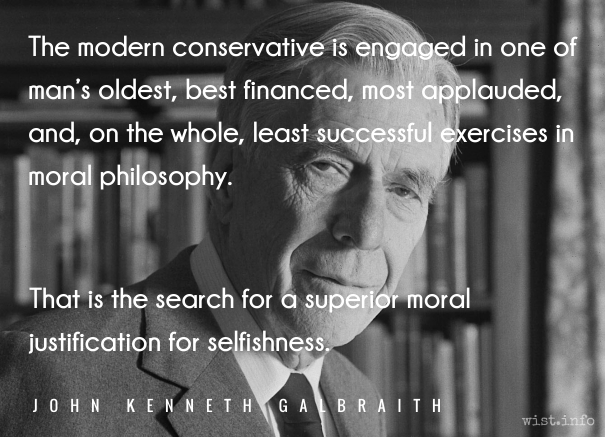
The modern conservative is not even especially modern. He is engaged, on the contrary, in one of man’s oldest, best financed, most applauded, and, on the whole, least successful exercises in moral philosophy. That is the search for a superior moral justification for selfishness. It is an exercise which always involves a certain number of internal contradictions and even a few absurdities. The conspicuously wealthy turn up urging the character-building value of privation for the poor. The man who has struck it rich in minerals, oil, or other bounties of nature is found explaining the debilitating effect of unearned income from the state. The corporate executive who is a superlative success as an organization man weighs in on the evils of bureaucracy. Federal aid to education is feared by those who live in suburbs that could easily forgo this danger, and by people whose children are in public schools. Socialized medicine is condemned by men emerging from Walter Reed Hospital. Social Security is viewed with alarm by those who have the comfortable cushion of an inherited income. Those who are immediately threatened by public efforts to meet their needs — whether widows, small farmers, hospitalized veterans, or the unemployed — are almost always oblivious to the danger.
John Kenneth Galbraith (1908–2006) Canadian-American economist, diplomat, author
Speech (1963-12-13), “Wealth and Poverty,” National Policy Committee on Pockets of Poverty
(Source)
Galbraith used variations on this quote over the years.
- The above quotation was from a speech given, that was then entered into the Congressional Record, Vol. 109, Senate (1963-12-18).
- This material was reworked into an article "Let us begin: An invitation to action on poverty," in Harper's (1964-03), which was in turn again entered into the Congressional Record, Vol. 110 (1964).
- One of the last is most often cited: "The modern conservative is engaged in one of man’s oldest exercises in moral philosophy, that is the search for a superior moral justification for selfishness. It is an exercise which always involves a certain number of internal contradictions and even a few absurdities. The conspicuously wealthy turn up urging the character-building value of privation for the poor." ["Stop the Madness," Interview with Rupert Cornwell, Toronto Globe and Mail (2002-07-06)]

The chief difference between free capitalism and State socialism seems to be this: that under the former a man pursues his own advantage openly, frankly, and honestly, whereas under the latter he does so hypocritically and under false pretences.
H. L. Mencken (1880–1956) American writer and journalist [Henry Lewis Mencken]
Minority Report: H.L. Mencken’s Notebooks, #397 (1956)
We do not go to cowards for tender dealing; there is nothing so cruel as panic; the man who has least fear for his own carcase, has most time to consider others.
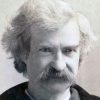
By trying we can easily learn to endure adversity. Another man’s, I mean.
Mark Twain (1835–1910) American writer [pseud. of Samuel Clemens]
Following the Equator, ch. 39, epigraph (1897)
We have always known that heedless self-interest was bad morals; we know now that it is bad economics.
Franklin Delano Roosevelt (1882–1945) American lawyer, politician, statesman; US President (1933–45)
Speech (1937-01-20), Inaugural Address, Washington, D.C.
(Source)
(Source (Audio)). Regarding the Stock Market Crash and ensuing Great Depression.

SELFISH, adj. Devoid of consideration for the selfishness of others.
Ambrose Bierce (1842–1914?) American writer and journalist
“Selfish,” The Devil’s Dictionary (1911)
(Source)
Originally published in The Devil's Dictionary [A-Z] as Vol. 7 of his Collected Works.

Love anything and your heart will be wrung and possibly broken. If you want to make sure of keeping it intact you must give it to no one, not even an animal. Wrap it carefully round with hobbies and little luxuries; avoid all entanglements. Lock it up save in the casket or coffin of your selfishness. But in that casket — safe, dark, motionless, airless — it will change. It will not be broken; it will become unbreakable, impenetrable, irredeemable. To love is to be vulnerable.
C. S. Lewis (1898–1963) English writer, literary scholar, lay theologian [Clive Staples Lewis]
The Four Loves

I have been a selfish being all my life, in practice, though not in principle.
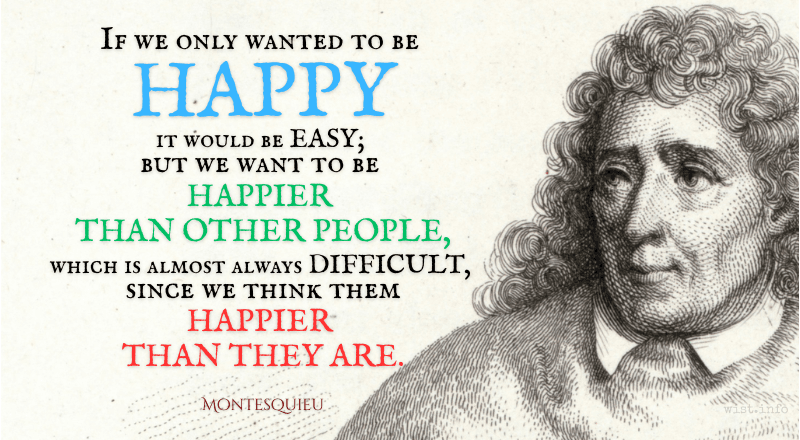
If we only wanted to be happy, it would be easy; but we want to be happier than other people, which is almost always difficult, since we think them happier than they are.
[Si on ne vouloit qu’être heureux, cela seroit bientôt fait; mais on veut être plus heureux que les autres; et cela est presque toujours difficile, parce que nous croyons les autres plus heureux qu’ils ne sont.]
Charles-Lewis de Secondat, Baron de Montesquieu (1689–1755) French political philosopher
Pensées Diverses [Assorted Thoughts], # 978 / 1003 (1720-1755)
(Source)
Also found as "Si on ne vouloit ’être qu'heureux ...."
This is sometimes mistakenly sourced to his Persian Letters [Lettres Persanes] (1721).
(Source (French)). Other translations:If one only wished to be happy, this could be easily accomplished; but we wish to be happier than other people, and this is always difficult, for we believe others to be happier than they are.
[E.g. (1891)]If we only wanted to be happy, that would soon be done. But we want to be happier than others, and this is almost always difficult because we believe others to be happier than they are.
[tr. Clark (2012)]