

Claims that cannot be tested, assertions immune to disproof are veridically worthless, whatever value they may have in inspiring us or in exciting our sense of wonder.
Carl Sagan (1934–1996) American scientist and writer
The Demon-Haunted World, ch. 10 “The Dragon in My Garage” (1995)
(Source)
Quotations about:
validation
Note not all quotations have been tagged, so Search may find additional quotes on this topic.
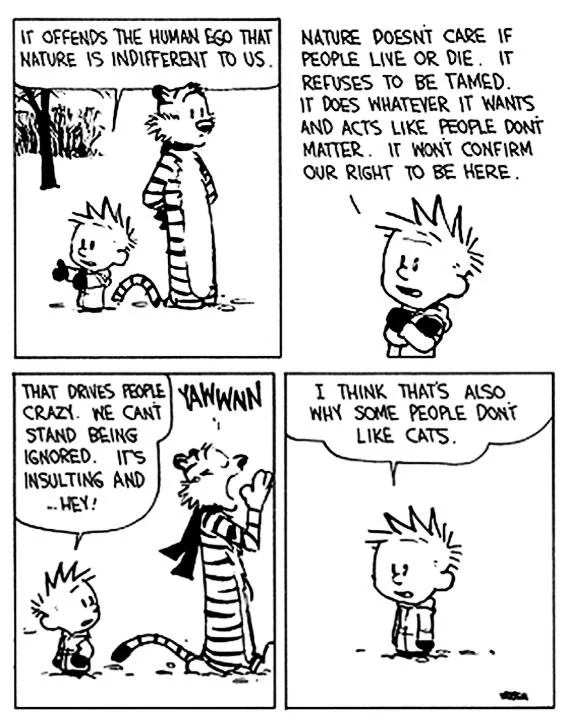
CALVIN: It offends the human ego that nature is indifferent to us. Nature doesn’t care if people live or die. It refuses to be tamed. It does whatever it wants and acts like people don’t matter. It won’t confirm our right to be here. That drives people crazy. We can’t stand being ignored. It’s insulting and … hey!
HOBBES: YAWWNN. [wanders off]
CALVIN: I think that’s also why some people don’t like cats.

CALVIN: Dad, are you vicariously living through me in the hope that my accomplishments will validate your mediocre life, and in some way compensate for all the opportunities you botched?

Be not deceived: it is not that which Men believe of thee will make thee happy or miserable; but that which thou believest of thyself.
Thomas Fuller (1654–1734) English physician, preacher, aphorist, writer
Introductio ad Prudentiam, Vol. 2, # 2073 (1727)
(Source)

HOLMES: That’s the frailty of genius, John. It needs an audience.
Steven Moffat (b. 1961) Scottish television writer, producer
Sherlock, 01×01 “A Study in Pink” (2010-07-25)
(Source)
(Source (Video); dialog confirmed)

I have learned yet again (this has been going on all my life) what folly it is to take anything for granted without examining it skeptically.
Joseph Jacobs (1854–1916) Australian folklorist, literary critic, historian writer
Dark Age Ahead, “Notes and Comments” (2004)
(Source)

But this I can tell you true — until you divest yourself of the notion that you are a collection of needs, an empty vessel that someone else must fill up, there will be no safe place to harbor yourself, no safe shore to reach. As long as you think mostly of getting, you will have nothing real to give.
Merle Shain (1935–1989) Canadian journalist and author
Hearts That We Broke Long Ago, ch. 8 (1985)
(Source)

Often have I marvelled how each one of us loves himself above all men, yet sets less store by his own opinion of himself than by that of everyone else.
[Πολλάκις ἐθαύμασα πῶς ἑαυτὸν μὲν ἕκαστος μᾶλλον πάντων φιλεῖ, τὴν δὲ ἑαυτοῦ περὶ αὑτοῦ ὑπόληψιν ἐν ἐλάττονι λόγῳ τίθεται ἢ τὴν τῶν ἄλλων.]
Marcus Aurelius (AD 121–180) Roman emperor (161–180), Stoic philosopher
Meditations [To Himself; Τὰ εἰς ἑαυτόν], Book 12, ch. 4 (12.4) (AD 161-180) [tr. Haines (Loeb) (1916)]
(Source)
(Source (Greek)). Other translations:I have often wondered how it should come to pass, that every man loving himself best, should more regard other men's opinions concerning himself than his own.
[tr. Casaubon (1634), 12.3]I have often wonder'd how it comes to pass, that every Body should love themselves best, and yet value their Neighbours Opinion about themselves, more than their own.
[tr. Collier (1701)]I have often wondered how each man should love himself more than any other; and yet make less account of his own opinion concerning himself, than of the opinions of others.
[tr. Hutcheson/Moor (1742)]I have often wondered, whence it comes to pass, that although every one loves himself more than he does any other man, he should yet pay a greater regard to the opinion of other people concerning him than to his own.
[tr. Graves (1792)]I have often wondered how it is that every man loves himself more than all the rest of men, but yet sets less value on his own opinion of himself than on the opinion of others.
[tr. Long (1862)]I have often wondered how it comes to pass that everybody should love themselves best, and yet value their neighbor's opinion about themselves more than their own.
[tr. Collier/Zimmern (1887)]How strange it is, that every one loves himself above all others, yet attaches less weight to his own view of himself, than to that of other men.
[tr. Rendall (1898)]I have wondered often how it comes that, while every man loves himself beyond all others, yet he holds his own opinion of himself in less esteem than the opinion of others.
[tr. Hutcheson/Chrystal (1902)]I often wonder how it is that every one loves himself more than all the world and yet takes less account of his own judgement of himself than of the judgement of the world.
[tr. Farquharson (1944)]I often marvel how it is that though each man loves himself beyond all else, he should yet value his own opinion of himself less than that of others.
[tr. Staniforth (1964)]I have often marvelled at how everyone loves himself above all others, yet places less value on his own opinion of himself than that of everyone else.
[tr. Hard (1997 ed.); Hard (2011 ed.)]It never ceases to amaze me: we all love ourselves more than other people, but care more about their opinion than our own.
[tr. Hays (2003)]I have often wondered how it is that everyone loves himself more than anyone else, but rates his own judgement of himself below that of others.
[tr. Hammond (2006)]I have often been amazed at how every person loves himself more than he loves others yet places less value on his own judgment of himself than of the judgments of others concerning him.
[tr. Needleman/Piazza (2008)]How is it that every person loves themselves more than any other person, yet still gives more value to the opinions of others than the opinion they hold of themselves?
[tr. McNeill (2019)]
In God we trust. All others must bring data.
W. Edwards Deming (1900–1993) American management consultant, educator
(Misattributed)
Variants: "All others must have/provide data."
Frequently attributed to Deming, probably through Mary Walton, The Deming Management Method, ch. 20 (1986), though it is presented there without attribution: "'In God we trust. All others must bring data.' If there is a credo for statisticians, it is that."
The earliest appearance in print comes from Edwin R. Fisher, Effect of Smoking on Nonsmokers: Hearing Before the Subcommittee on Tobacco of the Committee on Agriculture, House of Representatives, Ninety-fifth Congress, Second Session (7 Sep 1978): "I should like to close by citing a well-recognized cliche in scientific circles. The cliche is, 'In God we trust, others must provide data.'"
For more discussion see here.

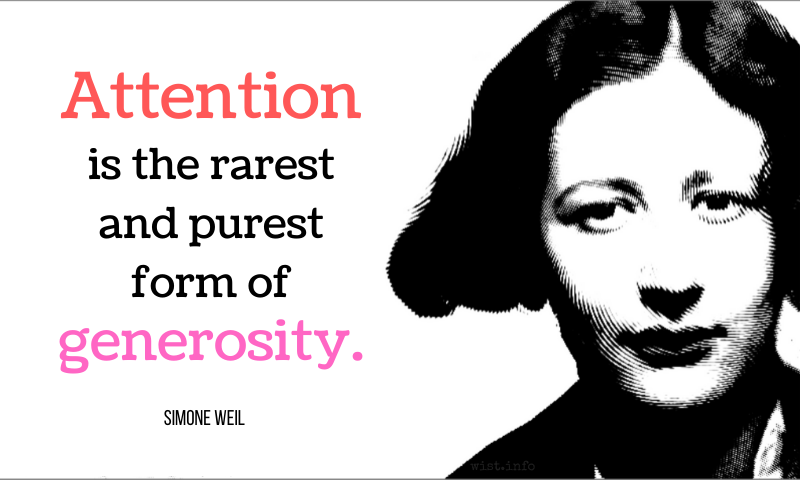
Attention is the rarest and purest form of generosity.
Simone Weil (1909–1943) French philosopher
Letter to Joë Bousquet (13 Apr 1942)
Quoted in Simone Pétrement, Simone Weil: A Life (1976) [tr. Rosenthal].

We don’t exist unless there is someone who can see us existing, what we say has no meaning until someone can understand, while to be surrounded by friends is constantly to have our identity confirmed; their knowledge and care for us have the power to pull us from our numbness. In small comments, many of them teasing, they reveal they know our foibles and accept them and so, in turn, accept that we have a place in the world.
Alain de Botton (b. 1969) Swiss-British author
The Consolations of Philosophy, ch. 2 “Consolation For Not having Enough Money” (2000)
(Source)

Care about people’s approval and you will be their prisoner.
Lao-tzu (604?-531? BC) Chinese philosopher, poet [also Lao-tse, Laozi]
Tao te Ching

The Americans, in their intercourse with strangers, appear impatient of the smallest censure and insatiable of praise.
Alexis de Tocqueville (1805–1859) French writer, diplomat, politician
Democracy in America, Vol. 2, sec. 3, ch. 16 (1840)

There is no Pleasure like that of receiving Praise from the Praiseworthy.
Richard Steele (1672–1729) Anglo-Irish writer, journalist, playwright, politician
Essay (1709-11-02), The Tatler, No. 89
(Source)

Whoso would be a man, must be a nonconformist. He who would gather immortal palms must not be hindered by the name of goodness, but must explore if it be goodness. Nothing is at last sacred but the integrity of your own mind.
Ralph Waldo Emerson (1803–1882) American essayist, lecturer, poet
Essay (1841), “Self-Reliance,” Essays: First Series, No. 2
(Source)
This essay was inspired by his reading of Walter Savage Landor in 1833, with passages pulled from his lecture "Individualism," last in his course on "The Philosophy of History" (1836–1837), with other passages from the lectures "School," "Genius," and "Duty" in his course on "Human Life" (1838–1839).
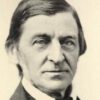
The desire of the esteem of others is as real a want of nature as hunger — and the neglect and contempt of the world as severe a pain as the gout or stone.
John Adams (1735–1826) American lawyer, Founder, statesman; US President (1797–1801)
Essay (1790), “Discourses on Davila: A Series of Papers on Political History,” No. 4, Gazette of the United States
(Source)

Proselytizing is more a passionate search for something not yet found than a desire to bestow upon the world something we already have. It is a search for a final and irrefutable demonstration that our absolute truth is indeed the one and only truth. The proselytizing fanatic strengthens his own faith by converting others.
Eric Hoffer (1902–1983) American writer, philosopher, longshoreman
True Believer: Thoughts on the Nature of Mass Movements, Part 3, ch. 14, § 88 (1951)
(Source)
The glory of friendship is not the outstretched hand, nor the kindly smile nor the joy of companionship; it is the spiritual inspiration that comes to one when he discovers that someone else believes in him and is willing to trust him with his friendship.
Ralph Waldo Emerson (1803–1882) American essayist, lecturer, poet
(Attributed)