So let us look for beauty and grace, for love and friendship, for that which is creative and birth-giving and soul-stretching. Let us dare to laugh at ourselves, healthy, affirmative laughter. Only when we take ourselves lightly can we take ourselves seriously, so that we are given the courage to say, “Yes! I dare disturb the universe.”
Madeleine L'Engle (1918–2007) American writer
Speech (1983-11-16), “Dare To Be Creative,” Lecture, Library of Congress, Washington, DC
(Source)
Quotations about:
self-worth
Note not all quotations have been tagged, so Search may find additional quotes on this topic.

There is another kind of “glory”: conceiving too high an opinion of our worth. This is an undeserved feeling by which we value ourselves, and that makes us think ourselves different than we are, just as the passion of love lends beauties and graces to the object it embraces and makes those smitten by it — with their judgment blurred and altered — find what they love different, and more perfect, than it is.
[Il y a une autre sorte de gloire, qui est une trop bonne opinion, que nous concevons de nostre valeur. C’est un’affection inconsideree, dequoy nous nous cherissons, qui nous represente à nous mesmes, autres que nous ne sommes. Comme la passion amoureuse preste des beautez, & des graces, au subject qu’elle embrasse ; & fait que ceux qui en sont espris, trouvent d’un jugement trouble & alteré, ce qu’ils aiment, autre & plus parfait qu’il n’est.]
Michel de Montaigne (1533–1592) French essayist
Essays, Book 2, ch. 17 (2.17), “Of Presumption [De la Presomption]” (1578) [tr. Atkinson/Sices (2012)]
(Source)
This essay and passage were in the 1st (1580) edition.
(Source (French)). Other translations:There is another kinde of glorie, which is an over-good opinion we conceive of our worth. It is an inconsiderate affection, wherewith wee cherish our selves, which presents-us unto our selves other then wee are. As an amorous passion addeth beauties, and lendeth graces to the subject it embraceth, and maketh such as are therewith possessed, with a troubled conceite, and distracted Judgement, to deeme what they love, and finde what they affect, to bee other, and seeme more perfect, then in trueth it is. [tr. Florio (1603)]There is another sort of glory, which is the having too good an opinion of our own merit. It is an inconsiderate affection, with which we flatter ourselves, and that represents us to ourselves other than what we truly are: like the passion of love, that lends beauties and graces to the object of it; and makes those who are caught with it, by a depraved and corrupt judgment, consider the thing they love other and more perfect than it is.
[tr. Cotton (1686)]There is another sort of glory, which is the having too good an opinion of our own worth. ’Tis an inconsiderate affection with which we flatter ourselves, and that represents us to ourselves other than we truly are: like the passion of love, that lends beauties and graces to the object, and makes those who are caught by it, with a depraved and corrupt judgment, consider the thing which they love other and more perfect than it is.
[tr. Cotton/Hazlitt (1877)]There is another sort of glory, which is a too high opinion that we conceive of our worth. It is an ill-advised affection with which we flatter ourselves, which represents us to ourselves other than we are; as amourous passion lends beauties and charms to that which it embraces, and causes those who are possessed by it, their judgement being disturbed and diverted, to deem what they love different from what it is, and more perfect.
[tr. Ives (1925)]There is another sort of glory, which is to have too good an opinion of our own worth. It is an unthinking affection with which we flatter ourselves, that represents us to ourselves other than we truly are: like the passion of love, that lends beauties and charms to the object it embraces, and makes those who are possessed by it, with a troubled and corrupt judgment, consider the thing they love other and more perfect than it is.
[tr. Zeitlin (1934)]There is another kind of vainglory, which is an over-good opinion we form of our own worth. It is an unreasoning affection, by which we cherish ourselves, which represents us to ourselves as other than we are; as the passion of love lends beauties and graces to the object it embraces, and makes its victims, with muddled and unsettled judgment, think that what they love is other and more perfect than it is.
[tr. Frame (1943)]There is another kind of glory, which is to have too good an opinion of our own worth. It is an unthinking affection with which we flatter ourselves, and which presents us to ourselves as other than we are; just as the passion of love lends beauties and charms to the object it embraces in such a way that the love's judgement is troubled and distracted, and he finds the lady he loves other and more perfect than she is.
[tr. Cohen (1958)]There is another kind of "glory": the over-high opinion we conceive of our own worth. It is an imprudent affection by which we hold our own self dear, presenting ourself to ourself other than we are, just as passionate love lends grace and beauty to the person it embraces and leads to those who are enraptured by it being disturbed and confused in their judgement, so finding their Beloved other than she is, and more perfect.
[tr. Screech (1987)]

To strive with difficulties, and to conquer them, is the highest human felicity; the next is, to strive, and deserve to conquer: but he whose life has passed without a contest, and who can boast neither success nor merit, can survey himself only as a useless filler of existence; and if he is content with his own character, must owe his satisfaction to insensibility.
Samuel Johnson (1709–1784) English writer, lexicographer, critic
Essay (1753-11-27), The Adventurer, No. 111
(Source)

Dig within. There lies the well-spring of good: ever dig, and it will ever flow.
[Ἔνδον σκάπτε, ἔνδον ἡ πηγὴ τοῦ ἀγαθοῦ καὶ ἀεὶ ἀναβλύειν δυναμένη, ἐὰν ἀεὶ σκάπτῃς.]
Marcus Aurelius (AD 121–180) Roman emperor (161–180), Stoic philosopher
Meditations [To Himself; Τὰ εἰς ἑαυτόν], Book 7, ch. 59 (7.59) (AD 161-180) [tr. Staniforth (1964)]
(Source)
On how to turn accidents and misfortune into learning experiences and behavior he will approve of in himself.
(Source (Greek)). Alternate translations:Look within; within is the fountain of all good. Such a fountain, where springing waters can never fail, so thou dig still deeper and deeper.
[tr. Casaubon (1634), 7.31]Look Inwards, and turn over your self; For you have a lasting Mine of Happiness at home, if you will but Dig for't.
[tr. Collier (1701), 7.60]Look inwards; within is the fountain of good; which is ever springing up, if you be always digging in it.
[tr. Hutcheson/Moor (1742)]Look into your own bosom; for you have there a fountain of happiness, if you will searcyh for it, and suffer it to flow without interruption.
[tr. Graves (1792), 7.52]Look within. Within is the fountain of good, and it will ever bubble up, if thou wilt ever dig.
[tr. Long (1862)]Look inwards, for you have a lasting fountain of happiness at home that will always bubble up if you will but dig for it.
[tr. Collier/Zimmern (1887)]Dig within. Within is the fountain of good; ever dig, and it will ever well forth water.
[tr. Rendall (1898)]Look inward. Within is the fountain of Good. Dig constantly and it will ever well forth.
[tr. Hutcheson/Chrystal (1902)]Look within. Within is the fountain of Good, ready always to well forth if thou wilt always delve.
[tr. Haines (Loeb) (1916)]Delve within; within is the fountain of good, and it is always ready to bubble up, if you always delve.
[tr. Farquharson (1944)]Dig within; for within you lies the fountain of good, and it can always be gushing forth if only you always dig.
[tr. Hard (1997 ed.)]Dig deep; the water -- goodness -- is down there. And as long as you keep digging, it will keep bubbling up.
[tr. Hays (2003)]Dig inside yourself. Inside there is a spring of goodness ready to gush at any moment, if you keep digging.
[tr. Hammond (2006)]Turn your attention within, for the fountain of all that is good lies within, and it is always ready to pour forth, if you continually delve in.
[tr. Needleman/Piazza (2008)]Dig within; for within you lies the fountain of good, and it can always be gushing forth if only you always dig.
[tr. Hard (2011 ed.)]Search inside yourself; inside you is the fountain of goodness, and it continues to surge as long as you search.
[ed. Taplin (2016)]

Be polite and generous, but don’t undervalue yourself. You will be useful, at any rate; you may just as well be happy, while you are about it.

Thou never wast so good as thou shouldest be; if thou does not strive to be better. And thou never wilt be better, if thou doest not fear to grow worse.
Thomas Fuller (1654–1734) English physician, preacher, aphorist, writer
Introductio ad Prudentiam, Vol. 2, # 2092 (1727)
(Source)

Q. Is it ever acceptable to be rude?
A. No. Now, that doesn’t mean you have to let people walk all over you. Etiquette does not render you defenseless. If it did; even I wouldn’t subscribe to it. But rudeness in retaliation for rudeness just doubles the amount of rudeness in the world.
Judith Martin (b. 1938) American author, journalist, etiquette expert [a.k.a. Miss Manners]
Interview (2011-08), “Q and A with Miss Manners,” by Arcynta Ali Childs, Smithsonian magazine
(Source)

The proud man can learn humility, but he will be proud of it.
Mignon McLaughlin (1913–1983) American journalist and author
The Neurotic’s Notebook, ch. 3 (1963)
(Source)

But there’s a class of persons, led astray
By false desires, and this is what they say:
“You cannot have enough: what you possess,
That makes your value, be it more or less.”
What answer would you make to such as these?
Why, let them hug their misery if they please.[At bona pars hominum decepta cupidine falso
‘nil satis est’, inquit, ‘quia tanti quantum habeas sis’:
quid facias illi? iubeas miserum esse, libenter
quatenus id facit.]Horace (65–8 BC) Roman poet, satirist, soldier, politician [Quintus Horatius Flaccus]
Satires [Saturae, Sermones], Book 1, # 1 “Qui fit, Mæcenas,” l. 61ff (1.1.61-64) (35 BC) [tr. Conington (1874)]
(Source)
(Source (Latin)). Alternate translations:But out (alas) the greater parte with sweete empoysned bate
Of welthe bewitchde, do weene their wants aboundance in eache state.
For monye maks, and mars (say they) and coyne it keepes the coyle,
It byndes the beare, it rules the roste, it putts all things to foyle.
A mann's his money, and no more, wherin confused is
An heaven of happs, a worlde of weeles, an hunnye hath of blisse.
O dottrells dome, and is it so? what guardon for these doultes
Shall we devyse? lets suffer still the foolishe frantycke foultes
To wallowe in their wilfulnes, whose under eating myndes
Is never cramde, but prooles for more and swarves not from their kyndes.
[tr. Drant (1567)]But most of men deceiv'd by false desire,
Say, Noughts enough; 'cause they absurdly guess
At what men are, by what they do possess.
To such a Miser what is't best to do?
Let him be wretched, since he will be so.
[tr. A. B.; ed. Brome (1666)]But most are lost in a Confounded Cheat,
They would have more, for when their Wealth is great
They think their Worth as much as their Estate:
Well then, what must we do to such a one?
Why, let him, 'tis his Will to be undone.
[tr. Creech (1684)]Some, self-deceiv'd, who think their lust of gold
Is but a love of fame, this maxim hold,
No Fortune's large enough, since others rate
Your worth proportion'd to a large estate.
Say, for their cure what arts would you employ?
"Let them be wretched, and their choice enjoy."
[tr. Francis (1747)]Yet thousands, duped by avarice in disguise,
Intrench themselves in maxims sage and wise.
Go on, say they, and hoard up all you can;
For wealth is worth, and money makes the man!
What shall we say to such? Since 'tis their will
Still to be wretched, let them be so still!
[tr. Howes (1845)]But a great majority of mankind, misled by a wrong desire, cry, “No sum is enough; because you are esteemed in proportion to what you possess.” What can one do to such a tribe as this? Why, bid them be wretched, since their inclination prompts them to it.
[tr. Smart/Buckley (1853)]But some one argues: -- many men, misled by wrong desire of fame, say no sum is enough, because we all are rated by the money we possess. What would you do with them? Why, bid them live a wretched life, since they act thus of their free will.
[tr. Millington (1870)]But a good many people, misled by blind desire, say, "You cannot have enough: for you get your rating from what you have." What can you do to a man who talks thus? Bid him be miserable, since that is his whim.
[tr. Fairclough (Loeb) (1926)]Mankind for the most part, fooled by its own false desires,
Says, “There’s no such thing as enough. You are worth
Only as much as you have.” And what can you do
With a person like this? Oh, well! Wish him hell and farewell,
Since he's headed that way by choice.
[tr. Palmer Bovie (1959)]Still, since false desires fool a large portion of mankind,
they'll tell you, *Nothing's enough. What we own, we are."
What can you say? Say, "Be miserable," for that's the choice
they freely made.
[tr. Fuchs (1977)]Too many men, bewitched by false desire, insist that
"Nothing is enough: people value you by what you own."
What can I say? Let him be miserable, that's how
He wants it!
[tr. Raffel (1983)]And yet a good part of humankind is deceived
by false cupidity. “Nothing is enough,”
they say. “For you are esteemed for as much as you
possess.” What can you do with one of these fools?
Leave him to his misery. It’s all of his
own doing anyway.
[tr. Alexander (1999)]But most people
want all that they desire, and so say, “There’s no such
thing as too much: you are what you acquire.”
You can always tell such a man but you
can’t tell him much. Tell him to suffer, since
that’s his choice.
[tr. Matthews (2002)]People are enticed by a desire which continually cheats them.
"Nothing is enough," they say, "for you’re only worth what you have."
What can you do with a man like that? You might as well tell him
to be miserable, since misery is what he enjoys.
[tr. Rudd (2005 ed.)]Still, a good many people misled by foolish desire
Say: ‘There’s never enough, you’re only what you own.’
What can one say to that? Let such people be wretched,
Since that’s what they wish.
[tr. Kline (2015)]
Fear comes from uncertainty. When we are absolutely certain, whether of our worth or worthlessness, we are almost impervious to fear. Thus a feeling of utter unworthiness can be a source of courage.
Eric Hoffer (1902–1983) American writer, philosopher, longshoreman
Passionate State of Mind, Aphorism 87 (1955)
(Source)

But this I can tell you true — until you divest yourself of the notion that you are a collection of needs, an empty vessel that someone else must fill up, there will be no safe place to harbor yourself, no safe shore to reach. As long as you think mostly of getting, you will have nothing real to give.
Merle Shain (1935–1989) Canadian journalist and author
Hearts That We Broke Long Ago, ch. 8 (1985)
(Source)

Friendship is the gift that goes on giving and is a gift to both the person given to and to the giver as well. But to really make it work, it isn’t enough to give to another person. You also have to let them give to you.
It is never until one realizes that one means something to others that one feels there is any point or purpose in one’s own existence.
Stefan Zweig (1881–1942) Austrian novelist, playwright, journalist, biographer
Beware of Pity (1939)
The writer … when he’s rejected, that paper is rejected, in a sense, a sizable fragment of the writer is rejected as well. It’s a piece of himself that’s being turned down. And how often can this happen before suddenly you begin to question your own worth and your own value? And even worse, fundamentally, your own talent?
Rod Serling (1924–1975) American screenwriter, playwright, television producer, narrator
“Rod Serling: The Facts of Life,” Interview with Linda Brevelle (4 Mar 1975)
(Source)

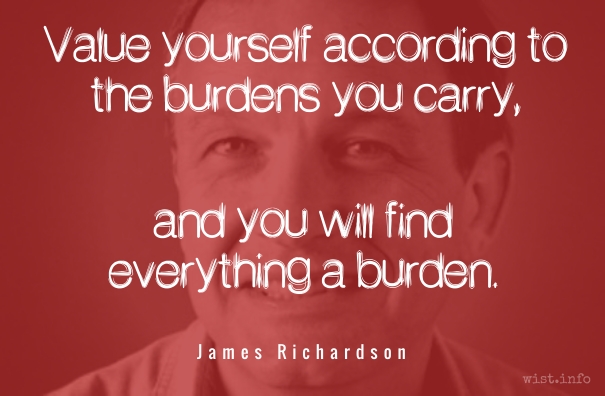
Value yourself according to the burdens you carry, and you will find everything a burden.
James Richardson (b. 1950) American poet
Vectors: Aphorisms and Ten-Second Essays, # 52 (2001)

The reason we struggle with insecurity is because we compare our behind-the-scenes with everyone else’s highlight reel.
Steven Furtick (b. 1980) American pastor
Speech, Willow Creek Global Leadership Summit (church gathering) (11 Aug 2011)
To believe that if we could have but this or that we would be happy is to suppress the realization that the cause of our unhappiness is in our inadequate and blemished selves. Excessive desire is thus a means of suppressing our sense of worthlessness.
Eric Hoffer (1902–1983) American writer, philosopher, longshoreman
Passionate State of Mind, Aphorism 6 (1955)
(Source)
“I have been Foolish and Deluded,” said Pooh, “and I am a Bear of No Brain at All.”
“You’re the Best Bear in All the World,” said Christopher Robin soothingly.A. A. Milne (1882–1956) English poet and playwright [Alan Alexander Milne]
Winnie-the-Pooh, ch. 3 “Pooh and Piglet Go Hunting” (1926)
(Source)

Be good at something, good enough so that you can take quiet pride in knowing that you are a valuable person, that you can do at least one thing well.
David H. Campbell, Jr. (contemp.) American careers expert
If You Don’t Know Where You’re Going, You’ll Probably End Up Somewhere (1974)